
Cost Basement Conversion: Guide to UK Project Costs
- Harper Latter Architects

- 3 days ago
- 14 min read
So, you’re thinking about a basement conversion. It’s a fantastic way to unlock new space, but the first question on everyone’s mind is always the same: what’s it actually going to cost?
In the UK, the cost of a basement conversion can vary massively, from around £1,600 to over £4,000 per square metre. Where your project falls on that spectrum really depends on its complexity and the level of finish you're after.
Understanding Your Basement Conversion Costs
A basement project isn't just a room renovation; it's a serious construction job that turns a forgotten space into a valuable, integrated part of your home. Getting a firm grip on the finances from day one is the key to a successful build.
The final bill is made up of several distinct but connected parts. It’s helpful to think of it like this:
The Structural Shell: This is the heavy lifting – the excavation, underpinning, and creating a waterproof concrete box. It’s the foundation of the entire project.
The Fit-Out: This is where your vision comes to life. It includes all the interior finishes like flooring, lighting, bespoke joinery, and any special features, whether that’s a home cinema, a gym, or a wine cellar.
Professional Fees: These are the essential costs for the experts who make it all happen safely and legally. Think architects, structural engineers, and party wall surveyors.
Building a Realistic Budget
Before you get carried away with design ideas, it’s vital to set a realistic financial framework. A simple refurbishment of an existing cellar will, of course, cost far less than digging out a brand-new basement under your garden.
Converting an existing cellar in a Victorian terrace—a common project across South West London—comes with its own set of challenges compared to a new-build basement.
To give you a clearer idea, here's a quick look at what you can expect.
Estimated UK Basement Conversion Costs at a Glance
This table summarises estimated costs for different types of basement conversions, helping you quickly identify a ballpark figure for your project.
Type of Conversion | Average Cost per Square Metre (inc. VAT) | Typical Project Total (40m²) |
|---|---|---|
Existing Cellar Conversion | £1,200 - £2,200 | £48,000 - £88,000 |
New Excavation (under house) | £2,500 - £3,500 | £100,000 - £140,000 |
New Excavation (under garden) | £2,000 - £3,000 | £80,000 - £120,000 |
Luxury Fit-Out (on top of shell) | £1,000 - £2,500+ | £40,000 - £100,000+ |
These figures give you a solid starting point, but remember that the specifics of your property and vision will ultimately shape the final investment.
The True Cost of a Basement
In the UK, and especially in prime London postcodes, a medium-sized 40m² project that needs significant structural work, like lowering the floor level, can easily land somewhere between £60,000 and £120,000. These figures reflect the complex labour, specialist waterproofing materials, and essential professional oversight involved. You can explore a detailed breakdown of these costs to see how it all adds up.
A common mistake is to overlook the "hidden" costs. Professional fees, building regulations applications (often £750+), and Party Wall Agreements (which can be £700+ per neighbour) aren’t optional extras. They are fundamental parts of a legally compliant and structurally sound project.
Why London is a Different Story
In a city like London where every square foot is at a premium, basement conversion costs are naturally higher—but so is the potential return on your investment.
High-spec projects in boroughs like Wandsworth or Richmond can range from £200,000 to over £800,000. These top-end budgets reflect the demand for luxury features and the higher operational costs in the capital. But when you weigh it up, this outlay unlocks space that would be far more expensive to gain by moving, making it a smart financial move for many homeowners.
Breaking Down the Core Cost Drivers
Ever wondered why one basement conversion quote can be thousands of pounds different from the next? It all comes down to what’s happening behind the scenes. This isn’t just about digging a hole; it’s a complex, multi-stage construction project where every step has its own price tag.
Think of your total investment in three main buckets: the heavy-duty construction, the essential professional oversight, and the unavoidable legal bits and pieces. Getting your head around these is the first step to planning a project without any nasty surprises down the line.
The chart below gives you a clear picture of how the overall cost typically breaks down between labour, materials, and professional fees.
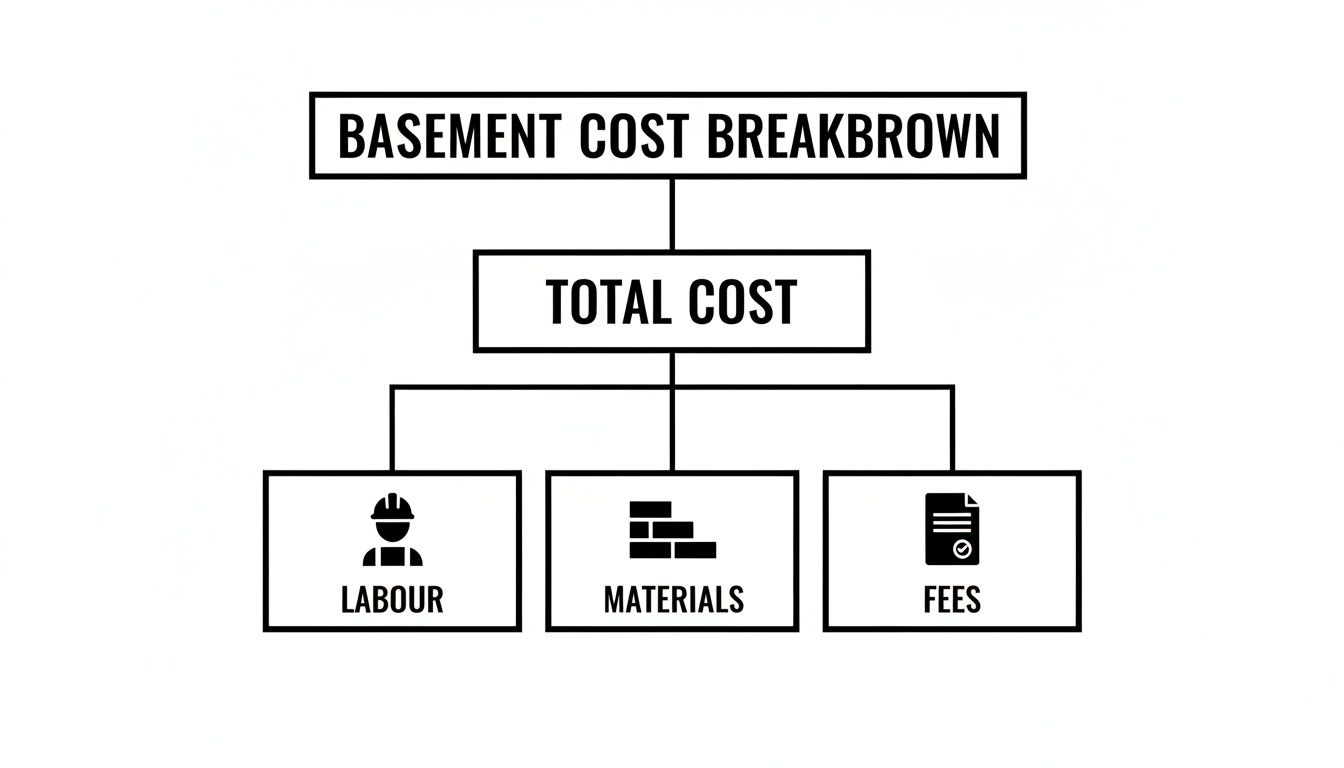
As you can see, while materials are a big chunk, the specialist labour and professional guidance needed to get the job done safely and legally are just as critical to the budget.
Structural Work: The Heavy Lifting
This is where a huge portion of the initial budget goes. These are the physically demanding, structurally critical jobs that create the 'shell and core' of your new space.
Excavation: Simply put, this is digging out the earth to create the space. The cost depends on how much soil needs to go, what the ground conditions are like, and how easily machinery can get to your site.
Underpinning and Structural Support: This is the painstaking process of strengthening your home’s existing foundations. It’s a highly skilled job that ensures the integrity of the entire house isn’t compromised. No shortcuts here.
Lightwells: Digging out lightwells is absolutely vital for bringing natural daylight into the basement and providing a means of escape. Bigger, more ambitious lightwells will cost more, but they completely transform the feel of the space.
These foundational tasks are labour-intensive and demand precision engineering, making them one of the biggest line items on any quote.
Waterproofing: A Non-Negotiable Cost
Creating a dry, liveable space below ground is probably the single most important part of a successful conversion. If you get this wrong, the entire investment is wasted. That's why professional waterproofing is a cost you simply cannot skimp on.
Modern systems usually combine a few techniques, like applying a waterproof membrane to the walls and floor and installing a cavity drain system with a sump pump to actively manage any water that gets in. The final cost will depend on the size of your basement and what the specific ground conditions demand.
In the UK, all basement waterproofing must meet the BS 8102:2022 standard. This isn't just a 'nice to have'—it's the official code of practice for protecting below-ground structures from water. Sticking to it is essential for getting guarantees and making sure your new space lasts.
To get a better feel for the systems involved, you can learn more about how to waterproof a basement in our detailed UK guide.
Mechanical and Electrical Installations
Once the shell is built and guaranteed to be dry, it’s time to bring it to life. The 'first fix' stage is all about installing the hidden arteries of the space—the wiring and pipework—before the walls are plastered over.
This includes:
Electrics: Running all the new circuits for lighting, power sockets, and any specialist kit like a home cinema or gym equipment.
Plumbing and Drainage: Installing all the pipework for new bathrooms, kitchens, or utility rooms and connecting everything up to the main drainage system.
Ventilation and Heating: Making sure the space will be comfortable with proper air circulation and heating, such as underfloor heating systems.
Professional Fees and Permissions
The final major cost driver is the team of experts and the administrative hoops you need to jump through to get the project off the ground legally. These aren't optional extras; they are fundamental to building a compliant, well-designed space.
Here are the key costs to factor in:
Architects and Structural Engineers: Their fees cover the detailed design, structural calculations, and technical drawings you'll need for planning and construction. On larger, more complex projects, this can range from £60,000 to £120,000 + VAT.
Planning Permission: You'll almost certainly need to submit an application to your local council, especially when excavating or altering the building’s exterior.
Party Wall Agreements: If you live in a terraced or semi-detached house, you are legally required to serve a Party Wall notice to your neighbours. This often involves hiring a surveyor and can cost £700–£1,500 per neighbour.
How Finishes and Fit-Outs Impact Your Budget
The structural work creates the canvas, but the fit-out and finishes are what turn a concrete box into a truly bespoke part of your home. This is the stage where the final cost of a basement conversion can vary dramatically, shifting a project from a standard functional space to a luxurious retreat. Your choices here directly dictate a huge portion of the final budget.
Once the structural shell is complete and fully waterproofed, the focus shifts to everything you can see and touch inside. This "fit-out" phase covers everything from the floors under your feet to the lights above your head. It’s where your personal style and day-to-day needs are translated into tangible design elements, each with its own price tag.
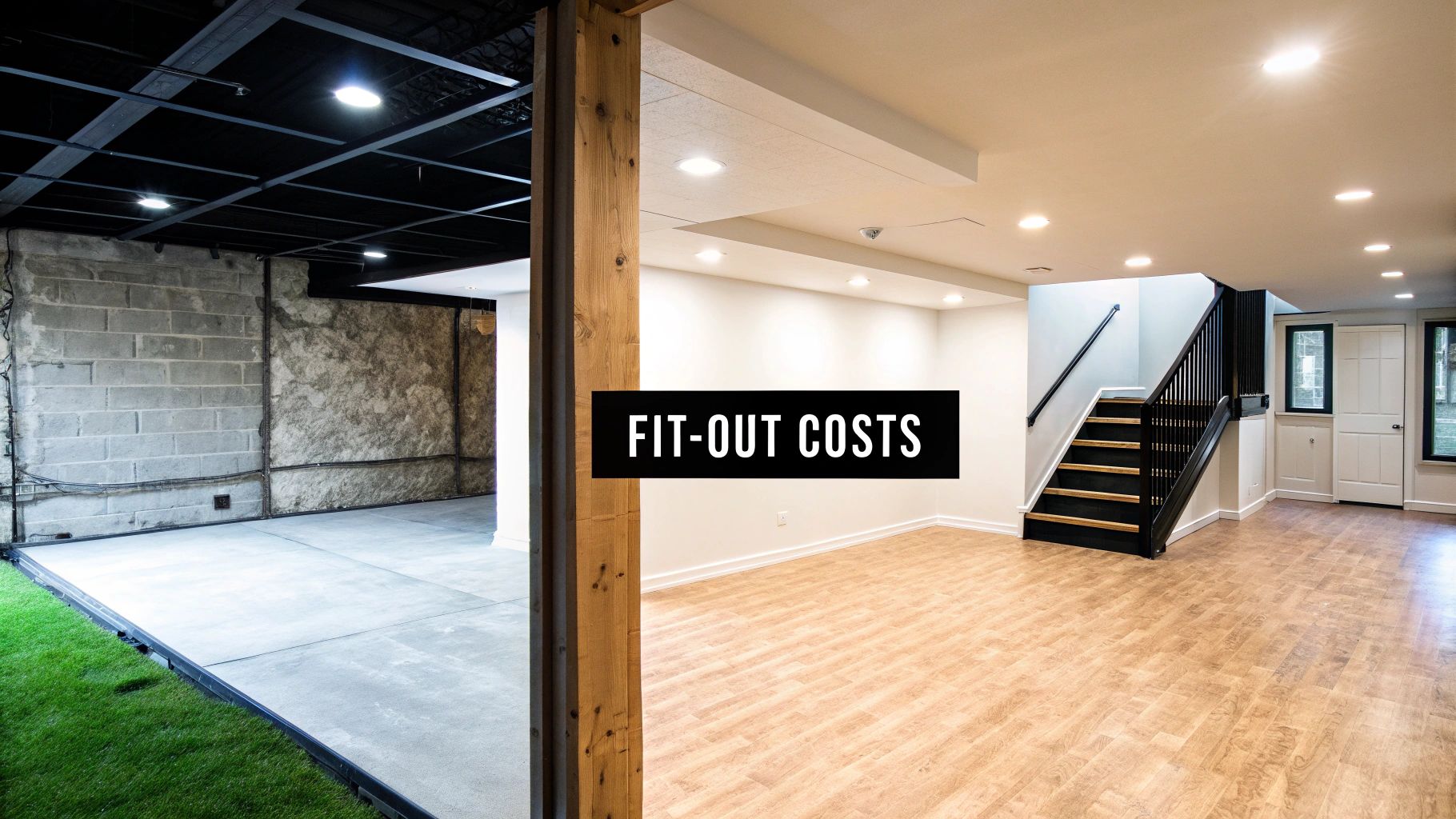
The spectrum of costs here is vast. A basic, high-quality fit-out might start around £1,200 per square metre. For a high-end, luxury specification, that figure can easily exceed £4,000 per square metre—and that’s before you factor in specialist installations like a swimming pool or a dedicated wine cellar.
Standard vs Luxury Specifications
Understanding the difference between a standard and a high-end fit-out is crucial for setting a realistic budget. It’s not just about recognisable brands; it’s about the complexity of installation, the quality of materials, and the level of craftsmanship involved. Let’s compare a few key elements.
Flooring: A standard specification might involve good-quality engineered wood or luxury vinyl tile (LVT), which are both durable and stylish. A luxury approach, however, could mean sourcing reclaimed antique timber, laying large-format Italian porcelain, or installing a polished concrete floor with a complex underfloor heating system.
Lighting: A functional scheme would include standard recessed LED downlights and simple pendant fittings. A bespoke lighting design, on the other hand, might involve layered lighting with architectural track lights, custom wall sconces, and a smart control system that creates different moods at the touch of a button.
Joinery: Standard joinery could mean off-the-shelf storage and simple, painted skirting boards and doors. In contrast, bespoke joinery involves custom-built, floor-to-ceiling wardrobes, media units, or libraries crafted from premium materials like walnut or oak, designed to fit the space perfectly.
This distinction shows how two basements of the exact same size can end up with wildly different final costs, based purely on the quality and customisation of the finishes.
Costing Your Dream Space
The way you intend to use your new basement is the single biggest driver of fit-out costs. A simple playroom or home office will always be far more budget-friendly than a space requiring specialist technology and construction.
For example, creating a high-performance home cinema involves much more than just a big screen. It demands acoustic insulation in the walls and ceiling, tiered seating platforms, specialist wiring for surround sound, and a sophisticated projection system. Each of these elements adds another layer of cost.
Similarly, a proper home gym needs more than just equipment. It requires reinforced flooring to handle heavy weights, extensive mirrored walls, dedicated power for machines like treadmills, and enhanced ventilation systems to keep the space fresh.
The fit-out is where you balance aspiration with pragmatism. It's essential to decide which features will add the most value to your lifestyle and allocate your budget accordingly. Prioritising a high-spec bathroom over expensive flooring, or vice versa, allows you to control costs without compromising on what matters most to you.
Example Fit-Out Budgets
To illustrate the range, let's consider a couple of potential scenarios. A basement designed as a guest bedroom and bathroom with a standard, high-quality finish could add £40,000 to £60,000 to the initial shell cost.
In contrast, a multi-purpose entertainment space featuring a bespoke bar, a small cinema area, and custom joinery could easily see fit-out costs rise to £100,000 or more. For those seeking the ultimate in luxury, such as a climate-controlled wine cellar or a wellness suite with a sauna, the fit-out budget will be a significant portion of the overall project investment.
Ultimately, the fit-out is where your basement's personality comes to life. By carefully considering your priorities, you can make informed decisions that align your vision with your budget, creating a space that is both beautiful and functional. To see what's possible, explore our guide to 12 luxury basement conversion ideas for London homes.
Budgeting for VAT, Contingency and Timelines
A successful project is always a well-planned one, and that means preparing for the unknown. Beyond the core construction and fit-out costs, a realistic budget must account for taxes, unexpected issues, and the overall project duration. Getting these elements right is critical for managing the financial health and timeline of your basement conversion.

Mastering these financial controls ensures your project runs smoothly from the initial architectural drawings to the final coat of paint. It’s all about managing expectations, maintaining healthy cash flow, and avoiding the stress of last-minute financial shocks.
The Essential Contingency Fund
No matter how meticulously a project is planned, unforeseen challenges can pop up, especially when you’re dealing with older London properties. This is where a contingency fund becomes your most important financial tool. Think of it as a dedicated pot of money set aside specifically for those unexpected costs.
This fund isn't for upgrading your choice of tiles; it's a safety net for genuine surprises. Common issues include discovering uncharted drains during excavation, needing more extensive underpinning than first thought, or dealing with tricky ground conditions.
We strongly recommend setting aside a contingency fund of 10-15% of the total build cost. For a £150,000 project, this means having an extra £15,000 to £22,500 in your back pocket. This buffer provides peace of mind and ensures that a surprise problem won’t derail the project or force compromises on quality elsewhere.
Understanding VAT on Your Project
Value Added Tax (VAT) is a significant and unavoidable part of the cost of a basement conversion in the UK. It’s crucial to remember that nearly all quotes from contractors and suppliers will have VAT added on top of the base price.
Currently, the standard rate of VAT is 20%. This applies to:
All labour costs from builders, electricians, plumbers, and other trades.
The vast majority of materials used in construction and fit-out.
Professional fees for architects, structural engineers, and surveyors.
When you receive an estimate, always clarify whether the figure is inclusive or exclusive of VAT. Forgetting to factor in this 20% can lead to a nasty shock, adding tens of thousands of pounds to your final bill. A quoted build cost of £100,000, for instance, will actually come to £120,000 once VAT is applied.
Mapping Out a Realistic Timeline
A question we hear all the time is, "How long will it all take?" While every project is unique, a typical basement conversion follows a predictable sequence. Understanding this timeline helps you plan your life and finances around the build.
The entire process can be broken down into two main phases: everything that happens before a spade hits the ground, and the construction itself.
Phase 1: Pre-Construction (3-6 months)This initial stage is all about detailed planning and securing the necessary permissions. It’s a vital period where the groundwork for a successful build is laid, long before any digging starts.
Design & Feasibility: Your architect develops initial concepts and detailed drawings.
Planning Permission: An application is submitted to the local council. This typically takes 8-12 weeks, but can be longer if complications arise. Getting this right is crucial, and our guide to securing architect planning permission approval offers valuable insights.
Party Wall Agreements: Notices are served to neighbours. This can take a few weeks or drag on for several months, depending on their response.
Technical Design & Tendering: Detailed structural calculations and construction drawings are finalised, and the project is put out to tender with contractors.
Phase 2: Construction (4-6 months)Once a contractor is on board and all permissions are in place, the physical work can begin.
Excavation & Structural Work: The heavy-lifting phase, including underpinning and creating the concrete shell (6-10 weeks).
Waterproofing & Drainage: Installing the critical damp-proofing systems (1-2 weeks).
First Fix & Plastering: Getting electrics, plumbing, and stud walls in place, then plastering to create the finished surfaces (3-5 weeks).
Second Fix & Finishes: This is the exciting part—fitting bathrooms, flooring, lighting, bespoke joinery, and decorating (4-6 weeks).
In total, you should expect a high-end basement conversion in South West London—from your first meeting with an architect to project completion—to take somewhere between 7 and 12 months.
Analysing Your Return on Investment
A basement conversion is far more than just another home improvement project; it's a serious investment in your property. While the initial costs can feel significant, it’s crucial to look beyond the immediate spend and consider the financial return you can realistically expect. This frames the project not as an expense, but as a strategic upgrade to both your home and your financial portfolio.
Thinking about the cost of a basement conversion purely in terms of expenditure misses the bigger picture. In a fiercely competitive property market like South West London, adding substantial, high-quality square footage almost always boosts a property's market value—often by more than the cost of the work itself.
The Financial Uplift
The most direct return you'll see is the uplift in your home's valuation. Unlike a simple kitchen refresh or a cosmetic update, a basement adds genuine floor space, fundamentally changing the size and functionality of your property. This is a powerful value driver, particularly in postcodes where every square metre is at a premium.
For instance, adding a 50-square-metre basement with a bedroom and en-suite can elevate a three-bedroom house into a four-bedroom one, instantly pushing it into a higher price bracket. Research consistently shows that a well-executed basement conversion, especially in prime London locations, can deliver a return of 10-20% above the project cost. The key here is quality; a seamless, light-filled space designed by an experienced architect will always command a higher premium than a poorly integrated, dark room.
Beyond the immediate capital gain, a basement conversion offers a powerful alternative to the immense costs of moving house in London. When you factor in Stamp Duty, legal fees, and removal costs—which can easily top £100,000 on a family home—reinvesting that money into your current property often makes far more financial sense.
Measuring the Lifestyle Return
While the financial figures are compelling, they only tell half the story. The other, equally important return is the invaluable 'lifestyle return'—the daily enjoyment and utility you get from your new space. This is the value of having a dedicated home gym just downstairs, a cinema room for family movie nights, or a quiet home office away from the main household hustle.
This lifestyle enhancement is harder to put a number on, but it’s often the primary reason homeowners decide to take the plunge. It's about creating a home that perfectly supports your way of life, something that adds immeasurable value long before you ever think about selling. Ultimately, a basement conversion is an investment in both your property and your quality of life.
Frequently Asked Questions About Basement Costs
When you start exploring the potential under your feet, it’s natural for questions to pop up. Here, we tackle some of the most common queries we hear from homeowners, giving you clear answers to help you plan with confidence.
How Long Does a Typical Basement Conversion Take in the UK?
For the construction phase alone, a standard basement conversion usually takes between 10 to 16 weeks. But that’s only half the story.
Before a single spade hits the ground, there's a vital pre-construction stage. This involves architectural design, securing planning permission, and sorting out Party Wall Agreements. This preparatory work can easily add another three to six months to your timeline. Realistically, you should budget for a total of seven to twelve months from the day you hire an architect to the final handover, depending on the scale and complexity of your project.
Do I Always Need Planning Permission for a Basement Conversion?
Not always, but it’s highly likely. If you’re simply converting an existing cellar and not changing the exterior of your property, it might fall under permitted development rights.
However, almost any significant structural work will require full planning permission. This includes excavating a brand-new basement, lowering the existing floor level to gain more headroom, or adding lightwells. The rules get even tighter in conservation areas or for listed buildings, so it's always best to consult your local authority before you get too far down the road.
What Is a Party Wall Agreement and Why Do I Need One?
For anyone living in a terraced or semi-detached home in England and Wales, the Party Wall etc. Act 1996 is a crucial piece of legislation you can’t ignore. If your conversion involves excavating near a shared wall—or even building on it—you are legally required to serve your neighbours a Party Wall Notice.
Your neighbours can either consent to the work or dissent. If they dissent, a surveyor is appointed to create a Party Wall Award. This is a legal document that sets out exactly how the work will proceed to protect everyone involved. It’s an essential step that prevents disputes and keeps the project running smoothly.
Ready to unlock the hidden potential in your home? The team at Harper Latter Architects specialises in creating bespoke, high-end basement extensions across South West London, turning your vision into a beautifully realised space. Start your journey with us today.
Comments