
Architects Costs UK Practical Fee Guide
- Harper Latter Architects

- 14 minutes ago
- 13 min read
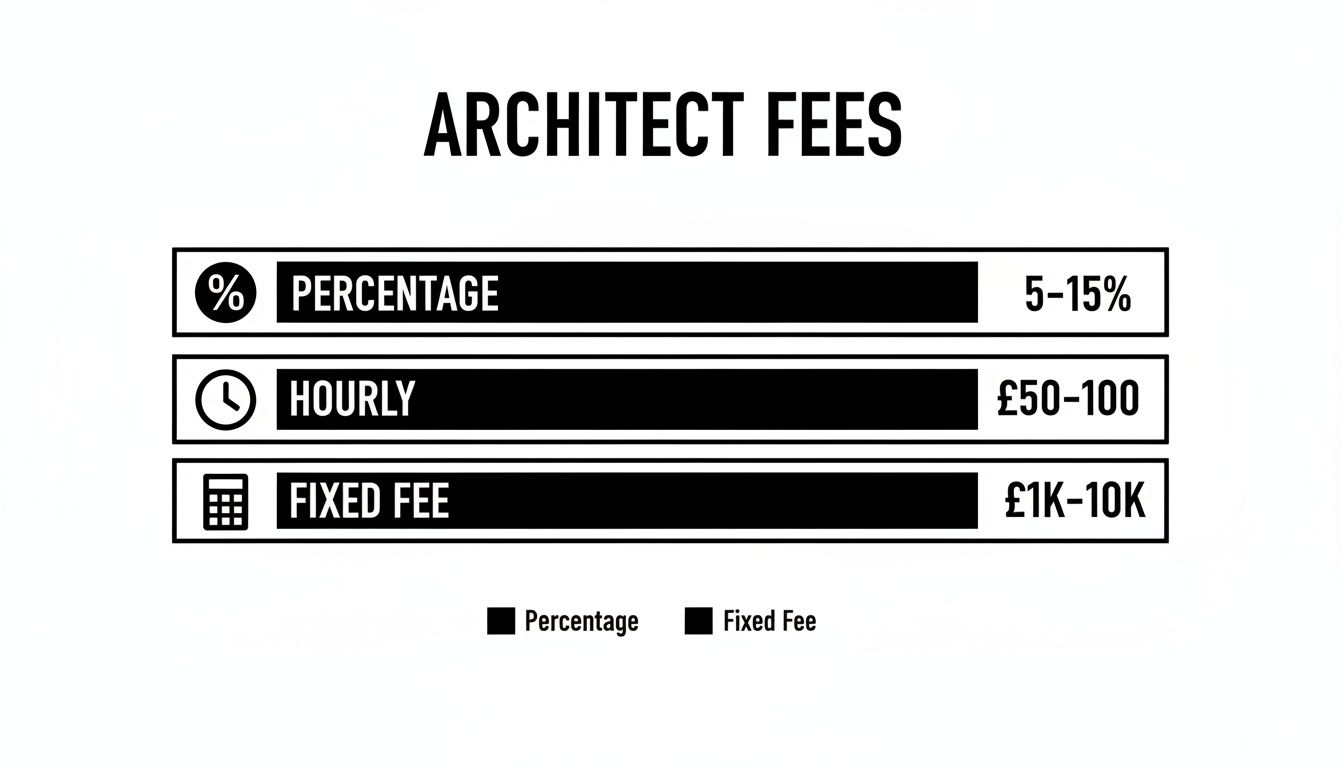
Architects costs in the UK vary with the size of your project and the fee structure you choose. You might end up paying 5–15% of your total build cost, £50–£100/hr for ad-hoc advice, or agree a fixed lump sum from £1,000 upwards.
VAT at 20% usually sits on top of these professional fees, so don’t forget to factor that in. On top of your architect’s charges, disbursements—things like planning application fees, specialist surveys or consultant reports—will also need covering.
Quick Summary Of Architects Costs UK

Architect fees generally slot into three main categories:
Percentage-Based Fees scale with construction costs (typically 5–15% of your build budget)
Hourly Rates suit early-stage advice or small-scale work (around £50–£100/hr)
Fixed Fees give you budget certainty for clearly defined scopes (from £1,000 upwards)
In the UK, architects generally charge between 5% and 15% of the total construction cost for their services—a standard that remains steady across industry sources as of 2025. Learn more about these findings on SketchProposal.
Summary Of Architect Fee Models
Below is a quick comparison of the main fee models used by architects in the UK and their typical ranges. Use this as a handy reference before you approach firms with your brief.
Fee Model | Typical Rate | When It’s Used |
|---|---|---|
Percentage | 5–15% | Major builds and complex renovations |
Hourly | £50–£100/hr | Early advice and feasibility studies |
Fixed Fee | £1,000–£10,000++ | Defined, single-stage services |
This table should give you a clear snapshot of each option so you can match the right model to your project.
Analogy To Everyday Choices
Picking a fee model isn’t so different from choosing how you travel:
Percentage fees are like pay-as-you-go rail tickets—your fare rises the further you go.
Hourly rates resemble a taxi: time equals money.
Fixed fees feel like a day travelcard—one price for everything within a set zone.
Thinking of architects’ charges in these everyday terms helps you understand where risks lie and how predictable your costs will be. Remember to pencil in time for initial meetings and follow-ups when you’re comparing quotes.
Plan early, budget wisely, and you’ll have a much smoother run-up to issuing that brief.
Understanding Architect Fee Structures
When you start exploring architectural services in the UK, you’ll quickly discover three main ways you might be charged: by percentage, by the hour or via a fixed lump sum. Each method sets a different rhythm for your cashflow and risk-sharing.
Think of choosing a fee model like shopping for a suit. You can go bespoke, pick something off-the-peg or pay for each fitting by the hour.
Percentage Fees scale with the project’s value, often favoured for major builds.
Hourly Rates are billed per hour, ideal for early advice or small tasks.
Fixed Fees lock in a total cost for a clearly defined scope, offering budget certainty.
How Percentage Fees Work
With percentage-based billing, your architect’s fee rises and falls with the size of your project. Economies of scale often mean the bigger the job, the lower the rate.
For example, you might pay 12% on a £300,000 extension, while a £1M new build could be charged at around 8%.
In one Wimbledon project—a mid-19th-century villa renovation—the £500,000 budget carried a 15% fee, covering planning, detailed design and contract administration.
Mid-level service benchmarks show fees sliding from 17% on £150,000 listed-building alterations down to 8% for £1M new builds, according to 2025 data from RISE Design Studio.
“Choosing a percentage model gave us flexibility and ensured our architect was invested in keeping costs down.” — Client, South West London
When To Choose Hourly Rates
Hourly billing gives you the freedom to pay only for the time you need, without a large upfront commitment. Rates typically range from £50–£100/hr, making this approach perfect for feasibility work and quick consultations.
Use hourly fees for:
Feasibility research and site appraisals
Concept sketches or design tweaks
Ad-hoc services without long-term engagement
An SW London homeowner, for instance, chose hourly billing to refine their loft conversion. They tracked work in 15-minute blocks and stayed within a £1,500 consultancy budget.
Benefits Of Fixed Fees
If you want a crystal-clear figure from day one, fixed fees suit well-defined projects. This model mimics buying off-the-peg: you know the price before the work begins.
To make it work smoothly:
Agree a detailed scope and deliverables
Set milestone payments and stages
Include VAT, disbursements and any extras
For a garden pavilion design, a £5,000 fixed fee covered concept sketches, planning drawings and two site visits—no surprises for client or architect.
Choosing The Right Fee Model
Your decision hinges on how clear your project brief is, how flexible your budget can be and how much risk you’re willing to share.
Fee Model | Pros | Cons |
|---|---|---|
Percentage | Flexible scaling | Budget may grow |
Hourly | Pay for what you use | Hard to predict total |
Fixed | Clear cost upfront | Less flexible to changes |
Once you’ve weighed scope, budget and project stage, you’ll be ready to pick the fee structure that aligns with your goals. Check out our guide on the RIBA Plan of Work Guide to see how fees map to each stage of your build.
Understanding these fee structures helps homeowners plan realistically, ease cost anxiety and foster transparency.
In the next section, we’ll explore how fees vary by project type and complexity—insight that will help you optimise your budget.
Estimating Fees For Different Project Types
Architects’ fees can feel mysterious at first, but once you see how they shift with project size and complexity, it all starts to make sense. Whether you’re planning a modest single-storey extension or embarking on a grand new build, understanding these numbers helps you budget confidently.
Typical Fee Percentages By Project Type
Below is a snapshot of the usual fee percentages you’ll encounter. It’s a handy reference to see how fees scale from simple extensions to specialist renovations.
Project Type | Construction Cost | Typical Fee % | Estimated Fee (£) |
|---|---|---|---|
Single-Storey Extension | £100,000 | 12%–15% | £12,000–£15,000 |
New Build House | £500,000 | 8%–10% | £40,000–£50,000 |
Listed Building Alteration | £200,000 | 15%–18% | £30,000–£36,000 |
This table brings into focus two things: larger projects often benefit from economies of scale, and historic or listed properties carry a premium for specialist expertise.
A Closer Look: Single-Storey Extensions
Single-storey extensions tend to sit at 12%–15% of construction costs. On a £100,000 build, you’re typically looking at £12,000–£15,000 for the architect’s work. That fee usually covers:
Concept sketches and layout options
Planning drawings and submission support
Site visits and contract administration
“Even simple extensions benefit from stage-by-stage clarity,” notes one SW London architect.
Don’t forget to add roughly 20% VAT and any disbursements to your allowance.
New Build Example
When you scale up to a £500,000 new build, fees often dip to 8%–10%. So instead of paying £60,000–£75,000, your architect’s total sits around £40,000–£50,000. Why the discount? Larger budgets spread fixed costs—like project setup and management—over more significant sums.
Listed Building Alterations
Tackling a listed building brings its own demands: specialist surveys, conservation reports and delicate detailing. Typically, architects charge 15%–18% of construction costs. On a £200,000 renovation, that’s roughly £30,000–£36,000 before VAT.
Allow an extra 5% contingency on top of fees to cover unexpected advice or additional heritage surveys.
Comparing Fee Scenarios
When you lay these examples side by side, the pattern is clear:
Small, straightforward jobs often work on fixed or hourly rates.
Mid-sized extensions lean towards percentage fees in the 12%–15% bracket.
High-value new builds benefit from 8%–10% rates.
Complex or conservation projects command 15%–18%.
To forecast your own fees:
Pin down your construction budget (e.g. £100k, £500k).
Select the percentage range that fits your project type.
Multiply your budget by that rate, then tack on 20% VAT and any disbursements.
Factor in at least 5% contingency for unexpected complexities.
Learn more about extension fees in our Cost of Architect for Extension UK Homeowner’s Guide.
Practical Takeaways
Always request a stage-by-stage breakdown in your proposal.
Clarify disbursements and VAT summaries up front.
Compare regional rates—SW London fees can sit higher than the national average.
Ask to see past project budgets to gauge real-world outcomes.
With these examples and clear percentage guidelines, you’re equipped to approach quotes with confidence—and avoid any unwelcome surprises.
Exploring Regional Variations In Architect Fees
Much like property values, architects’ fees shift as you move around the UK.Differences in office rents, labour costs and local demand can sway your budget more than you might expect.
Understanding these regional patterns helps you set realistic figures before you even ask for quotes.
Fee Uplifts In SW London And Wimbledon
In South West London, you’ll typically see fees 20–30% above the national benchmark. Wimbledon Village, with its period homes and conservation rules, often pushes fees toward 28%.
A commuter town in the South East might add around 15–20%, reflecting steady demand without central London overheads.
SW London costs include premium office leases and senior staff
Wimbledon work often needs specialist conservation input
South East rates sit between inner-London peaks and standard suburban charges
“Local overheads and demand drive price differences more than project complexity.” — Local Architect
Case Study Wimbledon Terrace
Imagine a mid-19th-century terrace in Wimbledon, where a £500,000 build budget attracted a 25% uplift over standard London fees.
That premium covered the full RIBA journey—from planning to contract administration—over 8 stages.
Base percentage fee: 8% of build cost
Regional uplift addition: 2% premium
Total architect fee before VAT: 10%
This example highlights how a sought-after location can nudge your architect’s fee up by an extra notch.
Comparing Other UK Regions
Venture beyond the M25 and fees tend to cool off:
Region | Typical Fee Uplift | Notes |
|---|---|---|
SW London | 20–30% | Premium urban overheads |
South East | 15–20% | Commuter belt demand |
Northern England | 5–10% | Lower staff and property costs |
Rural Areas | 0–5% | Small practices, modest fees |
Handy regional data like this lets homeowners sketch a rough fee estimate before diving into detailed proposals.
Key Drivers Behind Regional Uplifts
London’s price tag isn’t just glamour. It’s built on:
Premium salaries for top-tier architects
Sky-high office rents in prime areas
Complex planning zones requiring extra consultants
Competitive markets driving firms to bolster teams
Transport and logistics costs in and around the capital
Spotting these drivers arms you with the right questions—so you can challenge any premium that doesn’t align with your project’s specifics.
Strategies For Fair Fee Negotiation
You don’t need to accept the first figure on the table. Try these approaches:
Bundle concept, technical design and contract stages for a single package
Ask for a detailed, stage-by-stage breakdown to see exactly what you’re paying for
Suggest payment milestones tied to deliverables
Gather at least three quotes to identify any outliers
Offer clear payment terms to help the practice manage cashflow
Explore use of digital coordination tools to minimise site visits
When you base negotiation on local comparators and transparent figures, you can often secure a 5–10% reduction—without cutting corners on quality.
Key TakeawayNegotiation grounded in data and local comparators ensures fair terms without sacrificing quality.
Arming yourself with regional insights means you’ll enter talks informed and ready to commission high-end practices like Harper Latter Architects with confidence.
Identifying Key Drivers Of Architects Costs

When you glimpse an architect’s invoice, it can feel like a puzzle. In truth, their fees come down to a handful of core factors that influence both your spending and the project’s rhythm.
Understanding these cost drivers up front means fewer surprises and smarter trade-offs down the line.
Project Complexity — Custom geometry, extra levels or unusual details demand more drawing and coordination time.
Design Ambition — Premium finishes or multiple design revisions add hours in workshops and sourcing.
Sustainability Targets — Low-carbon materials, energy modelling and eco-accreditations require specialist skills.
Site Constraints — Tight access, heritage conditions or tricky ground issues often lead to extra surveys and inspections.
Project Complexity And Design Ambition
As soon as you introduce multi-storey layouts or interlocking volumes, you’re asking your architect to spend more time refining drawings. Every bespoke curve or hidden cupboard is another round of detailing.
Interlocking volumes on different levels.
Curved walls or custom joinery.
Additional coordination with structural, mechanical and electrical consultants.
At the same time, design ambition drives up hours spent on material research and client workshops. For instance, specifying an imported stone finish often means tracing suppliers, testing samples and updating drawings.
Impact Of Sustainability Targets
Pushing for greener buildings doesn’t just pay off in lower running costs – it also nudges fees upwards. Integrating low-carbon strategies typically adds 1–3% to a mid-level service package.
“Low-carbon design adds roughly 1–3% to architect fees but can save you double in running costs.” — Sustainability Consultant
Passivhaus certification demands detailed energy modelling and blower door testing.
Solar panel siting and structural checks add extra design hours.
Rainwater harvesting systems and green roofs need specialist detailing.
Managing Site Constraints
Every plot has its quirks. Whether you’re working on a listed building or battling uneven terrain, these hurdles translate into more surveys, planning applications and on-site visits.
Uneven topography requires detailed level surveys and bespoke drainage plans.
Restricted access adds logistics planning and bespoke scaffold design.
Party wall matters call for legal advice and neighbour consultations.
Knowing these drivers early on helps you balance your ambition with a realistic budget. If money is tight, simplify layouts or trim the brief during concept design.
Define clear priorities to focus design effort on key areas.
Request stage-by-stage fee breakdowns to track professional time precisely.
Engage early with consultants to minimise surprises and manage costs.
Working with Harper Latter Architects from the outset allows you to pinpoint these drivers quickly and shape a fee proposal that suits your needs.
Consider the table below for a quick overview of typical fee uplifts.
Driver | Typical Fee Increase |
|---|---|
Sustainability targets | 1–3% |
Listed building consent | 1–3% |
Ground and access issues | 1–2% |
Think of these cost drivers as performance upgrades on a car. A base model runs smoothly, but adding specialised features always bumps up the sticker price. By choosing which “upgrades” matter most, you align your project’s ambition with your budget.
Next up, we will explore sample budget scenarios and practical quote templates.
Sample Budget Scenarios And Practical Quotes
When you start asking about architects’ fees across the UK, seeing real-life examples makes all the difference. These scenarios lay out percentage and fixed fees, VAT implications and RIBA stage budgets in a clear way. That means you can stack quotes side by side before you even write your brief.
Single-Storey Extension Budget Breakdown
Let’s imagine a single-storey extension with a £100,000 build cost. Using a 12% fee model and 20% VAT means the total architect fee comes to £14,400.
Stage | % of Fee | Fee (£) |
|---|---|---|
Concept Design | 20% | £2,400 |
Planning Application | 10% | £1,200 |
Technical Design | 30% | £3,600 |
Tender And Procurement | 10% | £1,200 |
Contract Administration | 30% | £3,600 |
“Breaking down fees by stage makes budgets transparent and builds trust” — SW London Architect
You’ll also need to allow roughly £3,000 for disbursements such as planning fees, a topographical survey and structural engineer input. Always ask for a detailed line-by-line list so any hidden costs pop up early.
Four-Bedroom New Build Budget Breakdown
In the second scenario, a four-bedroom new build sits on a £500,000 construction budget. A reduced 9% percentage fee reflects economies of scale. VAT adds £9,000, taking the architect’s total to £49,500 inclusive of VAT.
For a full RIBA Plan of Work, expect:
Concept Design and Feasibility (15%)
Planning and Pre-Application Advice (10%)
Technical Design and Specification (35%)
Tender Management (10%)
Contract Administration and Handover (30%)
Clients often note that a thorough tender package is invaluable in keeping contractors aligned. Disbursements here typically run to £7,500, covering QS reports and planning consultant fees. Don’t forget to confirm whether your quote includes energy modelling or sustainability checks.
Practical Quote Template To Compare Proposals
Use this structure to level the playing field when requesting proposals. Every quote should spell out:
The basis of the fee model and the percentage rate
Which RIBA stages are included, with cost allocation
A summary of anticipated disbursements
How VAT is applied and itemised
Any recommended contingency percentage
Also check:
Example budgets for your region (e.g. Wimbledon Village or SW London)
Whether fixed-fee options exist for standalone stages
Written payment terms and milestone schedules
Comparing Proposals Across Firms
Firm Name | Fee Model | Percentage | Estimated Fee (£) | VAT incl | Disbursements (£) |
|---|---|---|---|---|---|
Harper Latter Architects | Percentage | 9% | £45,000 | £9,000 | £7,500 |
Example Practice A | Fixed Fee | N/A | £50,000 | £10,000 | £8,000 |
Example Practice B | Percentage | 10% | £50,000 | £10,000 | £7,000 |
This side-by-side view helps you spot outliers and judge value beyond the headline fee. A lower percentage rate may include fewer stages, while a fixed fee could limit flexibility. Always align each proposal with your project’s complexity and ambition.
Next Steps To Secure Realistic Quotes
Armed with these scenarios and templates, you have a clear roadmap for asking the right questions. Share your brief early, compare line items transparently and use regional data to negotiate fair terms. This approach ensures you choose an architect who fits both your vision and your budget.
Tips To Ask The Right Questions
Confirm who will lead your project and the hours allocated per stage
Check whether VAT and disbursements are included in the headline fee
Find out how scope changes are costed and approved
Ask for examples of similar projects with real fee breakdowns
Verify if digital coordination (BIM or 3D models) is part of the service
Understand cancellation or revision policies and any associated charges
Each question sharpens your brief, so proposals meet your needs precisely.
Example Quote Checklist
Item | Details To Confirm |
|---|---|
Fee Model | Percentage, fixed or hourly |
RIBA Stages Included | Which stages and deliverables |
VAT Treatment | Rate and itemisation on invoices |
Disbursement Summaries | Forecasted survey, consultant and legal fees |
Contingency Allowance | Suggested buffer for unforeseen issues |
Use this checklist when reviewing PDF or spreadsheet proposals. Mark any unclear items and follow up directly with the practice for clarity.
Having a structured checklist transforms quote review from guesswork into a straightforward process
Next, request a free initial consultation to discuss your brief, explore bespoke fee options and begin your journey to a tailored home design. Reach out to Harper Latter Architects via the contact page or phone and start planning with confidence. Happy budgeting and best of luck.
Frequently Asked Questions About Architects Costs UK
Why do fees differ so much? Think of it like ordering a bespoke meal: the more intricate the recipe and the rarer the ingredients, the steeper the bill. In architecture, your project’s scope, required service level and regional factors all play a starring role.
In South West London, a Wimbledon site can carry a 20–30% uplift. Always compare against local benchmarks so you don’t get caught off guard.
Percentage Model – Fees rise and fall in line with your build cost.
Hourly Rates – Perfect for one-off consultations or limited services.
Fixed Fees – You know your total cost from the outset, provided the scope is clear.
What should you ask at your briefing? Focus on deliverables, project milestones and any anticipated extras.
Which tasks are included at each stage?
How are disbursements handled?
What’s the process if the brief evolves?
Remember, VAT at 20% applies to all professional fees and must be itemised separately. Disbursements typically cover:
Cost Item | Typical Application |
|---|---|
VAT (20%) | Added to professional fees |
Disbursements | Site surveys, specialist reports, consultant fees |
Comparing Quotes Effectively
When you’re side-by-side with multiple proposals, don’t just eyeball the bottom line. Drill into scope definitions, VAT breakdowns and provisional disbursement figures.
“Clarity on deliverables and stage breakdowns saves headaches later.”
Ask for regional case studies and client testimonials. Seeing similar projects in your area helps you balance budget versus outcome.
Check out our guide on how to choose an architect in the UK to refine your selection process.
With targeted questions and clear comparisons, you’ll approach commissioning with confidence. Just be sure to review every detail before signing on the dotted line.
Ready to translate your budget into a design you’ll love? Reach out to Harper Latter Architects for personalised advice.
Visit their website to book a free, no-obligation initial consultation and receive a bespoke fee outline.
Start your project with clarity and confidence today.
Comments