
A Guide to Kitchen Diner Extensions in South West London
- Harper Latter Architects

- 1 day ago
- 16 min read
A kitchen diner extension is so much more than just adding a room; it’s about completely changing the way you live. For many homeowners in South West London, it marks a shift towards open, flexible living, creating a central hub for the family that’s bright, spacious, and connected seamlessly to the garden.
Why Kitchen Diner Extensions Are Redefining London Living

The traditional layout of many London homes, with their separate, often cramped rooms, simply doesn’t suit the rhythm of modern family life. A kitchen diner extension breaks down these walls, creating a versatile, light-filled space that quickly becomes the true heart of the home.
It’s where your day unfolds—from the first coffee in the morning and after-school homework sessions to relaxed family dinners and weekends spent entertaining friends. This isn’t just a trend; it’s a response to our need for connection and flexibility at home. By blending cooking, dining, and living into one cohesive space, these extensions nurture a far more social and interactive family life.
The Value of a Well-Designed Space
A thoughtfully designed extension does more than just add square footage. It genuinely transforms your home’s character and boosts your day-to-day well-being. The benefits are impossible to ignore:
Enhanced Natural Light: With features like bi-fold doors, skylights, and expansive glazing, these extensions can flood your home with daylight, making every corner feel brighter and bigger.
Seamless Indoor-Outdoor Flow: Creating a strong connection to the garden is a key goal. This not only gives you beautiful views all year round but also extends your living area outdoors in the warmer months.
Increased Property Value: A high-quality kitchen diner is a huge asset. It’s a feature that buyers actively look for, adding significant value and appeal to your home.
A Personalised Hub for Your Life: The space is a blank canvas. It can be tailored to your family's exact needs, whether that means incorporating a quiet home office nook or a comfy seating area to unwind.
A Smart Investment in Lifestyle and Property
The demand for these multifunctional spaces shows just how much homeowner priorities have changed. In fact, studies show a well-executed project can increase a property's value by 10-15%—a fantastic return on your investment. It’s no surprise that over 40% of homeowners now choose to create large kitchen-diner-living areas when they renovate, putting open-plan sociability first.
By re-imagining the ground floor, you’re not just building an extension; you are investing in a new way of living that adapts to your family's changing needs for years to come.
Ultimately, a kitchen diner extension is about creating a beautiful, functional backdrop for your life. For some initial inspiration on how to start shaping your own vision, take a look at our collection of 10 inspiring kitchen extension design ideas for 2025.
Planning and Design: The South West London Approach
Bringing a kitchen diner extension to life in South West London is a two-part dance. First, you navigate the legal permissions. Then, you get to the creative part: crafting a design that genuinely works for you and your family. Getting this initial phase right is fundamental; it sets the entire project on a successful path, ensuring your final space is not only compliant but a perfect reflection of how you want to live.
The regulatory side of things, especially in boroughs rich with period properties like Richmond, Wandsworth, or Wimbledon, demands a careful hand. Understanding your obligations from day one helps you sidestep costly delays and frustrations down the line. Think of it as the essential groundwork that allows truly creative design to flourish.
First Things First: Understanding Planning Permissions
Before we even start sketching, we need to clarify which consent route your project will take. It nearly always falls into one of two main categories, and the path you follow is dictated by the scale of your plans and the specifics of your property.
Permitted Development Rights (PDR): These rights are a real gift to homeowners, allowing certain types of work to go ahead without needing a full planning application. For a typical terraced or semi-detached house, you can often build a single-storey rear extension up to a certain size under PDR, as long as you stick to strict criteria on height, depth, and materials.
Full Planning Application: If your extension dreams are bigger than what PDR allows, or if your property is a flat, maisonette, or sits within a designated area, you'll need to submit a full planning application. This is a much more detailed process where the local council will assess the impact of your proposal on its surroundings and your neighbours.
These rules can feel like a maze. For a deeper dive into the requirements, our guide to UK house extension planning permission offers a much more thorough overview.
Special Considerations for London Homes
Many properties across South West London have extra layers of protection that will shape your plans. If your home is in a Conservation Area, for example, the council will scrutinise your design to ensure it preserves or even enhances the character of the neighbourhood.
Similarly, if you own a Listed Building, you'll need Listed Building Consent for almost any change you want to make, inside or out. These designations don't mean an extension is impossible, but they absolutely demand a more sensitive, thoughtful, and considered architectural approach.
The Art of Bespoke Design
Once the planning route is clear, the real fun begins: designing your new kitchen diner. This is about so much more than just sticking a box on the back of your house. It’s about creating a space that feels like a natural, intuitive part of your home—a space that makes daily life easier and more enjoyable.
A key idea we always come back to is strategic zoning. Even in a big, open-plan room, you need to carve out distinct zones for different activities without putting up walls. We can achieve this subtly, using clever changes in flooring, different lighting schemes, varied ceiling heights, or the smart placement of furniture like a kitchen island or a large dining table. This creates a psychological separation between the busy kitchen, the social dining area, and a relaxed seating nook.
Good design ensures that while the space is unified, each zone has its own clear purpose and atmosphere. It’s the difference between a large, echoing room and a harmonious, multi-functional living space.
Finally, we can't overstate the importance of the connection to the garden. Optimising sightlines to the outdoors makes any room feel larger and more connected to nature. Features like large skylights, elegant roof lanterns, and expansive bi-fold or sliding doors are our essential tools here. They don't just flood the new extension with beautiful natural light, making it feel airy and welcoming; they create that seamless, coveted flow between your indoor and outdoor living areas.
Choosing Structural Systems and Luxury Finishes
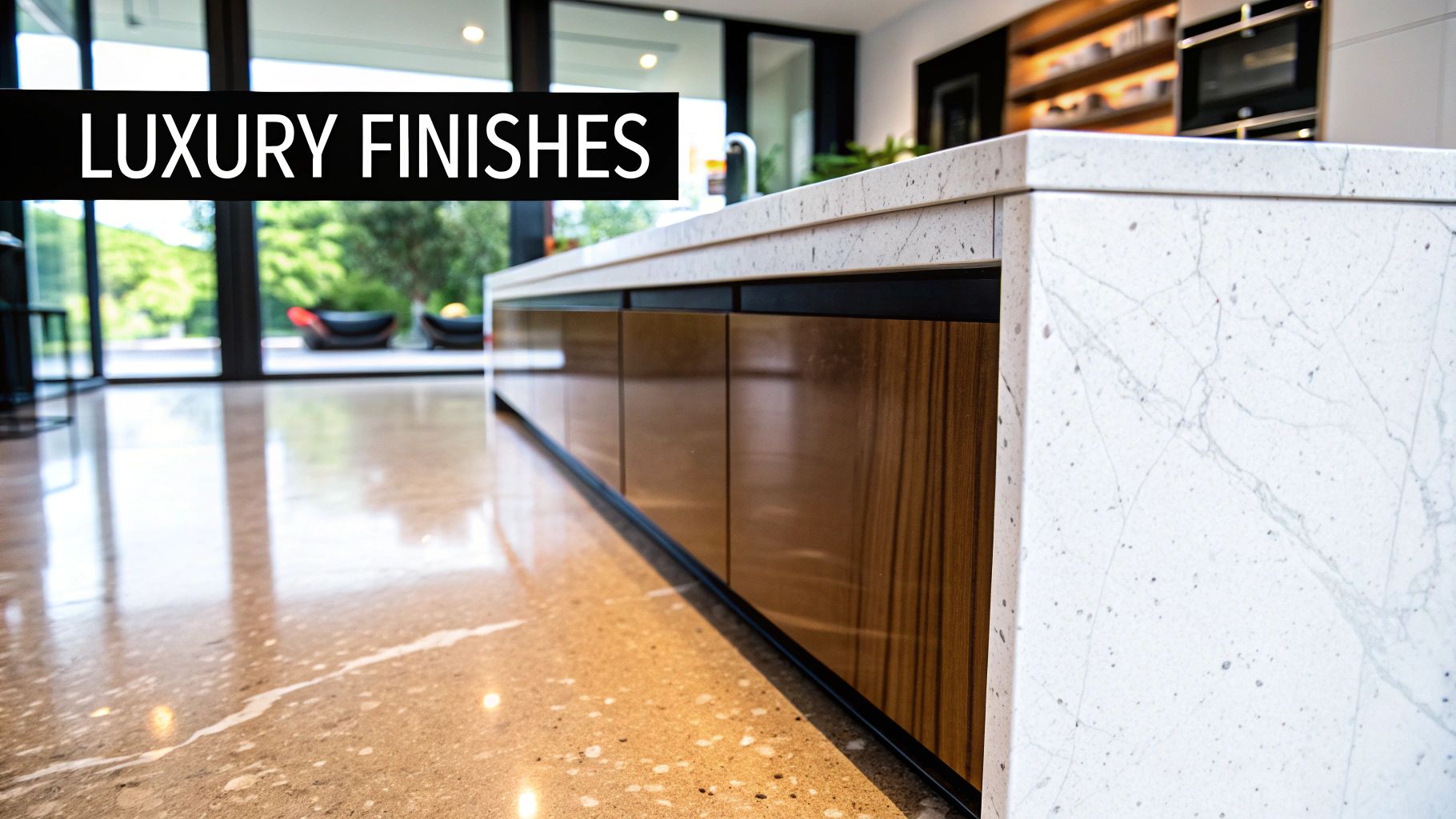
With the design vision agreed and planning approvals in the bag, our focus shifts to the tangible elements that will define the quality, longevity, and feel of your kitchen-diner. This is where architectural concepts meet engineering precision; where drawings become a robust, beautiful reality.
It’s a crucial stage involving decisions on everything from the unseen structural skeleton to the surfaces you’ll interact with every day. The right choices are fundamental. Get the structure right, and your extension is safe, sound, and seamlessly integrated. Select the perfect finishes, and you elevate the space from a simple addition to a truly exceptional heart of the home.
The Unseen Essentials: Structural Integrity
Before a single bespoke cabinet can be fitted, the core structure must be perfected. This is the domain of a structural engineer, a vital professional who works hand-in-hand with your architect. Their job is to calculate the precise needs for foundations, steel beams, and load-bearing walls, ensuring everything is safe, sound, and built to last.
This process involves several key steps:
Foundations: The ground conditions in South West London can be surprisingly varied. The engineer will determine the right foundation type for your specific site, considering soil type, nearby trees, and drains. This could range from a standard trench fill to more complex piled solutions.
Steelwork: Creating those beautiful, large open-plan spaces often means removing internal walls. Steel beams (often called RSJs) are inserted to support the floors above. The engineer’s calculations specify the exact size needed for maximum strength with minimal visual impact.
Integrating Services: A high-end kitchen-diner relies on flawlessly integrated services. We plan the routes for plumbing, electrics, ventilation, and underfloor heating right at the structural design stage. This avoids awkward compromises or last-minute changes down the line.
Selecting Your Luxury Finishes
The finishes are where your personal style truly comes to life, transforming the architectural shell into a sophisticated and inviting space. It's about choosing materials that offer a combination of timeless beauty, durability, and a touch of character.
Think of your worktop, for example. It's not just a place to prepare food; it’s a central feature of the room. A beautiful natural marble offers unparalleled elegance but needs a bit of care. High-quality quartz, on the other hand, provides incredible durability and consistency, while polished concrete brings an industrial-chic aesthetic that’s both tough and striking.
When it comes to high-end worktops, you have a fantastic range of options, each with its own character.
Comparison of Premium Kitchen Worktop Materials
Material | Key Benefits | Considerations | Typical Cost Bracket |
|---|---|---|---|
Natural Stone (Marble, Granite) | Unique veining, timeless and luxurious aesthetic. Granite is very durable. | Marble can be porous and susceptible to staining/scratching; requires regular sealing. | £££ - ££££ |
Quartz Composite | Extremely durable, non-porous, and resistant to stains and scratches. Wide range of consistent colours. | Can be damaged by extreme heat. Lacks the unique patterns of natural stone. | £££ |
Polished Concrete | Modern, industrial look. Highly durable and heat-resistant. Can be cast into unique shapes. | Can be prone to fine cracking over time and needs periodic sealing to prevent stains. | £££ - ££££ |
Sintered Stone (e.g., Dekton, Neolith) | Highly resistant to heat, scratches, and UV rays. Very low porosity. Suitable for indoor and outdoor use. | Can be more brittle at the edges than quartz. Requires specialist fabrication. | ££££ |
Solid Hardwood | Warm, natural feel. Can be sanded and re-oiled to remove scratches. Develops character over time. | Requires regular oiling to maintain its finish and prevent water damage. | ££ - £££ |
Choosing the right worktop is a balance between the look you love and the practical demands of your lifestyle. We can walk you through the samples and help find the perfect fit for your design.
The real mark of luxury is in the detail and the quality of execution. It’s the seamless join between a stone worktop and a bespoke splashback, the solid feel of custom-built cabinetry, and the perfect finish on a polished concrete floor.
Bringing Light and Warmth into Your Extension
Glazing is about so much more than just windows. It’s about framing views of your garden, controlling natural light, and keeping your home warm and efficient. High-performance, triple-glazed sliding or bi-fold doors are now a standard expectation, creating that essential indoor-outdoor link while providing excellent insulation.
For those wanting to really maximise daylight, we can incorporate structural glass elements like frameless skylights or glass-to-glass corners to create dramatic, light-filled features. To see how different options can transform a space, explore our detailed homeowner's guide to modern glass extensions.
Finally, sustainability is woven into every decision. This means specifying materials with strong green credentials, like responsibly sourced timber or flooring with a high recycled content. When paired with insulation levels that exceed building regulations, these choices ensure your stunning new space isn't just beautiful, but also comfortable, energy-efficient, and conscientiously built.
Understanding Your Project Costs and Timeline
Embarking on a kitchen diner extension is a serious commitment, both in time and money. Getting a firm grip on the likely costs and project duration from day one is absolutely essential for a smooth, stress-free process, especially in the fast-paced South West London market. Realistic budgeting and achievable expectations are the foundations of any successful build.
The total investment isn't just a single number; it's made up of several key parts. A properly structured budget accounts for each of these, stopping unexpected expenses from throwing your plans off course. Think of it less like a price tag and more like a financial blueprint for your vision.
Deconstructing Your Budget
A high-end kitchen diner extension budget in London typically breaks down into four main areas. The exact percentages will shift depending on how complex your project is and the level of finish you choose, but this gives you a solid starting point for your financial planning.
Structural Build (Approx. 50-60%): This is the biggest slice of the pie. It covers all the heavy-duty work: foundations, brickwork, roofing, structural steel, and fitting high-performance windows and doors.
Internal Fit-Out (Approx. 25-35%): This is where the empty shell comes to life. It includes all plumbing and electrical work, underfloor heating, plastering, flooring, decorating, and, of course, the supply and installation of your bespoke kitchen, worktops, and appliances.
Professional Fees (Approx. 8-12%): These are the costs for the expert team guiding your project, including your architect, structural engineer, and any other specialists needed. You’re not just paying for drawings; you’re investing in quality, compliance, and a well-managed project.
VAT and Contingency: Don't forget that VAT at 20% applies to most construction work and professional fees. On top of that, it's always smart to set aside a contingency fund of 10-15% of the build cost to cover any surprises that might pop up along the way.
Realistic Cost Expectations in London
It's crucial to be realistic about the "London premium." Labour and material costs here are significantly higher than in other parts of the UK. While you might see national averages quoted online, they often don’t reflect the reality of building in boroughs like Richmond or Wandsworth.
For example, a basic kitchen conversion might be quoted nationally at around £28,000, but actually adding new space with an extension is a different ball game. Typical build rates in London for a single-storey extension can start from £2,900 per square metre for just the structural shell. This means a high-spec 30 m² kitchen diner extension in South West London could easily see total project costs climb well over £90,000 once you factor in the fit-out, fees, and VAT. The final figure really depends on the complexity of the design and the luxury of the finishes you choose. You can find more insights on how extension costs vary across the UK on BuildPartner.com.
A detailed, itemised quote from a reputable contractor, based on your architect's technical drawings, is the only way to establish a truly accurate budget. This transparency is key to maintaining financial control throughout the project.
Mapping Your Project Timeline
Just as important as your financial budget is your time budget. A well-planned kitchen diner extension follows a logical sequence of stages, each with its own timeframe. Trying to rush the crucial early phases is a false economy that almost always leads to delays and extra costs down the line.
A typical timeline breaks down like this:
Design & Planning (8-16 weeks): This initial phase is all about developing the design concept, creating detailed technical drawings, and submitting for planning permission or a Lawful Development Certificate. The council’s determination period alone is typically eight weeks.
Contractor Selection (4-6 weeks): Once the technical drawings are ready, we tender the project to a shortlist of qualified contractors. This ensures you get accurate, like-for-like quotes to compare.
On-Site Construction (12-20 weeks): This is the main build phase. The duration depends heavily on the scale and complexity of your extension, but for a high-quality project, three to five months is a realistic window.
Fit-Out & Finishing (4-8 weeks): After the main structural work is done, the focus shifts inside for the fit-out, kitchen installation, and final decorations.
From the first design meeting to the day we hand over the keys, a high-end kitchen diner extension can take anywhere from six to twelve months to complete.
Your 8-Step Architectural Journey to a Finished Extension
Embarking on a high-end kitchen-diner extension is an exciting thought, but turning that idea into a finished, beautiful space can feel overwhelming. This is where an architect brings structure and clarity. We follow a proven, RIBA-aligned 8-step process that guides you through the journey, ensuring every decision is made with purpose and confidence.
Think of it as a roadmap. It breaks a large, ambitious project into manageable stages, allowing for clear communication, rigorous quality control, and sound financial management from the first sketch to the final handover.
Stages 1 & 2: Strategic Definition and Briefing
Our journey together doesn’t start with drawings; it starts with a conversation. In these crucial early stages, we sit down to properly explore your aspirations. We want to understand your lifestyle and the real problems you’re trying to solve. Is it about flooding the space with natural light? Forging a better connection to the garden? Or simply creating more room for a growing family to come together?
We then work with you to crystallise these ideas into a clear, detailed project brief. This document becomes our north star, the single point of reference that guides every design decision and ensures the final result is perfectly aligned with your vision and budget.
Stages 3 & 4: Concept Design and Spatial Coordination
With a solid brief in hand, the creative work really gets going. During Concept Design, we start translating your needs into initial architectural sketches and 3D models. We’ll explore different layouts, play with massing options, and present material palettes to find the most elegant and functional solution for your kitchen-diner extension.
This is a deeply collaborative phase where we refine the design together. Once we’ve settled on a direction, Spatial Coordination (formerly Developed Design) adds a serious layer of detail. We finalise the precise layout, coordinate the design with input from a structural engineer, and prepare all the drawings and documents needed for a planning application.
Stage 5: Technical Design
Once planning permission is in the bag, we move into the highly detailed Technical Design stage. Here, we create a comprehensive set of construction drawings and specifications. This isn't just a floor plan; this technical pack is incredibly detailed, covering everything from the exact type of insulation and window specifications to the precise location of every light switch and plumbing connection.
This stage is perhaps the most critical for guaranteeing quality and cost certainty. A thorough technical design package allows contractors to provide accurate, like-for-like pricing. It’s what minimises the risk of costly surprises or compromises cropping up during the build.
This visual timeline shows how these core stages flow from one to the next, taking your project from concept to completion.The infographic reinforces that a successful project relies on a logical progression, with each stage building upon the last to ensure a smooth transition from paper to reality.
Stage 6: Manufacturing and Construction
With a trusted contractor appointed, the on-site work finally begins. Our role shifts to contract administration and quality control. We’re on-site regularly, inspecting the work, answering the builder’s technical queries, and ensuring the project is being built exactly as specified in our drawings.
We act as your expert representative on the ground, making sure build quality is maintained and the project stays on track. It’s also helpful for homeowners to understand the practicalities here. For instance, the structure and shell (foundations, walls, roof) typically account for around 50–60% of the project budget. The internal fit-out, including that all-important kitchen, usually takes up another 30%, with professional fees for architecture and engineering making up the remaining 8–12%. For more insights, it's worth reading up on UK kitchen extension costs from MyJobQuote.co.uk.
Stages 7 & 8: Handover and In Use
As construction wraps up, we carry out a meticulous inspection to identify any final snags that need addressing before we certify the project as practically complete. We also ensure you receive all the relevant warranties, manuals, and certifications for your records.
The handover is that brilliant moment you officially take possession of your stunning new kitchen-diner. But our relationship doesn't end there. We remain on hand during the 'In Use' stage to advise on any questions that come up as you settle in, ensuring your new space performs perfectly for years to come.
Bringing Your Vision to Life with Local Case Studies
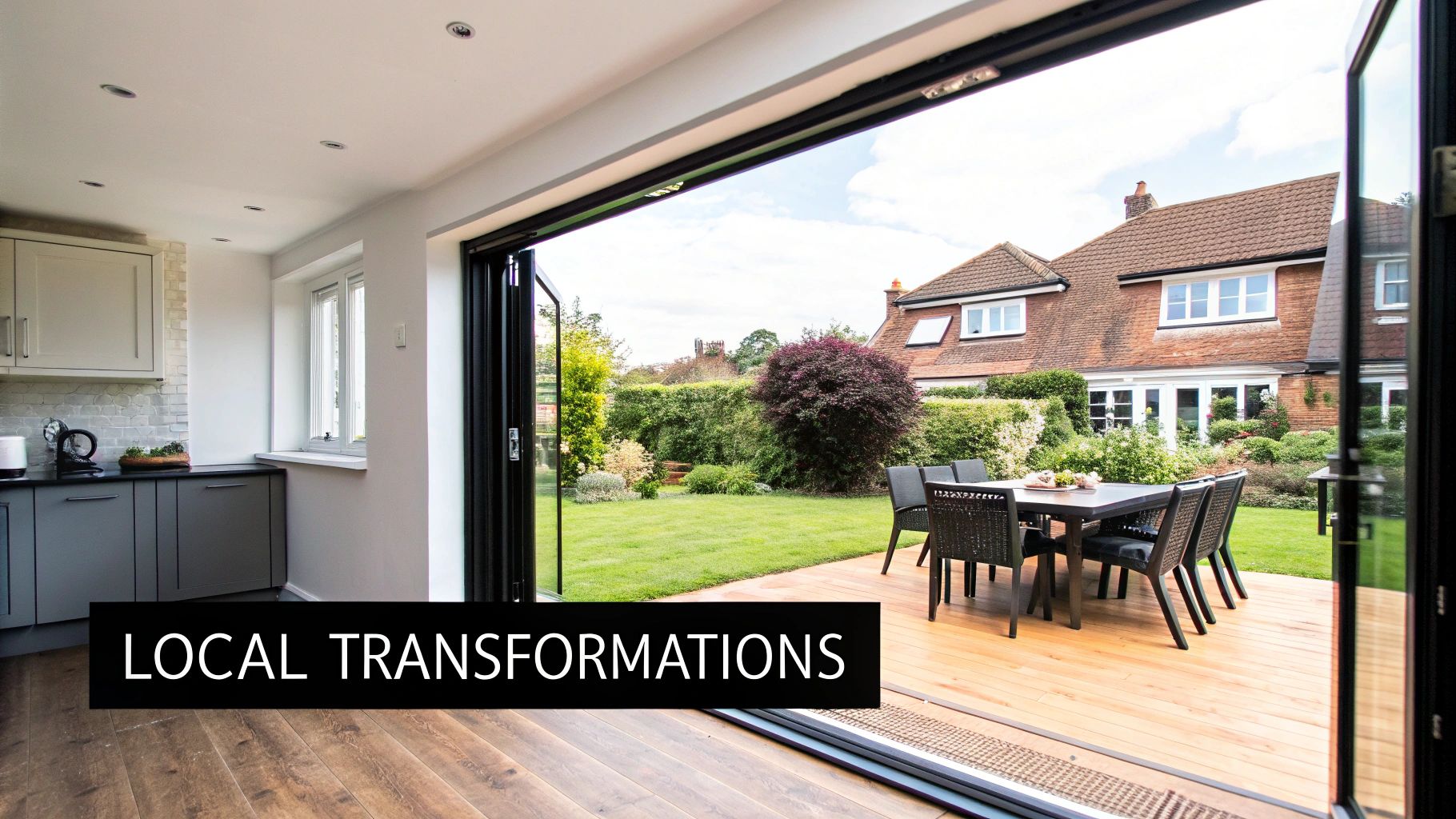
It’s one thing to talk about design theory, but it’s another to see it in action. Seeing real-world results is what truly brings the potential of a kitchen diner extension to life. We’ve helped homeowners across South West London, from the leafy streets of Wimbledon to the vibrant terraces of Clapham, overcome their own unique design puzzles to create some truly extraordinary living spaces.
These projects aren’t just about adding square footage; they show just how versatile an extension can be within our local architectural landscape. By seeing how others have navigated similar challenges, you can start to get a much clearer picture of what your own home could become.
A Wimbledon Side-Return Extension
A classic Victorian terraced home in Wimbledon presented us with a familiar problem: a long, dark galley kitchen that felt completely cut off from the garden. The owners wanted a bright, social space for their young family, but were worried about sacrificing their precious garden.
Our solution was an elegant side-return extension. By simply infilling that underused alleyway at the side of the house, we squared off the rear of the property, creating a wonderfully wide, open-plan kitchen and dining area. The key features that made all the difference were:
Expansive Glazing: We installed a large structural skylight right above the new dining area. It absolutely floods the space with daylight, drawing it deep into the home.
Seamless Connection: Beautiful Crittall-style doors now create a sophisticated, seamless link to the garden, blending classic aesthetics with modern thermal performance.
Clever Zoning: A large central island does more than just provide workspace; it acts as a natural divider between the functional kitchen zone and the more relaxed dining space, defining each area without needing a single wall.
This single project completely transformed the dark, cramped rear of the house. It’s now a light-filled hub and, without a doubt, the true heart of their home.
Realise Your Vision with Harper Latter Architects
These case studies are just a small glimpse into the transformative power of a thoughtfully designed extension. Your own home has its unique potential just waiting to be unlocked. Working with a specialist local architect ensures your design is not only beautiful and functional but also perfectly in tune with your property’s character and its place in the neighbourhood.
A successful extension is a collaboration—a partnership between your vision and our architectural expertise. Together, we can create a space that perfectly reflects how you want to live.
Ready to start your own journey? The first step is a simple conversation. We invite you to contact us to book an initial consultation. Let's sit down, discuss your ideas, and explore how we can bring your vision for the perfect kitchen diner extension to life.
Frequently Asked Questions About Kitchen Diner Extensions
Embarking on a big home renovation project always brings up plenty of questions. To give you some quick, clear answers, we’ve put together a few of the most common queries we get about planning and building kitchen diner extensions right here in South West London.
How Long Does Planning Permission Take in London?
For a standard extension, you should budget around eight weeks for a decision from your local council, starting from the day your application is validated. That timeframe can stretch to 13 weeks for schemes that are unusually large or complex.
It’s important to remember that this is just the council’s decision-making window. It doesn’t include the weeks or even months it takes for your architect to prepare the detailed drawings and documents needed to submit the application in the first place.
What Is the Difference Between a Side Return and a Wraparound Extension?
A side-return extension is a hugely popular choice for Victorian and Edwardian terraced houses. It simply fills in that narrow alleyway running alongside the back of the ground floor, squaring off the property and making the internal space feel so much wider.
A wraparound extension is a bit more ambitious. It combines a side-return with a rear extension, creating a much larger, L-shaped space that pushes out sideways and backwards. So, while a side-return maximises width, a wraparound boosts both width and depth, giving you a significantly larger open-plan area—though at a higher cost.
Will My Kitchen Extension Need a Party Wall Agreement?
It’s highly likely, yes. The Party Wall etc. Act 1996 comes into play if you’re digging new foundations within three metres of your neighbour’s property or building right on the boundary line. Both are common scenarios for kitchen extensions.
You are legally required to serve a formal notice to all affected neighbours. If they give you written consent, you’re good to go. But if they disagree or don’t reply, you must appoint a surveyor (or surveyors) to draw up a Party Wall Award. This is a legal document detailing how the work will be carried out safely. Factoring the time and cost for this into your plan from the very beginning is absolutely crucial.
A Party Wall Award is designed to protect both you and your neighbours. It provides a clear framework that prevents disputes and ensures any potential damage to their property is properly documented and fixed. Think of it as an essential safeguard for ambitious city renovation projects.
Are you ready to transform your home with a bespoke kitchen diner extension? The team at Harper Latter Architects specialises in creating exceptional living spaces across South West London. Explore our process and see how we can bring your architectural vision to life at https://harperlatterarchitects.co.uk.
Comments