
A Homeowner's Guide to Modern Homes Architects in the UK
- Harper Latter Architects

- 2 days ago
- 14 min read
Modern homes are defined by more than just an aesthetic. They are a direct response to how we want to live: in spaces that are minimalist, light-filled, and deeply functional. A modern homes architect is the professional who translates that desire into a tangible reality, blending creative vision with technical skill to design a house that truly works for you.
Translating Your Modern Home Dream into a Plan

Before you even start looking for an architect, the single most important step is to create a clear, actionable design brief. This isn’t just a collection of nice images from Pinterest; it’s the foundational document for your entire project. A good brief ensures that every professional you meet understands exactly what you want to achieve from that very first conversation.
To write a strong brief, you need to think deeply about your lifestyle—not just how it is today, but how you see it changing in the future. Consider your daily routines, your family’s evolving needs, and, crucially, how you want to feel in your new home. This process helps you nail down the practical requirements that will ultimately shape the design.
Defining Your Aesthetic and Functional Needs
Getting specific about your personal taste is vital. Are you drawn to the crisp, clean lines of pure minimalism, or do you prefer the warmth of biophilic design that brings nature indoors? Maybe the raw, honest materials of an industrial style speak to you more. Getting a handle on your preferences is key, and you can get a better sense of different approaches by exploring modern architecture in London today.
Beyond the look, you need to detail the function. Think about how you move through your home.
Do you need a completely open-plan living area for entertaining, or would you rather have distinct zones for different activities?
What are your non-negotiables for a home office, a kids’ playroom, or a kitchen built for a serious cook?
How much storage do you genuinely need, and where should it be located to make life easier?
Your brief is more than a wishlist; it's a strategic document. It communicates your priorities, defines the scope, and sets clear expectations, preventing misunderstandings and keeping the project aligned with your vision.
Integrating Sustainability from the Start
Sustainability shouldn’t be an add-on; it needs to be woven into the fabric of your brief right from the beginning. This goes far beyond just sticking some solar panels on the roof. Think about the building’s orientation to maximise natural light and cut down on energy use. Discuss where materials come from, prioritising locally sourced and recycled options where possible.
High-performance insulation, efficient glazing, and water-saving systems are all crucial elements that a good modern homes architect can integrate seamlessly from day one.
This forward-thinking is mirrored across the UK, as more homeowners invest in meaningful upgrades. The home improvement sector, valued at £11.2 billion in 2024, is expected to grow by nearly 49% to £16.67 billion by 2033. Architects are often at the helm of these projects, leading everything from major extensions to complex conversions.
Finding and Choosing the Right Architect for Your Project

With a solid brief in hand, you're ready to find the creative partner who will help shape your modern home. This isn’t just about a quick online search; it’s a strategic process of uncovering the right talent for your highly specific vision.
Your first port of call should always be the official professional bodies. Both the Royal Institute of British Architects (RIBA) and the Architects Registration Board (ARB) keep detailed directories of their accredited members. Using these resources is your baseline guarantee—it confirms you’re dealing with a qualified, insured professional, which is a non-negotiable for any serious project.
Beyond the Official Directories
While essential, these directories are just the start. To find modern homes architects who are genuinely pushing boundaries, you need to look at who’s being recognised for their work.
Architectural Awards: Keep a close eye on prestigious awards like the RIBA House of the Year. Winning, or even being shortlisted, is a powerful indicator of an architect's skill and creative ambition.
Design Publications: Magazines and websites focusing on architecture and contemporary design are brilliant for discovering architects whose style truly resonates with you.
Local Knowledge: Sometimes, the perfect fit is right on your doorstep. Local design publications often spotlight architects with direct experience navigating your local council’s planning department.
When you vet an architect, you're not just buying a service; you're entering a close, long-term partnership. The 'click' is as important as the portfolio, as you'll be collaborating on deeply personal and financial decisions for months, if not years.
Once you have a shortlist, the real analysis begins. Dive into their portfolios. Do their finished projects align with the aesthetic you’ve defined in your brief? Look for consistency in quality and style. It’s also wise to seek out testimonials and reviews, reading between the lines to get a feel for their communication style and problem-solving skills.
For a deeper dive into what to look for, check out our guide on how to choose an architect in the UK.
Checking for Relevant Experience
Direct experience with your local planning authority is invaluable, especially if your project involves a conservation area or a listed building. An architect who understands the local nuances can save you an incredible amount of time and frustration.
This is where you can start comparing your top candidates side-by-side. Use a simple checklist to keep your thoughts organised and make an informed, objective decision.
Key Architect Vetting Checklist
Evaluation Criteria | Architect A | Architect B | Architect C |
|---|---|---|---|
Portfolio Alignment (Modern aesthetic) | |||
Local Planning Experience (Your borough) | |||
Conservation/Listed Building Expertise | |||
Sustainability Credentials | |||
Client Testimonials & Communication Style | |||
RIBA / ARB Accreditation | |||
Initial 'Click' / Personal Rapport |
Filling this out as you meet with each practice will give you a clear, at-a-glance comparison, helping you move beyond just a 'gut feeling' to a well-reasoned choice.
The leading UK architectural firms are constantly shaping modern living through innovative, sustainable, and community-focused designs. Giants like Foster + Partners are renowned for landmark sustainability, while specialists such as Alison Brooks Architects are celebrated for their sculptural housing. This drive for innovation, combined with new regulatory reforms, positions architects to deliver resilient modern homes that truly prioritise wellbeing and decarbonisation.
Getting to Grips with Budgets, Planning, and Regulations
This is the point where the exciting vision for your modern home meets the practical realities of cost and compliance. Pulling together a realistic budget is much more than just a ballpark figure for the build; it’s about forensically accounting for every single expense you’ll encounter on a UK building project.
The final construction invoice is just one piece of a much larger financial puzzle. To sidestep any nasty surprises later on, it's vital to map out all the associated costs right from the start. A thoroughly prepared budget gives you clarity and control, preventing the stress that comes with unexpected bills.
Breaking Down the True Project Cost
When you’re planning the finances, it helps to think in layers. Any experienced modern homes architect will walk you through this process, but it’s a good idea to get your head around the main components yourself.
Architect's Fees: These are usually calculated as a percentage of the total construction cost. You can typically expect this to be somewhere between 5% and 15%, depending on how complex your project is and the level of service you need.
Other Professional Services: It’s not just the architect. You'll also need to budget for a structural engineer and potentially other specialists like a quantity surveyor or a party wall surveyor.
Statutory Fees: Don't forget the administrative costs. This covers the fees for submitting your planning application to the local council and, later, for building regulations approval.
Contingency Fund: This is absolutely non-negotiable. We always advise clients to set aside 10-15% of the total build cost for unforeseen issues. It’s a critical safety net that protects your project from delays and compromises.
A common pitfall we see is clients underestimating the ‘soft costs’. Fees for professionals, surveys, and planning applications can add a significant chunk to the final bill, so they must be factored in from day one.
Understanding UK Planning Permission
Navigating the UK’s planning system can feel like a maze, but it’s a logical process when you know how. Your architect will be your expert guide here, figuring out the right path for your specific project.
Some smaller extensions or alterations might fall under what’s known as Permitted Development rights. This is great because it means you don’t need to apply for full planning permission. However, these rights come with very strict rules on size, height, and location.
For most new builds or major alterations, a full planning application is unavoidable. This is where your architect’s local knowledge really pays off. If you want to get a head start, you can read our practical overview of the UK planning permission process.
The planning landscape is also shaped by wider government policy. The 'Levelling Up' agenda, for example, is shifting some architectural focus away from London, while the national drive for 300,000 new homes annually is encouraging innovation in construction. For a deeper dive into these kinds of industry trends, websites like ibisworld.com offer some great insights.
If you’re working on a listed building or a home in a conservation area, things get even more complex. These projects demand a specialist approach and a deep respect for heritage regulations. An architect with proven conservation experience isn’t just an advantage—it’s absolutely essential for securing approval and protecting the building’s unique character.
The Architect Interview and Commissioning Process
You’ve done your homework and put together a shortlist of promising modern homes architects. Now for the most crucial part of the journey: finding the one you click with. The interview is far more than just flicking through a portfolio; it's a two-way street designed to see if your personalities, communication styles, and professional outlooks align.
Think of this stage as your chance to ask the questions that really get to the heart of an architect’s approach. Go beyond their finished projects and dig into their design philosophy. How do they really listen to and handle client feedback? What’s their process for keeping a project on budget and on schedule? The answers will tell you everything you need to know about what it’s like to work with them day in, day out.
Putting Your Shortlist to the Test
To get the most from your interviews, it helps to have a consistent set of questions prepared. This isn’t about being rigid; it’s about making sure you can compare each practice fairly, moving from a gut feeling to a clear, objective decision.
This is your opportunity to understand not just what they do, but how they do it. Do they seem genuinely interested in your vision? Do they explain complex ideas without resorting to jargon? Remember, this will be a long-term professional relationship, so building a foundation of trust and open communication from the very start is absolutely vital.
We’ve put together a table of essential questions to help guide your conversations. These are designed to open up a real dialogue and give you a deeper insight into how each architect thinks and works.
Essential Questions to Ask a Potential Architect
Question Category | Specific Question to Ask | Why It's Important |
|---|---|---|
Design & Vision | "How would you interpret our brief, and what are your initial thoughts on the opportunities and constraints of our project?" | This reveals their creative thinking and shows whether they've truly understood your core goals. |
Process & Communication | "What is your preferred way of communicating, and how often can we expect updates throughout the design stages?" | Establishes expectations around communication, which is key to a smooth and collaborative process. |
Fees & Contracts | "Could you walk me through your fee structure? What’s included at each stage, and what would be an additional service?" | Provides clarity on costs and helps you avoid unexpected expenses down the line. |
Team & Collaboration | "Who would be our day-to-day contact, and who else from your team will be working on our project?" | Helps you understand the team structure and ensures you know who you’ll be working with directly. |
Problem-Solving | "Can you give an example of a challenging project and how you navigated it?" | Their answer demonstrates their problem-solving skills, resilience, and ability to handle the unexpected. |
Listen carefully to the responses. A great architect won’t just give you the answers they think you want to hear; they’ll be honest, thoughtful, and engaged, helping you feel confident in their ability to lead your project.
Remember, commissioning an architect is a partnership, not just a transaction. You are looking for a professional who not only understands your aesthetic goals but also respects your budget and can guide you confidently through the entire journey.
From Proposal to Contract
After the interviews, you'll start receiving proposals from the architects you connected with. These documents should be clear and comprehensive, outlining the scope of services, the proposed fees, and an estimated project timeline. This is usually structured around the RIBA Plan of Work, a framework that breaks the project into logical stages, from the first sketch to handing over the keys.
Signing the contract is the final step. Make sure the agreement is a standard RIBA appointment document and that you take the time to read and understand every clause. This isn't just a formality; it's a legally binding document that protects both you and the architect by setting clear expectations for the entire project.
The diagram below shows how the core parts of your project budget fit together, illustrating where the architect's fees sit alongside the main build cost and the all-important contingency fund.
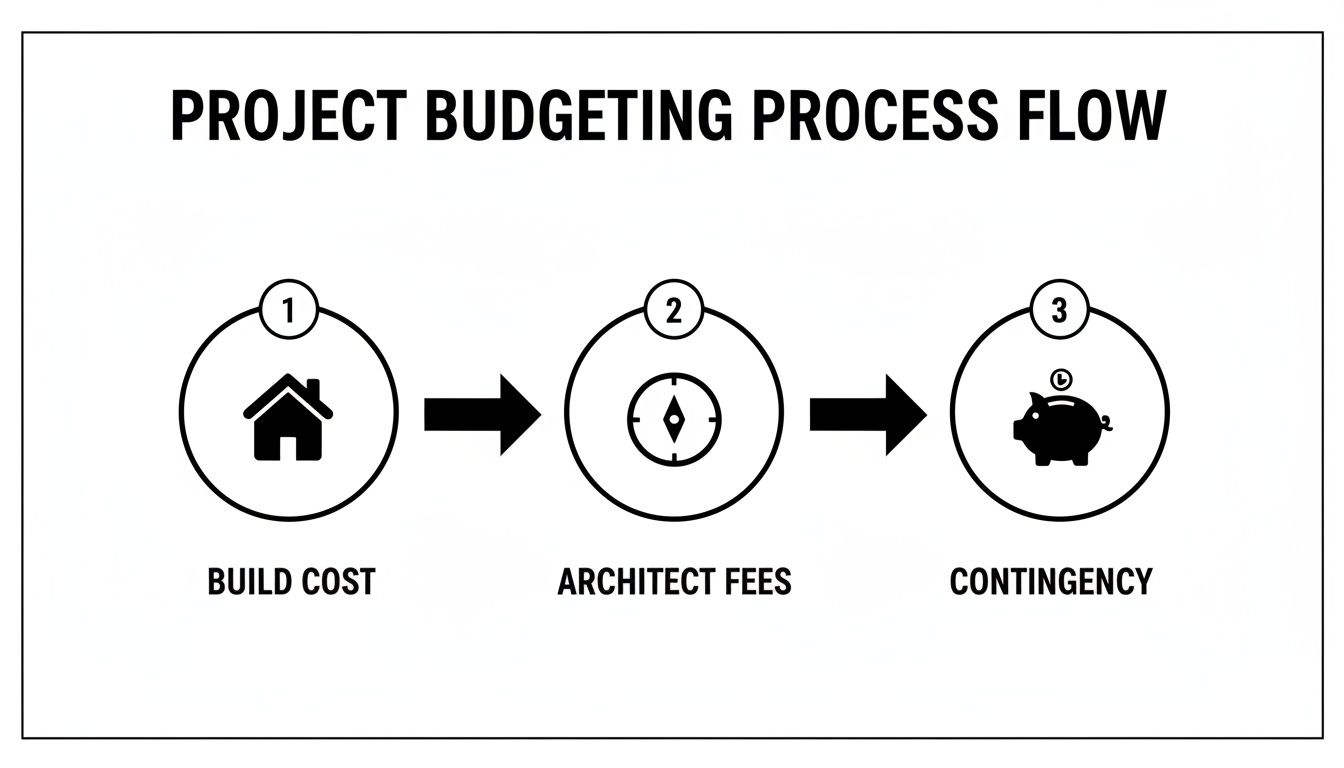
It highlights that a well-managed budget is a balanced equation where every element is defined before work begins. With a clear proposal and a solid contract in hand, you can move forward into the design phase with complete confidence.
Building a Successful Design Collaboration
Now that you’ve commissioned an architect, the truly exciting part begins: the design. This stage is all about open communication and mutual respect, a creative partnership that will turn your initial brief into a tangible, buildable vision.
A great collaboration is a careful balance between your personal dreams for the home and your architect’s professional expertise. It’s a two-way street. Your role is to stay actively engaged, offering clear, constructive feedback to guide the design so the final result is a true reflection of your lifestyle.
From First Sketches to Detailed Drawings
The design journey unfolds in stages. It usually kicks off with early concept sketches and simple massing models. This is where we explore the big ideas – the overall shape, the layout, and how the building will sit on its plot. Think of it as the brainstorming phase, where possibilities are wide open.
From there, your architect will flesh out these concepts into detailed 3D models and visualisations. These are incredibly useful tools. They help you get a real feel for the space, the flow between rooms, and how natural light will fill your home. It’s far easier to request a change when you can virtually walk through the design.
The final step before construction is producing the technical drawings. These are the highly detailed, specific documents the builders will work from, covering everything from structural connections to material specifications. This meticulous work by your modern homes architect is what ensures the vision is executed with absolute precision.
Providing Constructive and Clear Feedback
Knowing how to articulate what you think is a skill that will pay dividends throughout the project. Vague feedback like, "I just don't like it," can bring progress to a halt. The trick is to be specific and link your comments back to your original goals.
For instance, instead of dismissing a kitchen layout, you might say, "I'm worried this layout closes the kitchen off from the living area. We talked about wanting a really social, connected space for when we have guests over." This gives your architect a clear problem to solve.
Your role as the client is to be the expert on your own life. The architect's role is to translate that expertise into exceptional design. Clear, honest communication is the bridge that connects the two, ensuring every decision moves the project closer to your ultimate vision.
Making Informed Material Choices
The materials you choose are the building blocks of your modern home’s character. They define its look, its performance, and its environmental impact. Your architect will guide you through the options, but being an informed client will help you make choices that feel right.
Let's look at four cornerstone materials in modern architecture:
Glass: Absolutely essential for creating those bright, light-filled spaces and blurring the line between inside and out. Modern glazing offers fantastic thermal performance, but we always have to balance that with cost and structural considerations.
Steel: Its incredible strength allows for those dramatic, open-plan interiors and impressive cantilevers. It’s often left exposed to give a sharp, industrial feel to a space.
Concrete: Offers a raw, sculptural quality and brilliant thermal mass, which helps to keep internal temperatures stable. It can be formed into almost any shape, but it demands real craftsmanship to get right.
Timber: Brings a natural warmth and texture that nothing else can. Sustainably sourced timber is a fantastic, low-carbon choice for everything from the structural frame to interior cladding.
Talking through the pros, cons, costs, and sustainable credentials of each option with your architect will empower you to shape a home that is not only beautiful but also responsible and built to stand the test of time.
Your Questions About Modern Homes Architects Answered
Starting a new architectural project is exciting, but it naturally comes with a lot of questions. To help you feel prepared and confident, we've put together some straightforward answers to the queries we hear most often from homeowners.
Think of this as a quick guide to clear up any lingering doubts and set realistic expectations for the journey ahead.
How Much Do Architects Charge for Designing a Modern Home in the UK?
There’s no single answer, but architect fees are usually calculated as a percentage of the total construction cost, typically landing somewhere between 5% and 15%. For a complex, one-of-a-kind modern home, that figure will naturally shift depending on the project’s scale, the architect’s reputation, and how involved you want them to be.
Some practices might offer a fixed fee for certain stages or charge by the hour for consultations. The most important thing is to ask for a detailed fee proposal that breaks down exactly what’s included before you sign anything. Remember to treat this as a separate line item in your overall budget, distinct from the main build cost.
How Long Does It Take to Design and Get Planning Permission?
Patience is key here, as the timeline can vary quite a bit. The initial creative phase, where ideas are sketched out and refined, can take anywhere from two to six months. This all depends on the complexity of your project and how quickly decisions are made between you and your architect.
Once you submit a planning application to the local council, they have a statutory period of 8 weeks to make a decision on straightforward projects. For more intricate or sensitive schemes, this can stretch to 13 weeks or sometimes longer. A realistic timeframe, from the first conversation to getting that all-important approval, is often somewhere between six and twelve months.
Navigating the design and planning stages is a marathon, not a sprint. A well-considered, thorough process at the start prevents costly changes and delays later on, ensuring the final build is executed smoothly.
What Is the Difference Between an Architect and an Architectural Technologist?
It’s a great question, as their skills often overlap, but their main focus is different. An architect, who must be registered with the ARB, is primarily responsible for the creative vision. They shape the spatial design, the overall aesthetic, and the feeling of your home. They set the design intent.
An architectural technologist, on the other hand, is a specialist in the technical science of building. They focus on producing the highly detailed drawings, specifying materials, and making sure the building performs as it should and complies with all regulations. The two often work hand-in-glove, with the architect defining the ‘what’ and the technologist resolving the ‘how’.
Should I Hire an Architect for a Small Extension or Renovation?
Absolutely. It’s a common misconception that architects only work on grand, large-scale projects. In reality, their input on smaller schemes is often where they deliver the most tangible value. For something like a rear extension or reconfiguring your ground floor, their expertise in maximising space and light in clever ways is invaluable.
They can solve tricky structural puzzles and ensure the new addition feels like a natural part of your existing home, not just a box tacked on the back. A good architect can elevate a simple extension into a thoughtful, high-impact feature that dramatically improves how you live and adds real value to your property.
At Harper Latter Architects, we guide clients through every stage of creating exceptional modern homes, from the first idea to the final handover. Our RIBA-accredited team specialises in bespoke new builds, luxury refurbishments, and sensitive conservation work across South West London.
Discover our meticulous approach and see how we can bring your vision to life. Explore our architectural services to learn more.
Comments