
A Guide to UK Architect Fees for High-End Homes

When you’re planning a high-end residential project, one of the first questions that comes to mind is, 'how much are UK architect fees?' The answer isn’t a single figure, but a careful calculation based on your project's ambition and complexity. As a rule of thumb, you can expect fees to range from 8% to 15% of the total construction cost for bespoke residential work.
Understanding How UK Architect Fees Are Calculated

Getting to grips with an architect's fee is the first step towards a transparent and successful partnership. Far from being an arbitrary number, the fee is a direct reflection of the expertise, time, and creative energy required to transform your vision into a tangible, beautifully crafted home. It’s an investment in quality, risk management, and ultimately, value creation.
Architects in the UK generally use one of three methods to structure their fees, each suited to different project types and client needs. Choosing the right model ensures clarity from the start and aligns the architect's incentives with your goals, preventing any nasty surprises down the line.
The Three Core Fee Structures
These methods are designed to offer flexibility and transparency, whether you're embarking on a complex new build or a detailed refurbishment.
Percentage of Construction Cost: This is the most common approach for bespoke residential projects. The fee is a set percentage of the final build cost, which means it naturally scales with the project's size and complexity.
Lump-Sum or Fixed Fee: This model gives you cost certainty right from the outset. It’s best suited for projects where the scope of work is precisely defined early on and is unlikely to change.
Time-Charge or Hourly Rates: A flexible option that’s ideal for initial feasibility studies, planning consultations, or when a project's scope is still fluid and undefined.
Think of an architect's fee not as a cost, but as an investment in your property's future. A well-designed project led by a skilled architect can significantly increase a home's value, reduce long-term running costs, and prevent expensive mistakes during construction.
Across the UK, architects' fees for residential projects typically fall between 4% and 16% of the total construction cost. For the kind of high-end homes we specialise in here at Harper Latter Architects in Wimbledon, services often land between 8% and 13%, depending on the project's scale and intricacy.
For instance, a new build with a £500,000 construction cost might have fees around 10% (equating to £50,000). In contrast, a £1 million luxury bespoke home could see the percentage drop to 8% (£80,000) due to economies of scale on larger budgets. This sliding scale reflects the intensive design work involved in creating custom residences in South West London. You can discover more insights about UK architect fee scales and how they add value to your project.
Choosing the Right Fee Structure for Your Project
Architects in the UK generally use one of three ways to structure their fees. The goal isn’t to find the “cheapest” option, but to find the payment model that best aligns with your project’s scope, complexity, and how you want to work together. Getting this right from day one is key to building a transparent and collaborative relationship.
Think of it like choosing how to travel. A fixed-price train ticket is perfect when your destination and schedule are set in stone. A taxi on a meter makes sense for a journey with unknown stops. And a long-term car lease suits a lengthy, evolving trip where costs are tied to the vehicle's value. Each has its place, and the same logic applies to architect fees.
To help you understand the differences, let's take a side-by-side look at the three main fee models and see which might be the best fit for your home.
Comparing Architect Fee Structures
A side-by-side look at the three main fee models to help you decide which is the best fit for your residential project.
Fee Structure | How It Works | Best Suited For | Pros | Cons |
|---|---|---|---|---|
Percentage of Construction Cost | The architect’s fee is a set percentage of the final, agreed construction cost of the project. | Complex, bespoke projects where the scope may evolve, such as new builds or large-scale, high-end refurbishments. | Creates a partnership; fee is proportional to project scale and quality. Encourages high-quality outcomes. | Final fee is unknown until the construction cost is finalised. Can feel uncertain if the budget isn't controlled. |
Lump-Sum / Fixed Fee | A single, fixed price is agreed upon for a clearly defined scope of work. | Straightforward projects with a locked-in scope, like a simple extension or a specific interior architecture package. | Provides complete cost certainty from the start. Simple and predictable. | Inflexible. Any changes to the scope will require a fee renegotiation, which can cause delays and extra costs. |
Time-Charge / Hourly Rates | You pay for the architect's time based on an agreed hourly or daily rate. You receive itemised timesheets. | Early-stage work like feasibility studies, concept designs, or navigating tricky planning issues where the time is unknown. | Highly flexible; you only pay for the time used. Ideal for accessing expert advice without a long-term commitment. | Can be difficult to budget for over a long period. Costs can escalate if the scope isn't managed carefully. |
Each of these structures offers a different balance of certainty, flexibility, and partnership. The right choice really depends on how defined your project is at the outset and what level of involvement you foresee from your architect.
The Partnership Model: Percentage of Construction Cost
The most common approach for high-end residential projects is charging a percentage of the final construction cost. This method creates a genuine partnership, as the fee is directly linked to the project's scale and final quality. If your ambitions grow or you decide to invest in higher-spec materials, the fee adjusts to match, ensuring the architect’s input remains proportional to the work needed.
This model is a natural fit for complex, bespoke projects where the design is likely to evolve. For a complete new build in Wimbledon or an ambitious refurbishment in Richmond, where creative solutions and detailed oversight are non-negotiable, a percentage fee ensures your architect is fully invested in delivering the highest quality outcome.
The Certainty Model: Lump-Sum or Fixed Fees
For projects where every last detail is defined upfront, a lump-sum or fixed fee offers total budget certainty. It’s best suited for straightforward work with a very clear and locked-in scope, because any significant changes or additions will mean going back to the table to renegotiate the fee.
A fixed fee works beautifully when predictability is the top priority. It requires a comprehensive brief from you and detailed work from the architect at the very beginning to ensure everyone agrees on the exact scope of services before work commences.
This structure can be really effective for simpler extensions or interior design packages where you have a precise vision and a firm budget, removing any ambiguity about the final cost of professional services.
The Flexibility Model: Time-Charge or Hourly Rates
Working on a time-charge or hourly rate basis gives you maximum flexibility. This model is perfect for the initial stages of a project—think feasibility studies, early design concepts, or navigating complex planning consultations where the total time commitment is a bit of an unknown. It allows you to tap into expert advice without committing to a full scope of services.
Hourly rates also offer another way to understand value. For instance, resource-based calculations endorsed by RIBA show how fees are built from the ground up, reflecting the experience of the team members involved. A junior architect might be charged out at £57 per hour, while a senior associate's expertise could be £116 per hour. This method also helps practices calculate their percentage fees; a £150,000 new build might command a 13% fee (£19,500), whereas a £1M project could drop to 8% (£80,000), with premiums for complexities like sustainable features. You can see a detailed breakdown by exploring the RIBA Journal's survey on professional fees.
Ultimately, the best structure is the one that provides clarity and aligns with your project's journey, ensuring you get the dedicated expertise needed to bring your vision to life.
Mapping Fees to the RIBA Plan of Work Stages
An architect's fee isn't a single, upfront bill. It’s far more collaborative than that. Instead, it’s a structured payment plan that mirrors the progress of your project, giving you complete transparency and the assurance that you only pay for work as it's completed. This payment roadmap is mapped against the industry-standard framework known as the RIBA Plan of Work.
Think of the RIBA Plan of Work as a series of gateways, from Stage 0 (Strategic Definition) right through to Stage 7 (In Use). As your project moves through each gate, a portion of the total fee becomes due. This corresponds directly to the specific deliverables and milestones we’ve achieved together. This staged approach gets rid of any financial surprises and gives you a clear, predictable view of the journey ahead.
This structure is designed to de-risk the process for you. You’re not paying for the whole project in one go; you’re investing in each distinct phase, from the initial creative sparks to the final oversight of construction.
How Fees Are Allocated Across The Stages
You’ll find that the fee distribution is weighted towards the earlier, more intensive design stages. This is intentional. The initial phases—from dreaming up the concept to drawing up detailed technical plans—demand the most architectural time, creativity, and strategic problem-solving. A significant portion of the total fee is therefore allocated here, reflecting the immense value created before a single brick is even laid.
For instance, the initial feasibility and concept design stages might account for around 20% of the total fee. The Developed Design and Technical Design stages, where we finalise the plans for the planning application and meticulously prepare construction drawings, often represent the largest portion—potentially up to 55-60%. The final stages, covering the build itself and handover, would then make up the remaining 20-25%.
This front-loaded approach ensures that all the critical thinking, detailed planning, and regulatory hurdles are sorted before the costly construction phase begins. Ultimately, this saves you money and prevents expensive mistakes on-site.
The RIBA Plan of Work provides a transparent payment structure that directly links your architect’s fees to tangible project progress. It’s not just a billing schedule; it’s a framework for accountability and a clear measure of value delivered at every step.
This timeline shows how fee structures have evolved over the years, moving away from simple hourly rates towards models that better reflect the value and partnership at the heart of modern architectural practice.
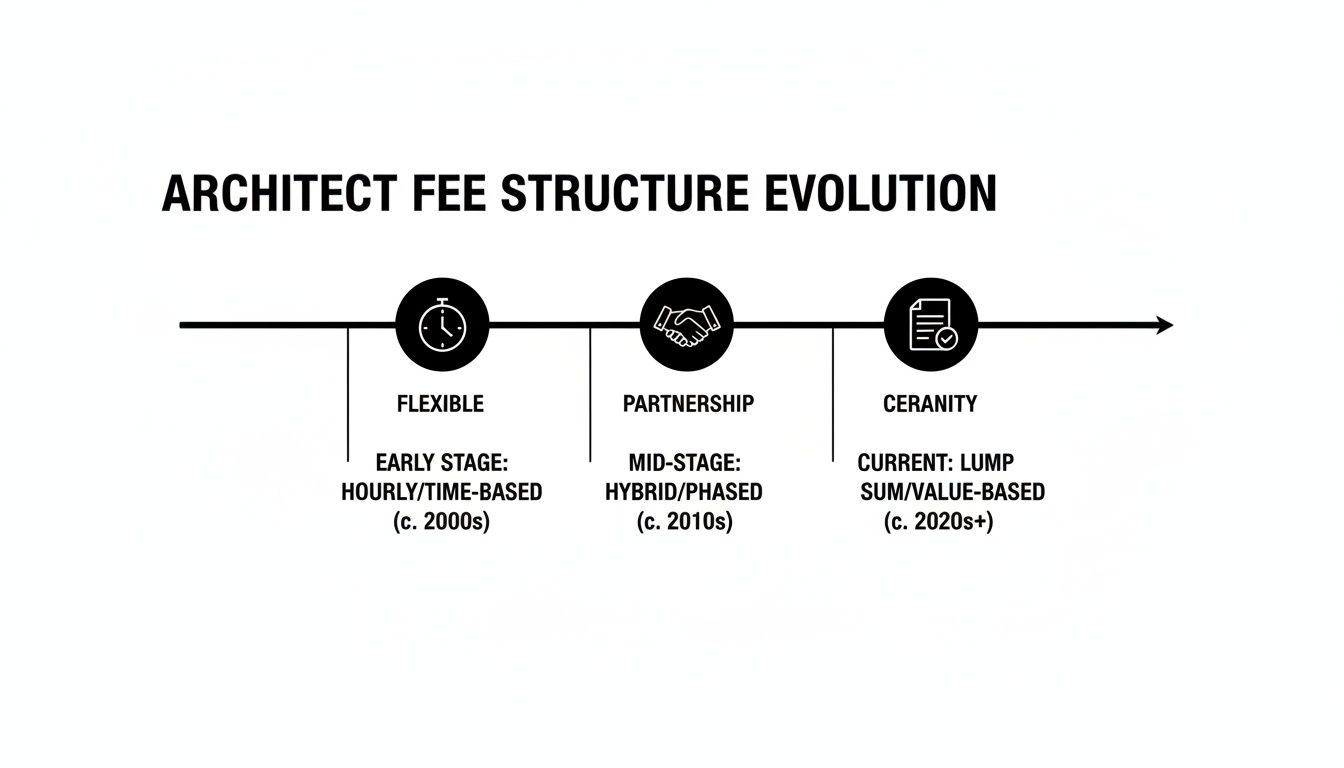
As you can see, there’s been a clear move towards fee models that prioritise certainty and partnership, aligning perfectly with frameworks like the RIBA stages that give clients total confidence in their investment.
A Typical Fee Breakdown Example
To make this crystal clear, let's walk through how a total fee might be invoiced across the key RIBA stages for a high-end residential project. This breakdown gives you a tangible sense of the deliverables you can expect at each payment milestone. You can dive deeper into the framework in our complete guide on what the RIBA Plan of Work is for UK homeowners.
The table below offers an illustrative guide to how a total UK architect fee might be allocated across the project.
Typical Fee Breakdown Across RIBA Work Stages
RIBA Stage | Key Activities | Cumulative Fee (%) |
|---|---|---|
Stages 0-1 Strategic Definition & Preparation | Initial consultation, defining the brief, feasibility studies. | 5% |
Stage 2 Concept Design | Developing initial architectural concepts, sketches, and 3D models. | 20% |
Stage 3 Developed Design | Refining the design, preparing and submitting the planning application. | 35% |
Stage 4 Technical Design | Producing detailed drawings and specifications for Building Regulations. | 70% |
Stage 5 Construction | Administering the building contract, regular site inspections, problem-solving. | 95% |
Stage 6-7 Handover and In Use | Final inspections, handover of the completed project, post-occupancy review. | 100% |
This phased payment structure ensures your architect is fully committed throughout the project’s lifecycle. It aligns our work directly with your project's most critical milestones, from securing planning permission with a compelling design to ensuring the builders execute that vision with absolute precision. This methodical approach is fundamental to delivering complex, high-quality homes on time and on budget.
What to Expect for Projects in South West London
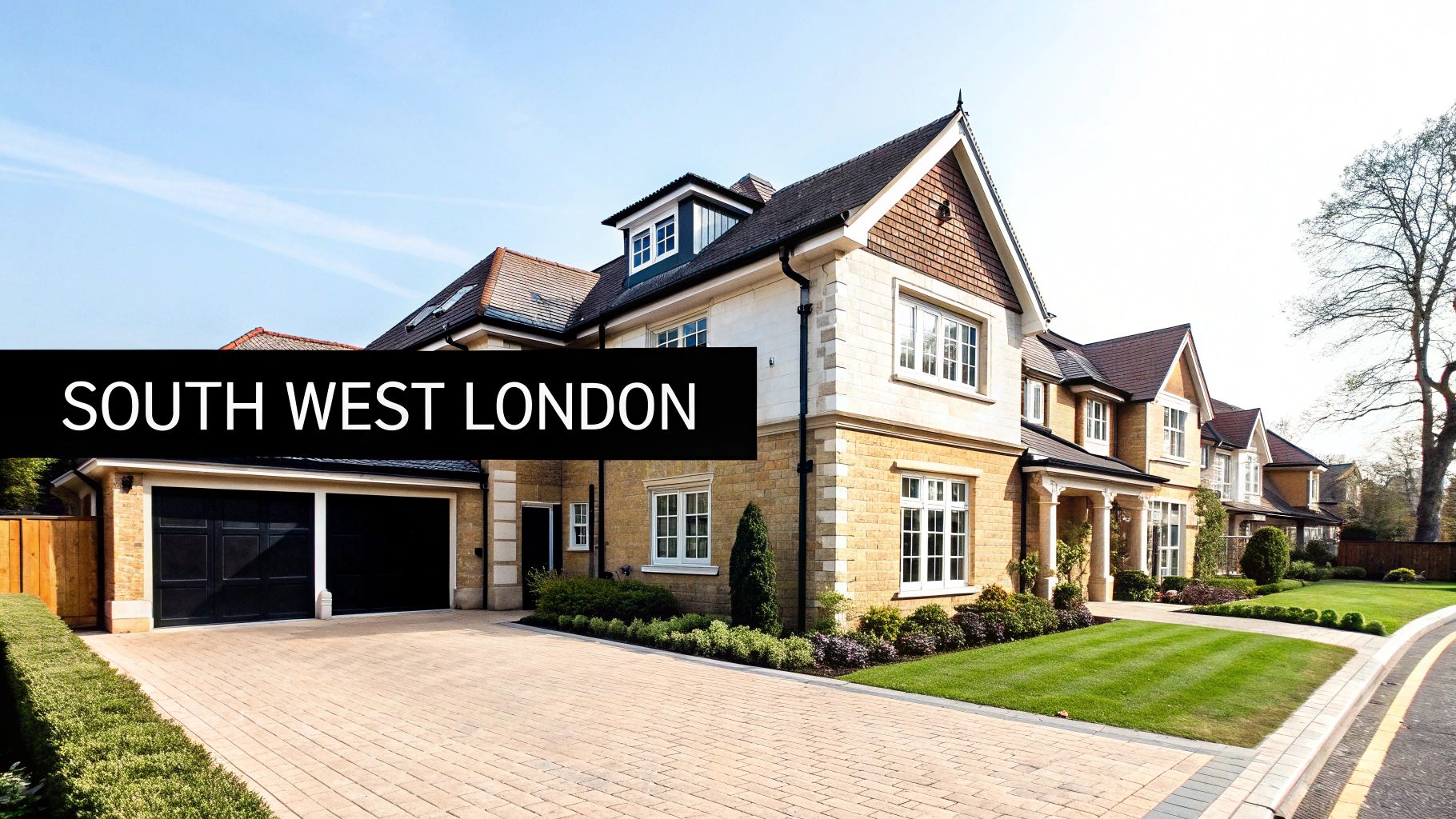
Theoretical percentages are a good starting point, but seeing them in the context of real-world projects is where things really click. In sought-after areas of South West London, the final UK architect fees are shaped by more than just the construction budget; they're driven by the project's scale, its complexity, and local planning sensitivities.
Factors like working within a conservation area or the desire for highly bespoke interior features will naturally demand a more intensive level of architectural service. To make this tangible, let's walk through a few realistic scenarios for high-end residential projects in this part of London. These examples should give you a practical feel for how construction costs and fee percentages interact.
Luxury New Build House in Wimbledon
Let's imagine you're commissioning a bespoke, five-bedroom detached family home in Wimbledon. The vision is for a property that champions both sustainability and luxury living, complete with extensive landscaping, a high-specification kitchen, and custom joinery throughout.
Estimated Construction Budget: £1,500,000
Typical Architect Fee Percentage: 8% - 10%
Estimated Architect Fee: £120,000 - £150,000 + VAT
A fee at this level gets you a comprehensive, end-to-end service. It covers everything from creating a unique design that truly maximises the plot's potential and navigating the planning process with Merton Council, right through to producing exhaustive technical drawings and overseeing the construction contract to ensure every last detail is executed perfectly.
Large-Scale Period Property Refurbishment in Richmond
Now, consider the full-scale renovation of a grand Grade II listed Victorian property in Richmond. The brief is complex: a sensitive restoration of period features, a modern glass box extension, a complete internal reconfiguration, and the seamless integration of modern building services.
Estimated Construction Budget: £1,000,000
Typical Architect Fee Percentage: 12% - 15%
Estimated Architect Fee: £120,000 - £150,000 + VAT
Why the higher percentage? It directly reflects the immense complexity and specialist knowledge needed for heritage projects. This fee accounts for detailed conservation surveys, heritage statements, careful negotiations with Historic England and Richmond Council's conservation officers, and the expertise required to blend old and new harmoniously. You can find more detail in our article covering house extension cost examples in South West London.
In high-value areas, an architect's role extends far beyond drawings. It involves sophisticated stakeholder management, navigating challenging local planning authorities, and acting as the guardian of your investment to ensure the final home is exceptional in every regard.
Complex Basement Extension in Cobham
Finally, let’s look at a complex basement extension beneath a semi-detached home in a desirable part of Cobham. The goal is a state-of-the-art leisure suite with a home cinema, gym, and wine cellar, a project demanding significant structural engineering and waterproofing expertise.
Estimated Construction Budget: £750,000
Typical Architect Fee Percentage: 11% - 14%
Estimated Architect Fee: £82,500 - £105,000 + VAT
This kind of project is all about intensive technical design and coordination. The fee reflects the architect’s vital role in managing a whole team of consultants (like structural engineers and party wall surveyors), producing incredibly detailed construction drawings to mitigate risk, and administering the specialist contracts essential for subterranean work. Their input ensures the space isn't just functional and compliant, but a beautifully integrated and valuable addition to your home.
As you can see, while the percentage might fall on larger projects, the real drivers of the fee are the complexity and the level of service required. Investing in that expertise is fundamental to achieving a truly remarkable home in a prime location.
Understanding Fees for Listed and Heritage Buildings
Working on a listed building or a property in a conservation area is a world away from a standard architectural project. It’s a specialist craft, one that requires a deep respect for the nation's architectural heritage, and that level of expertise is naturally reflected in the fees. The higher costs aren't arbitrary; they’re a direct measure of the added complexity, risk, and meticulous care these unique buildings demand.
These projects call for a unique blend of historical knowledge, conservation skill, and delicate negotiation. Your architect essentially becomes part historian, part materials scientist, and part legal expert, all while delivering a design that honours the past yet works beautifully for modern life. It’s a responsibility that carries significant weight.
Why Are Heritage Project Fees Higher?
The simple answer is that heritage projects come with a set of non-negotiable requirements that just don't exist in standard residential builds. Every single stage involves more research, more detailed documentation, and far more intensive management to ensure the historic fabric of the building is not just preserved, but enhanced.
This complexity means that working on listed buildings in the UK commands premium architect fees, often between 14-17% of the total construction costs. It's a clear reflection of the specialist skills needed for conservation work—precisely the niche we occupy at Harper Latter Architects in Wimbledon Village.
For a £200,000 restoration of a historic South West London property, fees could sit around 15% (£30,000). On a larger £500,000 project, this might look more like 14% (£70,000). The reason? We're navigating complex listed building consents, sourcing traditional materials, and coordinating with statutory bodies like Historic England. As this detailed 2018 report on UK architect fees shows, this uplift underscores just how resource-intensive heritage work truly is.
The Value a Conservation Architect Delivers
Bringing a specialist conservation architect on board is a critical investment in your property's future. Their expertise is essential for navigating a complex regulatory landscape and delivering a result that is beautiful, compliant, and timeless. You can find out more by reading our guide to listed building architects.
Here are just a few of the key areas where their expertise adds immense value:
Specialist Surveys and Analysis: They commission detailed historic building reports, material analyses, and structural surveys to fully understand the building's story and its current condition.
Heritage Negotiations: They lead the delicate discussions with local authority conservation officers and national bodies like Historic England or The Victorian Society to agree on appropriate, sensitive interventions.
Traditional Materials and Craftsmanship: They know how to specify authentic materials—like lime mortar or handmade bricks—and where to find the skilled craftspeople who can execute traditional repairs properly.
Sensitive Modern Integration: They have the skill to expertly weave modern systems, like sustainable heating or high-performance glazing, into a historic fabric without compromising its soul.
A conservation architect acts as the custodian of your property's history. Their fee is an investment in ensuring its story is respected, its value is protected, and its future is secured for generations to come.
Ultimately, the higher fee for a heritage project is a direct reflection of the heightened responsibility and specialised skillset required to successfully work with these cherished buildings.
What Your Architect's Fee Typically Includes and Excludes
To build a strong, transparent partnership, it’s vital to understand exactly what your architect's fee covers and, just as importantly, what it doesn’t. Think of the fee as your investment in our core expertise—the creative vision and technical skill needed to design your home and guide it through to completion.
Knowing what falls outside this fee from day one is the key to building a realistic project budget. A clear agreement prevents misunderstandings down the line and ensures the whole process is smooth and collaborative. Ultimately, the fee pays for our time, our professional skill, and the running of our practice, from those first initial sketches right through to the detailed oversight that ensures your vision is realised to the highest standard.
Core Services Included in the Fee
When you engage an architect, you're commissioning a comprehensive package of professional services. While we can always tailor the exact scope to your project, the fee typically covers all the essential architectural work needed to bring your home to life.
The main services included are:
Developing the Design: This is the creative heart of the project. We take your brief, your ideas, and your aspirations, and translate them into architectural concepts, floor plans, elevations, and 3D models so you can truly see the vision.
Producing Planning Drawings: Your architect will create and compile all the necessary drawings, reports, and documentation required for a formal planning application to your local council.
Creating Technical Drawings: This is a highly detailed phase where construction-ready drawings, specifications, and schedules are produced. These are the crucial documents needed for Building Regulations approval and for contractors to price and build from accurately.
Contract Administration: During the construction phase, your architect acts as your expert representative on site. We inspect the work, handle queries from the builder, certify payments, and ensure the project is being built according to the design and quality standards agreed in the contract.
These services are the intellectual and professional labour that transforms a simple idea into a buildable, beautiful reality.
Common Costs Excluded from the Fee
Just as important is understanding what sits outside our professional fee. These are genuine project expenses that we will manage and coordinate on your behalf, but they are paid for separately by you, the client. These are often referred to as disbursements or third-party costs.
Your project budget should always have two distinct parts: the architect’s professional fee and a separate allowance for all third-party costs and consultant fees. Getting to grips with both is the foundation of good financial planning for any build.
Budgeting for these items separately ensures total clarity and stops unexpected expenses from derailing your project.
Common exclusions you should plan for include:
Statutory Application Fees: These are the mandatory charges your local council levies for submitting Planning and Building Control applications. They are fixed costs that go directly to the authority.
Consultant Fees: Most high-end projects require a team of specialists. Your architect will lead this team, but the fees for professionals like structural engineers, quantity surveyors, party wall surveyors, and heritage consultants are separate costs.
Surveys and Reports: Before any design work can begin, you will almost certainly need a measured topographical survey of your property or site. Other specialist reports, such as arboricultural (tree) surveys or flood risk assessments, might also be required by the planners.
By outlining these inclusions and exclusions clearly from the very beginning, we make sure you have a complete picture of your investment. It’s how we build a relationship based on trust and total transparency.
Common Questions About UK Architect Fees
Navigating the financial side of any high-end residential project is bound to bring up questions. To give you complete clarity, we’ve put together answers to some of the most common queries we hear about UK architect fees. The goal is simple: to make sure you can move forward with confidence, fully understanding your investment.
We believe in total transparency, so this section is designed to clear up any lingering confusion and demystify the process of bringing an architect on board for your home.
Are Architects' Fees Subject to VAT in the UK?
Yes, they are. Architects provide a professional service, which means their fees are subject to the standard rate of VAT. It’s absolutely essential to factor this into your overall project budget from the very beginning.
While some of the construction work on your home might be zero-rated or qualify for a reduced VAT rate (this sometimes applies to certain new builds or work on listed buildings), the architect's professional fees will almost always have VAT added on top. Our fee proposals always state clearly whether VAT is included or excluded, so there are no surprises.
Can I Negotiate Architect Fees?
While there can be some discussion, it’s far more productive to think in terms of negotiating the scope of services rather than the fee itself. An architect's fee is a direct reflection of the time, specialist expertise, and resources we dedicate to making your project a success.
Simply asking to reduce the fee often means reducing the level of service, which can introduce risks and lead to much costlier mistakes down the line. A better approach is to have an open, honest conversation about your budget. We can then work with you to tailor a service package that delivers the best possible value for your specific investment.
Why Do Fees Vary So Much Between Different Architects?
Architect fees can differ quite a bit, and it usually comes down to a practice's experience, reputation, location, and the depth of service they offer. An established, RIBA-chartered practice specialising in luxury homes in South West London, for example, will naturally command a higher fee than a smaller, less specialised firm. This isn't just about paying for a name; it reflects a deep well of expertise in things like complex planning negotiations, heritage conservation, and bespoke high-end design.
When you're comparing quotes, it's crucial to look beyond the headline percentage. You need to assess the value, security, and proven track record each architect brings to your project.
Does the Fee Include Costs Like Planning Applications?
Typically, an architect's fee doesn't include third-party costs, which are often called disbursements. These are costs paid to other organisations and are passed on to you separately.
Common examples include:
Local authority fees for planning and building control applications.
The fees for other essential consultants like structural engineers, party wall surveyors, or quantity surveyors.
Costs for necessary surveys, such as topographical or arboricultural reports.
While we manage and coordinate all of these experts on your behalf, their invoices are a separate cost to account for in your total project budget. We always make a point of providing a clear schedule of these anticipated third-party costs right from the outset.
Ready to discuss your vision for a bespoke home in South West London? At Harper Latter Architects, we combine creativity with a transparent, client-focused process to deliver exceptional results. Contact us today for an initial consultation.

Comments