
A Guide to Listed Building Architects

When you own a piece of history, any changes you make require a very special touch. This is where a listed building architect comes in. They're specialist professionals who know exactly how to design and manage projects for properties protected for their unique architectural or historic character.
Their work is a careful balancing act, blending creative design with a deep, practical understanding of conservation law and traditional building techniques. It’s all about making sure any changes honour the building's irreplaceable heritage.
What Defines a Listed Building Architect
Think of a listed building architect as part-designer, part-historian, and part-diplomat. They are the specialists who can read the unique language spoken by heritage properties, understanding the stories held within their walls.
While any good architect designs for the future, a listed building architect has the added challenge of balancing that future with a profound respect for the past. Their skillset is fundamentally different, built on niche expertise that’s essential for navigating the complex world of conservation law, historic materials, and time-honoured building methods.
A Specialist Approach to Heritage
Imagine your home is a priceless, delicate antique. You wouldn't let just anyone try to restore it, would you? You'd seek out a specialist who understands its specific materials, construction, and history. A listed building architect is that specialist for your property.
They work to ensure any intervention—whether a repair, an alteration, or an extension—actually enhances the building’s health and character, rather than causing accidental harm.
Their role is multi-faceted and goes far beyond just drawing up plans:
Historical Analysis: They delve into the building's past, researching its story to inform designs that feel authentic and sympathetic.
Regulatory Navigation: They are your expert guide through the notoriously tricky Listed Building Consent process.
Material Expertise: They know which traditional materials are right for the job, specifying appropriate techniques for repairs and alterations.
Stakeholder Liaison: They act as the vital bridge between you, the local conservation officers, and the specialist craftspeople needed to do the work.
With around 379,845 listed buildings across the UK, each protected for its special architectural or historic interest, the need for architects with dedicated conservation and heritage skills is clear. It’s a huge part of our national story.
Ultimately, their goal is to protect our architectural heritage while making these incredible historic spaces practical, comfortable, and beautiful for 21st-century life. It's about giving our most treasured buildings a sustainable and vibrant future.
The Architect's Role in a Heritage Project
Thinking of a listed building architect as just a designer is missing the bigger picture. They're really the project's dedicated steward, part-historian, and your chief negotiator all rolled into one. Their role goes far beyond drawing up plans; it's about sensitively managing the entire journey to make sure every single decision respects the building's unique story.
It all starts with a deep dive into the property's past. They'll carry out meticulous heritage impact assessments to get a feel for how any changes might affect the building's special character. This isn’t just a box-ticking exercise; it often means hours spent in archives, poring over dusty old maps and records to piece together the history. These discoveries then feed directly into a design that feels right.
The Central Point of Communication
One of their most critical jobs is to act as the central hub for everyone involved. Your listed building architect is the essential link between you, the local authority’s Conservation Officer, and the highly skilled craftspeople—the stonemasons, thatchers, or lime plasterers—that these projects demand. They orchestrate the entire team, ensuring everyone is pulling in the same direction with conservation at the forefront.
A listed building architect doesn't just design for the present; they curate a conversation between the past and the future. Their primary function is to translate a client's modern aspirations into a language that a centuries-old building can understand and accept.
This specialist is also the one who prepares the incredibly detailed applications for Listed Building Consent – a legal step you absolutely cannot skip. This involves much more than just drawings. It requires a compelling written argument for the proposed work, one that shows a profound understanding of conservation principles and planning policies. They’ll specify the right materials (often bespoke) and oversee repairs to make sure every touch is sympathetic to the building's soul.
Within the UK's architecture sector, there are roughly 52,100 architects employed, but those with specialist heritage skills are always in demand. As we place more importance on preserving and adaptively reusing our historic buildings, the role of the listed building architect has never been more vital. You can dig into more data on the architectural profession by reading the full statistics on Statista.com.
Navigating the Maze of Listed Building Consent
When you own a listed building, any changes you want to make require more than just standard planning permission. You’ll need a special approval known as Listed Building Consent (LBC). This is a non-negotiable legal step for any work that could possibly affect the building’s character, both inside and out.
Trying to bypass this process isn't just a bad idea—it's a criminal offence. The consequences can be severe, including unlimited fines and a legal order to reverse every single change you made, all at your own expense.
This is precisely where a listed building architect becomes your greatest asset. They do far more than just fill in forms; their job is to build a compelling, watertight case for your proposed alterations. This involves preparing meticulously detailed architectural drawings and a persuasive design and access statement, all aimed at justifying why your plans are appropriate and respectful to the building's unique heritage.
The Crucial Role of the Conservation Officer
Every local council has a Conservation Officer, a specialist whose entire job is to protect the area's architectural heritage. They are the gatekeeper and key decision-maker your architect will need to convince.
Building a positive, collaborative relationship with the Conservation Officer from the very beginning is fundamental to a successful application. An experienced architect knows exactly how to frame your proposals, anticipating the officer's concerns and addressing them proactively before they even become sticking points.
The infographic below gives you a clear idea of the core stages your architect will manage during the consent process.
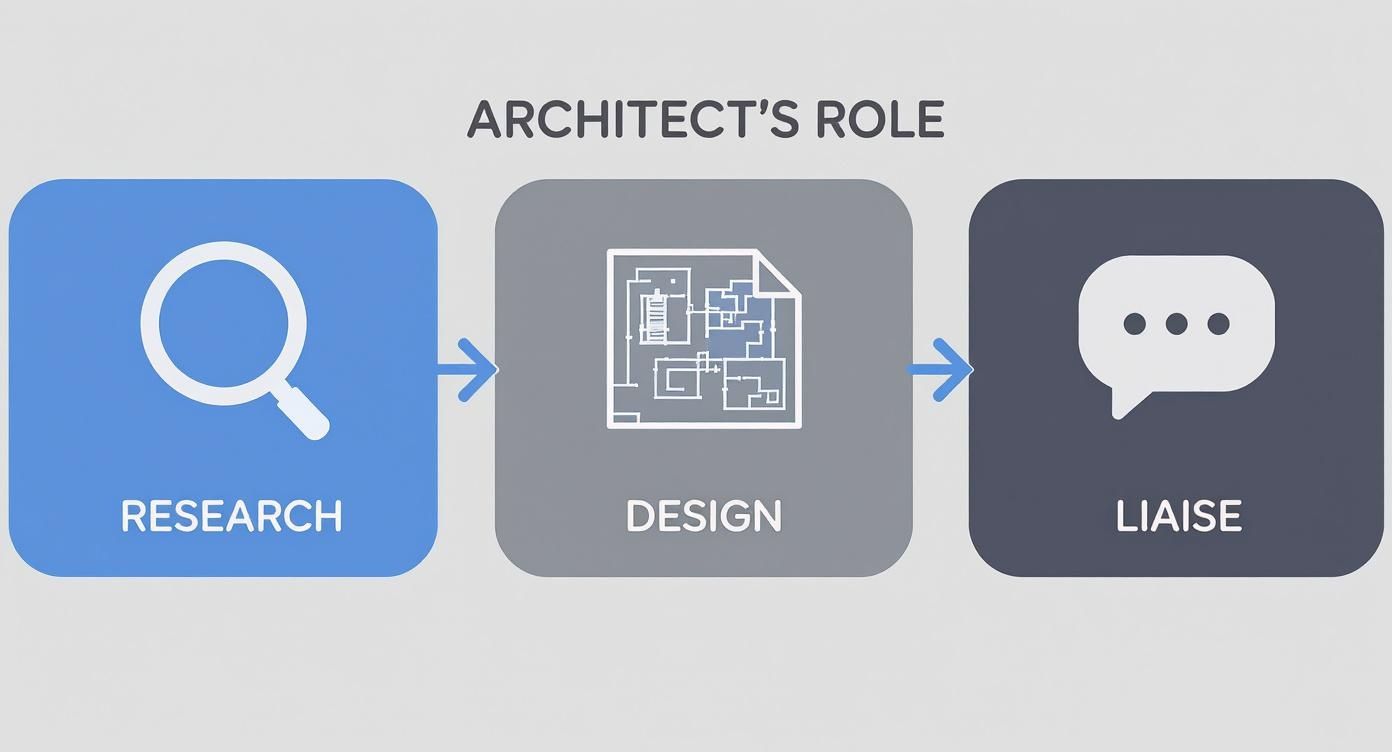
As you can see, the process isn't linear. It’s an interconnected cycle of research, design, and liaison, where each step informs the next to build a robust application that stands the best chance of success.
A strong application always shows a deep understanding of what makes the property significant. It’s not about preventing change, but about guiding it in an informed and sensitive way. For a much deeper dive into the nuts and bolts, take a look at our comprehensive UK listed building planning permission guide, which breaks the entire journey down.
The goal of Listed Building Consent isn't to prevent change, but to manage it thoughtfully. A skilled architect transforms this regulatory hurdle from a potential barrier into a structured pathway for enhancing a historic home.
Ultimately, your architect acts as both your translator and your advocate. They take a complex legal maze and turn it into a manageable, step-by-step journey. Their expertise not only gets your project approved but ensures the final result is a home that beautifully balances historic integrity with modern living.
Bringing a Listed Building Back to Life
To get a real feel for how these heritage projects unfold, let's walk through a common scenario. Picture this: a client has just bought a gorgeous but rundown Grade II listed mill. Their dream is to transform it into a modern family home, but they're unsure where to even begin. This is exactly where a listed building architect steps into the picture.
The process doesn't start with grand designs or blueprints. It starts with listening. The architect first sits down with the client to fully grasp their vision. Only then do they turn their attention to the building itself, peeling back the layers of time to understand its secrets, check its structural health, and pinpoint the historical features that absolutely must be preserved.
From Concept to Consent
With a deep understanding of both the client's hopes and the building's history, the architect can start sketching out a design concept. The real art here is weaving modern living requirements into the historic fabric of the mill. It’s a delicate balancing act, making sure new additions feel like a respectful continuation of the building's story, not a jarring interruption.
Next up is one of the most critical stages: informal chats with the local planning authority. The architect will present the initial ideas to the Conservation Officer, opening up a dialogue to test the waters and flag any potential issues early on. This kind of collaborative approach makes the formal application process far smoother down the line.
Once the concept is agreed upon, the architect pulls together the detailed application for Listed Building Consent. After getting the green light, they'll help the client find specialist builders—craftspeople who know their way around traditional materials and techniques.
The architect’s job on-site isn’t just to check progress; it's to be the building's guardian. They ensure every single detail, from the exact mix of the lime mortar to the careful repair of an original timber beam, is handled with the precision and respect the building demands.
This hands-on management is what turns the initial vision into a beautiful, compliant, and tangible reality. We dive much deeper into this journey in our listed building renovation practical guide, which is packed with more insights.
Leading UK architectural firms are constantly pushing the boundaries of how historic buildings can be thoughtfully modernised, improving not just how they function but also their energy efficiency—a vital piece of the puzzle in meeting the UK's carbon reduction targets. You can see more about the top architectural firms on The Landsite. Thinking about it as a story helps turn what can seem like a complex process into a clear path of transformation.
How to Choose the Right Architect for Your Project
Picking the right professional is easily the most important decision you'll make when dealing with a heritage property. Finding a listed building architect who is not only qualified but also the right creative partner for you requires a bit of homework and a clear plan.

The first step is always to check their credentials. You're looking for architects who are on specialist conservation registers – this is a clear sign that they have a proven level of expertise and are truly committed to heritage work.
Key Accreditations to Look For
Professional accreditations are your best shortcut to identifying a genuine specialist. When you start shortlisting potential architects, keep an eye out for memberships with these key organisations.
When you're looking for an architect to work on a listed building, certain accreditations act as a gold standard, signalling deep expertise in conservation. Here’s a quick rundown of the main ones to look for in the UK.
Comparing Key Conservation Accreditations
Accreditation Body | What It Signifies | Level of Expertise |
|---|---|---|
Architects Accredited in Building Conservation (AABC) | A highly respected register for architects with established, peer-reviewed expertise in historic building conservation. | Advanced/Specialist: Considered one of the top-tier accreditations for hands-on conservation work. |
RIBA Conservation Register | The RIBA offers multiple tiers, from Conservation Registrant up to the highest level, Specialist Conservation Architect (SCA). | Varies: Ranges from a general awareness (Registrant) to profound knowledge and skill (SCA). |
Seeing these on an architect's profile gives you immediate confidence that they understand the unique demands of working with historic buildings.
Once you’ve confirmed they have the right qualifications, it's time to dig into their portfolio. Look for projects that feel similar to yours in terms of scale, style, and age. An architect who has a strong track record with properties like yours, and crucially, with your local planning authority, is worth their weight in gold.
Choosing a listed building architect is like casting the lead role in a play. You need someone with not only the technical skill but also the right interpretation of the script—your vision for your home.
When you start meeting potential architects, go in prepared with good questions. Ask them about their philosophy on balancing modern comforts with historic character, and how they’ve tackled tricky challenges on past projects. It’s also vital to talk about fees upfront, making sure you're clear on what's included at every stage.
Ultimately, trust your gut. The best working relationships are built on a foundation of easy communication and shared passion for the project. Choose the architect you feel most confident in – someone who will be a true champion for your home’s unique story.
Common Questions About Listed Building Projects
Taking on a project involving a heritage property throws up a lot of questions. It's only natural. To give you a bit more clarity, we’ve put together answers to some of the most common queries we hear from clients thinking about working with a listed building architect.
Think of this as a quick reference guide to help clear up any initial doubts as you start to explore what’s possible.
Can I Make Modern Changes to My Listed Building?
Yes, you absolutely can. But there’s a catch: any changes have to be brilliantly designed and have a rock-solid justification behind them. This is where a skilled listed building architect really shines – creating contemporary additions or alterations that actually complement the building’s historic character, rather than fighting against it.
The trick is to prove to the planning authority that the changes you want are necessary, can be reversed if needed, and won’t harm the building's special architectural or historic interest. In fact, planners often prefer a high-quality, honest contemporary design over a clumsy attempt to mimic the past.
How Much Does a Listed Building Architect Cost?
You should expect the fees for a specialist architect to be higher than for a standard project. This isn't just a premium; it reflects the huge amount of extra time that goes into historical research, incredibly detailed surveys, and the lengthy back-and-forth with planning authorities and conservation officers.
Fees are usually structured in one of three ways:
A percentage of the total construction cost, typically landing somewhere between 10% and 20%.
A fixed, agreed-upon sum for the whole project or for specific stages.
An hourly rate based on the time they spend on your project.
Always ask for a detailed fee proposal. It should clearly break down what’s included at each stage of the project, so there are no surprises down the line.
The most successful heritage projects are born from collaboration. Your architect's role is not just to design, but to listen, interpret, and advocate for both your vision and the building's unique story.
How Long Does Getting Listed Building Consent Take?
Officially, the statutory determination period for a Listed Building Consent application is 8 weeks once the local authority has validated it. But that's only a small part of the timeline.
The real work happens in the pre-application phase. This involves deep research, developing the design, and – crucially – consulting with the Conservation Officer. This stage alone can easily take several months to get right. For more complex or sensitive projects, especially if national bodies like Historic England need to be involved, you can expect it to take even longer. Your architect will be able to give you a realistic timeline based on the specifics of your building and your plans.
Ready to discuss your heritage property? The specialists at Harper Latter Architects can guide you through every stage, from initial concept to successful completion. Explore our conservation and heritage services to see how we can bring your vision to life.
Comments