
Explore passive house design uk: The UK Guide to Efficient Homes

Passive house design is a seriously smart building standard that focuses on one thing: creating homes with phenomenal energy efficiency and comfort. Forget constantly fiddling with the thermostat. A Passivhaus uses its own super-insulated and airtight structure—what we call its 'fabric'—to keep the indoor temperature stable all year round. The result? Massively lower energy bills and a much healthier place to live.
What Is a Passive House and Why Is It So Popular?
Think of your home as a high-performance thermal flask. On a freezing winter's day, it locks the warmth in, and during a summer heatwave, it keeps the blistering heat out. That simple idea is the essence of passive house design in the UK, a concept that’s really taking off everywhere from bespoke new builds in Surrey to sensitive retrofits in South West London.
But this isn't about fiendishly complex tech. At its heart, Passivhaus is all about a 'fabric first' approach. It puts all the focus on the fundamental building blocks of the house itself: its insulation, its windows, and how airtight it is. Get these elements right, and the building does all the heavy lifting, creating a stable, comfortable environment that needs very little active heating or cooling.
The Driving Forces Behind the Passivhaus Movement
The buzz around Passivhaus isn't happening by accident; it’s a direct answer to some very modern problems. Homeowners are looking for homes that offer financial peace of mind and a better quality of life. A few key factors are really pushing this forward:
Soaring Energy Costs: With energy prices all over the place, the idea of a home with next-to-no heating bills is incredibly appealing. A certified Passive House can slash heating energy demand by up to 90% compared to a standard new build, offering real long-term financial security.
A Focus on Health and Wellbeing: The design includes a mechanical ventilation system that provides a constant supply of fresh, filtered air. This system removes pollutants, allergens, and damp air, creating amazing indoor air quality—a huge plus for any family.
Unmatched Comfort Levels: By getting rid of draughts and cold spots, a Passive House maintains a consistent and comfortable temperature everywhere. This creates a wonderfully calm and cosy living space, free from the annoying temperature swings so common in older UK homes.
Growing Environmental Awareness: As more of us look for ways to cut our carbon footprint, building a super-efficient home is one of the most powerful moves you can make. You can dive deeper into the principles of building greener homes in our guide to sustainable architecture in the UK.
A Passive House isn't just an energy-efficient building; it's a commitment to quality. The standard demands meticulous design and construction, ensuring every single detail works together to create a superior, future-proof home that is built to last.
Ultimately, the rise of Passivhaus shows a real shift in what discerning homeowners are looking for. It's no longer just about how a home looks, but about how it performs, how it feels, and how it’s truly designed for the way we live today. This standard provides a solid framework for getting all three right.
The Five Core Principles of Passivhaus Design
The incredible performance of a Passivhaus isn't magic; it's the result of five interconnected design principles working in perfect harmony. It's best to think of them not as a checklist of separate features, but as a complete, unified system engineered for exceptional comfort and efficiency. Getting to grips with how they work together is the key to understanding the sheer quality of passive house design in the UK.
Each principle methodically tackles a specific way a building loses or gains heat, essentially designing out the common inefficiencies found in standard construction. Let’s break down these five foundational pillars.
Exceptional Thermal Insulation
The very first step is to wrap the entire building—walls, floor, and roof—in a continuous, high-performance layer of insulation. Think of it like a perfectly tailored thermal duvet, with no gaps or thin spots. This seamless envelope drastically reduces the amount of heat that can escape during the UK's colder months.
But it's not just about cramming in thick insulation; it's the continuity that counts. The aim is to create a complete thermal barrier that cleanly separates your comfortable indoor space from the unpredictable temperatures outside.
High-Performance Windows
Windows are traditionally the Achilles' heel of a building's thermal defence. A Passivhaus confronts this head-on by using triple-glazed windows with advanced, invisible coatings and heavily insulated frames. These aren't your standard off-the-shelf units; they are engineered to a standard where their performance is almost as good as an insulated wall.
The critical metric here is the Uw-value, which measures heat loss. To meet the demanding Passivhaus standard, this figure must typically be 0.80 W/m²K or lower. These windows don't just stop warmth from leaking out; they are also strategically placed to capture free heat from the low winter sun—a smart concept known as passive solar gain.
Airtight Construction
Picture your home as a balloon. In a typical house, there are countless tiny, invisible holes letting the air out. A Passivhaus, on the other hand, is made incredibly airtight, completely stopping uncontrolled air leakage and putting an end to those uncomfortable draughts for good.
This is achieved by using specialist membranes and tapes to meticulously seal every joint, corner, and service penetration in the building’s structure. The result? A level of airtightness that is at least ten times better than what standard UK building regulations require. This is fundamental for preventing heat loss and ensuring the ventilation system can do its job properly.
The synergy of these principles is what makes Passivhaus so effective. Superior insulation is pointless if heat can escape through draughty windows, and an airtight structure requires a smart ventilation system to maintain fresh air.
Thermal Bridge-Free Design
A thermal bridge is essentially a weak spot in the insulation—a 'cold spot' where heat finds an easy escape route. Common culprits include the junctions where walls meet floors, poorly detailed window installations, or structural steel beams that slice through the insulation layer.
In a true Passivhaus, these bridges are meticulously designed out from the very start. Every single architectural detail is scrutinised to ensure that 'thermal duvet' remains continuous and unbroken. This obsessive attention to detail is crucial for preventing heat loss and completely eliminates the risk of condensation and mould growth in corners and around windows, fostering a much healthier indoor environment.
Mechanical Ventilation with Heat Recovery
With a building this airtight, you need a controlled way to bring in fresh, clean air. This is where the Mechanical Ventilation with Heat Recovery (MVHR) system comes in. It quite literally acts as the lungs of the home.
The MVHR system works silently in the background, continuously extracting stale, moist air from kitchens and bathrooms while supplying fresh, filtered air to living areas and bedrooms. Here's the clever part: before the old air is expelled, it passes through a heat exchanger that transfers over 90% of its warmth to the incoming fresh air. This means you get a constant supply of fresh air without throwing away the heat you've already paid for, making it a cornerstone of successful passive house design in the UK.
To bring it all together, here’s a quick overview of how these five pillars work in practice.
The Five Pillars of Passivhaus Design at a Glance
Principle | Technical Focus | Key Benefit for Homeowners |
|---|---|---|
Exceptional Thermal Insulation | A continuous, super-insulated envelope around the entire building (walls, roof, floor). | Consistent, comfortable indoor temperatures all year round with minimal heating. |
High-Performance Windows | Triple-glazed units with insulated frames and low-emissivity coatings (Uw-value ≤ 0.8 W/m²K). | Eliminates cold spots near windows and captures free solar heat in winter. |
Airtight Construction | A meticulously sealed building fabric to prevent uncontrolled air leaks and draughts. | Guarantees a draught-free home and enables the ventilation system to work perfectly. |
Thermal Bridge-Free Design | Careful detailing of all architectural junctions to eliminate 'cold spots' where heat can escape. | Prevents heat loss, mould, and condensation, ensuring a healthier living space. |
Mechanical Ventilation with Heat Recovery (MVHR) | A system that provides constant fresh, filtered air while recovering heat from stale, outgoing air. | Outstanding indoor air quality without energy waste, reducing dust and allergens. |
Each principle builds on the others to create a home that is more than the sum of its parts—it's a complete system for healthy, comfortable, and incredibly low-energy living.
The Real-World Benefits of Living in a Passive House
The five core principles are the technical engine of a Passive House, but the real magic is how they transform daily life. Once you move beyond the blueprints and building science, what does it actually feel like to live in one? The benefits go far deeper than just a smaller carbon footprint; they genuinely improve your quality of life, financial security, and peace of mind.
These homes are meticulously engineered to solve the common frustrations that plague UK homeowners—draughty rooms, shocking energy bills, and intrusive outside noise. The result is a home that feels consistently comfortable, healthy, and incredibly serene.
Unmatched Thermal Comfort and Stability
Imagine a home where every single room stays at a steady, comfortable temperature all year round, without you ever needing to fiddle with a thermostat. That’s the reality of Passivhaus living. Thanks to the powerful combination of exceptional insulation and a completely airtight building envelope, cold spots and draughts are simply designed out of existence.
You’ll no longer feel that familiar chill sitting near a window on a frosty winter morning, nor will you have to endure stuffy, overheated rooms during a summer heatwave. The house itself acts as a thermal buffer, maintaining a stable and pleasant indoor climate no matter what the British weather throws at it.
Superior Indoor Air Quality
Perhaps one of the most profound—yet least visible—benefits is the outstanding quality of the air you breathe. The hero here is the Mechanical Ventilation with Heat Recovery (MVHR) system, which works silently in the background to provide a continuous, steady supply of fresh, filtered air.
This constant, gentle circulation brings several crucial advantages for your family's health and wellbeing:
Pollutant Removal: The system’s filters trap dust, pollen, and other airborne pollutants before they can enter your home. For allergy sufferers, this is a game-changer.
Moisture Control: It constantly pulls excess moisture from kitchens and bathrooms, preventing condensation and completely eliminating the risk of damp and mould.
Odour Elimination: Stale air and lingering cooking smells are quickly whisked away, keeping your home feeling fresh and clean around the clock.
Significant Long-Term Financial Savings
The financial case for passive house design in the UK is incredibly strong. It creates a home that isn't just a pleasure to live in but is also a smart, future-proofed asset. The drastic reduction in energy needed for heating and cooling translates directly into substantial savings on your utility bills, year after year.
This is where the five principles—insulation, high-performance windows, airtightness, thermal bridge-free design, and ventilation—really work together as a cohesive system.
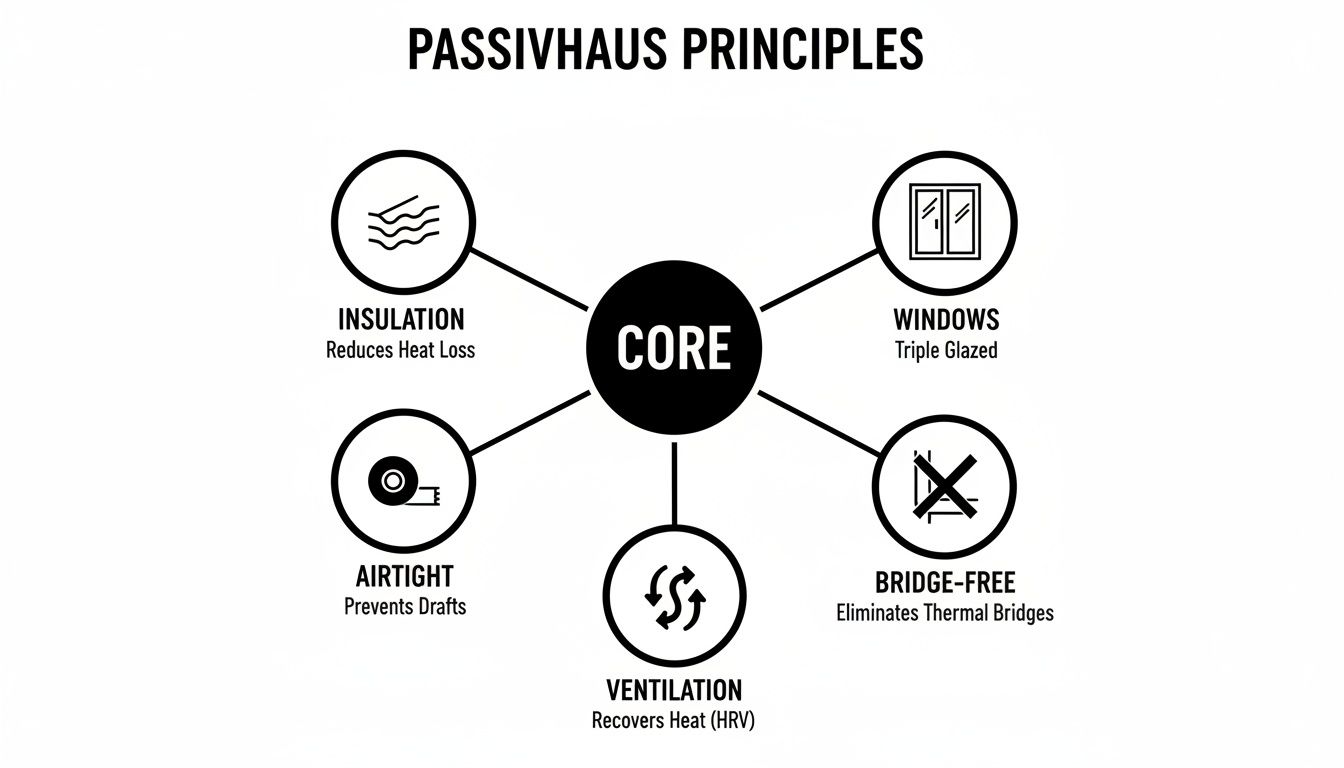
Each element plays a crucial role, creating a synergistic effect that minimises energy demand and lays the foundation for decades of savings and comfort.
A Passive House is engineered for resilience. By dramatically reducing your reliance on the national grid, you are effectively insulating your investment against future energy price shocks and ever-tightening environmental building regulations.
The leap in energy efficiency is staggering. While a typical UK home might consume around 231 kWh/m² per year for heating, a certified Passivhaus is designed to use less than 60 kWh/m². That’s a reduction of over 75%. This stark difference provides a powerful buffer against energy crises and rising costs, particularly when you consider how much UK homes contribute to national carbon emissions. You can discover more insights about UK Passivhaus retrofit standards and their impact.
A Peaceful and Quiet Sanctuary
Finally, an often-overlooked but hugely valuable benefit is the exceptional acoustic performance. The very same elements that make the house so thermally efficient—the high-performance insulation, triple-glazed windows, and airtight construction—also happen to create a brilliant sound barrier.
This dramatically cuts down on noise intrusion from the outside world. The result is a tranquil and peaceful sanctuary, a welcome escape from the hustle and bustle of city life.
Applying Passive House Standards to New Builds and Renovations
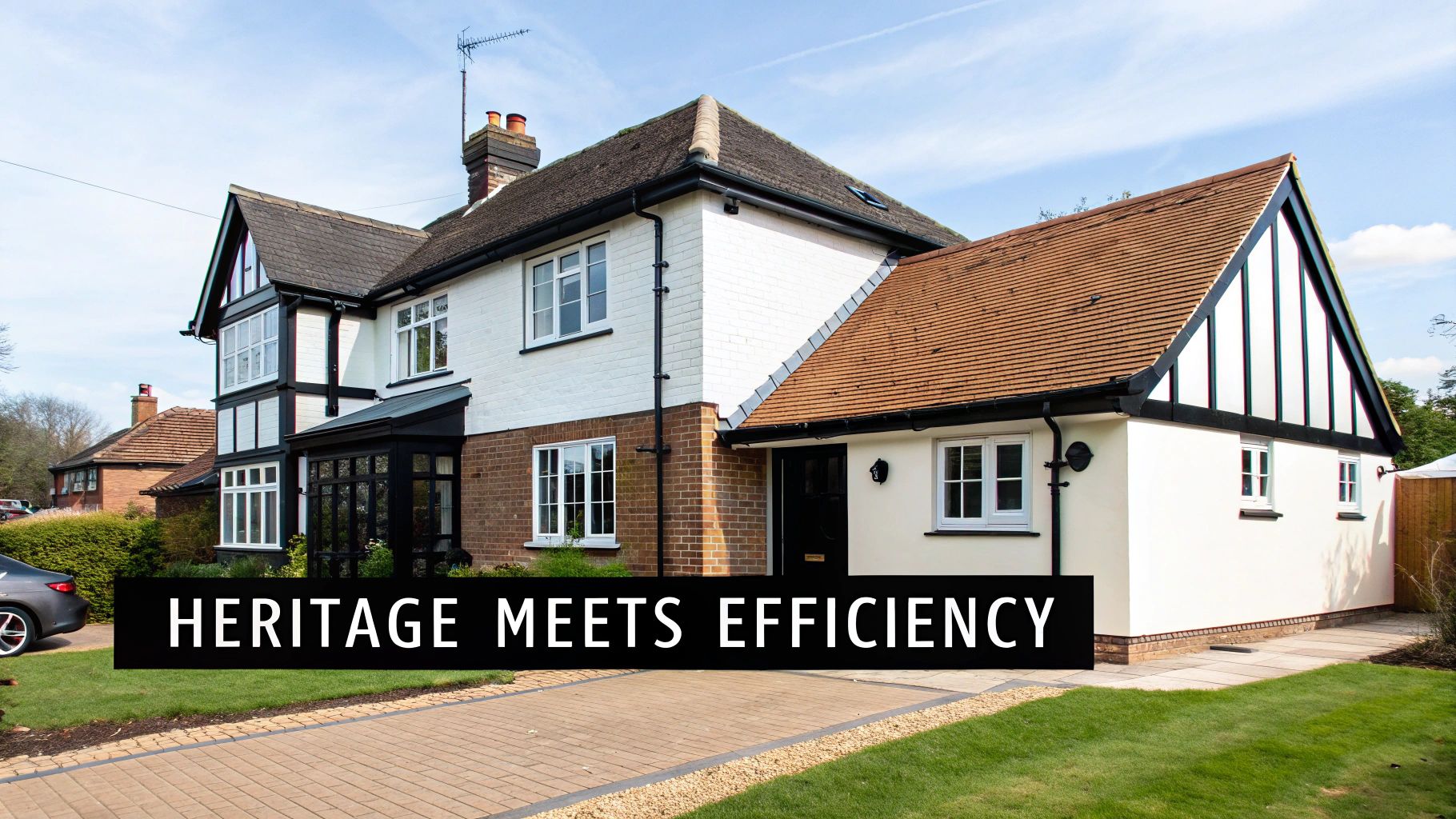
The rigorous principles of Passivhaus are incredibly versatile. They offer a clear pathway to exceptional performance for both brand-new architectural creations and the sensitive refurbishment of existing properties, including cherished period homes across the UK.
But the approach isn't one-size-fits-all. The Passivhaus Institute recognises the very different challenges of working with a blank canvas versus an existing structure. This has led to two distinct certification routes, each tailored to a specific project type.
Understanding the difference is crucial for any homeowner considering passive house design in the UK, as it sets the most appropriate and achievable performance target for your home.
The Passivhaus Standard for New Builds
For new-build homes, the classic Passivhaus standard is the goal. This is the most stringent certification, demanding that all five core principles are baked in from the very first sketch. It assumes your architect has total freedom to optimise the building’s shape, orientation, and construction details to hit those exacting energy targets.
Achieving this standard involves a meticulous design process. Every single junction and component is modelled to hunt down and eliminate thermal bridges and guarantee airtightness. It really is the gold standard for new construction, delivering the lowest possible energy bills and the highest levels of comfort.
EnerPHit: The Standard for Renovations
When it comes to upgrading existing buildings, especially older or heritage properties, hitting the full Passivhaus standard can be impractical or even impossible without compromising the building's character. This is where the EnerPHit standard comes into its own.
EnerPHit is the official Passivhaus certification for retrofits and renovations. It provides a more pragmatic and flexible framework, acknowledging that things like existing foundations, party walls, or protected facades present real-world constraints. While it still demands a huge leap in energy performance, its targets are adapted to be achievable within these limitations.
EnerPHit offers a robust, quality-assured route to transforming an existing property into a high-performance home. It allows architects to balance the preservation of period character with the integration of modern comfort and exceptional energy efficiency.
This makes EnerPHit the perfect vehicle for luxury refurbishments in areas like South West London, where so many projects involve working within conservation areas or on listed buildings. An experienced architect can use this framework to sensitively weave high-performance insulation, windows, and ventilation into the historic fabric of a home.
The focus is on making substantial, intelligent upgrades that respect the building’s heritage while delivering a space that is warm, healthy, and fit for the future. You can explore how these principles are put into practice in our comprehensive UK energy-efficient home design guide. This approach ensures that even a centuries-old property can offer a level of comfort and efficiency that rivals a brand-new build.
Navigating the Planning and Cost of a UK Passive House Project
Embarking on a bespoke home project always brings the practical questions of budget and planning approvals to the front of your mind. When considering a Passive House design in the UK, getting to grips with the financial and regulatory landscape right from the start is the key to a smooth and successful journey.
It’s true that building to the Passivhaus standard often involves a higher initial investment. But it’s a mistake to see this as just an added expense. Think of it instead as a long-term, high-return investment in quality, comfort, and a truly future-proof home.
The upfront costs are driven by the need for superior components—think triple-glazed windows and specialist ventilation systems—and the meticulous, skilled craftsmanship required to achieve exceptional airtightness. This investment, however, pays for itself for decades to come.
Understanding the Cost Uplift and Long-Term Value
Typically, the initial cost uplift for a Passive House project can range from 5% to 15% compared to a standard new build that just scrapes by current UK building regulations. This figure can shift depending on the complexity of your design, the materials you choose, and the experience of your construction team.
However, this initial premium is quickly balanced out by drastically reduced running costs. With heating bills almost entirely eliminated, the payback period is often far shorter than people assume. Over the lifetime of the home, the total cost of ownership is significantly lower than that of a conventional property.
The most effective way to manage the budget for a Passive House project is to integrate the principles from the earliest concept stage. Trying to "add on" Passivhaus features later in the design process is inefficient and almost always leads to higher costs and compromised performance.
The Planning Landscape for High-Performance Homes
Navigating the planning process is a critical step for any major residential project. The good news for aspiring Passivhaus owners is that local authorities across the UK, especially in forward-thinking boroughs, are increasingly supportive of high-performance, sustainable buildings.
Councils are under growing pressure to meet climate targets, and a well-designed Passivhaus project aligns perfectly with these green objectives. A proposal demonstrating a commitment to exceptional energy efficiency can often be a positive, persuasive factor in gaining planning permission.
Progress towards widespread adoption of Passive House design in the UK has been steady, with just over 2,700 fully certified buildings constructed since 2012. This consistent growth points to a strong and growing market for families seeking bespoke, energy-efficient homes. London is a key driver, with 34% of its boroughs having delivered Passivhaus projects, far exceeding the national council average of 14%. You can learn more about the UK's progress towards Passivhaus standards and what it means for future builds.
What’s more, a Passive House is inherently designed to meet and exceed current and future building regulations. This commitment to quality and performance provides long-term certainty, ensuring your home remains compliant and valuable for years to come. For more detailed information, check out our guide to building regulations compliance.
Is a Passive House Right for Your Bespoke Home?
The Passivhaus standard isn't about restricting style—it's a benchmark for quality. It’s a performance-based approach that works with almost any architectural vision, from an ultra-modern new build with vast walls of glass to a sensitively restored period property in a conservation area.
Ultimately, it shifts the conversation from just aesthetics to creating a genuinely superior living environment. For clients who want a truly bespoke, high-quality, and future-ready home, it offers a proven framework for achieving excellence in every last detail.
Performance, Not Prescription
One of the most stubborn myths about Passivhaus is that it dictates a certain 'look'. This couldn't be further from the truth. The standard doesn't tell your architect what the home should look like; it sets clear, measurable targets for energy use, comfort, and airtightness. This gives your design team complete creative freedom.
So, whether you're dreaming of a minimalist masterpiece or a traditional family home, the principles can be woven in to ensure the building performs exceptionally well. The focus is purely on the physics of the building, not a prescribed architectural style.
A common misconception is that you can't open the windows in a Passive House. You absolutely can, whenever you wish. The ventilation system simply ensures you don't have to for fresh air, making your home a healthier, more comfortable space all year round.
Aligning with Long-Term Goals
Choosing a passive house design in the UK is an investment in long-term value. It’s a commitment to a home that delivers on comfort, health, and financial stability, day in and day out. By designing out energy waste from the very beginning, you’re creating an asset that is shielded from volatile energy prices and future environmental regulations.
Real-world statistics show that Passive Houses can cut heating demand by up to 90% compared to standard new builds, all while fostering superior indoor air quality and comfort. While some reports flag initial costs and education as barriers, they consistently highlight the key benefits: durable structures with no damp spots, guaranteed by a rigorous design process. You can read more about Passivhaus achievability in the UK and the advantages it brings.
This standard provides a guarantee of quality that conventional construction simply cannot match. The meticulous attention to detail required during both design and construction results in a better-built home, engineered to last for generations. It protects your investment while delivering a peerless living experience—the ultimate expression of a home designed not just for today, but for decades to come.
Frequently Asked Questions About Passive House Design
It’s completely normal to have questions when you’re exploring something as different as a Passivhaus. To help you get a clearer picture of what it means in practice, we’ve put together answers to a few of the most common queries we hear from homeowners in the UK.
Think of this as a quick guide to the practical side of things, from design freedom to the official certification process.
Can I Still Have Large Windows and Open-Plan Living?
Absolutely. This is probably the biggest myth we have to bust. Passivhaus is all about performance, not prescribing a particular look. It's perfectly possible to design a stunning home with huge expanses of glass and the airy, open-plan layouts that are so sought-after in high-end properties.
The secret is simply smarter design from day one. It means using exceptional triple-glazing and orienting the building to welcome in the winter sun while using clever shading to keep things cool in summer. This way, you get the aesthetic you want without sacrificing an ounce of comfort or efficiency.
Do I Have to Keep My Windows Shut All the Time?
Not at all – another common misconception. You can open the windows in a Passivhaus whenever you fancy, just like in any other house.
The difference is, you don’t need to. The Mechanical Ventilation with Heat Recovery (MVHR) system is constantly working in the background, supplying fresh, filtered air around the clock. But if it’s a beautiful spring day and you want to let the breeze in, go right ahead. The airtight design just means that when you do close them, your home is completely sealed from draughts.
Is the Passivhaus Standard Suitable for a Heritage Property?
Yes, though the approach is tailored for existing buildings. For retrofits, we use the ‘EnerPHit’ standard, which is the official Passivhaus route for bringing older properties up to modern performance levels.
EnerPHit is a pragmatic standard. It acknowledges that you can't always treat a period property like a new build and sets realistic criteria to get you as close as possible to Passivhaus performance. It’s all about making a home incredibly energy-efficient while respecting and preserving its historic character.
What Does the Passivhaus Certification Process Involve?
Getting an official Passivhaus or EnerPHit certificate isn’t just a box-ticking exercise. It's a rigorous, independent verification that your home performs exactly as designed. It’s a guarantee of quality that you simply don't get with standard construction.
The process is thorough and ensures nothing is left to chance:
Detailed Design Modelling: Right from the start, a certified Passivhaus Designer uses specialist software to model the entire building, optimising every detail for peak performance before a single brick is laid.
Meticulous Construction Records: Throughout the build, a comprehensive evidence pack is assembled. This includes everything from photographs of crucial structural junctions to the official results from airtightness pressure tests.
Independent Verification: Finally, this complete dossier is submitted to an accredited certifier. They comb through every piece of evidence to confirm the home meets the exacting Passivhaus standard before issuing the certificate.
At Harper Latter Architects, we specialise in creating bespoke homes that merge beautiful design with exceptional performance. If you are considering a Passive House project in South West London or Surrey, our team has the expertise to guide you. Learn more about our approach at Harper Latter Architects.

Comments