
Smarter Spending: How Value Engineering in Construction Works

Value engineering is a term that gets thrown around a lot in construction, but what does it actually mean? It’s a systematic method for maximising the value of a project by analysing its functions and reducing unnecessary costs—all without sacrificing quality or performance. It's not about cutting costs for the sake of it; it's a creative, proactive process to find the most efficient and effective solutions for every pound spent.
What Value Engineering in Construction Really Means
Let's demystify value engineering for your high-end home. It's a concept often misunderstood as a race to the bottom on price, but its true purpose is far more sophisticated. Forget the idea of simply finding the cheapest option.
Think of it like commissioning a bespoke Savile Row suit. The goal isn't to find cheaper fabric but to ensure the cut, material, and craftsmanship perfectly serve your needs for years to come. You wouldn't pay for pointless embellishments that don't add to the suit's function or aesthetic—and the same logic applies to your home.
At its core, value engineering in construction is a strategic process to maximise the value of every pound invested. It's a structured discipline that interrogates every aspect of a design, asking a simple yet powerful question:
"Is there a better way to achieve this function?"
This proactive mindset improves the relationship between function and cost, ensuring that quality, performance, and design are enhanced, not compromised.
The Driving Force Behind Smarter Building
This focus on efficiency is more critical than ever. The UK construction market has faced significant challenges, with the Civil Engineering Project Construction sector declining at an annual rate of -2.0% between 2019 and 2024. More recently, the market size fell from £44.0 billion to £41.2 billion in just one year, a sharp -6.5% drop. This economic pressure makes value engineering essential for maintaining high standards while ensuring financial viability. Read more on recent trends in the UK civil engineering market.
Function Over Unnecessary Form
Value engineering achieves its results by focusing relentlessly on function. For every element of your home—from the structural frame to the choice of window ironmongery—we analyse its purpose and associated cost. This allows us to identify and eliminate costs that do not contribute to performance, quality, or aesthetics.
This process involves:
Challenging Assumptions: We question traditional methods and materials to see if modern alternatives offer better performance or lower lifecycle costs.
Creative Problem-Solving: Our team collaborates to brainstorm innovative solutions that meet or exceed the original design intent more economically.
Lifecycle Cost Analysis: We look beyond the initial construction cost, considering long-term expenses like maintenance, energy consumption, and eventual replacement.
Ultimately, this methodical approach is woven into the RIBA framework from the very first design stages. It ensures every decision is deliberate, every material is justified, and every pound contributes directly to the lasting value and enjoyment of your home. It’s also a key part of ensuring your home complies with all necessary standards. You might be interested in our guide to building regulations compliance for further reading.
Spotting the Difference Between Smart Value and Cheap Cuts
It’s a distinction that understandably makes many homeowners nervous. The moment budgets are discussed, a fear can creep in that any talk of "value" is just code for compromise and cutting corners.
But there’s a clear and vital line between intelligent value engineering and crude cost-cutting. Getting to grips with this difference is fundamental to a successful project.
Cost-cutting is reactive. It’s often a last-ditch attempt to slash costs, usually at the expense of the long-term quality, performance, and architectural integrity of your home. Think of it as swapping specified solid oak flooring for a cheap laminate right before installation—a move that lowers the initial bill but strips the home of its character and durability.
In contrast, value engineering in construction is a proactive, creative, and systematic discipline. It doesn't just ask, "What's cheaper?" Instead, it constantly probes, "Is there a better way to achieve this outcome?" The focus is always on function and long-term performance, not just the price tag.
A Tale of Two Approaches
Let’s imagine a design needs a large, expensive steel beam to create a stunning open-plan living space.
A simple cost-cutting mindset might hunt for lower-grade steel or a cheaper supplier, potentially compromising safety. Value engineering, on the other hand, steps back to examine the core objective.
The questions we would ask are completely different:
Could we rethink the structural layout to eliminate the beam entirely, perhaps using cleverly positioned walls that actually enhance the space?
Is there an alternative material, like engineered timber, that could do the same job more economically or sustainably?
Can we refine the beam’s specification to reduce its weight and cost without impacting safety or performance one bit?
This strategic thinking preserves—and often enhances—the architectural vision while being financially astute.
Value engineering is the thoughtful optimisation of a project to achieve the highest value for every pound spent. Cost-cutting is simply the reduction of expenditure, often at the expense of quality, longevity, and the original design intent.
Value Engineering Versus Simple Cost-Cutting
The difference becomes even clearer when you compare the motivations and outcomes side-by-side. One approach adds lasting worth, while the other can easily lead to future regrets and unforeseen costs.
Here’s a direct comparison of how each philosophy affects a high-end residential project.
Aspect | Value Engineering | Cost-Cutting |
|---|---|---|
Timing | Proactive; integrated from the initial design stages (RIBA Stage 1-3). | Reactive; often applied late in the project when budget pressures mount. |
Focus | Maximising the function-to-cost ratio and whole-life value. | Reducing the initial capital cost with little regard for the future. |
Outcome | Improved performance, lower maintenance, and enhanced design. | Compromised quality, potential for higher lifecycle costs, and diminished aesthetics. |
Example | Specifying an advanced heating system that costs more initially but delivers significant long-term energy savings of £1,000s per year. | Downgrading high-performance insulation to meet a short-term budget target, leading to higher heating bills for decades. |
Ultimately, this process gives you confidence that every decision is made to enhance the luxury, functionality, and sustainability of your home, never to diminish it. By applying rigorous value engineering from day one, we ensure your investment delivers exceptional results that stand the test of time.
How We Apply Value Engineering to Your Project
To see how value engineering moves from a powerful concept to a practical tool, it helps to see it in action. Our approach isn't an abstract theory but a systematic process, carefully aligned with the Royal Institute of British Architects (RIBA) Plan of Work stages you might already be familiar with. This ensures rigour and transparency from our very first conversation.
We weave this value-driven mindset into every phase of your project, making sure every decision maximises function, quality, and long-term performance. Think of it as a collaborative journey, designed to deliver the best possible results by questioning assumptions and seeking better alternatives at every turn.
The Information Phase: RIBA Stages 1 to 2
The journey begins right at the start, during the initial planning stages – specifically RIBA Stage 1 (Preparation and Briefing) and Stage 2 (Concept Design). This is the most critical period for value engineering. Why? Because the cost of making a change is minimal; often, it’s just the time it takes to revise a drawing.
During this phase, our main goal is to get to the heart of your vision and understand the core functions your home must perform. We gather all the relevant information, from your lifestyle aspirations to site constraints and budget parameters. We then carry out a detailed function analysis, breaking the project down into its essential components and asking what each element must do.
The Creative Phase: RIBA Stage 3
As we move into RIBA Stage 3 (Spatial Coordination), we enter the creative heart of the value engineering process. Here, we take the functional requirements we identified earlier and start brainstorming alternative ways to achieve them. This is where innovation really comes alive.
No idea is off-limits. Our team of architects, engineers, and trusted specialists collaborate to explore different materials, construction methods, and design configurations.
Material Specification: Could a lesser-known but higher-performing insulation deliver better thermal efficiency for a lower lifecycle cost?
Structural Systems: Is there a way to adjust the layout to reduce the need for complex, costly steelwork, perhaps using engineered timber instead?
Spatial Design: Can we reconfigure a floor plan to improve natural light and slash the reliance on artificial lighting, saving on future energy bills?
This diagram shows the clear difference in mindset between creating intelligent value and simply making cheap cuts.
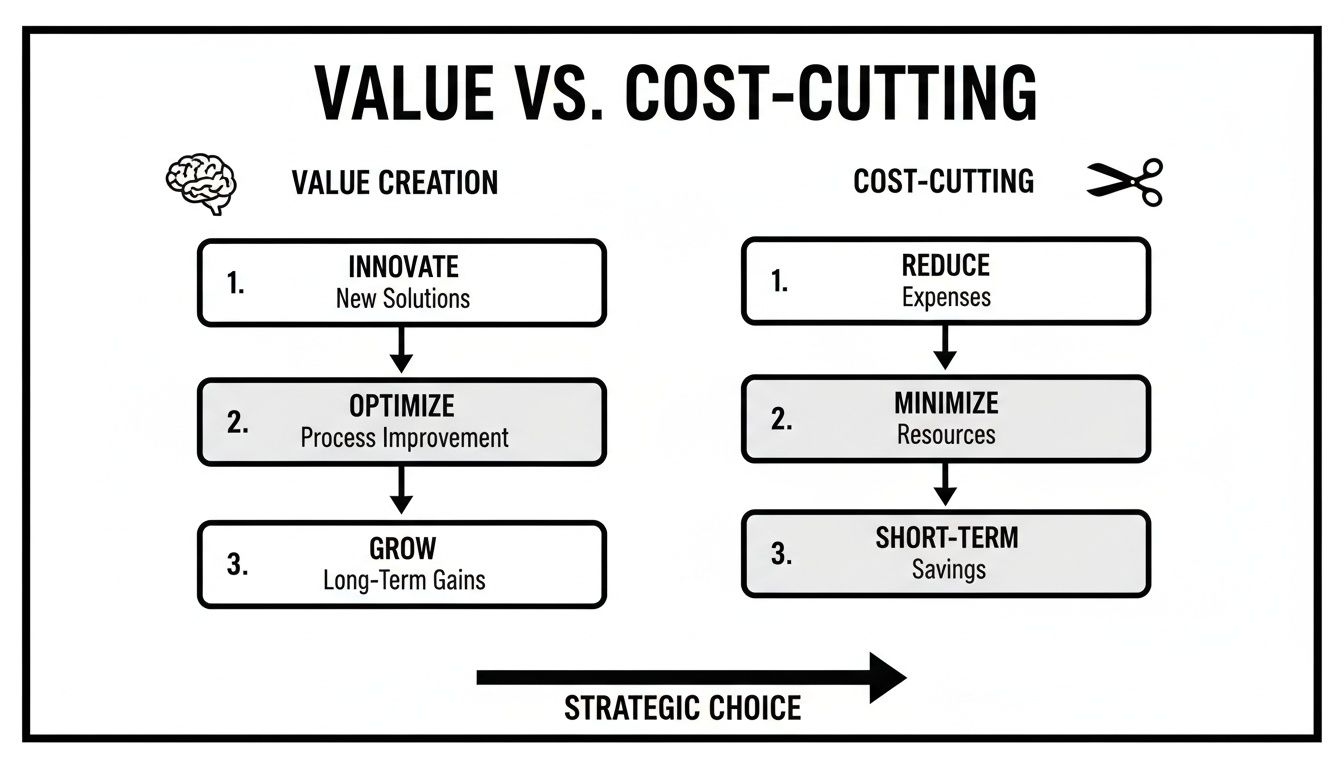
It highlights that true value creation is about strategic optimisation and innovation, whereas crude cost-cutting is just a short-term, reductive measure.
The Development and Implementation Phase: RIBA Stage 4
Once we have a shortlist of promising alternatives, we move into development and implementation, which aligns with RIBA Stage 4 (Technical Design). The most viable ideas are thoroughly evaluated against criteria like performance, buildability, and aesthetics. We use tools like lifecycle cost modelling to project the total cost of ownership over decades, not just the initial price tag.
The chosen solutions are then developed into detailed technical drawings and specifications. This meticulous planning ensures that by the time construction begins, every decision has been carefully weighed up to deliver the absolute maximum value for your investment. This structured approach is central to how we manage every project, and you can learn more about our process and its benefits for homeowners.
Seeing Value Engineering in High-End London Homes
The theory behind value engineering is one thing, but its real power comes to life when you see it applied to actual homes. It stops being an abstract concept and becomes a tangible benefit, transforming projects across London from merely expensive to genuinely valuable. This is where clever problem-solving meets technical expertise to deliver results you can see and feel.
Let's start with a basement extension planned for a Wimbledon property. The original design specifies a conventional waterproofing system—a reliable but costly choice. Using value engineering in construction, we don't just look at the price tag; we analyse the core function: to guarantee a dry, habitable space for decades to come.
This simple shift in focus opens the door to better alternatives. We might propose a modern cavity drain membrane system paired with an advanced sump pump. While the material costs might be similar, this system is often far quicker to install, which cuts down on labour costs. More importantly, it offers superior, more manageable long-term protection against water ingress. The result isn’t just a cost saving, but enhanced peace of mind and a more robust final build.
Heritage Refurbishments and Modern Performance
Now, picture a heritage refurbishment in Richmond. The brief is to replace the original but draughty single-glazed sash windows. A basic cost-cutting exercise might lead someone to suggest standard uPVC casements, a move that would permanently damage the property’s character and value.
Our value-driven approach is fundamentally different. We’d specify modern, thermally efficient timber sash windows that perfectly replicate the original design, right down to the slim sightlines and traditional ironmongery. Yes, the upfront investment is higher than the cheap plastic alternative, but the value created is immense.
The real benefit here is realised over the home's lifetime. These windows preserve the building's priceless aesthetic and historical integrity while dramatically improving thermal performance, slashing future heating bills and creating a far more comfortable living environment.
Landscaping with Intelligence
The principles of value engineering don't stop at the front door. Take a landscape design for a new build in Surrey, where the plans call for an expensive, engineered drainage system to handle surface water runoff across a large garden.
Instead of just accepting this, we'd challenge the assumption. Could the landscape itself perform this function? By subtly reshaping the ground contours and creating gentle swales or a strategically placed rain garden, we can manage drainage naturally.
This creative solution avoids the need for extensive pipework and mechanical systems, delivering an initial capital saving of potentially £8,000-£10,000. Even better, it creates a more sustainable, lower-maintenance, and beautiful garden that works in harmony with its environment. These examples prove value engineering isn't about cutting corners; it's a creative tool for innovation that delivers superior results through smarter thinking.
This isn't just wishful thinking; the effectiveness of this approach is well-documented. Value engineering has proven its impact across numerous UK construction case studies, with real-world projects demonstrating cost savings from 8% to 10% without ever compromising on quality. A London office refurbishment, for example, achieved a 10% cost reduction simply by simplifying interior specifications while maintaining the premium finishes. You can discover more insights about these real-world UK project savings and see the figures for yourself.
Pairing Smart Design with Sustainable Building
These days, the true value of a home goes far beyond its balance sheet. A modern approach to value engineering in construction naturally weaves in sustainability, creating properties that are not just financially smart but also environmentally responsible. This synergy is no longer a “nice-to-have”—it’s a core component of a home's long-term worth and future appeal.
The push towards greener building is also being driven by tightening regulations. Part L of the UK's building regulations, for instance, now demands significant cuts in operational carbon, compelling architects and clients to make energy efficiency a priority from day one. This regulatory pressure aligns perfectly with value engineering, where the focus is on performance over the entire life of the building, not just the initial cost.
A sustainable home is an inherently valuable home. By investing in high-performance insulation or triple-glazed windows, you are not just meeting regulations; you are making a calculated decision that will deliver tangible returns through lower energy bills for decades to come.
This long-term perspective is absolutely crucial. Specifying materials like reclaimed timber or a ground-source heat pump might look more expensive on paper initially. However, a proper lifecycle analysis—a key tool in value engineering—justifies this outlay by revealing the substantial savings on heating, cooling, and maintenance down the road.
The Power of Digital Precision
This level of sophisticated analysis is only possible thanks to modern digital tools that have completely changed how we design and build. Building Information Modelling (BIM) is at the heart of this shift, allowing us to create a detailed digital twin of a project before a single spade breaks ground.
With a BIM model, we can:
Test and Compare: Virtually test different sustainable materials and systems to see how they impact the building's overall energy performance.
Optimise Design: Adjust window placements or roof overhangs to maximise natural light and minimise heat loss with incredible accuracy.
Predict Costs: Accurately forecast both the upfront construction costs and the long-term running expenses of various design options.
The adoption of BIM, now a requirement for centrally procured UK government projects, has transformed how architects implement value engineering. This technology lets us run detailed cost comparisons and predict long-term savings with far greater accuracy. With Part L 2021 regulations demanding a 31% reduction in operational carbon, these tools are essential for engineering sustainable solutions that lower emissions over a building’s entire lifecycle.
This powerful combination of sustainable principles and digital precision means we can deliver homes that are not only beautifully designed and financially sound but also responsible and truly future-proof. Exploring these options is a key part of our design philosophy, which you can learn more about in our guide to green sustainable architecture in the UK.
Working with Your Architect for Maximum Value
The real success of value engineering in construction isn't just about spreadsheets and technical drawings; it hinges on open, honest collaboration. As the client, you are a vital part of this process. When you’re armed with the right knowledge and questions, you can ensure a value-driven approach is truly at the heart of your project from start to finish.
Think of your architect as more than just a designer. They should be your strategic partner, guiding you through the complexities of creating a high-end home that is both a beautiful reflection of your vision and an intelligent, sound investment. The relationship must be built on a shared commitment to maximising the long-term worth of your property.
Key Questions to Ask Your Architect
To make sure you're both on the same page, you should feel confident asking direct questions that get to the heart of their approach to value and efficiency. A genuinely value-focused architect will welcome this conversation as a sign of an engaged and thoughtful client.
Here are a few essential questions to bring to your initial consultations:
How do you integrate value engineering into your design process from RIBA Stage 1? Their answer should confirm it’s a proactive, early-stage activity, not a last-minute fix when the budget gets tight.
Can you share an example where you proposed an alternative that enhanced a project's long-term value, even if it wasn't the cheapest upfront option? This tells you whether they prioritise lifecycle costs over simple cost-cutting.
What tools or methods do you use to evaluate the long-term performance and maintenance costs of different materials and systems? Look for mentions of lifecycle cost analysis or hands-on experience with specific sustainable technologies.
How do you foster collaboration with engineers, builders, and other specialists to find innovative, value-driven solutions? This highlights their commitment to a creative, team-based approach rather than working in a silo.
A great architect doesn’t just present you with a design; they present you with a series of well-reasoned decisions. Each choice should be defensible not only on aesthetic grounds but also on its contribution to the overall, lasting value of your home.
Your Vision, Our Expertise
At Harper Latter Architects, these principles aren't an add-on; they are fundamental to how we work. Our goal is to be your ideal partner, translating your aspirations into a home that is both exceptional and efficient. We believe the smartest way of thinking is also the most creative.
Let's start a conversation about how we can apply this value-driven mindset to your project. By working together from the very beginning, we can ensure your investment delivers outstanding and enduring value for many years to come.
Your Questions Answered
It’s natural to have questions when you hear a term like ‘value engineering’, especially when it comes to your own home. Here are some straightforward answers to the questions we hear most often.
Will Value Engineering Make My Home Look Cheaper?
Absolutely not. This is probably the biggest myth out there, and it’s one we’re always happy to clear up. Proper value engineering in construction isn’t about cutting corners or choosing the cheapest option. It’s about making smarter, more informed decisions that enhance function and long-term quality.
Think of it this way: we might suggest a higher-spec material that’s quicker for tradespeople to install, which brings down labour costs. Or perhaps we’ll find an alternative that needs far less maintenance over the next 20 years. The aim is always to elevate the quality and feel of your home, never to diminish it.
When Is the Best Time to Introduce Value Engineering?
Right at the very beginning. The earlier we start, the more impact we can have. The biggest gains are found during the initial design stages (RIBA Stages 1-3), when ideas are still taking shape on paper. This is when we can adjust the layout, rethink a structural approach, or refine material choices without causing disruption or adding cost.
Trying to implement these changes once builders are already on-site is a different story—it becomes exponentially more difficult and expensive. That's why we weave these principles into our conversations from day one.
The most impactful and cost-effective changes are those made on paper. Introducing value engineering during the early design phases allows for maximum benefit with minimum disruption, securing long-term value from day one.
How Much Can Value Engineering Realistically Save?
The savings can vary depending on the project’s scale and how early the process begins. That said, UK construction case studies consistently point to savings in the range of 8% to 10% of the overall project cost, all without compromising on quality.
On a major London refurbishment or a new build, that’s a significant figure. And importantly, the savings don’t stop when the project is finished. They continue to add up over the building’s lifespan through lower energy bills and reduced maintenance costs.
Is Value Engineering Suited to Heritage and Listed Buildings?
Yes, and it’s particularly effective for these sensitive and character-rich projects. With listed or heritage properties, value engineering is never about altering or removing historic fabric. It’s about finding intelligent, modern solutions that work in harmony with the building’s original character.
For instance, this could mean:
Specifying discreet, high-performance insulation that’s completely invisible once installed, improving comfort without changing the look.
Finding more efficient, authentic methods to restore original features like cornices or fireplaces.
Designing elegant, modern extensions that complement the historic structure without overpowering it.
It’s all about focusing your budget where it truly counts: preserving heritage while making the home work beautifully for modern life.
At Harper Latter Architects, we believe that a truly exceptional home is both a work of art and a smart investment. To discuss how we can apply these value-driven principles to your bespoke new build, refurbishment, or heritage project, visit us at https://harperlatterarchitects.co.uk to begin your journey.

Comments