
A Guide to Building Regulations Compliance

Updated: Oct 13, 2025
Building regulations compliance is the legal process of making sure all construction work meets the UK’s national standards for health, safety, and energy efficiency. You can think of it as a property’s MOT; it’s a completely non-negotiable step that confirms your home is built correctly—from its foundations to its insulation—making it safe, healthy, and sustainable to live in.
The Foundations of Building Regulations Compliance
When you’re embarking on a high-end residential project, whether it’s a bespoke new build or an ambitious luxury refurbishment, you have to navigate a series of critical legal checkpoints. Chief among these is achieving building regulations compliance, a framework that ensures your project meets the minimum technical standards for design and construction in the UK.
It's important to realise these regulations aren't about aesthetics or the visual impact of your project. Instead, they focus squarely on the technical nitty-gritty of construction that guarantees a building is safe, structurally sound, and efficient for the people living inside. This is a crucial distinction that often trips people up.
The Key Difference: Planning Permission vs Building Regulations
One of the most common points of confusion is mixing up building regulations with planning permission. While you often need both, they serve entirely different purposes and are assessed by different people.
Planning Permission is all about the strategic and aesthetic side of development. It asks questions like: How will your project affect the local area? What will it look like? Will it impact your neighbours? Does it fit in with local planning policies?
Building Regulations are purely technical. They get into the how of construction, setting detailed standards for everything from structural integrity and fire safety to drainage, ventilation, and energy conservation.
Simply put, planning permission decides if you can build something, whereas building regulations dictate how it must be built. A project might not even need planning permission (like some internal alterations), but it will almost always need to comply with building regulations.
To make this crystal clear, here’s a quick breakdown of the two:
Building Regulations vs Planning Permission at a Glance
Aspect | Building Regulations | Planning Permission |
|---|---|---|
Purpose | Ensures the health, safety, and energy efficiency of buildings. | Manages the use of land and the appearance of buildings. |
Focus | Technical details: structure, fire safety, insulation, ventilation, drainage. | Aesthetic impact, land use, effect on the local area and neighbours. |
Question It Asks | "Is this building constructed safely and correctly?" | "Should this development be allowed to go ahead here?" |
When It Applies | Almost all building work, including many internal alterations. | New builds, major changes to a building, or changes of use. |
Who Approves It? | Building Control Body (either Local Authority or an Approved Inspector). | Local Planning Authority (your local council). |
Understanding this difference is fundamental. It prevents delays and ensures you’re seeking the right approvals at the right time.
Why Is Compliance So Important?
Getting building regulations approval isn't just about ticking boxes on a form; it's fundamental to the value, safety, and legality of your property. Without a final completion certificate from a Building Control Body, you’ll run into serious problems down the line. For a start, you'll find it incredibly difficult to sell your home, as mortgage lenders will refuse to lend against a property without one.
More importantly, these standards are there to protect you and any future occupants. They ensure that structural elements are sound, escape routes are safe in a fire, and the building provides a healthy environment to live in. The scrutiny is rigorous for a very good reason.
Recent data from England really drives this home: only 31% of submitted building control applications that received a decision were approved. For new builds, the picture is even starker, with a massive 77% being invalid, withdrawn, or rejected. This just goes to show how high the bar is for meeting these technical standards. You can dig deeper into the official building control application data to see the full picture.
Ultimately, getting to grips with building regulations is the first real step toward a successful, safe, and legally sound construction project. It provides the essential framework within which your architect and builders can create a home that is not only beautiful but built to last.
Decoding the Approved Documents
The Approved Documents are the practical guides to achieving building regulations compliance in the UK. Rather than seeing them as an intimidating legal text, it’s better to think of them as a detailed instruction manual for building a safe, healthy, and efficient home. Each document, known as a ‘Part’, tackles a specific area of construction.
For high-end residential projects, reading these documents cover-to-cover is not the best use of anyone's time. A far more practical approach is to understand them thematically. Grouping related parts together helps you see how they interact on a real-world project, turning abstract rules into tangible design and construction decisions.
Building a Solid and Secure Home
The structural safety and longevity of your home are non-negotiable, and this is where Approved Documents A and C come into play. They form the foundational layer of compliance, making sure your property is built on solid ground and can withstand all the forces it will face over its lifetime.
Part A (Structure): This is the bedrock of building safety. It gives guidance on everything from the depth of foundations and the specification of structural steel beams to the integrity of walls and roofs. For a luxury renovation involving the removal of internal walls to create an open-plan living space, Part A dictates the precise calculations and support systems needed to prevent a collapse.
Part C (Site preparation and resistance to contaminants and moisture): This document ensures the ground your home stands on is properly prepared and protected. It covers everything from preventing damp rising through floors to ensuring hazardous materials are safely cleared from the site before any work begins.
Together, these documents ensure your home starts with a strong, stable, and dry base, protecting your investment from the ground up.
Ensuring Fire Safety and Protection
Approved Document B is one of the most critical parts of the building regulations, focusing entirely on fire safety. Its goal is simple: to protect the lives of occupants by ensuring they can escape safely in a fire and by limiting the fire's spread.
For a high-end property, this goes far beyond simply installing a few smoke alarms. It demands a holistic fire safety strategy woven into the very fabric of the building.
A key concept within Part B is ‘compartmentation’. This means designing the building to contain a fire within a specific area for a set period. It's achieved using fire-resistant walls, floors, and, crucially, properly specified and installed fire doors.
Compliance with Part B might mean specifying internal doors with a 30-minute fire resistance (FD30), ensuring clear and protected escape routes from all floors, and using non-combustible materials for external cladding. It's a non-negotiable aspect that has a direct impact on the safety of your home and everyone in it.
This screenshot from the official government website shows the full collection of Approved Documents you'll need to reference.
Each link leads to detailed guidance on a specific aspect of construction, from structure to electrical safety.
Creating Healthy and Energy-Efficient Spaces
Modern building regulations place a huge emphasis on creating homes that are not just comfortable, but also highly energy-efficient and healthy to live in. This area is primarily governed by the interconnected requirements of Part L and Part F.
Part L (Conservation of fuel and power): This document is all about energy efficiency. It sets minimum standards for insulation in walls, floors, and lofts, as well as the performance of windows and doors, to minimise heat loss. It also covers the efficiency of heating systems, hot water cylinders, and lighting.
Part F (Ventilation): As we make our homes more airtight to meet the demands of Part L, we also have to ensure they are properly ventilated. This is vital for maintaining good air quality and preventing issues like condensation and mould. Part F provides guidance on adequate ventilation, whether through extractor fans, trickle vents in windows, or more advanced mechanical systems.
These two documents work hand-in-hand; you simply can't achieve compliance with one without considering the other. A highly insulated, airtight home (Part L) needs a robust ventilation strategy (Part F) to create a healthy living environment.
The UK is also on the cusp of major changes to building regulations focused on energy efficiency, notably under the forthcoming update to Part L. This aligns with the Future Homes Standard (FHS), which will mandate new builds to be 'net zero ready' with low-carbon heating and exceptional standards of insulation and ventilation. You can find out more about the performance of buildings by exploring the latest government statistics on the topic.
This focus on efficiency and health extends to other areas, too. When planning a bespoke garden room, for instance, specific regulations will apply depending on its size and use. You can explore this further in our detailed article about garden room building regulations in the UK.
Navigating the Building Control Process
With your architectural plans finalised, the next big step is getting the official green light from Building Control. This isn't just another box to tick; it's a crucial quality check that ensures your project is built to the highest technical standards, protecting your safety and your investment for years to come.
To get your project over the line and achieve building regulations compliance, you have two main routes to choose from. The path you take really depends on the scale of your project and how much risk you’re comfortable with. For the kind of high-end residential work we specialise in, one option is almost always the right call.
Choosing Your Approval Route
Your first decision is whether to submit a ‘Full Plans’ application or a ‘Building Notice’. They might sound similar, but they offer completely different levels of security and are designed for very different scenarios.
A Building Notice is essentially a simple heads-up to the council that you're about to start work. It’s quick and often used for tiny projects, like replacing a few windows. The catch? The inspector only checks the work as it's being done, which is a huge gamble.
The Full Plans application, on the other hand, is the professional standard. It involves submitting all your detailed architectural drawings, structural calculations, and technical specifications for a thorough review before a single spade hits the ground. A building control officer will meticulously comb through these documents to make sure everything lines up with the Approved Documents.
This infographic gives you a good sense of the key compliance areas your plans will be measured against.
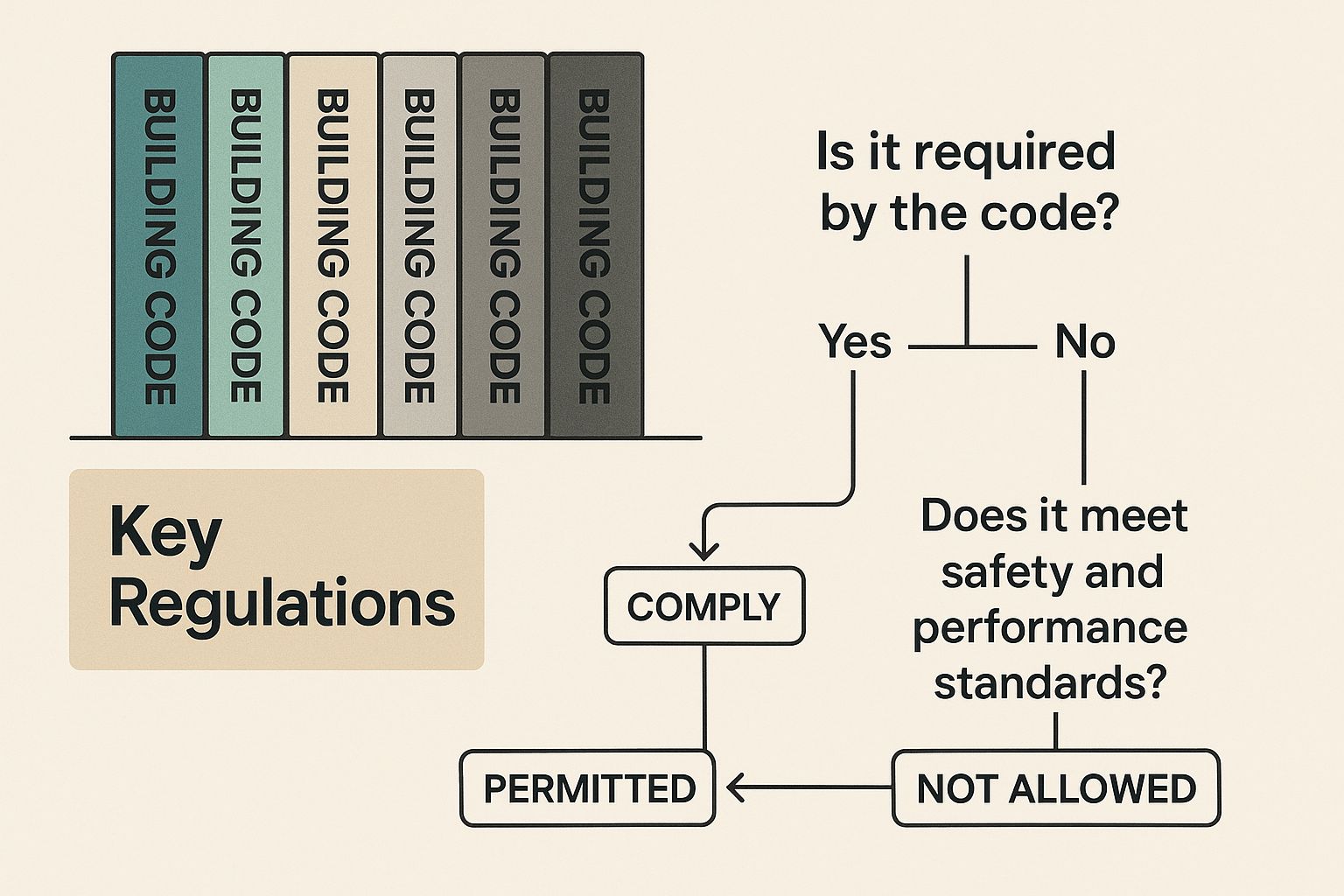
This front-loaded approach means any potential issues are flagged and sorted on paper, not on a muddy, half-built site.
For any project of substance—a bespoke new build, a basement conversion, or a major structural overhaul—the Full Plans route is the only way to go. It gives you the confidence of having a fully approved design before you commit serious money to construction, dramatically cutting the risk of being told to tear down and rebuild something later.
To make the choice clearer, here’s a look at how the two routes stack up against each other.
Choosing Your Approval Route: Full Plans vs Building Notice
Deciding between a Full Plans application and a Building Notice is a critical early step. This table breaks down the key differences to help you understand why, for most ambitious home projects, a Full Plans submission is the far safer and more professional choice.
Feature | Full Plans Application | Building Notice |
|---|---|---|
Upfront Review | Detailed plans are checked and approved before work starts. | No prior plan approval; compliance is checked as work progresses. |
Certainty | High. You have an approved blueprint to build from. | Low. You risk being ordered to undo expensive, non-compliant work. |
Best For | All major projects (new builds, extensions, structural changes). | Very simple, minor domestic jobs (e.g., small repairs). |
Cost | Fees are slightly higher due to the detailed plan check. | Lower initial fees, but the financial risk of rework is much higher. |
Completion Cert | Leads directly to a formal Completion Certificate upon sign-off. | Obtaining the final certificate can be a more complicated process. |
Ultimately, the Full Plans route provides invaluable peace of mind. Knowing your design is compliant before construction begins allows you and your build team to proceed with confidence, sticking to the programme and budget without the looming threat of costly surprises.
Local Authority or Approved Inspector?
Once you’ve settled on the Full Plans route, you need to decide who will actually check your plans and inspect the work. You have two choices: your Local Authority Building Control (LABC) department or a private firm known as an Approved Inspector.
LABC is the traditional council-run service, while Approved Inspectors are a private-sector alternative. Both are fully authorised to do the job, but many architects and clients find that Approved Inspectors offer a more collaborative and responsive service, which can be a real asset on complex, high-end builds. Your architect will be able to advise which is the better fit for your specific project.
The Site Inspection Stages
No matter who you appoint, the process involves a series of site inspections at key milestones. The inspector isn't there to manage the build day-to-day—that's what your contractor and project manager are for. Instead, they visit at critical points to sign off that the work meets the required standards.
These key inspection stages typically include:
Commencement: A visit right at the start of the project.
Foundations: Checking the excavations and steel reinforcement before the concrete is poured.
Damp-Proof Course: Inspecting the damp-proofing measures before they’re covered up.
Drainage: A check of the pipework before the trenches are backfilled.
Structural Elements: Inspecting major structural components like steel beams, columns, and floor joists.
Roof Structure: A look at the roof timbers before the tiles or slates go on.
Completion: The final inspection to confirm everything is finished to a compliant standard.
This structured, phased approach is a world away from the planning permission process, which can often feel more subjective. To get a better handle on that separate journey, take a look at our simple guide to the UK planning application stages.
Once the final inspection is passed, your Building Control Body will issue a Completion Certificate. This is the golden ticket—your official proof that the project complies with building regulations. It’s absolutely vital for selling or remortgaging your property in the future, so keep it in a safe place with your property deeds.
Common Pitfalls and How to Avoid Them
Even the most carefully planned high-end projects can get snagged on building regulations compliance. Honestly, learning from where others have gone wrong is one of the best ways to keep your own project moving smoothly, on time, and on budget. These slip-ups are rarely about cutting corners; they usually come from overlooking a crucial technical detail.
Navigating these potential traps means thinking ahead and having a solid grasp of how the Approved Documents play out in the real world. From a misplaced beam to a fire safety oversight, one mistake can trigger failed inspections, expensive rework, and frustrating delays. It’s all about spotting the risks before they become problems.
Structural Oversights When Creating Open-Plan Spaces
One of the most common—and dangerous—mistakes we see is a load-bearing wall being taken out without the right structural support. In the rush to create those beautiful, flowing open-plan living areas, it’s easy to underestimate the forces holding the house up.
Just swapping a wall for a steel beam isn’t the full story. The entire load path has to be recalculated. This means checking the new beam is correctly sized, making sure what it sits on can take the weight, and ensuring the foundations below can handle the new, concentrated pressure.
Regulation Breached: Primarily Approved Document A (Structure).
How to Avoid It: This is non-negotiable: you must hire a qualified structural engineer. They will run the numbers and provide detailed drawings for the new steelwork and supports. It’s a vital step for the safety and integrity of your home.
Inadequate Fire Separation in Loft Conversions
Loft conversions are a brilliant way to gain an extra room, but they bring serious fire safety responsibilities with them. A frequent error is failing to create proper fire separation between the new top floor and the rest of the house, which can turn a minor incident into a major emergency.
This is about much more than just sticking up a smoke alarm. The entire escape route, from the new loft room all the way down to the front door, needs to be a protected corridor.
This means that all doors along this escape path, including the one into the loft, typically need upgrading to FD30 fire doors. These are designed to hold back fire for at least 30 minutes. The walls and floors around the staircase must offer the same level of fire resistance, too.
Regulation Breached: Approved Document B (Fire Safety).
How to Avoid It: Get your architect to design a complete fire safety strategy right from the start. This plan should cover specifying the right doors, creating protected escape routes, and fitting interlinked, mains-powered smoke alarms on every floor.
Insulation and Ventilation Imbalances
As we make our homes more airtight and energy-efficient, the relationship between insulation and ventilation becomes critical. A classic pitfall is packing in lots of high-performance insulation but forgetting to upgrade the ventilation to match, which goes against the basic principles of a healthy building.
This simple mistake traps damp, stale air inside, quickly leading to condensation, mould, and a generally unpleasant environment. Beyond the health issues, it can cause long-term rot and damage to the building itself.
Regulations Breached: Approved Document L (Conservation of fuel and power) and Approved Document F (Ventilation).
How to Avoid It: Think of insulation and ventilation as two sides of the same coin. When you boost your home's thermal performance, you must also review the ventilation. This could mean fitting more powerful extractor fans in kitchens and bathrooms, adding trickle vents to new windows, or even installing a mechanical ventilation system.
Non-Compliant Drainage Connections
Drainage is probably the least glamorous part of a build, but getting it wrong is a recipe for disaster. A common blunder is connecting a new foul water pipe (from a toilet or sink) into a surface water drain (for rainwater), or the other way around.
This mistake can send raw sewage into local rivers or, in the other direction, flood the sewage system with rainwater during a storm, causing nasty backups.
Regulation Breached: Approved Document H (Drainage and waste disposal).
How to Avoid It: Make sure your builder has a clear drainage plan and has properly identified the existing foul and surface water systems before they start digging. All new pipework needs to have the correct gradient, or 'fall', to work properly, and it must be inspected by building control before being buried.
Fire Safety and Structural Integrity Explained
While every part of the Building Regulations matters, two stand out as the absolute, non-negotiable pillars of a safe home: Part B for Fire Safety and Part A for Structure. Getting these right isn’t just about ticking boxes for building regulations compliance; it’s about the fundamental safety of your family and the long-term integrity of your property.
These aren’t just static rules pulled from a textbook. They are living documents that evolve, often in response to real-world tragedies and advances in construction. They represent the core principles that elevate a beautifully designed house into a secure, resilient home.
The Modern Approach to Fire Safety
The tragic Grenfell Tower fire was a watershed moment that completely reshaped the UK's conversation around fire safety, particularly for cladding and external materials. The event exposed devastating gaps in the old standards, prompting urgent and wide-ranging updates to Approved Document B.
In the aftermath, it was discovered that the Aluminium Composite Material (ACM) cladding used on countless buildings was unlikely to meet Building Regulations, sparking a national remediation effort. This enormous, ongoing process highlights just how seriously compliance is now taken. You can get a sense of the scale of this work from the government's latest building safety technical notes.
For high-end residential projects today, this means an intense focus on everything from the materials you choose to the layout of your escape routes.
Here are the key ideas you'll encounter:
Compartmentation: Think of this as creating fireproof "boxes" inside your home. The aim is to contain a fire to its room of origin for a set period – usually 30 or 60 minutes – giving everyone ample time to get out. This is achieved through fire-resistant walls and floors, and critically, properly fitted fire doors.
Protected Escape Routes: This is your designated path to safety from anywhere in the house. In homes with more than one storey, the staircase and hallways forming this route must be "protected." This often means ensuring every door opening onto the escape route is a certified FD30 fire door.
Detection and Alarms: Forget battery-powered alarms. Modern standards demand mains-powered, interlinked smoke alarms on every level. If a fire starts in the kitchen, the alarm in the top-floor bedroom will sound instantly.
Upholding Structural Integrity
Approved Document A is, quite literally, the foundation of your entire project. It’s all about ensuring your home can safely handle every load and stress imaginable – from the weight of furniture and people to the force of gale-force winds and heavy snow.
This becomes absolutely critical in the kind of ambitious renovations common in luxury homes, like carving out vast open-plan spaces, adding a significant extension, or digging out a new basement.
When you knock down an internal wall to create that dream kitchen-diner, you’re fundamentally changing how your house holds itself up. It's not as simple as just slotting in a steel beam; that new load needs to be calculated precisely and transferred safely all the way down to the foundations.
This is exactly where a structural engineer becomes indispensable. They are the ones who perform the complex calculations to specify the right beams, columns, and supports, making sure your stunning new design is also completely safe. Trying to bypass this step is a recipe for catastrophic failure.
It’s vital to understand who does what on your project team. To get a clearer picture of the different roles, have a read of our guide on the difference between a structural engineer vs an architect. At the end of the day, complying with Part A is what ensures your home will stand strong for generations to come.
Answering Your Building Regulations Questions
Even after getting to grips with the basics, most people have a few specific questions that pop up along the way. To help you feel more confident, we’ve put together a quick-reference guide answering some of the most common queries we hear from clients.
What Happens If I Carry Out Work Without Approval?
Put simply, carrying out work without building regulations approval is illegal and can spiral into a very messy and expensive situation. The local authority has the power to issue an enforcement notice, which legally requires you to alter or even completely remove all the non-compliant work—at your own cost, of course.
If you don’t act on the notice, the council can bring in their own contractors to rectify the work and then bill you for the entire cost. It’s a nightmare scenario you really want to avoid.
On top of that, you will never receive a completion certificate. This single document is absolutely vital. Without it, you’ll run into serious trouble when you try to sell your property, as most mortgage lenders will refuse to finance a home with uncertified works.
How Long Does a Completion Certificate Last?
Good news here: a building regulations completion certificate lasts forever. It doesn’t have an expiry date. Think of it as a permanent record proving that the work met the required technical standards at the moment it was signed off.
This certificate becomes a core part of your property's legal history. You should keep it somewhere safe with your deeds and other important papers, as the buyer’s solicitors will definitely ask for it during the conveyancing process when you decide to sell.
It offers essential peace of mind to future owners, surveyors, and lenders about the quality, safety, and legality of the construction that took place.
Do I Need Approval for Repairs or Replacements?
This really depends on the scale and type of the repair. Simple, like-for-like maintenance—say, replacing a couple of broken roof tiles with identical ones—generally doesn’t require any approval.
However, the game changes if the replacement involves what’s known as a 'controlled service' or 'controlled fitting'. These are parts of a building that are fundamental to its safety and energy efficiency.
Key examples where you would need approval include:
Replacing entire window units: This impacts the building’s thermal performance and falls under Part L (Conservation of fuel and power).
Installing a new boiler: This involves combustion, flue systems, and energy efficiency, touching on Parts J and L.
Undertaking most electrical work: Any new circuits or work in ‘special locations’ like kitchens and bathrooms are governed by Part P (Electrical safety).
The rule of thumb is this: if a replacement could affect compliance with health, safety, or energy standards, it must be overseen by building control or a certified professional from a Competent Person Scheme.
Approved Inspector vs Local Authority Building Control
Both are official Building Control Bodies (BCBs) who check for compliance, but they operate quite differently. The right choice for you will hinge on your project’s specific needs.
Local Authority Building Control (LABC) is the service offered directly by your local council. As a public body, they have a statutory duty to provide the service and can't turn down a valid application.
An Approved Inspector is a private company or individual licensed by the government to perform the same function. Many clients—especially on complex, high-end projects—find their approach more collaborative and flexible. They often specialise in certain types of projects, which can be a real advantage. It's important to remember, though, that only local authorities have general enforcement powers. If a serious dispute arises or work is found to be non-compliant, an Approved Inspector must hand the project back to the local authority to take formal action.
At Harper Latter Architects, we navigate the complexities of building regulations every day, ensuring our clients' visions are realised safely, legally, and to the highest standard. If you're planning a bespoke residential project in South West London, explore our architectural services to see how we can guide you through the process.

Comments