
Architects For Loft Conversion Maximising Your London Home

A loft conversion is so much more than a building job. It’s a complex architectural project that needs a careful balance of creative design, structural engineering, and regulatory compliance. Bringing in specialist architects for loft conversion isn’t just an expense; it’s a strategic investment that protects your home’s value and ensures your vision is brought to life, safely and beautifully.
Why An Architect Is Your Greatest Asset
Thinking about converting your loft in a high-value area like South West London? Many homeowners see the potential locked away in their dusty attics—a space often used for forgotten belongings that could become a luxurious master suite, a quiet home office, or a vibrant playroom for the kids.
The temptation might be to jump straight to a builder, but this can lead to common pitfalls. Think budget blowouts, planning refusals, and uninspired designs that just don't make the most of your home's potential.
An architect acts as your creative partner and your expert guide. They're trained to transform your initial ideas into a reality that is functional, beautiful, and fully compliant with the rules. They see possibilities you might miss, making sure every single square metre is used effectively.
Maximising Value And Avoiding Pitfalls
The financial upside of an architect-led project is significant. According to research from Nationwide Building Society, a well-designed loft conversion that adds a double bedroom and a bathroom can increase a property's value by up to 24%.
For a £400,000 house in an area like Wimbledon Village, that could mean an uplift of £96,000—an amount that can easily cover the project costs and then some.
An architect’s true value lies in their ability to blend art with science. They balance aesthetics, structural integrity, and building regulations to create a space that not only looks stunning but is also safe, practical, and adds measurable value to your home.
The Architect's Core Responsibilities
Hiring an architect brings a structured, professional approach to your project. It de-risks the entire process and ensures you get a high-quality result. Their involvement typically includes:
Creative Vision and Spatial Planning: Crafting innovative layouts that maximise natural light, headroom, and storage, all perfectly tailored to your lifestyle.
Navigating Regulations: Managing the complexities of Planning Permission and Building Regulations, ensuring your project is fully compliant right from the start.
Technical Expertise: Producing detailed technical drawings that builders can follow precisely, which minimises costly on-site errors and frustrating delays.
Project Oversight: Helping you select a reputable contractor and overseeing the build to ensure the quality of workmanship meets the highest standards.
By managing these critical elements, an architect makes sure your loft conversion isn't just an add-on, but a seamless integration that genuinely enhances your entire home. You can explore more on how residential architects transform homes with vision and precision in our detailed guide.
Exploring Your Loft Conversion Options
Deciding to convert your loft is the easy part. The moment you start looking into it, you're hit with a barrage of new terms: Velux, Dormer, Mansard... what does it all mean? Getting your head around the fundamental differences is the first crucial step, as it affects everything from how much space you’ll actually gain to the planning hoops you’ll need to jump through.
Think of it like choosing the right tool for the job. Each conversion style is engineered to solve a specific problem, whether that's squeezing maximum headroom into a terraced house or simply flooding a dark attic with natural light. This is where the eye of an experienced architects for loft conversion becomes so valuable—they can see the potential in your roof space and help you visualise which option will best transform it into a beautiful, functional part of your home.
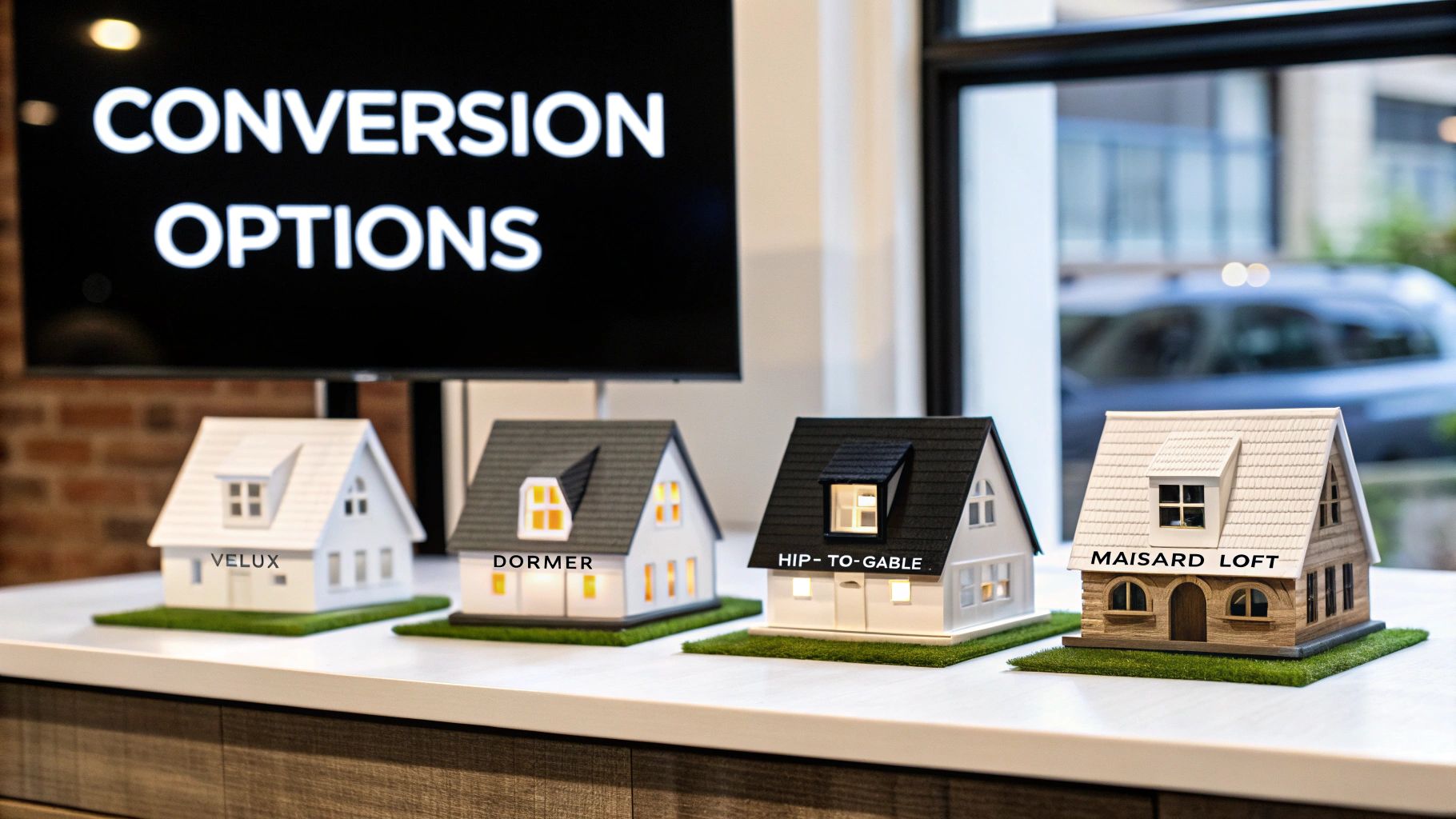
The Main Types of Loft Conversions
Let's break down the most popular conversion types you’ll come across, especially in and around South West London. Each one has its own distinct character, making it a better fit for certain types of property and different homeowner ambitions.
Velux (or Rooflight) Conversions: This is the simplest and most budget-friendly route. It involves fitting skylight windows, like the famous ones made by Velux, directly into the existing roof slope without altering the roofline. This approach is perfect for attics that already have decent headroom and is a brilliant way to create a bright home office or a cosy snug.
Dormer Conversions: A dormer is a structural box that extends vertically from the slope of the roof. It’s arguably the most popular type of conversion for a reason—it adds a huge amount of usable floor space and, crucially, full headroom. The flat-roof dormer is a common sight on terraced and semi-detached properties across London.
More Complex Structural Options
If you’re looking to create a truly expansive new floor, you’ll need to consider more significant structural changes. These conversions are more complex and carry a higher price tag, but the results can be absolutely transformative.
A well-chosen loft conversion does more than add a room; it reimagines the entire top floor of your home. The right design can unlock breathtaking views, flood your home with natural light, and create a seamless transition between the old and new.
Hip-to-Gable Conversions: This one is specifically for homes with a hipped roof (where the roof slopes downwards on all sides, like a pyramid). The project involves replacing the sloping 'hip' with a vertical wall, creating a gable end. This dramatically increases the internal volume and is often paired with a rear dormer to truly maximise the new space.
Mansard Conversions: Named after the 17th-century French architect François Mansart, this is a much more extensive alteration. It involves replacing one or both roof slopes with a new structure that has an almost vertical side (at a steep 72 degrees) and a flatter top. Mansards are common in London's conservation areas and are often considered the most elegant option, effectively creating a full extra storey.
To help you compare these options at a glance, here’s a quick breakdown of how they stack up against each other.
Loft Conversion Types: A Quick Comparison
Conversion Type | Typical Cost (London) | Best For | Planning Permission |
|---|---|---|---|
Velux/Rooflight | £25,000 - £40,000+ | Lofts with existing headroom, creating bright spaces on a budget. | Often falls under Permitted Development. |
Dormer | £45,000 - £70,000+ | Maximising headroom and floor space in most house types. | Usually falls under Permitted Development. |
Hip-to-Gable | £55,000 - £85,000+ | Semi-detached and detached homes with hipped roofs. | Often requires Full Planning Permission. |
Mansard | £60,000 - £90,000+ | Creating an entire extra storey, common in conservation areas. | Always requires Full Planning Permission. |
Of course, these figures are just a guide. The final cost and planning requirements will always depend on the specifics of your property and the local council's policies.
Making The Right Choice For Your Home
The best route for you depends entirely on your property, your budget, and what you’re hoping to achieve. A classic Victorian terrace in Richmond might be the perfect candidate for a stylish dormer, while a detached 1930s home in Wimbledon could easily accommodate a spacious hip-to-gable conversion.
This is exactly why the first step should be an architect's feasibility study. They’ll measure your existing headroom, assess the roof structure, and talk through your family’s needs before recommending the most suitable design. This expert guidance ensures you invest in a conversion that not only works for you today but adds real, lasting value to your home.
Navigating Planning And Building Regulations
Embarking on a loft conversion in the UK means you’ll quickly encounter two distinct sets of rules that often get confused: Planning Permission and Building Regulations. It helps to think of them as two different gatekeepers for your project.
Planning Permission is all about the look and impact of your build on the neighbourhood. Building Regulations, on the other hand, focus squarely on the safety and structural integrity of the work itself. They aren’t interchangeable, and it's a common tripwire for homeowners to assume that getting a pass on one means a pass on the other. For specialist architects for loft conversion, managing this dual system is second nature.
Understanding Permitted Development Rights
The good news is that many loft conversions, especially simpler styles like Velux or standard dormers, don’t actually need a full planning application. This is thanks to something called Permitted Development (PD) Rights.
Think of these as government-granted allowances that let you make certain changes to your home without having to ask the local council for permission first. It’s like having a pre-approved checklist; if your plans tick all the boxes, you can get started without the lengthy planning process. An architect will assess your design against these strict criteria, which include limits on:
Volume: For terraced houses, you can’t add more than 40 cubic metres of new roof space. This increases to 50 cubic metres for semi-detached and detached homes.
Height: Your extension cannot sit any higher than the highest part of your existing roof.
Materials: The materials you use must be similar in appearance to the existing house.
Positioning: No part of the extension can go beyond the principal elevation that fronts a highway.
This streamlined route is a huge plus, saving both time and money. But the rules are precise, and even a small miscalculation can lead to a breach of planning control.
When Full Planning Permission Is Unavoidable
While PD Rights cover a lot of ground, certain situations will always require a full planning application. Your architect is your navigator here, spotting these red flags right at the start.
The line between what is and isn't 'Permitted Development' can be surprisingly blurry and often varies between local authorities. An architect’s local knowledge, especially in areas with strict councils like those across South West London, is invaluable in steering your project down the correct and most efficient legal path.
You will almost certainly need full planning permission if your property:
Is a flat or maisonette.
Is a listed building, where any alteration needs special consent.
Is located within a Conservation Area, an Area of Outstanding Natural Beauty (AONB), or another designated zone where development is more tightly controlled.
In these cases, the design has to be far more sensitive to the character of the property and its surroundings. Architects with conservation experience, like our team at Harper Latter, are skilled at creating proposals that meet modern living needs while respecting historical context, which greatly improves your chances of approval.
For a deeper dive into the technical side, you might find our guide to Building Regulations compliance useful. Ultimately, an architect's guidance turns what can feel like a bureaucratic maze into a clear, manageable process.
Budgeting For Your Loft Conversion
When you start thinking about the cost of a high-end London loft conversion, it's easy to get fixated on a single headline figure. But the reality is a bit more complex. The final budget is a careful balancing act between your design ambitions, the structural work needed, and the quality of the finishes you choose. Think of it as a financial puzzle where every piece, from the architect's first sketch to the final coat of paint, has its place.
A common mistake is focusing only on the builder's quote, completely forgetting the essential professional services that make the project a success in the first place. A good architects for loft conversion will give you a realistic financial roadmap from day one, helping you see where every pound is going and why.
This kind of transparency is vital. The cost of loft conversions in the UK can vary wildly depending on the type and where you live, which really highlights an architect's role in smart budgeting and efficient design. A basic Velux loft conversion might start from £30,000-£45,000 elsewhere, but in London, you’re looking at £60,000-£130,000. Why the jump? Steeper labour and material costs, not to mention the logistical headaches like parking in dense areas like South West London.
Dormer conversions, a popular choice for gaining that all-important headroom, typically average £55,000-£120,000 across the UK. For more ambitious Mansard or L-shaped projects that often need full planning permission, the budget will likely exceed £100,000. To get a better feel for the numbers, you can discover more insights about loft conversion pricing here.
Breaking Down The Key Costs
A solid budget for a loft conversion generally falls into three main buckets. Getting to grips with these helps you see exactly where your investment is going and how an architect’s guidance adds real value.
Professional Fees: This is your first investment, covering all the expert brainpower behind the project. It includes the architect's fees for design, planning, and technical drawings; the structural engineer’s fees for crucial calculations; and maybe a party wall surveyor if you share a wall with neighbours.
Construction Costs: This is the big one. It’s the largest chunk of the budget and covers the builder’s labour and all the core materials needed to create the new structure. We're talking everything from scaffolding and structural steel beams to the roofing, windows, and insulation.
Finishes and Fittings: This is where you have the most direct control over the final cost. It covers all the interior touches that bring the space to life – think flooring, bathroom suites, tiling, lighting, bespoke joinery, and decoration.
How An Architect Protects Your Budget
One of the most valuable things an architect brings to the table is rigorous cost control. Without their detailed oversight, it’s frighteningly easy for budgets to spiral out of control due to unforeseen problems or vague specifications from the outset.
A detailed set of architectural drawings is your best defence against unexpected costs. It allows builders to provide accurate, like-for-like quotes and eliminates expensive guesswork on site, ensuring you get maximum value for every pound spent.
An architect’s detailed cost management typically includes:
Feasibility and Cost Planning: Right at the start, they’ll provide realistic cost estimates based on what you want to achieve and the specifics of your property.
Detailed Tender Pack: They create a set of precise technical drawings and a schedule of works. This is the document builders use to price the job accurately, so there are no grey areas.
Competitive Tendering: Your architect will send this tender pack out to a list of vetted, reputable contractors, making sure you get a fair and competitive market price for the build.
Contract Administration: They’ll manage the building contract, ensuring payments are made correctly at each stage and that any changes (variations) are fairly priced and, most importantly, approved by you first.
By managing the process this way, your architect essentially acts as your advocate, protecting your financial interests and making sure the project stays on track without any nasty surprises. For a more detailed explanation of how these professional fees work, you can check out our homeowner's guide to architect fees in the UK.
The Architect-Led Design And Build Journey
Starting a loft conversion can feel like a massive project, but with an architect guiding you, it becomes a clear, manageable journey. Instead of a messy series of unrelated decisions, a proper step-by-step process acts as a roadmap, taking you from the initial spark of an idea to a beautifully finished space. The whole approach is built on collaboration and transparency, which helps to de-risk the entire project from the outset.
This structured approach makes sure the final result lines up perfectly with your vision, timeline, and budget, all steered by a dedicated expert. A specialist architect for a loft conversion doesn't just draw up plans; they orchestrate the entire process to deliver a seamless, high-quality result, making the experience as straightforward as possible for you.
From Initial Idea To Feasibility
Every great project starts with a conversation. In our first chat, we’ll talk about what you’re hoping to achieve—are you dreaming of a peaceful master suite, a quiet home office, or an extra bedroom for your growing family? Your architect will listen carefully to get a real feel for your lifestyle, your taste, and what you need from the space day-to-day.
From there, the first technical step is a feasibility study. This is a vital stage where your architect figures out what’s actually possible in your attic. They will:
Take accurate measurements: Checking the existing headroom, floor area, and the pitch of your roof.
Assess the structure: Looking at the existing roof timbers and load-bearing walls to see what structural changes are needed.
Review local planning policies: Analysing your local council's rules, which is especially important for properties in Conservation Areas or with other planning restrictions.
The study gives you a clear, honest picture of what you can achieve, which planning route to take, and a rough idea of the costs involved. It’s the solid foundation the whole project is built on.
Creative Design And Planning Submission
Once we have a solid grasp of the potential, the creative work begins. Your architect will sketch out some initial concept designs, usually giving you a few different layouts to consider. This part is very collaborative—your feedback is key to refining the plans until they perfectly match what you had in mind.
When the design is nailed down, the focus turns to getting the right permissions. Your architect will prepare and submit all the necessary documents for either a Lawful Development Certificate (for projects under Permitted Development) or a Full Planning Application. Their expertise in putting together a professional, persuasive case for the local authority makes a smooth approval far more likely.
This visual breaks down how the budget is typically allocated in an architect-led loft conversion.As you can see, the journey moves from the initial design investment to the main build cost, finishing with the fixtures and fittings that bring your personal style to life.
Technical Drawings And Contractor Selection
With planning consent in the bag, the project moves into the technical design phase. This is where your architect, working alongside a structural engineer, produces a highly detailed set of Building Regulations drawings. Think of these as the instruction manual for your builders, spelling out everything from the size of the steel beams to the type of insulation.
A comprehensive set of technical drawings is the single most important tool for ensuring build quality and cost control. It leaves no room for ambiguity, meaning every contractor is pricing for exactly the same high-quality work.
With this technical pack complete, your architect will manage the tender process. They’ll send the drawings out to a handpicked list of trusted, vetted contractors to get competitive, like-for-like quotes. They will then help you go through the quotes, choose the best builder for the job, and get the formal building contract in place.
This structured approach, which we follow at Harper Latter, ensures our clients understand every single stage, from concept right through to completion. It provides clarity and confidence from start to finish.
Choosing The Right Architect For Your Project
Picking the right professional is easily the most critical decision you’ll make for your loft conversion. This is about more than just finding someone who can draw up a set of plans. It's about finding a creative partner who genuinely gets your vision, respects your budget, and has the local knowledge to steer your project through the complexities of planning.
Get this choice right, and you're setting yourself up for a smooth process and a final result that truly transforms your home.
When you start looking for architects for loft conversion, your first port of call should be their credentials. Make sure any professional you consider is registered with both the Architects Registration Board (ARB) and the Royal Institute of British Architects (RIBA). Think of these accreditations as your guarantee of professionalism, quality, and accountability.
Next, get stuck into their portfolio. You’re looking for real-world examples of loft conversions that feel similar to what you have in mind, especially in your local area like South West London. This shows they have hands-on experience with the types of properties and planning quirks common to your neighbourhood.
Key Questions To Ask Potential Architects
Those initial consultations aren't just a sales pitch; they’re your chance to see if the chemistry is right and to really probe their expertise. A good architect will be more than happy to answer your questions in detail. To get the most out of these meetings, it pays to be prepared.
Here are a few essential questions to get the ball rolling:
Design Philosophy: "Could you talk me through your design approach? How do you balance what a client wants with the practical and budgetary constraints?"
Local Experience: "How familiar are you with our local council’s planning department? What are their specific quirks or requirements when it comes to loft conversions?"
Budget Management: "How do you put a budget together and, more importantly, keep it under control? What steps do you take to stop costs from spiralling?"
Project Involvement: "What does your involvement look like once construction starts? How do you make sure the builder’s work is up to scratch?"
A great architect does more than just design a space; they unlock its hidden potential. Their ability to see creative solutions for maximising light, space, and functionality is what separates a standard attic room from a genuinely inspiring part of your home.
This proactive approach is becoming the norm. With the ongoing housing crisis, UK homeowners are increasingly turning to architects to make the most of what they've got. It’s a smart, strategic move. While research shows 71% of renovators focus on kitchens or bathrooms, a significant 24% are opting for lofts because of the huge space gains they offer.
In London, where a project can easily cost £60,000-£130,000, an architect's skill in value engineering is indispensable. They ensure that features like an ensuite bathroom aren't just nice-to-haves, but strategic additions that can deliver that impressive 24% boost to your property's value. You can read the full research about home renovation trends to dig deeper into the numbers.
By carefully vetting your options and asking the right questions, you can find a firm that not only aligns with your goals but has the proven track record to deliver the loft you’ve been dreaming of.
Your Questions Answered
When you’re thinking about a loft conversion, it's natural to have a few questions floating around. It's a big step, after all. Below, we've tackled some of the most common queries we hear from homeowners to give you a bit more clarity as you start planning.
How Long Does A Loft Conversion Take With An Architect?
Every project has its own rhythm, but a well-managed loft conversion in London generally unfolds in two key stages. The first part—the design and planning phase—is all about getting the groundwork right. This covers everything from initial sketches and detailed technical drawings right through to getting all the necessary permissions in place, which typically takes somewhere between three to six months.
Once all the approvals are sorted, the builders can get started. For a standard dormer conversion, the construction itself usually takes another three to four months. Having an experienced architect on your side is crucial here; they keep the project moving, solve problems before they cause hold-ups, and make sure everything stays on track.
Are Architect Fees For A Loft Conversion Worth The Cost?
Without a doubt. While hiring an architect adds a line to your budget, the value they bring to the table almost always pays for itself, often several times over. A good architect doesn't just draw a box on top of your house; they find clever ways to maximise space and light, which can significantly boost your property's value.
They also save you money in very real, practical ways. Their precise drawings prevent expensive mistakes during the build. Plus, they help you get fair, competitive quotes from builders they trust and steer your project smoothly through the planning system, dodging costly delays.
An architect's true value lies in their ability to see potential that others miss. They transform a purely functional space into an asset that enhances your lifestyle and delivers a significant return on investment.
Can An Architect Help In A Conservation Area?
Yes, and honestly, in this situation, their expertise isn't just helpful—it's absolutely essential. Proposing a loft conversion in a Conservation Area means navigating a whole extra layer of rules about design, materials, and preserving the local character.
An architect with a proven track record in conservation projects knows exactly what the council expects. They can design a space that feels modern and meets your needs while still respecting the building's heritage. This kind of thoughtful, informed approach is what gets planning applications over the line with authorities who are, quite rightly, protective of the area's history.
What Is The First Step To Start A Loft Conversion?
The very first thing you should do is have a chat with a RIBA-accredited architect who specialises in residential projects like yours. This initial consultation is the perfect, no-pressure way to talk through your ideas, find out if a conversion is even feasible for your property, and get a clear picture of the road ahead.
Think of it as your discovery session. It’s an opportunity to get expert advice before you commit to any major decisions or expenses, making sure your project gets off to the best possible start.
Ready to unlock the potential hiding in your attic? The team at Harper Latter Architects has spent years delivering beautiful, bespoke loft conversions for families across South West London. Contact us today for an initial consultation and let's start the conversation about your home.

Comments