
A Homeowner's Guide to Architect Fees UK for Residential Projects

When you’re planning a high-end residential project in the UK, one of the first questions that comes to mind is almost always, "So, what will the architect cost?" It's a crucial part of your budget.
As a general guide, you can expect architect fees in the UK to be between 8% and 15% of the total construction cost for the full scope of services. This isn't just an arbitrary figure; it reflects the immense value, design expertise, and rigorous project management an architect brings to the table to make your vision a reality.

Understanding How UK Architect Fees Are Structured
Trying to navigate the costs of a bespoke home project can feel daunting, but getting to grips with how architects structure their fees is the first step towards a clear and successful partnership. These fees aren’t just for a set of drawings. They cover a comprehensive service designed to guide your project from a fledgling idea to a beautifully finished home, safeguarding quality, ensuring compliance, and managing the budget every step of the way.
For homeowners in places like Wimbledon or Richmond, where projects often involve tricky heritage constraints or ambitious basement extensions, an architect’s role is particularly vital. Their fee is really an investment in expertise that helps you sidestep risks and unlock your property’s true potential. In the UK, most practices use one of three primary models to calculate their charges.
The Three Core Fee Models
Each fee structure is tailored to different kinds of projects and stages, offering flexibility for you as the client. Having a clear picture of these options will make your first conversations with your chosen practice far more productive.
The three main approaches are:
Percentage of Construction Cost: This is the most common method for full-service projects where an architect is involved from start to finish. The fee is a set percentage of the final build cost, which keeps the architect’s incentives aligned with the overall quality and scale of your project.
Fixed Lump-Sum Fee: This model gives you cost certainty right from the get-go. A total fee is agreed upon for a very clearly defined scope of work, making it perfect for more straightforward projects where the requirements are well understood from day one.
Time-Based Charges: Billed at an hourly or daily rate, this approach is ideal for initial feasibility studies, early-stage planning advice, or when the full scope of the project is still taking shape.
An architect’s value extends far beyond the creative vision. They act as your trusted advisor, navigating complex planning regulations, coordinating consultants, and overseeing construction quality to protect your investment from start to finish.
The services covered by these fees are typically mapped against a standard industry framework. To get a better sense of the project journey, you can explore our guide to understand exactly what is the RIBA Plan of Work for UK homeowners and how it organises everything.
Choosing the right fee structure ensures your vision for a luxury London home is realised without any unwelcome financial surprises. The table below gives you a quick comparison.
UK Architect Fee Structures at a Glance
Here’s a simple breakdown of the three primary ways architects calculate their fees for residential projects in the UK, helping you see which might be the best fit for you.
Fee Structure | How It Works | Best Suited For |
|---|---|---|
Percentage Fee | A percentage (e.g., 10%) of the final construction budget. | Full-service projects from concept to completion. |
Fixed Lump-Sum | A single, pre-agreed fee for a defined scope of services. | Projects with a very clear and unchanging scope. |
Time Charge | An hourly or daily rate for professional time spent. | Initial consultations, feasibility, or ad-hoc advice. |
Ultimately, the best structure depends entirely on your project's specifics. A good architect will always be transparent about their fees and help you decide on the most appropriate model for your needs.
How Do Architects Charge? The Three Main Fee Structures
Trying to get your head around architect fees can feel like learning a new language. But in reality, it all boils down to three main ways of calculating the costs. Each one is a different tool for a different job, and understanding them is the key to a transparent, successful partnership with your architect.
Whether you're planning a major renovation in a Wimbledon conservation area or a completely new build in Richmond, knowing how fees work will help you have a much clearer conversation from day one. Let's break them down.
1. Percentage of Construction Cost
This is the most common way architects charge for a full service, especially on complex, high-end residential projects where they’re with you from the first sketch to the final brick. The fee is a pre-agreed percentage of the final, certified construction cost.
So, how does that work in real life? If the final build comes in at £500,000 and you’ve agreed on a 10% fee, your architect’s total fee will be £50,000. This isn't paid all at once; it's invoiced in stages as the project moves through the RIBA Plan of Work.
The beauty of this method is that it aligns everyone’s interests. The architect is incentivised to deliver the highest quality project for the agreed budget. As the project's ambition and quality grow, so does the design work required to get there. It fosters a true partnership, with both you and the architect invested in getting the best possible result.
2. Fixed Lump-Sum Fee
A fixed lump-sum fee does exactly what it says on the tin: it gives you total cost certainty from the get-go. This approach works best when the scope of work is crystal clear and isn't likely to change. Think of it as the right choice for a specific, self-contained task, like producing a set of drawings for a straightforward planning application.
You and your architect agree on a single, fixed price for a precise list of services. That number won't budge unless the scope of the project officially changes, which would be handled through an agreed variation.
A fixed fee is brilliant for peace of mind if you're managing a tight budget. The key is that it demands a detailed and unambiguous brief from the start, as any significant changes will mean going back to the drawing board on the fee.
You're less likely to see this method used for an entire bespoke home, simply because the nature of that work involves evolving ideas and unexpected turns. But for specific project stages, it's a great way to control costs.
3. Time Charge or Hourly Rate
The third route is to charge based on time, using an agreed hourly or daily rate. This is the most flexible model of all and is perfect for the very early stages of a project or for one-off professional advice.
It's essentially 'pay-as-you-go' architectural expertise. This structure is often used for:
Initial Feasibility Studies: Working out if a site or property has the potential you think it does, before you commit fully.
Early Concept Work: Sketching out different ideas before you’ve settled on a clear direction.
Specific Consultancy: Getting expert advice on tricky planning issues, party wall matters, or other specialist tasks.
Projects with an Unknown Scope: When it’s impossible to define the full extent of the work right at the start.
With this approach, you only pay for the exact time your architect spends on your project. While it doesn't have the budget certainty of a fixed fee, it gives you incredible flexibility to draw on expert advice precisely when you need it. Any good architect will give you regular updates and cost estimates to make sure you always feel in control.
Ultimately, the best architect fees UK structure is the one that fits your project, your budget, and your comfort level. A good, open conversation with your architect is the best way to decide which path is the right one for your home.
What Your Architect's Fees Actually Cover
When you get a fee proposal from an architect, it’s easy to let your eyes jump straight to the final number. But it's so important to understand what that figure actually represents. An architect's fee isn't just a cost; it's an investment in expert guidance that will steer your project through every single stage, from a rough idea scribbled on a napkin to a finished, beautiful home.
Think of an architect less as a designer and more as the conductor of an orchestra. They are responsible for coordinating all the different players—planners, engineers, builders, specialist craftspeople—and making sure everyone works together perfectly to create something truly special. The fee covers this complex project management, navigating tricky regulations, and coming up with creative solutions to problems you haven’t even thought of yet.
The Journey Through the RIBA Plan of Work
To give every project a clear, logical structure, almost all UK architects follow the RIBA Plan of Work. This industry-standard framework breaks the entire process down into distinct stages. Your architect’s fees are usually invoiced as you complete each one, which means you only pay for the work as it’s delivered. Simple as that.
Here’s a look at what your fees cover at each key phase:
Stages 0-2: Strategic Definition & Concept Design: This is where it all begins. Your architect will sit down with you to really get to grips with your brief, explore what's possible with feasibility studies, and then start creating initial concept sketches and 3D models. It's all about building a solid foundation and setting a design direction that fits your lifestyle and budget.
Stage 3: Developed & Technical Design: Once you've agreed on a concept you love, the design gets refined. Your architect produces the detailed drawings, elevations, and specifications needed for a formal Planning Application. They’ll manage the entire submission, talking to the local council on your behalf to secure permission—a huge and often complicated step, especially in London’s many conservation areas.
The infographic below shows the three main ways architects in the UK typically structure their fees.
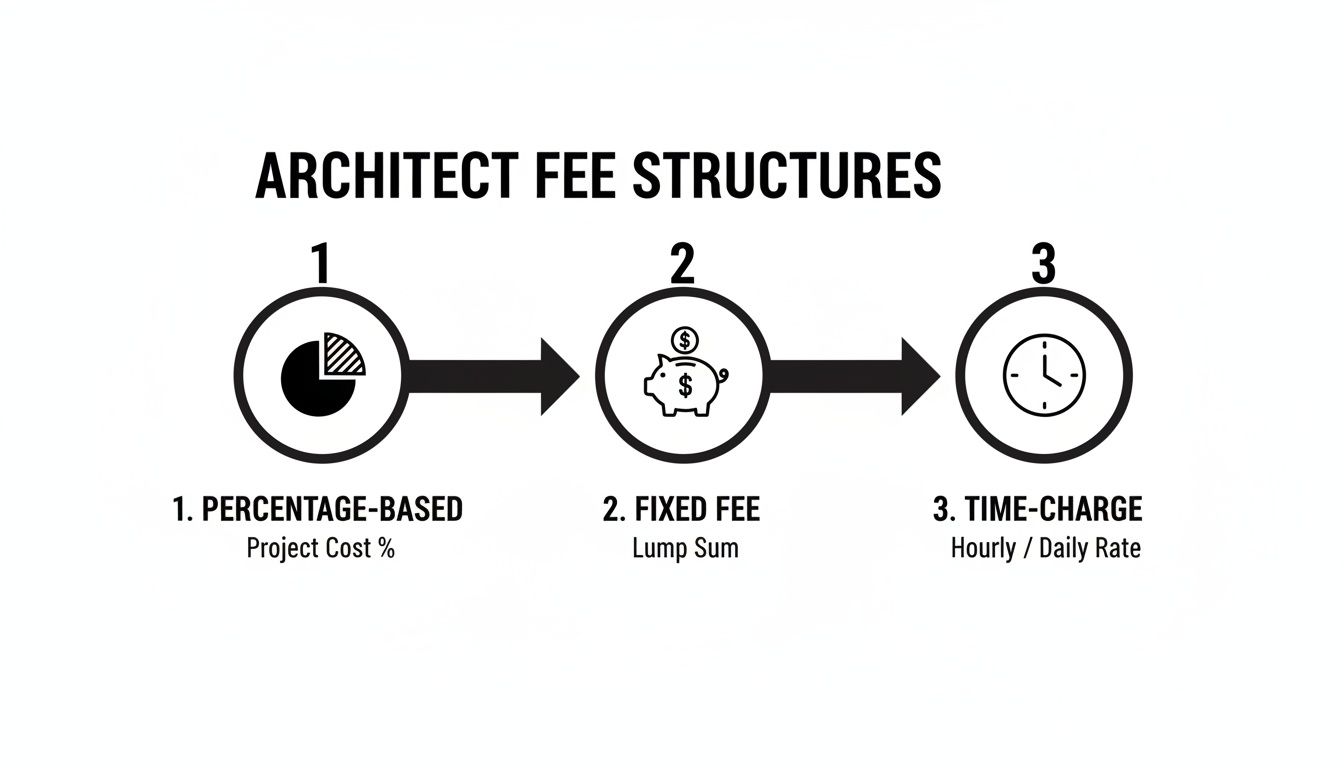
This helps explain how different models like percentage-based, fixed-fee, or time-charge billing are used for different kinds of projects.
From Paper Plans to Physical Reality
With planning permission in the bag, the project shifts gear from creative design to technical execution. This is where your architect's expertise really shines, preventing costly mistakes on-site and ensuring the quality of the build is second to none.
Stage 4: Technical Design: Now, your architect prepares an incredibly detailed set of technical drawings and construction notes. This package goes far beyond the planning drawings and is used to get Building Regulations approval, send the project out to builders for quotes, and form the basis of the building contract. It specifies absolutely everything, from the thickness of the insulation to the exact type of structural connections.
Stages 5-6: Construction & Handover: During the build, your architect is your representative on site. They'll administer the building contract, pop in for regular inspections, answer questions from the builders, and sign off on payments. This oversight makes sure the work is finished to the standard you expect, on time, and on budget. Finally, they manage the handover, making sure any small defects are fixed before you move in.
Your architect is your number one advocate during the construction phase. Their job is to protect your interests, make sure the final building is true to the design, and ensure the quality matches the vision you both worked so hard to create.
What Is Typically Not Included in Architect Fees
It’s just as important to be clear on what your architect's fee doesn't cover. Knowing this from the start helps you budget properly for the whole project without any nasty surprises.
Common exclusions are:
Statutory Fees: These are the charges from your local council for submitting Planning Applications and getting Building Regulations approval. You pay these directly to the authority.
Third-Party Consultant Fees: You'll likely need other experts like Structural Engineers, Party Wall Surveyors, or maybe a specialist heritage consultant. Your architect will find and coordinate them, but their fees are billed separately.
Surveys and Reports: The costs for things like topographical land surveys, asbestos reports, or detailed soil investigations are also additional expenses.
Understanding the full picture reveals the true value packed into architect fees UK. You aren’t just buying a set of drawings; you're investing in a complete design and management service that minimises risk and adds real, lasting value to your property. You can see the full range of our work by exploring our architectural services.
Key Factors That Influence Your Final Architect Fee
Ever wondered why one architect’s fee proposal can look so different from another, even for what seems like a similar project? The simple answer is that no two projects are ever truly the same. An architect’s fee is carefully calculated to reflect the specific time, skill, and complexity your unique vision demands.
Getting to grips with what drives these costs is essential. It helps you understand why a straightforward loft conversion has a completely different fee structure to a bespoke new build with a basement gym. Every design choice, from the materials you pick to the intricacy of the layout, has a direct impact on the amount of work involved—and, in turn, the final fee.
Project Scale and Complexity
The biggest factor influencing your architect’s fee is the overall complexity of the job. A simple single-storey rear extension on a modern, accessible property requires far less design time and coordination than a multi-level extension on a period home with challenging site access.
Think of it like this: building a standard flat-pack wardrobe is much quicker and easier than commissioning a piece of bespoke, fitted joinery for an awkward alcove. The latter requires more detailed design, precision measurements, and on-the-spot problem-solving.
Architectural projects work on the same principle. Factors that dial up the complexity include:
Ambitious Structures: Features like basement extensions, cantilevered elements, or large expanses of structural glass need intensive design work and close coordination with structural engineers.
Bespoke Features: Custom-designed staircases, unique window details, and intricate interior joinery all demand significant drawing time and specialist know-how.
Site Constraints: A sloping site, difficult access for machinery, or close proximity to neighbouring properties adds layers of planning and technical challenges that need to be carefully navigated.
Heritage and Conservation Status
Working with Listed Buildings or properties inside a Conservation Area is a specialist skill, and the architect fees will reflect that. These projects demand a deep understanding of historic building techniques, conservation planning policies, and sensitive design.
The process involves much more than standard design work. It includes preparing detailed heritage statements, engaging in lengthy negotiations with conservation officers, and specifying traditional materials and construction methods. This additional layer of research, justification, and management is a significant time commitment.
A project’s complexity is the primary driver of the professional fee. A £1 million new build on a simple, open site may require less architectural input than a technically challenging £500,000 renovation of a Grade II listed property in central London.
The Level of Service and Detail
The final piece of the puzzle is the level of service and bespoke detailing you need. A basic service for a planning application will naturally cost less than a full architectural service, where your architect manages the project from the first sketch to the final handover.
Likewise, a project with a high level of interior architectural detail—such as custom-designed kitchens, bathrooms, and lighting schemes—will require much more design time than one where standard, off-the-shelf products are used. Every unique element needs to be designed, specified, and coordinated with the wider team.
This link between project complexity and fees isn't new. Until the late 1980s, the Royal Institute of British Architects (RIBA) had “recommended fee scales” that acted as a benchmark across the UK. These scales often suggested higher percentage fees for more complex projects like bespoke homes. Although the official scales were withdrawn, their logic still holds true today, as intricate residential schemes continue to command higher fees simply because they demand more intensive design input and site time. You can explore detailed insights into historic UK fee data to see how these trends have evolved over the years.
How to Compare Proposals and Choose the Right Architect
When several fee proposals land in your inbox, it’s easy to feel a bit overwhelmed, especially if the numbers seem miles apart. But here’s a crucial piece of advice from our experience: the cheapest quote is rarely the best value. The real skill is looking past the headline figure to understand exactly what you’re getting for your money. This is the only way to make a fair, like-for-like comparison.

A detailed, transparent proposal is the hallmark of a professional practice. It’s a sign that the architect has genuinely listened, thought through your brief, and understood the complexities of what you want to achieve. Vague or overly brief proposals should be a red flag. They often hide an under-scoped service that could leave you facing costly extras and frustrating delays down the line.
Look Beyond the Headline Figure
When you’re laying proposals side-by-side, you need to analyse what’s included and—just as importantly—what’s been left out. A lower fee might look tempting at first glance, but it could mean the architect has omitted vital services, like contract administration during the build or detailed interior design work. This leaves you to manage these complex, time-consuming tasks all on your own.
To get to the bottom of it, ask yourself these critical questions for each proposal:
Are all RIBA Work Stages included? Does the fee genuinely cover the entire journey, from the first sketches right through to handing over the keys?
What are the specific exclusions? Get absolute clarity on what isn’t covered. Are fees for the structural engineer, party wall surveys, and planning applications all itemised separately?
Who will be my day-to-day contact? It’s important to know if you'll be working directly with a senior architect or a more junior team member. Consistent communication is the bedrock of a smooth-running project.
Understanding the True Cost of Value
Choosing the right architect is about finding a trusted partner, not just the lowest bidder. The relationship you build is fundamental to your project’s success. An experienced architect brings immense value to the table by navigating complex planning rules, managing contractors, and protecting the quality of the build—ultimately safeguarding your investment. For more on this, check out our guide on how to choose an architect in the UK.
It’s also helpful to be aware of the bigger picture. UK architectural fees have grown by approximately 48% in real terms between 2000 and the mid-2020s when adjusted for building cost inflation. For our clients commissioning high-end work in London, this means that while percentage bands might look similar to historical figures, the absolute fee has risen in line with construction costs and the level of professional expertise required.
A detailed and transparent proposal is a sign of professionalism. It demonstrates that an architect has taken the time to fully understand your vision and has thoughtfully costed the expertise required to bring it to life successfully.
Ultimately, your decision should come down to a mix of things: the clarity of the proposal, the architect’s relevant experience (especially with tricky sites, conservation areas, or listed buildings), your personal rapport, and the overall value they offer. A comprehensive proposal is your first clue that you’ve found a practice that is organised, thorough, and committed to your project from day one.
Common Questions About Architect Fees Answered
To wrap things up, let's tackle a few of the most common questions we get from homeowners about architect fees. These are the queries that often pop up in our initial conversations, and having the answers upfront can help you move forward with real confidence.
Are Architect Fees Paid All at Once?
No, you won't ever be expected to pay the entire fee in one go. Professional fees are always invoiced in stages, tied to key project milestones like completing the concept design or lodging your planning application.
Any reputable architect will give you a clear payment schedule right there in their fee proposal. This way, you know exactly what payments are due and when, which allows for transparent and predictable financial planning throughout your project.
Does a Higher Fee Guarantee a Better Outcome?
Not automatically, no. But what a realistic fee from an accredited practice does guarantee is that enough professional time and resources are being dedicated to your project. An unusually low fee can be a red flag, often hinting at an incomplete scope of services that can lead to expensive mistakes or omissions down the line.
The fee should always be a fair reflection of the expertise and level of service needed to deliver a high-quality, bespoke home. Think of it as an investment in a smooth process and an exceptional final result.
An architect’s fee is directly linked to the time and skill required to navigate your project’s unique complexities. A fair fee empowers them to protect your interests, manage quality, and deliver the value your home deserves.
Can I Negotiate Architect Fees?
It's generally far more productive to discuss the scope of services rather than trying to haggle over the headline percentage or hourly rate. If your budget is a key concern, a collaborative architect will be happy to explore different options with you.
This might involve:
Phasing the project to spread costs out over a longer period.
Adjusting the level of service for certain stages of the build.
Revisiting the design brief to find efficiencies without compromising on your core vision.
The goal is always to find a solution that delivers outstanding value while respecting your budget.
Why Are Architect Fees in London Often Higher?
Architect fees in London reflect several distinct local factors. For a start, overall construction costs are higher, and navigating planning in such a dense urban environment is inherently more complex. You also have the prevalence of heritage properties and conservation area constraints, which demand specialist knowledge.
On top of that, the professional overheads for practices based in the capital are simply greater. Experienced London architects possess the specific local knowledge needed to steer projects through these challenges successfully, and this expertise is naturally factored into their architect fees uk structure.
Ready to discuss the vision for your home? The team at Harper Latter Architects is here to provide the clarity and expertise you need for your bespoke project in Wimbledon or South West London. Contact us today for an initial consultation.
Comments