
How Much to Remodel a House: A UK Budgeting Guide
- Harper Latter Architects

- Feb 13
- 18 min read
The big question on everyone's mind: what does it actually cost to remodel a house in the UK? The figures can swing wildly, anywhere from £43,000 to over £110,000 for a typical three-bedroom home.
But for a bespoke, high-end renovation here in South West London, that number is really just the starting line. The final investment comes down to the real details: the scale of your vision, the quality of the finish, and the structural complexity of the work.
Your London Home Remodel: A Quick Cost Overview
Embarking on a home remodel is a serious commitment, and getting a firm grip on the potential investment right from the start is absolutely fundamental to a successful project. In London's unique property market, a one-size-fits-all budget just won’t cut it. The character of your home – whether it's a Victorian terrace in Richmond or a detached property in Wimbledon – demands a truly bespoke approach to financial planning.
At Harper Latter Architects, we believe realistic budgeting is the bedrock of every exceptional project we undertake. We guide homeowners through the financial maze, making sure there’s clarity and control at every single stage. This guide is designed to give you that initial clarity, offering a high-level view of what you can expect to invest in premium London postcodes.
Establishing a Realistic Financial Baseline
Before we get into the exciting specifics of extensions or bespoke joinery, it’s useful to get a feel for the general cost landscape. Recent data shows the average cost to renovate a three-bedroom house in the UK sits somewhere between £43,530 and £110,350, with a midpoint of around £76,690.
That’s a huge range, reflecting everything from simple cosmetic updates to full-blown structural overhauls. For homeowners in sought-after South West London postcodes, you can expect these costs to climb by 20-30% or more. This is down to higher labour rates and the specification of premium materials, which naturally pushes the total towards the upper end of that scale. You can dig deeper into the numbers by reviewing these detailed UK renovation statistics.
The chart below gives a visual snapshot of the typical cost brackets for a standard UK home remodel.
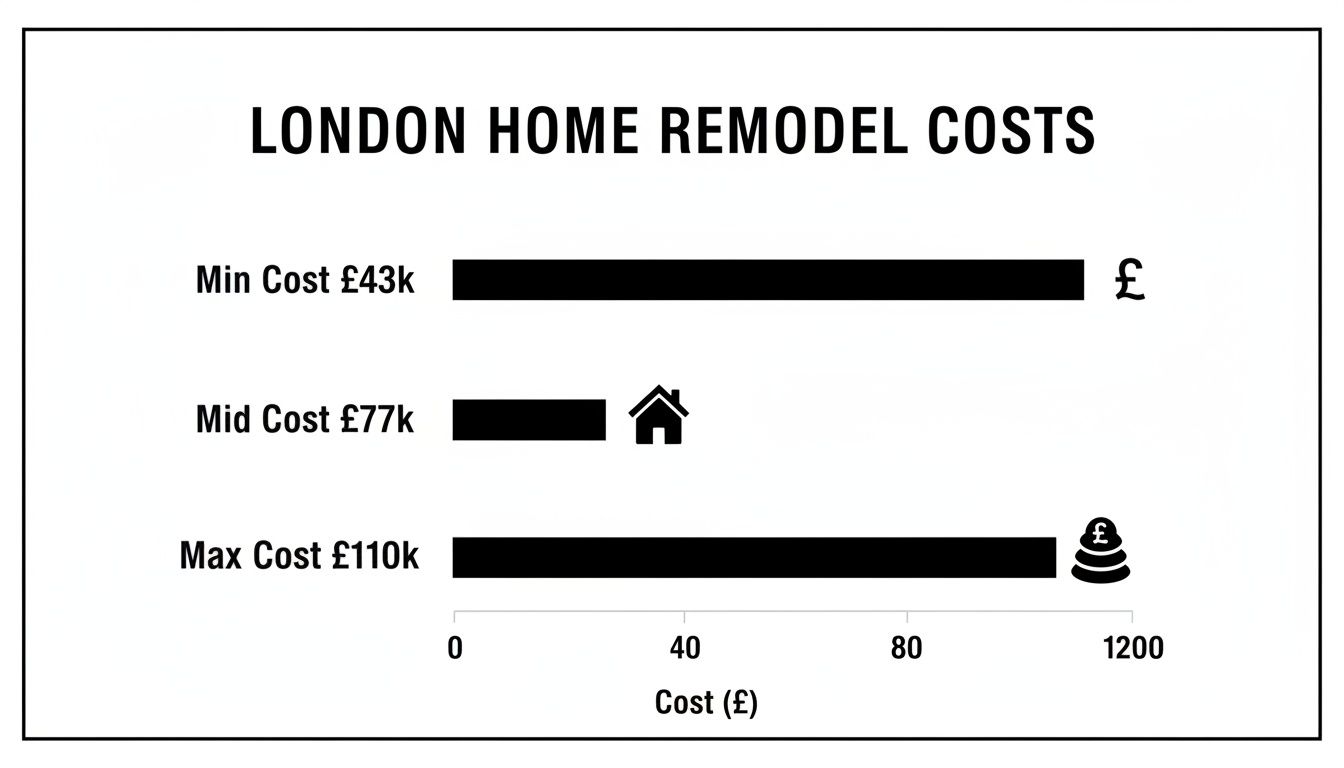
It’s a great illustration of the broad spectrum of investment involved, from basic refreshes to more ambitious transformations.
To give you a clearer idea of how this translates to projects in our local area, we've put together a quick reference table.
Estimated Renovation Costs in South West London at a Glance
This table provides a high-level summary of typical project costs in premium London postcodes, helping you quickly gauge potential investment levels.
Project Type | Typical Starting Cost (£) | High-End Bespoke Cost (£) |
|---|---|---|
Full House Refurbishment | £200,000 | £500,000+ |
Single-Storey Extension | £100,000 | £250,000+ |
Two-Storey Extension | £250,000 | £600,000+ |
Basement Conversion | £350,000 | £750,000+ |
Listed Building Works | £300,000 | £1,000,000+ |
These figures are, of course, a guide. The final cost will always depend on the unique aspects of your property and your specific ambitions for it.
Why a Bespoke Budget is Essential
While national averages offer a useful starting point, they simply can't capture the nuances of a high-end London renovation. Your final budget will be shaped by your personal vision, the architectural integrity of your property, and the level of quality you desire.
Here are a few key reasons why a personalised budget is non-negotiable:
Property Type: Renovating a listed or heritage building in a conservation area, for example, requires specialist skills and materials, which naturally drives up costs.
Level of Finish: The difference between off-the-shelf fixtures and custom-designed, handcrafted elements will have a huge impact on the final investment.
Project Ambition: A straightforward refurbishment will cost significantly less than a project involving a new basement or major structural alterations.
A well-planned budget isn't about limiting your vision; it's about realising it intelligently. By understanding the costs from the beginning, you can allocate resources effectively, ensuring every pound contributes to creating a home that truly reflects your lifestyle and aspirations.
Understanding the Key Drivers of Your Renovation Budget
So, why can one renovation project cost ten times more than another that looks similar on the surface? Getting to the bottom of this is the first step to building a budget you can trust. The final figure isn't just a number pulled from thin air; it's a careful calculation of several distinct, tangible elements.
Think of it like a balanced equation. If you change one variable, the total sum inevitably changes with it.
By breaking down the main things that drive costs, you can make smarter decisions and put your money where it will have the biggest impact for you. These drivers generally fall into four main categories, each playing a huge part in answering the real question: "how much will it really cost to remodel my house?"
The Specification Level
The specification is simply the quality and cost of every single material, fitting, and finish you choose for your home. This is almost always the biggest variable and the area where your personal taste directly influences the bottom line.
It’s like the difference between a high-street suit and a bespoke creation from a Savile Row tailor. Both will keep you warm, but one involves exceptional fabric, meticulous hand-craftsmanship, and a fit that’s uniquely yours. The exact same principle applies to your home.
Your choices here can create enormous cost differences. Just consider:
Kitchens: Are you thinking of standard laminate worktops, or are your sights set on bookmatched Calacatta marble? Will you choose well-made factory cabinetry or commission a joiner to create something entirely bespoke?
Bathrooms: A simple, attractive ceramic tile might cost £50 per square metre. High-end natural stone or designer porcelain, on the other hand, can easily climb past £300 per square metre.
Fixtures & Fittings: The price gap between a standard set of taps and a designer brassware collection from a premium brand can easily run into thousands of pounds for a single bathroom.
Structural Work and Complexity
Any work that involves changing the 'bones' of your house is considered structural work. The more complex these changes, the higher the cost for the engineering, specialist labour, and heavy-duty materials like steel beams.
In South West London homes, common structural jobs include removing walls for open-plan living, creating new openings for large glass doors, or building entirely new structures like extensions and basements. Each one needs meticulous planning and execution to ensure the building remains safe and sound.
The scale of structural work is what really separates a cosmetic refresh from a full-scale remodel. It’s the difference between repainting a room and completely changing its shape and function, which demands a much bigger investment in both professional expertise and the physical construction.
Mechanical and Electrical Systems (M&E)
Often hidden away behind walls and under floors, your home’s Mechanical and Electrical (M&E) systems are its central nervous system. This is everything from your plumbing and heating to your ventilation and electrical wiring.
A light refurbishment might just involve updating a few light fittings. But a high-end, comprehensive renovation almost always means a complete overhaul to support modern technology and comfort.
These M&E upgrades can include:
Full Rewiring: An absolute must in older properties to meet current safety standards and support modern appliances.
New Plumbing & Heating: This could mean installing underfloor heating or upgrading to a more efficient boiler and hot water system.
Smart Home Technology: Weaving in integrated systems for lighting, security, and home entertainment adds another layer of complexity and cost.
Ventilation: Systems like Mechanical Ventilation with Heat Recovery (MVHR) are becoming a hallmark of high-quality refurbishments, creating healthier and more energy-efficient homes.
Professional Fees and Statutory Approvals
Finally, a crucial part of any well-run project budget is allocated to professional fees. It’s important to see these not as a cost, but as an investment in getting the project designed beautifully, built correctly, and signed off legally.
These fees cover the expertise of your architect, structural engineers, and other specialist consultants. An experienced architect does far more than just produce drawings; they guide you through the entire maze, from the first sketch to securing planning permission and managing the building contract on-site.
This guidance is vital for navigating the technicalities of the construction process. You can learn more about building regulations compliance here to see how expert input makes this critical stage far simpler. Ultimately, professional oversight is what turns a good idea into a successful, stress-free project.
A Detailed Cost Breakdown for Major Renovation Projects
Now that we’ve covered the key cost drivers, let’s see how they play out in the real world. To truly get a handle on how much it costs to remodel a house, we need to move from general principles to the specific project types we see every day across South West London. This gives us tangible benchmarks to start planning from.
Every major renovation has its own unique character, but by looking at estimated costs per square metre (£/m²), we can build a solid foundation for your budget. It’s the industry-standard way to forecast build costs and offers a clear method for comparing the investment needed for different types of work.
Full House Refurbishments
A full house refurbishment is exactly what it sounds like—a comprehensive overhaul of your property. We’re talking about stripping the house back to its core structure, rethinking the layout, installing brand new mechanical and electrical systems, and applying beautiful new finishes throughout. It’s a chance to completely reimagine your home’s flow and feel.
For a high-specification refurbishment in sought-after areas like Wimbledon or Richmond, you should plan to budget between £2,500 and £4,000 per square metre. Where your project falls in this range will hinge on how much structural work is needed and, of course, the level of luxury you choose for the finishes.
Home Extensions
Extensions remain one of the most popular ways to bring valuable space and light into a London home. Whether it’s a side-return extension to create that magnificent open-plan kitchen-diner you've been dreaming of, or a multi-storey addition for new bedrooms, the structural complexity is what really drives the cost.
Single-Storey Extensions: These typically cost between £3,000 and £4,500 per square metre. The final figure is influenced by features like extensive glazing, high-performance doors, and the specification of the kitchen or living space you're creating. For a more detailed analysis, you might find our complete homeowner's guide to average extension costs useful.
Two-Storey Extensions: Adding a second floor naturally increases the complexity and, therefore, the cost. You should expect to budget from £4,000 to £5,500+ per square metre, as this involves more substantial structural work, foundations, and roofing.
Basement Conversions
Digging down to create new living space beneath your property is a highly specialised and structurally intensive project. Unsurprisingly, this makes it the most expensive on a per-square-metre basis. It requires serious excavation, underpinning, and robust waterproofing to create a warm, dry, and inviting environment.
A basement conversion in South West London is a significant undertaking. It often requires a budget of £5,500 to £7,500+ per square metre. This investment reflects not only the complex engineering but also the high-end finishes these spaces are designed for—think home cinemas, private gyms, or bespoke wine cellars.
The Premium for Heritage and Conservation Work
Working on a listed building or a property within a conservation area adds a whole other layer of complexity and cost. These projects demand a delicate touch, specialist craftsmanship, and the use of authentic, often expensive, materials to satisfy strict planning regulations. This essential expertise can add a premium of 20-40% to the overall build cost compared to a similar project on a non-listed property.
To put these London-centric figures into a wider context, renovating a typical two-bedroom house elsewhere in the UK usually costs between £107,900 and £147,300. This shows how property size directly shapes the budget. Here in South West London, where we operate, these figures often act as a starting point. They tend to climb upwards due to the London labour premium and our clients' preferences for luxury features like basement gyms or bespoke interiors.
To give you a clearer set of benchmarks, the table below outlines the typical build costs for different major projects.
Estimated Cost Per Square Metre for High-End London Projects
This table compares the typical build costs (£/m²) for different types of major renovation projects, providing a clear benchmark for budgeting.
Project Type | Average Cost per m² (£) | Key Influencing Factors |
|---|---|---|
Full House Refurbishment | £2,500 – £4,000 | Scope of structural change, M&E system upgrades, and level of interior specification. |
Single-Storey Extension | £3,000 – £4,500 | Amount of structural glazing, kitchen/bathroom specification, and bespoke joinery. |
Two-Storey Extension | £4,000 – £5,500+ | Structural complexity, roofing materials, and number of new bathrooms. |
Basement Conversion | £5,500 – £7,500+ | Depth of excavation, waterproofing system, and intended use (e.g., cinema, pool). |
Conservation / Listed Work | +20-40% Premium | Requirement for specialist trades, heritage material sourcing, and planning constraints. |
These figures are your foundational guides. The next step is to understand how bespoke elements within these spaces—from custom staircases to curated garden rooms—will further shape your investment.
Budgeting for Bespoke Interiors and Luxury Landscapes
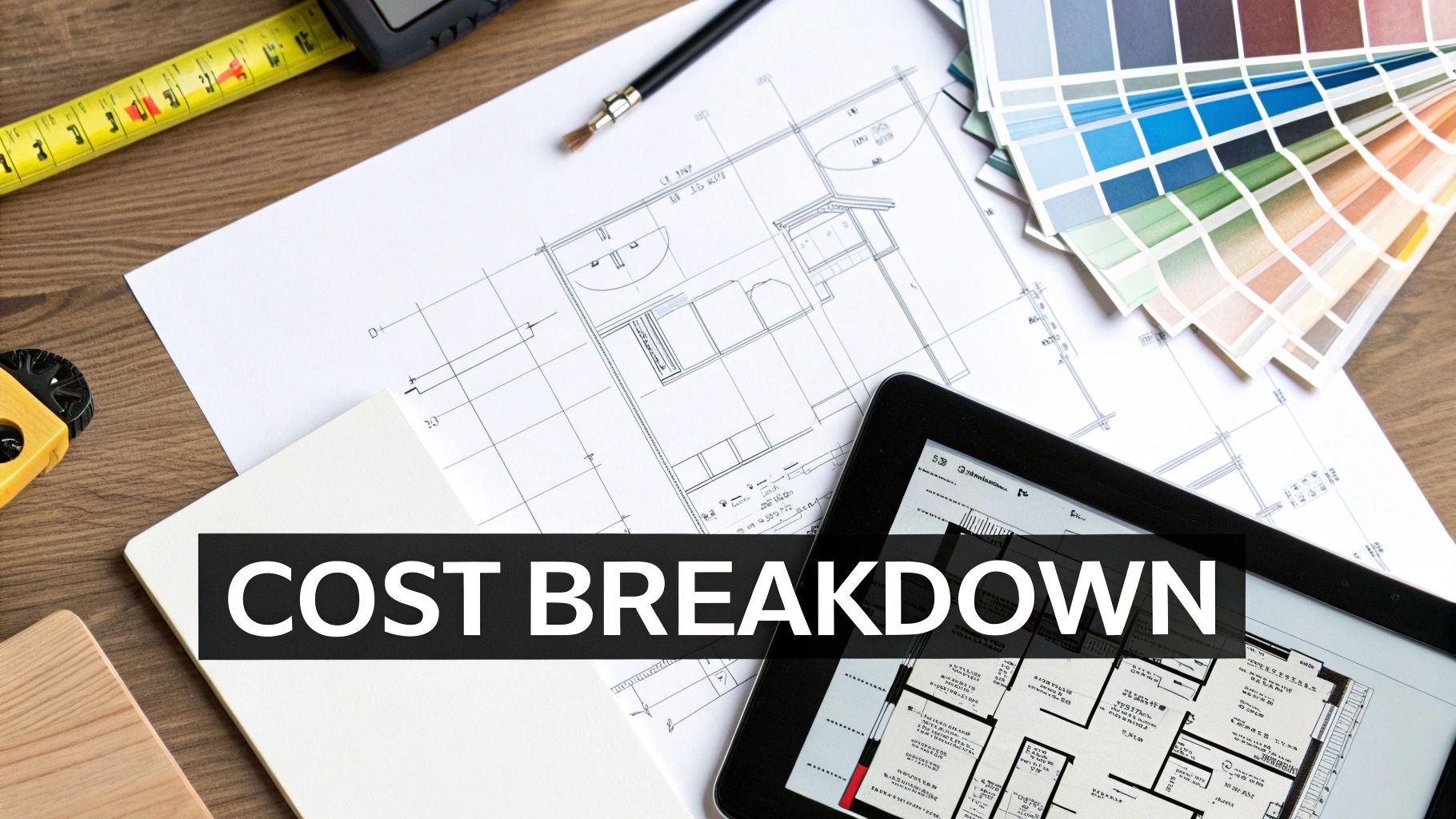
This is where a house truly becomes a home. The bespoke details—the things designed and crafted just for you—are what elevate a property from a well-built structure to a personal sanctuary. Off-the-shelf solutions simply can't compete.
Of course, when you start exploring how much to remodel a house with features like handcrafted joinery or a sculptural staircase, you quickly see where the real investment lies. These aren't just aesthetic flourishes; they are integral parts of the architecture that add genuine, lasting value.
Some of the key bespoke interior elements we often work with include:
Custom joinery from skilled artisans, which typically ranges from £1,500 to £5,000 per linear metre.
Feature staircases with real architectural presence, which can start from £20,000 and climb to over £50,000 depending on the complexity and materials.
Climate-controlled wine cellars, which average between £15,000 and £30,000 based on capacity and the level of finish.
As you can see, it's crucial to have clear discussions about these kinds of luxury fittings right from the start to ensure they are properly accounted for in your budget.
Cost Breakdown for Signature Interior Features
Elements like custom staircases and joinery often become the centrepieces of an interior design, and rightly so, they command a significant portion of the budget.
A beautifully curved oak staircase, for instance, can easily cost double what you'd pay for a standard design. That’s why we always recommend ring-fencing a specific amount for these 'hero' pieces early on, so there are no difficult conversations or compromises down the line.
“Investing in quality joinery early avoids mid-project surprises and ensures the final finish is exactly what you envisioned.” – Leading Renovation Expert
Now, let's take that same thinking outside.
Budgeting for High-End Garden Structures
Creating a true 'outdoor room'—a space that feels like a natural extension of your home—is a popular ambition for our clients in South West London. A high-quality garden room can cost anywhere from £20,000 to £60,000, with the final figure depending on foundations, the extent of glazing, and any bespoke furniture.
Similarly, a fully equipped outdoor kitchen can range from £15,000 to £40,000, depending on your choice of appliances and finishes.
Here’s a rough breakdown:
Garden Rooms: * Simple, well-built timber-framed pods start around £20,000. * More ambitious glazed studio spaces with services can begin from £40,000.
Outdoor Kitchens: * A good setup with a built-in BBQ and prep area will start at £15,000. * Luxury installations with refrigeration, sinks, and high-end finishes can easily exceed £30,000.
Hard Landscaping: * Paving and terrace work generally costs £100 to £200 per m². * Water features are a significant investment, typically from £5,000 to £20,000.
All these elements need to be considered together as you plan the total investment in your property's bespoke features.
Integrating Interiors and Gardens Cohesively
Creating that seamless flow between your house and garden is about more than just installing bifold doors. It requires a unified design vision. Factoring this in often adds 10–15% to your interior budget, but the result is well worth it.
This budget allows for a considered approach where materials and colour palettes move effortlessly from inside to out. Think about echoing the grain of your indoor oak flooring in the garden decking or continuing a specific stone from the kitchen into the terrace paving.
A cohesive design that bridges the interior and the landscape creates a unified, flowing experience that feels effortlessly luxurious.
A sample budget for a project combining both interior and landscape packages might look something like this:
Feature | Estimated Cost (£) |
|---|---|
Custom Joinery | £15,000–£40,000 |
Feature Staircase | £20,000–£50,000 |
Wine Cellar | £15,000–£30,000 |
Garden Room | £20,000–£60,000 |
Outdoor Kitchen | £15,000–£40,000 |
Hard Landscaping | £10,000–£25,000 |
Total Indicative Range | £95,000–£245,000 |
Of course, these are indicative figures. The final costs will always depend on site-specific constraints, access, and any planning permissions required.
Tips for Controlling Luxury Fit-Out Costs
Even with a healthy budget, smart financial control is key. Here are a few ways to manage costs without compromising on the vision:
Lock in your specification early. The single biggest cause of budget creep is changing your mind on finishes and fixtures once work has started.
Work with your architect to value engineer. We can help identify areas where you can make savings on non-essential elements without affecting the overall design integrity.
Bundle your tenders. Ask your main contractor to tender for both the interior and landscaping work together to achieve better economies of scale.
Consider reclaimed or second-life materials. For certain fittings, using high-quality reclaimed materials can reduce costs and add unique character.
Case Study: Wimbledon Garden Pavilion
We recently worked on a project in Wimbledon where the client invested £45,000 in a beautiful glazed garden pavilion.
The 30m² space was designed as a seamless extension of their home, featuring underfloor heating, full-height glazing, and bespoke oak shelving. It completely transformed how they used their garden.
The total budget for the combined interior and landscape work was £150,000. This was split roughly 40% on interior joinery and 60% on the garden pavilion and surrounding terraces. When the property was later valued, the client reported that this work was perceived to have added at least £60,000 to the resale price—a fantastic return.
An impressive uplift, indeed.
With a clearer idea of the costs involved, you can begin to set a realistic budget for the bespoke elements of your renovation. The best approach is always to prioritise your 'must-have' features first, and then we can help you refine the scope from there.
Smart Financial Planning for Your Home Remodel
A truly successful renovation isn’t just about inspired design; it’s built on a foundation of robust financial management. Knowing the ballpark cost to remodel your house is one thing, but keeping that figure under control requires a clear, structured plan from day one.
An architect-led process brings exactly this kind of financial rigour. It protects your investment and ensures the journey is as seamless as the final result. This section is all about actionable advice for keeping your project on track and, crucially, on budget.
Building Your Comprehensive Project Budget
Let’s be clear: your total project budget is much more than the builder's quote. A proper budget is a detailed document that anticipates every single expense, leaving no room for nasty surprises down the line. It needs to be broken down into clear categories to give you the complete financial picture.
An effective budget should always include:
Construction Costs: The main build contract, covering all the labour and materials.
Professional Fees: This covers your architect, structural engineer, party wall surveyor, and any other specialist consultants.
VAT: This is a big one. It's vital to remember that a builder’s estimate is often quoted exclusive of VAT. You must add 20% to the construction cost.
Contingency Fund: Your non-negotiable safety net for any unforeseen issues that crop up.
Statutory Fees: The necessary costs for planning applications and building control inspections.
Specialist Items: Separate budgets for things like bespoke joinery, kitchens, and landscaping that might fall outside the main build contract.
The Non-Negotiable Contingency Fund
No matter how meticulously a project is planned, older properties – particularly in London – have a habit of revealing surprises once work begins. This is why a contingency fund of 10-15% of the total construction cost is absolutely essential.
It’s not a slush fund for upgrades on a whim. It is a dedicated reserve to cover unexpected but necessary work, like dealing with hidden structural issues or needing to reroute drainage.
Think of your contingency fund as project insurance. You hope you never have to use it, but if you do, it prevents a minor hiccup from becoming a major financial crisis. It keeps your project moving without delay or compromise.
Having this fund in place offers incredible peace of mind and financial resilience. It’s the hallmark of any professionally managed project and a cornerstone of responsible budgeting.
Strategies for Managing Costs Without Compromise
Controlling your finances doesn't mean you have to sacrifice quality. With an experienced architect on board, you can employ several professional strategies to manage your budget effectively while still achieving that high-end finish you’re looking for.
One of the most powerful techniques we use is value engineering.
Value engineering is simply a systematic process of reviewing the design to find more cost-effective alternatives that don't impact the overall aesthetic or quality. For example, we might suggest specifying a different but visually identical stone for a worktop, or reconfiguring a steel design to be more efficient. It’s about making smart choices, not cheap ones.
This architect-led approach gives you continuous financial oversight. We help you secure competitive tenders from trusted contractors, we administer the building contract rigorously, and we manage payments based on verified work. This structured process provides complete financial transparency and control, turning your vision into a beautifully executed reality—on time and on budget.
How an Architect Delivers Value and Manages Your Budget
When you start asking, "how much to remodel a house?", it’s easy to focus almost entirely on the bricks-and-mortar construction costs. But one of the smartest investments you can make is in the expertise that guides the whole process. Bringing a RIBA-accredited architect on board isn’t just another line item on a spreadsheet; it’s a strategic move that adds real value, gives you financial control, and ensures the finished home is everything you hoped for.
Think of an architect as your advocate and creative partner, right from the very first sketch. Our job is to translate your vision into a design that is not only beautiful but also practical and buildable within your budget. This early-stage thinking is absolutely crucial. We can suggest intelligent design solutions that deliver the aesthetic you love without needless expense, making sure your money is spent on the things that truly matter to you.
Securing Quality and Competitive Costs
Once we’ve nailed down the design, an architect’s role in managing your budget becomes even more direct. We produce a full set of detailed technical drawings and specifications. This is the key that unlocks a true, like-for-like comparison when you get prices from contractors. This meticulous preparation is fundamental to receiving accurate, competitive quotes.
Without this level of detail, you're often left trying to compare vague estimates that can easily hide future costs. We run the tender process for you, inviting trusted, vetted contractors to bid for the work. This not only ensures you get a fair market price but also that you end up with a builder who has a proven track record of quality – something that’s non-negotiable for a high-end project in South West London.
"A well-managed tender process, led by an architect, removes ambiguity and protects the homeowner. It ensures that the price you agree upon is for the quality you expect, preventing costly disputes and budget creep down the line."
This rigorous approach to finding a builder is a cornerstone of effective budget management. It establishes a clear, legally binding framework for the construction phase, which we then oversee on your behalf.
Expert Guidance Through Every Stage
Beyond design and tendering, our role involves navigating the maze of planning permission, which is especially complex for properties in conservation areas or those with listed status. Our experience here prevents costly delays and the need for frustrating redesigns. For a deeper dive into this, our guide on UK architects' fees and budgeting offers some really valuable insights.
Once construction is underway, we’re on-site regularly, administering the building contract. This means we are:
Controlling Quality: Making sure the work being done on-site perfectly matches the drawings and meets the highest standards of craftsmanship.
Managing Costs: Signing off on payments to the contractor only for work that has been completed to the agreed standard.
Solving Problems: Dealing with any unexpected site issues quickly and effectively, shielding you from potential headaches and complications.
This constant professional oversight turns what could be a stressful and financially unpredictable process into a structured, well-managed journey. By partnering with an architect, you aren't just buying a set of drawings; you're investing in a service that protects your budget, champions quality, and ultimately delivers a home that is a true reflection of your vision.
Your Renovation Cost Questions Answered
We know that budgeting for a major home renovation in London can feel like navigating a minefield. To help you find your footing, here are answers to some of the most common questions we hear from homeowners.
Why Do Quotes from Different Builders Vary So Much?
It’s a classic scenario: you send your plans out to three builders and get three wildly different prices back. It’s confusing, to say the least. The problem almost always comes down to a lack of detail.
If your architect hasn’t produced a comprehensive set of technical drawings and a detailed schedule of works, builders are left to guess. They have to make assumptions about the quality of materials, the complexity of the work, and the level of finish you’re expecting. Their price will reflect their best guess, which is why the numbers can be all over the place.
This is where a proper tender package, which we manage for you, makes all the difference. We ensure every builder is pricing the exact same scope of work, right down to the last light switch. It levels the playing field, removes the guesswork, and gives you a true, like-for-like comparison. That’s how you know you’re getting a fair market price for the calibre of home you want.
Should I Factor in VAT on Top of My Build Cost?
Absolutely. This is a big one, and it catches so many people out. When you get a quote from a builder, it’s almost always quoted exclusive of Value Added Tax (VAT). You must always add 20% to the total construction cost to get a realistic idea of what you’ll actually be paying.
Forgetting to account for VAT can blow a 20% hole in your budget right from the start. We make sure this is clearly itemised in your project finances from day one, so there are no nasty surprises waiting for you down the line.
It's a fundamental rule of project budgeting: the builder's price is not the final price. Always add VAT and a contingency fund to understand the true total investment required.
How Can I Save Money Without Lowering the Quality?
Controlling costs doesn’t have to mean compromising on your dream home. The single most effective way to protect your budget is to finalise every decision on materials, finishes, and fittings before a single builder sets foot on site.
Changing your mind mid-project is the number one cause of budget creep. It creates a domino effect of delays, re-ordering costs, and additional labour charges. Decisiveness at the design stage is your best friend.
Working with an architect also opens the door to value engineering. This isn't about cutting corners; it's a collaborative process where we look for smart efficiencies. We might identify an alternative natural stone for a worktop that’s visually identical but comes at a fraction of the price, or suggest a subtle structural change that saves thousands without impacting the design. It’s about being clever with your money, not cheap with your home.
Ready to turn your vision into a meticulously planned and beautifully executed reality? The team at Harper Latter Architects is here to provide the clarity and expertise your project deserves. Contact us today to arrange your initial consultation and take the first step towards creating your exceptional London home.
Comments