
UK Architects Fees: A Homeowner's Guide to Budgeting

Embarking on a building project is exciting, but let’s be honest—one of the first questions on everyone's mind is always about the cost. So, how much should you budget for an architect?
For most residential projects here in the UK, architect fees typically land somewhere between 8% and 17% of the total construction cost. This isn’t a one-size-fits-all figure, of course. The final percentage will hinge on the complexity of your project, its location, and exactly how much support you need from us.
How Much Do Architects Actually Cost in the UK?

Getting to grips with how UK architects structure their fees is the first real step towards budgeting for your project with confidence. There’s no single price list for architectural services. Instead, the cost reflects the expertise, creativity, and careful management required to bring your vision to life. Think of it as an investment in maximising your property’s potential, navigating the complexities of construction, and ensuring a high-quality result.
It stands to reason, then, that the fee for a straightforward new build in Surrey will be quite different from that for a complex heritage renovation in Wimbledon Village. The level of detail needed, the unique challenges of the site, and the intricacy of the design all play a major role in shaping the final cost.
The Modern Approach to Fees
The way fees are structured today has evolved quite a bit. Believe it or not, until 1982, the Royal Institute of British Architects (RIBA) had mandatory fee scales based on a percentage of the build cost. This kept things uniform but didn’t leave much room for competition. These scales were eventually abolished in 2009, opening up a free market where practices like ours can tailor fees to the project. You can discover more about the history of architects fees and see how it affects today's market.
This change really empowers homeowners. It allows you and your architect to agree on a fee structure that provides genuine value for your specific project. In our experience, three main models have become the industry standard:
Percentage of Construction Cost: This is the most common approach for full residential projects, where the fee is a set percentage of the final build cost. It scales with the project.
Fixed Lump-Sum Fee: A single, agreed-upon fee. This works brilliantly for projects with a very clearly defined scope right from the beginning.
Time-Charge or Hourly Rate: Often used for initial consultations, feasibility studies, or smaller, ad-hoc tasks where the scope isn't yet set in stone.
To make things clearer, let's break down how each of these fee structures works in practice.
Architect Fee Structures at a Glance
This table offers a quick summary of the three primary fee models you'll encounter when discussing your project with a UK architect.
Fee Model | How It Works | Best Suited For |
|---|---|---|
Percentage Fee | The fee is a pre-agreed percentage (e.g., 12%) of the final construction cost. It's billed in stages. | Full architectural services for entire projects, from concept to completion. |
Fixed Fee | A single, lump-sum price for a clearly defined scope of work. It won't change unless the scope does. | Projects with a very predictable scope, like drawing up planning application documents. |
Hourly Rate | You pay for the actual time the architect spends on your project, based on an agreed hourly rate. | Initial feasibility studies, consultations, or small, undefined packages of work. |
Each model has its place, and the best one for you will depend entirely on the nature of your project and the services you require.
An architect's fee is not just a cost—it is an investment in a professional partner who will guide your project from a simple idea to a beautifully realised home, championing quality and protecting your interests every step of the way.
Breaking Down the Three Core Fee Structures
Getting a handle on how architects calculate their fees is the first step towards building a realistic and confident project budget. There’s no secret formula, just a few different methods suited to different types of projects. Once you understand these three core structures, you'll be able to have a much clearer conversation about the investment you're making in your home.
The way an architect prices their services is usually a direct reflection of the project's nature. A job with a clearly defined, locked-in scope is a perfect candidate for one model, while a more fluid, exploratory commission will naturally suit another. Let’s demystify the three main approaches you'll come across.
The Percentage of Construction Cost Model
This is by far the most common fee structure for full residential projects, from new builds to extensive refurbishments. The architect’s fee is simply calculated as a pre-agreed percentage of the final, certified construction cost.
Think of it as a sliding scale that keeps the architect's fee aligned with the scale and ambition of your project. This model ensures that as the scope of work evolves—perhaps you decide to upgrade your kitchen specification or add a garden room—the professional services needed to design and manage that work are fairly accounted for.
For example, a £500,000 new build might have a fee of 9%, while a more intricate £150,000 basement extension, which demands more complex technical detailing and coordination, could be set at 12%. This approach keeps everyone’s interests pointing in the same direction, as it’s in both your and the architect's best interest to manage the construction budget effectively.
The Fixed Fee or Lump-Sum Model
In contrast to the percentage model, a fixed fee gives you complete cost certainty right from the start. This approach is ideal for projects where the scope of work is perfectly defined and isn't expected to change.
A fixed fee is a contractually agreed lump sum for a specific set of architectural services. This provides absolute clarity on costs, making it a popular choice for distinct stages of a project, such as producing drawings for a planning application.
This model works brilliantly when you can provide a very precise brief. Let's say you only need an architect to produce the drawings and documents for a planning submission. The work involved is predictable, so a fixed fee can be accurately calculated. This gives you a clear, upfront cost with no variables tied to the final construction budget.
The crucial thing to remember, however, is that if the scope of the project changes significantly, the fixed fee will need to be re-negotiated to cover the additional work required.
Time-Charge or Hourly Rates
The third common structure is a time-charge basis, where you pay for the architect's time at an agreed-upon hourly or daily rate. In the UK, these rates often start from around £90 + VAT per hour and vary depending on the seniority and experience of the professional involved.
This pay-as-you-go model offers maximum flexibility and is perfectly suited for the very early stages of a project or for one-off professional advice.
It is particularly useful for:
Initial Feasibility Studies: When you're just exploring what might be possible on a site before committing to a full design process.
Pre-Application Planning Advice: Engaging an architect to consult with the local authority or provide high-level advice on planning strategy.
Specific, Unforeseen Tasks: If a particular issue pops up during the project that falls outside the original scope, it can be handled cleanly on an hourly basis.
While excellent for its flexibility, this model isn't really suitable for an entire project, as the final cost isn’t fixed and can be difficult to predict over a long period. At Harper Latter Architects, we often use this for initial consultations to help clients explore their vision before we move on to a more structured fee proposal.
Architect Fee Benchmarks for Your Project Type
Not all residential projects are created equal, and neither are the fees an architect will propose. The complexity, scale, and specialist knowledge required all have a say in the final percentage. Getting a handle on the typical fee benchmarks for your specific project is the key to creating a realistic and robust budget from the get-go.
A straightforward new build on an open plot, for instance, is a very different beast to a major refurbishment of a Victorian terrace. While both demand immense skill, the second involves navigating the quirks and challenges of an existing structure, which can unearth all sorts of unforeseen issues. This difference in complexity is reflected directly in the fee structure.
New Builds: A Clean Slate
For a standard new build project, you can generally expect architect fees to fall somewhere in the 8-12% range of the total construction cost. New builds offer a ‘clean slate’, which allows for a more streamlined design and construction process without the constraints of existing walls, foundations, or tricky neighbouring properties.
That said, the percentage often scales with the project's value. In the UK, it's common for architect fees on residential projects to decrease as the construction budget grows, rewarding more ambitious builds. For a new build with a £100,000 budget, fees might hover around 10.5%. This could drop to 9.5% for a £200,000 project, 9% at £500,000, and 8.5% for a build costing £1 million or more. This sliding scale simply reflects the efficiencies gained on larger, more valuable projects.
Extensions and Major Refurbishments
When you’re working with an existing building, the complexity jumps up a notch. For this reason, fees for extensions and large-scale refurbishments typically sit in a higher bracket, usually between 10-15%.
So, why the increase?
Structural Integration: The new design has to be woven seamlessly and safely into the old structure.
Site Constraints: Access is often more difficult, and work must be carefully planned around the parts of the home you're still living in.
Unforeseen Conditions: It’s not uncommon to discover hidden structural issues or outdated wiring once work begins.
A well-designed extension isn't just an add-on; it's a careful reorganisation of the entire home. For a deeper dive into this specific area, our guide on architect fees for an extension demystifies the costs involved.
Conservation and Heritage Projects: The Specialist Tier
Projects involving listed buildings or properties within conservation areas demand the highest level of expertise and, as you’d expect, command higher fees. For this type of specialist work, expect fees to range from 13-17%, and sometimes even more.
Engaging an architect for a heritage project is not just about design; it's about custodianship. The fee reflects the intricate process of navigating specialist surveys, sourcing rare materials, and conducting delicate negotiations with conservation officers to protect and enhance a piece of history.
This premium is entirely justified by the extra layers of work and responsibility involved:
Heritage Statements: Producing detailed reports that justify every proposed change.
Specialist Consultants: Coordinating with conservation experts and structural engineers who specialise in historic buildings.
Material Sourcing: Identifying and specifying historically accurate or appropriate materials and craftsmanship.
Planning Negotiations: Engaging in detailed, often lengthy, discussions with local authority conservation officers.
To put it into perspective, a £100,000 extension to a non-listed property might incur fees of around £12,000 (12%). The same value of work on a Grade II listed building could see fees closer to £16,000 (16%) to account for all the additional specialist services needed to gain consent and ensure the work is carried out sympathetically.
To give you a clearer picture, here’s a quick comparison of how fee percentages typically look across different project types and budgets.
Indicative Architect Fee Percentages in the UK
Project Type | Construction Budget £150k | Construction Budget £500k | Construction Budget £1M+ |
|---|---|---|---|
New Build | 10% - 12% | 9% - 10% | 8% - 9% |
Extension/Refurbishment | 12% - 15% | 11% - 13% | 10% - 12% |
Listed Building/Conservation | 14% - 17% | 13% - 15% | 12% - 14% |
As you can see, the trend is consistent: more complex projects command a higher percentage, while larger budgets benefit from economies of scale. These figures are a helpful starting point, but every project is unique, and a detailed quote from your architect will give you the true picture.
Mapping Your Fees to the RIBA Plan of Work
When you hire an architect, you're not just writing one big cheque at the start. Instead, think of it as a series of structured payments tied directly to tangible progress on your project. This approach brings much-needed clarity and predictability to the process. In the UK, this entire journey is mapped out by the industry-standard RIBA Plan of Work.
This framework breaks down a project into eight distinct stages, from the initial brainstorming (Stage 0) all the way through to checking in after you’ve moved in (Stage 7). By linking fee payments to the completion of these stages, you always know exactly what you’re paying for and which milestone has just been hit. It turns a large, daunting expense into a manageable, phased investment.
This infographic gives you a quick visual reference for how fee percentages tend to vary based on the main project types we’ve already covered.
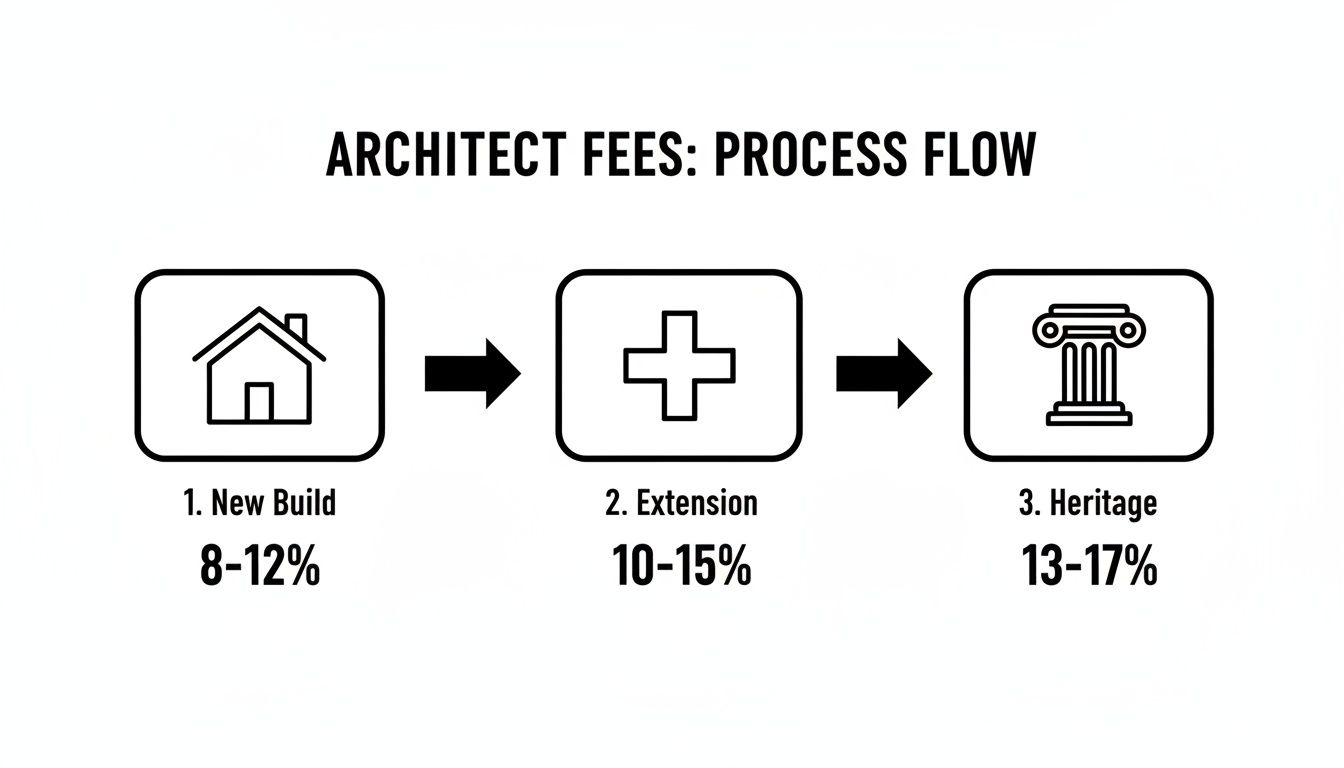
As you can see, complexity is a huge driver of cost. An intricate heritage project rightfully commands a higher fee percentage than a more straightforward new build.
How Fees Are Distributed Across RIBA Stages
A professional fee proposal from a practice like ours will break down the total fee into percentages allocated to each key work stage. Every project has its own unique rhythm, but a common distribution might look something like this. The key takeaway? You only pay for work as it gets done.
This de-risks the whole process for you. You're investing in clear, concrete deliverables at each step, not just a vague promise of a finished building months down the line. To get a better handle on this framework, you can learn more about the RIBA Plan of Work in our detailed guide for homeowners.
The RIBA Plan of Work provides a transparent roadmap for your project. Fee payments are linked to the successful delivery of each stage, giving you complete control and visibility over your investment from the initial sketch to the final handover.
So, let's look at what this means in practice.
A Practical Breakdown of Fee Payments
Here’s how a typical fee structure might be phased out, linking your payments to specific, valuable outcomes:
Stages 0-2 (Preparation and Brief, Concept Design): ~20% of Total Fee This initial investment covers the absolutely crucial groundwork: defining your vision, checking feasibility, and developing the first concept designs. It’s the foundation for everything that follows, culminating in the drawings you’ll need for your planning application.
Stage 3 (Developed Design): ~15% of Total Fee Once planning permission is in the bag, this phase is all about refining the design. Your architect will start coordinating with other consultants, like structural engineers, to develop a more detailed and coherent scheme, firming up the project's overall form and material palette.
Stage 4 (Technical Design): ~35% of Total Fee This is often the most intensive stage of the design process. Your architect produces the highly detailed construction drawings and specifications that builders will use to price up and construct your home. This technical package is vital for getting accurate quotes and for securing Building Regulations approval.
Stages 5-6 (Construction and Handover): ~30% of Total Fee The remaining fee covers your architect’s essential role during the build itself. This isn't a hands-off stage; it includes administering the building contract, carrying out regular site inspections to check on quality, and managing the whole process right through to practical completion and handing you the keys.
This structured payment schedule ensures your financial commitment always lines up with the project's progress. It provides real peace of mind and maintains a fair, transparent partnership between you and your architect from start to finish.
What Your Architect's Fee Actually Covers
When you agree to an architect's fee, it’s crucial to understand exactly where that investment is going. It’s not just a single payment for a set of drawings. Think of it as investing in a comprehensive professional service designed to steer your project from a fledgling idea to a beautifully realised home. It’s an investment in expertise, creative problem-solving, and meticulous project management.
This fee covers the entire design journey. It starts with developing initial concepts and sketches, moves through the complexities of preparing and submitting planning applications, and culminates in producing the highly detailed technical drawings your builder will work from. It also includes the architect's vital role during the construction phase, where they administer the building contract and carry out site inspections to ensure quality is upheld.
What Your Fee Typically Includes
A standard full-service fee from a practice like ours is structured to cover all core architectural tasks. This gives you a seamless, end-to-end service that protects your interests and champions the quality of the final build.
Your fee will almost always cover:
Initial Feasibility and Concept Design: Exploring what's possible with your property and developing the creative vision.
Planning Application Submission: Preparing all the necessary drawings, design statements, and forms to secure local authority approval.
Technical Design and Building Regulations: Creating the detailed, construction-ready drawings and specifications needed for Building Control approval and for your contractor to build from.
Tender Process Management: Helping you select a suitable contractor by preparing tender documents and evaluating the submissions.
Contract Administration During Construction: Regularly visiting the site, monitoring progress against the plans, certifying payments to the builder, and managing the project right through to completion.
Understanding the full scope of services is vital. Your architect’s fee isn’t just for design—it’s for the professional oversight, coordination, and administration that ensures your vision is executed correctly, on time, and to the highest standard.
What Is Usually Excluded From the Fee
Just as important as knowing what’s included is understanding what isn’t. Certain costs are almost always separate from your architect's professional fees. These are third-party charges and specialist consultant fees that you'll need to budget for separately to build a complete, realistic financial picture.
Don't worry, these exclusions are standard across the industry—they aren't hidden extras. They simply represent distinct, necessary services provided by other professionals.
Key Costs to Budget for Separately
To avoid any surprises down the line, make sure you have allocated funds for these common additional expenses:
Local Authority Fees: This includes the council’s charge for submitting your planning application and the separate fee for a Building Control submission.
Structural Engineer’s Fees: An engineer is essential for designing and certifying all structural elements, like steel beams or new foundations.
Other Specialist Consultants: Depending on your project, you might need reports from a party wall surveyor, a heritage consultant for a listed building, or an approved inspector for building control.
VAT on Professional Fees: And don't forget, VAT at 20% is usually chargeable on all professional fees, including your architect's. This is separate from the VAT on the construction costs, which can sometimes vary.
The landscape for UK architects' fees changes quite a bit depending on the project type and region. For instance, high-end residential work in affluent areas like Wimbledon Village often sees premiums due to complexity and higher client expectations—a challenge expertly handled by specialists like Harper Latter Architects.
As a general rule, new builds typically command a fee of around 8-13% of the build cost. This is often lower than extensions, which can be 12-15%, simply because a new site offers a blank canvas, whereas a retrofit involves grappling with an existing, often complex, structure. To dig deeper, you can read more about how architects' fees in the UK are structured and better understand these nuances.
Choosing Your Architect and Evaluating Fee Proposals

Picking the right architect is probably the single most important decision you’ll make for your entire project. When you have a few fee proposals sitting on your desk, it’s all too easy to let the lowest number make the choice for you. But be warned: this is often a false economy. The cheapest quote rarely translates to the best value.
A truly great proposal is so much more than a headline figure. It should clearly show that the architect understands your vision, lays out a comprehensive scope of work, and feels like the start of a partnership, not just a transaction. Your goal should be to find an expert who will protect the quality of your project and act in your best interests from day one.
Looking Beyond the Headline Figure
When you’re comparing proposals, price alone is a terrible compass. A low fee might just reflect a very limited service, perhaps only covering the absolute basics to get a planning application submitted. On the other hand, a more detailed proposal might include immersive 3D models, robust specifications, and thorough coordination with consultants—all things that prevent expensive mistakes down the line.
To properly weigh up a proposal, you need to look a bit deeper:
Scope of Services: Does the fee cover everything from the first sketch to the final handover, or just certain RIBA stages? A clear, stage-by-stage breakdown is a sure sign of professionalism.
Relevant Experience: Does the architect have a proven track record with projects like yours? If you own a listed building, for example, you need a conservation specialist like us at Harper Latter Architects, not a generalist.
Clarity and Transparency: A good proposal is clear, detailed, and leaves no room for confusion. It should explicitly state what’s included and, just as crucially, what’s excluded from the fee.
Essential Questions to Ask Your Architect
Before you sign on the dotted line, you need to ask some probing questions that reveal the true value and working style of the practice. Any confident, transparent architect will welcome this. Having a solid grasp of how to choose an architect in the UK will also give you more confidence during these chats.
An architect's proposal should be an assurance of partnership. It's your guide to their process, a reflection of their understanding of your goals, and a promise of the quality they will deliver.
Here are some crucial questions to get you started:
What specific services are excluded from your fee? This is a great way to force clarity on extra costs you might not have thought about, like structural engineer reports or council application fees.
How do you manage changes to the project scope and budget? Their answer will tell you a lot about their process for handling variations, which are almost inevitable in construction.
Who will be my day-to-day contact, and who else will be working on my project? Understanding the team structure helps set clear expectations for communication from the outset.
Can you provide references from clients with similar projects? There's no substitute for speaking to past clients. It gives you invaluable, real-world insight into their experience and the architect's reliability.
By asking these questions, you shift the conversation from cost to value. It ensures you partner with a professional who not only shares your vision but has the expertise to bring it to life flawlessly.
Your Questions About Architect Fees Answered
Navigating the costs of an architectural project naturally brings up a lot of questions. As a homeowner, you want to be completely sure you're making a smart, informed investment in your property. To help bring some clarity, we’ve put together answers to a few of the most common queries we hear from clients across the UK.
Getting these details straight from the start helps you approach your project with confidence, fully understanding the value and expertise an architect brings to the table. Let’s clear up some of the key concerns you might have.
Are Architects Fees Negotiable?
Yes, to a point, but it's much more of a conversation about value and scope than old-fashioned haggling. An architect's fee is tied directly to the amount of work and specialist expertise your project demands. If you have a firm budget in mind, the best approach is to talk openly about how the scope of services can be adjusted to meet it.
For instance, you might decide to bring an architect on board for the critical early design and planning stages (RIBA Stages 1-3) but feel comfortable taking on more of the project management yourself during construction. This reduces the architect's time commitment and, in turn, their fee. The key is to have a frank conversation about your budget right from the start.
A transparent discussion about fees isn't about getting a discount; it's about tailoring the architect's service to match your specific needs and budget, ensuring you get the best possible value for your investment.
Why Do Fees for Listed Buildings Seem So High?
This is a great question. Fees for projects involving listed buildings or homes in conservation areas are higher for a very good reason: they are vastly more complex and labour-intensive than a standard build, demanding a rare and specialist skill set.
The higher fee, often between 13% and 17% of the build cost, accounts for:
Specialist Knowledge: You need an architect with a deep understanding of conservation principles, historic materials, and traditional building techniques. This isn't something every practice offers.
Intricate Approvals: The planning process is on another level. It requires detailed heritage statements, painstaking negotiations with conservation officers, and a much higher burden of proof to justify any and all alterations.
Detailed Surveys: More in-depth surveys and reports are often needed from other specialists, all of which must be carefully coordinated and interpreted by the architect.
That premium really reflects the architect's role as a custodian of the building's history, navigating a delicate process to enhance it for modern living while respecting its unique character and story.
Do I Need to Hire an Architect for the Entire Project?
Not at all. While a full service from concept to completion (RIBA Stages 0-7) gives you the most comprehensive support and the tightest quality control, it’s not the only way to work. Many architects, including us, offer flexible services that can be shaped around your specific requirements.
You can engage an architect for particular stages of work. For example, some clients hire us purely to develop a concept design and secure planning permission. Others might need our help right up to the technical design stage, after which they feel confident managing the build themselves. This flexibility allows you to choose the exact level of professional support that suits your budget and your own project management experience.
At Harper Latter Architects, we believe in complete transparency. Our detailed proposals clearly break down the services for each RIBA stage, allowing you to make an informed decision that’s right for your home and your budget. To discuss your project, get in touch with our team today.

Comments