
Solar Panels on Listed Buildings: A Complete UK Guide

Yes, you can absolutely install solar panels on listed buildings, but it's not a straightforward job. It requires a special application known as Listed Building Consent. The process is more involved than a standard installation, with a laser focus on preserving the building's historic character through smart design and discreet technology. With the right experts in your corner, it's entirely achievable.
Marrying Heritage with Modern Energy
Owning a listed building is a unique privilege. You're the custodian of a piece of British history. But this responsibility often comes hand-in-hand with older infrastructure and higher running costs, making the switch to renewable energy feel less like a luxury and more like a practical necessity.
The big question for many heritage homeowners is how to embrace modern sustainability without compromising the very character that makes their property so special.
Fortunately, achieving energy independence and honouring conservation principles aren't mutually exclusive. Through careful planning, expert architectural design, and the latest solar technology, it’s possible to generate clean energy while protecting your property's historic soul. This isn't about just slapping standard panels on an old roof; it's a considered process of sensitive integration.
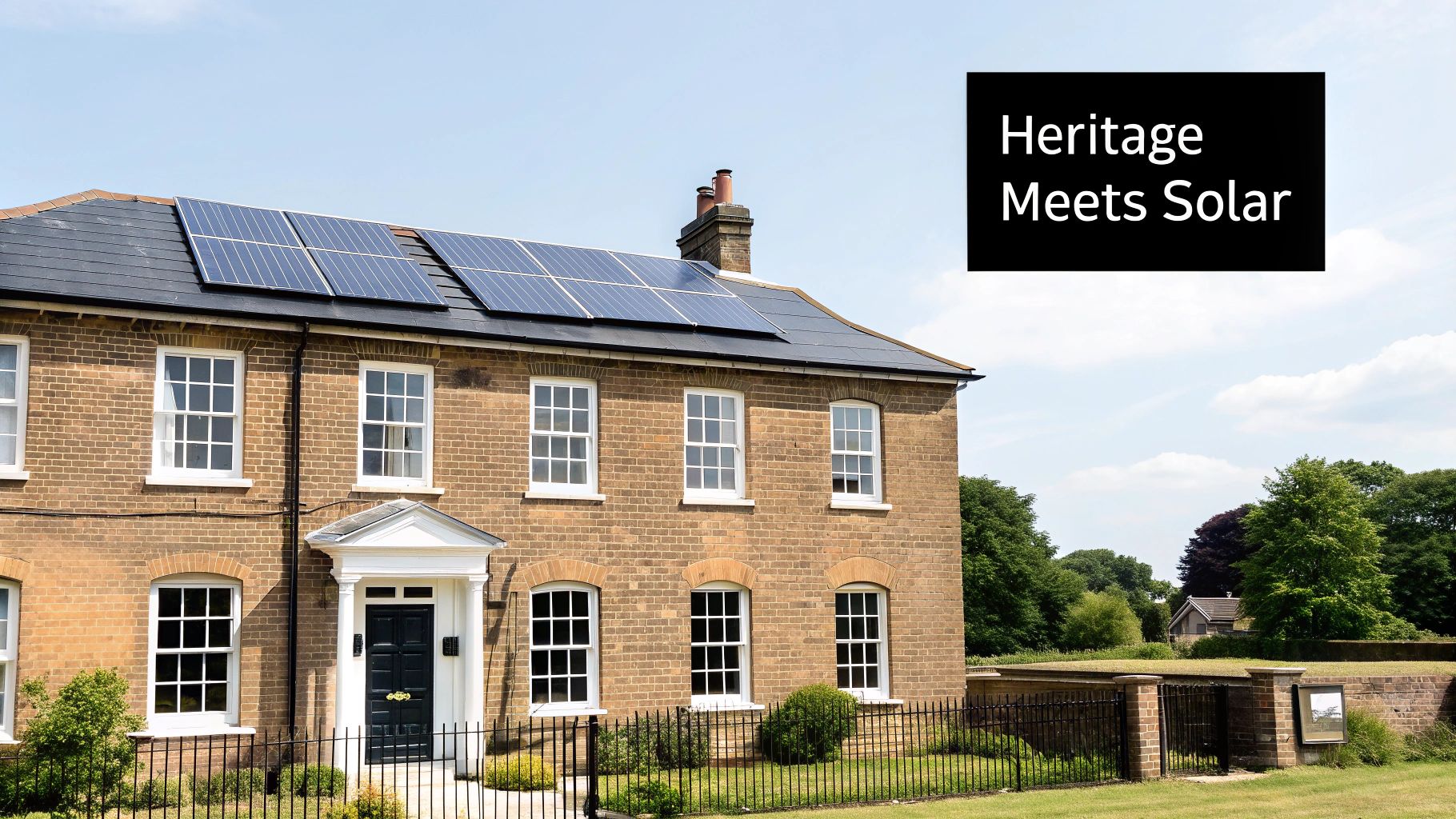
The Growing Trend Towards Heritage Solar
While it might have once seemed like an impossible task, fitting solar technology to historic properties is a rapidly growing field. Research by Historic England and UCL shines a light on this, noting that while only 0.25% of listed buildings in London had solar installations, the rate of adoption is actually higher than in the general housing stock.
This points to a really positive trend where conservation and renewable energy are increasingly working in harmony. You can dive into the full findings in the report on energy use in London's historic buildings from Historic England.
The journey involves navigating a specific set of challenges and opportunities, including:
Regulatory Hurdles: Understanding and successfully applying for Listed Building Consent is the most critical first step.
Aesthetic Integration: Choosing technologies like solar slates or custom-coloured panels that blend seamlessly with historic roofing materials.
Structural Integrity: Ensuring the historic roof can safely support the weight and fitting of a new solar array without causing any damage.
Conservation Principles: Working collaboratively with conservation officers to create a design that is reversible and has minimal visual impact.
A successful project always hinges on a conservation-led approach. The goal is to make the installation 'visually subordinate'—in other words, it must respect and not dominate the building's historic appearance. An experienced conservation architect is absolutely essential to navigate this delicate balance, turning what seems like a complex challenge into a successful, sustainable reality for your home.
Getting Listed Building Consent for Solar Panels
When it comes to putting solar panels on listed buildings, the biggest challenge isn't usually a technical one. It's the red tape. The main hurdle is something called Listed Building Consent (LBC), a special kind of permission that’s completely separate from a normal planning application. It's legally required for any work that could change the character of a building with special architectural or historic interest.
Unlike standard planning, which looks at the bigger picture of land use and appearance, LBC is laser-focused on one thing: protecting the unique historical and architectural soul of your specific property. This means even small changes that would be considered ‘permitted development’ on a regular home will almost certainly need formal consent here.
At its heart, the process is about showing the local authority’s conservation officer that your solar project respects and preserves the building's special character. It’s not about stopping progress dead in its tracks; it's about managing change in a way that’s sensitive, thoughtful, and appropriate for the building.
The Application Process in Practice
Getting LBC approval isn't a simple tick-box exercise. It requires a thorough, detailed, and methodical approach. The aim is to build a watertight, evidence-based case that shows just how much care and thought has gone into the proposal. This is where a conservation architect is worth their weight in gold—they can translate your goals into a language that planners and conservation officers understand and respect.
The journey usually breaks down into a few key stages:
Pre-Application Advice: Think of this as an informal chat with the conservation officer before you’ve committed to a final design. It’s a vital first step to float your initial ideas, get a feel for their gut reaction, and uncover any specific concerns they might have about your property right from the start.
Detailed Design and Justification: Armed with that early feedback, your architect will get to work on detailed drawings and pull together a strong justification for the project. This is where the nitty-gritty is decided: the specific panel technology, their exact placement, and the methods used to fix them to the roof.
Submitting the LBC Application: This is the formal submission. Your architect will compile a professional package with all the necessary documents, drawings, and supporting statements. To be taken seriously, it needs to be comprehensive and meticulously presented.
The Balancing Act: Public Benefit vs. Historic Harm
Every LBC decision boils down to a crucial balancing act. The conservation officer has to weigh the potential ‘harm’ to the building’s historic significance against the ‘public benefit’ the changes would deliver.
For solar panels, the public benefit is a powerful one: generating clean, renewable energy helps meet national environmental goals. Your job—and your architect’s—is to shrink the 'harm' side of the scale so that the public benefit clearly tips the balance in your favour.
How do you do that? By focusing on two golden rules: minimal visual impact and reversibility. An installation that can’t be easily seen from the street and can be removed in the future without leaving a permanent mark has a much, much better chance of getting the green light. Your application must spell out exactly how your design achieves this.
The key document for laying out this argument is the Heritage Statement. It is, without a doubt, the most important part of your application. Prepared by your architect, it will:
Assess the historical and architectural importance of your property.
Explain precisely how the solar installation will affect that significance.
Provide a compelling justification for why the public benefits of the project outweigh any minor impact.
To help clarify what this looks like in an application, the table below outlines the key factors a conservation officer will be looking at and how your architect will address them.
Key Considerations for a Listed Building Consent Application
Consideration | What Conservation Officers Look For | Architect's Role |
|---|---|---|
Visual Impact | How visible are the panels from public areas (roads, footpaths)? Do they detract from the building's key architectural features or roofscape? | To design a layout that hides panels on less prominent roof slopes, use discreet, non-reflective technology, and provide visualisations (photomontages) to prove minimal impact. |
Reversibility | Can the panels and all associated fixings be removed in the future without causing permanent damage to the historic roof fabric (e.g., slates, tiles, leadwork)? | To specify non-invasive fixing systems that clamp to roof seams or use existing structures, avoiding drilling into or altering original materials. The Heritage Statement will detail this. |
Materiality & Technology | Does the technology chosen complement or clash with the historic materials of the building? Are there more sensitive options available? | To research and propose the most appropriate technology, such as solar tiles that integrate with slate, or all-black panels that are less obtrusive than traditional ones with silver frames. |
Justification & Public Benefit | Is there a robust case explaining why this is necessary and beneficial? Has the 'harm vs. benefit' balance been convincingly argued? | To write a powerful Heritage Statement that articulates the clear public benefit of renewable energy while demonstrating how every effort has been made to minimise harm to the building's significance. |
Ultimately, a successful application hinges on a deep understanding of conservation principles. For a closer look at this specialised field, our guide on conservation and heritage architecture offers more insight. By following this careful, methodical process, what seems like a daunting regulatory maze becomes a clear path to getting your project approved.
Designing a Sympathetic Solar Installation
With the consents and paperwork out of the way, we can turn our attention to the real challenge: design. How exactly do you integrate 21st-century technology with architecture that might be several hundred years old? The secret lies in moving beyond the idea of standard, off-the-shelf panels and exploring solutions designed specifically for aesthetic sensitivity.
Successful solar panels on listed buildings all come down to one core principle: the technology must be visually subordinate. This simply means the solar array should never dominate or take away from the building's original character. It should blend in, becoming a quiet, functional addition rather than a jarring modern statement. To get this right, you need a combination of clever placement and the right choice of products.
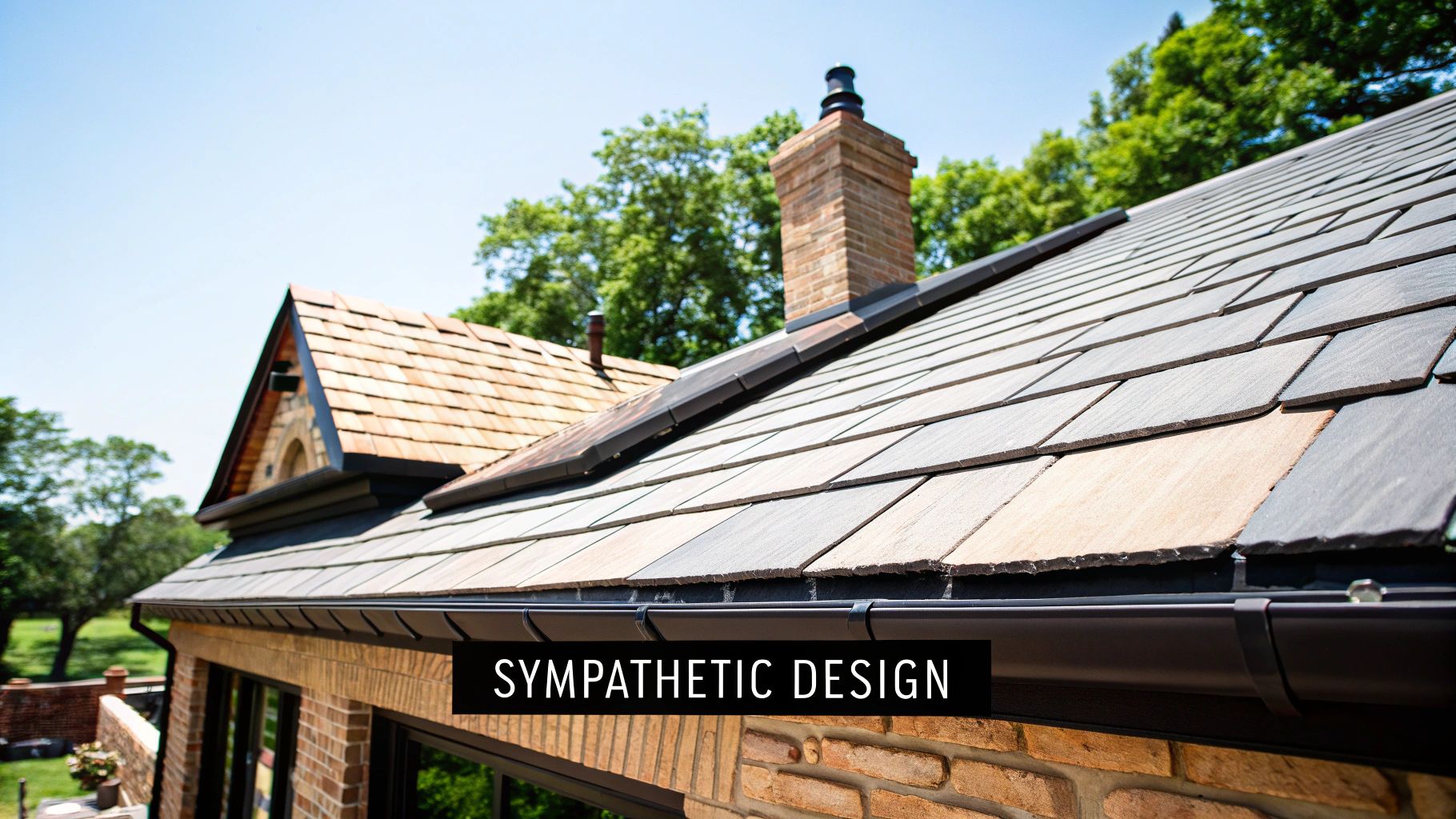
Beyond Standard Panels: Innovative Solar Options
The solar market has evolved well beyond the bulky blue panels of the past. Today, there's a growing range of products perfect for heritage properties, designed for discretion so you can generate clean energy without compromising your home's historic appearance.
Your architect will likely have a few sophisticated options in mind:
Integrated Solar Slates and Tiles: These are really the gold standard for listed buildings. They are designed to completely replace existing roof slates or tiles, sitting flush with the roofline and mimicking the colour and texture of traditional materials like Welsh slate. From the ground, they are often impossible to tell apart from the original roof.
Custom-Coloured Panels: If integrated tiles aren't quite right, it's now possible to get panels with coloured cells and frames. A terracotta or reddish panel, for example, will blend far more sympathetically with a clay tile roof than a standard black one, massively reducing its visual impact.
Non-Penetrating Mounting Systems: One of the biggest worries for conservation officers is any damage to the historic fabric of the roof. Thankfully, modern mounting systems can often be fixed without drilling into precious old slates or leadwork. These systems might use clamps that attach to the seams of a metal roof or even a weighted ballast system on a flat roof, ensuring the entire installation is reversible.
The primary goal is always to minimise harm. By selecting technology that respects the building's materials and form, you demonstrate a commitment to conservation that planning authorities value highly. The less visible and less invasive the installation, the stronger your application for consent will be.
Strategic Placement for Minimal Visual Impact
Just as important as what you install is where you install it. A good conservation architect will scrutinise your property to find the least obtrusive locations for a solar array, effectively hiding it in plain sight.
The first rule of thumb is to avoid the primary elevations—that is, the faces of the building most visible from public roads or pathways. Instead, the focus shifts to less prominent areas where the panels will have little to no effect on the building’s celebrated appearance.
This strategic approach involves a few key tactics:
Using Rear or Hidden Roof Slopes: The most common and effective strategy by far is to place panels on rear-facing roof slopes or those obscured from view by parapets or other architectural features.
Utilising Outbuildings: If your property includes garages, workshops, or modern extensions, these can be perfect locations. Installing panels here often faces far fewer planning hurdles while still providing power to the main house.
Ground-Mounted Arrays: For properties with larger grounds, a ground-mounted system set well away from the house can be an excellent solution. This approach completely avoids any intervention with the historic building fabric whatsoever.
Ultimately, designing a sympathetic installation is an exercise in creative problem-solving, requiring a deep understanding of both historic architecture and modern solar technology. For those interested in the broader principles of green design, exploring the fundamentals of sustainable architecture can provide valuable context. By combining discreet products with intelligent placement, your solar project can become a seamless addition that enhances your property's long-term future.
Protecting Your Historic Roof Structure
While getting the look right is crucial, the physical integrity of your property’s roof is the absolute priority when considering solar panels on listed buildings. A historic roof isn't just a covering; it's an intricate, often delicate, structural system that has stood for centuries. Before a single panel is fitted, we need to be certain it can stand for centuries more.
That process begins with a detailed structural survey. This is far more than a quick glance from the ground. It’s a hands-on, thorough examination of the roof's timbers, trusses, and load-bearing elements by a qualified structural engineer. They’ll assess the existing condition of the roof, hunting for any signs of weakness, rot, or past alterations that could compromise its strength.
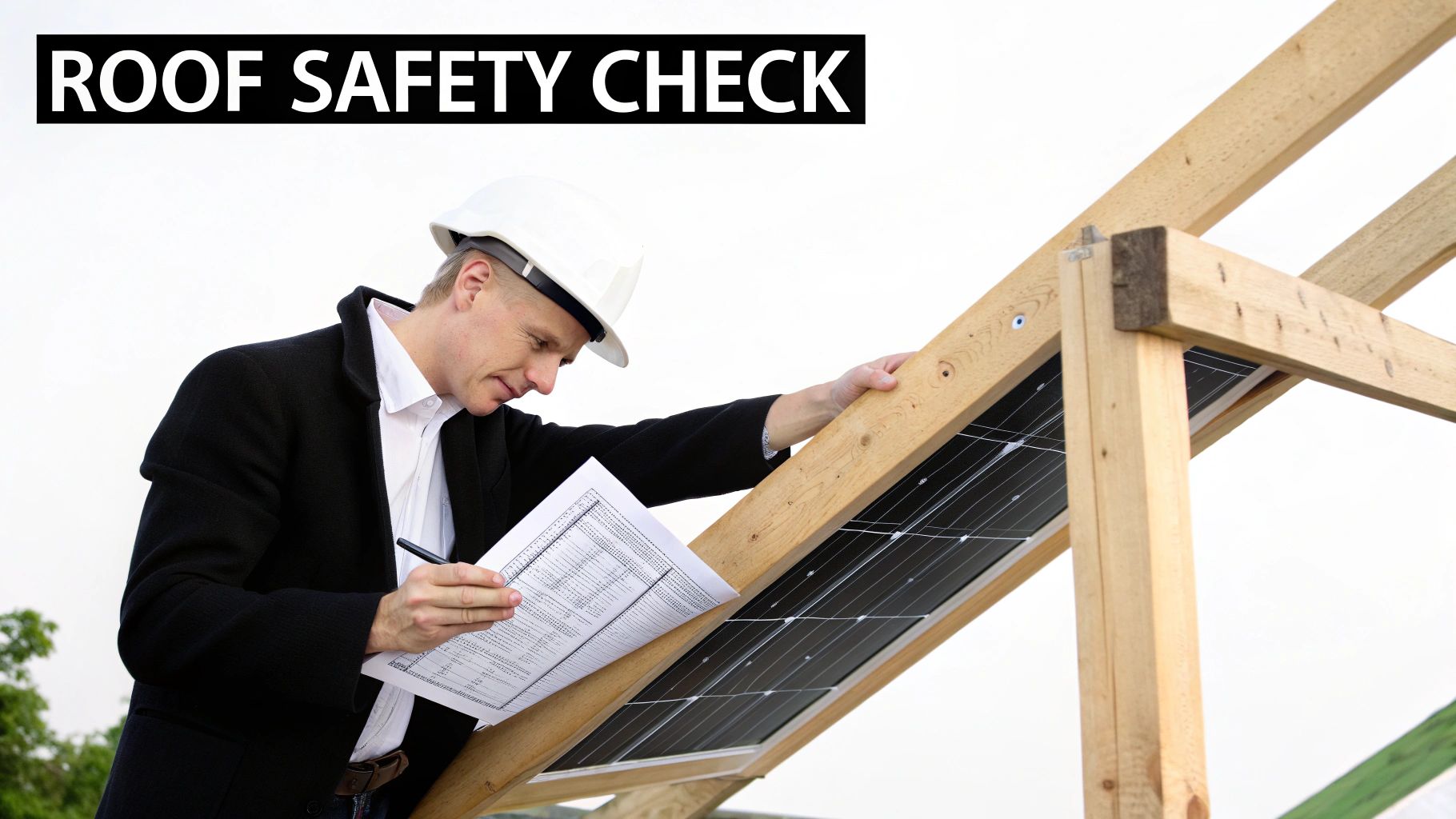
Assessing the Load-Bearing Capacity
Think of your roof like a historic bridge; it was designed to support a specific load—itself, plus things like snow and wind. Adding a solar array introduces a new, permanent 'dead load' that the original builders never anticipated. The survey’s main purpose is to confirm, with absolute certainty, that the structure can safely handle this extra weight without sagging, shifting, or placing undue stress on the historic fabric.
The age and construction style of your roof play a huge role here. An oak-framed mediaeval roof has completely different properties to a Victorian one built with sawn pine trusses. The engineer’s report will ultimately dictate which solar systems are viable and which are simply too heavy or invasive for your property.
A structural survey acts as the project's foundational safety check. It provides the essential data needed to design a system that is not only efficient but, more importantly, one that protects the long-term health of the building. Skipping this step is not an option; it's a fundamental duty of care.
Optimising for Performance and Efficiency
Beyond safety and structural soundness, the technical assessment also makes sure your investment will actually perform as expected. After all, what’s the point if it doesn’t generate much power? A solar array’s output is directly influenced by a few key environmental factors, and a comprehensive analysis will evaluate these to accurately forecast what your system can deliver.
Key performance factors include:
Roof Orientation: In the UK, a south-facing roof is the gold standard for capturing the maximum amount of sunlight. East or west-facing roofs are also perfectly viable, but you can expect them to generate slightly less power over the year.
Pitch or Angle: The sweet spot for a roof pitch in the UK is between 30 and 40 degrees. This angle helps the panels catch the sun's rays most directly and also allows rain to wash them clean, keeping them efficient.
Shading Analysis: Nearby trees, chimneys, or even neighbouring buildings can cast shadows on your roof at different times of the day. A detailed shading analysis is crucial because even partial shading on one part of a panel can significantly reduce its output.
This dual focus—on structural safety and energy performance—ensures the final installation is both safe and effective. It's a meticulous process that balances the preservation needs of a historic building with the practical demands of modern energy. These kinds of structural considerations are common when adapting older properties, a topic we explore further in our insights on architectural refurbishments and extensions.
Real-World Examples of Solar Success
It’s one thing to talk about sympathetic design and structural integrity in theory, but seeing these principles in action is where the real possibilities come to life. Success stories are the best proof that even the most sensitive historic properties can embrace solar technology, so long as it’s done with the right expertise.
Let's walk through a couple of scenarios, inspired by real projects we've seen across South West London, to show how clever design and a collaborative approach can overcome planning hurdles.
A Grade II Listed Georgian Terrace in Richmond
Picture a classic Grade II listed Georgian terrace, admired for its elegant symmetry and perfectly preserved roofline. The owner was keen to reduce their carbon footprint, but the main, street-facing roof was a complete non-starter – its historical significance and high visibility made it untouchable.
The Challenge: How could they generate meaningful solar power without disrupting that iconic front elevation or, worse, damaging the delicate, original Welsh slates?
The Solution: We worked with the architect to propose integrated solar slates on a less-visible, rear-facing roof slope. These weren't just any panels; they were specifically chosen to match the colour and texture of the existing roof, making them almost impossible to spot from the ground.
Winning the Argument: The application for consent was built on two core principles: minimal intervention and complete reversibility. We used photomontages to prove the system would have zero impact on the building's public-facing character. The Heritage Statement also detailed exactly how the installation would avoid drilling into historic timbers, protecting the building's original fabric.
The Outcome: Listed Building Consent was granted. The property now generates a significant chunk of its own electricity, future-proofing a historic home without sacrificing an ounce of its character.
A Victorian Villa in a Wimbledon Conservation Area
Now, think about a large, detached Victorian villa sitting within a tightly controlled conservation area. While not individually listed, any changes had to preserve the character and feel of the entire neighbourhood. The roof was a complex puzzle of multiple gables and pitches.
The first job was finding a spot that wasn't overshadowed by mature trees or prominent chimneys. After a detailed shading analysis, we identified the ideal location on a side roof elevation—it was visible, but not the primary feature you’d notice.
Here, the key was demonstrating that the 'public benefit' of renewable energy clearly outweighed the minor visual change. The design used sleek, all-black panels with black frames, mounted perfectly parallel to the roofline to create a low-profile, unified look that didn't clash with the dark slate.
This kind of project shows just how much solar technology is becoming accepted as part of the mainstream. The broader UK solar market has seen staggering growth, with 189,826 MCS-certified installations in 2023 alone—a 30% increase from the year before. This boom is being driven by rising electricity costs and environmental awareness, proving that solar is becoming a standard feature for homeowners. You can dive into more data on this record-breaking year for UK home energy tech over on Carbon Brief.
By presenting a well-researched and aesthetically sensitive proposal, we were able to convince the planning officers. The project was approved, showing that even in conservation areas, a carefully considered design can win support and bring sustainable energy to a historic property.
Your Step-by-Step Project Roadmap
Bringing solar power to a listed building isn’t a weekend DIY job; it’s a careful, methodical process that has to be done right. Success really comes down to three things: meticulous planning, bringing in the right experts early on, and maintaining a clear, open dialogue with the planning authorities.
I’ve broken the whole journey down into a clear roadmap, so you can see exactly what’s involved from that first spark of an idea right through to the final sign-off.
It's important to realise that the process for a heritage property is a world away from a standard solar installation. While it presents its own unique challenges, it’s worth noting just how mainstream solar has become. Thanks to updated ‘Part L’ building regulations, by late 2025, over 40% of new homes in England were being built with solar panels from the get-go. That’s a massive three-fold jump from the previous year. This shift really cements solar as a fundamental part of modern, energy-efficient home design. You can read more about this in the latest new-build solar figures from Renewable Energy Installer.
Of course, for your listed property, the journey is far more bespoke and has to be guided by the principles of conservation.
The Six Key Project Phases
The secret to navigating the approvals process is tackling each stage in the right order. One of the most common pitfalls I see is people rushing to submit an application without doing the proper groundwork first, which almost always leads to delays or an outright rejection. Your conservation architect is the crucial guide who will steer you through every single step.
The diagram below gives you a simple, visual overview of the journey, showing how we move from the initial challenge to a successful, approved installation that respects the building's character.
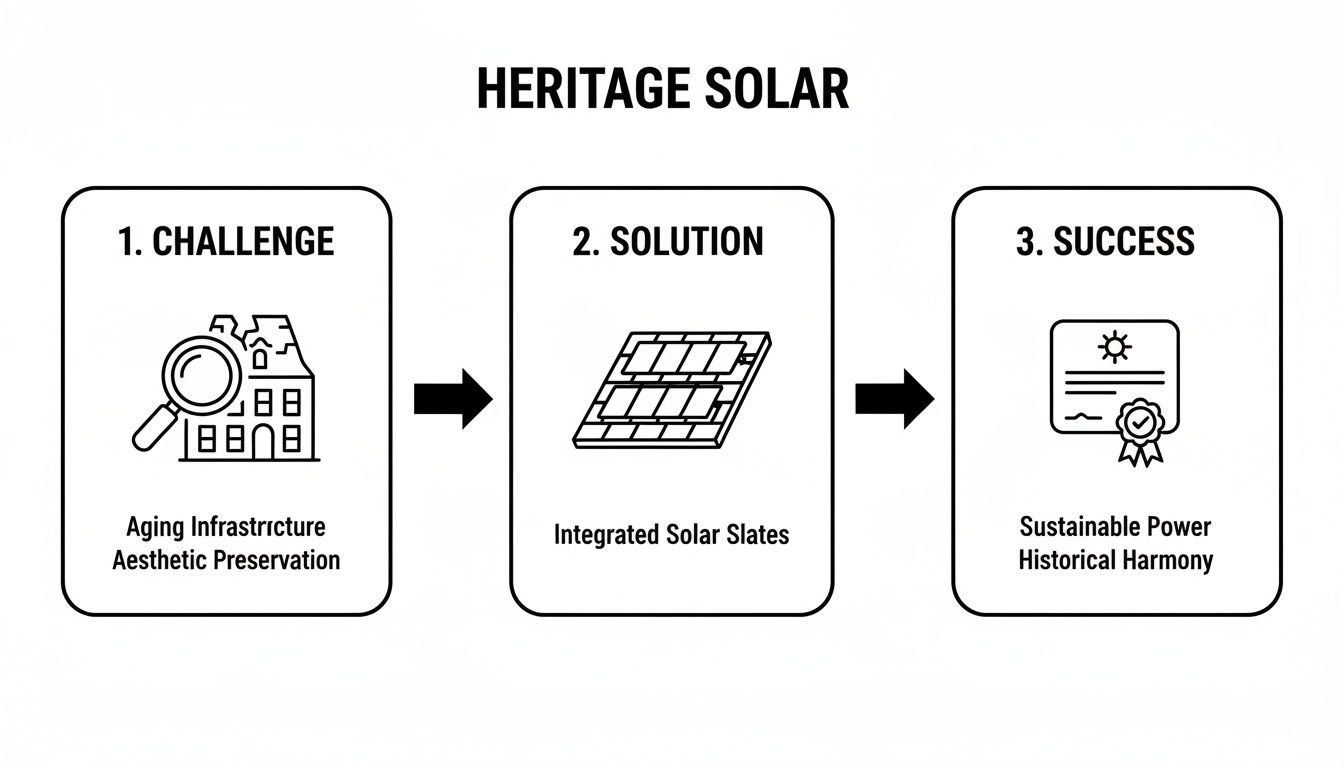
As the visual shows, the key to unlocking a project like this is finding a sensitive, integrated solution that solves both the aesthetic and structural puzzles.
Here’s a more detailed look at the path your project will follow:
Initial Feasibility and Consultation: This is where it all begins. You'll sit down with your architect to talk through your goals, take a hard look at the property’s specific constraints, and set a realistic budget. A preliminary analysis of the building's history and structure happens here.
Conservation-Led Design Development: With the initial findings in hand, your architect gets to work developing a sympathetic design. This involves selecting discreet technologies, like solar slates, and pinpointing the least obtrusive locations for any equipment.
Pre-Application Discussions with the Authority: This is a vital, collaborative step. Before any formal paperwork is submitted, your architect will open a dialogue with the local conservation officer. It’s all about getting early feedback, flagging potential concerns, and showing you’re keen to work with them.
Submitting the LBC Application: Now it’s time to make it official. Your architect will compile a comprehensive application pack, which includes detailed drawings, technical specifications, and a robust Heritage Statement explaining exactly why the project is justified and how it will be carried out sensitively.
Technical Design and Specification: Once you have Listed Building Consent, the work isn't over. The detailed technical plans are finalised, specifying everything from wiring routes to the exact structural fixings. This detailed pack is what potential installers will use to provide accurate quotes.
Appointing a Specialist Installer: The final piece of the puzzle. You’ll select and appoint a qualified installer who has proven, hands-on experience working on heritage properties to carry out the physical installation and commissioning of your new system.
Your Questions Answered
When you start thinking about solar panels for a listed building, a lot of specific questions naturally come up. Let's tackle some of the most common ones to give you a clearer picture of the practical, financial, and planning aspects involved.
Is It Ever Impossible to Get Consent for Solar Panels on a Listed Building?
While getting consent is definitely a high bar to clear, an outright "no" isn't a foregone conclusion. The final decision really hinges on the building's specific listing grade (with Grade I being the most stringently protected) and just how much the panels would be seen.
A carefully thought-out application, put together by a conservation architect to be as discreet and completely reversible as possible, stands a very good chance. It's the proposals that drastically change the building's main character or are glaringly obvious from the street that are most likely to be turned down. The secret always lies in a sensitive design backed up by a solid, well-argued heritage statement.
How Much Do Discreet Solar Tiles Cost Compared to Standard Panels?
There's no getting around it – integrated solar tiles or slates are a premium product. You can generally expect them to cost two to three times more than standard, on-roof solar panels for the same amount of power.
But while the initial outlay is higher, the subtle aesthetic is often the very thing that makes the project acceptable for Listed Building Consent. It’s best to see this cost not just as an add-on, but as an integral part of a heritage renovation budget where protecting the property's unique character is the absolute priority.
A sensitively designed and professionally installed solar system is increasingly seen as a positive investment that can enhance the value of a listed property. It demonstrates a commitment to future-proofing the building and reduces running costs, making it more attractive to future buyers. Conversely, a poorly designed, obtrusive installation could be detrimental. Securing Listed Building Consent is therefore vital to protect and ultimately enhance your asset.
What Is the Role of the Conservation Officer in the Process?
Think of the conservation officer as the local planning authority’s in-house specialist. Their entire job is to provide an expert opinion on how any proposed changes will impact the character and special interest of a heritage building.
Your architect will make a point of engaging with them early on, usually through a formal pre-application advice meeting, to talk through the ideas and get their initial take. Building a collaborative relationship and showing you’ve really thought about the conservation principles is absolutely crucial; their feedback carries a huge amount of weight in the council's final decision. It's less about seeing them as a gatekeeper and more as a vital partner in finding a solution that works for everyone.
At Harper Latter Architects, we specialise in marrying modern sustainable technology with the unique demands of historic and listed buildings. Our expertise in conservation and heritage architecture ensures your project is designed with the sensitivity and rigour required to achieve consent and protect your property's legacy.
To discuss your vision for a sustainable future for your heritage home, contact our team for an initial consultation.
Comments