
A Guide to Basement Conversions London

In a city like London, where space is the ultimate luxury, homeowners are increasingly looking beneath their feet to find it. Basement conversions have become the definitive answer for those wanting to expand their homes without the headache of extending outwards into the capital's crowded neighbourhoods. It's a smart, strategic way to unlock valuable square footage that's been there all along.
Why London Homeowners Are Building Downwards
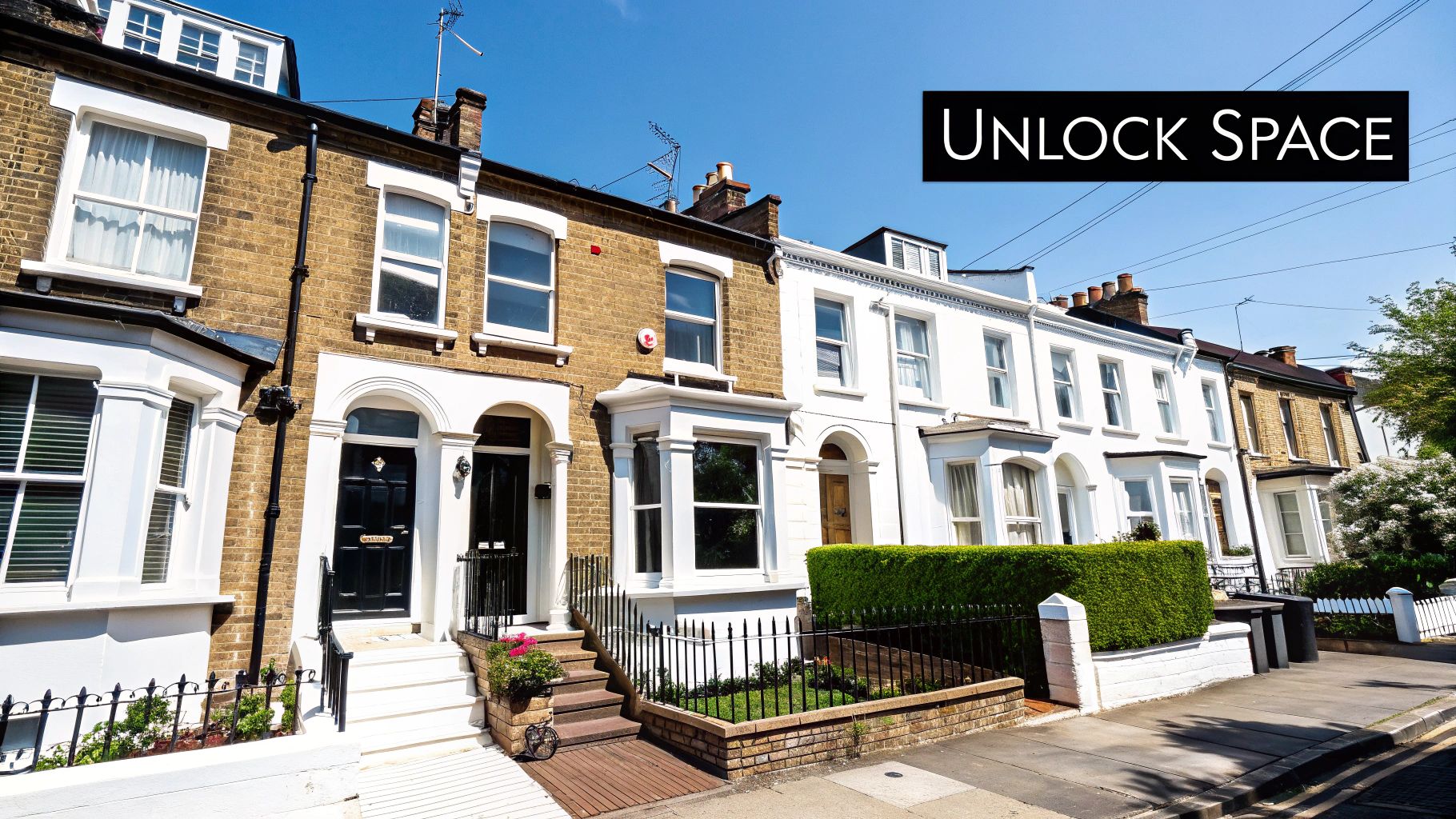
That feeling of staring at the same four walls, dreaming of just a bit more room, is something most Londoners can relate to. With limited options for traditional extensions and the stamp duty on moving often prohibitively high, digging down is a compelling alternative. It’s a practical response to the city’s tight constraints, transforming forgotten cellars into sophisticated, light-filled living spaces.
This isn't just about adding an extra room anymore. It’s about creating bespoke spaces that genuinely enhance a modern lifestyle. Homeowners are no longer content with damp, dark storage areas. Instead, they're working with architects to design incredible subterranean environments that feel like a natural part of the home.
The Rise of Lifestyle-Driven Spaces
Today, a basement conversion in London is an opportunity to add functional luxury that reflects your passions and day-to-day needs. These aren't just add-ons; they are integral parts of the home, designed for living, working, and relaxing. We're seeing a huge demand for:
Wellness Suites: Creating a personal sanctuary with a home gym, sauna, or spa.
Entertainment Hubs: Designing a state-of-the-art home cinema, games room, or even a private bar.
Functional Living Areas: Adding a dedicated home office, a children’s playroom, or self-contained accommodation for a nanny or guests.
Specialist Rooms: Building climate-controlled wine cellars or secure luxury car parks.
A well-designed basement conversion does more than just add square footage. It reimagines your home's potential, creating a seamless connection between existing and new levels that elevates your entire property.
A Growing Trend Across the Capital
The appetite for basement conversions in London has surged over the past decade, driven by a simple desire: improve, don't move. Between 2008 and 2019, London's 32 boroughs authorised a staggering 7,328 basement projects. This boom shows just how much homeowners—and planning authorities—realise the value of these developments when they're done professionally.
The data backs this up. Approval rates hover around 72% across the boroughs, which tells us that councils are generally supportive of well-conceived designs that meet their rigorous standards. You can find more insights on this trend over at Mimar Architecture.
Ultimately, choosing to build downwards is a forward-thinking investment. It not only future-proofs your property by adapting it to your family’s changing needs but also significantly increases its market value and appeal. You’re investing in both your lifestyle and your most valuable asset.
Understanding the Financial Case for a Basement
Of course, the appeal of a bespoke home cinema or a private gym is obvious. But the financial case for digging down is just as compelling. In a city like London, where every square metre comes at a premium, a basement conversion isn't just an expense—it’s a strategic investment that can deliver a serious return. It shifts your property from being just a home to a high-performing financial asset.
The logic is rooted in simple London economics: the cost to build a new subterranean level is often far less than the value it adds to your property, especially in the most sought-after postcodes. This isn’t just about adding square footage; it’s about elevating your property's entire market position, making it stand out to a more discerning pool of buyers.
Measuring the Return on Investment
For homeowners in areas like Wimbledon or Richmond, a well-designed basement dramatically increases the property's gross internal area (GIA) and, as a result, its market value. That extra space is often the deciding factor that pushes a home into a higher price bracket, setting it apart from similar houses on the same street that lack that extra level.
A professionally executed basement conversion is one of the few home improvements where the added value can substantially exceed the initial outlay. It creates a powerful competitive edge in London's demanding property market.
This investment becomes even more powerful in prime central London. Our analysis shows that professional basement extensions can boost a property's market value by 15-25%. In many parts of the capital, homes gain between £8,500 and £10,000 for every square metre added.
That figure skyrockets in boroughs like Kensington & Chelsea, Camden, or Westminster, where the added value can climb to £19,000 per square metre or even higher. For a typical 50m² basement, that translates to a potential value increase of between £425,000 and £500,000. You can explore more about these market dynamics and future trends with the specialists at Basement Structures.
Creating a Competitive Advantage
In the upper tiers of the London property market, luxury features are no longer a nice-to-have; they’re an expectation. For properties valued over £3.5 million in postcodes across Chelsea or Kensington, a high-quality basement with premium amenities is now considered a standard feature. A home without one is at a distinct disadvantage, automatically shrinking its appeal to potential buyers who expect that level of finish and functionality.
By undertaking a basement conversion in London, you are not just tailoring your home to your lifestyle but also aligning it with the expectations of the future market. You’re future-proofing its value and ensuring it remains a prime, sought-after asset. This proactive approach ensures your property doesn't just keep pace—it leads the pack.
Ultimately, looking at your project through this financial lens helps you make much better decisions. It turns the conversation from one of pure cost to one of calculated investment, showing how building downwards can be one of the smartest moves a London homeowner can make.
Budgeting Your Basement Conversion in London
Before a single shovel hits the ground, getting a firm grip on the finances is the bedrock of any successful architectural project. When it comes to basement conversions in London, building a realistic and transparent budget from day one is non-negotiable.
The best way to demystify the numbers is to split the project into two distinct phases: the heavy-duty structural work, known as the ‘shell and core’, and the interior transformation, or the ‘full fit-out’.
The shell and core phase is all about brute force and engineering precision. This is the groundwork—literally. It covers the excavation, underpinning your existing home, forming the concrete box, and installing all the structural steelwork. Crucially, it also includes the complex waterproofing systems needed to meet rigorous British Standards like BS 8102, ensuring your new space is completely dry and secure.
Once you have that robust, watertight shell, the project shifts to the full fit-out. This is where an empty concrete space becomes a beautiful, habitable part of your home. The costs here are driven entirely by your personal taste and specifications, from high-end finishes and bespoke joinery to sophisticated lighting schemes and luxury amenities.
Typical Per-Square-Metre Costs
So, how much should you actually budget per square metre? It’s the question every client asks.
As a general rule of thumb, expect to budget between £3,000 and £5,000 per square metre for the shell and core works. This figure typically covers the concrete structure, the all-important Type A, B, and C waterproofing systems, the excavation itself, and hauling the spoil away from the site.
For a full fit-out with high-end finishes—think underfloor heating, custom joinery, specialist lighting, and luxury bathroom suites—the total cost can climb to £4,500 to £7,500+ per square metre. For a more detailed look at the numbers, our guide on the UK cost of a basement conversion offers a comprehensive breakdown.
To give you a clearer picture, here’s a sample budget for a typical 50m² project. This table illustrates how the costs are divided between creating the basic structure and finishing it to a high standard.
Estimated Costs for a London Basement Conversion (50m²)
Expense Item | Shell & Core Cost Estimate | Full Fit-Out & Finish Cost Estimate |
|---|---|---|
Excavation & Spoil Removal | £25,000 - £40,000 | N/A |
Underpinning & Structural Work | £60,000 - £85,000 | N/A |
Waterproofing (BS 8102) | £15,000 - £25,000 | N/A |
Concrete & Screed | £20,000 - £30,000 | N/A |
M&E (First Fix) | £10,000 - £15,000 | N/A |
Interior Walls & Plastering | N/A | £15,000 - £25,000 |
Flooring & Finishes | N/A | £10,000 - £30,000+ |
Bespoke Joinery | N/A | £10,000 - £40,000+ |
Lighting & Electrics (Second Fix) | N/A | £8,000 - £20,000 |
Bathroom/Wet Room Fit-Out | N/A | £10,000 - £25,000 |
Subtotal | £130,000 - £195,000 | £63,000 - £140,000+ |
Total Estimated Project Cost | £193,000 - £335,000+ | (Combined Total) |
As you can see, understanding these two cost centres allows you to manage your budget far more effectively. You can prioritise investing in a high-quality, fully guaranteed structure first, then perhaps phase the interior finishes as your funds allow.
Financial Factors for Period Properties
Working with a period property in London—like a classic Georgian or Victorian terrace—throws a few extra variables into the mix. The age and original construction of these homes often demand more complex, and therefore more expensive, structural solutions.
You might face additional costs for extensive substructure works to properly support the existing building. It’s also common to need multiple RSJs (Rolled Steel Joists), which can cost anywhere from £800 to £3,500 each. On top of that, complex drainage solutions involving pumps and sumps can easily add another £3,500 or more to the budget. These figures underscore why partnering with architects experienced in heritage properties is vital for accurate financial planning.
The Importance of a Contingency Fund
No matter how meticulously you plan, construction projects can always throw up a surprise or two. This is especially true when you’re digging beneath an existing home. You might encounter unexpected ground conditions, have to reroute undocumented drains, or find that additional structural supports are needed once work is underway.
This is precisely why you need a contingency fund.
Standard Recommendation: We always advise clients to set aside a buffer of 15-20% of the total project cost. This is the industry standard for a reason.
Purpose: This fund isn’t for upgrading your kitchen worktops or picking fancier tiles; it’s a critical safety net to cover unforeseen but necessary structural or regulatory costs.
Peace of Mind: Having this fund in place gives you invaluable peace of mind. It ensures that an unexpected issue won’t derail your project’s timeline or, worse, its financial viability.
By approaching your budget with this level of detail and foresight, you can move forward with confidence, ready to turn your vision into a stunning reality without any costly shocks along the way.
Getting to Grips with Planning and Building Regulations
The thought of dealing with council planning departments can feel a bit daunting, but it's a structured and perfectly manageable part of any professional architectural project. For basement conversions in London, this process is all about making sure your new space is safe, considerate to your neighbours, and in line with local policies. With an expert guiding you, it becomes a clear, step-by-step journey rather than a bureaucratic maze.
The first thing to understand is the difference between Permitted Development (PD) rights and a full Planning Permission application. While some smaller home extensions can fall under PD, allowing you to build without a full application, the major work involved in digging out a new basement almost always requires full Planning Permission from your local council. This is especially true in London’s densely populated boroughs.
Planning Permission: The London Context
Every London borough has its own set of rules for subterranean development, which is why local expertise is so important. These policies are there to manage the impact of basement construction on the surrounding environment and neighbouring properties.
For instance, a council like Wandsworth might have a rule that a lightwell can't take up more than 50% of the front garden. Over in Merton, they might limit basement excavations to 50% of the total garden area. In boroughs like the Royal Borough of Kensington & Chelsea, you’ll often find strict limits preventing you from digging more than a single storey deep.
Understanding these borough-specific quirks from day one is absolutely crucial. A successful basement application in London is built on a design that respects these local guidelines, not one that tries to fight them.
Working with an architect who knows your local authority’s policies inside out is a huge advantage. They can design a proposal that isn’t just beautiful and functional, but also has the best possible chance of sailing through the approval process.
The Importance of The Party Wall Act
Any time your project involves work on or near a boundary you share with a neighbour, the Party Wall etc. Act 1996 comes into play. Given how close homes are in London, this is a key step for pretty much every basement conversion. The Act isn’t there to stop you from building; it’s a framework designed to protect everyone involved.
You're legally required to serve a formal notice to all affected neighbours before any work starts. They can then either consent to the works or appoint a Party Wall Surveyor to look after their interests. Often, a single, impartial surveyor can be appointed for all parties, which helps keep the process moving and costs down. The outcome is a formal agreement, known as a Party Wall Award, which sets out the rules for the build and protects your neighbours from any potential damage.
Adhering to Building Regulations
While Planning Permission is about whether you can build and what it looks like, Building Regulations are about how you build it. They're a set of non-negotiable standards for design and construction that ensure buildings are safe, healthy, and energy-efficient. For a basement, the key areas of focus include:
Structural Integrity: The design must prove the new structure is completely stable and won’t affect your existing house or the properties next door.
Fire Safety: This means having clear, safe escape routes, like properly designed lightwells with escape ladders or doors that lead directly into the garden.
Ventilation: A basement needs an effective mechanical ventilation system to prevent damp and ensure a healthy, comfortable living environment.
Waterproofing: The structure has to be made completely watertight. This usually involves a combination of systems to meet the official BS 8102 standard.
Compliance is mandatory and will be checked by a Building Control inspector at various stages of the build. For a closer look at what’s involved, you can read our guide to building regulations compliance for more detail.
Finally, if your home is a Listed Building or sits within a Conservation Area, a whole extra layer of rules will apply. These projects demand a more sensitive design and a specialist architect who can expertly balance your vision with the duty to preserve the building’s unique heritage.
Designing Your Ideal Subterranean Space
Once the structural puzzles are solved and the planners are happy, we get to the really exciting part: turning that expertly engineered shell into a living, breathing part of your home. This is where your vision for a basement conversion in London truly takes shape, moving from technical drawings to the incredible lifestyle possibilities waiting just downstairs.
This is the creative phase, a chance to design a space that doesn’t just work for you, but genuinely enhances your day-to-day life. It's time to banish any old-fashioned ideas of damp, dark cellars. Today's subterranean levels are bright, inviting, and feel completely connected to the rest of the property.
From Blank Canvas to Bespoke Living
The real beauty of digging down is the sheer freedom it gives you. Unlike a typical extension, you’re often starting with a completely blank canvas. This opens the door to creating rooms that simply wouldn't fit into the traditional layout of a period London home, like a state-of-the-art home cinema, a peaceful wellness suite, or a sophisticated, climate-controlled wine cellar.
But these aren't just single-use rooms; they are meticulously planned environments. A home cinema, for example, is far more than just a big screen. It’s an acoustically optimised space with tiered seating and seamlessly integrated smart technology. In the same way, a home gym can be expanded into a full wellness suite, complete with a sauna, steam room, and spa-like changing facilities—a private sanctuary just for you.
The ultimate goal is to create a space that feels integral to the home, not like an afterthought. It should be a destination—a level you want to spend time in, whether for entertainment, work, or well-being.
Embracing Natural Light
A common worry is that a basement will feel disconnected and gloomy. It’s a valid concern, but one that modern architectural solutions have completely overcome. Clever, innovative design is the key to flooding these lower levels with natural light, making them feel just as bright and airy as the floors above.
The most effective ways to do this include:
Lightwells: These are essentially open-air shafts built against the basement's external walls. Often finished with frameless glass balustrades or planting, they act like huge windows, pouring sunlight directly into the rooms below while providing a welcome glimpse of the outdoors.
Sunken Courtyards: For larger projects, we can excavate a full sunken courtyard or patio. This creates a wonderfully private outdoor space that you can step straight into from the basement, with huge glazed doors that dissolve the boundary between inside and out.
Walk-On Glazing: We can install panels of structural glass into the garden or terrace above, allowing daylight to filter down from directly overhead. It's a technique that creates dramatic, beautifully lit spaces and a real wow factor.
The Power of Bespoke Finishes
To really make the new level feel like part of the original home, the small details matter immensely. Thoughtful interior architecture ensures the transition between floors is seamless and natural. This is often achieved through bespoke elements that create a consistent design language running through the entire property.
Think about how custom joinery—like a feature staircase or built-in media units—can tie the aesthetic of the new space to the rest of the house. Intelligent lighting schemes are also crucial. A well-designed combination of architectural, ambient, and task lighting can create different moods and highlight key features. It's these considered details that lift a well-built structure into an exceptional living environment, perfectly suited to your lifestyle.
The Architect's Role in Your Project Journey
Embarking on a basement conversion is a huge commitment, and you need an expert guide to navigate the complexities. Think of your architect as a professional partner, someone who’s there from the first sketch to the final handover, turning your vision into a home that’s compliant, beautiful, and built to last. They provide the structured oversight needed to manage risks, control quality, and keep your project on schedule and on budget.
This structured process, which often follows the RIBA (Royal Institute of British Architects) Plan of Work, breaks the entire journey down into clear, manageable stages. It takes what feels like a daunting construction challenge and transforms it into a smooth, collaborative, and ultimately rewarding experience. More importantly, it ensures every decision is made at the right time, with the right information.
From Concept to Construction
The real work starts long before a single shovel hits the ground. These early stages are all about discovery and feasibility – a time for your architect to explore what’s truly possible on your property, balancing your ambitions against your budget and the local planning rules.
Feasibility & Briefing: It all kicks off with a detailed conversation to get to the heart of what you want to achieve. Your architect will then assess the property, dig into the specific planning constraints for your London borough, and help establish a realistic initial budget.
Concept Design: This is where your ideas begin to take shape on paper. Your architect will develop initial design concepts, including floor plans and sketches, showing how the space could look and function. This is the stage for creative solutions, especially for bringing in natural light and creating a seamless flow.
Developed Design: Once you’ve settled on a preferred concept, it’s time to refine it with more technical detail. This is when other key consultants, like a structural engineer, are brought on board to ensure the design is structurally sound and buildable. You can learn more about how these crucial roles differ by understanding the difference between a structural engineer vs an architect.
This structured approach builds a solid foundation for the entire project. The diagram below shows how design ideas for popular features like home cinemas, wellness suites, and wine cellars are developed through a clear, step-by-step process.
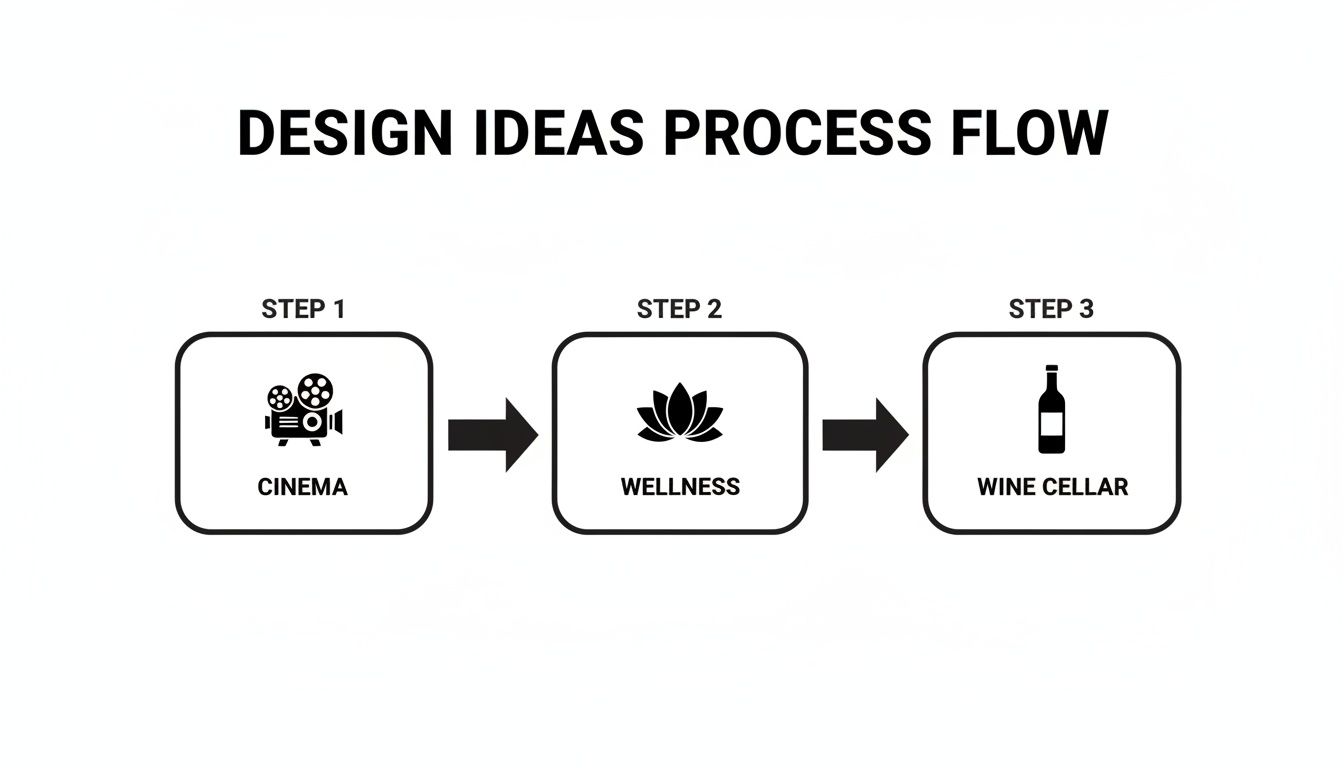
This visualisation helps clarify how a structured design process helps to refine and realise specific lifestyle ambitions within your new basement space.
Securing Permissions and Finding a Builder
With a robust design in place, the focus shifts to getting all the necessary approvals and preparing for construction. This is a critical phase where your architect’s technical knowledge really comes into its own.
An architect's true value lies in their ability to foresee challenges and manage complexity. They act as the single point of contact, coordinating a team of specialists to ensure every technical and regulatory detail is flawlessly handled.
The next steps involve rigorous technical work and careful vetting to assemble the perfect build team.
Technical Design: Your architect prepares a comprehensive package of technical drawings and specifications. This detailed information is needed for Building Regulations approval and allows contractors to provide an accurate price for the work.
Tendering: Next, they manage the tendering process. The technical package is sent out to a shortlist of vetted, reputable contractors, and your architect will help you analyse the returned bids to select the best team for your project.
Construction Phase: Once work begins on-site, your architect administers the building contract. They will conduct regular site inspections, resolve any issues that arise, and make sure the work is completed to the highest standard, exactly as specified in the drawings. This oversight is absolutely vital for any basement conversions London project.
A Few Common Questions About Basement Conversions
Even with a detailed plan in place, it’s completely normal to have questions. A basement conversion is a significant undertaking, after all. To give you a bit more clarity, here are our answers to some of the most common queries we hear from homeowners across London.
How Long Will My Basement Conversion Take?
This is always one of the first questions we’re asked, and the honest answer is that it really depends on the scale and complexity of your project. For a fairly typical basement of around 70 square metres, you should realistically set aside 9-11 months from the day the contractors arrive on site.
That timeline breaks down into a few distinct phases:
Shell and Core Construction: This is the heavy lifting – the excavation, structural work, and waterproofing. It’s the longest part of the job, and you should allow 5-7 months for a specialist contractor to get it done right.
Interior Fit-Out: Once you have a watertight shell, the fun part begins. Turning the space into a beautiful, habitable part of your home can take another 3-4 months, depending on the level of finish and any bespoke joinery.
Landscaping: Any work needed on gardens or lightwells can often happen at the same time as the interior fit-out and usually takes about a month.
How Deep Should We Dig for the Best Results?
Our advice is always the same: go as deep as you practically and legally can. The single biggest factor that transforms a basement from a functional box into a genuinely luxurious space is a generous ceiling height.
You should be aiming for a finished ceiling height of at least 2.7 metres, though closer to 3 metres is ideal. To achieve that, the initial excavation will likely need to go down between 4 and 4.5 metres. This might sound like a lot, but that depth allows for the structural slab, insulation, underfloor heating, and all the services, while still leaving you with a wonderfully bright and airy room.
Don't be tempted to cut corners on ceiling height. It's the most critical design decision you'll make for the space. A high ceiling makes a basement feel like a natural, seamless part of your home, not a subterranean afterthought.
Will the Construction Process Be Really Disruptive?
Let’s be honest, there’s no getting around the fact that excavating a basement is major construction work. During the initial structural phases, there will be noise, dust, and a fair amount of disruption.
However, a professional team’s job is to minimise that impact on you and your neighbours as much as possible. A detailed Construction Management Plan – which is often a condition of planning permission in London boroughs anyway – will be put in place. This document sets out clear working hours, manages lorry movements for spoil removal, and outlines how dust and noise will be controlled. Choosing an experienced, considerate contractor makes all the difference in ensuring the process is managed efficiently from day one.
Ready to unlock the hidden potential beneath your London home? At Harper Latter Architects, we specialise in designing and delivering exceptional basement conversions that enhance both your lifestyle and your property's value.
Comments