
Modern Guide: cost of a loft conversion in a bungalow for 2026 UK homeowners
Thinking of transforming your bungalow’s unused attic space? A loft conversion is a fantastic way to gain extra room, but it’s a different beast to converting the loft in a typical two-storey house. The cost of a loft conversion in a bungalow often starts from £62,500 and can climb to £87,500 or more, largely because of the unique structural work involved.
Your 2026 Bungalow Loft Conversion Cost Explained
For many bungalow owners, the idea of adding an entire new floor of living space without extending the footprint is incredibly appealing. But unlike a standard house, a bungalow’s roof structure wasn't originally designed to carry the weight of a habitable floor. It typically spans a much wider area, meaning the whole structure needs a serious rethink.
This is where the real work—and cost—comes in. To create a safe, compliant, and durable living space upstairs, the new floor has to be completely self-supporting. Imagine building a bridge inside your roof; you need substantial steel beams and new floor joists to create a robust platform that doesn’t rely on the existing ceiling joists. This fundamental engineering is the main reason a bungalow loft conversion comes with a higher price tag.
Average Costs at a Glance
Looking ahead to 2026, you can expect the cost of a loft conversion in a UK bungalow to fall somewhere between £62,500 and £87,500. This range directly reflects the need for those beefier structural elements we mentioned.
In sought-after areas like South West London, where we at Harper Latter Architects specialise in high-end refurbishments, costs can easily exceed £80,000. This allows for luxury specifications, from advanced sustainable insulation to premium Velux windows that meet stringent UK building regulations. For a broader look at national averages, resources like MyBuilder.com provide useful price guides.
The infographic below breaks down how these costs vary by project type and location.
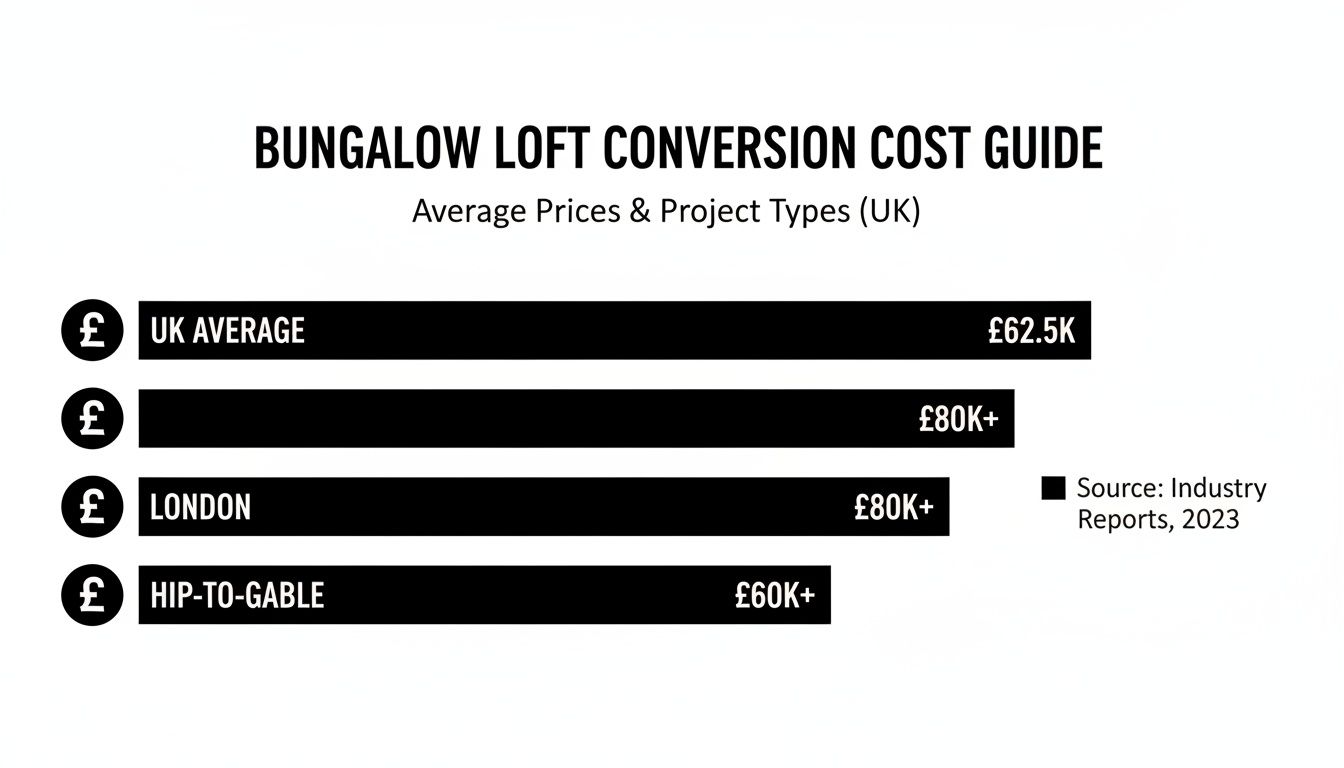
As you can see, London projects carry a noticeable premium. At the same time, more complex structural changes like a hip-to-gable conversion will naturally sit at the higher end of the budget, no matter where you are in the country.
Key Takeaway: The primary cost driver for a bungalow loft conversion isn't just the square footage you gain; it's the fundamental structural work needed to create that space safely. Budgeting for robust engineering from the outset is crucial for a successful and lasting investment.
To give you a clearer picture, here’s a quick overview of what you might expect to pay for different types of conversions.
Estimated Bungalow Loft Conversion Costs by Type (2026)
This table provides a high-level overview of average costs for the most common types of loft conversions in UK bungalows, helping homeowners quickly identify a budget range.
Conversion Type | Average UK Cost Range (£) | Typical South West London Cost Range (£) | Best For |
|---|---|---|---|
Velux / Rooflight | 62,500 – 70,000 | 70,000 – 80,000+ | Smaller budgets and spaces where ample headroom already exists. |
Dormer | 70,000 – 82,500 | 80,000 – 95,000+ | Maximising usable floor space and headroom with a flat-roofed extension. |
Hip-to-Gable | 75,000 – 87,500 | 85,000 – 100,000+ | Properties with a hipped roof, dramatically increasing internal volume. |
Of course, these are ballpark figures. The final quote will always come down to the specific type of conversion you choose, the size of your bungalow, and the quality of finish you’re aiming for. A simple Velux conversion will always be more budget-friendly than a complex hip-to-gable or large dormer, which alters the roofline to create far more headroom and floor area. We’ll dive into these cost drivers in more detail next.
What Really Drives Your Conversion Quote
While average figures are a useful benchmark, the final quote for your bungalow loft conversion will be unique to your home. Several key factors, particularly those specific to single-storey properties, will shape the total investment. Getting to grips with these is the first step toward creating a realistic budget and a smooth-running project.
The biggest single factor influencing the cost is the existing roof structure. Unlike a two-storey house, a bungalow’s roof trusses and ceiling joists were never designed to carry the weight of a habitable floor. This means a significant amount of structural work is needed before you can even think about fixtures and fittings.
Think of it as building a ‘bridge in the sky’. Your new floor can't just sit on top of the existing ground-floor ceiling. It needs to be an entirely independent structure, carefully engineered to transfer all the new weight safely down to the foundations. This process is at the very heart of the cost of a loft conversion in a bungalow.
The Critical Role of Structural Reinforcement
Creating this self-supporting floor means installing a new set of deeper floor joists, all held up by substantial steel beams. These steels form the new backbone, spanning the width of your bungalow to create a completely rigid and secure platform for your new rooms.
This essential engineering work makes up a large slice of the budget. It typically involves:
Structural Engineer Calculations: A specialist must design the steel framework, specifying the precise size and placement of all beams and joists.
Steel Fabrication and Installation: This covers the cost of the steel itself, plus the specialist labour and crane hire needed to lift the beams into the roof space.
New Floor Joists: Installing a brand new floor deck strong enough for living space, which is completely separate from the ceiling joists below.
Because bungalows often have a larger footprint than a typical two-storey house, the steel beams may need to be longer and more robust, which in turn makes them more expensive. This is a non-negotiable part of the build that ensures the long-term safety and integrity of your home.
The Challenge of Staircase Access
Another key cost driver is finding the right place for a new staircase. In a bungalow, you don’t have an existing flight of stairs to extend from, so the new staircase has to be carefully fitted into your ground-floor layout from scratch. It's a unique spatial puzzle.
This is where an architect’s skill really comes into play. The goal is to position the staircase so it feels natural, gives you comfortable access to the new loft, and doesn’t compromise your existing living space. A poorly placed staircase can easily devalue your ground floor by creating awkward hallways or carving a lump out of a key room.
An expertly designed staircase should feel like it was always meant to be there, seamlessly connecting the old and new parts of your home. This thoughtful integration, while potentially adding to the initial design cost, pays dividends in functionality and property value.
The complexity of the staircase—whether it’s a simple straight flight, a space-saving quarter-turn, or a bespoke spiral feature—will directly affect the cost of materials and carpentry. A well-designed solution is one of the smartest investments you can make, and you can explore how we approach these challenges in our in-depth guide to loft conversions in South London.
How Your Conversion Type Shapes the Budget
Finally, the type of conversion you choose will have the most direct impact on the final numbers. Each approach involves a different level of structural change to the roof itself, which naturally affects the cost.
Here’s a quick comparison of the main options:
Velux (Rooflight) Conversions: This is the most budget-friendly route as it doesn’t alter the existing roofline. It simply involves adding windows, reinforcing the floor, and fitting out the interior. However, it’s only a viable option if you already have plenty of headroom.
Dormer Conversions: A hugely popular choice for good reason, as it adds a great deal of headroom and usable floor space. It involves building a box-like structure out from the roof slope, but this requires more complex construction and finishing work.
Hip-to-Gable Conversions: Often the best solution for detached or semi-detached bungalows with sloping 'hipped' roofs. This involves replacing a sloping side of the roof with a new vertical gable wall, dramatically increasing the internal volume. It’s also one of the more expensive options due to the extensive roof reconstruction required.
Your final decision will be a balance between your budget, your property’s structure, and what you hope to achieve with the new space. An architect can model these different options for you, giving you a clear comparison of the cost versus the spatial gain for each.
Calculating Your Cost Per Square Metre
While looking at a total project cost gives you a useful ballpark figure, breaking it down into a price per square metre (£/m²) is a far more powerful way to budget. This simple metric helps you make tangible, early-stage calculations based on your bungalow’s unique footprint.
For homeowners, this approach turns an abstract, intimidating number into something you can actually measure. It allows you to draw a clear line between the size of your planned conversion and the overall financial commitment, empowering you to make informed decisions from day one.
What Is the Average Cost Per Square Metre
Right from the start, it's important to know that a loft conversion in a bungalow is typically more expensive per square metre than for a standard two-storey house. This premium comes down to the bespoke structural work needed to handle their often vast, less supported roof structures.
Across the UK, the cost of a loft conversion in a bungalow generally falls between £1,600 to £2,500 per square metre. If we apply that to a typical 40m² loft space, you're looking at a total project cost somewhere between £64,000 and £100,000. For hip-to-gable conversions—a very popular choice for bungalows to gain that all-important headroom—the average cost tends to sit between £60,000 and £80,000. You can explore more detailed cost breakdowns to get a feel for national figures by reviewing findings on sites like LoftCompare.
This per-square-metre rate gives you a solid foundation for your initial financial planning, helping you set a realistic budget before you get too far down the line. It's an essential tool for comparing quotes and understanding the value you're getting.
The London Premium Explained
As you might expect, these costs see a significant jump in high-value areas like South West London and Surrey. It’s not at all unusual for bungalow loft conversions in Wimbledon, Richmond, or Cobham to reach £2,000 to £4,100 per square metre.
This 'London premium' isn't arbitrary; it’s driven by a few key factors:
Higher Labour Costs: Skilled tradespeople and specialist contractors command higher rates in and around the capital, often between £300 and £500 per day.
Logistical Hurdles: Tighter site access, parking restrictions, and stricter local regulations in built-up areas can add time and complexity to a project.
Premium Materials: Projects in areas with a distinct architectural character or within Conservation Areas often call for high-end materials or specific finishes to meet planning guidelines.
Key Insight: Thinking in per-square-metre costs is about more than just numbers; it’s about transparency. This metric lets you see exactly how your budget is being allocated across the core structure, finishes, and specialist labour, turning a vague quote into an itemised, understandable investment.
What the Per-Metre Cost Includes and Excludes
To avoid any unwelcome surprises, it’s crucial to understand what this square metre rate typically covers. Getting clarity on this early ensures you, your architect, and your builder are all on the same page.
What is usually included:
Core Structural Work: This is the big stuff—the steel beams, new floor joists, and any roof alterations like creating dormers or new gable walls.
Basic Finishes: Standard plastering, basic electrics (sockets and lighting), and first-fix plumbing for bathrooms or radiators.
Labour: The cost of the main building contractor and their team to carry out the construction work.
Insulation and Windows: Standard-spec insulation to meet Building Regulations and the installation of windows, whether they are Velux units or part of a dormer.
What is often excluded:
Professional Fees: This covers the fees for your architect, structural engineer, and any party wall surveyors required for the project.
VAT: Always check if quotes are inclusive or exclusive of VAT. It’s a 20% charge that can significantly impact the final bill if forgotten.
Luxury Fittings: High-end bathroom suites, bespoke joinery, smart lighting, or premium flooring are almost always budgeted for separately.
Interior Architecture: The design and installation of features like custom-built wardrobes, media units, or a statement staircase.
Understanding the Return on Your Investment
So, we've talked about the costs. But let's shift gears to the question every homeowner really wants to ask: is a bungalow loft conversion a smart financial move? In our experience, the answer is almost always a clear yes. This isn't just an expense; it's a direct investment into your home's future value.
Think of it less like spending money and more like moving capital from your bank account directly into your property's equity. In a competitive housing market, adding genuinely usable space is one of the most reliable ways to increase what your home is worth.
The Financial Case for Converting
A well-designed loft conversion consistently delivers one of the best returns of any home improvement project. Why? Because it directly answers the market's biggest demand: more space. Buyers are constantly searching for homes with extra bedrooms, en-suite bathrooms, and dedicated home offices, and a loft conversion delivers this without the footprint and cost of a ground-floor extension.
The numbers back this up. Across the UK, a bungalow loft conversion can increase a property’s value by 10-25%. In many cases, the value added far outweighs the initial spend. A project with an average cost of £62,500 can easily add £125,000 or more to your home’s price tag, making it an incredibly sound investment. You can dig into more of the data in recent UK homeowner surveys.
Maximising Your Return in High-Value Areas
This financial upside becomes even more significant in premium locations. In South West London and Surrey, where bungalows in desirable spots like Wimbledon Village and Richmond are already prized assets, a thoughtful conversion can boost a property's value by an average of 20%.
Let’s put that into perspective with a real-world example:
Property Value: £1,000,000
Average Conversion Cost: £85,000
Potential Value Increase (20%): £200,000
Net Equity Gain: £115,000
As you can see, the initial cost isn't just recovered; it's more than doubled, delivering a substantial net gain.
The secret to unlocking that top-end return isn't just about adding square footage. It's about designing high-value, functional spaces that buyers are actively looking for.
Designing for Maximum Impact
To make sure your conversion hits that upper tier of returns, your design needs to focus on features that truly elevate your home. Forget just adding a basic room; think about creating spaces that add genuine lifestyle appeal.
Here are the additions that make the biggest difference to your home's value:
A Primary Bedroom Suite: A spacious bedroom paired with a walk-in wardrobe and a beautiful en-suite is the gold standard. It adds a touch of luxury that buyers will pay a premium for.
A Dedicated Home Office: With flexible working now the norm, a quiet, well-lit office space away from the main living areas is a massive selling point.
A Versatile Guest Suite: An extra bedroom with its own bathroom appeals to a huge range of buyers, from families needing space for relatives to those who love to entertain.
Juliette Balconies or Large Windows: Don't underestimate the power of natural light. Flooding your new space with light makes it feel bigger, more inviting, and ultimately, more valuable.
When you focus on these elements, your project transforms from a simple build into a carefully planned investment that will pay dividends for years to come.
Navigating Planning and Building Regulations
Embarking on a bungalow loft conversion involves more than just design and construction; you also have to get to grips with the official rules. These bureaucratic hurdles can feel intimidating, but they exist for a very good reason—to make sure your new space is safe, structurally sound, and in keeping with the local area.
Successfully navigating the system often comes down to one key question: can you use Permitted Development (PD) rights, or will you need to apply for full Planning Permission? Think of Permitted Development as a pre-approved set of rules for common home improvements. If your project fits neatly within these guidelines, you can often go ahead without needing to ask the local council for explicit permission.
For a bungalow loft conversion, this is a huge advantage. It saves you time and removes a lot of uncertainty. However, the criteria are strict.
Permitted Development vs Planning Permission
Permitted Development rights are generous, but they aren't a free-for-all. For a bungalow loft conversion, the key limitations you absolutely must stick to include:
Volume Allowance: You cannot add more than 50 cubic metres of new volume to the original roof space. This is a crucial measurement, especially for bungalows with a large footprint.
Height Restrictions: The conversion cannot be any higher than the highest part of the existing roof. This is particularly important for dormer or hip-to-gable designs.
Appearance and Materials: Any new materials used on the outside must be similar in appearance to those on the existing house.
Design Constraints: Verandas, balconies, and raised platforms are not allowed under Permitted Development.
If your plans push past these limits—for instance, if you want a particularly large dormer or your property has unique constraints—you’ll need to submit a full Planning Permission application. This is a far more detailed process where the council assesses the impact your proposal will have on the neighbourhood.
Key Insight: The path you take—Permitted Development or full Planning Permission—is one of the first and most critical decisions you'll make. An architect’s expertise is vital here. They can design a scheme that maximises your space while cleverly working within PD rules, potentially saving you months of waiting for a planning decision.
The Impact of Location and Heritage
Where your property is located can completely change the rules. If your bungalow sits within a designated area, Permitted Development rights are often restricted or removed entirely.
This is especially true for homes in:
Conservation Areas: In places like Wimbledon Village or Richmond, the main focus is on preserving the area's special architectural character. Any changes to the outside of your home will face much stricter scrutiny.
Listed Buildings: If your bungalow is listed, you'll need both Planning Permission and Listed Building Consent for almost any alteration, inside or out. This process demands a specialist conservation architect to ensure the work is sympathetic to the building's unique heritage.
The Non-Negotiable Role of Building Regulations
Here’s something you can’t get around: regardless of whether you need planning permission, your project must always comply with UK Building Regulations. These are a separate set of national standards that are all about health and safety.
They cover the technical nuts and bolts of your build, ensuring everything is constructed correctly. For a bungalow loft conversion, the key areas include:
Structural Safety: All new floor joists and any steel beams must be correctly specified and installed to handle the new loads.
Fire Safety: This means fitting mains-powered smoke alarms and ensuring there is a safe and clear escape route in case of a fire.
Energy Efficiency (Part L): Your new loft must be highly insulated to prevent heat loss, which is a key factor in keeping your energy bills down in the long run.
An architect manages this entire process. They produce detailed technical drawings and coordinate with building control inspectors to ensure every aspect of your project is properly signed off. For a deeper dive, you can explore our complete guide to Building Regulations compliance and what it all means for your home.
Partnering with the Right Architect for Your Project

Turning your bungalow's loft into a beautiful new living space is a big deal. It’s an exciting mix of ambitious design ideas and some pretty complex structural work. The final result—and just as importantly, how you feel during the process—really comes down to the team you choose to bring it to life.
Working with a RIBA-accredited architectural practice like ours means your project is in safe hands. It’s a guarantee of creativity, professionalism, and a sharp eye for detail, from the very first sketch right through to the moment we hand you the keys.
At Harper Latter Architects, we believe every project is a partnership. We start by listening, getting to the heart of what you want to achieve, and then we work with you to translate that vision into a home that is functional, beautiful, and built to last. We’re with you every step of the way, making the complex simple and keeping you in the loop.
This isn’t just talk. It’s all built on our tried-and-tested 8-step process. This structured approach is designed to ensure quality, keep a firm grip on the budget, and make the entire experience feel smooth. It means no nasty surprises when it comes to the final cost of a loft conversion in a bungalow.
A Bespoke Approach to Bungalow Conversions
Converting a bungalow loft is a specialist job. It needs a real understanding of both residential design and what’s structurally possible. Our background in high-end projects across South West London and Surrey, including sensitive work on listed buildings and in Conservation Areas, means we’re well-equipped for the unique challenges these homes can present.
You won't find any one-size-fits-all templates here. We create completely bespoke designs that honour your home's character while reflecting your family's lifestyle. Our process always involves:
Initial Consultation: We start with a complimentary chat to hear your ideas and take a look at your property's potential.
Concept Design: This is where we get creative, sketching out initial ideas and floor plans that start to bring your vision to life.
Technical Design: We then develop the highly detailed drawings needed for Building Regulations and construction, planning every single element with precision.
On-Site Management: Our job isn't done when building starts. We oversee the work on-site to make sure the craftsmanship is up to our exacting standards.
This methodical way of working allows us to "future-proof" your home, creating spaces that aren't just stunning today but will continue to work for you for years to come. Of course, understanding the financial side of the partnership is crucial; for a deeper dive, take a look at our guide on what to expect from UK architects' fees.
A great project is always the result of a partnership built on trust and communication. Think of your architect as your creative guide and your strongest advocate, there to ensure your investment becomes the home you imagined.
Let’s Begin the Journey
Whether you’re dreaming of a luxurious primary bedroom suite, a light-flooded home office, or a flexible space for visiting family, we have the expertise to make it a reality. Our real passion lies in creating homes that perfectly blend thoughtful design with exceptional quality—homes that truly reflect the people who live in them.
If you're thinking about a loft conversion for your bungalow and want to work with a team that puts quality and collaboration first, we’d love to talk.
Book an initial consultation with Harper Latter Architects today, and let’s start the journey of transforming your home together.
Frequently Asked Questions
Even with the most detailed plan in hand, it’s completely normal to have some lingering questions before starting a project as significant as a loft conversion. We get it. This is a major investment in your home.
Here, we’ll tackle some of the most common queries we hear from bungalow owners. Our goal is to give you clear, straightforward answers so you can move forward with real confidence, understanding the overall cost of a loft conversion in a bungalow and what the process involves.
How Long Does a Bungalow Loft Conversion Typically Take?
While every project has its own unique character, you can generally expect a bungalow loft conversion to take between 8 to 12 weeks for the main construction phase. Of course, several things can influence this timeline.
The complexity of the design is a big one. A simple Velux conversion, for instance, is naturally quicker than a hip-to-gable project that requires major changes to your roof’s structure. The amount of structural work and any waits for planning approval can also nudge the schedule.
We believe in total transparency from the outset. That’s why our rigorous 8-step process includes a detailed project plan that outlines every stage, giving you a clear and realistic timeline from day one.
Can I Live in My Bungalow During the Conversion?
Yes, in almost all cases, you can absolutely stay in your home while the work is underway. We plan every project meticulously to keep disruption to your daily life to an absolute minimum.
For the first few weeks, the majority of the structural and roofing work is self-contained. Our teams often work from exterior scaffolding, meaning the impact on your ground-floor living space is minimal.
The main point of disruption usually comes when it’s time to install the new staircase, but this is a fairly quick job that typically only takes a few days. Our team makes it a priority to keep the site clean, safe, and organised, ensuring the whole process is as smooth as possible for you and your family.
Is My Bungalow’s Roof High Enough for a Conversion?
This is one of the most critical questions, as having enough headroom is non-negotiable for a usable loft space. As a rule of thumb, the minimum practical head height you need is around 2.2 metres measured at the highest point of the roof's apex.
When we conduct our initial, no-obligation site visit, we take precise measurements to confirm whether your loft is a viable candidate. But please don’t be discouraged if your roof pitch looks a bit low.
There are some fantastic architectural solutions we can explore:
Hip-to-Gable Conversions: These are perfect for bungalows with sloping side roofs. We replace the 'hip' with a vertical gable wall, which dramatically increases the amount of usable internal headroom.
Roof Replacement: In some situations, the most effective route is to remove the existing roof and build a new, steeper one. This can completely transform the potential of your property, creating a full and spacious upper floor.
We’ll walk you through all the possibilities, advising on the most suitable and cost-effective approach for your specific home. Our focus is always on making sure the final design maximises both your space and your investment.
Ready to unlock the hidden potential in your bungalow? Harper Latter Architects specialises in creating bespoke, high-end residential spaces across South West London and Surrey. Book a free consultation with our team to discuss your vision and learn how we can transform your home. Learn more at https://harperlatterarchitects.co.uk.