
UK Cost of a Basement Conversion: Essential Guide 2024

Updated: Sep 8, 2025
So, you're thinking about a basement conversion? It’s a fantastic way to unlock a whole new floor in your home, adding masses of space and value without building outwards. But the first question on everyone's lips is always: "How much will it cost?"
The short answer is that a UK basement conversion typically falls somewhere between £75,000 and £150,000. But honestly, that’s just a starting point. Think of it like buying a car – the base model has one price, but the final figure depends entirely on the size, specs, and luxury extras you choose.
Your Guide to UK Basement Conversion Costs

Turning a dark, forgotten cellar into a bright, liveable space is one of the most rewarding projects you can tackle. You're not just adding a room; you're fundamentally changing how your home works. However, getting to grips with the financial side is the first crucial step.
The final bill isn't just about plasterboard and paint. A proper basement conversion is a complex construction project involving structural engineers, serious waterproofing, and high-quality finishes to make the space feel like a natural part of your home.
What Shapes Your Final Budget?
Several key things will pull your final costs up or down. Understanding these from the get-go will help you set a realistic budget and make smart decisions along the way.
Here are the biggest cost drivers:
The Type of Conversion: Are you simply upgrading an existing cellar, or do you need to dig out a brand new space from scratch? A "dig-out" is a far bigger, more complex, and therefore more expensive job.
Property Location: It’s no secret that labour and materials cost more in certain parts of the UK. You can expect to pay a significant premium for projects in London and the South East, where everything from skip hire to skilled trades comes at a higher price.
Size and Scope: This one’s straightforward – the bigger the basement, the more it will cost to dig, waterproof, and fit out.
Specification Level: This is where you have the most control. Your choice of flooring, lighting, bespoke joinery, and swanky bathroom or kitchen fittings will have a huge impact on the final invoice.
A basement conversion isn’t just an expense; it’s an investment in your home’s future value and your family's quality of life. The initial cost reflects the specialist skills and materials needed to create a safe, dry, and beautiful space that will last a lifetime.
To give you a clearer picture, the average UK basement conversion often lands around the £100,000 mark. This figure represents a full transformation that can take several months to finish, averaging out the costs across different property sizes and complexities. You can find more detailed cost breakdowns from resources like MyJobQuote.co.uk.
In this guide, we’ll break down these factors in more detail, giving you the knowledge you need to understand quotes, plan your budget, and finally realise the full potential of that valuable space right under your feet.
Breaking Down the Core Cost Factors

To get a realistic idea of what your basement conversion might cost, you need to break it down into its core parts. Think of it like pricing up a new kitchen; the final bill is a combination of everything from the basic units to the fancy taps. Some costs are simply unavoidable, while others depend entirely on the finish and features you're aiming for.
Let's unpack the main elements that will dictate your budget. Understanding what drives the cost will give you the confidence to read quotes properly and plan your spending without any nasty surprises.
Size and Existing Condition
Unsurprisingly, the first thing to consider is the space you’re starting with. A bigger basement means more materials, more labour, and more time, all of which push the price up. Builders often give initial ballpark figures based on a cost per square metre, so the total floor area is the most fundamental factor.
But it’s not just about size. The condition of your existing cellar is just as important. A relatively clean, dry space with decent head height is a much simpler proposition than a damp, cramped cellar with crumbling walls. If a lot of work is needed just to make the area stable before the real conversion begins, that will add a significant amount to both the timeline and the final cost.
The Scale of Structural Work
This is where the costs can really vary and, often, where the biggest chunk of your budget will go. The amount of heavy-duty structural work needed depends on your home’s existing foundations and how much head height you want to create.
Key structural jobs typically include:
Underpinning: This is the process of digging out beneath your home's existing foundations to extend them deeper. It's an absolute must if you need to lower the basement floor to get a comfortable ceiling height, as it secures the stability of the entire house above. It’s a highly specialised, labour-intensive, and therefore costly, part of the job.
Structural Supports: If you're dreaming of an open-plan layout or want to install lightwells, you'll need to remove existing supports. New steel beams (often called RSJs) will have to be installed to take the load, and a structural engineer will calculate exactly what's needed.
Excavation and Soil Removal: Lowering the floor means digging out tonnes of soil, all of which has to be removed from your property. This cost covers the labour, any machinery, and the skips needed for disposal. In tight urban areas with poor access, this part of the job can be particularly challenging and expensive.
Getting the structural work right is non-negotiable. This is not an area to cut corners, as the safety and integrity of your home rely on it being engineered and built perfectly. It's the very foundation of your investment.
Critical Waterproofing Methods
You can't have a habitable basement without it being completely dry. This makes waterproofing—often called 'tanking'—one of the most critical expenses. Given the UK's damp climate, it’s a specialist task that protects your new space from moisture, damp, and even flooding. Getting this wrong can lead to disastrous and expensive problems down the road.
There are two main approaches to waterproofing a basement:
Type A (Barrier Protection): This method involves applying a waterproof coating or membrane directly to the walls and floor, creating a physical barrier that stops water from getting in.
Type C (Drained Protection): This is the most reliable and commonly used system in the UK. It works by managing water rather than blocking it. A dimpled membrane is fixed to the walls and floor, creating a cavity. Any water that penetrates the structure is cleverly channelled into a perimeter drain and then pumped safely away by a sump pump.
The cost depends on the system you choose and the size of your basement. A full Type C system with a quality sump pump is a significant investment, but it's the price you pay for the peace of mind that your new room will stay permanently dry and usable.
Existing Cellar Conversion vs New Excavation
The journey to adding a new basement level to your home can go one of two ways. Each route has its own complexities, its own challenges, and—most importantly—its own price tag. Getting to grips with the difference between converting a cellar you already have and digging out a brand-new basement is the first step to setting a realistic budget.
Think of it this way: are you renovating an existing room, or are you building an entirely new extension from scratch? That fundamental difference is the single biggest factor that will shape the final cost of your project. Let's break down what each path really involves.
The Simpler Route: Upgrading an Existing Cellar
If your home is lucky enough to have an old cellar, you’ve got a massive head start. These projects are all about taking a damp, forgotten space and turning it into a warm, dry, and habitable part of your home. It’s still a serious job, but it neatly sidesteps the most disruptive and expensive parts of creating a basement.
For a cellar conversion, the main jobs on the list usually are:
Damp Proofing: This is non-negotiable. A robust waterproofing system, typically a Type C cavity drain membrane, is installed to guarantee the space stays completely dry.
Insulation: The space needs to be brought up to modern Building Regulations standards for thermal efficiency, making it comfortable year-round.
Utilities: Running all the necessary heating, lighting, plumbing, and electrics to make the room usable.
Finishing: The final touches like plastering, flooring, and decorating that bring the room to life.
Because the basic structure is already there, the whole process is far more straightforward. You’re working within the existing footprint, which simplifies planning and avoids the need for heavy-duty structural engineering. This makes the final costs much easier to predict.
Converting an existing cellar is about unlocking potential. The structural shell is already there; your investment goes into making it a safe, dry, and beautiful part of your home, rather than creating the structure itself.
The Complex Challenge: A New Basement Excavation
Carving out a basement where one doesn't already exist is a whole different ball game. This "dig-out" process is a major feat of structural engineering and earth-moving, making it far more complex and costly. It involves excavating tonnes of soil from underneath your home, all while making sure the house above remains perfectly stable.
The key stages of a new dig-out include:
Major Excavation: The big dig. This involves removing huge amounts of soil from the site to create the new space to your desired depth.
Underpinning: A painstaking process of strengthening and extending your home’s existing foundations to support the new, deeper level.
Structural Support: Installing a robust framework of steel beams and concrete to create the brand-new walls, floor, and ceiling for the basement.
Extensive Waterproofing: Building a completely watertight shell from the ground up to protect the new space.
This is, in essence, a subterranean extension. It demands a much higher level of professional expertise right from day one, including architects and structural engineers. The logistical headaches, especially on terraced streets with tight access, also push the price up.
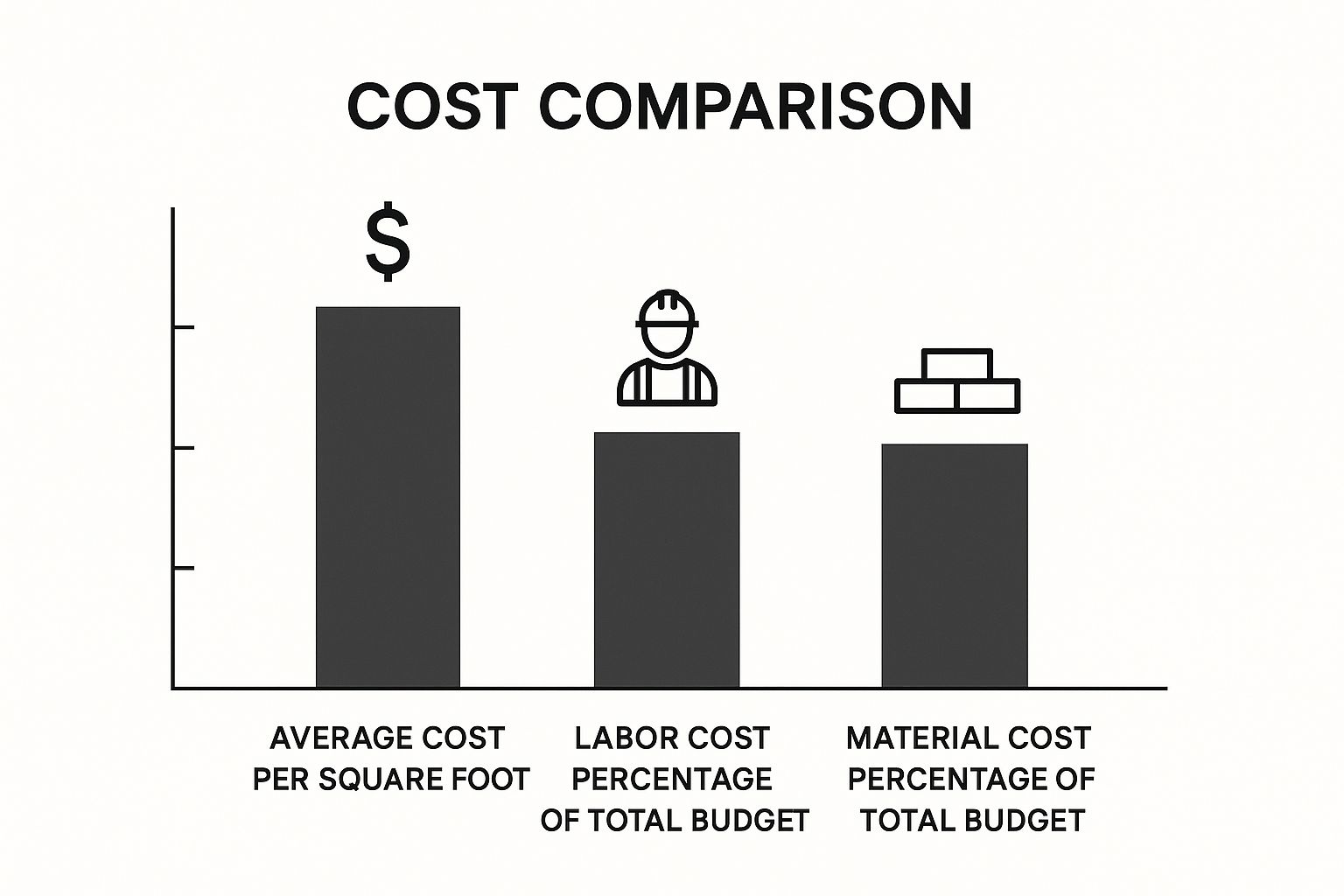
As you can see, labour makes up the lion's share of the budget. This really reflects the skilled, intensive work needed to ensure everything is structurally sound and completely waterproofed.
Cost Comparison: Existing Cellar vs New Excavation
To see how these differences play out in real terms, let's compare the typical scope and costs side-by-side.
Factor | Existing Cellar Conversion | New Basement Excavation |
|---|---|---|
Primary Task | Making an existing space habitable. | Creating a new space from scratch. |
Structural Work | Minimal; mostly internal reinforcements. | Extensive; underpinning and new structural shell required. |
Complexity | Moderate. Focus is on waterproofing and finishing. | High. Involves major engineering and logistical challenges. |
Typical Cost / m² | £1,500 – £2,500 | £3,000 – £5,000+ |
Disruption | Contained mainly within the cellar area. | Significant disruption to the ground floor and garden. |
Planning Permission | Often not required if no external changes are made. | Almost always required. |
This table makes the financial gap pretty clear. The level of engineering, labour, and risk involved in a new dig-out puts it in a completely different price bracket.
Comparing the Financial Impact
The cost difference between the two approaches is huge. In the UK, converting an existing cellar will typically set you back somewhere between £1,500 and £2,500 per square metre. This price covers the essential waterproofing, any necessary structural tweaks, and all the final finishes.
A new excavation, however, starts at a much higher price point—often from £3,000 per square metre and climbing steeply based on the project's complexity and your location. The intensive labour, hefty engineering fees, and sheer volume of materials needed are what cause this massive jump.
On top of that, new excavations almost always require formal planning permission, which adds another layer of cost and complexity. You can learn more about this in our guide on navigating basement extension planning permission.
Why London Basement Costs Are Higher
Anyone looking into the cost of a basement conversion in the UK will spot a common theme pretty quickly: prices in London are in a different league entirely. This isn't just a small bump; the 'London premium' is a serious factor that can completely reshape your budget. But it’s not for nothing—it’s the direct result of the unique and tricky challenges that come with digging down in one of the world's most built-up cities.
Getting your head around these specific challenges is the key to setting a realistic budget. The higher price tag is tied to real-world problems that you just don’t find to the same degree elsewhere. From squeezing down narrow Victorian streets to tackling complex ground conditions, a London basement project simply demands more expertise, planning, and investment right from the get-go.
The Access and Logistics Puzzle
One of the first and biggest headaches for any London basement project is plain old access. Many properties, especially the terraced houses you see all over boroughs like Kensington, Chelsea, and Fulham, have virtually no spare room for construction work. There’s often no straightforward way to get heavy machinery on-site or to get rid of the tonnes of excavated soil.
This logistical jigsaw puzzle has a direct knock-on effect on the cost:
Manual Labour: When mini-diggers can’t fit, a huge amount of the digging has to be done by hand. This is much slower and far more labour-intensive.
Waste Removal: Soil and rubble are often ferried out on conveyor belts and then loaded into skips on the street, which means paying for permits and managing traffic carefully.
Material Delivery: Just getting things like steel beams and concrete onto a cramped site can be a complex daily operation, adding hours and, therefore, money to the project.
Because of these constraints, a London basement build is often a masterclass in logistics, with every single step planned meticulously to cause as little disruption as possible in a crowded urban setting.
Complex Ground Conditions and Engineering
Under the streets of London is a complicated mix of soil types, from London Clay to sand and gravel, often tangled up with Tube lines and a maze of utilities. This unpredictable geology means much more detailed site investigations and sophisticated engineering are needed compared to a project somewhere with more stable ground.
On top of that, with neighbouring properties just a whisker away, the structural calculations have to be perfect. Party Wall Agreements become far more involved, and the underpinning process—which is all about securing your and your neighbours' foundations—has to be done with surgical precision. This level of specialist engineering and risk management naturally costs more.
In London, basement conversion costs are notably higher than the UK average. This reflects the city's unique challenges, such as complex structural engineering requirements, extensive excavation logistics, and costly underpinning due to the dense building environment. To get a deeper understanding of these pricing factors, you can explore the 2025 pricing guide on Reltic BIM.
Higher Labour and Material Costs
It's a simple fact of life: the cost of living and running a business in London is higher. This feeds directly into the price of construction. Skilled tradespeople, structural engineers, and specialist basement contractors all command higher wages in the capital to cover their own costs and reflect the huge demand for their skills.
It's the same story for materials and services—everything from ready-mix concrete to skip hire is more expensive. When you add it all up, these inflated baseline costs for labour and supplies make a big dent in the overall budget, pushing the per-square-metre rate well above what you'd see elsewhere in the country.
Stringent Local Authority Regulations
Many London boroughs have brought in their own specific planning policies to get a handle on the boom in basement projects. Councils in areas like the Royal Borough of Kensington and Chelsea or the City of Westminster have some of the toughest regulations you’ll find anywhere.
These rules can include:
Size Limitations: Putting a cap on how big a basement can be in relation to the property's garden or footprint.
Construction Management Plans: A mandatory, incredibly detailed plan showing how noise, dust, and traffic will be controlled throughout the build.
Flood Risk Assessments: Detailed reports needed to prove the new basement won’t make flooding worse for anyone.
Getting through these demanding planning hoops means paying extra professional fees for consultants and adds more time to the pre-construction phase. This regulatory red tape is a hidden but significant cost that homeowners have to build into their financial plans for any London basement conversion.
Budgeting for Often Overlooked Expenses
When a builder hands you a quote, it’s easy to breathe a sigh of relief and fixate on that one number. The reality? That figure is almost always just for the construction itself. A smart, realistic budget for a basement conversion needs to look far beyond the main build, accounting for all the crucial professional services that happen before a single shovel breaks ground.
Think of your main construction quote as just one piece of a much larger financial puzzle. Getting a handle on these "hidden" costs from the outset is the key to keeping your project on solid financial footing and avoiding stressful surprises down the line.
Professional Fees and Planning Costs
Long before the diggers arrive, you'll need a team of experts to design the space, ensure it’s structurally sound, and get the necessary legal permissions. These fees are completely separate from what your builder charges and are absolutely fundamental to your project’s success.
Here are the key professionals you'll need to factor into your budget:
Architect or Designer Fees: These are the people who turn your ideas into a detailed, buildable reality. Their fees typically range from 5% to 15% of the total construction cost, depending on how involved you want them to be – from initial concept drawings right through to full project management.
Structural Engineer Fees: For a basement conversion, a structural engineer is non-negotiable. They do the vital calculations for steel beams, underpinning, and structural supports that guarantee the safety and integrity of your entire home. Expect to pay somewhere between £1,000 and £3,000, though this can climb for more complex jobs.
Planning Application and Building Regulations Fees: You’ll need to submit a planning application to your local council, which comes with a fee of a few hundred pounds. On top of that, you’ll pay for Building Control inspections throughout the build to certify that the work meets all safety and quality standards.
Legal and Neighbourly Agreements
If your project involves work on or near a shared boundary, you have a legal duty to your neighbours. A Party Wall Agreement is a formal legal document required when you're excavating close to a neighbour's property or working on a shared wall.
This process often means you’ll need to appoint a surveyor. If your neighbour decides to appoint their own surveyor (which is their right), you are legally obligated to cover their fees as well. These costs can add up fast, often landing in the £1,000 to £2,000 per neighbour range.
Understanding and budgeting for Party Wall Agreements early is vital. It’s not just a courtesy but a legal requirement that protects all parties involved and prevents costly disputes from derailing your project timeline.
Don't Forget the VAT
Another significant cost that often catches people out is Value Added Tax (VAT). For most residential projects, builders' quotes will be subject to VAT, which currently stands at a hefty 20%.
Make a point to clarify with your contractor whether their quotes are inclusive or exclusive of VAT. A quote that looks like £100,000 will actually cost you £120,000 if VAT hasn’t been added. That’s a massive difference that can throw your entire budget off course.
Contingency and Other Hidden Costs
Finally, no experienced homeowner or builder would start a major renovation without a contingency fund. This is your financial safety net, typically 10-15% of the total project cost, set aside purely for the unexpected. You might discover tricky ground conditions during the excavation or encounter other unforeseen issues—this fund is what covers it.
Other potential costs to keep in mind include:
Temporary Accommodation: If the work is going to be especially disruptive, you may need to factor in the cost of moving out for a while.
Interior Finishes: The basic structural shell is one thing. High-end kitchens, bespoke bathrooms, or sophisticated lighting systems can quickly inflate your budget.
Waterproofing Systems: Although this is part of the build, the quality and type of waterproofing you choose is critical. For a deep dive, check out our guide on how to waterproof a basement properly.
Smart Ways to Manage Your Conversion Budget

Managing the budget for a basement conversion doesn’t have to mean sacrificing your vision. With a bit of strategic planning, you can keep costs in check and still end up with an incredible, high-quality space. The secret isn't about cutting corners; it's about making smart savings where they won't compromise the project's integrity.
This means pouring your investment into the non-negotiables first—things like the structural work and waterproofing. These are the absolute foundations of a successful conversion. Once those are rock-solid, you can find clever ways to save on the cosmetic elements, which can always be upgraded down the line.
Prioritise the Shell and Core Build
One of the best ways to manage a large, complex project is to break it down into phases. A great strategy is to focus your initial budget on completing the "shell and core" of the basement. This gets all the messy, disruptive, and critical work out of the way in one go.
This first phase typically covers:
Excavation and structural work: This is all the heavy lifting—underpinning, concrete pours, and steel installations.
Waterproofing: The crucial job of installing a reliable membrane and drainage system to guarantee a dry space.
Basic utilities: Running the first-fix electrics and plumbing into the new shell.
Once this is done, you have a structurally sound, completely dry, and secure space. You can then press pause and tackle the interior fit-out—the plastering, flooring, decorating, and joinery—when your budget allows. It’s a brilliant way to split the total cost into more manageable chunks.
Think of the shell and core approach as building the perfect blank canvas. You secure the most critical and complex part of the investment upfront, giving you the flexibility to complete the masterpiece when the time and funds are right.
Savvy Sourcing and Finishing Choices
The fixtures and finishes you choose will have a massive impact on the final bill. While it’s tempting to specify top-of-the-range everything from day one, this is where smart decisions can lead to big savings without harming the overall look.
For instance, you could opt for good quality, mid-range flooring or lighting to begin with, knowing you can upgrade it in a few years. Sourcing materials yourself, like tiles or bathroom suites, also lets you take advantage of sales and discover unique pieces that add character without the premium price tag. The key is to ensure the foundational work beneath it all is of the highest possible quality.
Get and Compare Detailed Quotes
Never, ever accept the first quote you receive. It’s absolutely vital to get at least three detailed, itemised quotations from reputable basement conversion specialists. A vague, one-page quote is a major red flag. What you need is a comprehensive breakdown that lists every single part of the job, from soil removal to the final coat of paint.
When you’re comparing quotes, don't just glance at the bottom line. Dig into the specifics to make sure you’re comparing like-for-like. Pay close attention to the allowances for finishes, the proposed waterproofing system, and what professional fees are included. Understanding the details of architect fees, for example, is essential for accurate budgeting. You can learn more in our [guide to the cost of an architect in the UK](https://www.harperlatterarchitects.co.uk/post/cost-of-an-architect-uk-fees-budgeting-guide). This diligence ensures you know exactly what you’re paying for and helps you find a partner who offers true value and transparency.
Frequently Asked Questions
Taking on a basement conversion is a big decision, so it's only natural to have a few questions swirling around. To give you a bit more clarity, we've answered some of the queries we hear most often from homeowners planning their projects.
Does a Basement Conversion Add Value to My Home?
Absolutely. A well-designed and properly built basement conversion can boost your property's value, often by as much as 10-20%. You're adding valuable square footage, which is a huge plus, especially in sought-after areas like South West London. It’s a project that generally delivers a strong return on investment.
The key, however, is to get the balance right. The final value added depends on the quality of the work and the price ceiling for similar homes in your neighbourhood. It's crucial to make sure the cost of the conversion doesn't end up being more than the potential uplift in your home's market price.
Do I Need Planning Permission to Convert My Cellar?
This is a common point of confusion. If you're simply converting an existing residential cellar and not changing the outside of your home, you often won't need full planning permission. This type of work can sometimes fall under permitted development rights.
However, you will almost certainly need to apply for planning permission if your project involves:
Digging out a completely new basement space from scratch.
Extending the cellar beyond its current footprint.
Adding a new lightwell to the front or side of your property.
No matter what, you must always comply with Building Regulations. This is non-negotiable and ensures the new space is safe, habitable, and structurally sound for you and your family to enjoy.
How Long Does a Basement Conversion Take to Complete?
There’s no single answer here, as the timeline really depends on the scale and complexity of the job.
A straightforward conversion of an existing cellar—think tanking, insulating, and finishing the space—might take around 8-12 weeks to finish. On the other hand, a complex project that includes a brand-new excavation, major underpinning, and structural changes is a much longer journey. These larger projects typically take anywhere from 6 to 12 months, from the first drawings to the final sign-off.
Realising the full potential of your home with a basement conversion is a significant undertaking, but the rewards in space, lifestyle, and value are immense. Understanding the costs and processes upfront is the first step toward a successful project.
At Harper Latter Architects, we specialise in designing and delivering exquisite, high-end basement extensions across Wimbledon and South West London. Our expert team navigates the complexities of planning and construction to create beautiful, functional spaces that perfectly match your vision. Explore our bespoke architectural services and see how we can transform your home.
Comments