
What Is a Certificate of Lawfulness? A UK Property Guide
A Certificate of Lawfulness is a formal, legally binding document issued by your local council. It officially confirms that a development on your property—whether it’s already built or still on the drawing board—is lawful for planning purposes and doesn’t need full planning permission.
Understanding Your Property’s Legal Passport
The best way to think of a Certificate of Lawfulness is as a 'legal passport' for your property's development. It provides definitive, watertight proof that specific works are immune from any council enforcement action. It’s your official green light.
Imagine you’re planning to build a large garden room and want absolute certainty that it falls under your Permitted Development Rights before laying a single brick. Or perhaps you bought a house with a loft conversion finished a decade ago, but there’s no paperwork to be found. These are precisely the scenarios a Certificate of Lawfulness is designed to resolve.
Why Is This Certificate So Important?
Without this legal confirmation, you could run into serious trouble, especially when you decide to sell. A buyer’s solicitor will scrutinise every detail of your property’s history, and any uncertified work can cause major delays, force you into price negotiations, or even cause the entire sale to collapse.
A Certificate of Lawfulness provides legal certainty and peace of mind. It removes ambiguity and formally protects you from the threat of costly enforcement action from the local authority, safeguarding your property's value and future potential.
It’s important to realise that this isn't the same as applying for planning permission. Instead, it’s a factual confirmation from the council that your project is lawful and doesn’t need planning permission in the first place. The decision is based purely on legal rules and evidence, not on subjective opinions about design or objections from neighbours.
There are two main types of certificate, and knowing which one you need is the first step.
Two Types of Lawfulness Certificates at a Glance
To help you distinguish between the two, here’s a quick comparison of the certificate for existing works (CLEUD) versus the one for future projects (CLOPUD).
Aspect | Certificate of Lawfulness (Existing Use/CLEUD) | Certificate of Lawfulness (Proposed Use/CLOPUD) |
|---|---|---|
Purpose | To prove an existing development is lawful. | To confirm a future development will be lawful. |
Timing | Applied for after works have been completed. | Applied for before any work begins. |
Key Requirement | Demonstrating the work has existed for a specific time (4 or 10 years). | Proving the proposed plans comply with Permitted Development rules. |
Common Use Case | An old extension or loft conversion without records. | A new rear extension or outbuilding you want to build. |
Outcome | Regularises past unauthorised works. | Gives you the legal confidence to start construction. |
Essentially, a CLEUD looks back in time to regularise something that’s already there, while a CLOPUD looks forward to give you a green light for your plans.
Understanding which certificate applies to your situation is crucial for navigating the planning system smoothly and protecting your most valuable asset.
Understanding CLEUD vs CLOPUD and Which One You Need
When you get into the nitty-gritty of planning law, you'll quickly come across two very similar-sounding acronyms: CLEUD and CLOPUD. Although they sound alike, they do completely different jobs. One is like a rear-view mirror for work that’s already been done, while the other is more like a crystal ball for projects you’re planning for the future.
Figuring out which one you need is the first, most important step in making sure your property is on the right side of the law. The choice really just comes down to timing: are you trying to formalise something that already exists, or are you hoping to get a green light for something new?
CLEUD: The Retrospective Confirmation
A CLEUD, or a Certificate of Lawfulness of Existing Use or Development, is all about looking backwards. You use it to get retrospective legal status for a building or a change of use that happened in the past without the right planning permission. Think of it as a way to regularise historical works that have, simply through the passage of time, become immune from any enforcement action by the local council.
To get a CLEUD, you have to prove the work has been continuously in place for a specific amount of time. The burden of proof is entirely on you, the applicant. You’ll need to pull together undeniable evidence showing that the structure or use has existed long enough to be safe from the council’s legal reach.
The key time limits for this immunity are:
Four Years: For building operations, such as creating a single house. This rule has recently changed for most new cases, so it only applies to works substantially completed before a key date.
Ten Years: For any other breach of planning control. This covers things like a material change of use (e.g., running a business from a residential garage) or not following a condition attached to a previous planning permission.
These timeframes are strict. If you can't prove the breach has been in place continuously for the whole period, a CLEUD simply can't be granted.
The Recent Shift From a Four to Ten-Year Rule
It’s absolutely vital for property owners to know about a major change in planning law. The rules for Certificates of Lawfulness changed dramatically on 25 April 2024. On that date, the UK government got rid of the 4-year rule for most breaches of planning control, making 10 years the standard enforcement period for both residential and operational development under the Levelling-up and Regeneration Act 2023.
Before this, building works or changes like converting an office to a single home could become lawful after just four years. Now, only works that were substantially finished by that April 2024 cutoff can still use the shorter timeframe. Everything else now needs a full decade of continuous use to become immune. This change makes it much harder to regularise unauthorised work, extending the period of risk for homeowners.
CLOPUD: The Proactive Green Light
On the other hand, a CLOPUD, or a Certificate of Lawfulness of Proposed Use or Development, is entirely forward-looking. You apply for this certificate before you even think about picking up a tool. The goal is to get a formal, legally binding decision from the council confirming that your planned project is lawful and doesn’t need a full planning application.
A CLOPUD is your ultimate insurance policy before you invest time and money into construction. It provides absolute certainty that your proposal complies with Permitted Development rights or other legal provisions.
This is the perfect route for projects you’re confident fall under Permitted Development, such as:
A new loft conversion with a dormer.
A single-storey rear extension.
A garden room you plan to use as a home office or gym.
By submitting detailed plans to the council upfront, you remove all the guesswork. If they agree your project is lawful, they issue the CLOPUD. This document gives you, your builder, and any future buyers total confidence that the development is authorised. The decision is based purely on a technical check of your plans against the rules, not on anyone’s subjective opinion.
Which Certificate Is Right for You?
Choosing between a CLEUD and a CLOPUD becomes pretty simple once you look at the status of your project.
Situation | Certificate Needed | Why? |
|---|---|---|
You bought a house with a rear extension built 12 years ago, but there's no planning record. | CLEUD | The work is already there, and you need to prove it's immune from enforcement due to how long it's been up. |
You plan to build a large outbuilding in your garden next year and want to be sure it's Permitted Development. | CLOPUD | The work is proposed, and you need official confirmation that it’s lawful before you start building. |
You converted your garage into a living room over 5 years ago without permission. | CLEUD | You need to regularise an existing change of use that is now potentially immune from council action. |
Ultimately, a CLEUD is about sorting out the past, while a CLOPUD is about securing the future. Both are incredibly valuable for protecting your property’s legal status and its financial value.
Proving Your Case During the Application Process
Applying for a Certificate of Lawfulness isn’t just filling out a form. Think of it as a serious legal process where the burden of proof falls squarely on you, the applicant. Your local council won’t be doing any detective work on your behalf—it’s up to you to build a watertight case.
Your goal is to gather enough solid proof to show that, on the ‘balance of probabilities’, your project is lawful. In simple terms, this means your evidence has to make it more likely than not that what you’re claiming is true.
Building an Unbreakable Evidential Timeline
When you apply for a Certificate of Lawfulness for an Existing Use or Development (CLEUD), your main job is to prove the building or use has been in place continuously for the required time—usually four or ten years. You can't just rely on a single document. Instead, you need to build a year-by-year timeline backed up by layers of evidence.
The council will look for any gaps or weak spots in your story, so a strong application combines multiple types of proof to paint a clear and convincing picture.
Here’s the kind of compelling evidence planners want to see:
Dated Photographs: There's nothing quite like a dated photo to prove something existed. Aerial shots or even old family photos showing the development over time can be incredibly powerful.
Historic Utility Bills: A stack of gas, electricity, and water bills addressed to the property is excellent proof of continuous occupation or use.
Council Tax Records: These official records confirm a property's status (e.g., as a single dwelling) and the date it was registered, making them a trusted source.
Statutory Declarations (Affidavits): These are sworn legal statements from people with firsthand knowledge of the property, like previous owners, long-standing neighbours, or tenants. They have to be detailed, specific, and witnessed by a solicitor to carry weight.
Invoices and Receipts: Got the original receipts from builders or suppliers? These can pinpoint exactly when work was done.
This flowchart shows how to decide which certificate you need based on whether your project is already built or still in the planning stages.
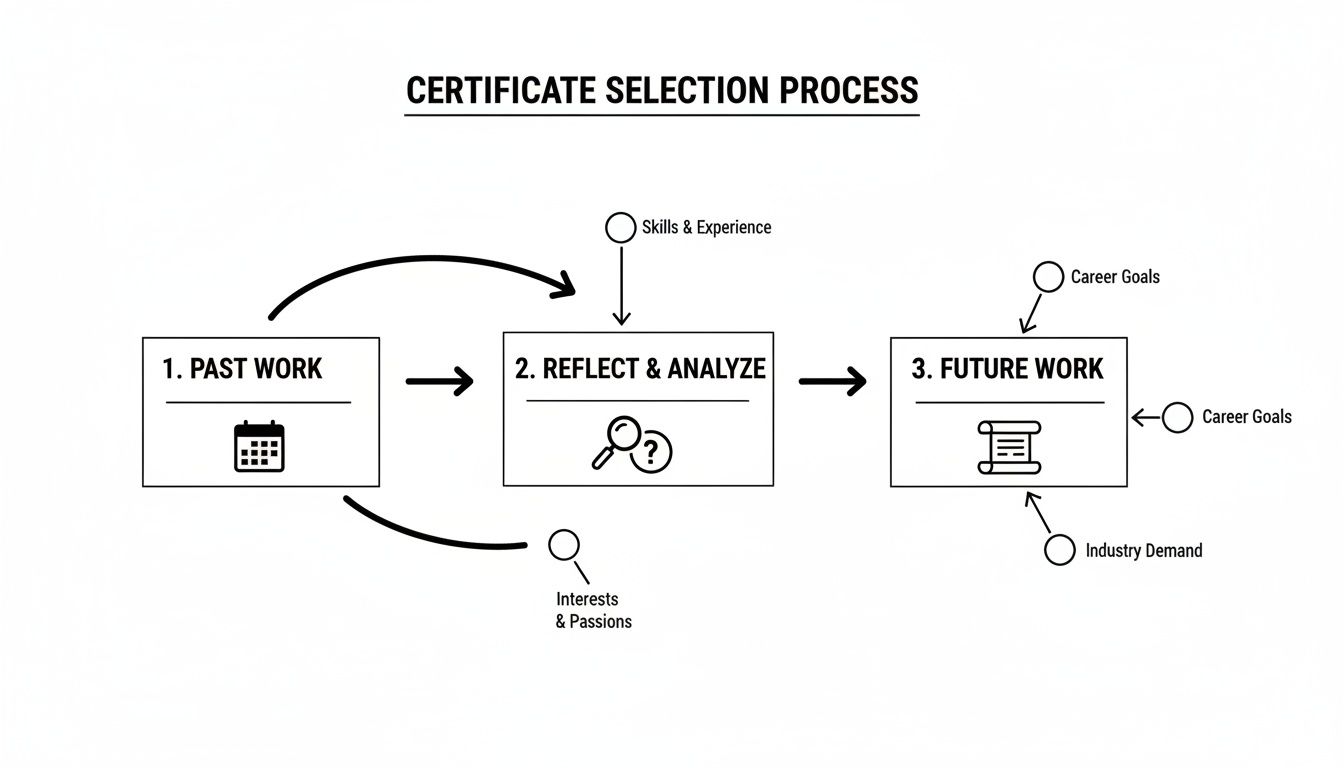
The key takeaway is simple: a CLEUD looks backward at work that's already done, while a CLOPUD looks forward to work you're planning to do.
The High Stakes of Your Application
The quality of your evidence is everything. A well-prepared application has a great chance of success, but submitting weak or, even worse, false information comes with serious risks.
Just look at the data from Haringey Council. Between 2009 and 2011, they approved 122 out of 157 CLEUD applications, which is a 78% approval rate. This shows that plenty of homeowners succeed when they have solid proof. However, 25 applications were refused, and more importantly, 5 certificates were later revoked when investigations found the evidence was false. This really highlights the consequences of being dishonest.
A Certificate of Lawfulness is granted based on the factual evidence provided. If that evidence is later found to be "materially false" or deliberately misleading, the council has the power to revoke the certificate, leaving the development once again unlawful and vulnerable to enforcement action.
This is why meticulous honesty is non-negotiable. Submitting a weak application will likely end in refusal, which is a waste of your time and money. But providing false information could lead to the certificate being withdrawn years down the line—perhaps right in the middle of a sale—and could even lead to prosecution.
Some applications may also need supporting documents like a Design and Access Statement to add important context. The aim is to build a case so clear and well-documented that the planning officer has no choice but to agree your project is lawful. Anything less is a risk you don’t want to take.
Why a Certificate of Lawfulness Is Essential for Your Property
So, what does a Certificate of Lawfulness actually mean for you as a homeowner? It’s easy to get bogged down in the technicalities, but it’s far more useful to think of it not as planning paperwork, but as a powerful tool that secures the value and potential of your home. Its real importance often snaps into focus during critical moments, like a property sale or when you’re planning your next big project.
At its core, a certificate offers three crucial benefits: it protects your home’s marketability, unlocks future development opportunities, and grants you invaluable peace of mind. Without one, you could be leaving yourself open to some incredibly stressful and expensive problems down the line.
Secures Your Property During a Sale
Imagine you’ve finally accepted an offer on your house. The conveyancing process is moving along smoothly until the buyer's solicitor drops a bombshell: that loft conversion, finished 12 years ago by the previous owner, has no official planning records. Just like that, the entire sale is in jeopardy.
This is a scenario we see play out far too often. Without official proof that the work is lawful, buyers and their mortgage lenders get understandably nervous.
A Certificate of Lawfulness provides definitive, legally binding proof that a development is legitimate. It removes the ambiguity that can cause a property sale to collapse, giving solicitors and lenders the confidence they need to proceed.
For a buyer, an uncertified extension or conversion is a huge unknown. They have no guarantee the council won’t suddenly appear with an enforcement notice, demanding the structure be changed or even torn down. This risk is often enough for them to pull out of the sale or demand a hefty price reduction. A certificate takes that problem off the table, paving the way for a much smoother and more secure transaction.
Unlocks Future Development Potential
A Certificate of Lawfulness isn’t just about sorting out the past; it’s about clearing the path for your future ambitions. If you’re planning a new project, regularising any historic works is often the very first step. It’s highly unlikely that a council will grant permission for a new extension if there are other unauthorised structures on the property.
Think of it this way:
You have a vision for a stunning new kitchen extension that will completely change how your family lives in the home.
But your house also has a conservatory that was built 15 years ago without planning permission.
Before the council will even look at your new plans, they will almost certainly insist you legitimise the old conservatory first.
By getting a Certificate of Lawfulness for the existing structure, you effectively wipe the slate clean. It shows the planning authority that you’re a responsible homeowner and allows them to assess your new application on its own merits. It’s a strategic move that unlocks the full potential of your home for years to come.
Delivers Permanent Peace of Mind
Perhaps the most underrated benefit is the simple removal of worry. The lingering threat of an enforcement notice from the local authority can be a heavy weight on any homeowner’s shoulders. This official demand could force you into costly remedial works or, in the worst-case scenario, require you to demolish a part of your own home.
This risk is especially sharp when dealing with heritage properties. For example, a homeowner with a 12-year-old unauthorised loft conversion in a listed building is living with constant uncertainty. Securing a Certificate of Lawfulness for Existing Use or Development (CLEUD) is completely transformative in these cases. The process demands robust evidence—councils often require things like old council tax records or utility bills to prove continuous use—and they can revoke certificates if they find any ‘materially false statements’. As Freedom of Information requests to councils like Haringey show, the evidence requirements are rigorous.
However, once that certificate is granted, it confirms the development’s lawfulness for good. You’re protected from enforcement action, allowing you to finally relax and even plan further bespoke works with confidence.
Navigating Complex Scenarios Like Listed Buildings and Basements
While many Certificate of Lawfulness applications are pretty straightforward, some projects throw unique challenges into the mix. This is where the rules can get far more complex. Niche scenarios, like working on a heritage property or dealing with a large-scale construction project that's been paused, demand a much deeper understanding of the system.
When you start digging into these cases, you quickly see just how vital it is to get specialist advice. Whether you’re dealing with a listed building, a half-finished basement extension, or even a simple garden office, careful handling is essential to avoid making a very costly mistake.
The Critical Distinction for Listed Buildings
Owning a listed building is a unique privilege, but when it comes to planning, the rules are significantly stricter. A common point of confusion is how a Certificate of Lawfulness interacts with Listed Building Consent, and it's vital to understand they are two entirely separate things.
A Certificate of Lawfulness for Existing Use or Development (CLEUD) can confirm that a development is lawful from a planning perspective. For instance, it could be used to prove that an internal alteration made over a decade ago is now immune from planning enforcement.
However—and this is the crucial part—this does not grant you Listed Building Consent.
A CLEUD offers no protection whatsoever against enforcement action under listed building legislation. Unauthorised works to a listed building are a criminal offence, and there are no time limits for the council to take action.
This means that even with a CLEUD in hand, the local authority’s conservation officer can still demand you reverse any unauthorised changes, no matter how long ago they were made. If you’re even thinking about making changes to a heritage property, our detailed guide to renovating a listed building in the UK offers some essential insights. Here, getting expert advice isn’t just a good idea; it’s fundamental to protecting your property and staying on the right side of the law.
Paused Construction and Large-Scale Projects
Ambitious projects like basement extensions often happen in phases, sometimes with long breaks in between. This can create a tricky situation if the work began years ago but was then put on hold before it was finished.
Imagine this: the initial excavation for a basement started six years ago, but the project was then paused. If you now want to restart construction, you may need to prove that the works were lawfully started and haven't been abandoned. This is where a CLEUD can be instrumental.
The application would aim to establish that the initial works were substantial enough to be considered a 'material start', which lawfully implements the original planning permission. This secures your right to complete the project without having to reapply for planning permission, which would likely be subject to newer, more restrictive policies.
Ensuring Ancillary Uses Are Compliant
The use of outbuildings is another area where a Certificate of Lawfulness can save you from future headaches. With the rise of remote working, many homeowners are adding garden rooms to use as home offices, gyms, or creative studios.
These structures can often be built under Permitted Development rights, but only if their use is ‘incidental to the enjoyment of the dwellinghouse’. In simple terms, this means the outbuilding must serve a secondary function that supports the main home, not an independent, primary activity.
Lawful Use: A home office for your personal use, or a gym for the family.
Unlawful Use: A self-contained flat you rent out, or a commercial business headquarters where clients come and go.
If the use of that garden room intensifies and is no longer considered 'incidental', it becomes a material change of use that needs full planning permission. By getting a Certificate of Lawfulness for a Proposed Use or Development (CLOPUD) before you build, you can confirm that your intended use is compliant from day one, protecting you from any enforcement issues down the line.
How Your Architect Can Ensure a Successful Application

Applying for a Certificate of Lawfulness isn’t just filling out a few forms; it’s a detailed legal process where the smallest oversight can lead to refusal. While you can tackle it alone, bringing an experienced architect on board significantly boosts your chances of success. They’re much more than designers—they become your strategic partner in all things planning.
A good architect acts as your guide through the planning system’s complexities. They ensure every part of your application is solid, convincing, and professionally put together. This kind of expertise is vital when the stakes are so high.
Building Your Case with Strong Evidence
Since the ‘burden of proof’ is entirely on you, gathering the right evidence is arguably the most important part of the application. An architect knows exactly what a planning officer needs to see to confirm a continuous history for a CLEUD.
They will help you build a watertight evidence file, which could include:
Statutory Declarations: They can advise on who should provide these sworn statements and make sure the wording is precise and legally sound.
Historic Documents: They'll guide you in pulling together council tax records, old utility bills, and invoices to create a complete timeline with no gaps.
Photographic Proof: They know how to source and present dated aerial or ground-level photos to paint a clear visual story for the council.
This structured approach turns a box of old papers into a powerful, persuasive case.
Getting the Drawings and Documents Spot On
Both CLEUD and CLOPUD applications depend on accurate, detailed architectural drawings. These are far from simple sketches; they are precise technical documents that either record an existing structure or clearly define a proposed development.
An architect’s drawings are the factual backbone of your application. They must be meticulously accurate, because any mistake can raise red flags, cause major delays, or even lead to an outright refusal.
For a CLOPUD, the drawings have to prove, without a doubt, that your proposal ticks every box under Permitted Development rights. For a CLEUD, they create a definitive record of the building as it has stood over time. Your architect will make sure these documents meet the exact standards your local authority demands.
Writing a Compelling Planning Statement
Finally, a seasoned architect will draft a clear and persuasive planning statement to support your application. This document is where everything comes together. It lays out the legal arguments for why the certificate should be granted and explains how the evidence proves your case on the ‘balance of probabilities’.
Think of this statement as your chance to make a professional argument, answering questions before they’re even asked and making the planning officer’s decision as straightforward as possible. For anyone just starting out, our guide on finding the right professional for your project is a great place to begin. With an expert in your corner, you can be confident your application is as strong as it can possibly be.
Frequently Asked Questions
When you get into the nitty-gritty of planning law, a few common questions always pop up. Let's walk through some of the practicalities homeowners often ask about when it comes to getting a Certificate of Lawfulness.
How Long Does a Certificate of Lawfulness Take and What Are the Costs?
Your local planning authority has a statutory deadline of 8 weeks to make a decision on your application. In reality, more complex cases can sometimes stretch beyond this, but that’s the official target they work towards.
The application fees are set nationally. For a proposed project (a CLOPUD), the fee is simply half the cost of what a normal planning application would be for that type of work. If you’re applying for an existing project (a CLEUD), the fee is the same as a full planning application. On top of that, you’ll need to factor in the professional fees for your architect or planning consultant who will prepare and manage the application.
What Happens if My Certificate of Lawfulness Application Is Refused?
If the council refuses your application, it’s not the end of the road. You have the right to appeal to the Planning Inspectorate, where an independent Inspector will take a fresh look at the council's decision and the evidence you've submitted.
A refusal doesn’t automatically kickstart enforcement action. However, it’s a clear signal from the council that they consider your development unlawful, which puts you at a much higher risk of running into problems later. That's why building a rock-solid case from the very beginning is always the best strategy to avoid a stressful and expensive appeal.
A Certificate of Lawfulness deals only with planning law; it has no bearing on Building Regulations. They are two entirely separate legal requirements, and compliance with one does not mean compliance with the other.
Does a Certificate of Lawfulness Cover Building Regulations Approval?
No, and this is a crucial point that many homeowners get wrong. The certificate purely confirms that your project is lawful from a planning perspective.
It offers absolutely no assurance that the work meets Building Regulations, which are the technical rules governing construction to ensure everything is safe and healthy. If you have uncertified work that doesn't meet these standards, you may need to apply for a separate retrospective approval, often called a 'Regularisation Certificate', from your local council's Building Control department.
Navigating the legalities of a Certificate of Lawfulness requires precision, attention to detail, and expertise. Harper Latter Architects can manage the entire process for you, from gathering the right evidence to communicating with the council, making sure your property is fully compliant and legally secure. Secure your property’s legal status by speaking with our team today.