
A Practical Guide to Renovating a Listed Building in the UK
Taking on a listed building renovation is a world away from a standard home improvement project. It’s a delicate balancing act, blending your own architectural ambitions with the duty to preserve a piece of history. You'll need to navigate a maze of strict regulations and secure Listed Building Consent for almost any change, making the process more complex, more expensive, and almost certainly longer.
Success isn't just about getting a beautiful home; it's about respecting the building's special character while making it work for modern life.
You're Not Just an Owner, You're a Custodian
When you take on a listed building, you’re stepping into the role of a temporary guardian. This isn't just about ownership; it's about custodianship. You become responsible for a slice of the UK's national heritage, a role that comes with its own legal duties and a very particular set of challenges. It requires a mindset that puts preservation first.
At the heart of this is the concept of 'listing'. A building is listed when it's judged to be of special architectural or historic interest and is added to the National Heritage List for England. This isn't just a plaque on the wall; it's a legal framework designed to protect these important places for everyone, for good.
Getting to Grips with the Listing Grades
The level of protection your property has—and by extension, the level of scrutiny your plans will face—is all down to its grade. Figuring out where your building fits in this hierarchy is the very first step to setting realistic expectations for your project.
We can break down the different grades of listing in England to understand what each one really means for a homeowner looking to renovate.
Grades of Listed Buildings and What They Mean for You
Listing Grade | Significance | Typical Examples | Renovation Implications |
|---|---|---|---|
Grade I | Buildings of exceptional interest. Only 2.5% of all listed buildings fall into this category. | Buckingham Palace, Canterbury Cathedral, major castles. | Alterations are extremely rare and require an overwhelmingly powerful justification. The preservation of every detail is paramount. |
Grade II | Particularly important buildings of more than special interest. This covers around 5.8% of the list. | Buildings with unique architectural features, significant interiors, or notable historical connections. | Renovations are possible but face intense scrutiny. Changes must be sensitively designed and proven to cause minimal harm. |
Grade II | Buildings of special interest, warranting every effort to preserve them. This is the most common grade, at 91.7%. | Most residential listed properties, from historic townhouses and cottages to unique farm buildings. | This is where most renovations happen. There's more flexibility, but all work must be conservation-led and respectful of the building's character. |
It’s crucial to understand that listing doesn’t just protect the front of the house. It’s a common and costly mistake to assume that. The protection covers the entire building—inside and out—and often extends to fixtures, fittings, and even the land it sits on (known as the 'curtilage'). This means that something as simple as moving an internal wall or changing the garden path could require formal consent.
Navigating the Current Planning Climate
Before you get too far down the road, it pays to have a realistic view of the current planning environment. The journey to getting the permissions you need can be a long one, and it's often influenced by wider trends. Renovating listed properties in the UK is facing some tough headwinds, with planning permissions for home improvements recently hitting a decade-long low.
Recent data shows that planning approvals in England fell to just 151,177 in the year to March—that’s a huge 27% below the 10-year average. This slowdown has a real knock-on effect for heritage projects, where you often need multiple layers of approval from the local council and sometimes Historic England. In the South West, including areas like Wimbledon and Surrey, the drop has been even steeper, at over 23% compared to five years ago. You can dig into the numbers in this home renovation statistics report.
The key takeaway here is that you're not just renovating a property; you are curating a piece of history. Every single decision, whether it's specifying breathable lime plaster or designing a sympathetic glass extension, must be justified through the lens of preservation.
This is precisely where bringing in a conservation-accredited architect becomes non-negotiable. They act as your expert guide, translator, and advocate, navigating the complex dialogue between your vision for a modern home and the conservation officer's duty to protect its heritage. Getting them involved early isn't a luxury—it’s fundamental to getting your project off the ground.
Navigating the Listed Building Consent Process
Securing the right permissions is without a doubt the most critical phase of renovating a listed building. This isn't just a box-ticking exercise; it's a journey that demands careful preparation, a dialogue with the right people, and a genuine appreciation for your property's history. It’s where your modern vision meets the legal duty to preserve, and success really hinges on building a compelling case for change.
The process starts long before any forms are filled out. Your very first port of call should always be your local authority’s conservation officer. Getting their pre-application advice is an invaluable step that can save you a huge amount of time, money, and stress later on.
This initial, informal chat is your chance to float your ideas and get an early feel for what might be acceptable. It helps build a constructive relationship and shows you’re committed to a thoughtful, conservation-led approach right from the start.
This helpful infographic breaks down the foundational steps to get your project started on the right foot.
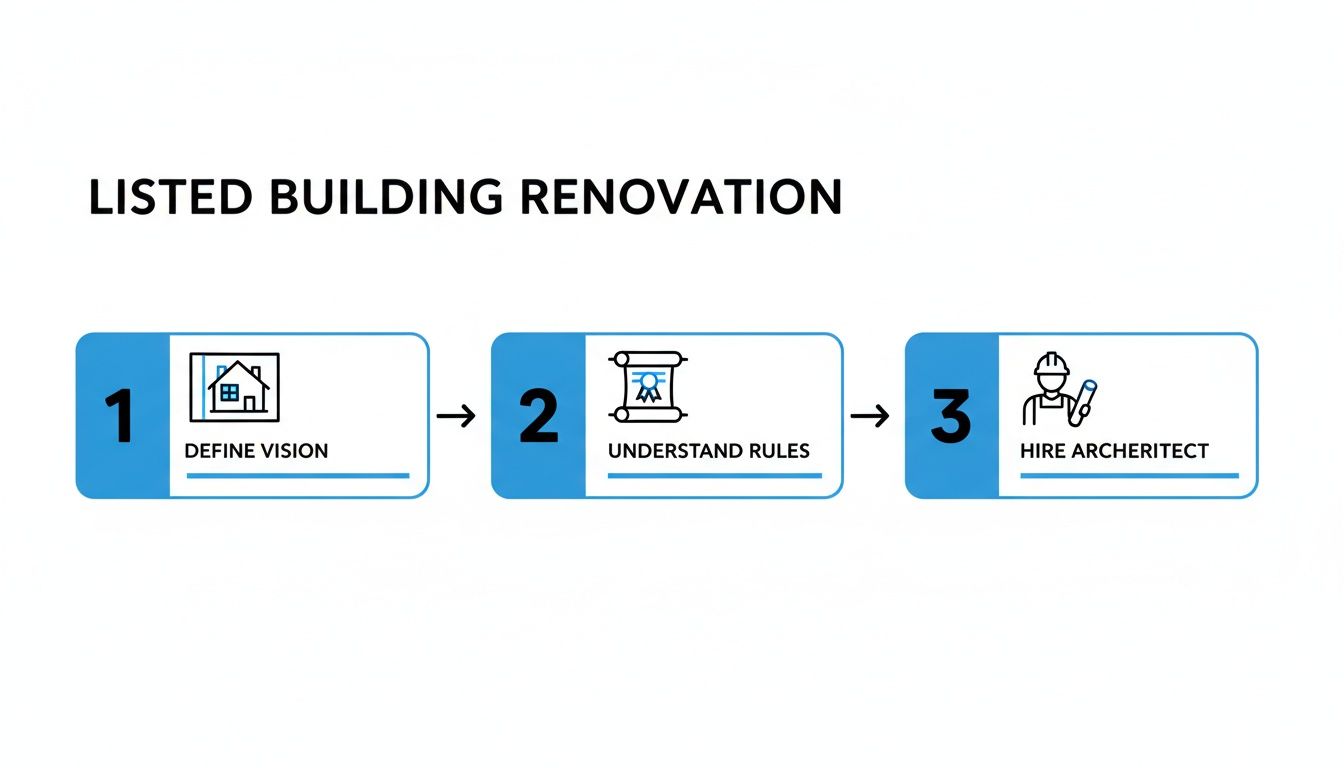
As you can see, defining your vision, understanding the rules, and hiring an architect are the core preliminary stages before any consent application even begins.
Consent vs Permission: What is the Difference?
One of the most common points of confusion is the distinction between Planning Permission and Listed Building Consent. They’re often handled by the same department at the council, but they are two entirely separate legal requirements covering different aspects of your project.
Planning Permission deals with the principle of the development and its impact on the wider area—things like the building's use, its size, and how it looks from the street.
Listed Building Consent focuses purely on any work that might affect the special architectural or historic character of your property. This applies to everything, inside and out, from moving an internal wall to replacing a fireplace.
For many projects, like adding a modern glass extension to a Georgian townhouse, you'll need to apply for both at the same time. It's crucial to get this right, as failing to secure Listed Building Consent when it's needed is a criminal offence.
Crafting a Persuasive Application
A successful application is far more than just a set of drawings. It’s a carefully constructed argument that justifies your proposed changes, showing you’ve thoroughly considered their impact on the building’s heritage significance. An experienced conservation architect is absolutely essential for preparing this robust submission. You can learn more about our specialist approach to conservation and heritage architecture here.
Your application will need to be backed up by several key documents:
Detailed Architectural Drawings: These must clearly show the building as it is now and how it will look after the work, covering floor plans, sections, and elevations.
Heritage Statement: This is a crucial document that analyses the history and significance of the building. It explains what makes the property special and assesses how your proposed changes will affect that character.
Design and Access Statement: This explains the design thinking behind your proposal, outlining why the changes are necessary and how your chosen solution is appropriate for a listed building.
A strong application pre-empts the conservation officer's questions. It needs to provide a clear, evidence-based narrative that shows every proposed change is justified, considered, and respectful of the building’s unique fabric and history.
For example, if you want to install a sleek, modern kitchen, your statement would detail how the new units can be fitted without damaging original plasterwork and how services can be routed discreetly. If you're designing a new garden room, you would justify using materials like zinc and glass by arguing they create a clear, honest distinction between the old and the new, celebrating the original façade rather than trying to mimic it.
It’s this level of detailed justification, guided by an expert, that turns a hopeful application into an approved project.
Assembling Your Specialist Heritage Team
Successfully renovating a listed building is never a one-person job. It’s more like conducting an orchestra, where every player—from the architect to the stonemason—needs to be a master of their craft. Trying to cut corners with a generalist team is a false economy that almost always ends in costly mistakes, planning refusals, and irreversible harm to the very character you fell in love with.
The right team isn't a luxury; it’s the most critical investment you'll make in the entire project.
At the helm should be a RIBA-accredited conservation architect. This isn't just a designer. They are your project lead, your strategic advisor, and the central point of contact for a whole host of other specialists. Their deep knowledge of heritage assets ensures every decision respects the building's past while creating a home that works for modern life. Crucially, they know how to translate your vision into a language that conservation officers understand and approve.
Beyond the Standard Building Survey
One of the first things your architect will do is coordinate a series of specialist surveys. A standard building survey, the kind you’d get for a modern house, barely scratches the surface of what’s needed for a listed structure. You have to dig much, much deeper to truly understand what you're working with.
This means a multi-layered investigation is needed before any real design work can even begin.
Historic Building Assessment: A building archaeologist or historian often puts this together. It documents how the property has changed over time, identifying original features versus later additions. This report establishes the building's 'significance' and forms the backbone of your all-important Heritage Statement.
Specialist Structural Report: You need a structural engineer with proven experience in historic materials. They understand how old timber frames, stone walls, and archaic roof structures move and breathe—a world away from modern concrete and steel.
Materials Analysis: Sometimes, we even need scientific analysis of old paint layers or mortar samples. This is vital to make sure any new materials are a perfect match and, just as importantly, chemically compatible with the old fabric.
The whole point of these initial investigations is to uncover the building’s complete story. This detailed, upfront analysis minimises nasty surprises during the build and gives you the solid evidence needed to justify your plans to the local authority.
Finding the Right Hands-On Experts
Once there's a clear picture of the building's condition and history, your architect will help you find the craftspeople to bring the project to life. This isn't a job for your average builder. Renovating a listed building demands artisans with skills passed down through generations.
Your project could require a whole range of specialists, including:
Traditional Lime Plasterers: Experts who know how to work with breathable lime-based renders and plasters, which are essential for managing moisture in old walls.
Sash Window Repairers: Artisans who can painstakingly restore original timber windows instead of pushing for unnecessary (and often unapprovable) replacements.
Specialist Joiners: Craftspeople who can replicate period-correct skirting, architraves, or bespoke cabinetry that feels like it has always been there.
Reclamation Experts: Professionals with a network for sourcing authentic materials, from handmade bricks fired the old-fashioned way to reclaimed roof slates that perfectly match the originals.
Pulling together this calibre of expertise is a core part of what a conservation architect does. Here at Harper Latter Architects, we have a trusted network of professionals and artisans we work with time and again. You can learn more about our team's collaborative approach and passion for heritage projects. This integrated team ensures every part of your renovation is handled with the specialist knowledge required to protect both your investment and the soul of the building.
Weaving Modern Life into Historic Fabric
The real magic in renovating a listed building is the delicate dance between past and present. How do you integrate a state-of-the-art kitchen or a sleek glass extension into a property that has stood for centuries, without stripping away the very character that makes it so special? This is the central challenge we thrive on.
Successfully introducing modern comforts into a historic home isn't about creating a pastiche of bygone styles. It's about a respectful conversation between old and new, ensuring that today’s additions enhance the building's story rather than compete with it.
Guiding Principles for a Sympathetic Touch
Every decision we make is guided by two core concepts. Getting these right is the key to gaining the enthusiastic support of conservation officers and achieving a design that feels both authentic and perfectly suited to modern life.
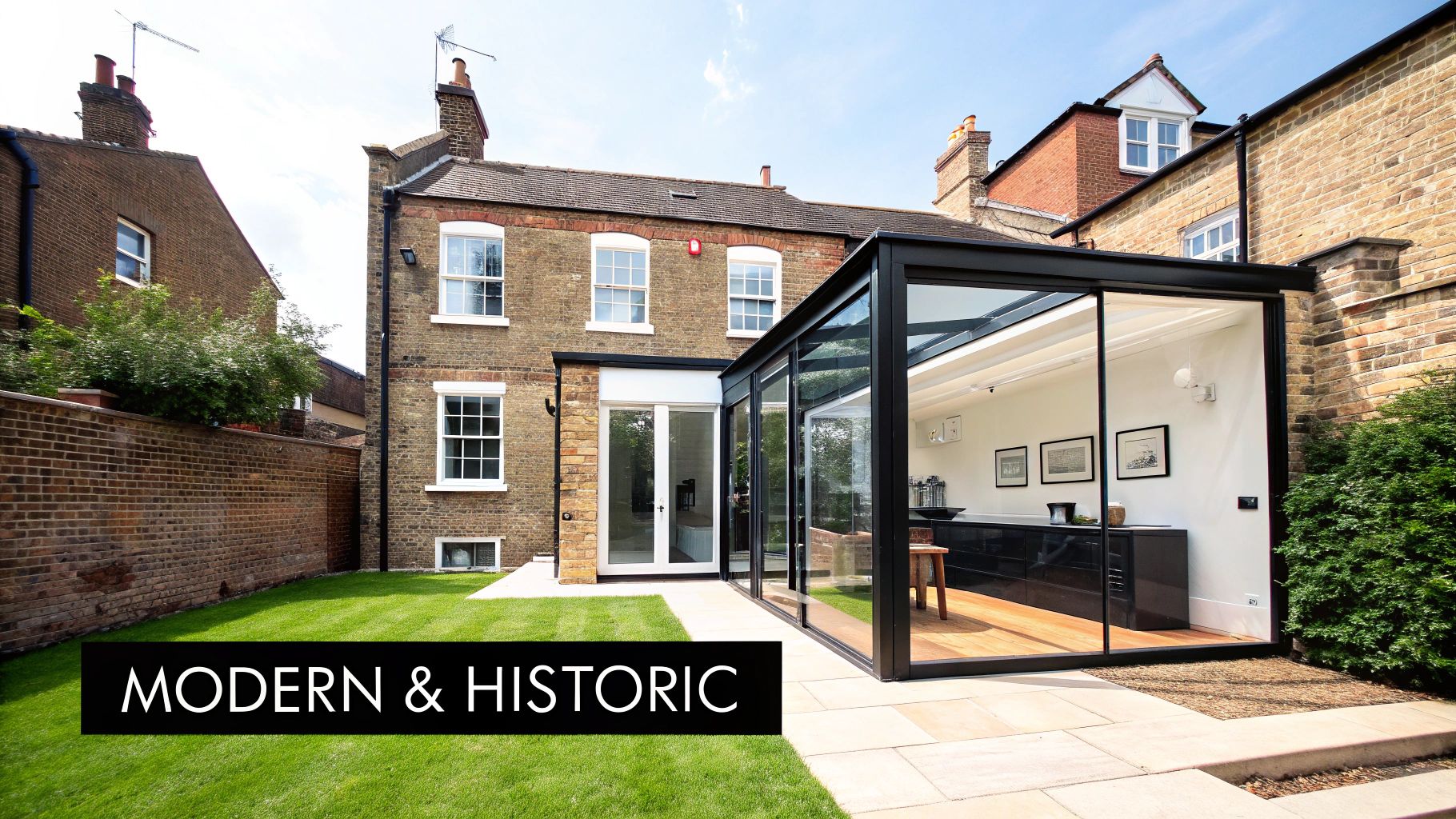
Legibility: Any new work should be clearly 'legible' or distinct from the original structure. Think of a modern glass box extension against historic brickwork. The honest contrast celebrates both elements, rather than trying to poorly mimic something it's not.
Reversibility: Wherever possible, new interventions should be designed so they could theoretically be removed in the future without causing permanent damage to the historic fabric. This principle is about stewardship, ensuring the original building remains intact for the next generation.
These ideas apply to everything, from a major basement extension to the choice of a new staircase. For a recent project in Richmond, we designed a floating glass and steel staircase. It was unapologetically modern, yet its minimalist form allowed the beautiful, original cornicing behind it to remain the star of the show.
Creating More Space Without Compromise
The desire for more room is a familiar story. Despite the economic climate, the ambition to improve our homes is strong, with nearly seven million UK homeowners planning works and an average spend of £14,000 expected over the next two years. In London, 25% of renovators are looking to extend, often to accommodate multigenerational living. This perfectly captures the goals of many homeowners in South West London wanting to add a basement gym or garden room to their listed property. You can see more on these trends in Aviva's recent How We Live report.
For listed homes, a basement extension is often the best way to add significant square footage without touching the historic elevations. The trick is to design these spaces with immense care, ensuring structural integrity with minimal impact on original foundations. A cleverly designed lightwell, for example, can flood a new basement cinema with daylight while being almost invisible from the garden above.
Likewise, a new garden room or conservatory needs to feel like a subservient addition. It should complement the main house, not dominate it, using a sensitive scale and high-quality, contrasting materials to create a beautiful and respectful new space.
Improving Sustainability and Energy Efficiency
Bringing a centuries-old building up to modern standards of comfort and efficiency is a big ask, but it's entirely achievable. The goal is to make improvements without harming the building's ability to 'breathe'—a crucial function of traditional materials like lime mortar and timber.
Your aim should be to work with the building, not against it. Heavy-handed solutions like spray foam insulation or uPVC windows are a conservation officer's nightmare, as they trap moisture and cause long-term decay.
Instead, we focus on sensitive upgrades that respect the historic fabric:
Breathable Insulation: Materials like sheep's wool or wood fibre are ideal for insulating roofs and suspended floors. They help regulate temperature while letting moisture escape naturally, keeping damp at bay.
Secondary Glazing: This is often the most welcome solution for improving the thermal performance of original single-glazed windows. A high-quality, discreet system can slash heat loss and draughts while preserving the historic glass and frames.
Draught-Proofing: It sounds simple, but meticulous draught-proofing around windows, doors, and floorboards is one of the most effective upgrades you can make. It vastly improves comfort without changing the building’s appearance one bit.
By thoughtfully applying these conservation-led principles, you can absolutely create a home that offers every modern convenience while honouring and protecting its irreplaceable history.
Budgeting Realistically for Your Heritage Renovation
Let's be upfront: financial planning for a listed building renovation is a completely different beast to budgeting for a standard project. The numbers are often significantly higher, the timelines longer, and the potential for nasty surprises is far greater. Approaching your budget with a clear-eyed view of these realities is the only way to avoid financial strain and see your project through to a successful finish.
The main reason for the higher costs comes down to specialist skills and materials. Your standard builder and off-the-shelf products from the local merchant simply won't cut it. You're stepping into the world of heritage craftsmanship, where every detail matters and is subject to the watchful eye of a conservation officer.
Understanding the Cost Premiums
When you’re renovating a listed building, several key areas will inevitably command a premium. It’s not just one or two things; it’s a cumulative effect across the entire project that pushes the budget upwards. This isn’t about extravagance or "gold-plating"—it’s about doing the job properly and, crucially, legally.
Your budget needs to make room for:
Specialist Labour: You’re paying for the deep expertise of craftspeople who have dedicated their careers to traditional methods. Think stonemasons, lime plasterers, and joiners skilled in painstakingly restoring original sash windows. Their day rates are justifiably higher than a general contractor's.
Authentic Materials: Sourcing materials that are either reclaimed or made using traditional techniques is an expensive business. Handmade bricks, reclaimed Welsh slate, or bespoke joinery that perfectly matches the original profiles all come at a significant cost compared to their modern, mass-produced cousins.
Professional Fees: The upfront costs for a specialist team—including a conservation architect and a structural engineer with historic building experience—are higher. These fees reflect the incredibly detailed surveys, in-depth reports, and meticulous planning required just to get consent.
Establishing Your Core Budget
Trying to give a generic cost per square metre for a heritage renovation is almost impossible, as every single building is unique. What is safe to assume, however, is that the costs will be substantially more than even a high-end conventional renovation. The complexity, the condition of the existing fabric, and the scale of your ambition are all massive variables.
To give you a clearer picture of the difference, we’ve put together a table looking at some of the key cost areas that often catch people out.
Sample Budget Considerations for a Listed Renovation
Cost Category | Typical Standard Renovation Cost | Typical Listed Renovation Cost | Key Influencing Factors |
|---|---|---|---|
Windows | Lower (e.g., uPVC, standard timber) | High | Restoration of original sashes vs. bespoke, like-for-like timber replacements. |
External Walls | Moderate (e.g., cement render, standard brick) | Very High | Use of lime mortar for repointing; sourcing reclaimed, matching brick or stone. |
Professional Fees | 8-12% of build cost | 12-18%+ of build cost | Need for heritage statements, detailed surveys, and prolonged negotiations. |
Roofing | Standard (e.g., concrete tiles) | Very High | Sourcing reclaimed slates or handmade clay tiles; specialist leadwork. |
This table shows exactly why a simple cost-per-metre calculation can be so misleading for a listed project. The real expense is hidden in the details and the non-negotiable requirement for specialist input at every turn.
The Non-Negotiable Contingency Fund
If you take only one piece of financial advice away from this, make it this one: set aside a robust contingency fund. With historic buildings, you are almost guaranteed to uncover issues once work begins—hidden structural problems, patches of rot, or damp that wasn't visible during initial surveys.
For a listed building project, a contingency of 15-20% of the total construction cost should be considered the absolute minimum. This isn't a 'nice-to-have'; it is an essential part of a realistic budget that protects you from the unknown.
This fund is your buffer. It’s what allows you to address those inevitable surprises without having to compromise on the quality of the finish elsewhere or, even worse, grinding the project to a halt. It’s the single most important tool you have for managing the financial risks that come with renovating a piece of history.
How Our Process Delivers Your Vision
Successfully renovating a listed building is about more than just a great design idea; it needs a proven, methodical approach that anticipates the unique challenges of working with heritage properties. Our process is built on years of hands-on experience, carefully blending creative architecture with a deep respect for historical fabric to turn your ambitions into a beautifully finished home. We know that every single project is a delicate balance between conservation and modern living.
Our entire workflow is structured to de-risk the process from day one and unlock your property’s true potential. From our first, no-obligation chat where we explore your ideas, through to the painstaking detail of securing consent and overseeing the build, every stage is managed with precision. This methodical approach is what sets a complex heritage project on the path to success.
At its core, our role is to act as your expert guide and advocate. We translate your lifestyle needs into a design narrative that conservation officers will support, ensuring the final outcome is both stunning and compliant.
This careful orchestration of design, planning, and construction is absolutely essential when you’re dealing with a listed building. We manage the specialist teams, administer the contracts, and make sure the craftsmanship on site meets the highest conservation standards.
To see exactly how we guide projects from the first sketch to the final handover, you can explore our process in full detail. It’s a rigorous 8-step journey we’ve refined for high-end residential work in Wimbledon and South West London. We’re ready to bring our expertise to your project, so get in touch to discuss your plans.
Your Questions Answered: Renovating a Listed Building
Embarking on a listed building renovation is exciting, but it’s completely normal to have questions. Getting to grips with the nuances from day one can demystify the process and set your project up for success. We’ve answered some of the most common queries we hear from homeowners to give you a bit more clarity and confidence.
These questions tackle the practicalities of altering historic features, untangling the planning system, and understanding the financial commitments involved.
Can I Replace Old Windows in My Grade II Listed House?
This is a question we get all the time. Generally speaking, original windows are seen as a fundamental part of a listed building's historic character. Because of this, swapping them out for modern units like uPVC is almost always a non-starter. Conservation officers will push for the careful repair and restoration of the original timber frames wherever possible.
If the decay is so severe that replacement is the only option, it has to be done on a strictly like-for-like basis. This means using traditional materials and construction methods to replicate the originals exactly. For homeowners looking to improve thermal performance, sensitively installed secondary glazing is often the most accepted—and effective—solution.
What’s the Difference Between Planning Permission and Listed Building Consent?
It’s easy to get these two confused, but the distinction is crucial. Planning Permission deals with the principle of the development—its use, its size, and how its external appearance impacts the local area and your neighbours.
Listed Building Consent, on the other hand, is required for any work that would alter the special character of the building, both inside and out. For many projects, like adding an extension to a listed home, you’ll actually need to apply for both at the same time.
A word of warning: carrying out works that require Listed Building Consent without getting it first is a criminal offence. It’s absolutely vital to get expert advice before you begin any project, no matter how small it might seem.
Do I Need Consent for Minor Repairs or Redecoration?
For simple, like-for-like repairs—like mending a broken pane of glass with the same type of glass—you typically won’t need consent. The same goes for standard redecoration, as long as you’re using appropriate, breathable materials like lime-based paints.
However, the line between what is and isn’t allowed is incredibly fine. Any work that alters the historic fabric will almost certainly require consent. Think stripping original paint from joinery, replacing a period fireplace, or changing an internal layout. The safest approach? Always check with your conservation architect before picking up a tool.
How Much More Expensive Is Renovating a Listed Building?
There’s no magic number, but you should always budget for significantly higher costs than you would for a standard renovation. This is down to a few key things: the need for specialist consultants, the requirement for detailed historic surveys, and the use of more expensive traditional materials like lime mortar or reclaimed tiles.
On top of that, the highly skilled labour needed for heritage craftsmanship comes at a premium. We strongly recommend having a contingency fund of at least 15-20% of the total construction cost to cover the unexpected issues that are so common in older properties.
Ready to start the conversation about your own heritage project? The team at Harper Latter Architects has the specialist expertise to guide you through every stage of renovating a listed building in Wimbledon, South West London, and Surrey. Contact us to arrange your initial consultation.

Comments