
A lot of homeowners arrive at the same moment. The exciting part is already underway. Sketches are forming, the brief is taking shape, and the house you have now is starting to give way, at least in your mind, to the one you want to live in.
It might be a rear extension that opens the house to the garden. It might be a basement with a cinema, gym or wine room. It might be a careful reworking of a listed property in Wimbledon, Richmond or further into Surrey. The design conversation tends to begin with light, materials, flow and value. Very quickly, it turns into a more practical question. When is building control required, and what happens if you get that answer wrong?
That question matters early, not halfway through site works. Building Control isn't there to comment on whether stone, brick or zinc looks better. It exists to make sure the work is safe, buildable, compliant and capable of standing up to inspection both during construction and long after you've moved back in. In a high-end residential project, that reaches into almost every decision, from structure and fire protection to drainage, insulation, ventilation and glazing.
For discerning homeowners, the challenge isn't usually willingness to comply. It's knowing what triggers approval, what can be handled through specialist installers, and where a seemingly modest design change becomes regulated work. A new bathroom in the wrong place, a widened opening in a kitchen, replacement windows across the whole house, or a new heat pump can all carry consequences that people don't always anticipate.
Handled properly, Building Control protects the investment. It also protects the finish, because the best projects don't treat compliance as an afterthought patched in after planning. They build it into the design from the start, so the house works technically as well as architecturally.
From Dream Project to Building Reality
A homeowner in South West London might start with a simple ambition. Open up the back of the house. Add a calm, beautifully lit kitchen. Create a basement level that feels like part of the home rather than a compromise below it. Restore original detailing upstairs while introducing modern comfort subtly and intelligently.
The ambition is rarely simple once work begins.
The point at which a project shifts from aspiration to obligation usually comes sooner than expected. Removing a wall changes structural loading. Excavating a basement changes how the building is supported and waterproofed. Replacing windows may affect thermal performance and means of escape. A new drainage run, a new boiler arrangement or a more complex ventilation strategy all draw technical scrutiny.
That is where homeowners often ask, quite reasonably, whether this is a planning issue, a builder's issue or something else entirely.
The practical answer most clients need
In most substantial residential work, Building Control is not optional. It is part of the legal and technical framework that governs how work is designed and constructed. If your project involves a new build, extension, alteration, loft conversion, drainage, services, or replacement elements such as windows and doors, there is a strong chance Building Regulations approval is required.
The easiest way to think about it is this. If the work changes how your home stands up, keeps warm, stays dry, vents properly, drains safely or protects occupants in a fire, Building Control is likely involved.
In practice, the projects that catch people out are not always the largest. A luxury refurbishment can trigger just as much technical review as an obvious extension if it involves structure, fire separation, insulation upgrades, glazing changes, services or drainage alterations.
Why experienced guidance matters on premium homes
High-end London homes rarely fit neatly into generic advice. Period properties bring conservation sensitivities. Basements raise complex questions around waterproofing, means of escape and ventilation. Bespoke interiors often conceal significant structural intervention. Sustainable upgrades can activate Part L and Part O considerations in ways many homeowners do not expect.
What works is early coordination. What doesn't work is leaving compliance to site improvisation.
A good design team will identify the regulatory triggers before the builder prices the work, because by that point the technical path should already be clear. That avoids the expensive version of Building Control, which is discovering on site that something elegant on paper isn't acceptable in construction.
What is Building Control and Why Does It Matter
A common London scenario goes like this. A homeowner commissions a beautifully detailed basement gym and wine room beneath a stucco townhouse, agrees the finishes, appoints the contractor, and assumes the hard part is over. The primary risk often sits in the concealed work. Temporary support, waterproofing strategy, fire escape, ventilation, drainage, insulation continuity, and structural alterations all need to satisfy Building Regulations before the spaces can be signed off and used with confidence.
Building Control is the formal process used to check that building work complies with the Building Regulations. It deals with how the work performs in use. That includes structure, fire safety, moisture protection, ventilation, drainage, thermal performance, and access where relevant.

On high-end residential projects, that distinction matters. Elegant finishes can conceal poor compliance just as easily as budget work can. I have seen expensive joinery installed before fire stopping was properly resolved, and premium glazing specified without the full knock-on effect on ventilation, overheating, and energy calculations being understood. The cost of rectifying those issues on a finished home is rarely minor.
What the regulations actually cover
Building Control checks the parts of a project that owners often never see again once the house is complete. Foundations, steelwork, lintels, insulation build-ups, damp proofing, waterproofing, drainage runs, ventilation routes, and fire protection all fall within its scope. On a listed house or a finely detailed refurbishment, the challenge is often fitting those requirements into an existing structure without damaging historic fabric or compromising the design intent.
That is particularly true in London. Heritage houses, lower ground floor reconfigurations, and basement extensions tend to involve constrained sites, party wall conditions, and existing buildings that do not behave like standard new-build construction. Sustainable upgrades raise their own technical questions. New glazing, improved airtightness, heat pumps, MVHR, solar installations, and fabric upgrades can all trigger further regulatory checks if they alter how the building performs.
For homeowners who want a more detailed primer, Harper Latter's overview of what building control is gives a helpful starting point.
Why it matters beyond sign-off
Safety is the obvious reason. Long-term performance matters just as much.
A properly coordinated Building Control process reduces the chance of hidden defects, disputed workmanship, and expensive opening-up works later. It also protects the paper trail. On a premium home, future buyers, lenders, and their solicitors will usually want clear evidence that structural alterations, basement works, replacement windows, and building services were approved and inspected. Missing certificates can delay a sale, reduce confidence, and prompt requests for indemnities or retrospective applications.
The site stages that matter most
Building Control does not happen once, then disappear. It usually follows the work at the points where inspection is still meaningful.
Before work starts: drawings, specifications, and structural information are reviewed.
At excavation and foundations: inspectors check what will soon be buried.
At structural stages: steels, bearings, floor build-ups, and key connections may need inspection.
Before closing up: insulation, drainage, fire stopping, ventilation, and waterproofing details often need to be visible.
At completion: the final stage supports certification of the finished works.
Contractors who treat Building Control as paperwork for the end of the job create avoidable risk. Once plasterboard, joinery, stone, and finishes are in place, the evidence of compliance may already be hidden. On an exacting residential project, that is how small oversights become expensive problems.
Planning Permission vs Building Control A Critical Distinction
These are two separate systems, and homeowners often conflate them.
Planning Permission deals with whether the proposal is acceptable in planning terms. It looks at use, scale, appearance, impact on neighbours, conservation context and the wider street scene. Building Regulations approval deals with whether the proposal is technically acceptable to build.
One asks, "Should this be allowed here?" The other asks, "Can this be built safely and properly?"
Planning Permission vs Building Control at a Glance
Aspect | Planning Permission | Building Regulations Approval (Building Control) |
|---|---|---|
Main concern | The form and impact of the proposal | The technical compliance of the construction |
Typical questions | Is the extension too large? Does it affect neighbours? Is it suitable in a conservation setting? | Is the structure adequate? Is fire safety addressed? Does insulation, drainage and ventilation comply? |
What it governs | What you build and where you build it | How you build it |
Who usually reviews it | The planning authority | Building Control body or regulator, depending on project type |
Design focus | Appearance, massing, heritage impact, amenity | Structure, health, safety, energy performance and construction standards |
Can one replace the other | No | No |
The misunderstanding that causes trouble
A homeowner secures planning consent for a handsome rear extension and assumes the difficult part is done. From a design and neighbourhood perspective, perhaps it is. From a technical compliance perspective, nothing has been resolved unless the Building Regulations path has also been addressed.
That distinction becomes even more important on refined residential projects. A clean frameless opening to the garden may have planning support because it suits the architecture. Building Control will still require the hidden steelwork, thermal detailing, escape strategy, glazing performance and drainage to be resolved.
A planning approval drawing can be elegant and completely insufficient for construction.
Why both should inform the design
The best projects don't treat planning and Building Control as disconnected hurdles. They feed into each other. If a glazing scheme is too ambitious to satisfy thermal or fire requirements, or a basement arrangement struggles to provide suitable escape and ventilation, those technical realities should shape the design early.
That is why homeowners benefit from a team that doesn't stop at "it got planning". A house needs to pass from concept to built reality without losing coherence. The technical route matters as much as the visual one.
Common Projects That Require Building Control Approval
A homeowner may describe a project as "just opening up the back of the house" or "only fitting out the basement properly". In practice, many of the works that feel straightforward on site are exactly the ones that trigger Building Control scrutiny, particularly in London houses where structure, fire strategy, drainage and thermal upgrades are tightly interlinked.
The safest working assumption is simple. If the work changes structure, layout, services, thermal performance or means of escape, approval is likely to be required.
Structural alterations inside the existing house
This catches people out more often than any other category. Period houses in Chelsea, Kensington or Hampstead were not designed for wide kitchen openings, concealed steel frames and long-span rear rooms. The moment a load-bearing wall is removed, a chimney breast is altered, floor joists are trimmed, or new support is introduced, Building Control becomes part of the job.
The visual effect may be restrained. The technical implications are not.
A single opening can involve structural calculations, padstone design, lateral stability, fire protection to steel, and checks on how loads transfer through the house to the foundations. In higher-value refurbishments, the detailing is often finer and less tolerant of compromise, which makes early coordination even more important.
Other internal works commonly requiring approval include:
Forming larger openings between rooms: beams, bearing conditions and load paths must be properly designed and inspected.
Changing stair layouts: geometry, headroom, guarding and fire separation need to comply.
Replanning bathrooms or utility spaces: drainage runs, ventilation, waterproofing and hot water provision often bring the work within scope.
Altering floors in older houses: strengthening, acoustic performance and fire resistance may all need attention.
Extensions, loft conversions and new houses
Rear extensions, side returns, loft conversions and new-build homes almost always require Building Control approval. They affect the core parts of the Building Regulations, including structure, insulation, ventilation, drainage, fire safety and glazing.
For homeowners pursuing highly customized design, the pressure points are usually hidden in the interfaces. A slim roof edge, a large sliding door, a flush threshold or a deep rooflight can all be achieved, but only if the technical design is resolved properly before work starts. That is one reason we usually advise clients to review the building regulations compliance requirements for residential projects alongside the design package, not after the contractor has priced the work.
Loft conversions deserve special care in London. Beyond the obvious structural work, they often affect the protected stair route, fire doors, smoke detection, insulation to the roof, and the relationship between the new floor and the storeys below. In larger townhouses, those decisions can ripple through the whole house.
Basements and below-ground work
Basement projects sit in a different category of complexity. Excavation changes how the building is supported. Waterproofing has to be designed rather than improvised. Ventilation, drainage and escape strategy must work in spaces with less natural tolerance for error.
That is especially true on luxury basement schemes with spas, gyms, cinemas, staff accommodation or substantial plant rooms. More ambitious use brings more servicing, more heat gain, more moisture risk and more technical interfaces between structure, architecture and MEP systems.
In heritage properties, there is an added layer of judgment. The basement may be out of sight, but the work can still affect the stability and fabric of the original building. Approval needs to be approached with that in mind from the outset.
Replacement works and other triggers homeowners underestimate
Building Control is not limited to obvious construction. A project can fall within scope because of replacement elements or upgraded systems, even where the house looks largely unchanged at the end.
Common examples include:
Replacing windows and external doors: thermal performance, safety glazing and escape requirements may apply, particularly on larger refurbishments.
Installing or altering drainage: below-ground drainage is regularly inspected because defects are expensive to uncover later.
Electrical and heating works: some installations require notification or certification through the correct route.
Moving kitchens or bathrooms: new locations often raise questions about extract ventilation, pipework falls, hot water supply and drainage connections.
Garden rooms and ancillary buildings: exemption is often assumed too quickly, especially where the structure includes sleeping use, extensive services or drainage.
Exemptions are narrower than many homeowners expect
Small detached buildings can sometimes fall outside the approval process, but those exemptions are specific and should be checked carefully against the intended use and method of construction. The problem in practice is not the rule itself. It is the assumption that a garden building, studio or pavilion is automatically exempt because it appears secondary to the main house.
On high-end residential projects, that assumption regularly fails. Add a shower room, heating, bespoke glazing, sleeping accommodation, or a more permanent relationship to the house and the position needs to be reviewed properly.
A short conversation at the right stage usually avoids expensive corrections later.
Navigating The Approval Process Routes Timelines and Costs
A familiar moment on London residential projects is this: the contractor is ready to start, the structural engineer has issued drawings, and the homeowner assumes the approval route is a formality. It is not. The route chosen at the outset affects programme, tender accuracy, inspection risk and, in high-value work, the likelihood of expensive changes once the house is already open.
There are two main routes for domestic projects. Full Plans and Building Notice. Both can lead to compliance, but they suit very different jobs.
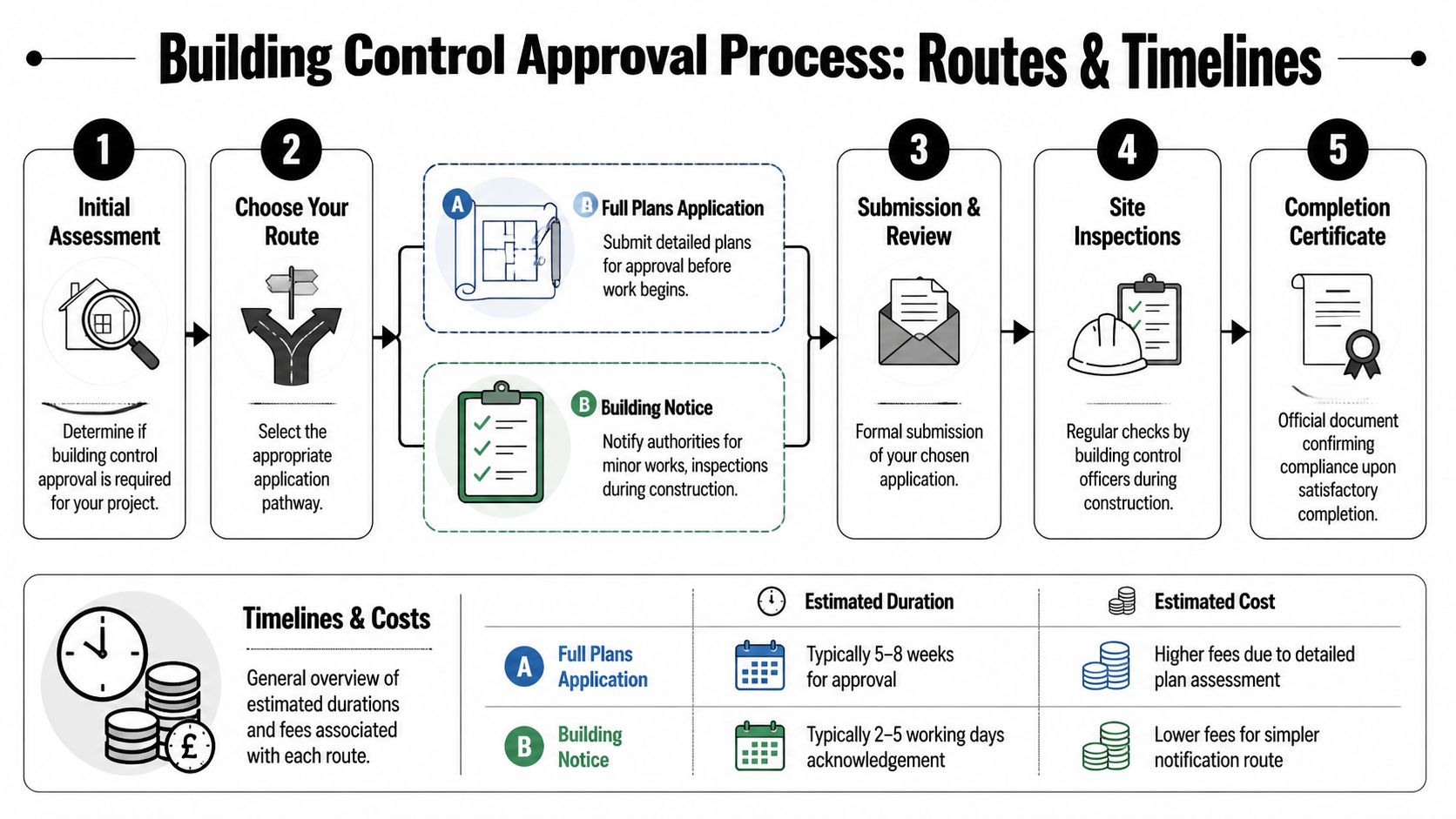
Full Plans route
For substantial residential work, this is usually the safer choice. Drawings, specifications and supporting technical information are submitted before work starts, so key points can be reviewed in advance rather than argued over on site.
In practice, that matters most where the house is complex or the finish level is high. A basement conversion in Chelsea, a full townhouse refurbishment in Kensington, or alterations to a listed or locally sensitive property all benefit from decisions being made early. Structure, fire strategy, insulation build-ups, drainage runs and stair geometry are easier to resolve on paper than after demolition.
A Full Plans submission also gives the contractor something firmer to price against. That tends to reduce provisional allowances and defensive contingencies, which is often where costs drift on bespoke projects.
Building Notice route
A Building Notice is lighter at the front end. It can suit smaller, straightforward works where the design is settled, the construction is conventional, and the compliance issues are limited.
The trade-off is less certainty.
More of the checking happens during construction, which can be uncomfortable on projects with tight programmes, specialist finishes or heritage constraints. If a concern is raised once work is underway, the answer is rarely cheap. It may mean opening up completed work, redesigning junctions, or waiting for revised structural or thermal information while the site team stands idle.
For high-end homes, that is usually poor value.
Which route tends to suit premium London projects
For most architect-led residential schemes in London, Full Plans is the route that gives the best control over risk, cost and sequencing.
Greater pre-construction certainty: technical issues are identified before trades are booked and materials are ordered.
More reliable pricing: builders are pricing drawn information rather than assumptions.
Fewer site interruptions: inspections are still required, but fewer compliance questions are left unresolved until the build phase.
Better records at completion: the approval history is clearer, which helps with certification, future sales and estate management.
Homeowners comparing the two routes often find that a clear guide to building regulations compliance helps frame the decision properly.
Timelines and fees
Programmes vary by borough, by approved inspector or local authority building control team, and by the quality of the information submitted. The common mistake is to assume the formal approval period is the whole story. It is not. Time is also lost when drawings are incomplete, structural coordination is late, or the construction team starts before technical questions are properly closed out.
Fees vary in the same way. A modest domestic package may be relatively contained. A large house refurbishment with underpinning, complex drainage, specialist glazing and fire safety upgrades will cost more to assess and inspect. On premium projects, the bigger financial issue is rarely the application fee itself. It is the cost of delay, redesign and opening up completed work.
Competent person schemes and specialist certification
Some elements can be certified through competent person schemes, depending on the work and the installer. Windows, certain electrical installations and some heating-related works are common examples.
That only covers the specific package being certified. It does not remove the need for Building Control oversight on the rest of the project. Good administration matters here, especially on larger refurbishments, because missing certificates often cause problems long after the builder has left.
Higher-risk buildings and the gateway system
Some London residential schemes sit within a different approval regime altogether. Multi-unit buildings of a certain height, along with some hospitals and care homes, fall under the higher-risk building framework and are subject to gateway approvals administered by the Building Safety Regulator.
For a single private house, this will usually be irrelevant. For a luxury apartment scheme, or a project that forms part of a taller residential building, it can alter the programme materially and increase the level of design coordination required before work starts. That distinction needs checking early, particularly where an apparently domestic brief sits within a more complex wider building.
Building Control for Heritage High-End and Sustainable Homes
A Chelsea townhouse can have listed status, a new basement under the garden, slimline heritage glazing, air source heat pumps and a full interior refurbishment in one brief. On projects like that, Building Control is not a box-ticking exercise. It is woven through the design from the first technical decisions onward.

Listed and heritage properties
Owners of period and listed houses often assume that heritage protection somehow overrides Building Regulations. In practice, the opposite is usually true. The older and more sensitive the building, the more carefully the technical case needs to be assembled.
That is particularly true in London, where high-value houses are frequently being adapted to modern standards without losing the character that made them worth buying in the first place. A new stair, upgraded floor build-up, repaired roof, replacement windows, internal insulation or altered layout can all bring Building Control into play, even where the visible intervention appears modest.
The hard part is coordination. Conservation officers may want existing fabric retained. Building Control will still expect the work to satisfy the relevant standards for structure, fire safety, insulation, ventilation and drainage where those requirements are engaged. Good projects resolve those tensions on paper before site work starts.
Getting the heritage balance right
Listed buildings rarely suit standard details lifted from a developer housing job. Existing walls need to breathe. Timber structures may need opening up before anyone can confirm what they are spanning. Thermal upgrades have to improve performance without driving moisture into historic fabric. Window replacements often need a carefully justified specification rather than an off-the-shelf unit.
Basements under period houses intensify the problem. Lowering a floor level or excavating beneath a Victorian or Georgian property affects structure, waterproofing, means of escape, ventilation and often party wall strategy at the same time.
I see the same mistake repeatedly. Homeowners spend time refining stone samples, joinery profiles and ironmongery, then assume compliance can be checked later. In heritage work, late technical decisions are what usually cause redesign.
Luxury basements and bespoke amenity spaces
A cinema, spa, wine room or gym below ground may read as a lifestyle upgrade. From a Building Control perspective, it is a technically dense part of the house.
Excavation support, groundwater management, tanking design, sump provision, drainage falls, headroom, ventilation, fire detection, escape strategy, plant space and access for maintenance all need proper thought. Add steam rooms, pools, saunas or large areas of glazing and the coordination burden increases again.
On high-end projects, the finishes are often immaculate. The concealed construction has to be equally disciplined. A basement that looks exceptional but overheats, feels airless or depends on unresolved fire strategy is poorly designed, whatever the finish budget.
Sustainable upgrades and retrofit traps
The same issue arises with sustainability works. Better glazing, fabric insulation, solar panels, battery storage, heat pumps and MVHR systems are all attractive improvements, but they are not outside the regulatory framework. They can trigger Building Control because they affect energy performance, ventilation, electrical safety, structure, overheating risk or the way the house is serviced.
In London houses, especially tight urban sites and top-floor conversions, Part O and ventilation strategy now need far more attention than many homeowners expect. The problem is not the idea of greener living. The problem is assuming a supplier-led installation package will deal with compliance by itself.
That assumption causes trouble later, particularly if certificates are missing or the work has altered several parts of the building at once. A clear record of inspections and sign-off matters just as much as the installation itself. Our guide to the building control certificate and what it confirms explains why that paperwork becomes so important at refinance, sale and final completion.
For heritage, high-end and sustainable homes, the common thread is straightforward. The more bespoke the project, the less room there is for casual assumptions. Early technical coordination protects the design, the programme and the value of the house.
The Risks of Non-Compliance and Retrospective Approval
A project can look finished, beautifully detailed and fully paid for, then stall because one certificate is missing or a hidden element was never inspected. I see this most often when owners come to us just before a refinance, a sale, or the final stages of a complex renovation in London.

Ignoring Building Control does not remove the requirement. It usually defers the problem until the work is built, concealed and far more expensive to put right.
Under the guidance cited earlier, Building Control can require defective work to be altered or removed. In serious cases, enforcement action can follow against the person responsible for the work. For a high-value home, the practical consequences are often felt before any formal sanction. Delay, loss of negotiating position, contractor disputes and anxious buyers tend to appear first.
What non-compliance looks like on site
The pattern is familiar. A builder installs a steel before inspection. A glazing package arrives with assumptions about certification that do not match the approval route. A basement contractor focuses on waterproofing and excavation, but fire protection, drainage or ventilation evidence is incomplete. In listed or period houses, one early shortcut can spread through several packages of work.
The trouble usually surfaces late.
Finished work has to be opened up: walls, floors or ceilings may need exposing so structure, insulation, fire stopping or drainage can be checked.
Details need redesign after installation: a solution that would have been simple on paper becomes awkward once joinery, finishes and services are in place.
Costs are paid twice: first for the original construction, then for remedial work and reinstatement.
Property transactions slow down: buyers, lenders and solicitors ask for clear evidence of approval, inspections and completion.
Hidden work is not approved work.
For owners of prime London homes, there is also a reputational and commercial point. Bespoke interiors, specialist stone, integrated lighting and climate systems can all be disrupted by late compliance problems. The higher the level of finish, the more painful the correction.
A clear explanation of the paperwork involved is set out in this guide to the building control certificate and what it confirms.
For broader context on how homeowners should think about the issue, this short video is also useful:
Retrospective approval has limits
Homeowners often ask whether the position can be fixed later through retrospective approval or regularisation. Sometimes it can. It is still a remedial route, not a comfortable one.
The difficulty is evidence. Once finishes are complete, proving compliance becomes harder because the inspector cannot assess what they cannot see. That may mean opening up floors, cutting access into ceilings, exposing structural connections or replacing elements that cannot be certified with confidence.
On heritage projects, the trade-off is sharper. Opening up completed work in a period or listed property can damage historic fabric and trigger another round of specialist detailing, listed building considerations and contractor cost. On basement schemes or major refurbishments, late compliance work can also interfere with waterproofing warranties, acoustic build-ups and high-spec fit-out packages.
Retrospective approval should be treated as damage control. The better route is to get inspections, certificates and technical coordination right while the work is still visible.
Your Partner in Compliance How We Navigate Building Control
A high-end residential project can look settled on paper and still come under pressure once Building Control comments arrive. On a London townhouse renovation, that often happens at the junction between elegant design and technical proof. A slim rooflight may affect fire strategy. A basement stair that feels generous in plan may need a different arrangement once headroom, escape and smoke protection are tested properly. The benefit of an experienced team is that these points are addressed early, while they are still easy to resolve.
Building Control works best when it is built into the project, not treated as a final check before site starts. The architect, structural engineer, MEP designer, specialist suppliers and contractor all contribute information, but someone needs to keep the package coordinated and buildable. On heritage homes, that also means weighing compliance against conservation, because the right answer is often the one that satisfies the regulations while disturbing as little historic fabric as possible.
What proper coordination looks like
On a complex home, the process usually includes:
Identifying approval triggers early: structure, fire safety, drainage, thermal upgrades, glazing, ventilation and building services are reviewed before construction information is signed off.
Coordinating technical drawings: the approval route is supported by drawings and specifications that can be checked, priced and built.
Planning inspections around the programme: site stages are set so structural work, insulation, drainage, waterproofing and fire protection are seen before they are covered up.
Controlling certificates and specialist sign-off: test results, warranties and contractor documentation are collected as the work proceeds, not chased at practical completion.
A practice such as Harper Latter Architects fits into that process by preparing the design information, coordinating consultants, corresponding with Building Control and checking that the project stays aligned with the agreed compliance route as work progresses on site.
For the homeowner, the value is straightforward. You need a clear answer on whether approval is required, which route suits the project, what information must be submitted, when inspections need booking and what paperwork should exist at completion.
The more expensive the house, the less room there is for technical ambiguity.
That is particularly true on listed refurbishments, basement excavations and low-energy upgrades. A change to insulation build-up can affect cornices, skirtings and window reveals. A waterproofing detail in a luxury basement may need input from both the structural engineer and the specialist installer before it can be signed off with confidence. Triple glazing, MVHR and airtightness measures can improve performance, but only if they are coordinated with fire safety, background ventilation and the realities of an existing London structure.
Good Building Control management is usually quiet. Problems are resolved in the drawings, in consultant meetings and during timely inspections, rather than in a finished room that now has to be opened up.
The best homes are not only well designed. They are technically resolved, properly certified and ready to stand up to scrutiny when you sell, refinance or insure the property.
If you're planning a new build, a listed renovation, a basement extension or a sustainable refurbishment in South West London or Surrey, Harper Latter Architects can help you assess the regulatory path early and shape a project that is both beautifully designed and fully compliant.