You may be at the stage where the exciting decisions are taking over. The staircase detail. The glazing line to the garden. The basement cinema, wine room, or garden studio. If you're renovating a period house in Wimbledon or planning a substantial extension in Surrey, it's natural to focus on what the finished home will feel like.
But there’s another system running alongside the design. It’s less visible, more technical, and absolutely central to whether the project is safe, lawful, insurable, and straightforward to sell later. That system is building control.
Many homeowners first hear the term after planning drawings are underway. They assume it’s a form-filling exercise or a final sign-off at the end. It isn’t. Building control affects decisions from the earliest stages, especially on high-end residential work where structural complexity, heritage constraints, drainage, fire safety, insulation, and bespoke detailing all meet in one place.
If you want the simplest answer to what is building control, it’s this. It’s the statutory process that checks whether building work complies with the Building Regulations. In practice, that means someone independent of the design team reviews the technical side of the project and inspects key stages on site.
For clients, that matters because elegant design only works when it can be built, approved, and certified. A beautiful basement extension isn’t a success if drainage fails inspection. A refined listed building refurbishment isn’t a success if thermal upgrades or structural alterations are handled in a way that creates compliance problems later.
That’s why experienced architects treat building control as part of design, not an obstacle after the fact.
Your Project's Essential Safety Net An Introduction
When clients ask me what building control is, I usually start with a simple comparison. Planning permission decides whether you may do something. Building control checks whether it can be built properly.
That distinction matters because a project can have planning approval and still fail on technical compliance. A rear extension might be acceptable in planning terms, but the foundations, insulation, drainage, structural supports, means of escape, and ventilation still have to satisfy the Building Regulations.
Why homeowners often misread it
Many individuals only build or renovate a handful of times in their lives. So they understandably think of approval as one thing. In reality, there are separate systems, separate drawings, and separate risks.
Building control exists to protect safety, health, accessibility, sustainability, and build quality at a minimum legal standard. In a home, that touches far more than obvious structural work. It includes fire doors, drainage falls, waterproofing details, insulation thicknesses, stair geometry, glazing safety, extract ventilation, and much more.
Practical rule: If work changes the structure, layout, thermal performance, drainage, or fire strategy of a home, building control is usually close by.
Why it matters more on bespoke homes
High-end residential projects tend to push into difficult territory. Basements introduce excavation, waterproofing, and drainage coordination. Period homes bring awkward floor levels, hidden structure, and delicate fabric. Lifestyle spaces such as home gyms, cinemas, and wine rooms can alter ventilation, acoustics, loading, and fire considerations.
That’s where building control becomes a safety net rather than a hurdle. It creates a formal process for checking that the technical backbone of the project is sound before defects become expensive.
A straightforward way to think about it is this:
Planning protects the area. It looks at neighbours, streetscape, and land use.
Building control protects the building. It looks at whether the work is safe and compliant.
Good architecture protects the outcome. It brings the two together so your home is both beautiful and buildable.
For homeowners investing serious time and money into a property, that technical reassurance is part of protecting the investment itself. The right approvals, inspections, and final certification help keep the project moving and reduce the risk of uncomfortable surprises at the point of completion, insurance, or sale.
The Core Concepts Building Control and The Building Regulations
The easiest way to understand what is building control is to separate two terms that people often merge together.
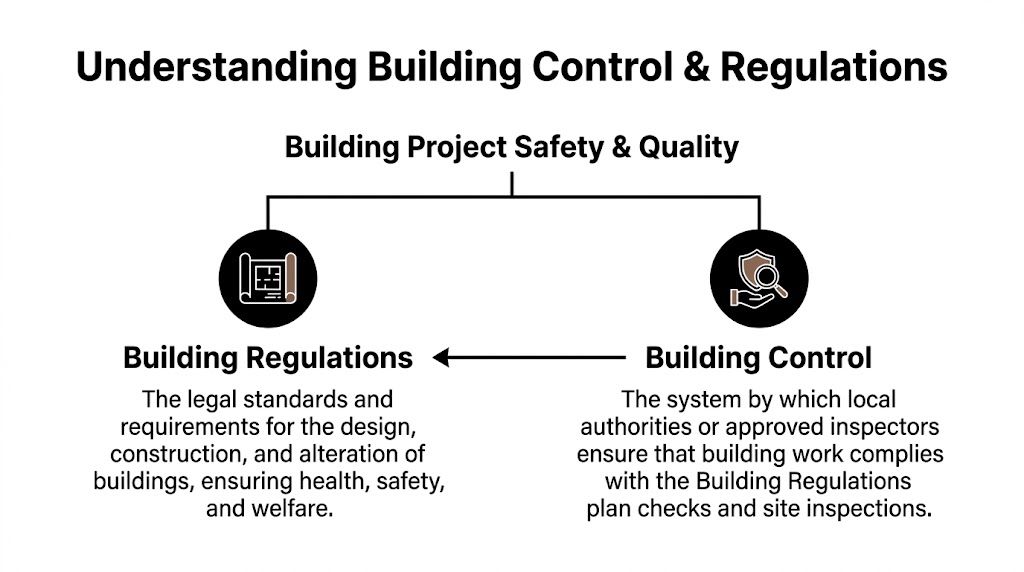
The Building Regulations are the legal standards.Building control is the checking process.
If you like analogies, think of the Regulations as the rulebook and building control as the referee. The rulebook sets the minimum standard. The referee checks whether the work on paper and on site follows it.
The legal foundation
In the UK, building control is the statutory process that ensures buildings comply with the Building Regulations, and the system was formalised under the Building Act 1984. It was significantly reformed after Grenfell through the Building Safety Act 2022, which introduced the Building Safety Regulator and stricter compliance gateways from October 2023, as outlined in this summary of UK building control reform.
That history matters because it explains why the system can feel exacting. It isn’t just administrative housekeeping. It grew out of public safety failures, long-term health concerns in housing, and the need for accountability in construction.
What the Regulations cover in plain English
Homeowners often hear references to “Part A” or “Part L” and understandably switch off. The Parts are sections of the Approved Documents that deal with different aspects of compliance.
Here are the ones that tend to shape residential projects most clearly:
Part A for structure This deals with whether the building stands up properly. For an extension, loft conversion, or basement, that means foundations, beams, load paths, retaining walls, and stability.
Part B for fire safety This covers escape routes, fire resistance, alarms, doors, and compartmentation. If you’re creating a basement cinema or reworking upper floors, Part B becomes especially important.
Part C for moisture resistance This is critical where the ground and the building meet. Basements, lowered floor levels, and older masonry buildings often need careful detailing here.
Part H for drainage and waste disposal This governs foul and surface water drainage. It’s one reason below-ground and rear extension schemes can become more technically involved than they first appear.
Part L for conservation of fuel and power This is the energy efficiency section. It affects insulation, glazing, airtightness, and building services. For homeowners, it influences both compliance and future running costs.
Why Approved Documents matter on luxury projects
On a bespoke project, the Regulations don’t stop at broad principles. They reach right into the detailing. A frameless glass corner may need careful structural and thermal coordination. A listed sash window repair may involve a more nuanced conversation about upgrade strategy. A wine room in a basement may seem like an interior decision, but it can have consequences for ventilation, fire protection, and services.
In other words, technical compliance is not something pasted on at the end.
The most successful projects absorb the Regulations early, so the design develops with them rather than fighting them.
For anyone who wants a deeper companion read, this guide to building regulations compliance is a helpful next step.
Why the distinction is useful
Once you separate the rulebook from the checking process, a lot of confusion disappears.
Term | What it means | Why it matters to you |
|---|---|---|
Building Regulations | The legal minimum standards for building work | They shape what can be designed and specified |
Building control | The approval and inspection process that checks compliance | It determines whether the work can be signed off |
That’s why architects, structural engineers, and building control professionals all need to coordinate closely. The Regulations don’t only ask whether an idea is attractive. They ask whether it is safe, durable, efficient, and properly documented.
Planning Permission vs Building Control A Crucial Distinction
This is the point where many projects become muddled. A homeowner receives planning approval and assumes they’re ready to build. Then someone asks about building control, and it feels like a second round of the same thing.
It isn’t the same thing.
Planning permission is concerned with the principle and appearance of development. Building control is concerned with the technical execution of that development. One looks outward to the area and neighbours. The other looks inward to the building itself.
Planning Permission vs Building Control at a Glance
Aspect | Planning Permission | Building Control Approval |
|---|---|---|
Main question | Should this development happen here? | Can this work be built safely and lawfully? |
Focus | Use, scale, appearance, impact on neighbours, streetscape | Structure, fire safety, insulation, drainage, ventilation, accessibility |
Typical drawings | Design-led proposals showing form and external appearance | Technical drawings, specifications, calculations, construction details |
Who usually reviews it | Local planning authority | Local authority building control or an approved inspector |
Common outcome | Permission, refusal, or permission with conditions | Approval, comments requiring amendment, inspections, completion certificate |
When it matters | Before development is accepted in principle | Before and during construction |
A simple example from residential work
Take a rear and side extension to a family house in a conservation area. Planning may focus on whether the extension is too visible, whether the materials suit the character of the area, and whether neighbours lose light or privacy.
Building control will ask different questions. Are the new foundations adequate? Does the roof meet thermal standards? Is the glazing safe where it falls close to floor level? Has the drainage layout been resolved? Do the altered stairs and doors still allow safe movement and escape?
You can have planning approval for a scheme and still need to redesign technical parts of it before it can pass building control.
Why both matter on high-value projects
In high-end work, the line between design ambition and technical compliance can become thin. A lower-ground leisure space may require planning input because of excavation and external light wells. The same scheme may need detailed building control review because of waterproofing, structure, ventilation, drainage, and fire safety.
Listed and heritage properties add another layer. You may need listed building consent or planning-related approvals because of the building’s historic significance, while building control separately assesses how the proposed work performs technically.
Clients find this easier once they stop seeing approvals as a single gate. They’re different gates for different purposes. Your architect’s job is to choreograph them properly so one doesn’t undermine the other.
Your Two Paths to Compliance Local Authority vs Approved Inspector
Once you know you need building control, the next question is practical. Who handles it?
In the UK, homeowners can choose either local authority building control or a private approved inspector. As of 2023, 845 local authorities handled the majority of residential work and covered 95% of building projects in England. The same source notes that in 2022/23, authorities processed 1.2 million applications and issued completion certificates for nearly 900,000 new dwellings, as explained in this overview of compliance routes and application volumes.

Local authority building control
This is the traditional route. The local council’s building control team checks plans, undertakes inspections, and holds enforcement powers.
For some projects, especially domestic alterations in established boroughs, local authority teams can bring useful local familiarity. They may already know the drainage context of a street, common construction issues in a particular housing type, or recurring conditions in older building stock.
This route often suits:
Projects with strong local context Older houses, conservation settings, and sites with known drainage or record issues can benefit from local familiarity.
Clients who prefer public-sector oversight Some homeowners feel more comfortable with the council route.
Schemes where continuity with other council processes helps That can be useful where planning conditions, highways matters, or local records overlap with the technical approval process.
Approved inspectors
Approved inspectors offer an alternative route for many projects. In practice, some design teams value the flexibility, responsiveness, and single point of contact that can come with a private-sector arrangement.
That can be particularly useful if an architect works across several boroughs and wants a consistent review process from one project to the next. On complex residential jobs, speed of communication and clear technical dialogue can make a noticeable difference to programme certainty.
Here’s a simple explainer if you’d like to see the process in action:
How to choose between them
There isn’t a universal right answer. The best route depends on the project, the borough, the complexity of the work, and the strength of the consultant team around it.
A useful way to compare them is this:
Consideration | Local authority | Approved inspector |
|---|---|---|
Local knowledge | Often strong | Varies by individual and practice |
Consistency across multiple areas | Less relevant if you build in one borough | Can be useful for teams working across boroughs |
Administrative style | Council-led process | Often more direct and commercial |
Perceived flexibility | Can vary by department | Can vary by provider |
For homeowners, the important point is that this choice is strategic, not clerical. The route can affect response patterns, coordination style, and how quickly technical questions are resolved.
If you want a practical walkthrough of inspection stages after that choice is made, this guide to building control inspections is worth reading.
On complex residential work, the right building control route is usually the one that fits the project team’s ability to communicate clearly and resolve details early.
The Building Control Process From Plans to Completion
Once the route is chosen, the process becomes much easier to follow if you think of it as a series of checkpoints rather than one approval at the end.
Building control in the UK operates as a multi-phase framework with risk-based prioritisation. Technical scrutiny is highest during construction across fire safety, structural stability, and energy efficiency, and for complex work such as basement extensions the system triggers enhanced checks of geotechnical and structural details, as outlined in this European building control systems report.
Step one starts before the builder does
For domestic work, homeowners often hear two application types mentioned. A Building Notice can suit simpler jobs. A Full Plans submission involves a fuller technical review of drawings and information before work starts.
For straightforward minor work, a Building Notice can sometimes be adequate. For high-end residential projects, especially basements, substantial refurbishments, listed properties, and new builds, a Full Plans route is usually the sensible approach because it forces technical issues into the open earlier.
That means the design team can resolve details on paper before they become expensive on site.
What gets checked on the drawings
A proper technical submission may include architectural plans, sections, construction details, structural calculations, drainage information, insulation strategy, ventilation proposals, and fire safety information.
The reviewer isn’t judging taste. They’re checking whether the proposal meets the Regulations.
Common areas of review include:
Structural adequacy Foundations, steelwork, temporary support, retained walls, and alterations to load-bearing fabric.
Energy performance Insulation build-ups, junction detailing, glazing performance, and the wider thermal strategy.
Drainage and moisture control Pipe runs, access points, falls, waterproofing details, and the relationship between below-ground spaces and groundwater risk.
Fire and escape Protected routes, alarm coverage, internal layouts, and how occupants get out safely.
What happens on site
Approval on paper is only part of the story. Building control also inspects key stages during the build.
Typical inspections may happen when foundations are excavated, drainage is laid, structural elements are exposed, insulation is installed, and the project reaches completion. Exact stages vary by scheme, but the principle is the same. Critical work must be seen before it is covered up.
If a contractor pours concrete, closes ceilings, or buries drainage before inspection, everyone’s options narrow very quickly.
That’s one reason architects and contract administrators keep a close eye on sequencing. A technically sound drawing set still needs disciplined site coordination.
Why the completion certificate matters
At the end of the process, the aim is a Completion Certificate or equivalent final confirmation of compliance. This is far more than a ceremonial piece of paper.
It is often important for future sale, mortgage questions, insurance discussions, and plain peace of mind. If the work hasn’t been properly signed off, the issue tends to surface at the least convenient moment.
For a homeowner, the process looks roughly like this:
Design is developed technically
Building control application is submitted
Comments are addressed and drawings refined
Construction begins with staged inspections
Final compliance issues are closed out
Completion certificate is issued
For a more focused explanation of the final document itself, this guide to the building control certificate is useful.
Building Control in High-End and Heritage Projects
Building control becomes especially important when a project moves beyond the ordinary. That’s often the case in London homes, where ambition, age, and site constraints overlap.
A straightforward extension on a modern plot can still be technical. A listed townhouse refurbishment, a deep basement under a period property, or a sustainable new build with large glazed openings and bespoke interiors is technical at another level altogether.

Basement extensions
Basements look calm and luxurious when finished. During design and construction, they are among the most demanding parts of residential work.
The obvious issues are structure and waterproofing. Less obvious issues often cause equal trouble. Drainage routes, sump strategy, ventilation, fire escape, and coordination of services in low ceiling zones all need careful thought.
The financial risk of getting this wrong is not abstract. For homeowners undertaking projects from £500k to £2m+, non-compliance can be significant. Withheld completion certificates can affect saleability in premium markets, and non-compliant basement work can lead to remediation costs averaging tens of thousands of pounds, as noted in this discussion of building control risks for homeowners.
Listed buildings and conservation work
Heritage projects create a delicate balancing act. Clients want comfort, performance, and longevity. The building itself may resist standard solutions.
A listed wall may not welcome a conventional insulation build-up. Original floor structures may need reinforcement without visible loss of character. Existing breathability and moisture movement may matter just as much as headline thermal performance.
That’s why building control on heritage work is often about careful negotiation and evidence. The design team needs to show that the proposal respects historic fabric while still meeting present-day requirements as far as reasonably possible.
In older buildings, the technically correct answer on paper isn’t always the right answer in practice unless it also respects how the original building works.
Sustainable new builds and luxury refurbishments
On contemporary homes, clients usually feel Part L most directly through fabric performance, glazing choices, heating systems, and airtightness expectations. Those decisions affect both comfort and aesthetics.
Large-format glazing, hidden frames, bespoke rooflights, and slim details all need proper technical backup. The same applies to amenity spaces. A gym may alter floor loading and ventilation needs. A home cinema changes fire, acoustics, and mechanical coordination. An outdoor kitchen or garden room can bring its own service and drainage questions.
Experienced design teams demonstrate their value. Ambition doesn’t disappear. It needs to be translated into a compliant technical language that contractors can build and inspectors can approve.
How Harper Latter Architects Navigates Building Control
The easiest projects to certify are usually the ones that start thinking about building control long before an application is submitted.
That matters particularly on heritage and complex residential work. Early architect-led consultation with building control can reduce design iterations and delays, and it is especially important for listed buildings and conservation settings where design intent must be balanced against energy, structural, and compliance requirements, as described in this summary of early building control involvement.
What early involvement changes
When building control is considered from the start, the design develops on a more realistic footing. Stair geometry, floor build-ups, escape routes, insulation zones, drainage runs, and structural assumptions are tested while there is still room to adjust them sensibly.
That saves homeowners from a familiar and costly pattern. A beautiful concept gets approved in principle, technical information lags behind, the contractor prices against incomplete detail, then awkward compliance issues appear once work is underway.
Early coordination reduces that risk because key consultants can answer the right questions in the right order.
What an architect actually does in this process
An architect’s role here is not just to draw the scheme and leave the rest to others. On a well-managed residential project, the architect helps coordinate the compliance path from design into construction.
That often includes:
Shaping the design around the Regulations Not in a defensive way, but in a way that protects the concept while keeping it buildable.
Preparing technical drawing packages Sections, junctions, schedules, notes, and specifications need enough depth for meaningful review.
Coordinating with engineers and specialists Structural design, drainage, waterproofing, energy strategy, and fire considerations need one coherent story.
Liaising with building control during review and on site Queries need timely answers, and inspections need the right information at the right stage.
One option homeowners use for that end-to-end coordination is Harper Latter Architects, whose service includes building regulation submissions as part of a broader project process.
Why this helps the client
For the homeowner, the practical benefit is calm. You’re less likely to be asked to make rushed decisions on technical matters you were never meant to decode on your own.
You also gain a clearer audit trail of what was designed, what was approved, what was inspected, and what was completed. On substantial residential projects, that clarity is part of protecting both the property and the investment in it.
Good building control management doesn’t flatten the design. It gives the design enough technical discipline to survive contact with reality.
If you’re planning a refurbishment, basement extension, listed building renovation, or bespoke new home in South West London or Surrey, Harper Latter Architects can help shape the design and the compliance strategy together, so the project moves from concept to completion with fewer surprises and clearer technical control.