
Southern Water Build Over Agreement: A 2026 Guide
You may be at the stage where the exciting decisions feel visible and tangible. Kitchen layout, glazing, garden connection, basement stairs, joinery, lighting. Then a far less glamorous issue appears on the drawings and suddenly starts driving the programme. There's a public sewer under or near the proposed works.
For many homeowners, that's the first time they hear about a Southern Water build over agreement. It can sound like a minor utility formality. In practice, it often affects feasibility, foundation strategy, sequencing, and risk across the entire project. On high-end residential schemes, especially where the brief includes generous rear extensions, lower-ground works, or substantial remodelling, it needs to be treated as an early design constraint.
The mistake is to deal with it late. The better approach is to let it inform the architecture from the outset, alongside planning, structural coordination, drainage design, and building control requirements.
Planning Your Extension The Hidden Hurdle Below Ground
Clients usually come to this issue after they've already formed a clear picture of the new space. A larger kitchen opening to the garden. A garden room with a continuous floor finish. A basement with a gym, cinema, or guest suite. On paper, the proposal may look straightforward. Below ground, it may not be.
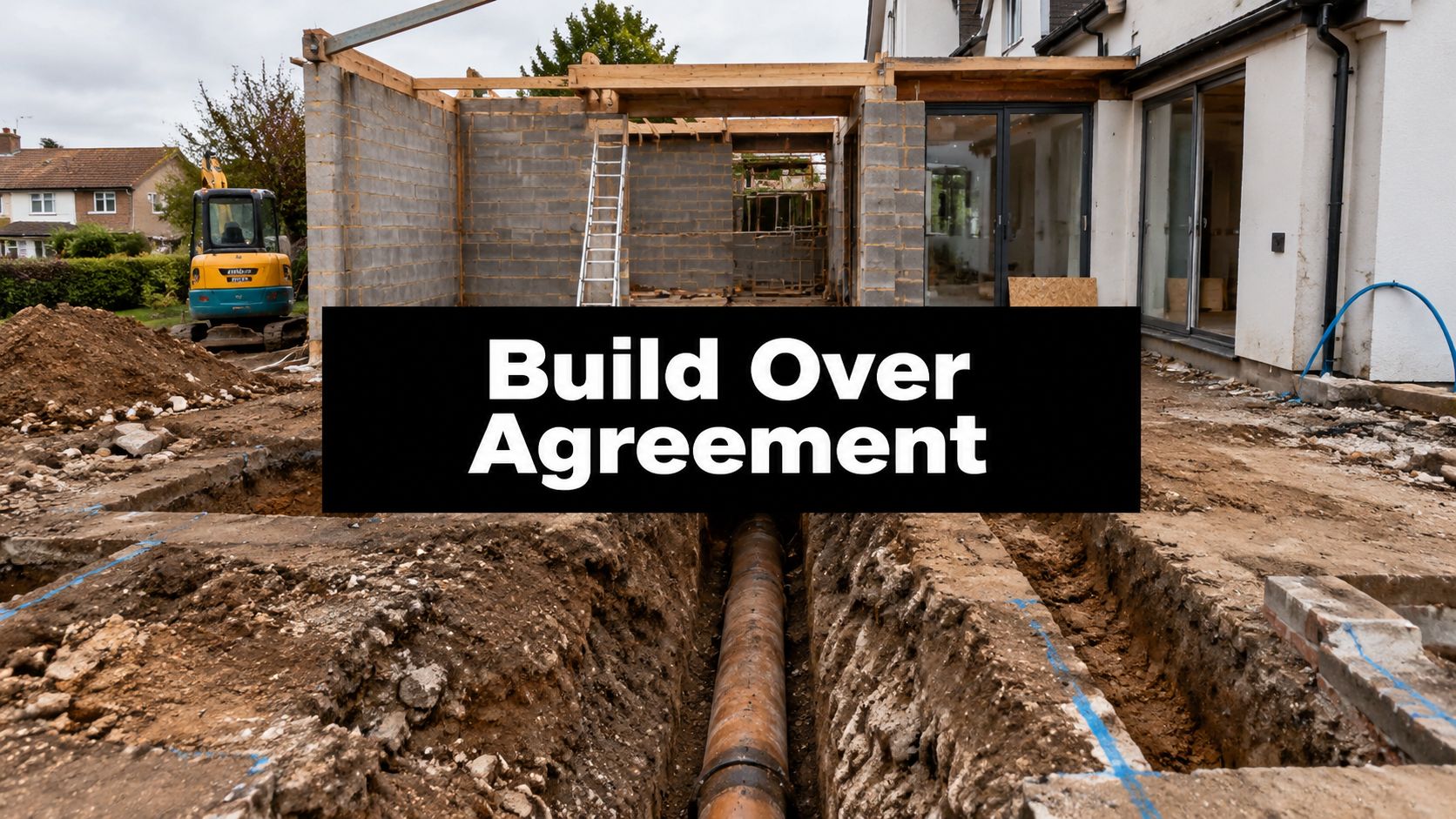
A public sewer can sit directly under the footprint of a rear extension, just beyond the back wall, or close enough to influence the foundation design. In dense suburban plots across South West London and Surrey, that isn't unusual. What catches people out is that drainage infrastructure can become one of the first technical constraints that materially changes what can be built and how.
Why this matters early
This isn't just about permission. It's about protecting the asset, preserving access, and ensuring that the building works don't create a structural problem for the pipe or for the new extension itself.
When this issue is picked up early, there's room to make calm, sensible adjustments. A footprint can move. A structural solution can be coordinated properly. The drainage information can be checked before tender assumptions harden.
Practical rule: If an extension, basement, or outbuilding is getting close to buried drainage infrastructure, treat that as a design question immediately, not after planning drawings are complete.
What tends to go wrong
The common failure isn't bad intent. It's sequencing.
Homeowners often assume that if planning permission is achievable, the rest will follow. Contractors may price from planning drawings that don't yet reflect the drainage constraints. By the time the sewer issue is identified, the project may already have a preferred layout, a fixed budget expectation, and a programme that leaves little room for redesign.
That's why the build over question belongs at feasibility stage. It protects the brief, but it also protects your budget from late structural changes and your programme from unnecessary delay.
What Is a Build Over Agreement and Why Is It Necessary
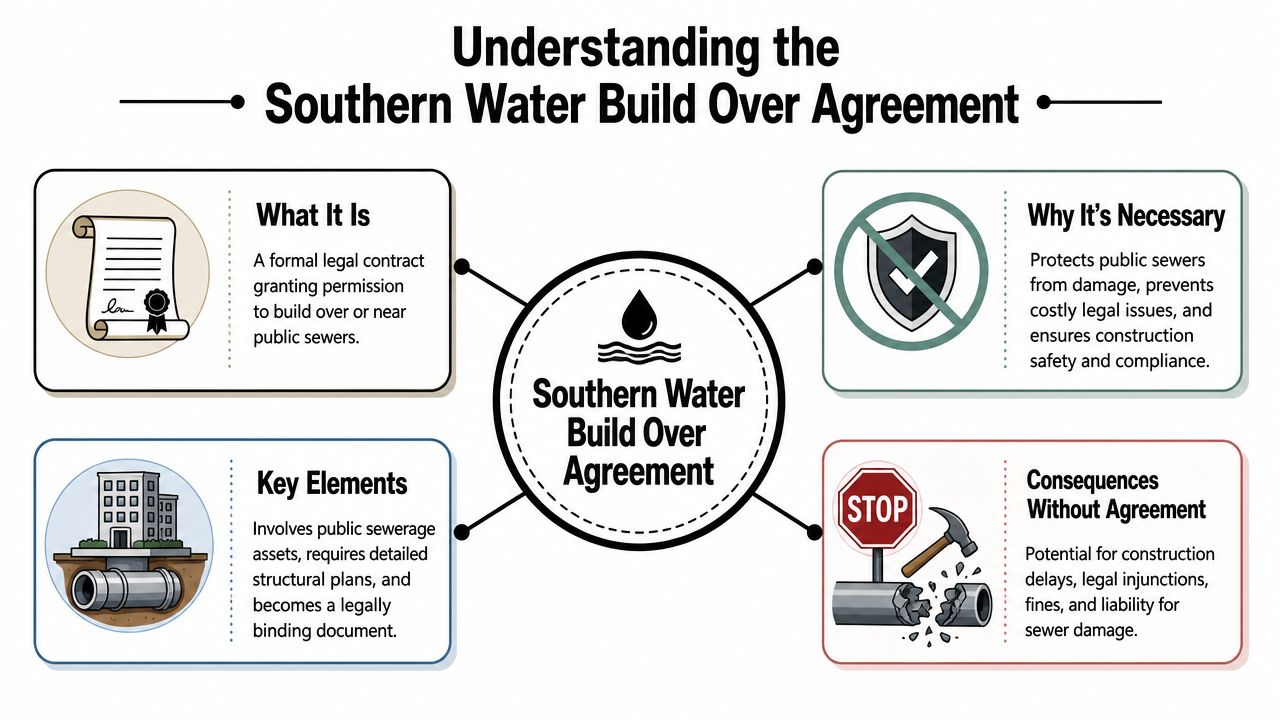
A build over agreement is formal approval to construct over or near a public sewer. In Southern Water's area, the utility refers to this approval as a Sewer Protection Agreement in its guidance for certain scenarios. Whatever label is used in day-to-day conversation, the underlying point is the same. You're asking for consent to build where public wastewater infrastructure could be affected.
It protects two things
The first is structural integrity. Foundations, excavation, and loading can damage a sewer if they aren't designed with the pipe's position and depth in mind.
The second is future access. A public sewer remains part of the utility's network even when it passes beneath private land. If there's a blockage, collapse, or maintenance issue later, the utility must be able to deal with it. That concern doesn't disappear because a homeowner has built a new kitchen above.
This is why the agreement shouldn't be dismissed as bureaucracy. It's a practical framework for making sure private works don't compromise public infrastructure.
Why the technical detail matters
Southern Water's published guidance makes clear that approval isn't limited to major developments. In its area, a Sewer Protection Agreement is required when a proposal covers 8 metres or more of a public sewer, spans boundary to boundary, or covers two or more sewers. The same guidance states that where construction is within 3 metres of a public sewer, foundations must typically extend to at least 150mm below the invert of the sewer. Those requirements appear in Southern Water's build over guidance notes.
That single sentence tells you a lot about the nature of the process. It isn't a box-ticking exercise. It's a technical review of the relationship between the building and the buried asset.
A sewer issue can alter the structural concept before it changes the architecture. By the time a client sees the effect on room layout or cost, the real constraint has usually been present for some time.
Public sewer or private drain
This distinction matters. A homeowner can often work more freely around purely private drainage on their own land, subject to normal design and Building Regulations requirements. Public sewers are different because a statutory undertaker has rights and responsibilities in relation to that pipework.
In practice, the architect's job is to identify the asset status early enough that the wrong assumptions don't become embedded in the scheme. That usually means drainage searches, careful review of available records, and coordination with structural and drainage consultants before the design is treated as settled.
Determining if Your Project Requires an Agreement
A typical pattern is easy to spot. A client approves a promising rear extension layout, the structural approach starts to settle, and only then does a drainage check show that a public sewer runs straight through the build zone. At that point, the issue is no longer administrative. It affects programme, foundation design, cost, and sometimes the shape of the scheme itself.
The right question does not concern only whether a pipe exists somewhere on site. The question is whether the proposed works could interfere with a public sewer or lateral drain, either by building over it or by working close enough to affect it. If there is any real possibility of that, we treat the design as provisional until the drainage position is clear.
The practical triggers homeowners should watch
For domestic projects, the usual trigger is straightforward. A proposal that sits over, or sufficiently close to, a public sewer or lateral drain may need consent. In practice, that catches more projects than clients expect.
Rear extensions are the obvious example because drainage often runs across the back garden. Basements raise the stakes because excavation and retaining works can affect the area around the sewer even when the footprint above seems manageable. Detached garden buildings can also create a problem if the foundation line falls across a public asset. Loft conversions are rarely the issue on their own, but any associated ground floor extension or structural work can bring the drainage route back into play.
This is why we check early.
What an architect checks first
The first job is to overlay the proposed footprint against known drainage routes and test whether the geometry is credible before the design hardens. That depends on reliable existing information. Small clearances that look comfortable on an early sketch often disappear once the survey is accurate, which is why a proper measured building survey is often part of sensible early risk control.
The key checks are usually these:
Where the public sewer or lateral drain is likely to run
Whether the proposed walls and foundations cross that route or sit close enough to influence it
Whether excavation, underpinning, or basement construction could disturb the surrounding ground
Whether manholes or access points are being blocked, covered, or awkwardly left inside the new layout
If the sewer position is uncertain, the safe assumption is that the design is not settled yet.
Projects that often need adjustment
Full-width rear extensions are a common pressure point because they reduce the options for stepping around buried infrastructure. Lower-ground projects can be even more sensitive. The architecture may depend on open, uninterrupted space, while the structure and drainage constraints point in a different direction.
That does not automatically mean the project becomes smaller. It often means the design needs to become more deliberate. Sometimes we shift the footprint. Sometimes we change the foundation strategy. Sometimes we protect the planning intent by identifying the drainage constraint early enough that the engineering can support it, rather than forcing a late compromise after drawings and expectations are already in place.
Handled properly, this stage protects the project from expensive false starts.
The Southern Water Application Process Step by Step
A build over application is one of those points in a project where good coordination saves weeks. Clients often assume this sits at the end of the design process as a formality. In practice, it works better as a control point. If the architect, structural engineer, and drainage information are aligned before submission, the approval process is usually far more predictable.
Begin with a coordinated scheme
The application should follow design clarity, not guesswork. That means the extension footprint is settled enough to test properly, the likely foundation approach has been discussed, and the relationship to the sewer is shown clearly on the drawings. If those points are still shifting, submission usually creates more correspondence rather than progress.
Southern Water publishes a set application route with a fee, standard drawing requirements, and an expected response period once an online application is made, as noted earlier. The practical point is less about the form itself and more about what the utility is assessing. It wants to see where the pipe sits, how close the proposed works come to it, and whether the structure protects the asset during and after construction.
That is why I treat the application pack as part of project risk management. On higher-value residential work, a poorly timed submission can force redesign after planning expectations have already been set.
The sequence that works on real projects
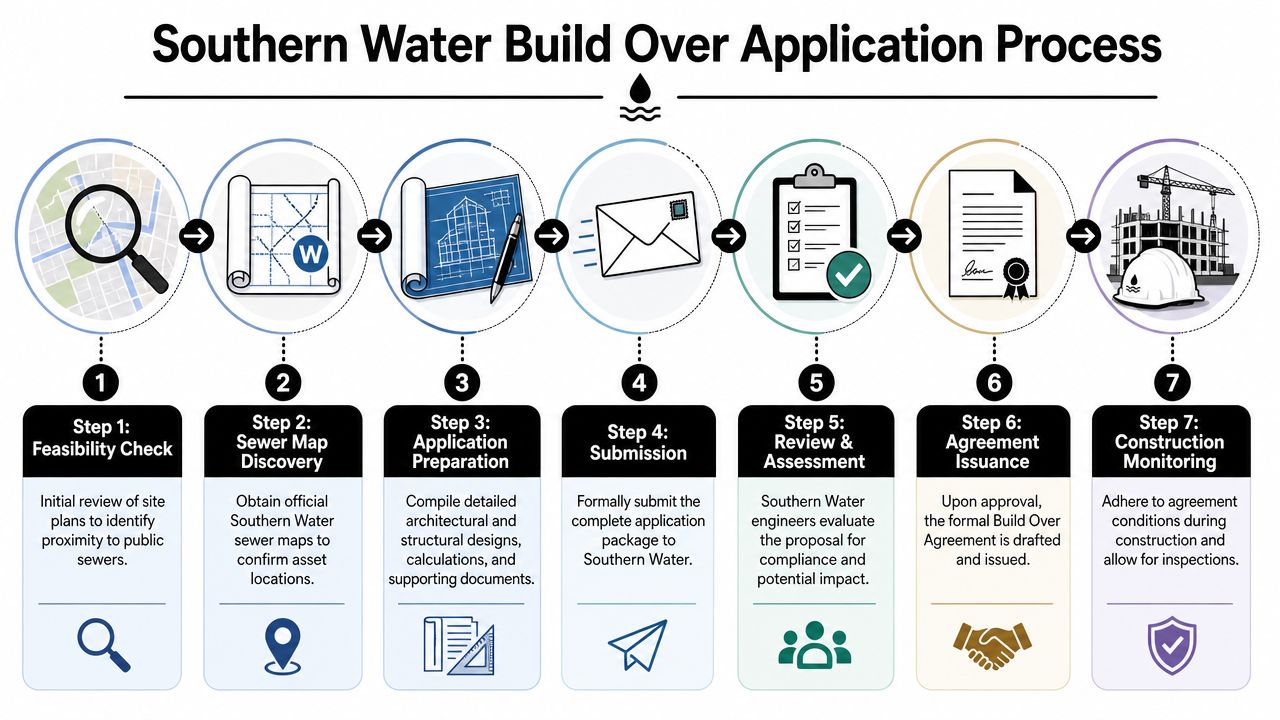
A reliable application process usually runs in this order:
Check the available drainage information so the likely sewer route and access points are understood.
Develop the architectural design until the footprint, internal arrangement, and build strategy are credible.
Coordinate structural input so the foundation proposal shown in section matches the architectural intent.
Prepare a complete drawing pack with consistent dimensions, levels, and relationships to the sewer.
Submit only when the information agrees across all documents.
That last step matters. Delay often comes from contradiction, not complexity. If one drawing shows a standard trench foundation and another implies a different structural response, the utility will query the pack, and the programme starts slipping.
What the application pack needs to show
The required documents are straightforward on paper, but they need to work together. A planning layout on its own is rarely enough. The technical reviewer needs to understand the proposed building in section as well as in plan, which is why properly coordinated planning application drawings often form the starting point rather than the finished package.
Document | Required Scale | Key Details to Include |
|---|---|---|
Existing and proposed site plan | 1:100 or larger | Building footprint, sewer position if known, and the relationship between the existing house and proposed works |
Site location plan | 1:1250 or larger | Wider site context and enough information to identify the property and affected land clearly |
Cross-section foundation design | 1:100 or larger | Foundation depth, sewer position, relative levels, and the structural relationship between the building and pipe |
Supporting site information | As requested by Southern Water | Drainage context, access points, and any details needed for technical review |
CCTV information where requested | As requested by Southern Water | Route and condition information if the utility requires it |
For homeowners, this is usually the point where generic builder sketches stop being useful. The application has to show that the design can be built without creating avoidable risk to the sewer or to the programme.
Working advice: Submit once the architectural, structural, and drainage information all say the same thing. That single discipline prevents a large share of avoidable delay.
Design Constraints and Architectural Implications
Once a sewer constraint is confirmed, the design work becomes more interesting, not less. Good architecture doesn't ignore the problem. It absorbs it and resolves it without making the house feel compromised.
Where the constraint shows up first
The first impact is usually structural. A foundation arrangement that would be entirely routine on a clear site may no longer be appropriate once a public sewer sits under or near the extension line. The structural engineer may need to consider bridging the asset, changing the load path, or revising how excavation is handled.
For clients, this often becomes visible in three areas:
Footprint decisions: A slight shift in the rear wall or side return geometry can avoid a much heavier engineering response.
Internal planning: A manhole or access requirement may affect where cabinetry, utility spaces, or circulation can sensibly sit.
Buildability: Contractors need a scheme that can be constructed around the protected asset without improvised site decisions.
Basements need particularly careful judgement
Basement projects bring a different level of sensitivity because the issue isn't only what sits above the sewer. It's also the excavation around it, the temporary works, and the long-term relationship between the new retaining structure and the existing pipework.
On a high-value refurbishment, the temptation is to force the basement footprint to match the ideal brief exactly. That approach can become expensive quickly if the drainage condition then dictates a more complex structural solution than the budget or programme anticipated.
A more disciplined approach is to treat the drainage constraint as one of the fixed lines in the project, alongside party wall implications, existing structure, and planning context.
What tends to work and what doesn't
What works is strategic flexibility. A modest design adjustment made early is often far cheaper than a heroic engineering fix introduced late.
What doesn't work is assuming technical problems can be absorbed invisibly. They usually reappear somewhere else. In reduced floor-to-ceiling height, awkward construction sequencing, compromised landscaping, or unnecessary structural complexity.
There are practices that regularly coordinate this sort of issue as part of technical design risk management, including Harper Latter Architects, where high-end residential projects often involve extensions, basements, and drainage-sensitive sites in tight urban settings.
Managing Risks Delays and Retrospective Applications
The main cost of a Southern Water build over agreement issue is rarely the application itself. It's the disruption caused when the matter is discovered too late.
That can happen before construction, during construction, or at the point of sale. Each scenario is more awkward than dealing with the issue properly at feasibility stage.
The avoidable delay
When approval is left until after planning, the design team may have to revisit the footprint, foundation strategy, or drainage layout under pressure. Contractors may need revised information. Costs can move for reasons the homeowner didn't see coming when the project first looked settled.
This is why I treat the build over question as a risk-management item rather than a utility add-on. It affects certainty. And certainty is what keeps a residential project calm.
Retrospective applications are the most uncomfortable
A frequent problem is existing work that was started or completed without the necessary approval. Southern Water states that retrospective agreements may not be approved if the pipework was not properly protected, according to Thames Water's homeowner guidance on building over sewers or public drains.
That matters because the issue often surfaces during conveyancing, refinancing, or wider refurbishment planning. At that point, the homeowner may not just be filing missing paperwork. They may be confronting uncertainty about whether the existing construction can be regularised at all.
The worst time to discover a sewer approval problem is when the build is complete and someone else is asking for proof that it was done properly.
A better way to reduce risk
The practical answer is simple, even if the coordination isn't. Check early. Draw accurately. Resolve structure and drainage together. Keep the approval process aligned with the actual design, not a placeholder version of it.
That approach doesn't remove complexity, but it does stop complexity turning into surprise.
Navigate the Process with Harper Latter Architects
For homeowners planning a substantial extension, basement, or full refurbishment, the most useful role an architect plays here is not form-filling. It's protecting the project from avoidable design conflict.
That means identifying the drainage issue before the layout is overcommitted, coordinating measured surveys and technical drawings, and making sure structural thinking is embedded before a Southern Water application is prepared. It also means advising candidly when the most elegant answer is not to fight the constraint, but to redesign around it.

On high-end residential work in Wimbledon, Richmond, and across South West London, that kind of early technical judgement is what preserves both design quality and programme certainty. A Southern Water build over agreement is rarely the most visible part of a project, but it can be one of the most consequential if mishandled.
Handled properly, it becomes part of a disciplined pre-construction strategy. The design remains ambitious, the technical submissions stay coherent, and the build is far less likely to be derailed by a problem that was always sitting underground waiting to be noticed.
If you're planning an extension, basement, or major refurbishment and want clear advice on drainage constraints before they disrupt the design, speak to Harper Latter Architects. We can help assess whether a Southern Water build over agreement is likely to affect your scheme and shape the project around that reality from the outset.