
Finding an architect: A practical guide to hiring the right professional

Taking on a high-end residential project in South West London is a huge commitment, and your choice of architect is easily the most important decision you'll make. The secret to a great outcome is finding a professional partner who not only gets the local area but can also turn your vision into a beautiful, liveable home. It’s a process that calls for a bit of homework, a clear brief, and knowing what makes a great practice tick.
Starting Your Architectural Journey In South West London

The architectural scene in London is buzzing with talent. For homeowners in sought-after spots like Wimbledon, Richmond, or Surrey, this is both a blessing and a challenge. Sure, your ideal design partner is out there, but finding them requires a structured approach.
This isn't a decision to rush into. The architect you choose becomes your most trusted advisor, steering you through everything—from the first sketches and tricky planning permissions to overseeing the build and keeping an eye on the budget. A brilliant partnership is built on a shared vision, open communication, and mutual trust.
Understanding The Competitive Landscape
The sheer number of architects can feel a bit much. In fact, there are currently 17,240 architectural businesses operating across the United Kingdom. For anyone in somewhere like Wimbledon Village planning a bespoke new build or a luxury refurbishment, this means plenty of choice but also highlights the need to vet candidates carefully.
This competitive environment makes your due diligence even more critical. It’s not just about finding a competent professional; it’s about finding the right one for your specific project, location, and style.
Why A Local Specialist Matters
An architect with deep-rooted experience in South West London brings so much to the table. They’ll have a nuanced understanding of the local planning departments in boroughs like Merton and Wandsworth, know the ins and outs of conservation area restrictions, and have established relationships with top-quality local builders. That kind of local expertise can be the difference between a smooth project and one plagued by delays.
A great architect does more than design four walls and a roof. They craft spaces that enhance your lifestyle, solve complex spatial puzzles, and add significant value to your property. The right local specialist acts as your creative partner and staunchest advocate.
To navigate this process well, you need a clear roadmap. We'll walk you through the key steps, from defining your brief and shortlisting practices to understanding fee structures. Getting the financials right from the start is crucial, and you can get a better sense of the numbers by looking at our detailed house extension cost examples in South West London.
By focusing on practices that are not only creatively aligned with your vision but are also experts in your neighbourhood, you set the stage for something truly exceptional. A local firm like Harper Latter Architects combines world-class design with the practical, on-the-ground knowledge needed to bring ambitious residential projects to life in this unique part of London.
How To Create A Powerful Project Brief

Before you even think about picking up the phone to an architect, the most powerful thing you can do is create a well-considered project brief. This isn't just a shopping list of rooms. It’s a genuine expression of your lifestyle, your frustrations with your current home, and your aspirations for the future.
A strong brief is your project's compass. It ensures every architect you speak to understands exactly what you’re trying to achieve, right from the first conversation. It also forces you to think deeply about how you actually live. What are your daily routines? What parts of your home just don't work? What changes would bring you the most joy?
A vague brief will only ever get you vague proposals. A clear, thoughtful one is the bedrock of a great partnership.
Defining Your Vision: Must-Haves vs. Nice-to-Haves
First things first, you need to separate your absolute necessities from your desirable extras. Getting this clarity is crucial for managing both the design and your budget. Start by writing down everything you can think of, then sort it into two simple columns.
Your ‘must-have’ list should cover the non-negotiables, often driven by your family’s practical needs. A Wimbledon family, for instance, might list a ground-floor extension for a larger, open-plan kitchen-diner as essential. Other examples could be a fourth bedroom for a growing family or specific accessibility improvements.
The ‘nice-to-have’ list is where your daydreams come to life. This is where you can put that basement cinema for your Wandsworth home, a bespoke wine cellar, or a dedicated home gym. These are the elements that can elevate a home from purely functional to truly exceptional.
Must-Haves: These are the core project goals that have to be met. * Example: "We must have a fourth bedroom and an ensuite for the main bedroom." * Example: "The project needs to incorporate a home office with excellent natural light."
Nice-to-Haves: These are the aspirational features you’d love to include if the budget and design allow. * Example: "We would love a walk-in wardrobe if space permits." * Example: "A garden room for summer evenings would be a fantastic addition."
This simple exercise helps an architect focus their creative thinking. They’ll know to deliver your core needs brilliantly, while looking for clever ways to integrate your desired luxuries.
Harnessing Inspiration Effectively
Platforms like Pinterest and Houzz are brilliant for gathering visual ideas, but they come with a word of warning. A folder stuffed with hundreds of disconnected images can be more confusing than helpful. The key is to add context.
Instead of just saving a picture of a kitchen you like, jot down a quick note explaining what it is you like about it. Is it the colour of the cabinetry? The layout of the island? The type of lighting, or just the overall sense of space? This kind of detailed feedback gives an architect a much deeper insight into your personal taste.
A project brief is the story of your future home. It should articulate not just what you want, but why you want it. This narrative allows an architect to design a space that is not only beautiful but is also a true reflection of you and your family.
This process turns your brief from a simple wish list into a powerful communication tool. To see how this fits into the wider project timeline, take a look at our detailed guide on the RIBA Plan of Work.
Setting A Realistic Budget From The Start
Talking about money early and openly is absolutely essential. Your budget influences every single decision, from the scale of the project to the finish on the taps. A realistic budget needs to cover three main components:
Construction Costs: The amount you will pay the builder for all the physical work.
Professional Fees: This covers your architect, structural engineer, and any other consultants needed.
Contingency Fund: This is crucial. Always set aside 10-15% of your construction cost for the unexpected. Trust me, something always comes up.
For a sensitive renovation on a listed building in Richmond, for example, you might want to push that contingency a bit higher. You just never know what you might uncover when you start opening things up.
Being upfront about your total budget allows an architect to design a scheme that is both ambitious and, most importantly, achievable. It saves everyone from disappointment down the line.
Discovering The Best Local Architects
With your project brief taking shape, it's time for the exciting part: finding the right architect for the job. This isn't just about a quick Google search. It’s about being strategic, identifying professionals whose work genuinely resonates with your vision, and finding someone who has the specific local knowledge your South West London project needs.
Knowing where to look is half the battle. Your aim should be to create a focused shortlist of three to five practices that feel like a great fit, rather than getting lost in an endless sea of portfolios. This targeted approach will save you a huge amount of time and make sure those first conversations are productive right from the start.
The UK's architecture scene is thriving. There are currently around 54,100 architects employed in the country, and with housing demand so high in prime locations like ours, finding a practice with the right experience has never been more critical. You can get a better sense of the industry with insights on the UK architectural market from Statista.com.
Where To Begin Your Search
Starting your search with trusted, professional bodies is always the smartest move. These platforms vet their members, giving you an immediate baseline of quality and professionalism.
The most authoritative place to start is the Royal Institute of British Architects' (RIBA) 'Find an Architect' tool. This database is brilliant because you can filter chartered practices by location, project type, and even budget. It’s an invaluable first step for finding accredited professionals right here in South West London.
Another great tactic is to look through architectural publications and awards shortlists. Magazines like Dezeen or Architects' Journal are fantastic sources of inspiration, and even local lifestyle magazines often feature stunning residential projects in areas like Richmond, Wimbledon, or Surrey. If a project catches your eye, make a note of the practice behind it.
Comparing Architect Search Methods In South West London
Finding the right architect involves weighing up different approaches. Some methods offer speed, while others provide deeper, more personal insights. Here’s a quick comparison to help you decide where to focus your energy.
Search Method | Pros | Cons | Best For... |
|---|---|---|---|
RIBA 'Find an Architect' Tool | Vetted, accredited professionals. Detailed filtering by location, budget, and project type. | Can feel overwhelming due to the sheer number of results. Portfolios might not be fully up-to-date. | Homeowners who want a comprehensive, reliable starting point and value professional accreditation. |
Architectural Magazines & Awards | Features high-quality, innovative design. A great source of inspiration for unique projects. | The featured architects may have high-end fees or long waiting lists. Less focus on smaller-scale work. | Those with a strong design vision looking for a practice known for its distinctive, award-winning style. |
Personal Recommendations | Honest, first-hand feedback. Insights into communication style and process you can't get online. | The architect may not be the right fit for your specific project type or aesthetic. | Anyone looking for a trusted referral and who values hearing about real client experiences. |
Local Planning Portals | Finds architects with proven success in your specific neighbourhood. Shows they understand local council rules. | Takes more time and effort to search addresses and track down firm names. | Projects in conservation areas or with tricky planning constraints where local experience is paramount. |
Ultimately, a combination of these methods often yields the best results. Start broad with a tool like RIBA's, then narrow your focus using local insights and recommendations.
The Power of Local Knowledge
Never underestimate the value of a trusted recommendation. Talk to friends, family, or colleagues in the area who’ve recently completed a similar project. A first-hand account of what it was really like to work with an architect can offer insights you simply won’t find on a website.
Also, get out and about in your local area. Take a walk or a drive around your neighbourhood. If a recently completed extension or new-build home catches your eye, don't be shy. A quick search of the local council’s planning portal for that address will almost always reveal the name of the architectural practice that designed it. This is a brilliant way to find architects with proven success in your specific borough.
Choosing an architect is as much about personality and communication as it is about their portfolio. You will be working closely with this person for months, possibly years, so finding someone you connect with and trust implicitly is non-negotiable.
Building Your Shortlist
As you start gathering names, dive into their online portfolios with your brief in hand. Look for a consistent style that aligns with your own taste, but more importantly, search for hard evidence of projects similar to yours.
If you’re planning a complex basement extension, does their portfolio showcase this kind of work? If you own a listed building, have they demonstrated genuine expertise in conservation and heritage projects? An architect with a deep, practical understanding of the planning quirks in boroughs like Merton or Wandsworth is an invaluable asset.
This initial review is about more than just pretty pictures. It’s about finding proof of creative problem-solving and technical skill relevant to your unique project. Curating your list this carefully will set the stage for successful first conversations.
Vetting Your Shortlist With The Right Questions

You’ve done the research, created a powerful brief, and narrowed your options down to a focused shortlist of maybe three to five architects. Now comes the most important part: the initial conversations where you move beyond the polished website and find out how they really work.
This is your chance to gauge their design flair, but also their communication style, problem-solving skills, and professional backbone. These meetings are all about building rapport and asking the right questions. A slick portfolio is one thing, but genuine chemistry and a shared understanding are what will get your project over the finish line successfully.
Remember, you are interviewing them just as much as they are assessing your project. Go into each conversation prepared so you can compare each practice fairly afterwards.
Beyond The Obvious Questions
Of course, you’ll talk about fees and timelines. But to really get under the skin of a practice, you need to dig deeper. Their answers to more nuanced questions reveal everything about their design philosophy and how they handle the inevitable bumps in the road.
Here are a few essential questions to get the conversation flowing:
Their Philosophy: How would you describe your architectural style? Can you show me a project you’re especially proud of and tell me why it worked so well?
The Process: Who will be my day-to-day contact? How often can I expect updates, and what format do they come in?
Problem-Solving: Tell me about a time a project hit an unexpected snag. What happened, and how did you resolve it?
Local Knowledge: What’s your experience with the planning departments in Merton, Wandsworth, or Richmond? Have you worked on listed buildings or in local conservation areas before?
Budgeting: How do you manage the project budget from start to finish? What’s your process for handling client-requested changes that might affect costs?
These aren’t yes/no questions. They’re designed to open up a proper conversation. Listen to how they answer. Are they engaged and transparent, or are they giving you generic sales patter?
A great architect listens more than they talk in the first meeting. They should be asking you probing questions about your lifestyle, your family's needs, and what you hope to achieve, demonstrating a commitment to understanding the 'why' behind your project.
Assessing Portfolios And Past Projects
A portfolio isn’t just a gallery of glossy photos; it’s a library of evidence. When you’re looking through an architect’s work, search for projects with a similar scale and complexity to your own. If you’re planning a sensitive renovation of a Victorian terrace in Wimbledon, a portfolio full of ultra-modern new builds in the countryside might signal a mismatch.
Ask them to walk you through two or three relevant case studies. Look closely at the 'before' and 'after' floor plans – this is where you’ll see their creativity in action. A talented architect can find potential in a property that you never knew existed, and the drawings are where that thinking comes to life.
The Importance Of References
Never, ever skip the reference check. This is your opportunity to get an unfiltered perspective from a past client on what it’s really like to work with the architect. It’s an invaluable final step.
When you call, ask specific questions that go beyond a simple, "Were you happy?"
Communication: Was the architect responsive and easy to get hold of?
Budget: Did the final cost match the estimate? If not, how were the overages handled?
On-Site Presence: How involved was the architect during the actual construction phase?
The Big Question: Would you hire them again?
If you can, ask to visit a completed project. Seeing the quality of the finish and craftsmanship for yourself is the ultimate test. It allows you to actually stand in the spaces they’ve designed and judge whether their work stands the test of time. This final piece of due diligence will give you all the confidence you need to make your decision.
Getting to Grips with Fees, Contracts, and the Design Process
Once you’ve had a few initial chats and checked some references, the conversation will naturally shift to the practical side of things: money, contracts, and what the design journey actually looks like. Diving into the financials can feel a bit daunting, but any good architect will make it their job to be completely transparent, making sure you feel confident and in control from the very start.
Getting a clear handle on how fees are calculated and what’s covered in the contract is non-negotiable. This isn’t just about the numbers; it’s about laying a solid, professional foundation for a creative partnership that could easily last a year or more.
Demystifying Architect Fees
Architects generally use one of three main ways to structure their fees, and the best fit usually comes down to the size and complexity of your project. There’s no single "right" answer—it’s about what provides the most clarity for you and your specific plans.
Here are the most common approaches you'll come across:
Percentage of Construction Cost: This is a very common method. The fee is simply a set percentage of the final build cost, which for residential projects in London, typically falls somewhere between 8% and 15%. A complex refurbishment of a period property in Wimbledon, for instance, would likely be at the higher end of that scale compared to a more straightforward new build out in Surrey.
Fixed Fees: If your project has a crystal-clear scope from the get-go, a fixed fee is a great option. It gives you complete cost certainty. This lump sum is agreed upon right at the beginning and is often preferred for smaller jobs or projects broken down into distinct phases.
Time-Based Fees: This is exactly what it sounds like—you're charged an hourly or daily rate. It’s most often used for the very early stages of a project, like initial feasibility studies, or when the full extent of the work isn’t yet known.
Making sense of these options is key. To get a much more detailed breakdown, have a look at our homeowner's guide to architect fees in the UK.
Why a Watertight Contract is So Important
Before any design work kicks off, your relationship with your architect must be formalised in a written contract. Think of this document as your project's safety net. It clearly lays out everyone's responsibilities, the agreed scope of services, the fee structure, and the payment schedule.
A standard RIBA Agreement is the industry gold standard. It’s a fair, balanced contract that covers all the essentials, including what happens if the brief changes or if there are unexpected delays. Whatever you do, never move forward based on a verbal agreement or a quick email.
A detailed contract isn't about a lack of trust; it's the hallmark of a professional. It creates a clear, shared roadmap for the entire project, protecting your investment and ensuring everyone knows exactly where they stand.
What to Expect From the Design Process
The architectural journey isn't a free-for-all; it’s a structured process, typically broken down into sequential stages defined by the RIBA Plan of Work. This step-by-step approach ensures that the right decisions are made at the right time, moving logically from big-picture ideas to the tiny details needed for construction. While the full plan has eight stages, the key phases you’ll be involved in are:
Concept Design: This is where the fun begins! We’ll explore initial ideas with sketches, drawings, and mood boards to find a direction you love.
Developed Design: We take the chosen concept and start refining it, turning it into a more detailed set of drawings.
Technical Design: Here, we create the highly detailed construction drawings and specifications that a builder will need to actually build your project.
Construction: During the build, the architect’s role shifts to administering the building contract and inspecting the work on-site to ensure it meets the design intent and quality standards.
The UK's architecture sector is buzzing with activity at the moment. Recent industry figures show that fee income for practices has surged, with 76% reporting increases and average revenue climbing by 15%. This points to a healthy capacity among high-end firms to take on ambitious projects—like those basement extensions with home gyms or wine rooms that are so popular in areas like Wimbledon. You can dig into the full findings in the UK Architecture Sector Benchmarking Report. This positive momentum really highlights why having a clear, professional process in place is so important for managing these significant investments.
A Few Common Questions We Hear
Even when you've got a shortlist, a few final questions always pop up. Getting clear, honest answers at this stage is what builds the trust you need to appoint the right practice for your South West London home. Here are some of the most common queries we get from homeowners just like you.
ARB Registered or RIBA Chartered?
So, what’s the real difference between an ARB-registered and a RIBA Chartered Architect? It’s a great question, and the distinction is crucial.
In the UK, the title ‘architect’ is legally protected. Anyone calling themselves an architect must be registered with the Architects Registration Board (ARB). Think of this as the baseline legal requirement, confirming they have the right qualifications and competence.
A RIBA Chartered Architect, however, signifies a higher standard. To be chartered by the Royal Institute of British Architects (RIBA), an architect also commits to a strict Code of Professional Conduct and ongoing training. For a significant home project, choosing a RIBA Chartered Practice gives you an extra layer of confidence in their quality, ethics, and professionalism.
How Much Should I Expect to Pay in Architect Fees?
Architect fees aren't one-size-fits-all; they depend on the project's complexity, its location, and exactly what services you need.
Here in London, fees are often a percentage of the total construction cost, usually falling somewhere between 8% to 15%. For trickier projects, like renovating a listed building in Richmond or digging a new basement in Wimbledon, you can expect the fee to be at the higher end of that scale.
Some architects might offer a fixed fee if the scope is very clear from the outset, or charge an hourly rate for initial feasibility studies. The key is transparency. A good architect will be upfront about their fee structure in your first meeting and will document it clearly in your contract, so you know exactly what’s included.
This diagram breaks down the core parts of a solid professional agreement.
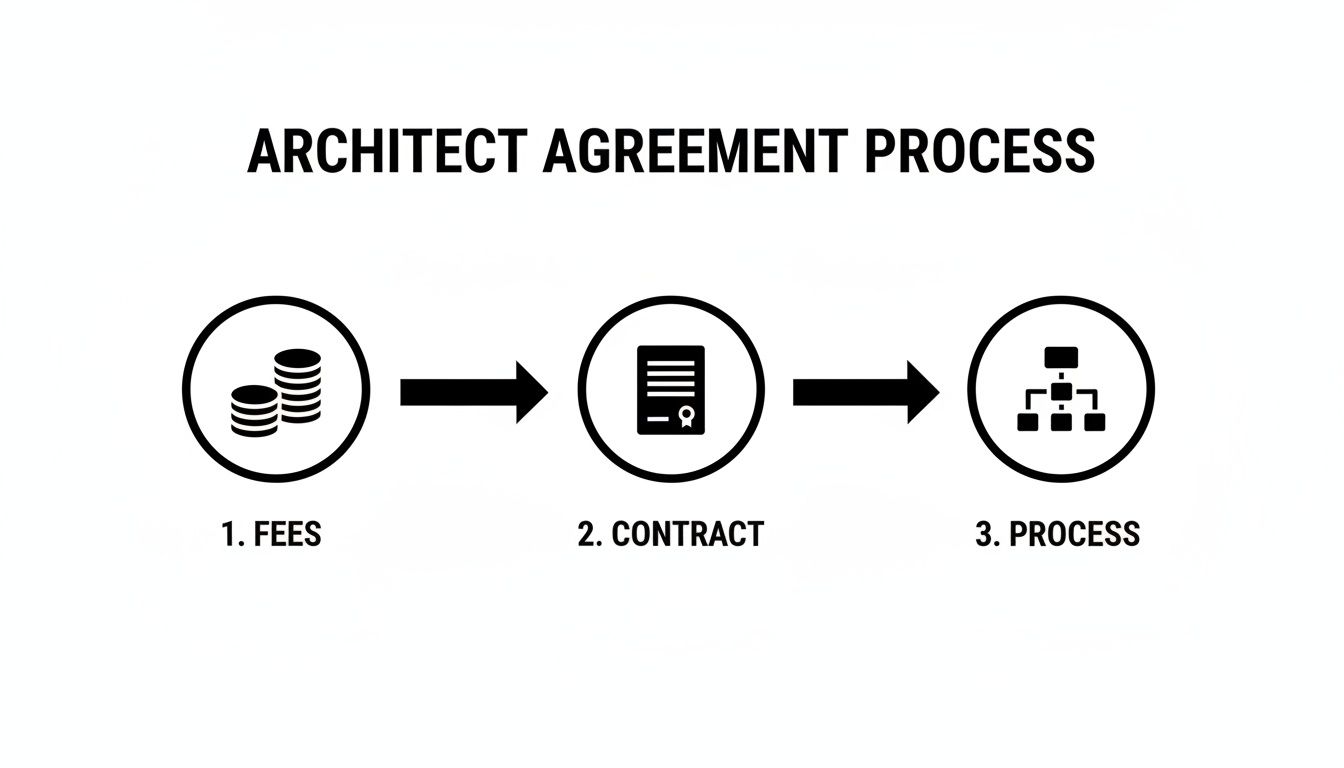
As you can see, a strong agreement is built on three pillars: clearly defined fees, a comprehensive contract, and a shared understanding of the design journey ahead.
Do I Really Need an Architect for a Small Extension?
It’s easy to see an architect as just another cost, especially on a smaller project. But their value almost always outweighs the fee. They do so much more than just draw plans.
Architects are expert problem-solvers. They can find clever ways to maximise light and space you hadn't thought of, navigate the tricky planning permissions in conservation areas, and add significant value to your property through intelligent design.
They can also manage the tender process to find a reliable builder at the right price and oversee the work to ensure the finish is up to scratch. Good design is just as important for a small side-return as it is for a brand-new house.
Hiring an architect for a smaller project isn't a cost; it's an investment in quality and peace of mind. Their input ensures the final space is not just well-built and compliant, but a place that genuinely makes your daily life better.
What Should I Do if I Disagree With My Architect?
The best way to prevent disagreements is through clear and regular communication right from the start. This is precisely why that initial chemistry check is so important. A proper contract, like a RIBA Agreement, also helps by setting out everyone's responsibilities from day one.
If a problem does pop up, raise it directly and professionally as soon as you can. Most issues are simply misunderstandings that a quick, honest conversation can sort out. A great working relationship is built on mutual respect and the shared goal of creating a brilliant home.
In the rare event you can't find a resolution, your contract should outline a formal dispute process. RIBA also offers services like mediation, which are a far better alternative to costly legal action. This provides a safety net, but frankly, in a healthy client-architect partnership, it’s rarely ever needed.
At Harper Latter Architects, we believe in building strong, collaborative relationships founded on transparency and shared vision. Our RIBA-accredited team specialises in creating exceptional homes across South West London, from sensitive heritage restorations to ambitious new builds. To see how our structured process can bring your vision to life, explore our architectural services or contact us to arrange an initial consultation.
Comments