
Architect Fees for an Extension: Architect Fee for Extension Demystified

Figuring out the architect fee for an extension isn't as simple as looking up a price list; it's about understanding the expertise and value you're investing in. For a typical UK home extension, fees are often calculated as a percentage of the final construction cost, usually falling somewhere between 10% and 15%. This figure can shift based on how complex your project is and the level of service you need.
Your Guide to Architect Fees for a Home Extension
Planning an extension is one of the most exciting things you can do for your home, but navigating the costs can feel a little overwhelming. Your architect's fee is one of the first significant investments you'll make, and getting it right is crucial for setting your project on the right path.
It helps to think of this fee not as a standalone cost, but as the blueprint for your entire build. It guides everything from the initial creative sparks to the final, fully compliant structure.
What you're paying for isn't just a set of drawings. It’s a comprehensive professional service that ensures your project is thoughtfully designed, legally sound, and built to an exceptional standard. This journey typically includes:
Creative Design and Feasibility: Exploring what's actually possible with your space, your ideas, and your budget.
Navigating Regulations: Preparing and submitting all the necessary paperwork for Planning Permission and Building Regulations approval.
Technical Detailing: Producing the incredibly detailed drawings that builders rely on to construct your extension with precision.
Project Oversight: Keeping an eye on the construction phase to make sure the original design is brought to life exactly as planned.

Different Ways Architects Structure Their Fees
To make sense of the quotes you receive, you need to get your head around the different ways architects charge for their work. There’s no single, universal method; the approach often depends on the project's scale and how predictable the scope is. You'll almost always come across one of four main structures.
Choosing an architect is about more than just finding someone to draw plans. It's about finding a partner who will protect your investment, add significant value to your property, and turn your initial ideas into a beautifully crafted reality.
Getting to grips with these models is the first step towards a transparent and successful collaboration. Here’s a quick rundown of the common fee structures you'll see when looking for an architect for your home extension.
Architect Fee Structures at a Glance
This table summarises the common ways architects charge for home extension projects in the UK.
Fee Structure | How It Works | Best Suited For |
|---|---|---|
Percentage Fee | The fee is a set percentage of the final construction cost (e.g., 10-15%). | Full-service projects where the architect is involved from concept to completion. |
Fixed Fee | A single, agreed-upon price for a clearly defined scope of work. | Projects with a very clear and predictable scope, like planning drawings only. |
Hourly Rate | The architect charges for their time at an agreed hourly rate (e.g., £90+ per hour). | Small-scale consultations or tasks where the scope is uncertain. |
Staged Payments | Fees are broken down and paid upon the completion of specific project milestones (RIBA stages). | Most projects, as it aligns payments with tangible progress and deliverables. |
Each of these structures has its place, and the right one for you will depend entirely on the specifics of your project and the level of involvement you want from your architect.
How Do Architects Charge? Breaking Down the Four Main Fee Structures
Getting your head around an architect's quote is the first step towards a clear, successful project. When a proposal lands in your inbox, the architect fee for an extension will almost always be presented in one of four ways. Each has its own logic and is suited to different types of projects and how involved you want to be.
Understanding these models is key. It lets you compare different proposals like-for-like and pick the approach that feels right for your budget and your plans. Let’s unpack them one by one.
The Percentage Fee Model
This is the most common route for full, start-to-finish architectural services. The fee is simply a percentage of the final construction cost, which for a high-end residential extension typically falls between 10% and 15%.
You can think of it as a partnership model. With the fee linked to the final build cost, your architect is naturally invested in delivering the highest quality result that your budget can achieve. It keeps them focused on the project's success, from the first sketch right through to the day they hand you the keys.
This method is perfect for complex or unique projects where the full scope might not be known from day one. It gives you flexibility while making sure your architect’s commitment is tied to the overall quality and ambition of the build.
It's worth noting that renovation projects often carry a higher percentage. UK statistics show that extensions and basement conversions typically see architect fees of 12-15% of the build cost. In contrast, new builds are often lower, at around 8-13%, because working with existing structures and planning sensitivities just adds another layer of complexity. You can learn more about how project type impacts architect fees and discover detailed cost breakdowns for various budgets.
The Fixed Fee Model
Just like it sounds, a fixed fee is a single, agreed-upon price for a very clearly defined scope of work. Many homeowners love this model because it gives them complete cost certainty from the get-go.
This approach is at its best when the project requirements are crystal clear from the start. For example, you might hire an architect on a fixed fee just to produce the drawings needed for a planning application.
The upside: You know exactly what you’re paying, which makes budgeting a breeze.
The downside: If the scope of the project changes or grows, the fee will need to be renegotiated. It can be a bit rigid if unexpected issues pop up.
A fixed fee is great for predictable stages of a project, but it all hinges on having a precise and detailed brief from day one.
The Hourly Rate Model
Sometimes called a 'time charge', this is essentially a pay-as-you-go service. You pay your architect for the actual hours they put into your project. For a qualified architect in the UK, rates often start from £90 per hour and go up depending on their experience and location.
This structure is ideal for specific, one-off tasks or for those very early consultations. You might hire an architect for a few hours to see if an idea is feasible or to sketch out some initial concepts before you commit to the whole journey.
It gives you maximum flexibility, but you lose the budget predictability of a fixed fee. That’s why it’s less common for an entire extension project, but it’s invaluable for getting targeted, expert advice when you need it most.
Staged Payments
This isn't really a fee structure in its own right, but a payment method that's almost always used alongside percentage or fixed fees. It breaks the total fee down into smaller chunks, which you pay as specific project milestones are completed.
These milestones usually line up with the official RIBA Plan of Work stages.
Payment 1: After the Concept Design (RIBA Stage 2) is finished.
Payment 2: Once the Planning Application (RIBA Stage 3) has been submitted.
Payment 3: On completion of the Technical Design and Building Regulations drawings (RIBA Stage 4).
Final Payments: These are spread across the construction and handover phases (RIBA Stages 5 & 6).
This way of working is a win-win. It helps you manage your cash flow and gives you the confidence that you’re only paying for real, tangible progress. It creates clear checkpoints and deliverables all the way through the project.
Mapping Your Fees to the RIBA Plan of Work
An architect’s fee isn’t just an arbitrary number; it’s a carefully structured investment mapped directly to your project's journey. This journey is professionally defined by the RIBA Plan of Work, a step-by-step framework that breaks down a complex building project into manageable stages. Understanding this connection is vital, as it ensures your payments are always tied to tangible progress.
Think of it like commissioning a bespoke piece of furniture. You wouldn't pay the full price upfront. Instead, you'd pay in stages: a deposit for the initial design sketches, another payment once the timber is selected and cut, and the final amount upon assembly and delivery. An architect fee for an extension works in the same way, using the RIBA stages as clear, industry-recognised milestones for payment.
This staged approach de-risks the process for everyone involved. It gives you, the homeowner, complete transparency over what you're paying for at each point, while ensuring your architect is fairly compensated for the work they've completed.
From First Sketch to Final Build
Each RIBA stage represents a distinct phase of work with its own set of deliverables. Your architect’s proposal will typically break down their total fee—whether it's a fixed sum or a percentage—and assign portions of it to these key stages. This provides a clear payment schedule that aligns with your project's momentum.
Let’s walk through a typical extension project to see how this works in practice.
RIBA Stage 2 Concept Design: This is where your vision starts to take shape. Your architect will explore various design options, produce initial sketches, and establish the project's overall direction. The fee for this stage covers this foundational creative work.
RIBA Stage 3 Spatial Coordination: Once a concept is agreed upon, the design is developed further to prepare for the planning application. Your architect will produce more detailed drawings and documents required by your local council. A payment is typically due upon submission of the planning application.
RIBA Stage 4 Technical Design: This is one of the most intensive stages. Here, the approved design is turned into a highly detailed set of technical drawings and specifications that a builder can use to price and construct the extension. This includes coordinating with other consultants like structural engineers.
RIBA Stage 5 Manufacturing and Construction: During the build, your architect's role shifts to one of oversight and contract administration. They will make regular site visits, answer builder queries, and ensure the work is being carried out according to the technical drawings. Fees during this phase are often paid monthly.
For a comprehensive breakdown of each step, you might be interested in our detailed guide explaining the RIBA Plan of Work for UK homeowners, which explains what happens at every stage of your architectural project.
The infographic below illustrates the different ways architects structure their fees, which are then applied across these RIBA stages.
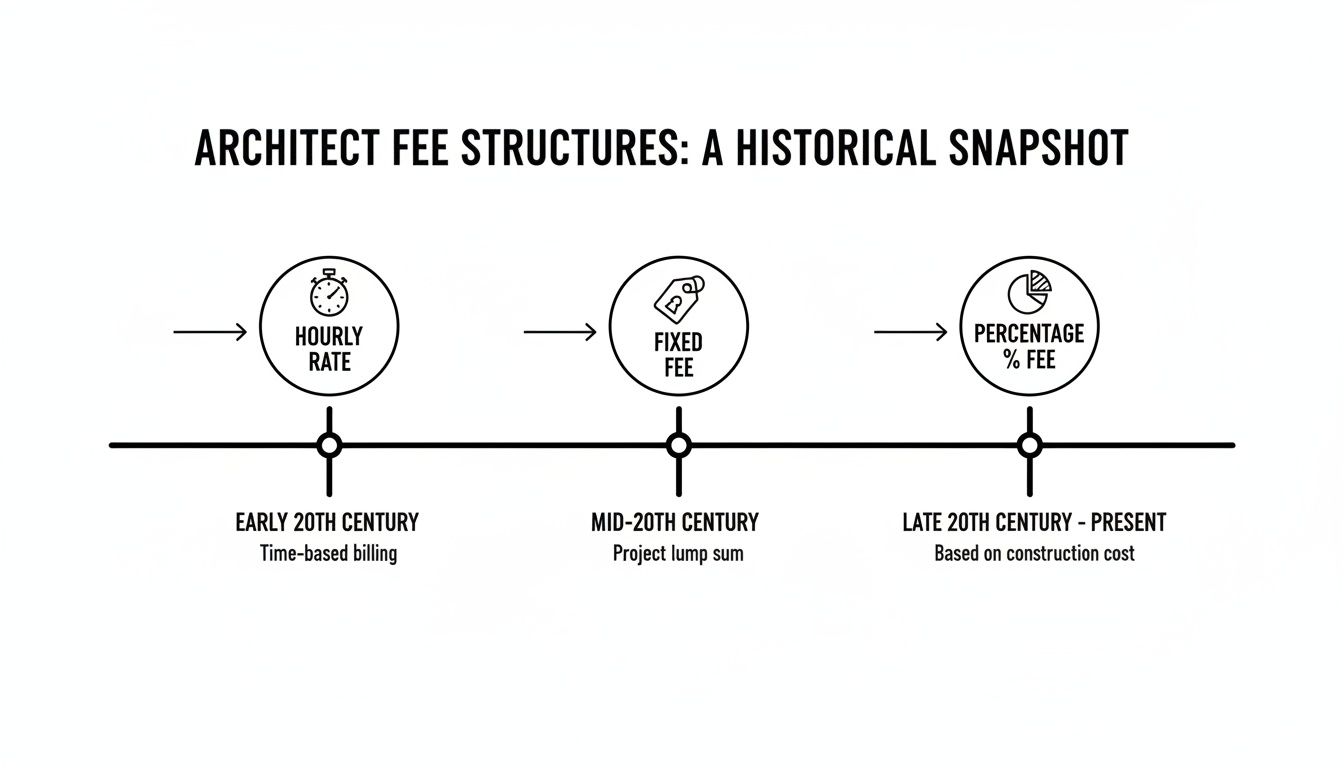
This visual flow shows how fee structures can be adapted to suit different project needs, from the flexibility of hourly rates for initial advice to the comprehensive coverage of a percentage fee for the entire build.
Why This Matters for Your Budget
Linking payments to the RIBA Plan of Work brings much-needed clarity and control to your budget. You’re not just handing over lump sums without seeing results; you're investing in a structured, professional process where each payment unlocks the next phase of your project.
This staged payment model is a hallmark of a professional architectural practice. It demonstrates a commitment to transparency and accountability, giving you peace of mind that your investment is being managed responsibly from the initial concept right through to completion.
This method also allows for natural break clauses. Should your circumstances change or you decide not to proceed after the planning stage, you will only have paid for the services you've received up to that point. This progressive structure provides a clear, logical, and secure financial roadmap for bringing your dream extension to life.
Understanding What Influences Your Architect's Fee
When you start gathering quotes for your extension, you'll probably notice they vary quite a bit. This isn't because some architects are just plucking figures out of thin air; it's because the architect fee for an extension is a direct reflection of the time, skill, and risk your specific project involves. Simply put, no two extensions are ever the same, and a few key factors will always shape the final number.
Getting to grips with these variables is important. It helps you understand the 'why' behind a quote and appreciate that a higher fee often points to greater complexity, more specialised expertise, or a more hands-on level of service. Let's break down what really shapes your architect's proposal.
Project Complexity and Scale
By far the biggest driver of cost is the complexity of what you're hoping to build. A simple, single-storey rear extension with a flat roof and off-the-shelf bifolds requires far less design time and technical detailing than a double-storey, wrap-around extension that involves tricky structural work or a new basement.
Think of it this way: designing a straightforward rectangular room is one thing. But designing a space that has to elegantly wrap around a period property, navigate different floor levels, and incorporate bespoke structural glass is another challenge entirely.
Key complexity factors include:
Structural Demands: More ambitious projects, like removing several internal walls or digging a new basement, demand intricate structural engineering and a huge amount of coordination.
Design Ambition: A highly bespoke design with unique features, curved walls, or non-standard materials will naturally take up more of your architect’s creative and technical time.
Project Scale: A larger extension generally means a bigger construction budget, which will directly impact a percentage-based fee.
Site and Property Constraints
The existing conditions of your property and where it's located play a massive role. An easily accessible, level site with no immediate neighbours is the dream scenario, but the reality is often much more complicated.
Constraints that can push an architect’s fee up include:
Difficult Access: If your home is on a narrow street or has limited side access, it complicates everything from initial surveys to the final build, requiring more detailed logistical planning.
Site Topography: A sloping garden demands more complex design work for foundations, drainage, and levels compared to a completely flat one.
Existing Condition: An older property might be hiding structural surprises or have outdated services, which means more investigation and careful detailing are needed.
The unique character and constraints of your property are what make a bespoke architectural service so valuable. An experienced architect doesn't just design a generic box; they respond thoughtfully to the site's specific challenges and opportunities, turning potential problems into unique design features.
Special Status and Planning Hurdles
If your home has a special designation, the entire architectural process becomes significantly more involved. Navigating the planning system for these properties requires specialist knowledge, incredibly detailed reports, and careful, patient negotiation.
Properties in Conservation Areas or buildings that are Listed demand a much higher level of design scrutiny. Your architect will need to produce heritage statements, design and access statements, and detailed drawings that prove the extension respects and enhances the property's historical character. This is substantial extra work, and the fee will reflect that.
Level of Service and Specialist Input
Finally, the fee is shaped by how much you want your architect to do. A basic service might only get you the drawings needed for a planning application. In contrast, a full service from a practice like Harper Latter Architects covers every single RIBA stage, from the first sketch to overseeing the build and handing you the keys. For a detailed overview, our guide on the cost of an architect in the UK explores how different service levels impact your budget.
On top of this, bringing in specialist services will also adjust the fee:
Interior Architecture: Thinking about bespoke joinery, a custom-designed staircase, or a detailed lighting scheme.
Landscape Design: Creating that seamless connection between your new extension and the garden.
Sustainable Technologies: Integrating things like solar panels, heat pumps, or advanced insulation requires specialist design knowledge.
In the UK, especially for high-end residential projects in areas like South West London, architect fees for house extensions typically range from 10% to 15% of the total construction cost. This means for a £150,000 extension, a full-service fee could be between £15,000 and £22,500, reflecting the comprehensive management and expertise required from start to finish.
How to Compare Quotes and Choose the Right Architect
Getting a few quotes back for your extension project is both an exciting and a slightly daunting moment. Faced with different numbers and formats, it's easy to feel a bit lost. The real skill is learning to look past the final figure and understand what each proposal is actually offering. This is how you make sure you’re comparing like with like.
The lowest price is rarely the best measure of value, especially for an investment as important as your home. A cheaper quote might conveniently leave out essential services or offer very little flexibility for design changes, which almost always leads to unexpected costs popping up later. A detailed, thorough proposal, on the other hand, represents a genuine partnership designed to protect your investment and deliver a far better result.
Looking Beyond the Bottom Line
To properly weigh up each architect fee for an extension, you need to get into the nitty-gritty of what’s included. A good, transparent quote will break everything down, clearly itemising what you’re getting (and what you’re not) at each stage of the project.
Before you make a decision, run through these crucial questions for every proposal you receive:
What RIBA Stages are covered? Does the fee see you through the entire journey from initial concept to the finished build (RIBA Stages 2-6), or does it stop once planning permission is submitted (Stage 3)?
Are third-party fees included? The quote needs to be crystal clear about whether costs like planning application fees or the structural engineer’s invoice are part of the main fee or will be billed on top.
How many design revisions do I get? A good architect will expect a reasonable amount of back-and-forth during the design phase, but the number of included revisions should be stated clearly to avoid any awkward conversations later.
Is contract administration part of the deal? This is a critical service where the architect oversees the build, manages the contract with your builder, and signs off on payments. It’s a vital layer of protection for you and your home.
Answering these questions shifts your mindset from simply comparing prices to truly comparing the value and depth of the service on offer.
The Importance of Professional Credentials
When choosing an architect, their credentials aren't just fancy badges; they are your guarantee of quality, professionalism, and accountability. In the UK, there are two key accreditations you should consider non-negotiable for a project of this scale.
Choosing an architect who is both RIBA Chartered and ARB registered is the single most important step you can take to safeguard your project. These credentials guarantee a recognised standard of excellence, a strict professional code of conduct, and the requirement for professional indemnity insurance.
Here’s a quick breakdown of what they mean for you:
ARB (Architects Registration Board): This is the official, statutory body for architects in the UK. It’s actually illegal for someone to call themselves an "architect" unless they are on the ARB register. Think of this as your baseline guarantee of professional competence.
RIBA (Royal Institute of British Architects): A RIBA Chartered Practice takes things a step further. It shows a firm’s commitment to the highest professional and ethical standards, ongoing professional development for its team, and solid quality management systems.
For a more detailed checklist on what to look for, our guide on how to choose an architect in the UK offers practical advice to help you find the perfect partner for your vision.
Ultimately, selecting an architect based on their proven expertise and a comprehensive, transparent service—not just the lowest quote—is the surest way to achieve a beautifully designed, well-managed extension that adds lasting value to your home.
The Long-Term Value of an Expert Architect
It’s easy to view the architect fee for an extension as just another line item on a spreadsheet. That’s a common mistake. A far better way to see it is as a strategic investment in your property's future—one that pays dividends long after the builders have packed up their tools.
An experienced architect doesn’t just add space; they add tangible, lasting value in ways that a simple cost-benefit analysis can't quite capture.
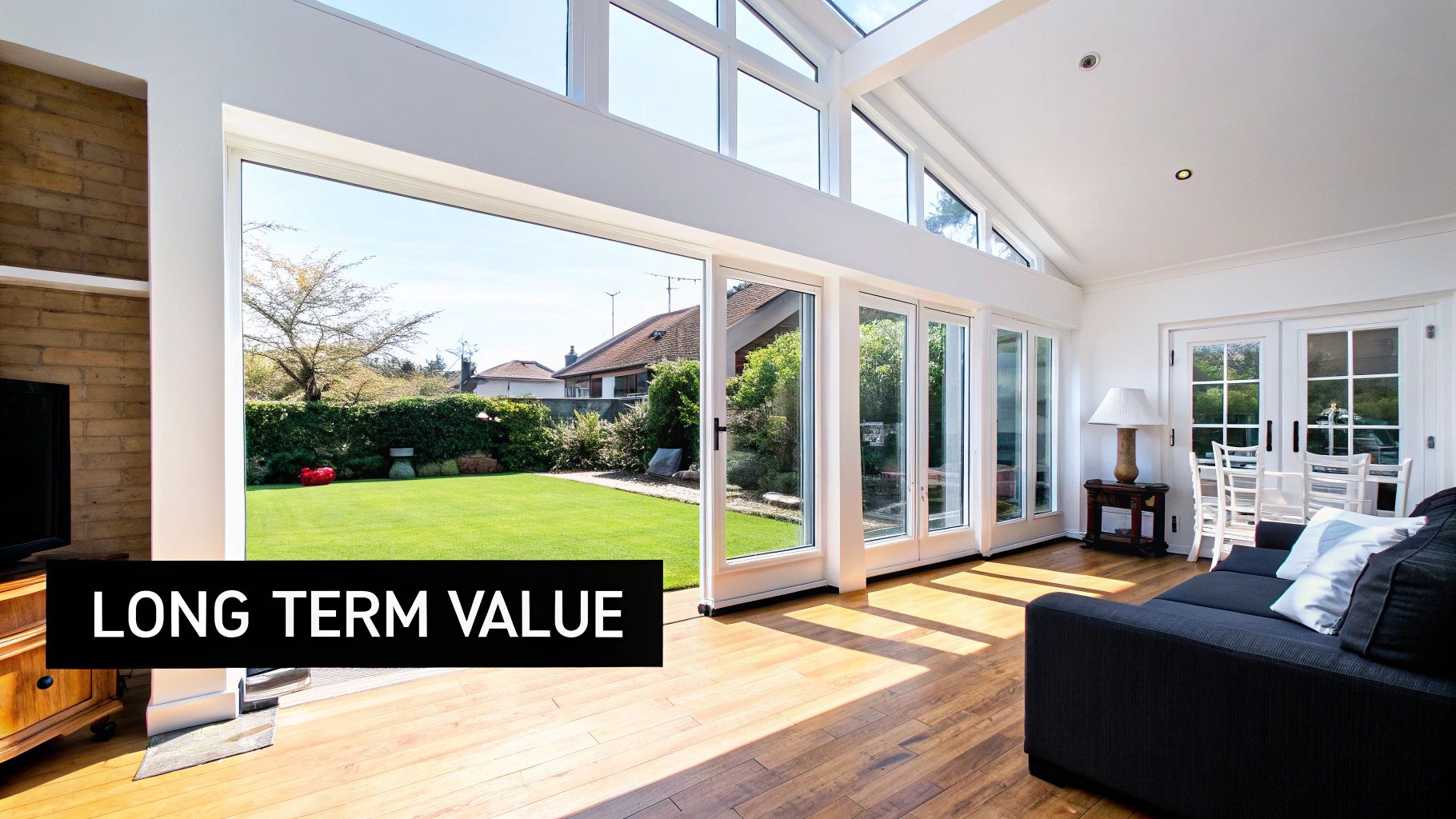
The most obvious return is financial. A thoughtfully designed and flawlessly executed extension can significantly lift your property's market value, often by far more than the initial architectural and construction costs. This isn't just about adding square footage. It’s about improving the flow, function, and feel of your entire home, making it a more desirable and valuable asset.
Beyond the Financial Return
While boosting your property's value is a huge benefit, the true worth of a skilled architect is something you experience every single day. Their expertise translates into a superior quality of finish, clever solutions to tricky problems, and a home that is genuinely a joy to live in.
A great architect delivers this value through:
Intelligent Design: They create spaces that aren't just beautiful but are perfectly tailored to your lifestyle. This could be a seamless indoor-outdoor living area for entertaining or a light-filled kitchen that becomes the real heart of your home.
Problem Solving: They expertly navigate complex planning regulations, especially in Conservation Areas or with Listed Buildings. This saves you from costly delays and the stress of potential enforcement issues down the line.
Quality Assurance: Your architect acts as your advocate during the construction phase. They ensure the build quality meets the highest standards and that the finished extension perfectly matches the original design intent.
An architect's real value lies in their ability to see the bigger picture. They balance your aspirations, your budget, and the constraints of your property to create something that is greater than the sum of its parts—a home that enriches your life for years to come.
A Partnership for a Better Home
Ultimately, the fee you pay is for a professional partnership. It’s for the peace of mind that comes from knowing every detail has been considered, every regulation has been met, and your investment is being managed by an expert committed to realising your vision.
The lasting legacy of a well-designed extension isn’t just the extra space, but the enhanced quality of life it brings. From maximising natural light to creating a better connection with your garden, the right architect delivers a home that works beautifully for you and your family. That makes their fee one of the soundest investments you can make.
Still Have Questions About Architect Fees?
Even with a clear fee proposal, it’s natural to have a few lingering questions about the costs involved. Let’s tackle some of the most common queries we hear from homeowners when they’re budgeting for an architect fee for an extension.
Getting these details straight from the outset helps ensure a smooth, transparent process from start to finish.
Are Council Planning Fees Included in My Architect's Quote?
This is a really common point of confusion, but the short answer is no. It’s important to distinguish between your architect’s professional fees and statutory fees, which are separate third-party costs paid directly to the council.
Your architect’s quote covers their expertise in preparing, detailing, and managing your Planning Permission and Building Regulations applications. Think of them as your expert guide navigating the system on your behalf. A good, transparent proposal will always list council fees as a separate item so you can budget for them accurately. Always double-check your quote to see what’s included versus what’s considered an additional cost.
Do I Have to Hire an Architect for the Entire Project?
Not always. Many architects offer a flexible service and can be brought on board for specific RIBA stages. For example, you could hire a practice just to get you through the crucial design and planning permission phases (RIBA Stages 2 & 3).
However, we almost always recommend a full architectural service, from the first sketch to the final handover. Why? Because this continuity protects the integrity of your design. Having your architect on board during construction ensures the quality, detailing, and vision are executed exactly as planned, helping to avoid expensive mistakes on-site.
While a partial service might seem cheaper upfront, a full service often delivers far greater long-term value. It safeguards the quality of your biggest investment—your home—and is the best way to ensure a high-end finish and a less stressful build.
Is VAT Included in the Architect's Quoted Fee?
This is a critical detail that can catch people out. As a professional service, architects’ fees are subject to VAT. You should always clarify whether any figures you see are quoted inclusive or exclusive of VAT.
Forgetting to factor this in can give your budget a nasty shock. A quoted fee of £20,000 + VAT, for instance, actually comes out to £24,000 at the current 20% rate. Confirming this simple point right at the start prevents any unwelcome surprises and keeps your financial planning precise.
At Harper Latter Architects, we believe in complete transparency. We provide detailed, itemised proposals that clearly explain our fees and the value we bring to every stage of your project. If you're planning a bespoke extension in South West London, we invite you to start a conversation with our team.
Discover our process and see how we can help bring your vision to life by visiting us at https://harperlatterarchitects.co.uk.

Comments