
What Is the True Rear Extension Cost in South West London

Planning a rear extension is an exciting prospect, promising to completely change how you live in your home. But let’s be honest, the first question on everyone's mind is a practical one: what’s it actually going to cost?
While national averages offer a useful starting point, they rarely paint the full picture for a high-value area like South West London. Here, the final figure is shaped by a unique blend of variables. It's not just about the size of your extension; it's about the context of your property and the quality you're aiming to achieve.
Understanding the London Premium
Building in boroughs like Richmond, Wimbledon, or Chiswick comes with what’s often called the "London premium." This isn’t just an arbitrary markup; it’s a direct reflection of real-world costs tied to working in the capital.
Higher Labour Rates: Skilled tradespeople are in constant demand here, and their wages reflect that.
Logistical Complexity: Navigating tight streets, coordinating deliveries, and even just hiring a skip in congested areas all add to a project's overheads.
Site Constraints: Many properties in South West London are terraced or have tricky access, which often demands more complex and labour-intensive building methods.
To give you a clearer idea, a single-storey rear extension cost generally starts from £2,200 to £3,500+ per square metre. A more complex double-storey project often begins at a similar rate but naturally involves a higher overall investment.
To help you visualise this, here is a table summarising the typical costs you might expect.
Estimated Rear Extension Costs in South West London
This table breaks down the average costs for both single and double-storey rear extensions in the area. It contrasts the price for a basic, well-built shell against the high-specification finishes that are more typical for bespoke architectural projects in South West London.
Extension Type | Average Size (m²) | Estimated Cost per m² (£) | Total Estimated Cost (£) |
|---|---|---|---|
Single-Storey Rear | 30 | £2,200 - £3,500+ | £66,000 - £105,000+ |
Double-Storey Rear | 60 | £2,100 - £3,400+ | £126,000 - £204,000+ |
These figures should give you a realistic baseline for budgeting. As you can see, while a double-storey extension is a larger investment, the cost per square metre can sometimes offer better value.
The following chart illustrates the typical cost escalation, clearly showing the premium you can expect for projects in South West London compared to national averages.
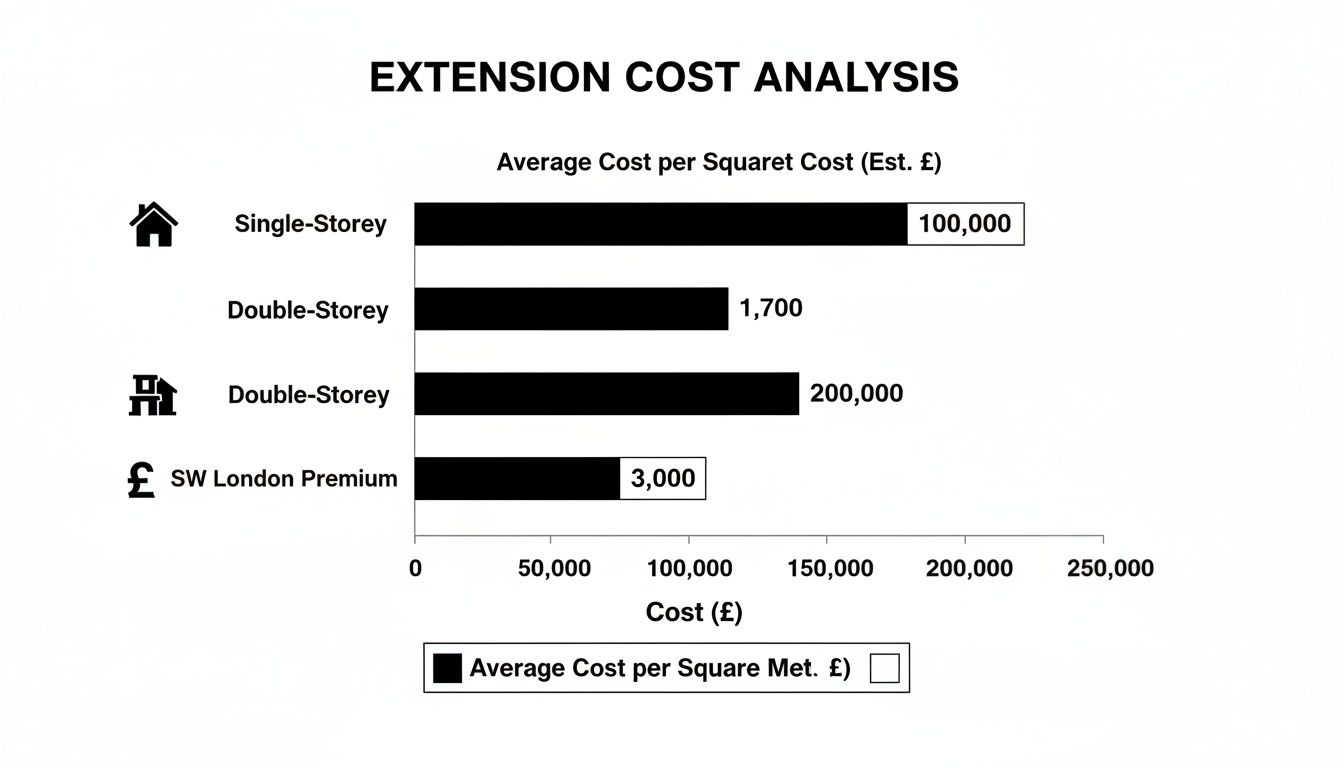
As the data shows, a double-storey extension requires a bigger budget, but the cost-per-square-metre can be more efficient – a point we’ll explore in more detail later.
Beyond a Simple Calculation
The true cost of a rear extension goes far beyond a simple price-per-square-metre figure. It’s the sum of the foundational work, structural choices, material quality, and the level of interior finish you choose. For the high-end residential projects we specialise in at Harper Latter Architects, the focus is always on bespoke design and superior craftsmanship, which naturally shapes the budget.
A common mistake is to budget only for the builder's quote. In reality, professional fees, planning applications, structural engineering, and high-specification finishes are all essential components of the total project investment.
This guide is designed to give you a clear-eyed view of all these expenses, breaking down the financial elements so you can plan with confidence. To see how these costs play out in the real world, you can explore some detailed house extension cost examples in South West London in our recent article.
We’ll move from these initial estimates to the detailed line items that form your final budget, making sure you’re fully informed every step of the way.
Calculating Your Single-Storey Extension Budget
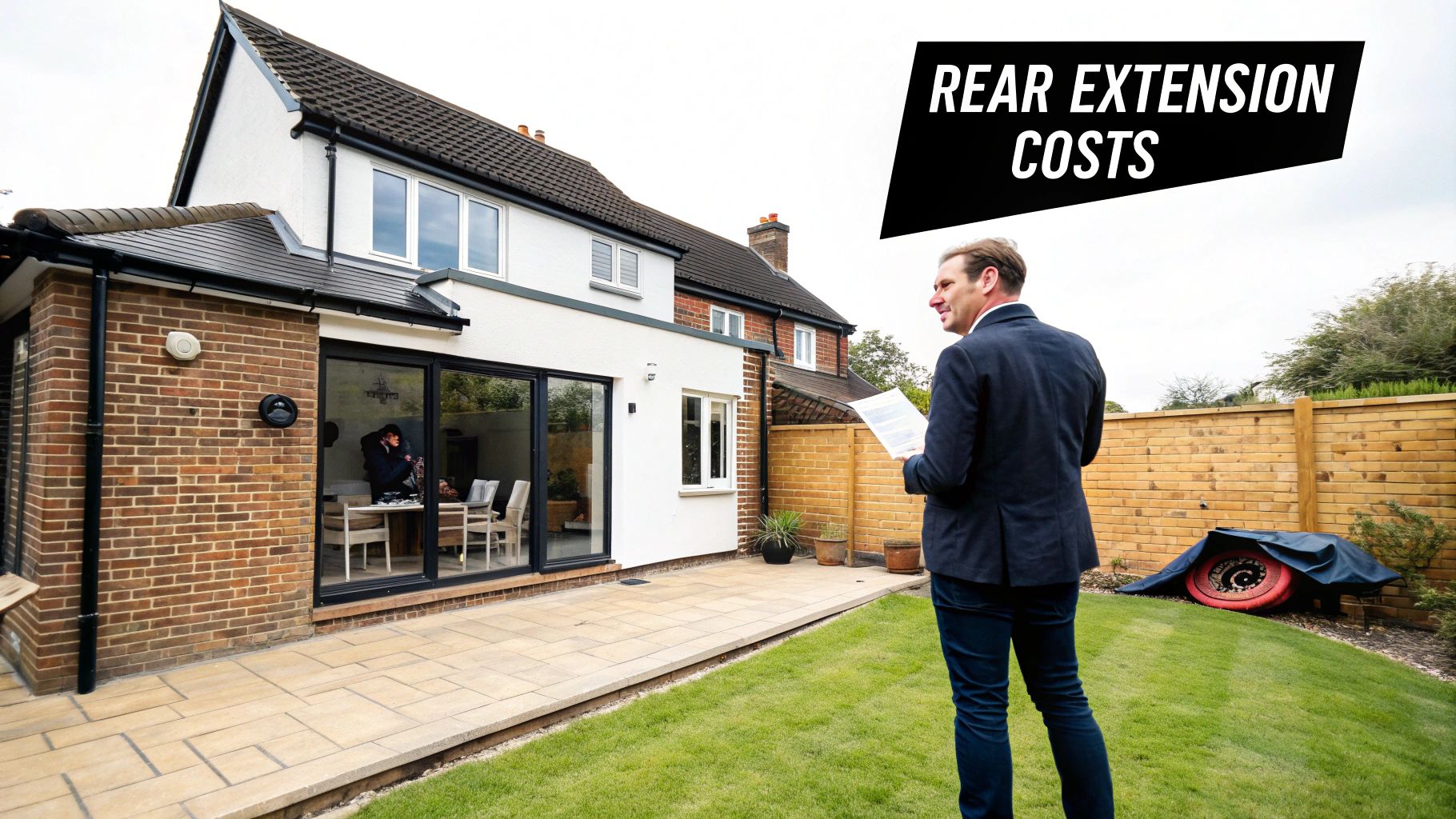
Single-storey extensions are an enduringly popular choice for homeowners, offering a fantastic way to create those light-filled, open-plan living spaces that flow seamlessly into the garden. But getting a handle on the budget requires looking beyond a simple cost-per-square-metre figure. The final number is actually a detailed sum of many different parts, each with its own price tag.
Think of your extension budget like building a bespoke car. The chassis and engine make up the basic cost, but it’s the leather seats, premium sound system, and custom paintwork that truly define the final price and feel. In the same way, your rear extension cost is built from foundational work and structural elements, but it's the choices you make on glazing, brickwork, and interior finishes that shape the end result.
Breaking Down the Core Construction Costs
The lion's share of your budget will go towards the physical construction itself. This "shell and core" phase covers several key stages, each one a significant cost contributor. Understanding these helps you see exactly where your money is going and where you can make impactful decisions.
A typical itemised breakdown will always include:
Groundworks and Foundations: The essential starting point. This involves preparing the site and pouring a stable base for the new structure to sit on.
Structural Shell: This covers the main superstructure, including the walls, flooring, and the roof structure itself.
Exterior Finishes: Key decisions here involve roofing materials—like tiles, slate, or a modern flat roof system—and the choice of brickwork to either match or contrast with your home.
Glazing: This is a major cost centre. It covers everything from large bifold or sliding doors to feature windows and skylights.
Internal First Fix: This is the behind-the-scenes work, running all the plumbing pipework and electrical wiring before the walls are plastered over.
Recent market data really highlights the financial realities, particularly in the capital. While a basic 20-30m² single-storey extension might land between £30,000 and £40,000 nationally, the London average for a 30m² build is closer to £77,957. This jump is largely down to the high cost of skilled labour, which can add £18,000-£22,000 to a project. You can explore more detailed breakdowns about rear extension costs on MyJobQuote.
How Material and Glazing Choices Impact Your Budget
Your choice of materials is where a bespoke architectural design truly comes to life, but it's also where costs can climb quickly. An experienced architect can help you navigate these decisions, striking the right balance between your aesthetic vision and your financial goals to ensure every choice adds real value.
For instance, sourcing reclaimed London stock brick to perfectly match your period property will naturally carry a premium over standard modern bricks. The final result is seamless and beautiful, but the higher material cost and the specialised labour required must be factored into your rear extension cost.
The specification of glazing is one of the most significant variables in any extension budget. The difference between standard uPVC bifold doors and bespoke, slim-profile aluminium or Crittall-style frames can easily run into tens of thousands of pounds.
This is a critical area where an architect’s expertise is invaluable. We can help you understand the thermal performance, durability, and visual impact of different glazing systems, guiding you towards an option that delivers that 'wow' factor without blowing the entire budget. This strategic approach ensures your single-storey extension not only meets but exceeds your expectations, creating a beautiful and functional space that stands the test of time.
Analysing the Investment in a Double-Storey Extension
Opting to build upwards with a double-storey rear extension is a big decision, but it’s also a surprisingly efficient investment. While the total cost is higher than for a single level, the logic isn't as simple as just doubling the price. In fact, a two-storey project often delivers better value per square metre, creating truly transformative space across both floors.
The secret to this value lies in the shared foundations. Once the groundworks, damp proof course, and concrete slab are in, you’ve already paid for the most disruptive and costly part of the build. Adding a first floor on top of this footprint is far more economical than starting a separate extension from scratch.
This efficiency makes double-storey extensions a powerful choice for homeowners looking to fundamentally change their property, especially in high-value areas like South West London where making the most of every square metre is key.
Understanding the Additional Costs Involved
Although you gain efficiencies on a per-square-metre basis, a two-storey build brings its own set of costs that need careful management. The project becomes more complex, demanding more from both the design and construction teams. An experienced architect is essential for navigating these extra layers of coordination and technical challenges.
Here are some of the key cost factors unique to a double-storey extension:
Complex Structural Engineering: A second floor needs more robust structural calculations and materials to support it, which means deeper foundations and stronger steel beams (RSJs).
Scaffolding and Site Access: The entire project will need full scaffolding for a significant amount of time. This is a major hire cost that climbs with the height and duration of the build.
First Floor Integration: Creating a seamless connection between the new upper level and your existing home is a delicate job. It involves breaking through exterior walls, creating new openings, and carefully integrating staircases and hallways so they feel natural.
Roofing and Weatherproofing: The roof structure is more complex, and it requires meticulous weatherproofing where the new and old parts of the house join.
The financial reality of these projects has shifted significantly in recent years. While you might see basic double-storey extensions starting from £40,000-£50,000 in other parts of the UK, the figures for London are substantially higher. For a 60m² build, homeowners should realistically budget for costs ranging from £136,132 to £136,525, reflecting the higher rates for complex structural work and materials in the capital. You can get a deeper insight into how steel prices and engineering fees affect build costs from PRG Extensions.
A double-storey extension isn’t just about adding rooms; it’s about reimagining your home’s entire layout and flow. This level of complexity requires meticulous planning to ensure the new spaces feel like a natural part of the original house, not a disjointed addition.
Maximising Space for Ambitious Features
The real magic of a two-storey rear extension is its potential to create ambitious, lifestyle-focused spaces. A single storey might give you a bigger kitchen-diner, but two storeys can deliver that dream space and add a luxurious master bedroom suite right above it.
This opens up possibilities that can completely change the way you live. For our clients in areas like Chiswick or Richmond, this often means creating features that elevate daily life.
Just imagine the opportunities:
A ground-floor, open-plan kitchen and living area that flows seamlessly into the garden.
A spacious master suite on the first floor, complete with an ensuite bathroom and walk-in wardrobe.
An extra bedroom or a dedicated home office, tucked away from the main living areas.
A purpose-built home gym, a quiet studio, or a playroom for the kids.
This is where an architect's role becomes indispensable. We help clients see beyond just adding square footage. We focus on creating a cohesive, intelligent design that maximises light, space, and functionality across both levels, ensuring the final rear extension cost translates into genuine, lasting value.
Uncovering the Hidden Costs That Drive Your Budget
The builder's quote for your rear extension is the headline figure, but it’s a long way from the full story. To get a true handle on the total rear extension cost, you have to look past the bricks and mortar and factor in the professional fees, council charges, and site-specific hurdles that are part and parcel of any successful project.
For an experienced architect, these aren't "hidden" costs at all—they are predictable, essential parts of a properly managed budget.
Thinking you can sidestep these is like planning a road trip but only budgeting for petrol. You'll inevitably be caught out by the motorway tolls, parking fees, and the map you should have bought from the start. A good architectural process flags these items from day one, making sure your budget is robust, realistic, and free from nasty surprises.
Site and Location Factors
The unique character of your property plays a huge part in shaping the final bill. Of course, a perfectly flat, square site with wide-open access for diggers and deliveries is the dream scenario. But here in South West London, that’s a rarity.
Several common site issues can add to your budget:
Site Access: For terraced houses with no back entrance, every bag of cement and sheet of plasterboard has to be carried through the property. That adds significant labour time and, therefore, cost.
Soil Conditions: Tricky ground conditions, like London's heavy clay soil or a high water table, often demand deeper or more engineered foundations. A proper site investigation upfront prevents unforeseen structural costs once the digging starts. It's well worth understanding the importance of a structural survey and why you need one before you commit.
Local Labour Rates: As we've mentioned, skilled trades in London are in high demand and command higher rates, which directly feeds into your overall budget.
Design Complexity and Finishes
The architectural ambition of your design is another key cost driver. A simple rectangular box will always be kinder on the wallet than an extension with complex angles, swathes of bespoke glazing, or dramatic rooflights. The choice between a traditional layout and a modern, open-plan space also has big financial implications.
Achieving that vast, light-filled open-plan space almost always requires serious structural steelwork. Once internal walls are removed, hefty beams are needed to support the floors above, and this engineering is a substantial—but necessary—cost.
Likewise, the journey from a plastered shell to a fully finished, liveable space is where a huge chunk of your budget gets spent. The final rear extension cost is heavily swayed by the quality of your interior finishes.
Your choices in these areas will ultimately define where your project lands on the cost spectrum:
Kitchen and Bathrooms: An off-the-shelf kitchen from a high-street supplier can cost a fraction of a bespoke, handcrafted design fitted with high-end appliances and stone worktops.
Joinery: Custom-built wardrobes, media units, and clever storage solutions add that premium, seamless feel but come at a higher price than freestanding furniture.
Flooring and Tiling: The difference in cost between standard laminate flooring and beautiful engineered oak or large-format porcelain tiles can easily run into thousands of pounds.
Planning and Statutory Requirements
Finally, navigating the world of planning permissions and legal agreements is a crucial phase with its own set of non-negotiable costs. These are essential for ensuring your extension is fully compliant, legal, and built to the required safety standards. For properties in conservation areas or those that are listed, these processes become even more complex and, as a result, more expensive.
It's vital to set aside a portion of your budget for these professional and statutory fees right from the start. To give you a clearer picture, the table below breaks down the typical charges you should anticipate on top of the main construction quote.
Budget Breakdown of Additional Rear Extension Costs
Fee/Charge Type | Typical Cost Range (£) | Description |
|---|---|---|
Architect Fees | 8-15% of build cost | Covers everything from initial concepts and planning drawings to technical design and site inspections. |
Structural Engineer | £1,500 - £2,500+ | Provides the essential calculations for foundations, steel beams, and any other structural elements. |
Planning Application | £206+ (in England) | The standard fee paid to your local council for submitting a full planning application. |
Party Wall Agreements | £1,000 - £3,000 per neighbour | Required if your work affects a shared wall. This covers the surveyors' fees for both you and your neighbour. |
Building Regulations | £500 - £1,500 | Fees for submitting your technical plans to Building Control and for their site inspections to ensure compliance. |
Factoring in these professional services and statutory approvals ensures your project is designed correctly, legally sound, and built to last—turning them from "hidden costs" into planned investments.
Demystifying Architect Fees and Professional Costs

It’s easy to see professional fees as just another line item in the budget. But in reality, investing in the right expertise is one of the smartest ways to control your rear extension cost, manage risks, and ensure you end up with a fantastic result. A RIBA-accredited architect does so much more than just draw up plans; they become your strategic partner, guiding the project from the first sketch to the final handover.
Their role is to turn your vision into a design that is beautiful, practical, and fully compliant with the law. This involves navigating the maze of planning permission, creating incredibly detailed technical drawings for builders to follow, and providing critical oversight during the build itself. This kind of guidance isn't a luxury—it’s the bedrock of a well-run, cost-effective project.
Understanding Architect Fee Structures
Architects generally use one of two main fee structures, and knowing the difference is vital for accurate budgeting. The most common approach is to charge a percentage of the total construction cost.
For high-end residential extensions in South West London, this usually falls somewhere between 8% and 15%. This method makes sense because it aligns the architect's fee with the overall size and complexity of your project.
As an alternative, some architects might charge a fixed fee for specific pieces of work, like preparing a set of drawings for a planning application. While this offers certainty for distinct stages, the percentage model is more typical for architects managing a project from start to finish. If you want to dive deeper into this, we've put together a detailed guide explaining how architect fees for an extension are structured.
Investing in a skilled architect is an exercise in value, not cost. Their expertise in design, planning, and project management can save you thousands in costly mistakes, contractor disputes, and inefficient use of space.
Budgeting for Other Key Consultants
Your architect isn’t the only professional you’ll need on your team. A handful of specialist consultants are essential to make sure your extension is structurally sound and legally compliant. These fees are a non-negotiable part of the overall project cost.
The main consultants you’ll need to bring on board include:
Structural Engineer: They’re the ones who provide the crucial calculations for foundations, steel beams (RSJs), and the structural integrity of the new build. Their input is absolutely vital for getting building regulations approval and typically costs between £1,500 and £2,500+.
Party Wall Surveyor: If your extension work affects a shared wall with a neighbour, you're legally required to serve a Party Wall Notice. You’ll need to cover the surveyor fees for both yourself and your neighbour, which can range from £1,000 to £3,000 for each neighbour affected.
Forgetting to budget for these professional services from day one can cause a major financial headache down the line. By factoring them into your initial rear extension cost calculations, you’re creating a much more realistic and robust financial plan. This proactive approach, led by your architect, ensures every part of your project is properly planned and professionally managed, protecting your investment and delivering a home that’s even better than you imagined.
Smart Ways to Manage Your Extension Budget
Keeping your finances in check doesn’t mean you have to compromise on the quality of your extension. Really, controlling your rear extension cost is all about smart planning, clear communication with your builder, and making the right decisions before anyone even thinks about digging a foundation. A proactive approach, with your architect as your guide, is the best way to fend off surprise costs and budget blowouts.
It all starts with making savvy choices on materials and finishes. Of course, high-end specifications are always tempting, but a good architect can show you where to spend your money for the biggest impact and where more modest, cost-effective options can create a nearly identical look and feel. This conversation is a fundamental part of the design process, making sure your vision comes to life without breaking the bank.
Get Proper Quotes and a Watertight Contract
Once your technical drawings are complete, it's time to get quotes from a few trusted contractors. The key here is to make sure every builder is quoting on a like-for-like basis, using the exact same detailed specification your architect has prepared. If you don't do this, you're not comparing apples with apples, and a quote that looks cheaper on the surface could be hiding some expensive omissions.
When you’ve picked your contractor, you absolutely must insist on a detailed, fixed-price contract. This is your project's rulebook. It should clearly set out the full scope of work, a payment schedule, and exactly how any changes will be handled. A vague contract is just asking for costs to spiral, so this formal agreement is non-negotiable for protecting your investment and keeping a firm grip on the budget.
The Power of Value Engineering
Value engineering sounds a bit technical, but it’s a systematic approach architects use to deliver the function and feel you want in the most cost-effective way possible. It’s not about cutting corners or cheaping out; it’s about clever design choices and smart material substitutions.
For instance, your architect might:
Redesign a complicated roof shape into a simpler form that cuts down on labour and material costs without sacrificing the look.
Suggest an alternative cladding material that gives you a similar appearance and durability to a much pricier option.
Work with your engineer to optimise the structural design, reducing the amount of expensive steel needed.
This all happens before construction starts, which is crucial for preventing costly on-the-fly changes once builders are on site. It's a huge part of how professional design adds real value and helps manage your rear extension cost right from the beginning.
Always Plan for the Unexpected with a Contingency Fund
No matter how carefully you plan, things can pop up—especially when you’re working with older properties in South West London. You might uncover hidden structural issues, discover tricky ground conditions, or run into unexpected drainage problems. Any of these can add to the final bill.
That’s why a contingency fund isn’t an optional extra; it’s an essential part of any responsible extension budget. We always advise our clients to set aside 10-20% of the total construction cost just for this.
Having this fund ready gives you peace of mind. It means you can tackle any surprises without having to derail the project or cut back on the quality of the finish. Think of it as your financial safety net, allowing you to navigate the build with confidence, knowing you’re prepared for whatever might be hiding behind that wall.
Common Questions About Rear Extension Costs
Navigating the financial side of a rear extension can feel like a minefield. To give you some clarity, we’ve gathered a few of the most common questions we hear from homeowners across South West London. Our goal is to provide straightforward answers to help you plan your project with confidence.
How Much Value Does a Rear Extension Add to a London Property?
A thoughtfully designed rear extension can boost your home’s market price by a significant margin, often somewhere between 10% and 20%. In a high-demand area like South West London, the return on investment is particularly strong, especially when the project creates the kind of open-plan kitchen and living space that buyers are looking for.
Of course, the final value depends on the quality of the design and finish. It's also wise to be mindful of the price ceiling for properties on your street. Even so, a high-end extension that genuinely enhances the way a home works almost always delivers a robust return.
Do I Need Planning Permission and How Much Does It Cost?
Many single-storey rear extensions can actually be built under Permitted Development rights, which means you can avoid a full planning application. However, these rights come with a strict set of rules about size, height, and how close you can build to your boundaries.
You will almost certainly need to apply for full planning permission for larger double-storey extensions, wrap-around designs, or any work on listed buildings or properties inside a conservation area. The standard fee for a homeowner planning application in England is currently £206, but you’ll also need to budget for the architectural drawings required to make the submission.
What Is the Difference Between an Architect's Estimate and a Builder's Quote?
This is a really important distinction, and getting it right is key to managing your rear extension cost.
An architect’s estimate is a professional cost projection we provide during the early design stages. It’s based on current market rates and the scope of work we're proposing, giving you an essential tool for your initial budgeting.
A builder’s quote is a firm price from a contractor to carry out the specific work detailed in the architect's technical drawings. This quote is far more detailed and will form the basis of your formal construction contract.
To get quotes you can accurately compare, it’s vital that your architect produces a comprehensive set of drawings and a specification. This ensures every builder is pricing for the exact same scope of work.
How Long Does It Take to Build a Rear Extension?
For a relatively straightforward single-storey rear extension, the on-site construction phase typically takes around 12 to 16 weeks. If you’re planning a more complex, double-storey project, you should expect it to take 20 to 26 weeks, sometimes longer.
It’s crucial to remember this timeline doesn't include everything that happens before a builder even sets foot on site. This pre-construction phase includes design development, securing planning permission (which can take 8-12 weeks alone), and finalising party wall agreements (which can sometimes take several months). It’s always a good idea to start the process with your architect at least six to nine months before you hope to begin building.
Ready to turn your vision into a beautifully designed reality? The team at Harper Latter Architects specialises in creating bespoke, high-end residential extensions across South West London. We can help you navigate every aspect of the project, from initial concept to final completion, ensuring your investment adds lasting value and transforms the way you live. To discuss your project, get in touch with us today.

Comments