

Loft Extensions London: Your Ultimate 2026 Guide
Most South West London clients come to a loft project at the same point. The house still suits the street, the school run and the way they want to live, but the rooms no longer support the life happening inside them. A growing family needs another bedroom. A couple working partly from home wants a proper suite, office or gym. Moving feels wasteful, expensive and disruptive.
The loft is usually the most underused part of the house, particularly in Wimbledon, Richmond and the wider period housing stock across this part of London. It already sits within the home's envelope, it often offers the best natural light in the building, and when it is designed properly, it can feel less like an add-on and more like the room the house was always missing.
Realising Your Home's Untapped Potential
That shift in thinking has been building for years. During the first UK national lockdown in 2020, Google searches for 'loft conversions' surged by over 200%, as London homeowners looked to maximise the homes they already had rather than move, according to research on UK loft conversion demand during the pandemic. In practice, that interest hasn't faded. It has matured. Clients now arrive with sharper briefs and higher expectations.
In high-value areas, a loft extension isn't only about squeezing in one more room. It is about correcting the balance of the whole house. A well-planned top floor can free up a first floor for children, create a private principal suite, add a calm work space away from family noise, or carve out room for the sort of amenities many clients now want, such as a dressing area, en suite, reading nook or compact fitness room.
Why premium homes need a different approach
Bespoke loft extensions london projects are not standard box-building exercises. Period houses in South West London often bring awkward roof geometry, party wall conditions, conservation sensitivities and stairs that have to be threaded through tight existing plans without damaging the character below.
The projects that work share a few traits:
They start with the whole house: The stair, the landing and the rooms below are designed together.
They respect the building's character: A Victorian terrace needs a different architectural response from a detached Arts and Crafts house.
They prioritise long-term liveability: Head height, daylight, acoustics, storage and fire strategy matter as much as the outward shape.
A successful loft extension should improve the way the entire house works, not just add square footage at roof level.
Luxury in this context is rarely about excess. It is about proportion, restraint and decisions that feel inevitable once built. That's the standard worth aiming for.
Choosing the Right Loft Extension for Your London Home
A loft extension starts with the existing roof, but the right answer is rarely obvious from outside. Two houses on the same Wimbledon street can need completely different approaches because ridge height, party wall position, chimney stacks, staircase options and planning sensitivity all change what is practical.
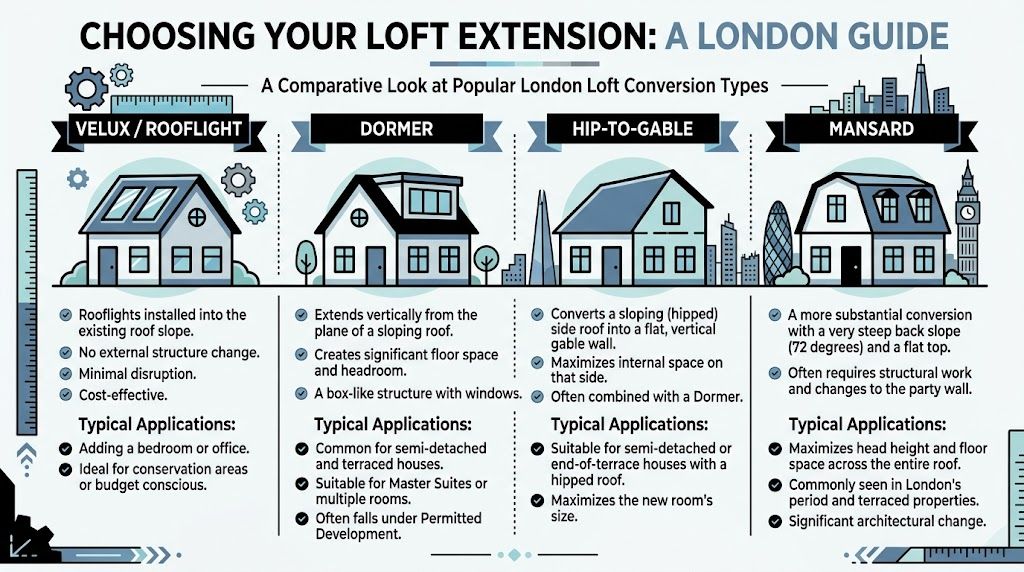
In South West London, four forms come up repeatedly: Rooflight or Velux, Dormer, Hip-to-Gable and Mansard. Some leave the roof profile largely intact. Others reshape it to create proper floor area. The trade-off is straightforward. More internal volume usually means more design, planning and construction complexity.
On higher-value homes, the decision should be driven by the room you want to live in every day. A dressing area needs usable wall length. A principal suite needs calm ceiling lines and privacy. A guest room can tolerate tighter margins. Before settling on a type, it helps to understand how planning applications are assessed in practice, particularly if the house sits in a conservation area or forms part of a carefully composed terrace.
Rooflight or Velux conversions
This is the least invasive route. The roof shape stays much as it is, and new rooflights bring in daylight and ventilation.
It works best where the loft already has generous height and width. Some detached and Arts and Crafts houses in South West London can accommodate this approach well, especially where owners want to keep the external character almost unchanged. In conservation areas, that restraint can be an advantage.
The weakness is internal usability. Sloping ceilings eat into the edges of the room, which affects wardrobes, bathrooms and bed positions. For a study, occasional bedroom or quiet retreat, that can work perfectly well. For a full principal suite in a premium property, it often falls short.
Dormer extensions
The Dormer is the workhorse of London loft extension projects for good reason. It adds full headroom where it matters and makes the top floor feel like part of the house rather than leftover roof space.
A well-designed dormer does three things particularly well:
Creates proper wall height: Easier for joinery, beds, desks and bathroom layouts.
Improves planning flexibility: Rooms can be arranged with fewer awkward corners.
Makes better use of the footprint: The space gained is usually the most practical per square metre built.
The difference between an average dormer and a strong one is proportion. On a rear elevation, oversized cheeks, heavy fascias or poorly aligned windows can make the extension feel clumsy. On a substantial period house in Richmond, Putney or Wimbledon, that level of detailing is where value is either protected or eroded. We usually treat the dormer as part of the architecture of the whole house, not as a bolt-on box at roof level.
Hip-to-Gable and Mansard approaches
A Hip-to-Gable conversion replaces the sloping side roof with a vertical gable wall. It is particularly effective on end-of-terrace, semi-detached and detached houses where the hipped roof wastes a surprising amount of usable floor area. Pairing it with a rear dormer often produces a much better staircase landing and cleaner room layout.
A Mansard is more ambitious. It rebuilds the roof form to create a steep rear face and a flatter top, which can deliver the most convincing new storey of all. Internally, mansards often give the best proportions for a principal bedroom suite, especially where clients want generous wardrobes, a larger bathroom and ceiling lines that feel settled rather than improvised.
They also attract the closest scrutiny. In conservation areas, on listed buildings, or on terraces with a strong repeated roofline, a mansard may be appropriate only if the design is extremely disciplined. The planning case, materials and external detailing need to be handled with care from the outset.
Practical rule: Choose the loft type by the quality of room it creates and the way it sits on the house. Names matter less than headroom, stair geometry, daylight and external proportion.
London Loft Extension Types Compared
Loft Type | Typical SW London Cost (2026) | Best For | Key Benefit |
|---|---|---|---|
Rooflight / Velux | Qualitative only | Homes with strong existing roof volume and sensitive exteriors | Minimal alteration to roof form |
Dormer | Qualitative only | Victorian terraces, family houses needing a full extra room | Strong balance of space gain and practicality |
Hip-to-Gable | Qualitative only | End-terrace, semi-detached and detached homes with hipped roofs | Recovers wasted side roof volume |
Mansard | Qualitative only | Houses where planning context and architecture support major roof remodelling | The most complete-feeling new storey |
The best option is usually the one that looks inevitable once built. It should feel as though the house was always meant to have that extra floor.
Navigating London's Planning and Permitted Development Rules
Many homeowners begin by asking a simple question. Can this be done under Permitted Development, or is a full planning application needed? The answer depends on the property type, its location and the amount of roof volume being added.
In London, the volume limits are clear. Under Permitted Development, terraced houses are limited to 40m³, while semi-detached and detached houses can add up to 50m³. Go beyond that and a full planning application is required, as explained in this practical guide to loft extensions and Permitted Development rules.
What Permitted Development actually means
Permitted Development is not a free-for-all. It is a route that allows certain forms of development without a full planning application, provided the scheme stays within specific limits and conditions. Those conditions affect more than just volume. They also shape how the extension sits on the roof and how it appears from outside.
For a loft extension, that means checking:
Property type: Flats and many converted buildings don't benefit from the same rights.
Planning history: Previous roof alterations count towards the total allowance.
Site constraints: Conservation areas and listed buildings can narrow or remove rights.
In streets with strong architectural rhythm, even technically permissible schemes can create trouble if they are clumsy in form or detailing. That is where architectural judgement matters as much as legal compliance.
Where South West London gets more complex
Wimbledon Village, Richmond and similar neighbourhoods often include conservation areas, heritage settings or houses with carefully preserved roofscapes. In those locations, the planning conversation becomes more nuanced. The council won't just look at volume. It will assess character, visibility, materials and the cumulative effect on the street or rear townscape.
Listed buildings sit in a different category again. They usually require a more detailed heritage-led approach, and the standard loft playbook doesn't apply.
A sensible starting point is to review the wider approval pathway before sketch designs are fixed. Harper Latter's practical guide to the UK planning permission process is useful for understanding how that sequence usually unfolds.
Why a Lawful Development Certificate is worth having
Even when a loft qualifies under Permitted Development, I advise treating the paperwork seriously. A Lawful Development Certificate creates a formal record that the work was lawful at the time of approval. That matters later, particularly when a house is sold or refinanced.
The cleanest projects are usually the ones where planning strategy is settled early. Design moves faster once the legal route is clear.
Trying to reverse-engineer compliance after a design has been priced is where delays begin. In high-end residential work, that almost always costs more than taking the planning route seriously from the start.
Understanding Building Regulations The Blueprint for Quality
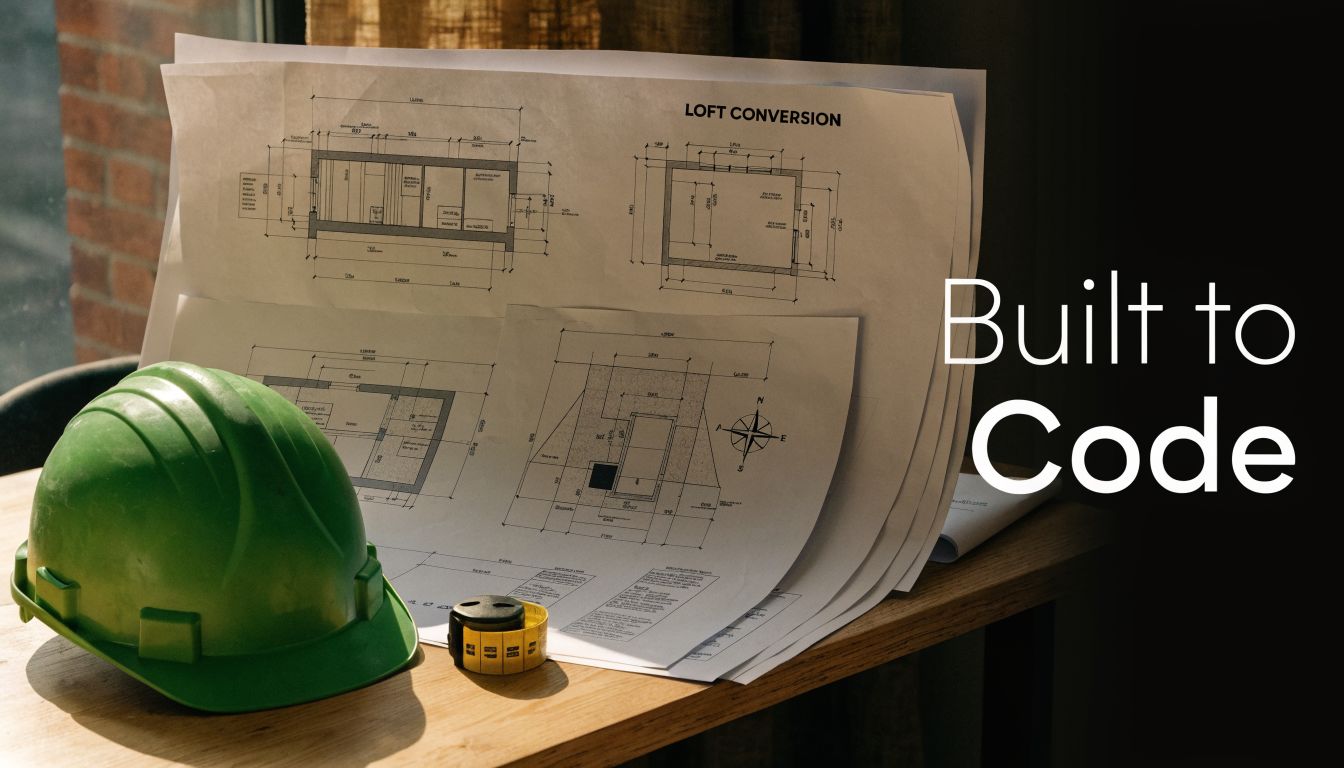
Planning permission tells you whether you may build. Building Regulations govern how the loft must be built so that it is safe, stable, comfortable and durable. Many generic guides often lack depth at this stage. In practice, this stage determines whether the finished rooms feel quiet, solid and properly integrated with the house, or temporary and compromised.
Structure and the feel underfoot
The existing ceiling joists in an older house are rarely suitable to become the floor of a new habitable room. A loft floor needs engineered structural support sized for span and load. Under Part A, for example, 47x170mm joists can span up to 3.38m for domestic loads, according to UK Building Regulations guidance for loft conversions.
That might sound technical, but the effect is easy to understand. If the structure is underspecified, the floor can feel springy, doors may drift out of alignment and finishes can crack over time. In a premium project, the aim is a floor that feels as composed as the rest of the house.
Key structural considerations include:
Joist sizing and spacing: These are based on span, dead load and live load.
Load transfer: New steel or timber members must carry loads safely into the existing structure.
Roof alterations: Dormers, hips and stair openings all affect how the roof works structurally.
Fire safety is not a paperwork exercise
Loft conversions add another storey to the escape route. That changes the fire strategy of the house. One of the most under-discussed risks in London loft work is inadequate fire safety planning, especially in heritage properties. Fire can spread within a minute, and smoke can fill rooms quickly, as highlighted in London Building Control guidance on common loft conversion issues.
That affects decisions on doors, alarms, protected escape routes, glazing and the way rooms connect to the stair. In older houses, this often needs careful integration to avoid stripping out the character that made the property worth keeping in the first place.
If the staircase looks elegant but doesn't form part of a coherent escape strategy, the design has failed at a basic level.
A short visual explainer helps demystify the technical side of compliance:
Stairs, insulation and daily comfort
The stair is usually the hardest move in the whole design. Part K governs matters such as headroom, width and riser geometry. In practical terms, the stair has to be safe to use every day and natural enough that it feels like part of the original house.
Thermal performance also matters more than many clients expect. A loft that overheats in summer and leaks heat in winter is badly designed, however attractive the finishes. Insulation, airtightness, ventilation and glazing specification need to be coordinated from the start, not patched in at tender stage.
A quality loft should deliver:
A stair that is comfortable to use
A floor with proper acoustic separation
A roof build-up that supports energy efficiency and comfort
Windows positioned for daylight, privacy and ventilation
The best loft spaces feel easy. That ease is the result of technical discipline.
Budgeting and Timelines for a High-End London Project
A family in Wimbledon often starts with a simple question. Can the loft become a proper principal suite before the new school year, and what level of investment will that take? On a high-end South West London project, the answer depends less on the label attached to the conversion and more on the house itself, the planning context, and the standard of finish expected at the end.
A rear dormer on a straightforward house sits in a very different category from a bespoke roof extension on a property in a conservation area, or a listed building where every external change needs a more careful approach. The cost difference is not cosmetic. It comes from structure, approvals, craftsmanship, and the amount of design coordination needed to make the new floor feel consistent with the rest of the house.
For a clearer explanation of how these allowances are typically built up, see our guide to London loft conversion costs.
What drives cost on a premium loft project
The shell is only the starting point. Budgets usually move upward because clients want the loft to perform like a first-class part of the home, not an isolated top floor with a bedroom and a shower room added as an afterthought.
The main cost drivers tend to be:
Structural intervention: Steelwork, trimmed openings, difficult spans and lower-floor alterations all affect labour, programme and engineering input.
Planning sensitivity: Houses in conservation areas often need a more restrained external approach, better-quality materials and a longer design period before an application is ready.
Stair integration: A stair that arrives naturally on the floor below often requires more reshaping of the existing house than clients expect.
Bathrooms and services: High-spec bathrooms, boosted water pressure, underfloor heating and air conditioning all add cost quickly.
Bespoke joinery: Wardrobes, dressing areas, window seats and built-in storage are often what make awkward roof geometry useful.
Finish level: Timber floorboards, natural stone, specialist ironmongery, decorative lighting and carefully matched skirtings and doors change the character of the space and the budget with it.
In premium houses, the interior fit-out is often where the difference is felt most. Two lofts can share the same square footage and roof form, yet land in very different budget ranges because one is finished as a basic extra storey and the other is detailed as part of a whole-house upgrade.
A sensible way to set the budget
I advise clients to separate the budget into three parts.
First, the structural and weatherproof package. Second, the technical requirements needed to secure approvals and build properly. Third, the interior layer, where the project becomes customized for the way the household lives. That simple split helps clients see where money is fixed, where there is flexibility, and where late changes usually become expensive.
Contingency matters as well. Older South West London houses can conceal uneven structure, awkward chimney arrangements, tired services and party wall complications that do not fully reveal themselves until technical design or early site work.
How long a high-end loft extension usually takes
The construction period is only one part of the programme. Design development, planning, technical coordination and contractor procurement often take longer than clients expect, especially on houses with heritage constraints or where the brief includes bespoke interior work.
A typical sequence runs as follows:
Feasibility and survey The existing roof, head height, stair location and planning position are assessed.
Concept design The layout is tested against the brief, and the effect on the floors below is resolved properly.
Planning or lawful development application The route is confirmed and the submission is prepared to suit the property and its setting.
Technical design Structure, drainage, joinery, bathroom layouts, lighting, insulation and builder's information are coordinated in enough detail to price and build accurately.
Tender and contractor selection Contractors price the same information, which gives a more reliable comparison and reduces disputes later.
Construction and completion Site work begins once the project is sufficiently resolved, not while major design decisions are still outstanding.
Projects run better when decisions are made in the right order. Speed at the front end often creates delay on site.
On higher-value homes, the shortest programme is rarely the best one. A measured pre-construction phase usually protects both cost and quality, particularly where the loft has to sit comfortably within a well-finished period house rather than only add floor area.
Assembling Your Team and Managing The Build
A loft extension involves more people than most homeowners expect. Architect, structural engineer, contractor, Building Control inspector and, in many London streets, a party wall surveyor all have a role. The smoother projects are not the ones with the smallest teams. They are the ones where each person knows what they are responsible for.
Why architect-led projects usually hold quality better
A loft can look deceptively simple from outside. Inside, it requires planning judgement, structural coordination, stair design, fire strategy and detailed interior thinking. That is why architect-led projects tend to protect quality better on complex houses, especially where heritage, conservation or premium interior expectations are involved.
An architect should do more than produce a planning drawing. The role is to:
Test whether the brief suits the building
Coordinate consultants and technical information
Protect the design intent during procurement and site decisions
Resolve awkward junctions before they become site improvisations
For homeowners weighing up routes, Harper Latter's overview of architects for loft conversion projects in London outlines what that service can involve. It is one model among several, but it reflects the fact that lofts become far more exacting once the house is architecturally sensitive or the finish level is high.
Choosing the right contractor
The contractor matters just as much as the drawings. I would look for a builder with direct experience of roof extensions in occupied London homes, not just general renovation work. Access is tight, neighbour relations matter, and small errors in sequencing can create unnecessary disruption.
When interviewing contractors, pay attention to how they talk about:
Temporary weather protection
Daily site access through or around the house
Dust control and protection of existing finishes
Joinery and finish quality, not only structural work
A vague answer usually means a vague site process.
The Party Wall Act and neighbour relations
On terraced and semi-detached houses, the Party Wall etc. Act 1996 often comes into play. Homeowners sometimes treat this as a nuisance. That is the wrong mindset. It is a framework for recording condition, notifying adjoining owners and reducing the chance of disputes.
Handled properly, it protects everyone. Handled late, it can delay the programme and sour relationships before work starts.
The easiest neighbour conversations happen before scaffolding arrives, not after the first drill goes through a shared wall.
This matters even more in dense South West London streets, where good projects depend on careful logistics as much as good design.
Project Snapshots Inspiring London Loft Transformations
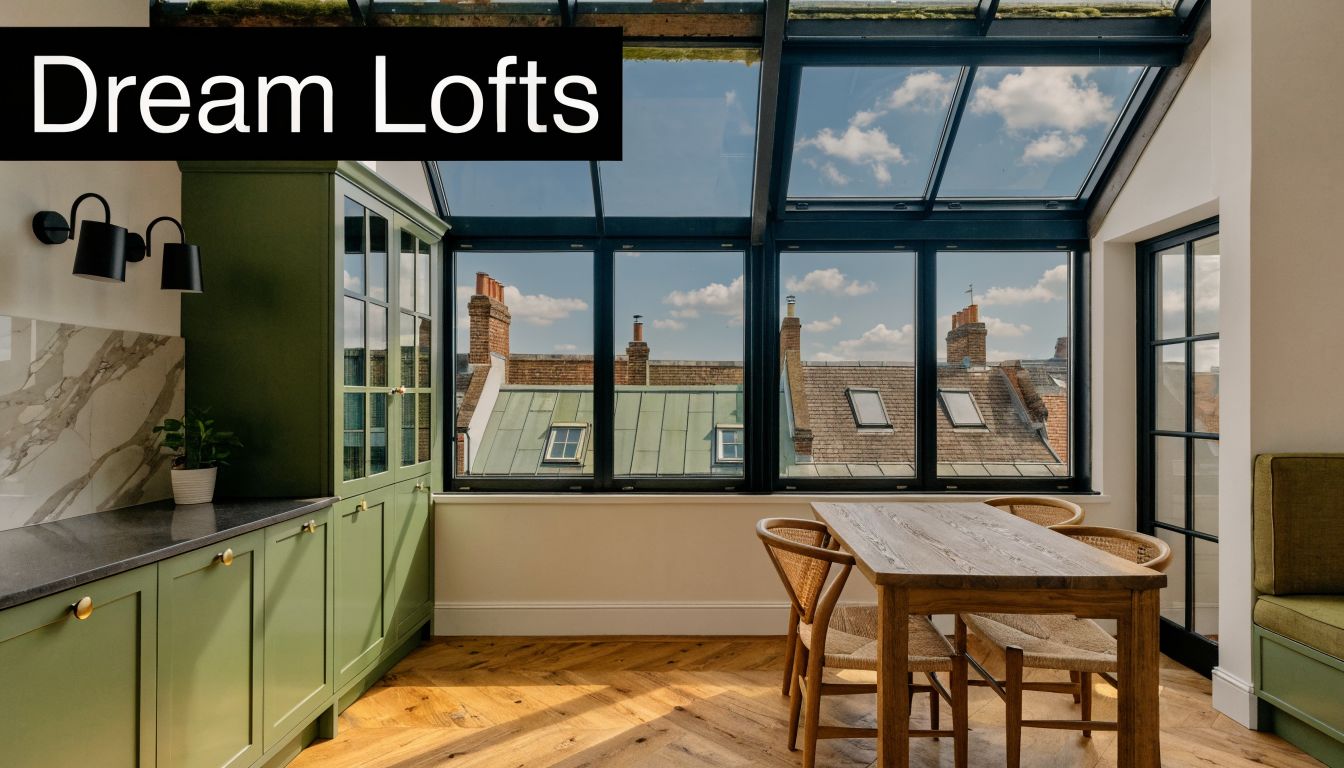
Abstract advice only gets you so far. The value of a loft project becomes clear when you look at how different households use the space once it is finished.
A Wimbledon terrace needing breathing room
A family in a Victorian terrace had reached the usual pinch point. Children were sharing, parents were working partly from home, and the first floor had become overburdened. The loft's role was not just to add another bedroom. It was to rebalance the whole plan.
The right answer was a rear dormer with a carefully threaded stair above the existing flight. That allowed a calm principal suite at the top, complete with fitted storage tucked into the lower edges of the roof. The improvement downstairs was as important as the new room itself. The former principal bedroom became a generous child's room, and the family stopped feeling that every square metre was under strain.
A Richmond house shaped by awkward roof geometry
Another project involved a detached house with a hipped roof that was wasting valuable side volume. The brief included a guest room, shower room and a study that would still feel pleasant to use on a daily basis.
A hip-to-gable move enabled the plan. Without it, the study would have sat in leftover space with poor headroom. With it, the new floor could take a proper sequence of rooms rather than a collection of compromises. The clients cared about restraint, so the interior palette stayed quiet. Oak joinery, soft wall finishes and well-positioned rooflights carried the scheme.
A heritage-minded approach in a conservation setting
In a more sensitive setting, the main challenge was not space but character. The owners wanted a top-floor retreat, but they were wary of damaging the house's historic feel. The answer was to design the loft as part of a wider refurbishment language rather than a standalone intervention.
The staircase used proportions and detailing that felt consistent with the house. Storage was built into wall planes rather than added as bulky furniture. The result did not announce itself as a loft conversion. It felt like a natural upper floor.
That is usually the strongest outcome. The architecture does its work unobtrusively.
Frequently Asked Questions and Your Next Step
Can you live in the house during the build
Often, yes. Many families do. The practical answer depends on access, the extent of internal alterations and how early the new stair must be opened through the existing floors. The less resolved the design and sequencing are before site start, the harder it becomes to live around the work.
How much headroom do you really need
As a starting point, feasibility usually hinges on a minimum 2.2m headroom from joist to apex, as noted in the verified loft conversion guidance cited earlier in this article. That doesn't mean every part of the room needs to be full height. It means the loft has enough basic volume to be worth testing properly. A measured survey tells you quickly whether the space can work.
Is a dormer always the right answer in London
No. It is often the most practical answer, but not always the most elegant one. Some houses already have enough roof volume for a lighter-touch conversion. Others need a hip-to-gable or a more carefully argued planning approach. The right choice comes from the house, not from trend.
What tends to make a loft feel high-end
Usually, it is not one expensive gesture. It is the combination of proportion, daylight, joinery, acoustic comfort and a stair that feels properly embedded in the home. Premium lofts also avoid the common mistakes. Overcomplicated roof forms, oversized dormer cheeks, poor bathroom planning and arbitrary window placement all make a new room feel cheaper than it was.
When should you bring in an architect
Early. Before layout assumptions harden, before builders are asked for rough prices, and before the planning route is guessed at. Early input saves redesign later and tends to produce a calmer project overall.
A loft extension can be one of the most intelligent changes you make to a London house. It adds room where the home already has latent value, and when designed with care, it can improve far more than the top floor. It can restore order to the entire plan.
If you're considering a bespoke loft extension in South West London, Harper Latter Architects can discuss the property, planning context and spatial options in an initial conversation, then guide the project from concept through construction with a coordinated residential design process.