
If you're planning any kind of construction work, one question often comes up: "When do the CDM regulations actually apply to my project?" The short answer is, almost always. The Construction (Design and Management) Regulations 2015 are designed to cover nearly all building work in Great Britain, from a simple kitchen knock-through to a major new build.
The real question isn’t if they apply, but how their requirements scale with the size and complexity of your job.
Decoding Your Project and CDM Duties
It’s best to think of CDM not as a single, rigid rulebook, but as an adaptable framework for managing health and safety. Even on the smallest projects, basic duties are in place to make sure the work is properly planned and managed. This is all about making sure risks are considered right from the start, protecting everyone involved – from the architects and builders to the people who will eventually live in the home.
The regulations push health and safety to the forefront of project management, rather than letting it be an afterthought. This proactive mindset is crucial, whether you’re refurbishing a single bathroom or embarking on a complex basement conversion.
When the Duties Escalate
The level of legal responsibility really ramps up when a project becomes ‘notifiable’ to the Health and Safety Executive (HSE). This notification is a formal line in the sand, signalling that a project is of a significant scale and needs much stricter oversight. Understanding this threshold is vital for any client planning substantial work on their home.
So, what triggers this? A project becomes notifiable if the construction work is scheduled to:
Last longer than 30 working days AND have more than 20 workers on site at the same time at any point.
Exceed 500 person-days of construction work in total (for example, 10 people working for 50 days).
For a quick reference, here’s a simple table to help you see where your project might fall.
Quick Guide to CDM Application Triggers
Project Characteristic | Threshold | Resulting CDM Duties |
|---|---|---|
Any construction work (e.g., small internal alteration with one contractor) | Any duration or number of workers. | Basic client duties apply (appoint competent people, provide information). |
Work involving more than one contractor (e.g., a plumber and an electrician on site) | Any duration or number of workers. | Appoint a Principal Designer and Principal Contractor to coordinate health and safety. |
Larger, more complex projects (e.g., a major extension or new build) | Lasts over 30 working days with 20+ workers simultaneously, OR exceeds 500 person-days. | All of the above, plus the client must formally notify the HSE before work starts on site. |
This table provides a snapshot, but it’s always best to get professional advice to ensure you’re meeting your specific legal obligations.
It's easy to think of CDM in a silo, but it’s actually part of a bigger picture. It works hand-in-hand with other critical rules. Our guide to building regulations compliance explains how these different legal frameworks fit together.
What This Means for You
Ultimately, if you’re commissioning construction work, you have responsibilities under CDM 2015. For smaller, non-notifiable projects, the duties are fairly straightforward and centre on appointing the right people for the job.
But as your project grows and crosses that notifiable threshold, your obligations expand. You’ll need to make formal appointments and send off official notifications to the HSE, ensuring a robust safety structure is locked in from day one.
What Counts As Construction Work Under CDM
When you hear the word “construction,” it’s easy to picture cranes on a skyline or a team of builders laying foundations for a new housing estate. But in the eyes of the Health and Safety Executive (HSE), the term construction work is far, far broader. Getting to grips with this definition is the first step in knowing whether the CDM regulations apply to your project.
The rules don’t just cover grand new builds. They extend to a huge range of alteration, renovation, and even repair jobs. In short, if your project involves building, altering, or dismantling a structure, it almost certainly falls under the CDM umbrella. This wide net is cast to make sure safety is front and centre on nearly every job, no matter its size.
It’s a common myth that CDM is just for large commercial sites. The reality is, the definition is so comprehensive it pulls in many high-end residential projects—from complex basement conversions and loft extensions to significant internal refurbishments.
The Broad Spectrum of Construction Activities
So, what does this look like in practice? To get a clearer idea, it helps to see what the HSE actually classes as construction. It’s not just about bricks and mortar; it’s about any work that changes the fabric or fixed services of a building.
The official definition of construction work includes things like:
Building and assembly: The construction, alteration, or conversion of any building or structure.
Repair and maintenance: This covers redecoration and upkeep, but also cleaning that involves high-pressure water, abrasives, or corrosive/toxic substances.
Demolition or dismantling: Taking a structure down or carefully removing parts of it.
Installation of services: Any work on the mechanical, electrical, gas, or telecommunications systems fixed within the structure.
This means that installing a new bespoke kitchen, rewiring your home, or even carrying out extensive re-plastering and decorating are all officially considered construction.
Drawing the Line: Practical Examples
Where, then, is the boundary? It really boils down to whether the work involves altering the building’s structure or its fixed services. Assembling a piece of flat-pack furniture, for instance, isn’t construction work because it doesn’t become part of the building itself.
On the other hand, installing custom-built joinery, like a set of fitted wardrobes or a media unit, is construction work because it’s integrated into the fabric of the home. Similarly, while hanging a picture frame doesn’t count, preparing a wall for a heavy art installation that requires new structural support certainly would.
Recognising that your project involves ‘construction work’ is the foundational step. It’s the trigger that confirms CDM 2015 applies, setting the stage for you to understand your duties as a client and ensure your project is safe and compliant right from the start.
Crossing the Line to a Notifiable Project
While CDM regulations touch on almost every construction project, there's a critical line that, once crossed, seriously steps up your legal responsibilities. This is the threshold for what’s known as a notifiable project—a formal classification that means you must alert the Health and Safety Executive (HSE) before any work even thinks about starting on site.
Getting this right is absolutely crucial. Failing to notify the HSE isn't just a simple admin slip-up; it's a legal breach that can bring your project to a grinding halt and lead to serious penalties.
The Two Triggers for Notification
So, what pushes a project over this line? The HSE has set out two very clear triggers. If your project ticks either of these boxes, you have a legal duty to notify them.
The project becomes notifiable if the construction work is planned to:
Last longer than 30 working days AND have more than 20 workers on site at the same time at any point.
Exceed 500 person-days of construction work in total.
The first trigger is pretty straightforward. The second one, however—the concept of 'person-days'—often trips people up.
Understanding Person-Days
Think of 'person-days' as the total labour budget for your project's construction phase. One person working for one day uses up one 'person-day'. Simple.
The 500 person-day threshold can be reached in all sorts of ways. A team of 10 builders working for 50 days gets you there. But so does a smaller, more specialist team of five people working for 100 days. This calculation is especially important on complex residential projects like basement extensions or major refurbishments, where the timeline might be long even if you don't have a huge number of workers on site each day.
This flowchart gives you a simple visual for that first big decision: does CDM apply at all?
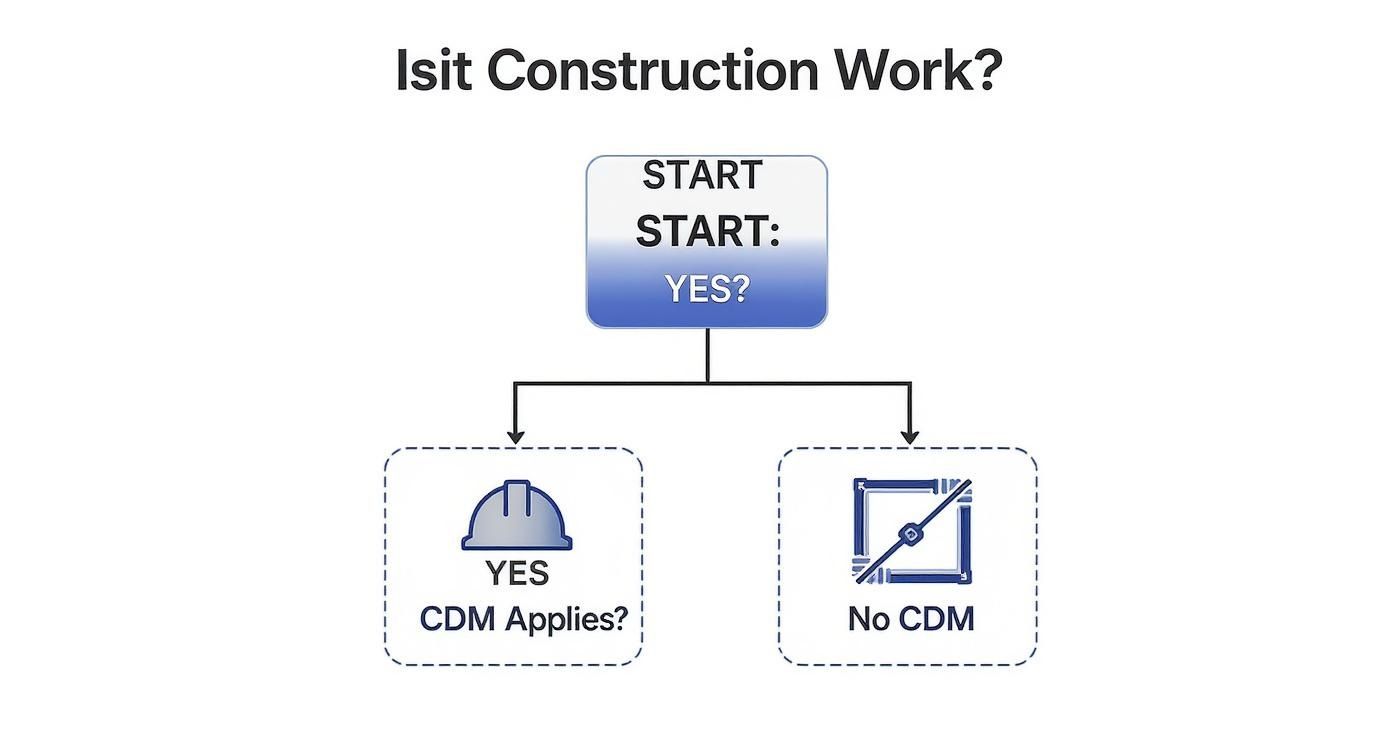
The key takeaway is this: once you've established your project is 'construction work', the next step is to figure out its scale and duration to understand which specific duties kick in.
Notifiable vs Non-Notifiable Projects: A Duty Comparison
Crossing into notifiable territory adds some significant weight to your shoulders as the client. It’s not just about filling out a form; it demands a more formal, structured approach to health and safety right from the get-go. The roles of key players like the Principal Designer and Principal Contractor suddenly become much more critical.
This is where your choice of professional team is paramount. The expertise of both your architect and structural engineer is vital for navigating this increased complexity. If you're wondering how those roles differ, you can learn more about the structural engineer vs architect on our blog.
The ultimate responsibility for notifying the HSE rests with you, the client. While you can (and should) have your Principal Designer or architect manage the process, the legal duty is yours to make sure it’s done, and done on time.
The table below breaks down the main differences in duties between the two project types.
CDM Duty or Requirement | Applies to Non-Notifiable Projects | Applies to Notifiable Projects |
|---|---|---|
Client Duties | Yes, you must appoint competent people and ensure sufficient time and resources are allocated. | Yes, all standard duties apply but with greater emphasis on formal appointments and management. |
Appoint Principal Designer | Yes, if there is more than one contractor working on the project at any time. | Yes, mandatory. |
Appoint Principal Contractor | Yes, if there is more than one contractor working on the project at any time. | Yes, mandatory. |
Notify the HSE | No, formal notification is not required. | Yes, mandatory. The client must submit an F10 form before the construction phase begins. |
Construction Phase Plan | Yes, the Principal Contractor (or sole contractor) must create one before work starts. | Yes, mandatory and typically more detailed to reflect the project's scale and risks. |
Understanding these distinctions ensures you are prepared for the level of oversight your project legally demands. It’s about protecting your investment, but more importantly, it’s about protecting everyone involved.
Domestic vs Commercial Projects: A Tale of Two Clients
https://www.youtube.com/embed/UHI1UcDQe04
When it comes to construction work, your legal role as the client commissioning the project changes dramatically based on one simple question: is the work for your own home, or is it for a business?
The Construction (Design and Management) Regulations 2015 draw a very clear line in the sand between domestic clients and commercial clients. Understanding which side of that line you fall on directly shapes your level of responsibility and legal liability from day one.
If you’re a domestic client planning work on your own home (or a family member's, as long as it's not connected to a business), there’s good news. The regulations rightly recognise that you aren’t a construction expert. Because of this, many of your legal duties under CDM are automatically passed on to the professionals you hire.
This transfer of responsibility is a cornerstone of the CDM framework and a key reason it has been so effective. Since CDM 2015 was introduced, the UK has seen a steady fall in fatal and major injuries on construction sites, dropping by around 15% between 2015 and 2022. You can find out more about these UK economic and safety trends here.
The Domestic Client: Your Responsibilities
Even with most duties transferred, you're not entirely off the hook. As a domestic client, you hold onto a couple of vital responsibilities that lay the foundation for a safe and well-run project.
Your key duties are to:
Appoint a Principal Designer: If your project involves more than one contractor (think a builder and an electrician), you must appoint a designer with control over the pre-construction phase to take on this formal role.
Appoint a Principal Contractor: In the same way, you need to appoint one contractor to be in overall control during the construction phase itself.
For many high-end residential projects, the architect you've hired will often take on the role of Principal Designer. If you don't make these appointments in writing, the law automatically deems the lead designer and contractor to be in these roles. However, a formal, written appointment is always best practice for absolute clarity.
The Commercial Client: A Different Story
For commercial clients—that is, any individual or organisation having work done as part of a business—the story is completely different. Your duties are far more extensive, and critically, they cannot be automatically transferred away.
As a commercial client, you are fully and directly responsible for making suitable arrangements to manage the project from start to finish. This means you have to actively ensure that:
The right duty holders are appointed.
Enough time and resources are allocated for every stage of the project.
All relevant information is prepared and passed on to other duty holders.
The Principal Designer and Principal Contractor are carrying out their duties properly.
Welfare facilities (like toilets and washbasins) are provided on site from the very start.
Grasping this fundamental distinction is the first and most important step in managing your legal obligations correctly. It sets your project on the right path, ensuring a safe, compliant, and ultimately successful conclusion.
Applying CDM to Real-World Residential Projects
Theoretical rules are one thing, but seeing how CDM regulations play out in the real world is where it all starts to click. Let's move beyond the abstract and walk through two realistic scenarios for high-end residential projects to see how these duties come to life.
These examples translate the legal framework into tangible actions, helping you see how the rules would affect your own ambitious home project.
Example 1: The Chelsea Basement Extension
Imagine a project to create a new basement level beneath a terraced house in Chelsea. The plan is ambitious: a home cinema, a gym, and a dedicated wine cellar. The construction phase is estimated to last 40 working days and will involve a peak of 25 workers on site at once, from groundworkers and steel installers to electricians and specialist fit-out teams.
Straight away, we can see this project is notifiable. It crosses both thresholds: it’s over 30 working days and has more than 20 workers on site simultaneously.
This immediately triggers several key actions for you, the homeowner (the domestic client):
Formal Appointments: You must appoint a Principal Designer (very likely your architect) and a Principal Contractor in writing to manage and coordinate health and safety from start to finish.
HSE Notification: An F10 form must be completed and submitted to the HSE before any construction work can begin.
Detailed Planning: The Principal Contractor is now required to develop a comprehensive Construction Phase Plan. For a project like this, the plan would need to address very specific, high-risk activities like managing the temporary works for the excavation, ensuring the structural stability of your home and your neighbours’ properties, and controlling dust and noise.
Example 2: The Cotswolds Listed Building Refurbishment
Now, let's consider a major refurbishment of a historic Grade II listed cottage in the Cotswolds. The project involves sensitive structural repairs, a new rear extension, and a complete internal fit-out. The work is scheduled to take 150 days but will only ever have a small, specialist team of four craftspeople on site at any one time.
This project is also notifiable, but for a completely different reason. While it never has more than 20 workers on site, it easily exceeds the 500 person-day threshold (4 workers x 150 days = 600 person-days).
Even with a small, dedicated team, a long project duration can make it notifiable. It’s a common misconception that you need a large crew for the higher-level duties to apply; the total labour involved is just as important.
The client's duties here are similar to the Chelsea project, but the specific risks identified by the Principal Designer will be very different. The key concerns would likely include:
Asbestos: The risk of discovering asbestos-containing materials (ACMs) in a historic property is always high. A full survey and management plan would be an essential piece of pre-construction information.
Structural Integrity: Working with old, and sometimes fragile, structures requires incredibly careful planning to prevent collapses during alterations.
Handling Hazardous Materials: Traditional building materials, such as old lead paint, need to be identified and managed safely by the construction team.
These scenarios show how the principles of CDM are applied not as a tick-box exercise, but as a framework for tackling real-world challenges. For more inspiration on projects of this nature, you can explore our portfolio of high-end refurbishments and extensions.
Common CDM Myths You Need to Ignore
There's a surprising amount of misinformation floating around about the CDM regulations. Acting on flawed advice isn't just a minor mistake; it can lead to serious compliance headaches and throw your project timelines completely off course. Let's tackle these myths head-on so you know exactly where you stand.
One of the most dangerous myths is that CDM is only for massive commercial building sites. As we’ve seen, the regulations apply to almost all construction work, no matter the size. A high-end basement conversion in Chelsea is just as much a construction project in the eyes of the law as a new skyscraper in the City. Scale is not the deciding factor.
Another common misconception is that certain small jobs are simply ‘exempt’. While it’s true that a tiny, short-duration task might have fewer duties attached, almost no construction work is truly free from the core principles of health and safety.
Shifting Responsibility Is Not an Option
This one is a particularly risky belief for clients: “My architect is handling all that, so I’m off the hook.” It’s a nice thought, but it’s wrong. While your Principal Designer and Principal Contractor manage the day-to-day coordination, certain key duties legally remain with you.
These core responsibilities are yours alone:
Making suitable project management arrangements from the outset.
Formally appointing competent duty holders (like the PD and PC).
Ensuring those you appoint are actually doing their jobs properly.
You simply cannot delegate away your ultimate responsibility for the project’s safety framework.
Thinking you’re absolved of all duties just because you've hired professionals is a critical error. The regulations are designed to ensure the client, as the one who starts the project, remains accountable for establishing a safe foundation from day one.
Finally, there’s the idea that CDM only applies to the main build, not to later stages like interior fit-outs or landscaping. This is incorrect. If these activities involve construction work—like installing complex joinery, building a garden studio, or carrying out hard landscaping—they fall squarely under CDM.
By seeing past these common fallacies, you can steer clear of compliance issues that arise from bad assumptions. This clarity gives you the power to ask the right questions and make sure your project is managed correctly from start to finish.
Common Questions About CDM
When you're planning a high-end residential project, the practicalities of CDM regulations can throw up a lot of questions. Let's walk through some of the most common queries we hear from our clients.
Does Replacing a Kitchen or Bathroom Fall Under CDM?
Yes, almost certainly. Any project involving assembly, installation, and refurbishment is officially classed as 'construction work', which means fitting a new kitchen or bathroom falls squarely under the CDM regulations.
While a project of this scale is highly unlikely to need notifying to the HSE, your duties as a client still stand. For a domestic project, these health and safety responsibilities are automatically passed to your main contractor, or the principal contractor if you're bringing in multiple trades.
What Happens if We Don’t Notify the HSE?
Failing to notify a project that meets the thresholds is a serious breach of the regulations. The Health and Safety Executive (HSE) has the power to take immediate enforcement action, which can have significant consequences.
This could be anything from issuing an order to stop all work on site right through to prosecution. As the client, you could face hefty fines and, of course, very costly delays to your project's timeline.
It's worth remembering that the legal duty to notify the HSE ultimately rests with you, the client. It's a fundamental requirement that you must ensure is handled correctly before any construction work begins.
Do CDM Regulations Apply to an Interior Designer?
They absolutely do. If you hire a professional to prepare or modify designs for any part of a construction project, they are formally considered a 'designer' under CDM.
This gives them a legal duty to eliminate, reduce, or control any foreseeable health and safety risks through their design choices. They must think about the safety of everyone who will build, use, clean, maintain, and one day even demolish what they have designed.
Is Painting and Decorating Considered Construction Work?
Yes, it is. Painting and decorating officially fall under the category of 'redecoration' and are therefore defined as construction work by CDM 2015.
A simple redecoration of a single room is very unlikely to be notifiable. However, the regulations still technically apply, and there's still a duty to make sure the work is planned and managed safely.
Navigating CDM regulations is a critical part of any successful high-end residential project. At Harper Latter Architects, we integrate these responsibilities into our process, ensuring your project is not only beautifully designed but also fully compliant from concept to completion. Discover how we can guide you by visiting our website.
← Journal