
Understanding the cost of converting a cellar: A Practical Guide

So, you’re thinking about converting your cellar. It’s a fantastic way to unlock extra square footage and boost your home’s value, especially in tight-knit areas like South West London where every inch counts. But before you start dreaming of a new home cinema or gym, let’s talk numbers.
Your Quick Guide to Cellar Conversion Costs
The truth is, there’s no single price tag for a cellar conversion. The final cost hinges entirely on what you’re starting with and what you want to achieve. A simple refresh is one thing; digging out a brand-new level beneath your home is something else entirely.
On average, you can expect the cost of converting a cellar in the UK to be around £1,600 per square metre. However, this is just a ballpark figure. A basic refurbishment might come in closer to £1,000 per m², while a complex project that involves major excavation and structural changes could easily exceed £2,200 per m².
Understanding the Investment Levels
Converting an existing cellar into a proper, habitable room is a smart move. You gain a whole new floor without sacrificing any of that precious garden space. For a project that includes the essentials—like robust waterproofing, structural support, and all the final finishes—that £1,600 per square metre figure is a solid starting point.
Industry data, including insights from resources like Checkatrade.com, confirms this range, highlighting how much the property’s condition and your specific plans can influence the final bill.
To give you a clearer idea, here’s a quick breakdown of what you might expect to pay depending on the scale of your project.
Estimated Cellar Conversion Costs at a Glance
This table offers a snapshot of the potential costs, helping you align your budget with the scope of work you have in mind. Remember, these are estimates and will vary based on your home and chosen specifications.
Project Scope | Average Cost per m² (excl. VAT) | Estimated Total for 40m² Project |
|---|---|---|
Basic Refurbishment (Existing cellar, no excavation) | £1,000 – £1,400 | £40,000 – £56,000 |
Standard Conversion (Some structural work, full tanking) | £1,400 – £1,800 | £56,000 – £72,000 |
Full Excavation (Digging deeper/wider, underpinning) | £1,800 – £2,200+ | £72,000 – £88,000+ |
As you can see, the jump from a simple update to a full-blown excavation is significant. The more earth you move and the more structural work required, the higher the investment.
A cellar conversion is a unique opportunity to create a space that’s perfectly tailored to your lifestyle—whether that’s a quiet home office, a state-of-the-art media room, or a much-needed extra bedroom. The key is to balance your vision with a realistic grasp of the costs from day one.
Think of this as your starting point. In the sections that follow, we’ll dig deeper into what really drives these costs, from the structural nuts and bolts to the luxurious final touches that will make the space truly yours.
Deconstructing the Costs: A Detailed Breakdown
So, beyond the headline price per square metre, where does your money actually go? Understanding the different stages of a cellar conversion is the key to setting a realistic budget. The total figure you pay is a sum of several distinct, specialist phases, and getting your head around them means you can have much clearer conversations with your architect and builder.
It all starts with the heaviest lifting – literally. The structural work is almost always the chunkiest part of the budget, especially if you’re digging out a new space rather than just sprucing up an existing cellar.
This first phase is all about creating a solid, safe shell and typically includes:
Excavation and Muck Away: If you want decent ceiling height, you’ll need to lower the floor. That means digging out and getting rid of tonnes of soil.
Underpinning: This is a serious bit of structural engineering. It involves strengthening your home's existing foundations so you can safely excavate beneath them without the whole house falling down.
Structural Supports: Big steel beams (often called RSJs) are usually installed to carry the load of the house above the new space you've just created.
For anyone in prime South West London, this is a major investment. A standard project in areas like Wimbledon often lands around the £100,000 mark. For a typical 30m² space in a terraced house in Chiswick, you might see material costs for retrofitting at around £1,000 per square metre, with labour adding another £2,000. That can easily bring the total to £90,000. The figures can vary, of course, and you can explore a detailed UK cost guide from MyJobQuote to get a broader picture.
The chart below gives a great visual on how the final cost stacks up depending on the level of finish you’re aiming for.
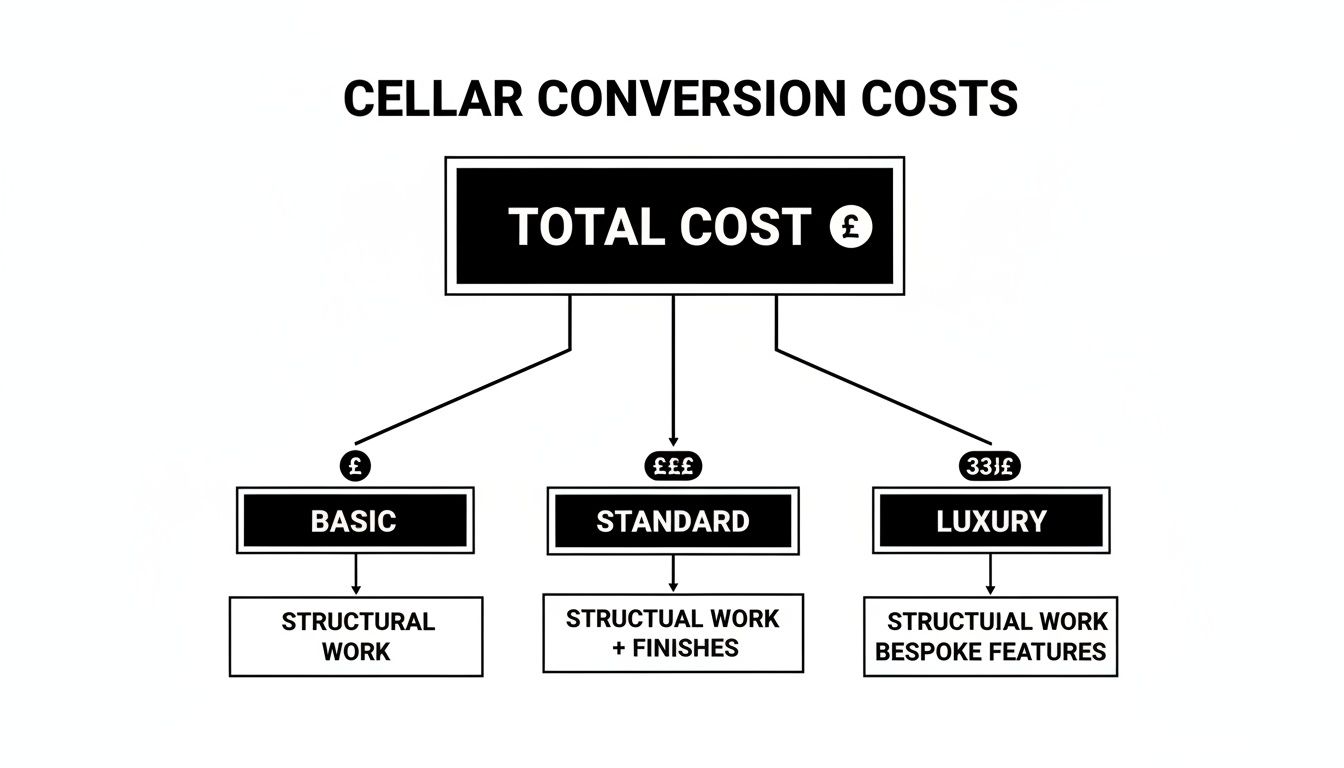
As you can see, while a basic conversion is perfectly achievable, the jump to a standard or luxury spec really pushes the budget up, reflecting higher-end materials and more complex installations.
Securing Your Space: Waterproofing Systems
Once the structure is sound, the next non-negotiable step is waterproofing. A damp basement is a useless basement, so this stage is absolutely critical for protecting your investment. There are two main ways to go about it, each with its own pros and cons.
The traditional method is 'tanking'. Think of it like painting the inside of a swimming pool. A waterproof slurry or membrane is applied directly to the walls and floor, creating a sealed box designed to physically hold back any water trying to get in.
The more modern approach is a cavity drain membrane system, which works more like a high-tech Gore-Tex jacket for your cellar. A dimpled plastic sheet is fixed to the walls, creating a small air gap. Any water that gets through the outer wall is simply collected in this cavity, channelled into a hidden drainage system, and quietly pumped away. It’s now the preferred method because it manages water rather than just trying to block it.
A cavity drain membrane system is considered the gold standard in modern cellar conversions. It actively manages water ingress, offering a robust and long-term solution that provides peace of mind against damp and water damage.
Bringing the Room to Life: M&E and Finishes
With the shell now structurally sound and completely dry, it's time to bring the space to life. This is where the cost of converting a cellar can really start to vary, as it’s all down to your personal taste and how you want to use the room.
The 'first fix' for mechanical and electrical (M&E) services happens right after the waterproofing is complete. This means laying all the hidden pipework and wiring before the walls are plastered.
Key M&E work includes:
Plumbing: Essential if you're planning a bathroom, utility room, or maybe even a small kitchenette.
Electrics: Planning the layout for lighting, power sockets, and any fancy AV kit for a home cinema or media room.
Ventilation: This is vital. A proper system ensures fresh air circulates and stops the space from feeling stuffy or getting condensation.
Heating: Options range from simple radiators to luxurious underfloor heating, which is a wonderfully efficient way to keep a basement room cosy.
Finally, you get to the fun bit: the finishes. This is what turns a structural box into a beautiful, liveable part of your home. The cost range here is enormous because it’s entirely driven by your choices. Bespoke joinery for a wine cellar will cost a lot more than simple shelving, just as high-end hardwood flooring has a very different price tag to practical vinyl. Everything from the light fittings to the door handles will define both the character and the final cost of your new space.
Key Factors That Influence Your Final Bill
No two cellar conversions are ever the same, which is why the cost can swing so wildly. While an average cost per square metre is a helpful starting point, a few key factors act as powerful levers, pushing your final bill up or down. Getting your head around these variables is crucial if you want to set a realistic budget.

Think of it like buying a car. The basic model has its sticker price, but once you start adding a more powerful engine, a premium sound system, or a sunroof, that final figure changes fast. In the same way, the cost of converting a cellar is shaped by both the essential structural work and the bespoke features you want to include.
Your Cellar's Starting Point
The existing condition of your cellar is easily the biggest cost driver. Are you starting with a damp, cramped space with a low ceiling, or a relatively dry void that already has decent headroom? The difference in cost is significant.
A cellar with a low ceiling will need extensive excavation to create a comfortable, habitable height – you're aiming for at least 2.4 metres. This involves a huge amount of labour, tonnes of soil removal, and almost certainly the need for expensive structural underpinning to support your home’s foundations.
Likewise, the ground conditions and local water table play a huge role. A high water table means your waterproofing system will need to work much harder, often requiring a sophisticated cavity drain membrane system with pumps. You can learn more about how these systems work by reading our in-depth guide on how to waterproof a basement to keep your new space perfectly dry.
The less you need to alter the existing structure and the drier the ground conditions, the more predictable and lower your costs will be. Major structural changes like excavation and underpinning represent the most substantial portion of any conversion budget.
The Impact of Location
Where you live has a profound effect on project costs. Labour rates, material delivery charges, and professional fees all vary massively across the UK. It’s no secret that there’s a ‘London premium’ that can add a substantial percentage to the overall bill.
For instance, in desirable South West London postcodes like Wimbledon Village, converting an existing space can range from £1,500 to £2,500 per square metre. For a 40m² luxury project, this works out at a budget of £60,000 to £100,000, excluding VAT. In comparison, similar projects in Inner London can soar to between £4,000 and £6,500 per square metre, pushing a similar project towards £260,000. These higher costs are driven by tighter regulations, logistical challenges, and a scarcity of specialist contractors.
Design Ambition and Specialist Features
Finally, your own vision for the space will heavily influence the cost. While a simple utility room or storage area has fairly modest requirements, creating high-end habitable spaces introduces new layers of complexity and expense.
Consider how these common features can impact your budget:
Lightwells and External Access: Bringing natural light into a basement is transformative, but it requires serious structural work. Creating lightwells or a separate entrance involves excavation, retaining walls, and high-spec glazing, adding thousands to the bill.
Specialist Rooms: A home cinema needs intricate audio-visual wiring, acoustic insulation, and specialist lighting. A gym might need a reinforced floor and enhanced ventilation, while a wine cellar demands climate control systems and beautiful bespoke joinery.
Bathrooms and Kitchenettes: Adding plumbing is a major cost factor. It means installing new pipework for water supply and waste, which often requires pumps to move wastewater up to the main drainage level.
Each of these ambitious additions elevates the project from a simple conversion to a bespoke renovation, directly impacting the final cost. By carefully weighing these factors, you can make informed decisions, balancing your dream space with a realistic and manageable budget.
Navigating Planning Permission and Building Regulations
Before any soil is disturbed or a single brick laid, you’ll need to get to grips with the legal side of your project. The total cost of converting a cellar isn't just about diggers and decorators; a chunk of your budget will go towards professional fees and statutory applications. Trying to sidestep these can bring your project to a grinding halt and land you in serious legal trouble.
The two main hurdles are Planning Permission and Building Regulations. It's easy to confuse them, but they do very different jobs. Think of Planning Permission as being concerned with your home's outward appearance and how it affects the neighbourhood. Building Regulations, on the other hand, are all about ensuring the new space is structurally sound, safe, and healthy enough to live in.
Understanding Planning Permission
The good news is that for many straightforward cellar conversions—ones that don't change how your house looks from the outside—you might not need to go through the full planning process. These projects often fall under what’s known as Permitted Development (PD) rights, which let homeowners make certain changes without a formal application. But don't assume you're in the clear.
You will almost certainly need to apply for Planning Permission if your project involves:
Creating a Lightwell: Digging out a new lightwell at the front or side of your home changes its external look, and that needs the council's green light.
Altering the Building's Façade: This includes adding a new door or window as part of the conversion.
Living in a Conservation Area or Listed Building: If your property has a special designation, the rules are much tighter. Nearly any external alteration will need formal consent.
Getting your head around these rules can be tricky, as every local council has its own quirks and policies. For a much deeper dive, you can explore our ultimate guide to navigating basement extension planning permission, which breaks it all down. An experienced architect will be your best friend here, helping you put together a solid application with the best possible chance of success.
Complying with Building Regulations
Here’s the non-negotiable part: regardless of whether you need Planning Permission, you must comply with Building Regulations. This is a legal requirement to ensure your new cellar space is safe, warm, and genuinely liveable. A building control officer, either from the council or a private approved inspector, will need to check the work at key stages.
Building Regulations are not optional. They are the benchmark for quality and safety in construction, covering everything from fire safety and ventilation to structural integrity and energy efficiency. Failure to comply can render your conversion legally uninhabitable.
Some of the crucial areas covered by Building Regulations include:
Structural Stability: Making sure any digging and underpinning is properly designed by an engineer and carried out correctly.
Fire Safety: This means providing a safe way to get out in a fire, which usually involves a protected stairway or a suitably sized external door or window.
Ventilation: Installing proper mechanical ventilation is vital to prevent damp and keep the air quality healthy.
Damp Proofing: Guaranteeing your chosen waterproofing system is installed correctly and does its job effectively.
Ceiling Height: You’ll need to achieve a comfortable floor-to-ceiling height, typically around 2.3 to 2.4 metres, to make the space feel like a proper room.
The Party Wall Act
If you live in a terraced or semi-detached house, the Party Wall Act 1996 will almost certainly come into play. This piece of legislation is there to protect your neighbours from potential damage caused by your building work. Because a cellar conversion often involves digging near or underpinning a shared wall, you are legally required to serve a formal notice to your neighbours before you start.
This process involves appointing a Party Wall Surveyor—or potentially one for each side if your neighbour doesn't agree to use a shared one. It adds another layer of professional fees to the budget, but handling it correctly is key to keeping the peace and avoiding costly disputes. Your architect can guide you on when and how to serve notices and can often recommend a trusted surveyor.
How an Architect Controls Costs and Maximises Value
It’s a common myth that architects just draw pretty pictures. While great design is absolutely at the heart of what they do, bringing a RIBA-accredited architect on board is one of the smartest financial decisions you can make when planning a cellar conversion. Their role goes far beyond aesthetics, creating a solid framework that keeps costs in check, prevents budget blowouts, and ultimately boosts the value of your home.
Think of an architect as your project's financial guardian. Right from the very first chat, they'll help you shape a realistic budget by balancing your ambitions with what’s actually achievable in your property. They know construction costs inside out and can spot potential challenges long before they become expensive problems down the line.
This early guidance is where the real value kicks in. An architect’s clever design can transform a potentially dark, awkward basement into a bright, welcoming room that feels like it’s always been part of your home. This might mean strategically placing a lightwell to flood the space with daylight or designing a flexible layout that serves multiple purposes—all adding serious value to your property.
From Vague Ideas to Watertight Specifications
One of the biggest financial risks in any building project is ambiguity. Vague instructions lead to assumptions, and assumptions almost always lead to unexpected costs. An architect gets rid of this risk by producing a highly detailed set of technical drawings and a Schedule of Works.
This crucial document lists out every single element of the job, from the exact type of damp-proof membrane to the brand of light switches. It leaves absolutely no room for interpretation. When builders tender for the work, they are all pricing for exactly the same thing. This creates a fair, transparent, and competitive process, ensuring you get the best possible price.
Without that level of detail, you could end up with wildly different quotes, making it impossible to compare them like-for-like. Even worse, a builder might submit a low price based on cheaper materials, only to hit you with extra charges later for the things you assumed were included.
An architect's detailed specification is your single best defence against scope creep and unexpected bills. It transforms your project from a loose concept into a precisely defined set of instructions, giving you complete control over quality and cost.
Managing the Project and Protecting Your Investment
Once the builders are on-site, your architect’s role shifts to contract administration and project management. They become your expert representative, making sure the work is sticking to the schedule and being built to the exacting standards specified. They’ll carry out regular inspections, handle the builder’s technical questions, and only sign off on payments when work is completed to the right standard.
This oversight is vital for keeping the project on track and on budget. Architects are also skilled negotiators, ready to manage any disagreements that might crop up with the contractor and shielding you from potential conflicts. While they oversee the bigger picture, they work in tandem with other specialists. It’s useful to understand how these roles fit together, and our guide on the differences between a structural engineer vs architect sheds more light on this collaboration.
Ultimately, an architect’s fee isn’t just another cost—it’s an investment in certainty and quality. By guiding the project from the first sketch to the final handover, they ensure the cost of converting a cellar is a well-managed investment that delivers a beautiful, functional, and valuable new space for your home.
Real-World Examples of Cellar Conversion Budgets
To really get your head around the cost of converting a cellar, it helps to look past the averages and see how budgets actually come together on real projects. Abstract numbers can be tricky to visualise, so let’s walk through three realistic, albeit hypothetical, case studies.
Each is based on the kinds of projects we see all the time across South West London, showing what you can achieve at different budget levels.

These examples will show you exactly how the scope of work, your choice of finishes, and the property’s location translate into the final project cost – from a simple, functional refurbishment to a full-blown luxury build.
Example 1: The Wimbledon Utility Room
First up, let’s imagine a terraced house in Wimbledon. It has an existing cellar with decent head height, but it’s plagued by damp. The homeowners need a practical utility room and some extra storage, so the focus here is purely on function, not fancy finishes.
This is a refurbishment project, not a new excavation. The scope is pretty straightforward:
Install a modern cavity drain membrane system to get rid of the damp for good.
Run new plumbing and electrics for a washing machine, dryer, and maybe a spare freezer.
Fit durable vinyl flooring and basic plasterboard walls.
Add simple, cost-effective lighting and ventilation.
Because there are no major structural changes, the timeline is shorter and the costs are kept in check. The biggest line item here is the professional waterproofing system – it’s the one thing you simply can't cut corners on if you want a dry, usable space.
Example 2: The Richmond Family Snug
Next, think of a semi-detached property in Richmond. The current cellar is small with a low ceiling, making it more of a crawl space than a room. The family wants to create a cosy TV room and playroom for the kids by digging down to increase the ceiling height and extending a little under the garden.
This is a much more involved project, and the budget reflects the significant structural work required. Key costs include:
Major Excavation and Underpinning: This is essential to create a proper 2.4m ceiling height.
Structural Steelwork: Needed to support the house above the newly enlarged space.
Lightwell Installation: A small lightwell will be added to bring in some natural daylight, making the room feel less like a basement.
Mid-Range Finishes: This covers things like engineered wood flooring, underfloor heating, and a good quality lighting scheme.
This kind of project sits squarely in the mid-to-high price range. The structural work is the main cost driver, but the investment creates a hugely valuable new living area that completely changes how the family uses their home.
Example 3: The Chiswick Luxury Cinema
Finally, let's picture a large detached house in Chiswick where the owners want the ultimate entertainment space. This luxury conversion involves excavating a brand-new basement to house a home cinema, a small bar area, and a WC.
This project is at the very top end of the cost spectrum, with a sharp focus on bespoke features and premium materials.
A luxury conversion is more than just adding a room; it’s about creating an experience. The budget reflects not only the complex construction but also the specialist technology and craftsmanship required to achieve an exceptional result.
The budget for a high-spec project like this would need to cover:
All the excavation and structural works from the Richmond example.
Specialist Acoustic Insulation: Crucial for getting that perfect cinema sound quality.
High-End AV and Lighting Systems: Think integrated speakers, a professional-grade projector, and atmospheric lighting.
Bespoke Joinery: For the custom-built bar and media unit.
Premium Finishes: This includes luxury carpets, designer sanitaryware, and custom wall finishes.
Sample Project Budget Breakdowns
To make these differences even clearer, the table below shows how the costs might break down for each of our South West London examples. You can see how the budget shifts dramatically depending on the scale of the structural work and the level of finish.
Cost Item | Example 1 Basic Refurb (Wimbledon) | Example 2 Family Space (Richmond) | Example 3 Luxury Conversion (Chiswick) |
|---|---|---|---|
Professional Fees | £5,000 - £8,000 | £15,000 - £25,000 | £30,000 - £50,000 |
Waterproofing | £10,000 - £15,000 | £15,000 - £20,000 | £20,000 - £30,000 |
Excavation & Structural | N/A | £80,000 - £120,000 | £120,000 - £180,000+ |
M&E (Plumbing/Electrics) | £4,000 - £7,000 | £10,000 - £18,000 | £25,000 - £40,000+ |
Fit-Out & Finishes | £8,000 - £12,000 | £25,000 - £40,000 | £60,000 - £100,000+ |
Contingency (10%) | £2,700 | £14,500 | £25,500 |
Total Estimated Cost | £29,700 - £42,000 + VAT | £160,000 - £223,000 + VAT | £285,000 - £400,000+ + VAT |
Note: These figures are indicative estimates for 2024 and can vary based on the specific site, contractor, and material choices.
As you can see, the cost of converting a cellar is a direct reflection of the project's complexity and your personal vision for the space. A simple utility room is worlds away from a custom-built cinema, and the budget reflects that journey.
Common Questions About Cellar Conversion Costs
Even when you have a plan in place, the cost of converting a cellar often brings up more questions. To help you feel confident moving forward, we’ve put together some straightforward answers to the queries we hear most often from homeowners during the planning stage.
How Much Value Does a Cellar Conversion Add to My Property?
A high-quality cellar conversion can boost your property's value by a surprising amount, often by 10-20%. This is especially true in sought-after areas like South West London where every square foot counts.
The key is to create a space that feels like a natural part of the home – think an extra bedroom with an en-suite, a dedicated home office, or a family cinema room. In most cases, the financial return comfortably outweighs the initial cost of the project.
How Long Does a Typical Cellar Conversion Take?
The timeline really hangs on how complex the project is. A simple conversion of an existing cellar, where the focus is on waterproofing and fitting it out, might take around 8–12 weeks.
On the other hand, a major project involving excavation, structural underpinning, and creating a new lightwell could easily stretch to 4–6 months for the construction phase alone. It's also vital to factor in an extra 3–6 months for all the pre-construction work, which covers design, planning permission, and sorting out any party wall agreements.
A well-structured timeline from an experienced architect is non-negotiable. It gives you a realistic schedule, manages expectations, and helps coordinate all the different tradespeople, preventing the kind of delays that cost both time and money.
What Is the Difference Between Tanking and a Cavity Membrane System?
These are the two main ways we waterproof a cellar, and they work very differently. ‘Tanking’ is the traditional method, where a waterproof cementitious slurry or coating is applied directly to the walls and floor. It essentially creates a sealed barrier to physically block water from getting in.
A ‘cavity drain membrane’ system is the more modern, and often more reliable, solution. We fit a dimpled plastic membrane to the internal surfaces, which creates a small air gap. Any water that finds its way through the wall is cleverly channelled down the gap into a hidden drainage system and then quietly pumped away. It manages water rather than fighting it, which is why it’s the preferred choice for most high-spec conversions today.
Are There Any Hidden Costs I Should Be Aware Of?
Yes, it’s smart to plan for the unexpected. Potential hidden costs are a real consideration in any basement project. Things like discovering difficult ground conditions during the dig, unexpected party wall surveyor fees if neighbours raise complex issues, or finding structural problems once the work is underway can all add to the bill.
It is absolutely vital to budget for:
Professional Fees: This covers your architect, structural engineer, and party wall surveyor.
VAT: Don't forget that VAT applies to most construction work and materials.
Contingency Fund: Always set aside at least 10-15% of the total construction cost. This is your safety net for any surprises.
Your best defence against these costs is to invest in thorough initial surveys and detailed planning with your architect right from the start.
Ready to transform your unused cellar into a valuable and beautiful part of your home? At Harper Latter Architects, we specialise in creating bespoke basement extensions across South West London, guiding you through every step from concept to completion. Contact us today to arrange your initial consultation.

Comments