
Architects Costs Extension: A Complete UK Guide for Your Project

Planning an extension is an exciting time, but getting a handle on the costs is absolutely crucial. The short answer is that architects' costs for an extension in the UK typically range from 8% to 15% of the total construction budget. So, for a high-quality £150,000 extension project, you can expect architect fees to fall somewhere between £12,000 and £22,500.
Decoding Architect Fee Structures
When you start talking to an architect, you’ll quickly find their fees aren’t just a single, plucked-from-the-air number. They are carefully calculated based on the expertise and immense value they bring to your project. The two most common ways they structure these fees are percentage-based agreements and fixed-fee structures.
Understanding the difference is the first step toward building a realistic and transparent budget for your home extension. Each approach has its own benefits depending on your project's scope and how you prefer to manage your finances.
Percentage-Based Fees
The most common method, particularly for complex or high-end residential projects, is the percentage-based fee. As mentioned, this is usually between 8% and 15% of the final construction cost. This approach is popular because it aligns your architect's interests directly with yours; their goal is to deliver the best possible project within an agreed budget.
Think of it like this: you're hiring a personal financial adviser whose success is tied to how well your investments perform. A percentage fee incentivises the architect to manage the project efficiently, from optimising the design to overseeing the build, ensuring every pound spent adds real value. It’s a collaborative approach that can flex and adapt as the project evolves.
Fixed-Fee Agreements
On the other hand, some architects offer a fixed fee for their services. This method is often a great fit for projects with a very clearly defined scope and a predictable set of tasks right from the beginning.
A fixed fee gives you complete cost certainty from day one. You know exactly what you will pay for the architectural services, which can be a huge comfort when you’re managing a tight budget.
This structure is ideal for homeowners who value predictability above all else. It’s a bit like buying an all-inclusive holiday package; the price is agreed upon upfront for a specific itinerary. If you decide to add any changes or extras later on, these would simply be discussed and costed separately, so there are no nasty surprises down the line. Both methods are perfectly valid, and the right one for you often comes down to the specifics of your extension and your personal comfort level.
To help you visualise how a percentage fee translates into actual figures, here’s a quick table showing estimates for different project budgets.
Estimated Architect Fees Based on Project Construction Cost
This table gives you a quick reference for how percentage-based fees might look for different home extension budgets.
Construction Cost (Excl. VAT) | Typical Architect Fee Range (8-15%) | Estimated Fee in GBP (£) |
|---|---|---|
£100,000 | 8-15% | £8,000 - £15,000 |
£150,000 | 8-15% | £12,000 - £22,500 |
£250,000 | 8-15% | £20,000 - £37,500 |
£400,000 | 8-15% | £32,000 - £60,000 |
Remember, these figures are a guide. The final percentage will depend on your project’s complexity, the level of service you need, and the architect’s experience.
How Architects Calculate Their Fees
Working out how an architect arrives at their fee is the first step to budgeting for your extension with any real confidence. Whether you’re looking at a percentage or a fixed fee, the final number isn’t just plucked from thin air; it’s the result of a detailed calculation based on several crucial factors. It’s never just about the size of the extension, but the complexity, the scope of work, and the level of expertise needed to get your project over the line.
At its heart, an architect’s quote is a reflection of the time, skill, and resources your specific project demands. You could have two extensions of the exact same size, yet their fee structures might be worlds apart. Why? Because one might be a straightforward build, while the other requires clever, intricate design solutions to make it work.
The Impact of Project Complexity and Scope
Without a doubt, the single biggest driver of an architect's fee is the complexity of your project. A simple, rectangular single-storey extension with off-the-shelf fittings will always require less design and technical input than a more ambitious, bespoke project.
Several factors can ramp up the complexity – and therefore the architects costs extension fees:
Bespoke Features: Think cantilevered roofs, large expanses of structural glass, curved walls, or custom-made joinery. These elements demand far more detailed drawings, careful engineering, and coordination.
Site Constraints: Is your garden on a steep slope? Is access tricky? Are there protected trees nearby? Each of these adds another layer of planning and technical challenges that need solving.
Heritage Properties: Any work on listed buildings or homes in conservation areas calls for specialist knowledge. It involves detailed heritage statements and careful negotiation with planning authorities, all of which is factored into the fee.
The scope of service you need is just as important. Are you just after a set of drawings to secure planning permission? Or do you want a full service that sees the architect through the detailed technical design, the builder tender process, and managing the contract during the build itself? A comprehensive service costs more, but the support and oversight it provides are invaluable.
Fixed Fees vs Hourly Rates
While percentage fees are common for full-service projects, architects often use other methods depending on the situation. A fixed-fee structure is a great option when the scope of work is clear and well-defined right from the start. This gives you absolute certainty on costs, which is a massive plus for budgeting.
A fixed fee is ideal for a well-defined project stage, such as producing a set of drawings for a planning application. It removes ambiguity and ensures both you and the architect have a clear, shared understanding of the deliverables and costs.
On the other hand, an architect might work on a time-charge or hourly rate. This is usually reserved for initial consultations, feasibility studies, or for ad-hoc advice that falls outside an already agreed scope. It’s flexible, but it’s less predictable for larger chunks of work. To get a better feel for how these different fee structures work in practice, take a look at our complete guide to the cost of an architect in the UK.
What Is Included in a Fee Proposal
Any professional fee proposal from an architect should be a completely transparent document. It needs to spell out exactly what is included and, just as importantly, what isn’t. This clarity is non-negotiable if you want to avoid misunderstandings down the road.
Typically, an architect's proposal will cover their professional services for specific project stages, like:
Developing initial concept designs.
Producing all the detailed drawings needed for a planning application.
Preparing technical specifications for building regulations approval.
Administering the building contract with your chosen builder.
However, you also need to get your head around what’s generally excluded. These are separate costs that you must add to your overall extension budget. Common exclusions are the statutory fees you pay directly to third parties, like council planning application fees and building control submission fees. On top of that, the costs for other essential consultants – think structural engineers, party wall surveyors, or arboricultural consultants – are almost always separate. You’ll be billed directly by those professionals. Always read the proposal carefully to make sure you have the full financial picture.
Mapping Your Fees to Project Milestones with the RIBA Plan of Work
When you hire an architect, you're not just handed a single, hefty bill at the start. Instead, the fee is broken down into phased payments, tied directly to the tangible progress they make on your extension. This structured approach follows the RIBA Plan of Work, the gold-standard framework for every construction project in the UK.
Think of it as your project's roadmap. The RIBA Plan of Work splits a complex build into eight clear, manageable stages, from the first conversation right through to moving in. For homeowners, this means total transparency. You know exactly what your architect is doing, what you’ll get at the end of each stage, and when your fee instalments are due.
This progressive payment structure is great for managing cash flow. It also clearly shows the value your architect brings at every step, taking your initial ideas and turning them into a beautifully built, fully realised home extension.
Breaking Down the Key RIBA Stages and Fees
While the full RIBA plan is comprehensive, a typical home extension project really focuses on Stages 2 through to 6. Your fee proposal will clearly show how the total fee is divided across these crucial phases, with a percentage allocated to each one.
Here’s a quick look at what happens at each key stage and how your fees line up with the work being done:
RIBA Stage 2 Concept Design: This is where the creative magic happens. Your architect will explore different design options, sketching out ideas, simple floor plans, and initial 3D models to help you see what’s possible. A good chunk of the early fee is weighted here because it sets the entire direction for your project.
RIBA Stage 3 Spatial Coordination: Once you've settled on a concept you love, this stage is all about refining it. The plans get more detailed as architectural ideas are blended with initial thoughts on the structure and services (like plumbing and electrics). By the end of this stage, you’ll have a solid design ready to submit for planning permission.
The following infographic shows the key factors that go into calculating an architect's fee before it gets broken down across the RIBA stages.
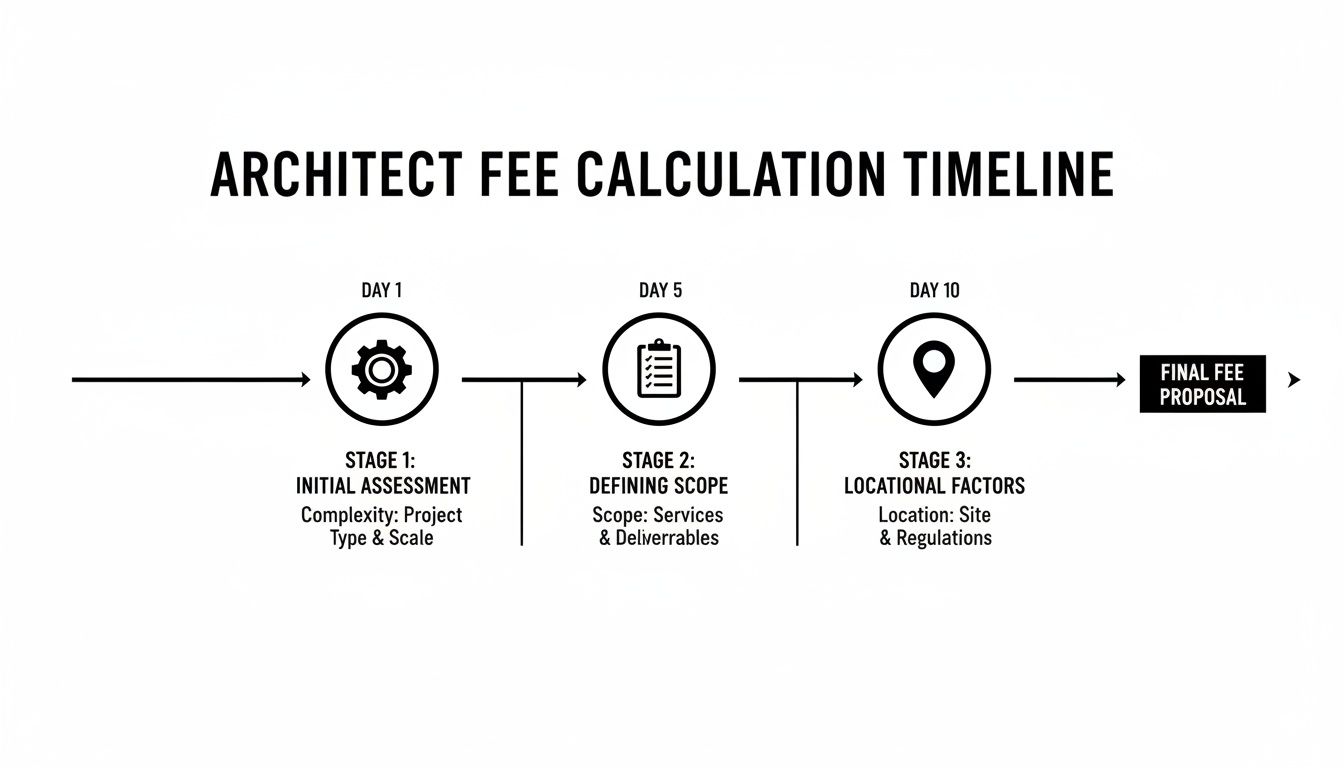
As you can see, the complexity, scope, and even the location of your project are the foundational elements that determine the overall fee, which is then distributed across the project's lifecycle.
From Detailed Drawings to On-Site Management
The later stages are where your vision is turned into a technical blueprint that a builder can actually follow. The fee allocation here reflects the immense technical skill and detailed work required. For many homeowners, this is where an architect's value becomes crystal clear.
The RIBA Plan of Work ensures you pay for progress, not just promises. Each invoice corresponds to a completed package of work, giving you control and clarity over your investment in professional services.
This methodical approach is vital for keeping control of architects costs extension fees and the overall project budget. To get a deeper understanding of this framework, take a look at our detailed guide on what the RIBA Plan of Work means for UK homeowners.
RIBA Stage 4 Technical Design: This is one of the most intensive stages. Your architect produces a highly detailed package of construction drawings, specifications, and schedules of work. This technical information is used for Building Regulations approval and is what allows builders to provide accurate, like-for-like quotes.
RIBA Stage 5 Manufacturing and Construction: Once a builder is on board, your architect steps into a contract administration role. They’ll make regular site visits, answer the builder’s technical questions, and certify that the work is being done correctly and to the required standard.
RIBA Stage 6 Handover: As the build nears completion, your architect will inspect the works for any defects and manage the handover process from the builder to you, making sure everything is finished exactly as it should be.
For UK house extensions, architectural fees often come in at around 10% of the total project cost. As an example, a 30m² single-storey extension might involve architect fees between £4,500-£6,500, sitting alongside other professional costs like those for structural engineers. This highlights the structured value that RIBA-accredited firms bring to the table.
Budgeting Your Entire Extension Project

Understanding your architect’s fee is a fantastic start, but it’s just one piece of a much larger puzzle. To budget for an extension successfully, you need to see the whole picture, not just individual line items. The total project cost is a combination of the build itself, professional fees, council charges, and the all-important interior finishes.
Getting a firm grip on these figures early on is the secret to a smooth, stress-free project. It allows you to have productive conversations with your architect, ensuring your design dreams are perfectly aligned with your financial reality. Think of your budget as the most important tool you have.
Estimating Your Construction Costs
The biggest slice of your budget will almost always be the construction cost—the amount you pay your builder to create the physical structure. A reliable way to get a ballpark figure is to use a cost per square metre (£/m²) calculation. This rate can shift quite a bit depending on your location, the quality of finish you're after, and how complex the design is.
In desirable areas like Wimbledon and South West London, you should expect a high-quality single-storey extension to cost somewhere between £2,300 and £3,400 per square metre, excluding VAT. Across the UK, particularly in sought-after parts of London, the cost for this kind of extension generally falls between £1,800 and £3,300 per square metre before VAT. It's a popular choice for homeowners wanting to add valuable living space without major structural upheaval.
So, for a typical 30m² extension, your initial construction estimate would look something like this:
30m² x £2,300/m² = £69,000 (Lower end)
30m² x £3,400/m² = £102,000 (Higher end)
This range gives you a solid foundation for your budget, but it’s crucial to remember that this is just for the core build. For a more tailored estimate, you can use our simple UK Home Extension Cost Calculator.
Building Your Complete Project Budget
Once you have a handle on the construction estimate, you can start layering on the other essential costs. These include fees for the other experts you'll need, statutory charges paid to the council, the interior fit-out, and a contingency fund.
Let’s build out a sample budget for our 30m² extension, using a mid-range construction cost of £85,000 as our starting point.
To help you visualise how all these costs come together, here is an illustrative breakdown for a typical high-quality single-storey extension project.
Sample Budget Breakdown for a 30m² Extension
Cost Item | Estimated Cost Range (GBP £) |
|---|---|
Construction Cost (30m² @ £2,833/m²) | £85,000 |
Architect Fees (10% of construction) | £8,500 |
Structural Engineer | £1,500 – £3,000 |
Party Wall Surveyor (per neighbour) | £1,000 – £2,000 |
Planning Application | £206 |
Building Control Fees | £750 – £1,500 |
Interior Fit-Out (Kitchen, flooring, etc.) | £20,000 – £55,000+ |
VAT (20% on fees & most materials) | £22,000 – £30,000+ |
Contingency Fund (10-15% of build cost) | £8,500 – £12,750 |
Total Estimated Project Cost | £147,456 – £197,956+ |
This table shows how quickly the total project cost adds up once you account for all the necessary elements beyond just the builder's quote. It's a vital exercise for any homeowner to undertake.
The Non-Negotiable Contingency Fund
No building project, no matter how meticulously planned, is entirely predictable. Things happen. You might encounter tricky ground conditions during excavation, or a key material might be delayed. This is where a contingency fund becomes your safety net.
Think of a contingency fund as your project's insurance policy. It's not a 'nice-to-have'; it is an essential part of a responsible budget that protects you from financial stress and allows the project to proceed smoothly if surprises arise.
You absolutely must set aside 10% to 15% of your total construction cost for this fund. For our £85,000 build, that’s an extra £8,500 to £12,750 that needs to be in the bank. Budget for it from day one and simply hope you never have to touch it.
If you get to the end of the project and the fund is still intact, fantastic! You have a bonus for furniture or landscaping. But planning without it is a recipe for serious trouble.
Key Factors That Influence Your Extension Costs
Ever wondered why two extensions of the exact same size can end up with wildly different price tags? The answer isn't just about the builder's quote. It comes down to a handful of key variables that shape both the construction costs and the professional fees tied to them.
Getting your head around these drivers is the first step towards making smart decisions that line up with your budget. When you understand how design choices, materials, and even the quirks of your own property affect the bottom line, you can have much more productive conversations with your architect. This knowledge puts you in control of your architects costs extension budget, without having to sacrifice the quality you’re aiming for.
Design Complexity and Bespoke Features
By far, the biggest factor driving up costs is the complexity of the design itself. A simple, rectangular extension with a straightforward flat roof will always be cheaper to design and build than one with curves, sharp angles, or intricate architectural details.
Every unique element demands more from everyone involved – more detailed design work from the architect, more complex calculations from the engineer, and more skilled labour on site. Think about the difference between:
Standard vs. Bespoke: Using off-the-shelf windows and doors is miles cheaper than commissioning custom-made, oversized glazing or handcrafted timber joinery.
Simple vs. Complex Shapes: Straight walls and right angles are simple. The moment you introduce curved walls, cantilevered corners, or a complex roofline, you dramatically increase the time, skill, and materials required.
Structural Ambition: An extension that needs hefty steel box frames to create a vast, open-plan space is in a different league of complexity compared to one using standard load-bearing walls.
Quality of Materials and Finishes
Your choice of materials and the level of finish you opt for can cause a huge swing in the final budget. This applies to everything, from the bricks on the outside to the light switches on the inside. A high-end finish is certainly an investment in the feel and future of your home, but it comes at a premium.
Just look at how costs can diverge when you compare standard options with their luxury counterparts:
Cladding: Standard brickwork or render is a reliable, cost-effective choice. In contrast, specialist options like charred timber (Shou Sugi Ban) or zinc cladding can easily be three or four times the price.
Flooring: You can get a beautiful and durable result with quality laminate or engineered wood. But if you have your heart set on polished concrete or high-end porcelain tiles, the cost per square metre will jump substantially.
Kitchens & Bathrooms: A well-made kitchen from a trade supplier might land around £20,000. A bespoke, hand-painted kitchen with premium stone worktops, however, could easily sail past £70,000.
The specification is where a budget can truly run away from you. It’s vital to work with your architect to pinpoint where to invest in high-impact, quality materials and where you can pull back with more standard finishes to keep costs on track.
Site Conditions and Access
Finally, the unique character of your property plays a surprisingly big role. A project on a flat, stable site with easy access for deliveries is the dream scenario. Unfortunately, complications can quickly add unforeseen costs.
Tricky site conditions often demand more complex foundation designs, more labour, and sometimes even specialist equipment. Be mindful of things like a steeply sloped garden, poor ground conditions requiring much deeper foundations, or restricted access that turns every delivery into a logistical headache. These issues will inevitably push up the builder's quote and require more time from your professional team to resolve.
Getting the Best Value from Your Architect
Hiring an architect is a significant investment, not just in your home's future value but in your family's quality of life. To truly get the most out of that investment and keep your architects costs extension budget on track, it helps to be proactive. The best approach is to stop seeing your architect as just a designer and start thinking of them as your project’s financial guardian.
Your most powerful tool for controlling costs is a detailed, well-thought-out brief. Before a single line gets drawn, spend real time thinking about what you need from the new space. How will you live in it day-to-day? What are your absolute must-haves, and where could you be flexible? A crystal-clear brief prevents the expensive changes and redesigns down the line that are notorious for derailing budgets.
Engage Early for Financial Clarity
One of the biggest mistakes we see homeowners make is setting a final budget before they’ve even spoken to an architect. Bringing an expert on board early in your journey—ideally before you have a fixed number in your head—allows them to give you realistic cost guidance based on your wish list and the realities of your property. This simple step avoids disappointment later and sets a solid, achievable financial foundation for the entire project.
An experienced architect acts as your advocate from day one. They use their expertise to ensure your budget is realistic, your design is cost-efficient, and your investment is protected throughout the build.
This early collaboration ensures the design that develops is one that is inherently buildable within your financial comfort zone. It shifts the process from one of potential compromise to one of informed, strategic decision-making.
Your Architect as a Financial Guardian
A great architect delivers value that goes far beyond a beautiful set of drawings. They play a critical role in managing the financial health of your extension, actively looking for ways to protect your budget without cutting corners on quality. This financial stewardship shows up in several key ways.
They can add value through:
Clever Design Solutions: An architect might suggest reconfiguring an internal layout to achieve your goals without the expense of a larger extension, or specify materials that deliver a high-end look for a more reasonable cost.
Managing the Tender Process: Your architect will prepare a detailed technical package and send it to a selection of trusted builders. This forces builders to quote on a like-for-like basis, fostering genuine competition that often leads to significant savings for you.
Contract Administration: During the build, they oversee the works, checking that the builder is sticking to the drawings and specifications. This prevents costly mistakes and ensures you only pay for work that has been completed to the required standard.
Ultimately, a good architect doesn't just cost you money; they are instrumental in saving it. Their expertise helps ensure your project is a resounding success, both aesthetically and financially.
Common Questions About Architect Costs
Getting your head around the costs and process for a home extension can feel a bit overwhelming at first. To help clear things up, we've answered some of the questions we hear most often from homeowners planning a project.
Do I Really Need an Architect for an Extension?
For a tiny, straightforward extension that falls neatly under permitted development rights, you might get by without one. But for anything more ambitious, complex, or located in a conservation area, a RIBA-chartered architect is your most valuable asset.
They aren't just drawing pretty pictures; they're experts at navigating the maze of planning rules, adding real design flair that can boost your home’s value, and managing the whole process to save you stress, time, and expensive missteps. If you want a high-quality, bespoke result that genuinely improves your home, an architect is the way to go.
Are Planning Application Fees Part of the Architect's Quote?
Usually, no. An architect’s fee covers their professional services—the expertise, time, and creativity that goes into preparing and submitting your planning application. The actual statutory fee paid to your local council is a separate cost that you'll pay directly to them.
It's always a good idea to clarify this when you receive a fee proposal. Making sure this is clear from the start helps you build a comprehensive budget with no hidden surprises, giving you a much better handle on the total architects costs extension.
An architect’s true value isn’t just in the drawings, but in the problems they solve before they ever happen. Their expertise in design, planning, and construction can save you far more than their fee over the life of the project.
Can an Architect Actually Help Me Save Money?
Absolutely. It might sound counterintuitive, but a good architect often saves you more than their fee in the long run. They do this through smart, efficient design that makes the most of every square metre, floods your home with light, and specifies cost-effective materials without ever skimping on quality.
What's more, their incredibly detailed drawings allow builders to provide much more accurate quotes. This cuts down on ambiguity and the risk of those dreaded "unexpected costs" once construction is underway. By managing the builder tender process, they also ensure you get competitive, fair pricing for a high-quality build that protects your investment.
At Harper Latter Architects, we're committed to a transparent, collaborative process that makes the most of your investment. To see how our expertise can bring your vision to life, take a look at our proven architectural approach.
Comments