
What Is a Design and Build Contract in the UK

Think of a design and build contract as a single, all-encompassing agreement where one company takes full ownership of both designing and building your home. It’s a beautifully simple concept that bundles two traditionally separate services—architecture and construction—into one seamless package. This way, you get total clarity and accountability from the very first sketch to the moment you’re handed the keys.
The Master Tailor Approach to Building Your Home
Imagine you wanted a bespoke suit. You could hire a designer to create the pattern and then find a separate tailor to stitch it all together, hoping they communicate perfectly and share your vision. Or, you could entrust the entire process to a single master tailor who handles everything from the initial measurements and fabric selection to the final fitting.
That unified approach is exactly what a design and build contract brings to your home project.
Instead of trying to manage separate contracts with an architect and a builder—who might have conflicting ideas or interpretations—you have just one point of contact. This single firm is responsible for delivering the entire project, ensuring the design is buildable, the costs are controlled, and the timeline is respected.
This model is a game-changer for complex, high-end residential projects across South West London and Surrey, where an exceptional finish and meticulous attention to detail are non-negotiable.
To give you a clearer picture, here’s a quick summary of what this model involves.
Key Features of a Design and Build Contract at a Glance
Feature | What This Means for You |
|---|---|
Single Point of Contact | You have one firm to communicate with, simplifying decisions and updates. |
Integrated Team | The design and construction teams work together from the very beginning. |
Fixed Price (Often) | Costs are typically agreed upon earlier, giving you greater budget certainty. |
Streamlined Timeline | Overlapping design and construction phases can shorten the overall project duration. |
Sole Responsibility | One company is accountable for both design quality and construction execution. |
Ultimately, this table highlights the core benefit: simplicity. It’s about creating a collaborative partnership instead of a fragmented process.
A Single Point of Responsibility
The real magic of this arrangement is accountability. When one firm is responsible for both the creative vision and its physical execution, the classic "blame game" between the architect and builder simply disappears. Any issue that pops up, whether it's a design query or a construction snag, lands squarely on the shoulders of the design and build company.
This streamlined responsibility is a huge advantage for homeowners, especially when tackling ambitious projects like:
New Builds: The architectural vision is grounded in buildability and cost from day one. To learn more about the complexities, read our guide on working with new build architects in the UK.
Heritage Renovations: A single, expert team can carefully balance creative design with the strict requirements of listed building consent.
Basement Conversions: Complex structural engineering, waterproofing, and high-end interior finishes are all integrated seamlessly under one roof.
In essence, a design and build contract simplifies the entire journey. It transforms what can be a fragmented and sometimes adversarial experience into a true partnership, where everyone is focused on a shared goal: bringing your vision to life, beautifully and efficiently. This model gives you a clear line of communication and a direct path to resolving issues, offering invaluable peace of mind for such a significant investment.
How the Design and Build Process Unfolds
A design and build contract isn't about juggling different professionals; it’s about having a single, cohesive team guide your project from a simple idea to a finished home. Think of it as a clear roadmap where each stage flows logically into the next, all under one roof.
This integrated approach means that from the very first conversation, the practical realities of construction are influencing the creative design. It’s a powerful way to ensure your home is not only beautiful but also buildable and on budget.
The journey kicks off with an initial consultation. This is far more than a simple briefing; it's a deep dive into your vision, your lifestyle, and your practical needs. We’ll talk about everything from the aesthetic you're aiming for to how you imagine using the spaces day-to-day. This conversation forms the bedrock of the entire project.
From there, we move into the concept design phase. This is where your vision starts to take shape through initial sketches, floor plans, and mood boards. Crucially, because the builders are already part of the team, every creative idea is immediately weighed for its buildability and cost. This early collaboration is what sets design and build apart from the traditional route, catching potential problems long before they become expensive headaches.
From Concept to Construction
Once you’re happy with the concept, the team develops the detailed drawings and specifications. These are the technical blueprints that guide every single decision on site. They cover everything from structural calculations and electrical layouts to the exact materials and finishes you’ve chosen.
This stage is also when we manage all the necessary planning applications and permissions. Having one team handle this simplifies communication with local authorities, which is especially vital for complex projects involving listed buildings or homes in conservation areas like Wimbledon or Richmond.
With all approvals secured, the project moves seamlessly into the construction phase. The on-site team isn't coming in cold; they’re already deeply familiar with the design because they helped shape it. This continuity makes for a much more efficient build, as most of the tricky construction challenges have already been solved on paper.
A Visual Guide to the Journey
To show how this all fits together, the diagram below illustrates the simplified, three-stage journey from your initial idea to your finished home.
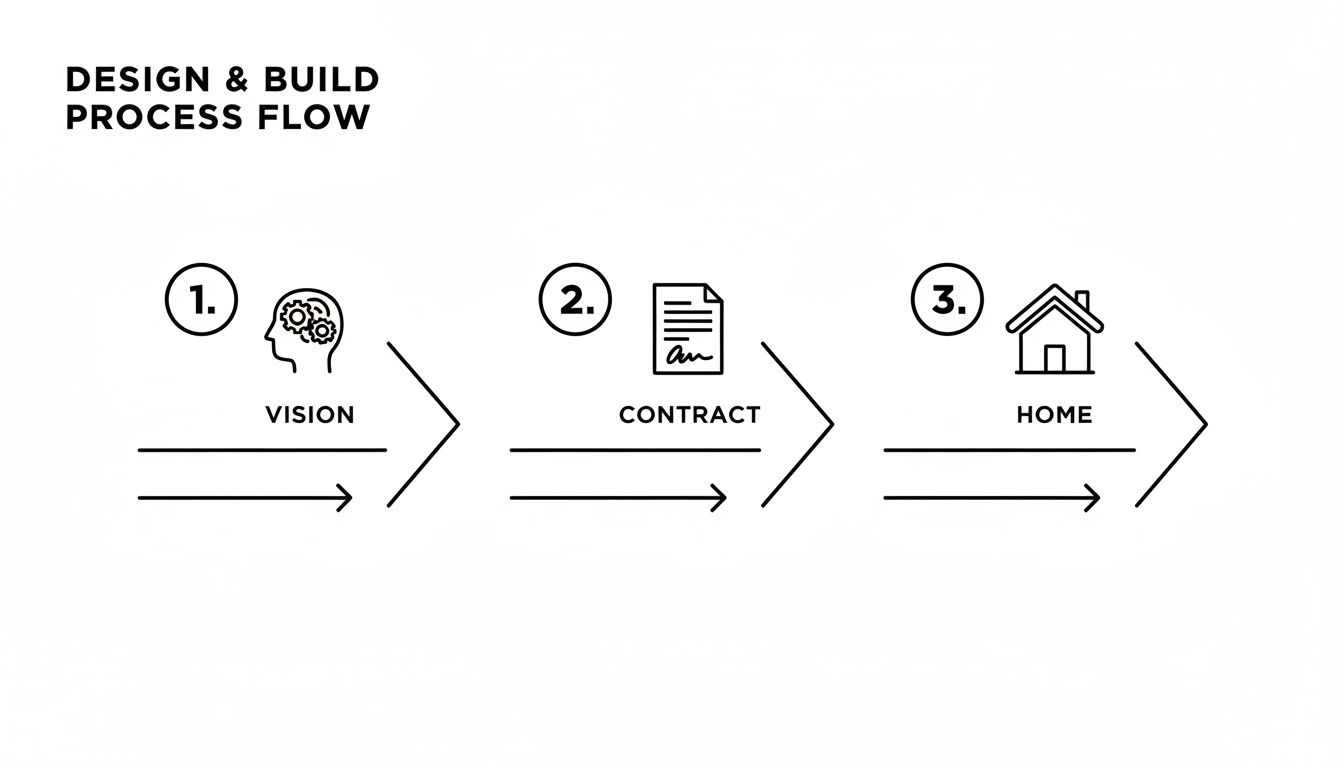
As you can see, a single contract connects your vision to the final build, neatly closing the gaps that often cause friction between separate design and construction teams.
Throughout the build, we hold regular site meetings and provide progress updates to keep you fully in the loop. You remain central to the process, making decisions on the final touches and watching your vision come to life. Your single point of contact means communication is always direct and decisions can be made without delay.
The final step is the handover. This isn't just about getting the keys; it involves a meticulous inspection to ensure every detail meets the exacting standards we agreed upon. You’ll receive all the necessary documentation for your new home, and we'll walk you through its features. It’s the satisfying conclusion to a journey designed for clarity, collaboration, and control.
Design and Build Versus Traditional Contracts
Choosing how to manage your project is one of the biggest decisions you’ll make. Broadly, you have two main routes: the integrated design and build model and the more conventional, architect-led traditional method. While both can deliver a beautiful home, they are built on fundamentally different ideas about relationships, risk, and responsibility.
Getting to grips with these differences is the key to picking the approach that feels right for you—one that matches your goals, your appetite for risk, and how hands-on you want to be.
The traditional path is a step-by-step process. First, you hire an architect to produce a complete set of detailed drawings. Once they’re finished, the project goes out to tender, where several builders bid for the construction work. You end up with two separate contracts and two different parties to manage, with your architect often acting as the go-between.
In contrast, a design and build contract bundles everything together. You sign a single contract with one firm that takes full responsibility from start to finish. The designers and builders are on the same team from day one, which changes the entire dynamic of the project.
Contractual Relationships and Communication
The most noticeable difference is who you talk to. In a traditional setup, you’re often the central hub, passing messages between your architect and builder. If a design detail proves tricky or expensive to construct on-site, it can quickly become a blame game over who should solve it—and who pays for it.
A design and build contract does away with this triangular setup. You have a single point of contact and one team accountable for both the quality of the design and its execution. This direct line of communication cuts down on misunderstandings and delays, creating a far more collaborative and less confrontational atmosphere.
Allocation of Risk and Cost Certainty
Risk is another major dividing line. With the traditional method, the risk of design errors often sits with you and your architect. If unexpected problems crop up during the build because of a flaw in the plans, the cost of fixing them usually lands on your shoulders, leading to budget creep.
The design and build model flips this on its head by transferring design liability to the contractor. Because one company is responsible for both designing and building, they own the risk of making sure the design is buildable within the agreed price. This gives you far greater cost certainty, much earlier in the process—a huge advantage for complex projects like a heritage restoration or a new home with specialist features.
This model is gaining serious traction, especially for high-value homes. In the UK, design and build contracts are increasingly the go-to for luxury projects. Data from the Office for National Statistics (ONS) shows that total construction new orders jumped by 9.8% in Quarter 3 2025, with much of this growth in sectors where design and build is the dominant approach. You can explore the full construction output statistics on the ONS website.
A Head-to-Head Comparison
To help you see the differences at a glance, we’ve put together a simple comparison table outlining how each approach works for a homeowner.
Comparing Design & Build vs. Traditional Contracts
Aspect | Design and Build Model | Traditional (Architect-Led) Model |
|---|---|---|
Contracts | One single contract with one firm for both design and construction. | Two separate contracts; one with the architect and one with the builder. |
Accountability | Single-point responsibility. The design-build firm is solely accountable for everything. | Split responsibility. Can lead to disputes between the architect and builder. |
Cost Certainty | High. A fixed price is typically agreed upon much earlier in the process. | Lower. Final construction cost is unknown until the tender process is complete. |
Timeline | Faster. Design and construction phases can overlap, shortening the project duration. | Longer. A fully detailed design is required before a builder can be appointed. |
Collaboration | Inherent. Designers and builders work together from day one, optimising the design. | Sequential. The builder is brought in after the design is largely finalised. |
Client Role | Focused on defining the initial brief and approving key stages. | More hands-on management, often mediating between parties. |
Ultimately, the traditional route might appeal if you want an architect acting as a completely independent check on the builder’s work. But for our clients in South West London and Surrey who value efficiency, cost certainty, and a single, accountable partner, the integrated approach of a design and build contract offers a powerful, modern alternative.
The Upsides and Downsides: A Balanced View
Opting for a design and build contract brings some powerful advantages to the table, particularly if you’re embarking on a complex residential project. But like any delivery method, it has its own unique character and isn’t without things to watch out for. Understanding both sides of the coin is the key to making this model work brilliantly for your home.
The single biggest draw is undiluted accountability. With one firm holding the reins for both the architectural vision and the build quality, the classic blame game that can derail traditional projects simply evaporates. If a problem crops up on site, there’s no debate over whether it’s a design flaw or a construction error. You have one team, one contract, and one port of call.
This streamlined responsibility brings a sense of clarity and calm, which is invaluable when you're navigating the complexities of a listed building renovation or a technically demanding basement extension.
The Benefits of a Truly Integrated Team
Beyond clear accountability, the design and build approach offers some very tangible rewards that you'll feel in your budget, your timeline, and your overall peace of mind. When the design and construction teams are one and the same, natural efficiencies emerge right from the get-go.
Here are the key advantages:
Greater Cost Certainty, Sooner: Because the builders are in the room from the earliest design stages, they provide real-time cost feedback. This means a realistic, fixed price can often be locked in much earlier than in a traditional setup, giving you powerful protection against surprise budget hikes down the line.
A Faster Path to Completion: The ability to overlap the design and construction phases can shave a significant amount of time off the project schedule. For instance, groundwork could get underway while the final interior details are still being pinned down—a level of parallel working that’s incredibly difficult to orchestrate with two separate companies.
A Hotbed for Collaboration and Smart Solutions: When architects and builders work hand-in-glove, they can spark off each other to develop innovative solutions that are as practical as they are beautiful. A builder's on-the-ground knowledge can help refine an architect's concept, ensuring it’s not just stunning on paper but can be built flawlessly and cost-effectively.
This inherent efficiency is a major reason why design and build is so popular across the wider construction industry. Projections for 2025 show steady growth in UK construction, with many London projects—including 169 schemes worth £2 billion started in Q2 2025—favouring delivery models that get the job done efficiently. You can dig deeper into the UK construction outlook and market trends at PwC.
Potential Pitfalls and How to Sidestep Them
While the benefits are compelling, it’s just as important to go in with your eyes open to the potential drawbacks. Knowing the risks allows you to manage them proactively so they never become your problem. The most significant risk is that a less-than-scrupulous firm might engage in 'value engineering'—a benign-sounding term that can sometimes be a cover for cutting corners or swapping high-quality specified materials for cheaper alternatives to pad their profit margin.
Another point to consider is the critical role of your initial brief. Because the contract price is fixed early, the entire project's success rests on a meticulously detailed 'Employer's Requirements' document.
A vague or incomplete brief is a recipe for misunderstanding, disappointment, or the need for expensive changes later on. The initial design phase is precisely when your vision must be captured and translated into a watertight technical specification.
To navigate these challenges, you need to be proactive. Insisting on a partner who is completely transparent and committed to quality is simply non-negotiable.
Here’s how you can mitigate the risks:
Invest Time and Energy in the Brief: Don't rush the initial design and briefing stage. Work closely with your architect to detail every single aspect of your vision, from the big structural elements right down to the exact finish on the door handles. A robust, comprehensive brief is your best form of protection.
Get Quality Commitments in Writing: Make sure your contract explicitly lists all materials, brands, and finishes. Ask for samples and, where it makes sense, mock-ups. Crucially, ensure there are clear clauses that prevent any substitutions without your express written approval.
Choose a Partner with a Proven Reputation: Your best defence is selecting a firm with a solid track record in high-end residential work. Look for a portfolio that demonstrates an absolute commitment to quality craftsmanship, and don't be afraid to check references or even ask to visit completed projects.
Navigating Essential Clauses in Your Contract
A design and build contract is far more than just a piece of paper; it’s the rulebook for your entire project. While the legal language can feel a bit dense, getting to grips with its key parts is the best way to protect your investment and ensure your vision is realised just as you imagined. In the UK, most of these agreements are based on standard industry forms, like the widely used Joint Contracts Tribunal (JCT) Design and Build Contract.

Think of the contract as a detailed map you all agree on before the journey starts. It clearly marks the destination (your finished home), the route (the process), and the rules of the road for everyone involved. Let's break down some of the most critical clauses into plain English.
Employer’s Requirements and Contractor’s Proposals
These two documents are the absolute heart of any design and build agreement. They are essentially a detailed brief and the formal response to it.
Your Employer’s Requirements (ERs): This is your definitive wish list, which we as your architect would meticulously prepare with you. It outlines absolutely everything you expect from the finished project—from the overall layout and aesthetic to specific material quality, performance standards, and finishes. A well-drafted ER is your number one tool for quality control.
The Contractor’s Proposals (CPs): This is the design and build firm's official reply. It sets out exactly how they will deliver on your requirements, including their initial designs, technical specifications, and, crucially, the fixed contract price. Once you agree to the CPs, they become legally binding.
The success of your entire project really hinges on the quality and detail of the Employer's Requirements. This is where a diligent architect acts as your unwavering advocate, creating a watertight document that leaves no room for misinterpretation. It's all about translating your vision into a technically precise brief that protects your interests on quality, budget, and design integrity.
Payment Schedules and Valuations
The contract will clearly define how and when the contractor gets paid. It's almost never a single lump sum at the end. Instead, payments are typically made in stages as the project hits certain milestones, or through monthly valuations of the work completed on site.
This staged approach ensures you only pay for work that has actually been done to a satisfactory standard. Your architect can be central to this, helping to assess the progress and certify that the payment requested is a fair reflection of the work carried out. For a closer look at this, our guide to the essential elements of a home renovation contract offers some valuable extra detail.
Managing Variations and Time Extensions
Even with the most careful planning, things change. A good design and build contract has clear, established procedures for dealing with this.
A variation is the formal term for any change to the agreed-upon plan. This could be a request from you to add something new or a necessary adjustment because of an unforeseen issue on site. The contract will specify exactly how variations must be documented, priced, and approved in writing before any work starts, giving you total transparency over any impact on cost and timelines.
Similarly, an extension of time clause deals with potential delays. It outlines the legitimate reasons a contractor can claim more time (like exceptionally bad weather or delays caused by the client) and the formal process for making that claim. This protects you from excuses and helps keep the project moving forward. Having these clauses clearly defined from day one is absolutely essential for a smooth project.
Getting Started on Your Project
Understanding the theory behind a design and build contract is one thing. But turning that knowledge into action is where the real excitement begins – it's the moment your vision starts to become a tangible reality.
For ambitious, high-end residential projects, this integrated approach offers a clear, collaborative, and refreshingly straightforward path forward.
This model truly shines when complexity and quality are the top priorities. In areas like Wimbledon and Richmond, where bespoke new builds and sensitive heritage restorations demand a perfect marriage of creative design and expert craftsmanship, the single point of responsibility is a game-changer. It guarantees a seamless journey from the very first sketch to the day we hand over the keys.
At Harper Latter Architects, we’ve built our reputation on this exact philosophy. Our deep expertise in creating luxury interiors, stunning landscape architecture, and flawlessly executed new builds and refurbishments makes us the ideal partner to guide you through the process.
Your Next Steps
Taking that first step towards a new home should feel inspiring, not intimidating. We’ve designed our process to be clear and supportive from the very beginning, ensuring you feel confident and fully informed at every stage.
Here’s a simple way to get started:
Gather Your Inspiration: Start collecting ideas, images, and notes on what you want your home to be. Think about your lifestyle, your aesthetic tastes, and the practical functions your space needs to deliver day in, day out.
Define Your Core Goals: Get clear on your budget, your ideal timeline, and the absolute must-haves for your project. Is it a state-of-the-art kitchen, a tranquil garden room, or maybe a basement cinema?
Book Your Initial Consultation: This is the most crucial step. A friendly, no-obligation chat allows us to really listen to your ideas, understand your ambitions, and start discussing how we can bring them to life together.
Choosing the right architect is the foundation of any successful project. This is a partnership built on trust, a shared vision, and proven expertise. It’s about finding a team that not only understands the technical details but genuinely connects with your personal aspirations for your home.
We believe the journey of creating a home should be just as exceptional as the final result. If you're considering a design and build project and want to learn more about selecting the right professional partner, our guide on how to choose an architect in the UK offers some valuable insights.
Ready to talk about your vision? Contact us today to schedule your initial consultation, and let’s begin the journey of creating your extraordinary home together.
Your Questions, Answered
Navigating the world of home renovation can feel complex, so we’ve put together answers to a few of the questions we hear most often from homeowners considering a design and build contract.
Think of this as a straightforward guide to help you decide if it’s the right path for your project.
Am I Still Involved in the Design Process?
Absolutely. In fact, your involvement is most critical right at the start. Everything hinges on the 'Employer's Requirements' document, which is where we meticulously detail your vision, lifestyle, and quality expectations. You'll work closely with the design team to perfect this brief long before any contract sum is agreed.
While the contractor then takes the lead on developing the detailed technical drawings, there are still key moments for your approval—particularly when it comes to finishes, fixtures, and fittings. A well-run design and build project is a genuinely collaborative process.
We make sure our clients are central to the creative journey. Structured review points are built in from the beginning to guarantee the final home is a perfect reflection of their aspirations. Your input is the foundation of the entire project.
Is a Design and Build Contract More Expensive?
Not necessarily. It often provides far greater cost certainty, which can save you a significant amount of money in the long run. While the initial quote might seem higher, it’s important to remember this figure usually includes the design fees, which would be a separate, additional cost in a traditional setup.
The real financial benefit comes from fixing the price much earlier in the process. This dramatically reduces the risk of unexpected costs creeping in during the build—a common headache that can cause budgets to spiral in a traditional architect-led project.
By bringing design and construction together from day one, potential buildability issues are spotted and solved on paper, not on-site. For a homeowner, this means better budget control and invaluable peace of mind.
What Happens If I Want to Make Changes During Construction?
Making changes mid-project, known in the contract as 'variations', is handled through a clear, transparent process. Any change you want to make is formally documented, priced by the contractor, and then presented to you for approval before any work goes ahead.
This gives you a complete picture of how the change will impact both the final cost and the timeline. Because the team is fully integrated under one roof, assessing the feasibility of a change is often much quicker than in a traditional setup.
It's worth remembering, however, that changes made late in the game are almost always more expensive than those decided upon during the initial design phase. This is exactly why spending time on a thorough, detailed brief at the start is so vital—it minimises the need for costly alterations down the line.
Who Is Responsible for Defects in Design or Workmanship?
This is perhaps the clearest and most compelling advantage of a design and build contract. The contractor holds sole responsibility for everything—both the design and the construction. There’s no finger-pointing between a separate architect and builder if an issue arises.
If a defect is found, you have a single point of contact who is contractually bound to put it right, whether it stems from a design error or poor workmanship on site.
This simplifies the resolution process enormously. It gives you a much clearer, more direct path to getting things sorted, offering greater security for what is likely to be one of the biggest investments you’ll ever make.
At Harper Latter Architects, we believe the journey of creating a home should be as exceptional as the final result. Our design and build approach offers clarity, accountability, and a collaborative spirit to clients across Wimbledon and South West London. If you are ready to start a conversation about your project, please explore our services.

Comments