
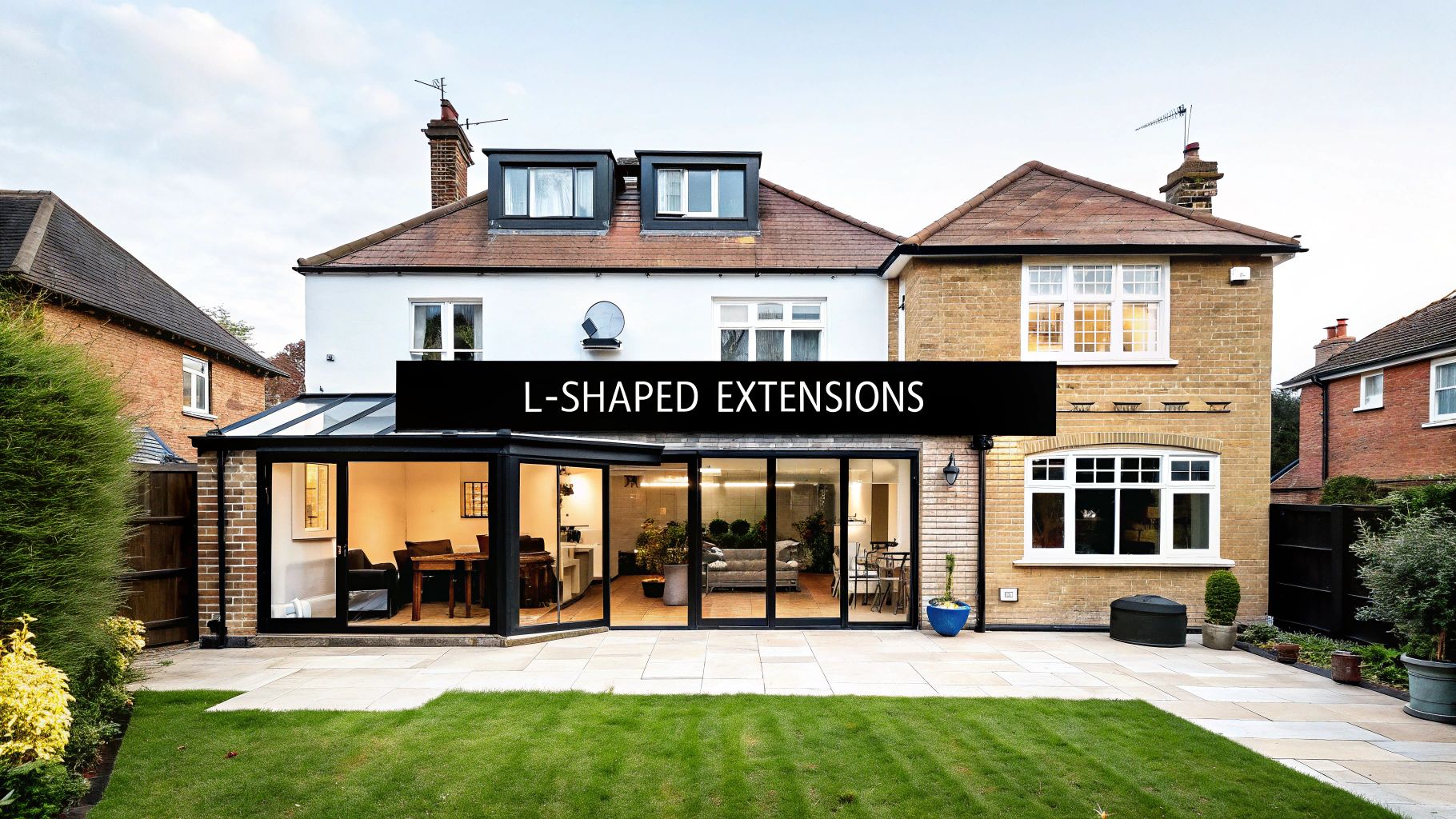
L-shaped extensions: A Guide to South West London Homes
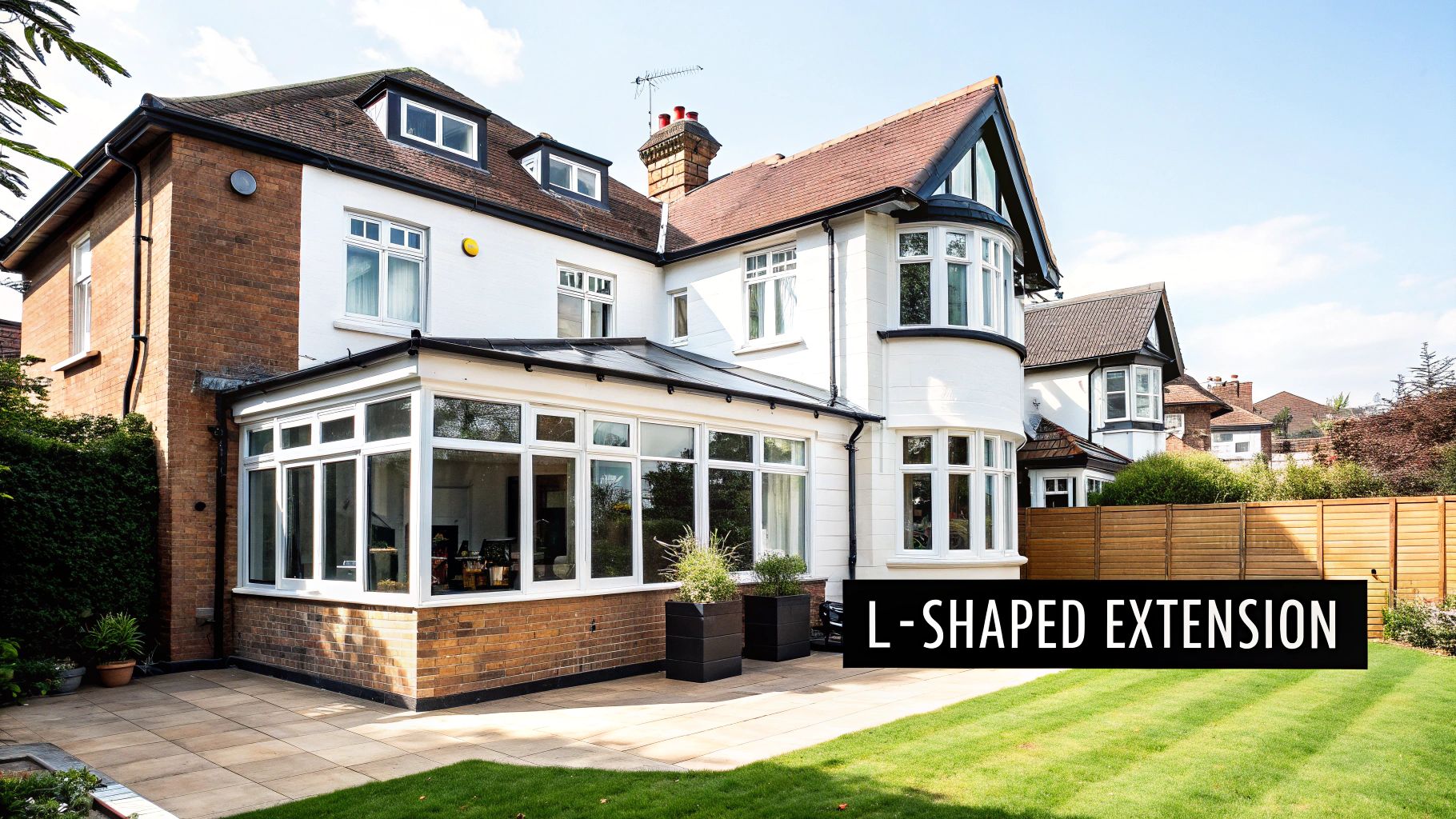
Often called a wraparound extension, an L-shaped extension is a clever way to blend two extensions—a side-return and a rear extension—into one seamless, transformative build. The result is a distinctive ‘L’ shape that wraps around a corner of your property, unlocking a huge amount of new, versatile living space.
So, What Exactly Is an L-Shaped Extension?
For anyone owning a period property in South West London, from the charming Victorian terraces in Wimbledon to Richmond’s elegant Edwardian semis, an L-shaped extension is less about just adding a room and more about completely reshaping your home for modern life. It reimagines the entire ground floor’s character and flow. This approach is particularly effective for homes with an existing outrigger, a common feature in the region's older housing stock.
Merging Two Extensions Into One
Think of it as two projects working in perfect harmony. The side-return extension fills in that often-neglected alleyway space, while the rear extension pushes out further into the garden. By joining them, you create an expansive, open-plan area that would be impossible to achieve with either extension on its own.
What you get is a vast, flexible room flooded with natural light from two different directions. This dual aspect is one of the biggest wins of an L-shaped extension, creating a bright, airy atmosphere that feels deeply connected to the garden.
Designing Distinct Zones for Modern Living
This newfound space is perfect for creating distinct zones for different activities, all within a single open-plan layout. Imagine a seamless journey from a state-of-the-art kitchen to a spacious dining area and then to a relaxed family living space—no walls to interrupt the view or the conversation. This layout is ideal for:
Family Life: The children can do their homework at the dining table while you prepare dinner, all within the same sociable space.
Entertaining Guests: It provides a natural hub for parties, allowing guests to move freely between the kitchen, dining table, and out into the garden.
Connecting with the Outdoors: With huge expanses of glazing like bi-fold or sliding doors on two sides, the boundary between inside and out simply melts away.
By wrapping around the original rear corner of the home, an L-shaped extension doesn’t just add square footage—it fundamentally improves the property’s relationship with its garden and dramatically increases the amount of usable, light-filled living area.
It’s no surprise this style has become the gold standard for high-value home improvements across South West London. It directly tackles the classic problems of period properties—dark, narrow rooms and wasted side passages—and replaces them with the open, functional, and beautiful spaces that today’s families are looking for.
Unlocking Your Home's Architectural Potential
An L-shaped extension is so much more than a simple box on the back of your house; it’s a chance to fundamentally redefine your home's entire character and the rhythm of daily life. This isn't just about adding square footage. It's an architectural tool that lets us craft a living space that’s both visually striking and perfectly in tune with your family’s lifestyle, unlocking a level of flow and function you didn't know your property had.
The real magic lies in its ability to create distinct 'zones' within one large, cohesive open-plan area. This is the very essence of modern living—spaces that feel connected yet serve their own clear purpose.
Crafting a Multi-Functional Living Space
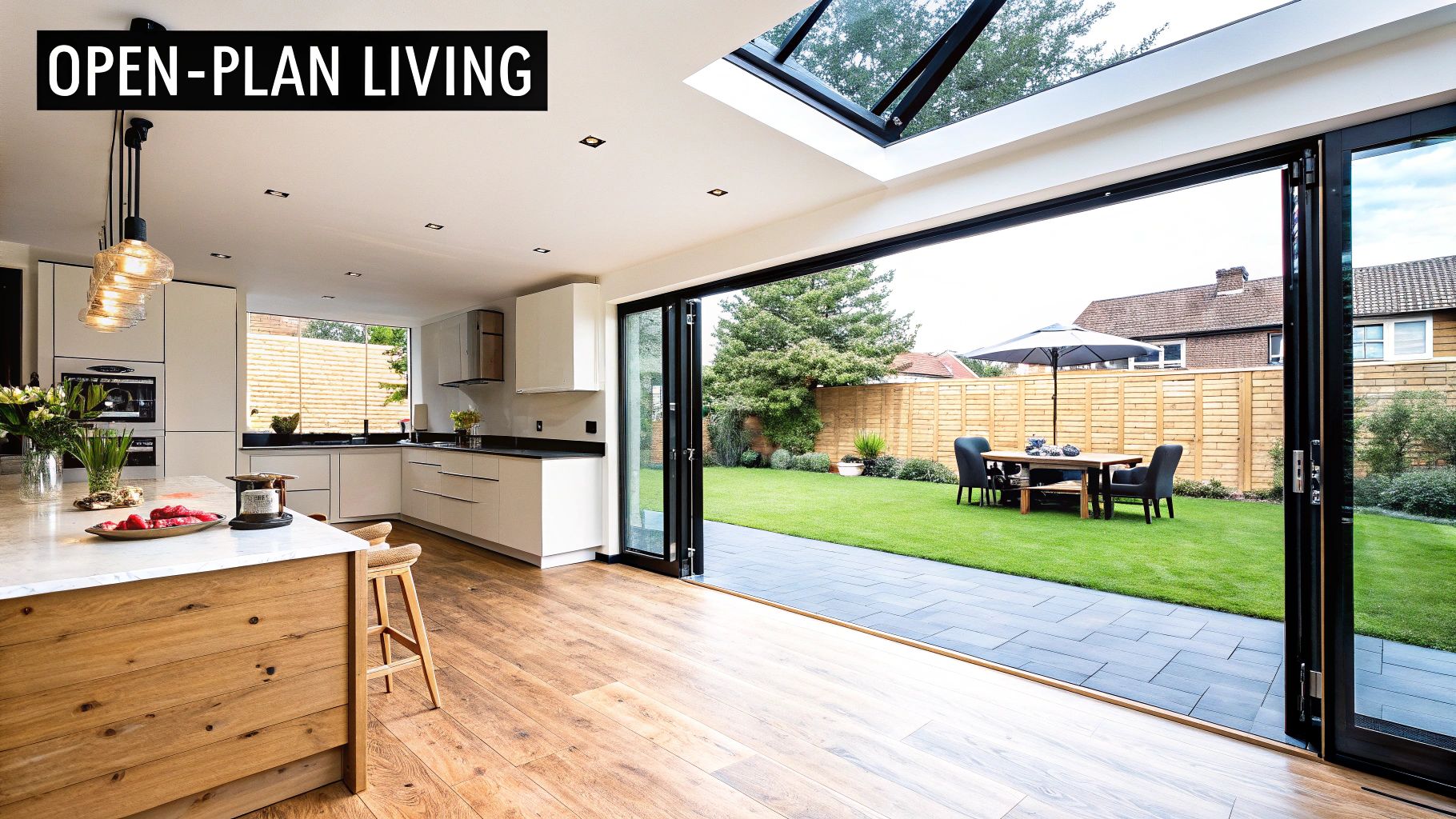
Picture this: a kitchen island that starts the day as a coffee bar, becomes a homework station after school, and ends the night as the heart of a dinner party. This zone flows effortlessly into a dining area defined by a beautiful pendant light, which then transitions into a relaxed seating area with uninterrupted views of the garden. Each zone has its own identity, but there are no walls to break the connection.
This layout naturally fosters a more connected family life. It allows for different activities—cooking, playing, relaxing, or working—to happen all at once in a shared environment. It brings back the sense of togetherness that so often gets lost in traditional, compartmentalised homes.
An L-shaped extension doesn’t just add a room; it creates a dynamic ‘hub’ where life unfolds. By carefully planning the layout, we can design a space that adapts to your needs throughout the day, from a bright breakfast spot to an intimate evening retreat.
Enhancing Lifestyle with Bespoke Features
This is where your vision really comes to life. The generous footprint of L-shaped extensions provides the perfect canvas for those bespoke elements that elevate daily living from the ordinary to the exceptional. These are the details that turn a house into a home that is uniquely yours.
Here’s a look at the design potential these extensions unlock, summarising the kinds of luxury features our clients in South West London often request.
Design Potential of L-Shaped Extensions
Design Feature | Architectural Benefit | Ideal For... |
|---|---|---|
Bespoke Joinery | Creates integrated, stylish storage that maximises space and reduces clutter. | Incorporating media units, hidden home offices, or feature window seats. |
Integrated Appliances | Achieves a sleek, high-end finish by seamlessly blending technology into the cabinetry. | Custom wine coolers, walk-in pantries, or state-of-the-art coffee stations. |
Bi-Fold or Sliding Doors | Removes the boundary between inside and out, making the garden feel like part of the room. | Creating a seamless flow for entertaining and enjoying warm weather. |
Structural Glazing | Floods the space with natural light from multiple angles, enhancing wellbeing and spaciousness. | Maximising garden views and creating a bright, uplifting atmosphere. |
Zoned Lighting | Allows for different moods and functions within the open-plan area. | Highlighting architectural features, dining zones, or relaxing seating areas. |
These features are more than just add-ons; they are integral to creating a space that is not only beautiful but also functions perfectly for modern family life.
Maximising Light and Garden Views
One of the most celebrated qualities of an L-shaped design is its ability to pull in natural light from two different directions. This dual-aspect glazing, often paired with strategically placed skylights, floods the interior with daylight. The result is a healthier, more uplifting environment that relies less on artificial lighting.
This strong connection to the outdoors does wonders for your wellbeing and makes the space feel even larger than it is. Our expertise in both architecture and landscape design means we always consider the extension and garden as one cohesive project. We carefully align views, frame key features like mature trees, and design patios that truly function as outdoor rooms.
This sophisticated approach delivers a significant return on investment. Market analysis for South West London consistently shows that well-designed L-shaped extensions add 10-15% more to a property's value than simpler designs. Their superior flow and high-end feel are exactly what discerning buyers are looking for. In one of our local projects, a thoughtfully designed extension delivered a staggering 132% net return on investment—a powerful testament to the value of getting the architecture right. You can discover more about London extension costs and their impressive returns.
Navigating Planning Permission in South West London
Before any ground is broken on an L-shaped extension in South West London, there's a crucial hurdle to clear: securing the right permissions. The planning process can feel like a tangled web of rules, especially in boroughs like Richmond or Wandsworth where local character and heritage are fiercely protected.
With the right guidance, however, it becomes a clear, manageable part of the journey. The two main routes to getting your project approved are through Permitted Development (PD) rights or a full Planning Application. Figuring out which path your project will likely follow is the first step towards a successful build.
Permitted Development vs Full Planning Application
Permitted Development rights are essentially a government green light for certain types of home improvements, allowing you to build without needing to apply for formal consent. Think of it as a pre-approved allowance for straightforward projects. An L-shaped extension can sometimes fall under this, but it comes with a strict set of rules on size, height, and how close you can build to your boundaries.
The reality for many ambitious L-shaped extensions in this part of London is that they often push beyond these tight limits. If your design is bigger, taller, or more architecturally expressive than what PD allows, you’ll need to submit a full Planning Application. This is a much more detailed process where the local council carefully weighs up your proposal against its own specific planning policies.
Special Considerations in South West London
While the basic principles of planning apply everywhere, South West London has its own unique challenges. Many of its most sought-after neighbourhoods are designated as Conservation Areas, which exist to protect the special architectural or historic feel of a place.
Living in a Conservation Area puts significant restrictions on your Permitted Development rights. The side-return element of an L-shaped extension, for instance, is almost never allowed under PD in these locations. This is where an expert approach is vital; we focus on creating designs that are sensitive to the local character, using materials and proportions that complement the existing streetscape to give your application the best chance of success.
Adding another layer of complexity are Article 4 directions. A local council can issue one of these to remove specific Permitted Development rights in a certain area, often to prevent small, incremental changes that could harm a neighbourhood's character over time. If your property is under an Article 4 direction, even seemingly minor works might require a full planning application.
For many homeowners, getting to grips with these local nuances is the most daunting part of the process. Our role is to bring clarity and confidence, handling the entire application for you. We prepare robust design statements and manage all communication with the council, ensuring your project is presented in the best possible light.
Listed Buildings: A Sensitive Approach
If your home is a listed building, the rulebook is even stricter. Any alteration that might affect its character as a building of special architectural or historic interest requires Listed Building Consent. This is a separate process from a normal planning application and demands a deep understanding of heritage conservation.
Our experience with listed properties across the region means we can design an L-shaped extension that is both beautiful and respectful of your home’s history. We work closely with conservation officers to develop a proposal that enhances your home while preserving its unique legacy.
The planning system is designed to be thorough, but it shouldn't be a barrier to creating your dream home. Our team's deep familiarity with the policies of local councils means we can anticipate challenges and prepare applications that tick all the right boxes for a smooth approval. To understand the essentials of this process, you can find valuable insights in our comprehensive guide to UK house extension planning permission.
Getting to Grips with the Cost of an L-Shaped Extension
Embarking on an L-shaped extension is a major investment, not just in your property, but in your quality of life. Understanding the costs involved is the first step to making confident decisions, so we believe in giving you a clear financial picture from the very start. No surprises, no hidden fees—just a realistic overview of what to expect.
Here in South West London, we have to factor in a 'London premium', which means labour and materials simply cost more. That’s why it’s so important to work with up-to-date, location-specific figures. It's also crucial to distinguish between a standard finish and the high-end, bespoke specification that is the hallmark of our architectural projects.
What Is the Typical Cost Per Square Metre?
The most common starting point for a budget is the cost per square metre. L-shaped extensions have become incredibly popular across the home counties and South West London, as homeowners look for clever ways to gain more living space. Based on recent industry analysis, these wraparound designs typically cost between £1,800 and £3,000 per square metre, before VAT. You can learn more about the factors influencing house extension costs from Checkatrade's 2026 guide.
This range generally covers the core build—foundations, structure, roofing, and a basic internal fit-out. Where your project falls on that scale really comes down to the level of finish and the complexity of your design. A standard finish might mean off-the-shelf kitchen units and simple lighting, whereas a high-end specification opens the door to bespoke joinery, premium materials, and integrated home technology.
Beyond the Build: Other Key Costs to Factor In
While the construction cost is the biggest slice of the pie, it’s certainly not the whole thing. A complete, realistic budget for an L-shaped extension needs to account for several other essential professional services and statutory fees.
Here’s a breakdown of the other costs you should have on your radar:
Professional Fees: This covers your architect, structural engineer, and sometimes a party wall surveyor. As a rule of thumb, budget around 10-15% of the total build cost. Our role as architects goes beyond design; we focus on delivering real value and a strong return on your investment.
Planning and Building Control Fees: Submitting a planning application to a local council like Richmond or Wandsworth comes with a fee, which is currently about £206 for a home extension in England. Securing Building Regulations approval will involve a separate fee.
Party Wall Agreements: With properties so close together in South West London, a Party Wall Agreement is almost a given for L-shaped extensions. If your neighbours decide to appoint their own surveyor, you could be looking at costs of £1,500 or more per neighbour.
VAT: This is a big one. Most builders' quotes won't include VAT, so you need to remember to add the standard rate of 20% to the final construction cost.
Contingency Fund: We can plan every detail, but building projects can still throw up surprises. We always advise clients to set aside a contingency fund of 10-15% of the construction cost. This gives you a safety net for anything unforeseen, from tricky ground conditions to supply chain delays.
Budgeting for an extension is about seeing the complete picture. By accounting for professional fees, statutory charges, and a healthy contingency from day one, you can move forward with financial clarity and peace of mind.
Understanding these different elements helps you build a robust and realistic budget from the outset. To give you an even clearer idea of how these costs play out in the real world, we’ve put together 8 detailed house extension cost examples in South West London. These case studies show how different specifications and project scopes affect the final investment. This kind of transparency is central to our process, making sure you feel in control of your project's finances from the first sketch to the final handover.
Designing a Sustainable and Future-Proof Home
For many of our clients across South West London and Surrey, creating a home that’s both beautiful and responsible is a real priority. An L-shaped extension is a fantastic opportunity to weave sustainability into the very fabric of your property, boosting its energy efficiency and securing its value for the future.
This isn’t about compromising on luxury or style. It’s about blending intelligent, eco-conscious design with the high-end finish our clients expect. The goal is to create a space that not only shrinks your carbon footprint but also lowers your long-term running costs—a critical factor with energy prices on the rise. Smart choices at the design stage lead to a home that is comfortable, cost-effective, and resilient for years to come.
Core Strategies for Sustainable Design
Achieving a truly sustainable home isn’t about one single feature; it’s a multi-layered approach that considers everything from the building materials to the systems that run it. The generous footprint of L-shaped extensions makes them the perfect canvas for integrating these features seamlessly.
We focus on a few key areas:
High-Performance Glazing: We specify triple-glazed windows and bi-fold doors as standard. This simple upgrade minimises heat loss in winter and prevents your home from overheating in summer, creating a stable and comfortable indoor climate all year round.
Superior Insulation: Good insulation is non-negotiable. We use high-grade insulation for walls, floors, and roofs that goes far beyond standard building regulations, effectively wrapping your new space in a thermal blanket.
Ethical Material Choices: We prioritise sustainable materials like ethically sourced timber, reclaimed local brick, and low-VOC (Volatile Organic Compound) paints. These choices don't just look good; they create a healthier living environment for you and your family.
Energy-Efficient Systems and Smart Technology
Beyond the physical structure, the technology you choose for your extension plays a huge part in its performance. Modern systems can dramatically cut energy consumption while adding a new level of comfort and convenience to daily life.
We often specify energy-efficient heating options like underfloor heating connected to an air source heat pump, which is far more efficient than a traditional boiler. We also design intelligent LED lighting schemes that use a fraction of the energy of older systems and can be controlled with smart home technology, ensuring lights are only on when you actually need them.
For our clients with heritage or listed properties, our expertise is crucial in navigating the consents needed to introduce these eco-friendly upgrades. We specialise in creating sensitive designs that incorporate low-energy features, aligning with the growing green push in South West London, where 40% of new extensions now prioritise sustainability. If you'd like to read more on current trends, you can explore the insights on home extension costs in the UK.
Our Architectural Process From Concept to Completion
Taking on a big architectural project, especially something like an L-shaped extension, can feel pretty daunting. That's why we've honed a clear, 8-step process that guides every project we do, from the first chat right through to handing over the keys. It’s a road map we’ve tested and refined over many years, designed to keep things creative, precise, and running smoothly. Most importantly, it keeps you in the loop and feeling confident at every stage.
This structured approach is really the backbone of our practice. It turns what could be a complex and stressful series of tasks into a manageable—and even enjoyable—journey towards creating your ideal home.
From Initial Vision to Detailed Plans
Everything begins with you. Our first few steps are all about listening, exploring ideas, and really getting to grips with what you need. We want to understand not just what you want to build, but how you want to live in the new space.
Step 1: Initial Consultation & Brief: We'll start with a complimentary meeting to talk through your ideas, your budget, and what’s possible with your property.
Step 2: Concept Design: This is where ideas start to take shape. We create initial sketches and 3D models to explore different layouts and aesthetics for your L-shaped extension.
Step 3: Developed Design: We take the concept you love and flesh it out, adding more detail and thinking about materials, finishes, and the core structure.
Step 4: Planning Application: With a solid design ready, we handle the entire planning application. Our deep knowledge of South West London’s councils means we know exactly what they’re looking for.
Getting these early stages right is absolutely vital. It lays a solid foundation for everything that follows, ensuring the design we submit for approval is both inspiring and, crucially, buildable.
From Technical Drawings to Final Handover
Once planning permission is in the bag, we switch gears and focus on the technical nuts and bolts that will bring your design to life. This is where precision becomes paramount, making sure every last detail is specified for quality and compliance.
Step 5: Technical Design & Building Regulations: We produce a full set of highly detailed drawings and specifications for the builders, ensuring everything meets UK Building Regulations.
Step 6: Tender & Contractor Selection: We manage the tender process, getting competitive quotes from builders we trust, and help you choose the right team for your project.
Step 7: Site Operations & Contract Administration: We act as your expert on-site, overseeing the build, managing the contract, and making sure the work is finished to the highest standard.
Step 8: Handover & Completion: After a final walkthrough and inspection, we make sure you’re completely happy before handing over your beautiful new space with all the necessary certificates.
The following visual shows how core sustainable principles are integrated into our technical design process, focusing on key elements like insulation, glazing, and materials.
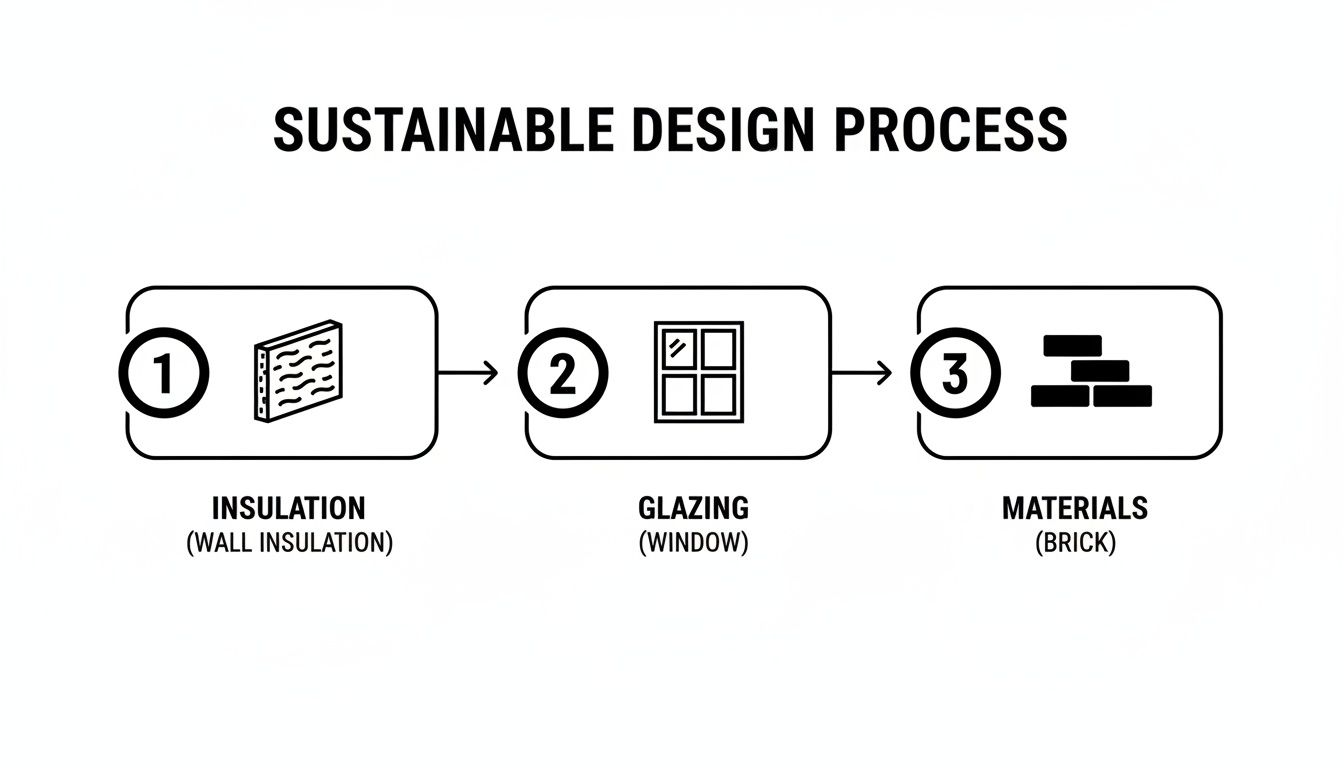
This focus on integrating high-performance elements ensures your extension is not only beautifully designed but also energy-efficient and comfortable year-round. You can learn more about how we apply this framework by exploring the full details of our architectural process.
Common Questions About L-Shaped Extensions
To help you move forward with confidence, we've gathered the most common questions we get asked about L-shaped extensions. The answers are straightforward and practical, tackling the key concerns that might still be on your mind. Our goal is to clear up any final uncertainties so you can take the next step.
How Long Does Building an L-Shaped Extension Take?
The timeline really depends on the scale of the project and the planning route we need to take. As a general guide, you should set aside around 3-4 months for the design and planning approval phase. This initial period is vital for getting the detailed plans right and securing consent from the local council.
Once we have the green light, the construction phase itself typically takes between 4 to 6 months. Our structured 8-step process is specifically designed to manage each stage efficiently, which helps minimise delays and ensures a smooth, well-managed build from start to finish.
Are L-Shaped Extensions Suitable For Every Property?
They are exceptionally well-suited to semi-detached and end-of-terrace homes, especially the Victorian and Edwardian properties common across South West London that already have a side return. They are also a brilliant solution for detached houses, particularly those on corner plots where space can be properly maximised.
While it's possible to build them on mid-terrace houses, this usually involves more complex structural work and navigating Party Wall Agreements with neighbours on both sides. An initial consultation with us can quickly establish what’s feasible and the best architectural approach for your specific home.
One of the biggest wins with an L-shape is its ability to capture light from two different directions. We always look to amplify this by incorporating large-scale glazing like bi-fold doors and strategically placing rooflights over key areas, like a kitchen island or dining table. It's a signature part of our design philosophy.
Will I Need My Neighbours' Permission?
While you don't need their 'permission' in a planning sense, you are legally required to notify them under the Party Wall etc. Act 1996 if you are building on or near the boundary line. For L-shaped extensions in densely populated areas of London, this is almost always the case.
This formal notification is a legal duty designed to protect everyone involved. We manage the entire Party Wall Agreement process on your behalf, making sure all obligations are correctly met while aiming to keep things positive and cooperative with your neighbours throughout the project.
Ready to unlock your home's potential with a beautifully designed L-shaped extension? The team at Harper Latter Architects is here to guide you through every step, from initial concept to flawless completion.