
Home Renovation Contract: Your Guide to a Smooth Project

Updated: 13 hours ago
Think of a home renovation contract as more than just a piece of paper. It’s a legally binding agreement that maps out every single detail of your project, from the scope of work and payment schedule to the specific materials and completion dates. In essence, it becomes the single source of truth for your build, protecting both you and your builder from costly misunderstandings down the line.
Your Contract Is Your Most Important Tool

It’s tempting to see the contract as a formality, but it’s actually the master blueprint for your entire project. Just like an architect’s drawings, a well-drafted contract prevents crossed wires, manages everyone's expectations, and provides a solid foundation for success.
Embarking on a renovation, whether it's a kitchen extension in Wimbledon or a loft conversion in Richmond, is a huge emotional and financial investment. Your contract is the primary tool you have to safeguard that investment.
Defining Your Project on Paper
A clear, detailed agreement is your best defence against the classic renovation nightmares: spiralling budgets, unexpected delays, and disagreements over the quality of work. It’s the bridge that turns conversations and design ideas into a concrete, actionable plan everyone has signed off on.
With over half of UK homeowners (51%) now undertaking renovations and the median spend hitting £21,440, the financial stakes have never been higher. This surge in home improvements really shines a light on why a robust contract is absolutely essential.
This guide will walk you through what makes a contract truly protective, giving you the confidence to navigate your renovation from start to finish. It’s all about making sure every detail, from the exact shade of Farrow & Ball to the project handover date, is documented and agreed upon before the first hammer swings.
A great contract does more than just list tasks; it builds a relationship of trust and transparency between you and your contractor, ensuring the project aligns perfectly with your vision from start to finish.
Understanding what goes into an effective contract is the very first step toward a successful build. In fact, a well-defined contract is fundamental to our process, turning architectural concepts into beautifully realised living spaces. It provides a clear roadmap, ensuring the journey is smooth and the outcome meets the highest standards, right from the initial consultation through to completion.
Understanding the Key Clauses in Your Contract
A home renovation contract can feel like a mountain of dense legal jargon. I get it. But the best way to think about it is as the project's official rulebook. It's there to make sure everyone – you and your builder – knows exactly what's expected of them, from the first day on site to the final handover.
Once you start breaking down the individual clauses, the whole thing becomes much less intimidating. When you know what each part is for, you can review any contract with confidence, spotting potential issues before a single hammer is swung. This document isn't just a formality; it's your single most important tool for a smooth, predictable renovation.
The Foundation: The Scope of Work
The Scope of Work is, without a doubt, the most important clause in the entire document. It needs to be an incredibly detailed, exhaustive description of every single task the builder will perform. Think of it as the ultimate to-do list for your project, leaving absolutely no room for dangerous assumptions.
A vague scope like "renovate kitchen" is a massive red flag. A proper one will detail everything: "Supply and fit Howdens Clerkenwell Super Matt kitchen units in Marine Blue, including all specified handles, soft-close hinges, and internal shelving." It should specify everything from demolition and structural changes right down to the exact models of taps and the precise paint colours for the walls.
This diagram shows a simplified view of the core elements, with the Scope of Work sitting as a primary pillar alongside payments and warranties.
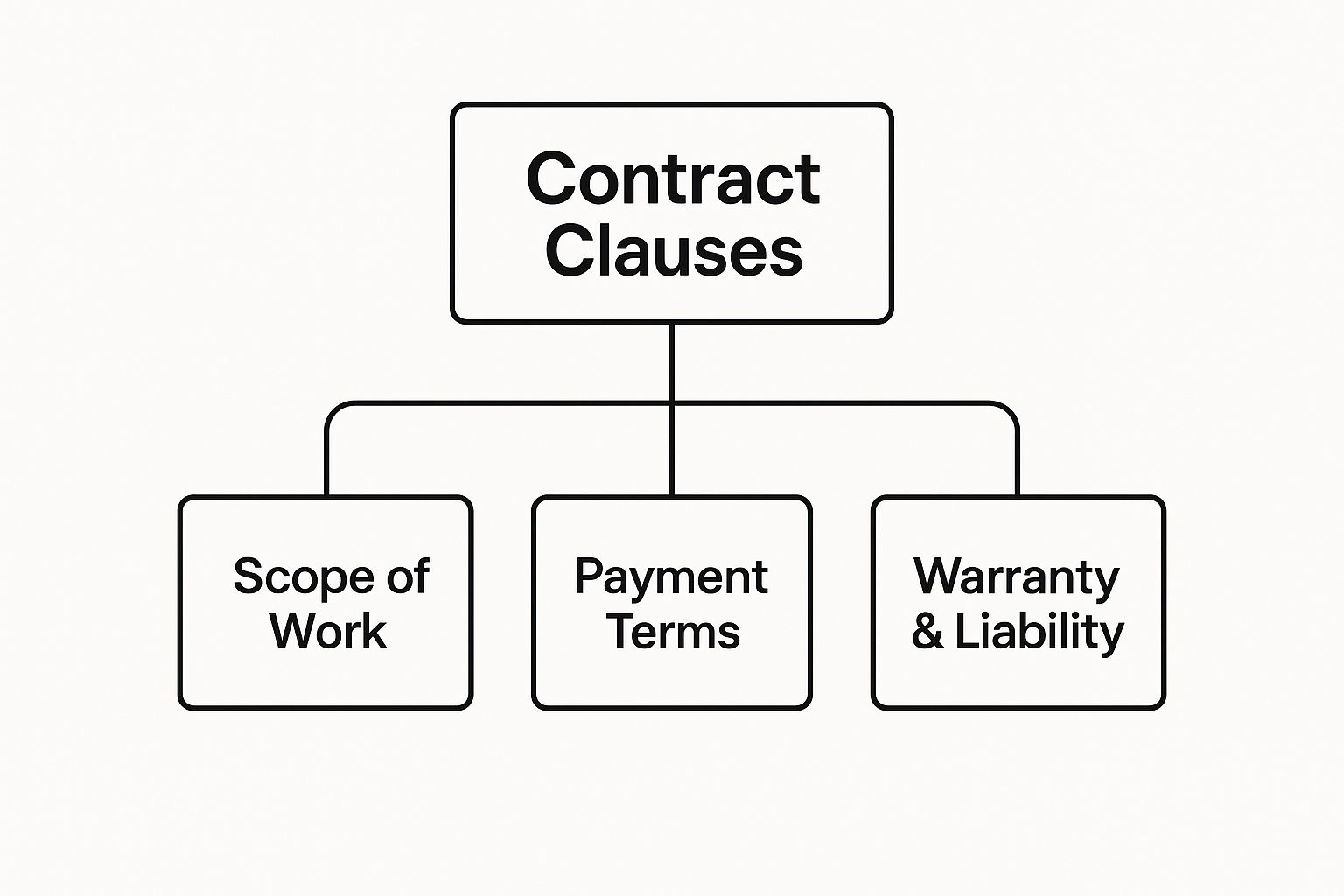
As you can see, a solid contract is built on these three fundamental areas, each protecting a different, vital aspect of your project.
Mapping Out Finances and Timelines
Next up are the clauses that control the money and the clock – often the two biggest sources of stress in any renovation. Having these clearly defined from the outset is essential for keeping control and managing everyone's expectations.
Payment Schedule: This sets out when and how much you will pay your builder. Crucially, payments should be linked to the completion of specific, tangible milestones, not just random dates on a calendar. For instance, a payment might be due after the foundations are complete, another when the roof is watertight, and so on.
Project Timeline: This section needs a clear start date, a projected completion date, and key dates for major phases in between. It gives you a benchmark to measure progress against and helps hold your contractor accountable.
Change Orders: Let's be realistic – almost no renovation goes exactly to plan. A change order clause creates a formal, written process for any tweaks or additions to the original Scope of Work. This ensures that any changes to cost or timeline are agreed upon by both of you before the extra work begins, preventing nasty surprise bills at the end.
A demand for a large upfront deposit (anything over 15%) is a major warning sign. Payments should always correlate with completed work, protecting your investment and incentivising the builder to make consistent progress.
Ensuring Quality and Protection
Finally, a robust contract needs clauses that define the quality of the work and give you a safety net if things don't go to plan. These are your guarantees of a professional finish and your ultimate peace of mind.
Clauses covering Materials and Workmanship should specify the quality standards you expect. This might mean referencing official British Standards or simply stating that all materials must be new and fit for purpose. It’s your defence against shoddy work or corner-cutting.
The contract must also confirm the builder holds adequate Insurance, specifically Public Liability and Contractors' All Risks insurance. This is what protects you financially if there's an accident on site or damage to your property during the build. Lastly, look for a Warranty clause, which guarantees the contractor will come back and fix any defects in their work for a set period after completion.
To make this easier to digest, here's a quick summary of the most important clauses and what you should be looking for when you review them.
Essential Contract Clauses and What to Check
Clause | Purpose | What to Verify |
|---|---|---|
Scope of Work | To detail every single task, material, and finish included in the project. | Check for extreme detail. Vague descriptions like "install new bathroom" are unacceptable. It should list specific models, brands, and colours. |
Payment Schedule | To define when and how much you will pay the contractor. | Ensure payments are tied to tangible milestones (e.g., "foundations complete"), not arbitrary dates. Avoid large upfront deposits. |
Project Timeline | To set clear start and finish dates and key project phases. | Look for a specific start date and an estimated completion date. Are there penalties for significant, unexcused delays? |
Change Orders | To establish a formal process for any changes to the original plan. | Verify that any changes must be documented in writing and signed by both parties before the work is carried out, including cost and time implications. |
Materials & Workmanship | To define the expected quality standard for all work and materials used. | The clause should state that all materials will be new and work will meet or exceed British Standards or other recognised industry standards. |
Insurance & Liability | To confirm the builder is insured against accidents, damage, and injury. | Ask for a copy of their current insurance certificates for Public Liability and Contractors' All Risks insurance. Check the expiry dates. |
Warranties/Guarantees | To guarantee the contractor will rectify defects after completion. | The contract should specify a warranty period (typically 6-12 months) for workmanship and detail the process for making a claim. |
Taking the time to understand these sections before you sign anything is one of the smartest investments you can make in your project. It turns a daunting legal document into a clear, agreed-upon plan that protects everyone involved.
Managing Your Budget and Payment Schedule

Financial surprises are easily the biggest source of stress during a renovation. A well-structured home renovation contract is your best defence against them, making sure every pound is accounted for and spent exactly as you planned. It turns a vague budget estimate into a predictable, manageable roadmap for your project.
The contract’s core financial component is the payment structure. For many projects here in South West London, homeowners and builders lean towards a fixed-price contract. This sets the total cost upfront, which is great for budget certainty. The key, however, is to ensure the scope of work is detailed with surgical precision to avoid unexpected extra charges down the line.
The alternative is a cost-plus contract. Here, you pay for the actual cost of labour and materials, plus an agreed fee or percentage for the contractor's profit and overheads. This route offers more flexibility if you suspect the project might evolve, but it demands close supervision from you to keep costs from spiralling. The right choice really comes down to your project's complexity and your personal comfort level with financial risk.
Negotiating a Fair Payment Schedule
Think of the payment schedule as the engine that keeps your project running smoothly and fairly. It protects both you and your builder. The golden rule? Link every single payment to the completion of a specific, tangible milestone. This creates a simple, fair exchange: you only release funds for work that has been verifiably completed to the right standard.
A typical milestone-based schedule often breaks down something like this:
10% Deposit: Paid upfront to secure your start date and allow for initial material orders.
25% Payment: Released once major structural work is finished (e.g., foundations poured, steelwork in place).
25% Payment: Due when the property is watertight (meaning the roof is on and windows are installed).
25% Payment: Paid after the "first fix" of electrics and plumbing is complete.
10% Payment: Handed over upon practical completion, just before the final snagging list is tackled.
5% Retention: The final payment, which you hold back until every last snag is sorted.
This tiered structure ensures your financial risk is always capped at the value of the work already done. With UK renovation spending varying so much—17% of homeowners plan to invest between £5,001 and £10,000, while 10% will spend over £20,000—it's clear why your contract needs to be tailored to your specific budget and project scale.
The Power of Retention
The concept of retention is one of the most powerful safeguards a homeowner has. It’s a small slice of the total project cost, usually 2.5% to 5%, that you deliberately hold back even after the main work is finished.
Think of retention as your project's 'security deposit'. It’s your final piece of leverage to ensure the builder returns promptly to fix any minor defects or "snags" on the final checklist to your complete satisfaction.
This final amount is only released when you've signed off on every last detail. Including a retention clause is a non-negotiable part of any contract that truly protects your investment and guarantees a high-quality finish. Of course, these payments are just one part of the bigger picture; understanding the **cost of an architect in the UK** is another vital piece of the puzzle when planning your overall budget.
How to Handle Project Delays and Changes
Even with the most detailed plans, renovations rarely go exactly as expected. Life happens. A wall comes down revealing a structural surprise, or a once-in-a-decade storm stops all exterior work. Your home renovation contract is your playbook for navigating these bumps in the road, ensuring delays and changes are handled fairly, without turning into a source of stress or dispute.
A good contract doesn't pretend problems won't happen; it prepares for them. It draws a clear line between different kinds of delays. For instance, discovering asbestos behind a wall or severe weather holding up roofing work are typically considered excusable delays – they are genuinely outside of anyone's control.
On the other hand, inexcusable delays are those that fall squarely on the contractor’s shoulders. Think poor planning, failing to order materials on time, or general disorganisation. A well-drafted contract will spell out exactly how each scenario is treated, so you aren’t left paying for someone else’s poor management.
Introducing the Change Order Process
Almost every renovation project evolves as it progresses. You might see the new kitchen taking shape and suddenly decide you want different splashback tiles, or perhaps a supplier discontinues the worktop you had your heart set on. This is precisely why the Change Order process is so vital.
A Change Order isn't a casual chat or a quick text message. It’s a formal, written amendment to the original contract that documents any deviation from the initial plan. Think of it as an official update that keeps everyone on the same page.
A proper Change Order has to clearly state three things: the exact nature of the change, the impact on the total project cost (whether it’s an extra charge or a credit), and any adjustment to the final completion date.
This formal step is your best defence against "scope creep"—that all-too-common situation where small, undocumented changes slowly inflate your budget without you even realising it. It ensures that both you and your builder agree on the details before any new work starts. For complex projects like the [refurbishments and extensions](https://www.harperlatterarchitects.co.uk/refurbishments-extensions) we often manage in South West London, this structured approach is non-negotiable.
Navigating Delays in a Busy Market
The UK construction industry is incredibly busy at the moment, with a significant rise in new orders putting a strain on labour and materials. For homeowners, this pressure makes a watertight contract more important than ever. It’s your tool for locking in timelines and managing expectations when shortages inevitably cause hold-ups. You can learn more about the current state of the UK construction industry to understand these market pressures.
Your contract should insist on a clear communication protocol for when delays do occur. It should require your builder to give you immediate written notice explaining why there's a delay and what their proposed plan is to get back on schedule. This kind of transparency is the foundation of a good working relationship and is absolutely key to keeping things moving forward.
Your Legal Safeguards and Dispute Resolution

While a well-drafted home renovation contract is your best tool for preventing problems, it absolutely must prepare for them too. Think of this part of the document as your project’s insurance policy. It spells out your legal protections and gives you a clear, pre-agreed roadmap for what to do if things go seriously off track.
Understanding these clauses brings real peace of mind. You’ll know that if a major disagreement pops up, you have a clear process to follow, turning a potential crisis into something far more manageable.
The Non-Negotiables: Insurance and Warranties
Before a single hammer is swung, your contract must confirm that your builder has the right insurance cover. This isn't just a bit of admin; it's a fundamental shield for your home and your finances. Without it, you could find yourself liable for accidents on your own property.
There are two key types of insurance your contract needs to verify:
Public Liability Insurance: This is crucial. It covers the cost of claims if someone is injured or property is damaged as a result of the building work. For example, if a falling tile were to damage your neighbour’s car, this insurance would cover it.
Contractors' All Risks Insurance: This is a more specialised policy that protects the project itself. It covers the work in progress and materials on-site against things like theft, fire, or storm damage. It ensures that if a batch of expensive glazing is stolen or the new structure is damaged, the financial hit doesn't land on you.
Beyond insurance, the contract must detail the warranties for the workmanship. This clause is a written promise that your builder stands by the quality of their work. It means they will return to fix any defects that appear within a set period – typically 6 to 12 months after the project is finished.
Always ask to see a current Certificate of Insurance before you sign anything. Don't just glance at it – check the policy limits and the expiry date to make sure the cover is adequate for the scale of your renovation.
Charting a Course for Dispute Resolution
Even with the best people and intentions, disagreements can happen. The difference between a minor hiccup and a full-blown legal battle often comes down to having a clear, contractually defined process for resolving disputes. A solid contract takes the emotion and guesswork out of the equation.
Instead of jumping straight to costly and stressful court action, a good contract will outline a tiered approach. This structure is designed to find a fair outcome as efficiently as possible.
The process usually looks something like this:
Formal Written Notice: The first step is always to put the issue in writing, pointing to the specific parts of the contract that are relevant. This creates a formal record.
Negotiation: The contract should then require both parties to meet and negotiate in good faith to try and find a solution together.
Mediation: If talking it out doesn’t work, the next step is often mediation. Here, a neutral third-party professional helps guide the conversation towards a mutually agreeable settlement. It's not about winning, it's about resolving.
Adjudication: For construction-specific disputes, adjudication is a faster, less formal alternative to court. An expert adjudicator reviews the case and makes a binding decision, keeping things moving.
By mapping out these steps in your home renovation contract, you create a predictable framework. It ensures any issues are tackled constructively, protecting your relationship with your builder and, most importantly, keeping your project on the right path.
Common Questions About Renovation Contracts
Getting your head around a home renovation contract can feel a bit like learning a new language, but it’s absolutely vital for protecting your investment. To help cut through the jargon, we’ve put together some straightforward answers to the questions we hear most often from UK homeowners. The goal? To give you the clarity you need to sign on the dotted line with complete confidence.
What Is a JCT Contract and Should I Use One?
Think of a JCT (Joint Contracts Tribunal) contract as the industry-standard, off-the-shelf agreement for building projects across the UK. For homeowners embarking on a significant project, the specific one to look for is the ‘JCT Building Contract for a Home Owner/Occupier’.
While you’re not legally forced to use one, we strongly recommend it. Why? Because a JCT contract provides a fair and balanced legal framework that any reputable builder in London will already be familiar with. It covers all the critical areas we've discussed, saving everyone the headache of drafting a contract from scratch and, more importantly, reducing the risk of misunderstandings or leaving out crucial protections.
My Builder Wants a Large Deposit Upfront. Is This a Red Flag?
Yes, this is a huge red flag. A small, reasonable deposit of around 10-15% to book your slot in their schedule and cover the first batch of materials can be normal practice. But a demand for a large chunk of the budget before a single tool has been lifted is not.
Your payment schedule should be tied directly to progress on-site. The contract should clearly link payments to completed milestones—for example, foundations laid, roof watertight, first-fix electrics complete. This structure is your protection. It ensures you only pay for work that has been finished to the standard you agreed upon, and it gives the builder a powerful incentive to keep things moving.
What Should I Do If the Quality of Work Is Poor?
First things first: document everything. Don't just rely on memory. Take clear photos and make dated, detailed notes of every issue you find. Once you have your evidence, refer to the 'Workmanship and Materials' clause in your contract.
Next, communicate your concerns to the builder formally—in writing—referencing the standards you both agreed to. A well-drafted contract will lay out a clear process for rectifying defects. If the builder doesn't resolve the problems, your contract's dispute resolution clause kicks in, guiding you on the next steps, like mediation. And remember, that final 'retention' payment you're holding back is your ultimate piece of leverage to ensure every last snagging issue is fixed before you pay the final invoice.
Who Is Responsible for Planning Permission and Building Regulations?
This is a point that absolutely must be crystal clear before any work begins. Legally, the ultimate responsibility for complying with local planning permission and building regulations lies with you, the homeowner. Getting this wrong can lead to eye-watering fines or even being ordered to tear down the work at your own expense.
However, your contract must state exactly who is tasked with managing the application process. This role is usually assigned to the architect or the main contractor. Make sure this duty is explicitly written into the scope of work. Whatever you do, never let construction start until you have official written confirmation that all necessary approvals are in place. It’s your best defence against what could otherwise become a legal and financial nightmare.
At Harper Latter Architects, we guide clients through every detail of their project, from the initial concept to the final, legally sound contract. Our rigorous process ensures your renovation is built on a foundation of clarity and trust.
Ready to start your bespoke renovation in South West London with confidence? Contact us today for an initial consultation.

Comments