
A Guide to Basement Conversion in London

A basement conversion in London is one of the smartest ways to add significant living space and value to your property, especially when extending upwards or outwards just isn't an option. It’s all about transforming an existing cellar or digging out a new subterranean level to create beautiful, functional rooms that feel like a natural part of your home.
Why London Homeowners Are Building Down
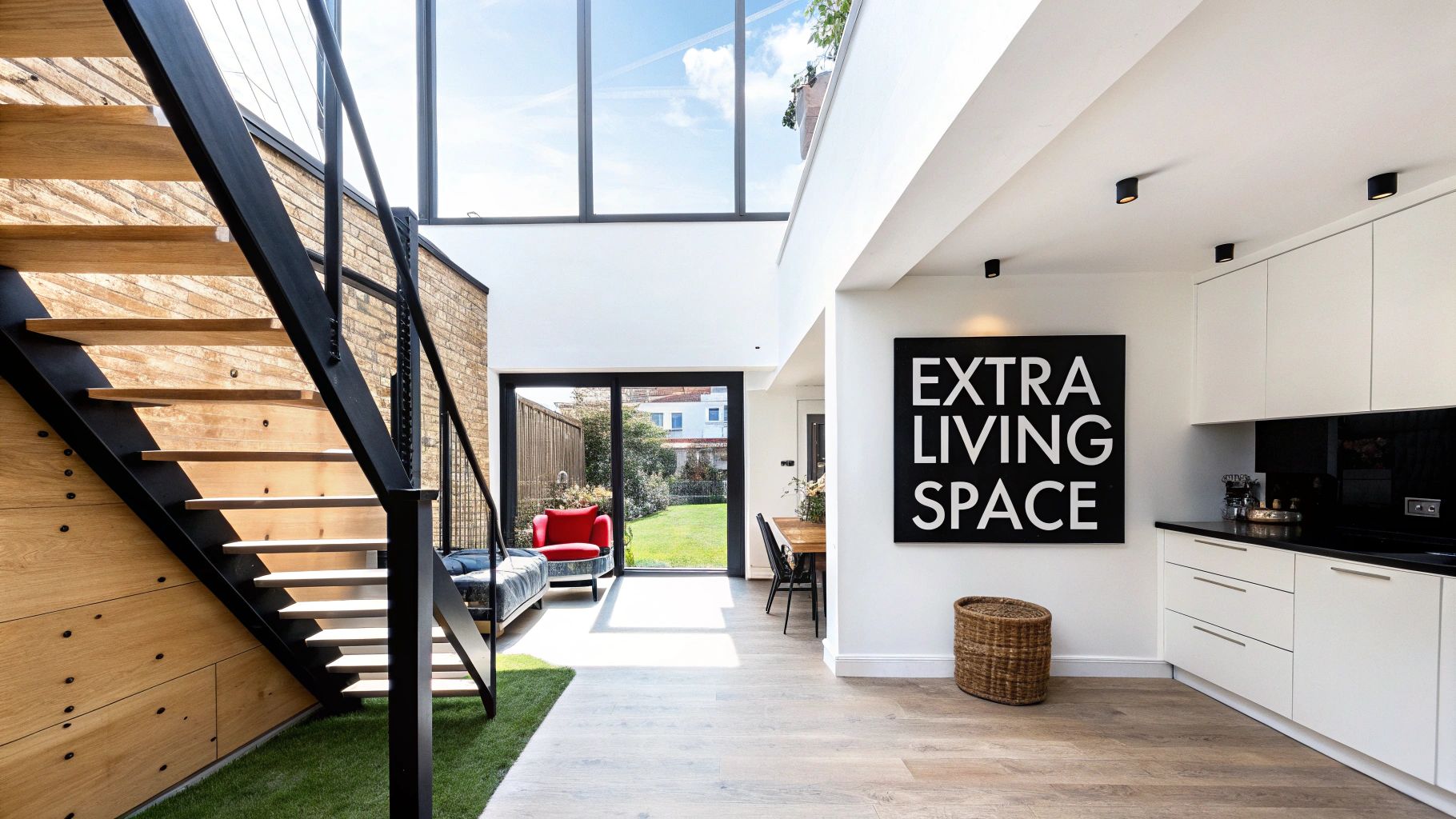
In a city defined by a fiercely competitive property market and notoriously strict planning rules, building down has become the go-to solution for Londoners needing more space. When your garden is precious and the loft has already been converted, the only way left to go is down.
This approach cleverly sidesteps many of the usual headaches that come with traditional extensions. It allows you to add substantial square footage without changing the external look of your property—a game-changer, particularly in conservation areas. For many, it's not just about getting an extra room; it's a strategic move that enhances both their lifestyle and their home's market value.
A Modern Answer to Urban Space Constraints
The move towards subterranean living isn't just a fleeting trend. It’s a direct response to London's unique architectural and economic pressures. A study from Newcastle University's School of Architecture paints a clear picture: between 2008 and 2019, London's boroughs gave the green light to a staggering 7,328 basement projects.
This boom has made single-storey basements as common as the loft conversions of previous decades. Unsurprisingly, the activity is most intense in affluent boroughs, with Hammersmith and Fulham alone approving 1,337 projects. These numbers show just how much a basement conversion in London is now seen as a primary route for home improvement, right up there with other major refurbishments and extensions.
A basement conversion reframes your home's potential. It's not about digging a cellar; it's about creating a new ground floor filled with light, luxury, and possibility, tailored entirely to your family’s needs.
More Than Just Extra Rooms
Forget the damp, dark cellars of the past. Thanks to huge advances in waterproofing, lighting, and ventilation, these lower-ground spaces are often transformed into the most desirable parts of a home. They offer a completely blank canvas, giving you the freedom to create bespoke environments that simply wouldn't be possible in the rest of a period property.
The only real limit is your imagination and what your lifestyle demands:
Entertainment Hubs: Think custom-built home cinemas, games rooms, or even a private bar for hosting friends.
Wellness Sanctuaries: Create your own private gym, a peaceful yoga studio, a sauna, or a spa-like bathroom to escape the city buzz.
Functional Spaces: Get that dedicated home office you've always wanted, a guest suite with its own bathroom, or a secure, temperature-controlled wine cellar.
Family Living: Design an expansive playroom for the kids or a self-contained apartment for a nanny, grandparents, or young adults.
Ultimately, building down is a unique opportunity to personalise your home. You gain immediate lifestyle benefits while making a long-term financial investment—all without the upheaval and stress of moving.
Navigating Planning Permission and Regulations
Embarking on a basement conversion in London means stepping into a world of specific rules and legal duties. This isn’t just about the build itself; it’s about getting the right approvals to ensure your project is legal, safe, and fair to your neighbours. Getting your head around this framework from day one is the key to a smooth process.
Two completely separate sets of rules will govern your project: Planning Permission and Building Regulations. People often mix them up, but they serve very different purposes. Planning Permission is all about the principle of the development—what you want to build, how big it will be, and its impact on the neighbourhood. Building Regulations, on the other hand, focus on the technical nuts and bolts of the construction, making sure the new structure is safe, energy-efficient, and sound.
For a London basement conversion, you’ll almost certainly need both. This dual requirement highlights just how important it is to have a thorough, well-prepared approach long before any digging starts.
The London Borough Lottery
When it comes to planning, London isn't one big city with one set of rules. Each of the 32 boroughs has its own policies, creating a complex patchwork that can change dramatically from one street to the next. What’s perfectly fine in Wandsworth might be a non-starter in Westminster.
Many councils have also introduced their own Supplementary Planning Documents (SPDs) specifically for basement projects. These documents add yet another layer of local control, often bringing in strict limitations. For example:
Garden Space: The London Borough of Merton’s policy restricts basement excavations to no more than 50% of any garden area.
Single-Storey Limits: The Royal Borough of Kensington & Chelsea typically limits new basements to a single storey in depth.
Front Garden Preservation: Some boroughs insist that at least 50% of a front garden must be left untouched after digging out a lightwell.
Navigating this "borough lottery" demands specialist knowledge. An architect with deep experience in your specific part of London is essential. They can interpret these local quirks, design a proposal with the best chance of approval, and help you sidestep costly mistakes. This is even more critical if your home is a listed building or sits within a conservation area, where the rules get even tighter. To learn more about these specific challenges, you can read about working on conservation and heritage properties in our detailed guide.
Understanding The Party Wall Act
Beyond the council, another crucial piece of legislation comes into play: The Party Wall etc. Act 1996. This Act is designed to protect your neighbours when you carry out excavation or construction work close to a shared boundary or "party wall".
A basement conversion almost always involves work covered by the Act because the excavation will be close to your neighbours' foundations. The Act isn't there to stop you from building; its purpose is to ensure the work is done safely and that any potential damage to adjoining properties is properly documented and put right.
The Party Wall Act is a facilitator, not a barrier. It provides a legal framework for resolving disputes and ensuring your project proceeds with transparency and respect for your neighbours, safeguarding everyone's property.
To comply, you must serve a formal "Party Wall Notice" on all affected neighbours at least two months before you plan to start. They have three choices: consent in writing, dissent and appoint their own surveyor (which you pay for), or dissent and agree to use a single "agreed surveyor" to act impartially for both of you.
Handling this process thoughtfully is vital. Proactive, friendly communication can make a world of difference. By sharing your plans early and addressing any concerns head-on, you can often secure consent without a fuss, fostering goodwill and avoiding the delays and extra costs that disputes can cause. Your architect and a specialist Party Wall Surveyor will guide you through every step, ensuring all your legal obligations are met.
Understanding Costs and Financial Returns
Let's talk about the money. A basement conversion in London is a serious financial undertaking, but it's much more than just an expense—it's one of the smartest investments you can make in your property. Understanding where the money goes and, more importantly, what you get back, is key to making a confident decision that improves your home and grows your equity.
Of course, no two projects are the same. The final figure will always depend on a few key variables: the complexity of the dig, the ground conditions under your home, and just how luxurious you want the finished space to feel.
Breaking Down the Costs
The total budget for a London basement conversion typically falls into three main buckets. Each stage demands specialist skills and comes with its own cost profile, which can shift depending on your project's specific needs.
Professional Fees (£60,000 - £120,000 +VAT): This is the upfront investment in expertise before a single shovel hits the ground. It covers everything from architectural design and planning submissions to structural engineering, site surveys (like geotechnical and drainage reports), and party wall surveyor fees.
Shell and Core Construction (£2,700 - £3,500+ per m² +VAT): This is the heavy lifting—the cost of the structural work itself. It includes the excavation, underpinning your existing home, forming a waterproof concrete box, installing drainage, and fitting structural glass for lightwells.
Fit-Out (£1,200 - £4,000+ per m² +VAT): This is where your personality comes in, and it's also the most flexible part of the budget. The cost covers everything needed to transform the concrete shell into a liveable, beautiful space—think flooring, lighting, plumbing, bespoke joinery, and all the finishes. A high-spec home cinema will naturally cost more to fit out than a simple guest bedroom.
We always advise clients to set aside a contingency fund of 15-20% of the total project cost. Think of it as a financial safety net. It’s there to absorb any surprises, like tricky ground conditions or design tweaks along the way, ensuring your project stays on track without cutting corners.
Realistic Cost Estimates for Your Project
To give you a clearer idea, the table below breaks down the typical costs per square metre for different types of basement projects. Naturally, upgrading an existing cellar is a much lighter touch than digging out a brand-new level from scratch.
Here's a look at what you can expect for the structural shell, excluding VAT and professional fees.
Estimated Costs for a London Basement Conversion
Project Stage / Specification | Typical Cost Range per m² |
|---|---|
Upgrading an Existing Cellar | £1,200 - £1,800 |
Lowering Floor & Underpinning | £2,000 - £3,000 |
New Excavation (Shell & Core) | £2,700 - £3,500+ |
New Excavation Under Garden | £3,000 - £4,000+ |
As you can see, the more complex the structural work, the higher the baseline cost. Digging out under a garden, for instance, often involves more complicated access and landscaping reinstatement, which pushes the price up.
The Impressive Return on Investment
While the initial outlay is significant, the payback on a London basement conversion is exceptionally strong. In a city where every square metre is precious, building down is a proven strategy for boosting your home's market value, often by far more than you spend.
On average, basement projects increase a property’s value by 15-25%. In prime central postcodes, that uplift can easily top 25%.
To put it in numbers, a well-executed conversion can add between £8,500 and £10,000 per square metre to your home's value across the city. In ultra-desirable boroughs like Kensington & Chelsea, Camden, or Westminster, that figure skyrockets to £19,000 per square metre.
This means converting just 50m² could add hundreds of thousands of pounds to your property’s worth, delivering a powerful ROI of 60-90%. This isn't just a home improvement; it's a powerful financial move. To learn more, you can explore detailed market analysis and future trends.
Solving Key Structural and Technical Challenges
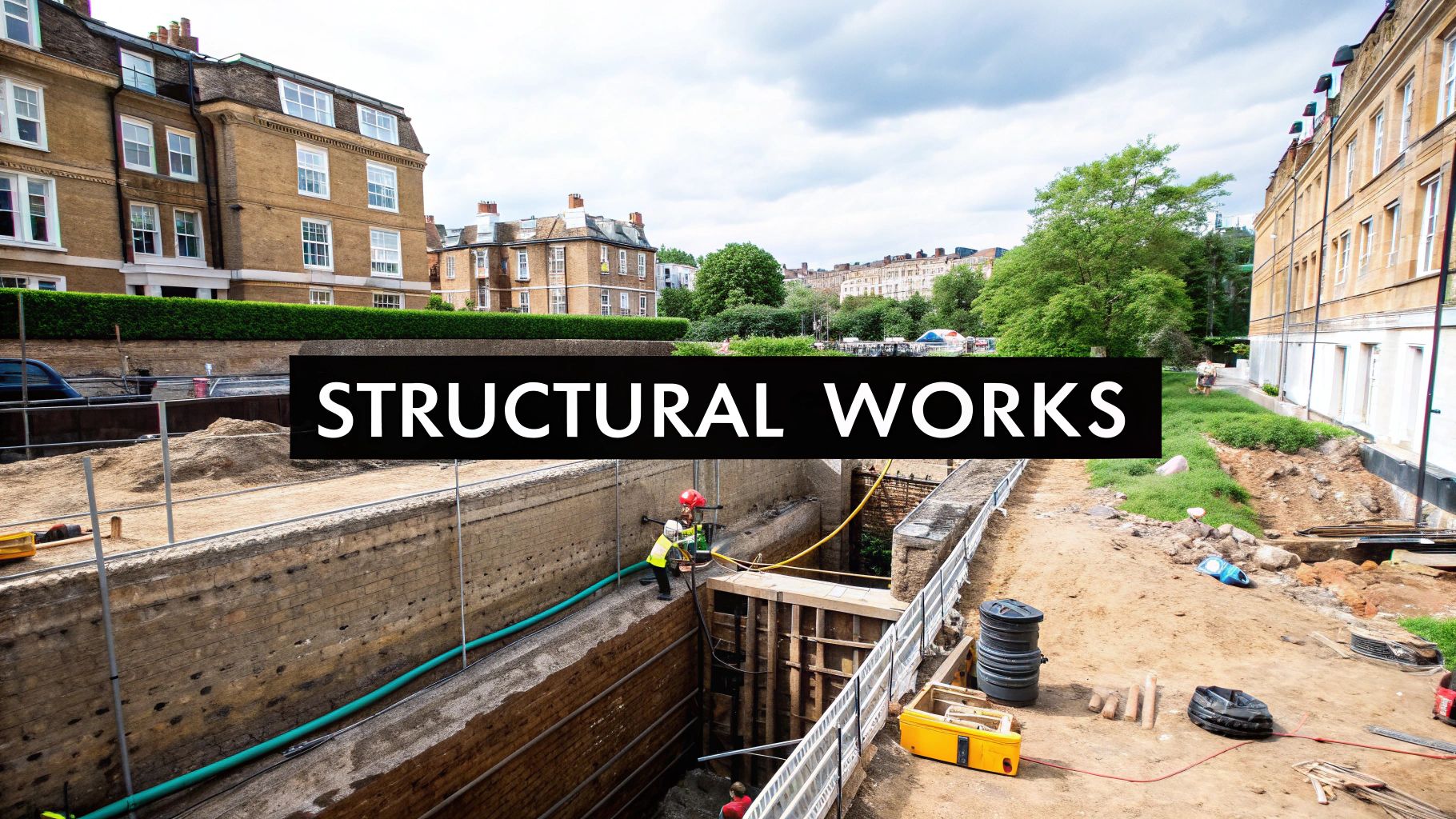
A basement conversion in London is far more than an interior design project. It’s a serious feat of civil engineering happening right beneath your feet. Understanding the key structural and technical hurdles is essential, as getting them right is the difference between a stunning subterranean asset and a costly, damp liability. These challenges are exactly why specialist expertise isn’t just a recommendation—it’s a necessity.
The first major undertaking is underpinning. This is the process of strengthening your home’s existing foundations. Essentially, your contractor digs out sections beneath your house in a carefully controlled sequence, pouring new, deeper concrete foundations. This transfers the entire weight of your home to a lower level, creating a stable base for the new basement to be built within.
Mastering the Unseen Forces Below Ground
Beneath the streets of London lies a complex mix of geology, including different soil types and, most importantly, the local water table. Managing groundwater is one of the most critical aspects of any dig. The water table—the level at which the ground is saturated—can fluctuate with the seasons and rainfall. An experienced team will always start with a geotechnical survey to understand these conditions and design a structure that can resist the immense hydrostatic pressure this water exerts on your new walls.
This brings us to the science of waterproofing, which is arguably the single most important technical element of your project. A leaky basement is a homeowner's worst nightmare, which is why UK construction follows a rigorous standard known as BS 8102. This code of practice outlines three types of waterproofing systems designed to keep subterranean spaces bone dry.
Type A (Barrier Protection): Think of this as a waterproof jacket wrapped around the concrete shell of your basement to physically block water from getting in.
Type B (Structurally Integral Protection): With this method, the concrete structure itself is designed and mixed to be watertight. Special additives are used in the concrete to make it impermeable.
Type C (Drained Protection): This is a clever system that accepts that some water might get through the outer walls. It uses a dimpled membrane on the internal walls to create a small cavity, channelling any moisture down to a sump and pump system, which then safely pumps it away.
For a London basement conversion, relying on a single system is a risk not worth taking. Best practice, and what any reputable specialist will insist upon, is a dual system—often combining Type B and Type C—to provide multiple layers of protection and total peace of mind.
Overcoming Logistical and Architectural Hurdles
Beyond the earthworks and waterproofing, there are plenty of practical, on-the-ground challenges to solve. London's tight urban environment means site access is often restricted. Getting excavators onto the property and, just as importantly, removing hundreds of tonnes of soil requires meticulous planning. This often involves running conveyor belts straight through the house to a skip on the street.
Equally important is ensuring your new space doesn't feel like a bunker. The architectural design must cleverly introduce natural light and fresh air to make the basement feel seamlessly connected to the rest of the home. This is usually achieved through smart solutions like:
Lightwells: Large, glazed openings dug into the front or rear gardens that flood the space with daylight.
Walk-on Glass: Structural glass floors or rooflights that allow light from the ground floor to filter down.
Sun Pipes: Highly reflective tubes that capture sunlight at roof level and channel it down into the deepest parts of the home.
These technical and logistical complexities highlight a clear truth: a successful basement conversion in London depends entirely on the expertise of your team. From structural engineers to waterproofing specialists, every professional plays a vital role in transforming raw earth into a beautiful, secure, and enduring part of your home.
Designing Your Ideal Subterranean Space
Once the structural complexities are handled, you can turn your attention to the most exciting part of the journey: shaping your vision. A basement conversion in London offers a rare blank canvas, free from the constraints of your home's existing layout. This is your chance to create a space driven entirely by your lifestyle, moving far beyond extra bedrooms to build extraordinary, personal amenities.
The key is to think without limits. Forget the old stereotypes of dark, damp cellars; today’s subterranean spaces are bright, airy, and seamlessly integrated with the rest of the home. Modern designs are architectural statements in their own right and can easily become the most desirable rooms in the property.
Creating a Destination Within Your Home
The true luxury of a basement is its ability to house bespoke environments that simply wouldn't fit anywhere else. It allows you to bring your passions and hobbies to life, creating dedicated zones for entertainment, wellness, or pure indulgence. This is where a basement conversion in London evolves from a practical extension into a transformative lifestyle upgrade.
Imagine creating your own private retreat, tailored perfectly to you:
Home Cinemas: Go beyond just a large screen and a comfy sofa. Think tiered seating for an authentic cinematic experience, professional-grade acoustics, integrated mood lighting, and even a dedicated bar area for refreshments.
Private Wellness Suites: Build a sanctuary to escape the city's hustle. This could include a personal gym with state-of-the-art equipment, a tranquil yoga studio, a traditional Finnish sauna, a steam room, or even a massage and treatment room.
Climate-Controlled Wine Cellars: For the connoisseur, a basement provides the perfect stable environment for a serious collection. You can design a stunning, temperature-controlled cellar with bespoke racking, elegant display areas, and an adjoining tasting room for entertaining guests.
Subterranean Swimming Pools: The ultimate in subterranean luxury, a private swimming pool offers year-round fitness and relaxation. When combined with spa facilities, it creates an unparalleled wellness hub right beneath your home.
Elevating the Design with Light and Bespoke Features
Great subterranean design is an art form, one that balances ambitious ideas with architectural intelligence. The goal is to make the space feel as open, bright, and inviting as any other floor in your house. Achieving this requires clever strategies to maximise light and create a sense of volume.
Large lightwells at the front or rear are essential, acting as sunken courtyards that draw daylight deep into the space. Walk-on structural glass can be used to pull light down from the floor above, creating visual connections between levels. A strategic lighting scheme—combining ambient, task, and accent lighting—is also crucial for crafting the right atmosphere.
A statement staircase does more than just connect floors; it becomes a sculptural centrepiece that sets the tone for the entire conversion. It’s an architectural handshake, welcoming you into a beautifully realised new part of your home.
This is also where bespoke features come into their own. Custom joinery, from built-in media units in a cinema room to elegant wardrobes in a guest suite, ensures every inch of space is used effectively. The choice of materials, finishes, and detailing is what elevates the final result from functional to exceptional. Integrating these elements requires a holistic approach, which is where specialist knowledge of interior architecture becomes invaluable.
Ultimately, your basement design should be a direct reflection of you. By collaborating with an experienced architect, you can translate your boldest ideas into a functional, beautiful, and light-filled reality that adds immense value to both your property and your daily life.
Assembling Your Expert Team
A basement conversion in London is a complex and high-stakes project. There's no getting around it. The success of your build and the quality of the finished space hinge entirely on the professionals you bring on board. Assembling the right team isn't just a preliminary step—it's the single most important decision you'll make.
Each project needs a symphony of specialists working in close collaboration. Trying to manage this intricate process without expert guidance is a recipe for stress, delays, and costly mistakes. Think of a cohesive, experienced team as your best insurance policy, making sure every technical, legal, and creative detail is handled with precision from day one.
Your Core Professional Team
For a seamless basement conversion, there are four key roles that are simply non-negotiable. Each professional brings a distinct skillset to the table, and their ability to work together is what will bring your vision to life safely and efficiently.
The Architect: This is your creative lead. The architect translates your lifestyle needs into a beautiful, functional design. They are also responsible for navigating the labyrinth of local planning policies, securing the necessary permissions, and acting as your primary advocate throughout the project. Always look for a RIBA-accredited practice with a strong portfolio of London basement projects.
The Structural Engineer: This expert is responsible for the technical integrity of your project. They design the underpinning, the concrete structure, and all the load-bearing elements, ensuring your home remains stable and secure both during and after the excavation.
The Party Wall Surveyor: An impartial specialist who manages the legal obligations under the Party Wall etc. Act 1996. Their job is to ensure your neighbours' properties are protected and that all legal protocols are followed, preventing disputes and keeping the project on good terms with those living next door.
The Specialist Contractor: Not just any builder will do. You need a contractor with proven, specific experience in subterranean construction. They are the ones who handle the physical build—the excavation, waterproofing, and structural work—turning the architectural and engineering plans into a tangible reality.
This diagram shows how creative design concepts can flow into specialised, lifestyle-focused spaces within a new basement.
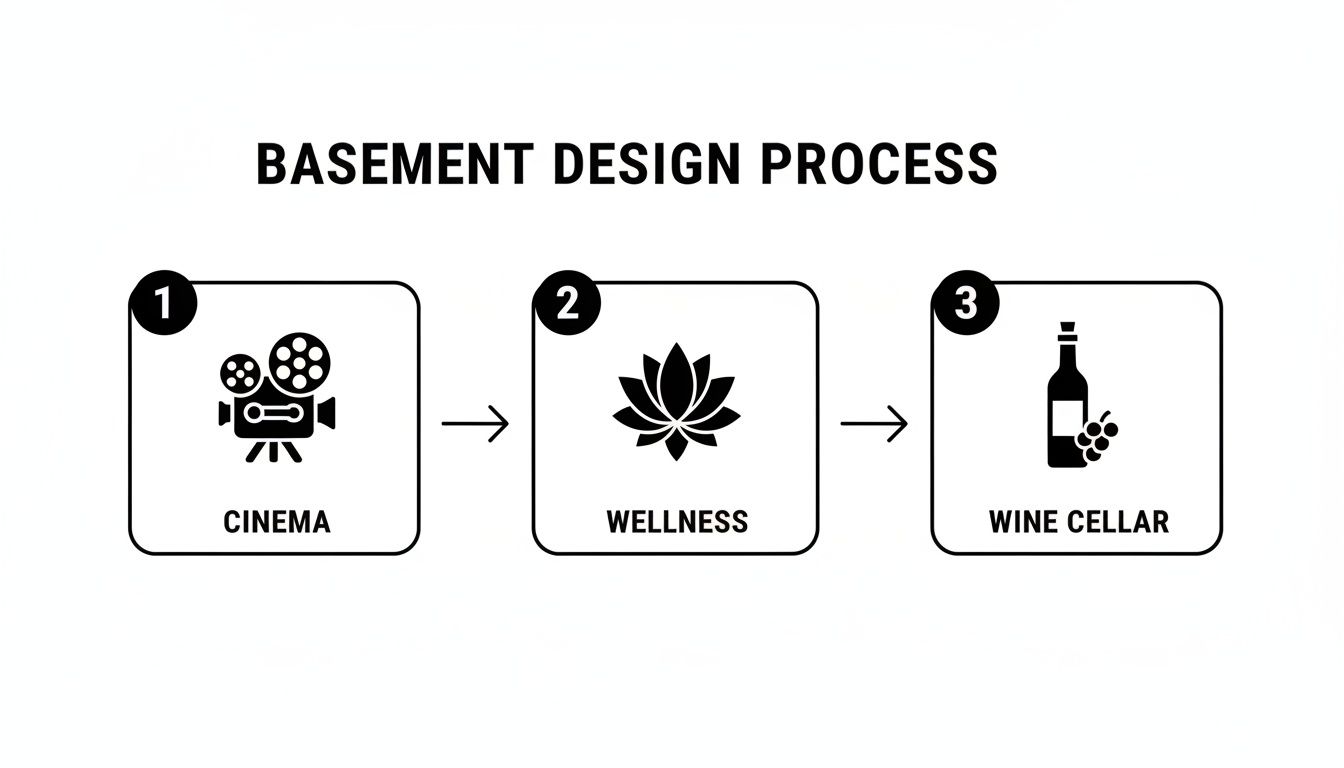
It helps visualise that initial step of turning raw subterranean space into a highly personalised amenity, like a home cinema, a wellness suite, or a bespoke wine cellar.
Our Proven 8-Step Process
At Harper Latter Architects, we’ve developed a structured and transparent 8-step process to guide our clients through the entire journey. This client-focused framework is designed to provide clarity and confidence at every stage, from the first spark of an idea to the final handover of your stunning new space.
A structured process demystifies the complexity of a build. It provides a clear roadmap, ensures all key decisions are made at the right time, and transforms a potentially overwhelming project into a managed and even enjoyable experience.
Our approach covers everything you need:
Step 1 Initial Consultation: We start with a complimentary meeting to discuss your vision, your budget, and the feasibility of your project.
Step 2 Concept Design: From there, we develop initial design ideas, sketches, and 3D models to really explore the possibilities for your new space.
Step 3 Planning Submission: We prepare and submit a robust planning application, expertly navigating your local council’s specific requirements.
Step 4 Technical Design: This is where detailed construction drawings and specifications are produced, refining every single technical aspect of the build.
Step 5 Tendering: We manage the entire process of selecting the best specialist contractor for your specific project.
Step 6 Party Wall Awards: Our recommended surveyors handle all the necessary notices and agreements to ensure you're fully compliant with the law.
Step 7 Construction: We oversee the build, ensuring work is completed to the highest standard, on time, and within budget.
Step 8 Completion: Finally, we manage the handover, checking every detail is perfect before you start enjoying your new basement.
This methodical approach positions us as your trusted partner, dedicated to delivering a beautiful, high-value basement conversion in London with professionalism and creative flair.
Frequently Asked Questions
Even with a detailed guide in hand, we find that most clients still have a few specific questions about the realities of a London basement conversion. It’s a major project, after all. This final section tackles some of the most common queries we hear, giving you clear, straightforward answers to help you plan with confidence.
How Long Does a London Basement Conversion Take?
While no two projects are ever the same, a typical timeline for a standard single-storey basement of around 70 square metres is roughly 9-11 months from the day builders arrive on site.
It's helpful to think of the construction in two distinct phases:
Shell and Core (5-7 months): This is the heavy-duty structural part of the job. It covers all the digging, underpinning, creating the waterproof concrete box, and putting in the drainage.
Fit-Out (3-4 months): Once the shell is complete, this is where it all comes to life. Think flooring, electrics, plumbing, plastering, and decorating – turning the concrete structure into a beautiful, liveable space.
Don't forget, this clock only starts after the pre-construction phase is complete. The design work, securing planning permission, and sorting out party wall agreements can add several months to the total project timeline.
Will I Have to Move Out During the Works?
For the most part, you can absolutely stay in your home. The most disruptive period is right at the start during the excavation, as the builders often need to run a conveyor belt through the house to get all the soil out. It’s messy, but it’s temporary.
Once the structural shell is built and fully weatherproofed, the team can usually access the basement independently. This means the internal fit-out causes much less disruption to your daily life.
Careful planning and open communication with your contractor are everything when it comes to living on-site. A good team will work with you to create a schedule that respects your home and keeps the inconvenience to a minimum.
What is the Biggest Risk with a Basement Conversion?
Water. Without a doubt, the single biggest risk is water getting in. A leaking basement is a nightmare scenario – and incredibly disruptive and expensive to fix once everything is finished.
This is precisely why a professionally designed and installed waterproofing system is non-negotiable. We always recommend a dual system, which combines two different methods to provide a failsafe.
The best way to protect your investment is to choose a contractor who has proven, specialist experience in subterranean waterproofing and insists on following the BS 8102 standards to the letter. Make sure your project is also backed by robust guarantees and the right insurance.
Ready to explore the potential beneath your home? The team at Harper Latter Architects combines creative vision with technical excellence to deliver exceptional basement conversions across South West London. Start your journey with a complimentary consultation today.
Comments