
A London Homeowner's Guide to Side Return Extension Planning Permission

It's a common assumption that any side return extension will automatically need planning permission, but that’s not always the case. Many projects can actually be built under Permitted Development rights – a government scheme allowing certain home improvements without a full planning application, which makes for a much quicker and more straightforward process.
Your Essential First Steps for a Side Return Extension
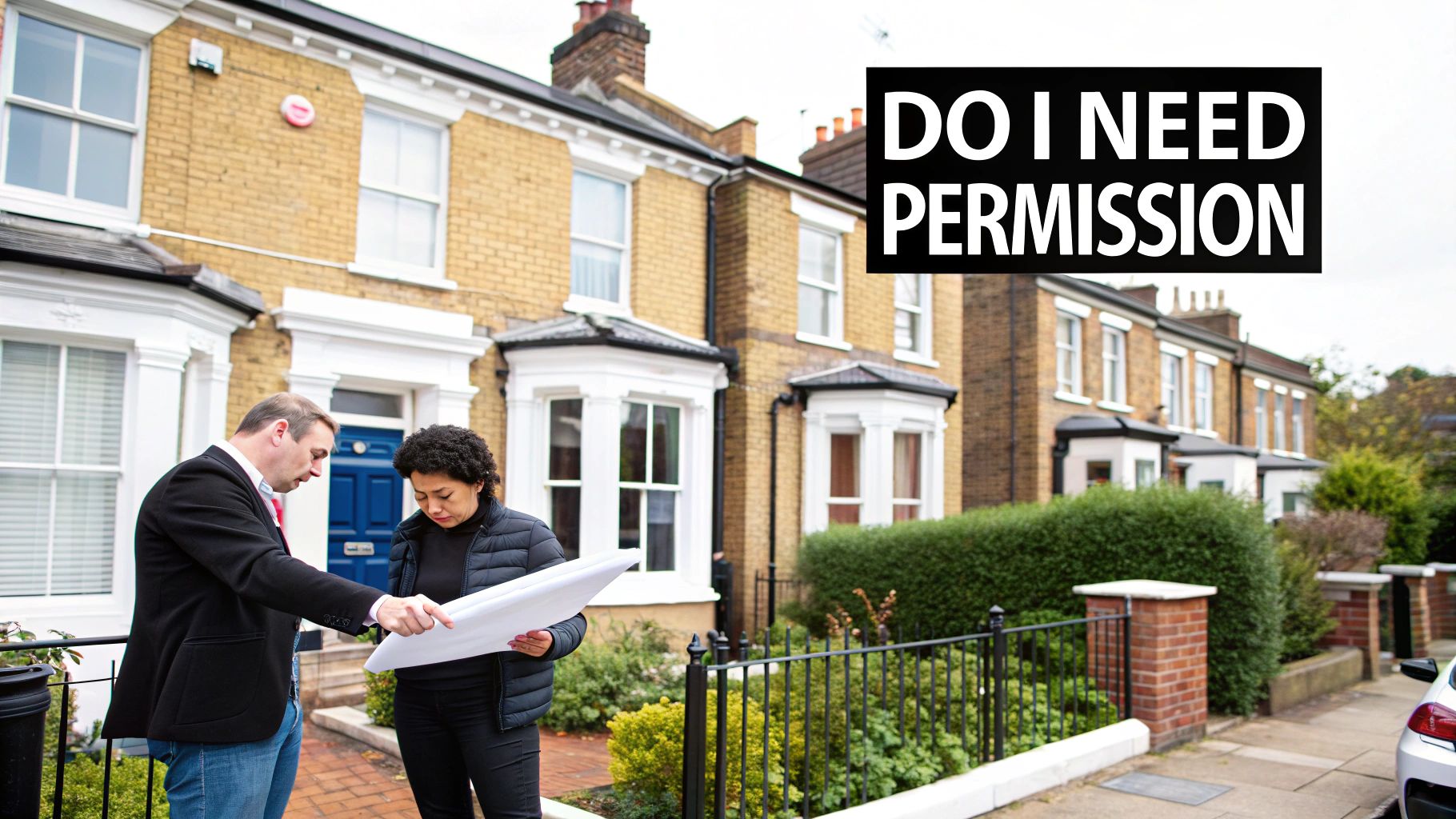
Transforming that narrow, often neglected alleyway alongside your home is one of the most effective ways to enhance a London property. A well-designed side return extension can turn a cramped galley kitchen into an expansive, light-filled hub for your family.
But before you start dreaming of glazed roofs and bi-fold doors, the first hurdle is always the planning system. The journey begins with one crucial question: will your project fall under Permitted Development (PD) rights, or will you need to submit a Full Planning Application? Answering this early on defines your project's timeline, budget, and even its design possibilities.
Understanding Your Two Main Pathways
For many standard extensions, Permitted Development is the ideal route. It provides a set of national rules and limitations; if your design fits within them, you can bypass the more subjective and lengthy full planning process. This is precisely why side returns are so popular – they often align perfectly with PD criteria.
These extensions are a firm favourite for homeowners across the country. In fact, recent government planning statistics show that large householder extensions accounted for 51% of all permitted development applications, with an impressive overall acceptance rate of 78%. You can explore the latest data on permitted development trends yourself on the official government website.
However, navigating the system here in South West London introduces its own unique complexities. Many properties in boroughs like Wimbledon, Richmond, and Wandsworth are subject to specific local constraints that can override these national rights.
Navigating the planning system is the foundational step of any successful extension. Understanding whether you can use Permitted Development or need a full application will shape every decision that follows, from design and materials to your project timeline and budget.
Permitted Development vs Full Planning Application At a Glance
To help you get a clear picture, here’s a quick comparison of the two primary routes for your side return extension.
Factor | Permitted Development (PD) | Full Planning Application |
|---|---|---|
Speed | Faster, typically 6-8 weeks for a Lawful Development Certificate. | Slower, typically 8-12 weeks for a decision, plus pre-application time. |
Design Rules | Strict, objective criteria (height, depth, materials, etc.). | Subjective; assessed against local and national planning policies. |
Cost | Generally lower application fees and design costs. | Higher fees, often requiring more detailed reports and drawings. |
Certainty | High certainty if your design meets all the criteria. | Less certain; depends on the planning officer's interpretation. |
Applicability | Not available in conservation areas, for flats, or on listed buildings. | Required for projects that don't meet PD rules or are in restricted areas. |
While Permitted Development offers a more direct path, a Full Planning Application provides greater design flexibility if your vision is more ambitious than the PD rules allow.
Common London-Specific Hurdles
Even if your design seems to meet all the standard PD rules, local policies can change everything. It's vital to be aware of these potential restrictions right from the start:
Conservation Areas: If your home is in a designated conservation area, your Permitted Development rights are often heavily restricted or removed entirely to protect the area's special character.
Listed Buildings: Any work on a listed building requires Listed Building Consent, a separate and far more detailed process than standard planning permission.
Article 4 Directions: Local councils can issue an Article 4 Direction, which removes specific Permitted Development rights in a defined area. These are very common in London's historic neighbourhoods.
Because of these factors, what appears to be a simple project can quickly require a full, detailed planning application. This is why engaging an architect early is such a strategic move. We can help you identify the correct path for your specific property and significantly improve your chances of success. Learn more about how you can unlock your home's value with a side return extension in our detailed guide.
Unlocking Permitted Development Rights for Side Extensions
Permitted Development (PD) rights often feel like a golden ticket for your home renovation. They allow certain extensions to go ahead without needing a full, formal planning application. For many homeowners with Victorian or Edwardian terraces here in London, a side return extension is the perfect candidate for this streamlined route.
But these rights aren't a free-for-all. They come with a very strict set of rules and limitations your project must follow to the letter. Get this wrong, and you could face costly enforcement action from the council, so understanding the criteria from day one is non-negotiable.
The Core Rules of Permitted Development
To qualify under PD, your side return extension has to meet several key conditions. Think of these national guidelines as a checklist your design must pass.
The rules are quite specific. Side extensions under permitted development cannot be more than four metres high, must be single-storey only, and can’t be wider than half the width of the original house. These are just the headline criteria – additional rules cover things like materials, which must look similar to the existing house. For a complete breakdown, the official guidelines on the Planning Portal are the best resource.
A common mistake is assuming the 'original house' is the property as it was when you bought it. For planning, it means the house as it was first built or as it stood on 1 July 1948. Any extensions built by previous owners count against your allowance.
London's Unique Planning Challenges
While national rules provide the framework, building in London means navigating an extra layer of local complexity. Boroughs like Richmond, Merton, and Wandsworth often have specific policies that can override standard Permitted Development rights, even if your project ticks all the national boxes.
The biggest hurdle you might face is an Article 4 Direction. This is a special planning regulation used by local councils to remove specific PD rights in a certain area, often to protect the character of a conservation area or a neighbourhood with a distinct architectural style.
If your property is in an Article 4 area, you will almost certainly need to submit a full planning application for work that would otherwise be permitted. This is one of the very first things we check for our clients.
Securing Your Project’s Legal Standing
Even when a side return extension clearly falls within Permitted Development, we always advise clients to get a Lawful Development Certificate (LDC) from the council. This isn't the same as planning permission, but it’s just as vital.
An LDC is official confirmation that your proposed extension is lawful and doesn't need planning permission. It's incredibly valuable for a few reasons:
Peace of mind: It removes any shred of doubt about the legality of your build before you start spending serious money.
Proof for future buyers: When you eventually sell, the LDC is the legal paperwork the buyer’s solicitors will need. It prevents delays and headaches.
Protection from policy changes: It future-proofs your project against any planning rule changes down the line.
Think of it as an insurance policy for your extension. At Harper Latter Architects, submitting an LDC application is standard practice for any project using Permitted Development. We prepare the detailed drawings and supporting documents to prove full compliance, making sure you have the official all-clear.
When a Full Planning Application Is Your Best Route
While Permitted Development offers a quicker path for some, many of the most ambitious, high-end extensions in London find that a full planning application isn't just a necessity—it's an opportunity. This route opens the door to far greater design freedom, allowing us to create bespoke and architecturally significant additions that PD rules simply can’t accommodate.
Opting for a full planning application becomes the clear choice when your design goals are more ambitious or your property is subject to specific planning constraints. In boroughs like Wimbledon, Richmond, or Wandsworth, where a rich architectural heritage is carefully protected, this is often the most appropriate and successful approach. It allows us to craft a truly unique space that respects its context while perfectly matching your lifestyle.
Navigating Conservation Areas
Living in a designated Conservation Area means your property is recognised for its special architectural or historic interest. This status has a big impact on your side return extension planning permission journey, as standard Permitted Development rights are often heavily restricted or even removed entirely. The local authority’s primary goal here is to preserve or enhance the character of the area.
This doesn't mean you can't build; it just means the design has to be exceptionally well-considered. The council will scrutinise every detail, from the brickwork and window frames to the roof materials, ensuring it all feels right.
For a recent project in a Wimbledon Conservation Area, we focused on using reclaimed London stock bricks and designing timber-framed glazing that mirrored the property's original Victorian sash windows. By showing a deep respect for the local character in our Design and Access Statement, we successfully argued that the extension was a sensitive, high-quality addition, which helped secure a smooth approval.
Understanding Article 4 Directions
An Article 4 Direction is a tool used by local councils to withdraw specific Permitted Development rights across a designated area. You’ll find them in many of London’s historic neighbourhoods, where they’re used to prevent minor alterations from gradually chipping away at the area's character. If your property falls under an Article 4 Direction, you’ll need a full planning application for work that would otherwise be permitted.
This can sometimes be a surprise for homeowners, but it ensures that all changes, including side return extensions, are subject to the same level of design scrutiny. We see this frequently in areas with a uniform architectural style, such as the Victorian terraced streets of Wandsworth.
An Article 4 Direction essentially requires you to make a case for your design's quality and appropriateness. It’s an opportunity to collaborate with your architect to create something truly exceptional that contributes positively to the streetscape.
The Special Case of Listed Buildings
Owning a listed building is a custodianship of a piece of national heritage. Any alteration, no matter how minor, that could affect its special character requires Listed Building Consent on top of a full planning application. This is the most stringent level of planning control, and the process is, quite rightly, meticulous.
For a side return extension on a listed property, the bar for design excellence is incredibly high. The key challenges often include:
Minimal Intervention: The design must touch the original fabric of the building as lightly as possible.
Material Honesty: New materials should be of the highest quality and either match the original or be clearly distinguishable as modern, yet subservient, additions.
Reversibility: In some cases, planners may favour designs that could theoretically be removed in the future without causing permanent damage to the historic structure.
Working on a Grade II listed property in Richmond, our approach involved creating a "glass box" link between the main house and the new extension. This clear structural separation honoured the original building's form while allowing the new space to feel modern and light-filled. This kind of strategy, backed by a detailed Heritage Statement, is often the key to unlocking the potential of these unique properties. A full planning application isn't just a hurdle here; it's the only way to create a meaningful dialogue between the old and the new.
Crafting a Successful Planning Application Strategy
Once you’ve confirmed a full planning application is necessary for your side return extension, the game changes. The question is no longer if you need permission, but how you secure it.
This stage is all about strategy. It demands meticulous preparation and expert guidance to present your vision in a way that aligns with council policies. It’s our job to anticipate potential concerns and maximise your chances of a first-time approval.
At Harper Latter Architects, we don't see the planning application as just another bureaucratic hurdle. We see it as the first formal step in making your design a reality. A strong submission is always built on a foundation of thorough research, clear communication, and a compelling case for your project.
The Value of Pre-Application Advice
Before we get stuck into the detailed work of a full application, one of the smartest moves we can make is to seek pre-application advice. This is a formal service offered by local councils where we present an early draft of your proposal to a planning officer. It’s an invaluable chance to open a dialogue and get their initial take on the design.
Why is this so important? It helps de-risk the entire application.
The feedback might highlight a specific local policy we need to address more directly, or it could reveal a neighbour-related concern we can solve before the formal submission even goes in. While it adds a little time and a small cost upfront, it can save months of delays and the expense of a redesign or appeal down the line. For any project in a sensitive spot, like a Wimbledon conservation area, this early engagement is non-negotiable.
This diagram shows the common triggers that push a project towards a full planning application, all of which we check right at the start.
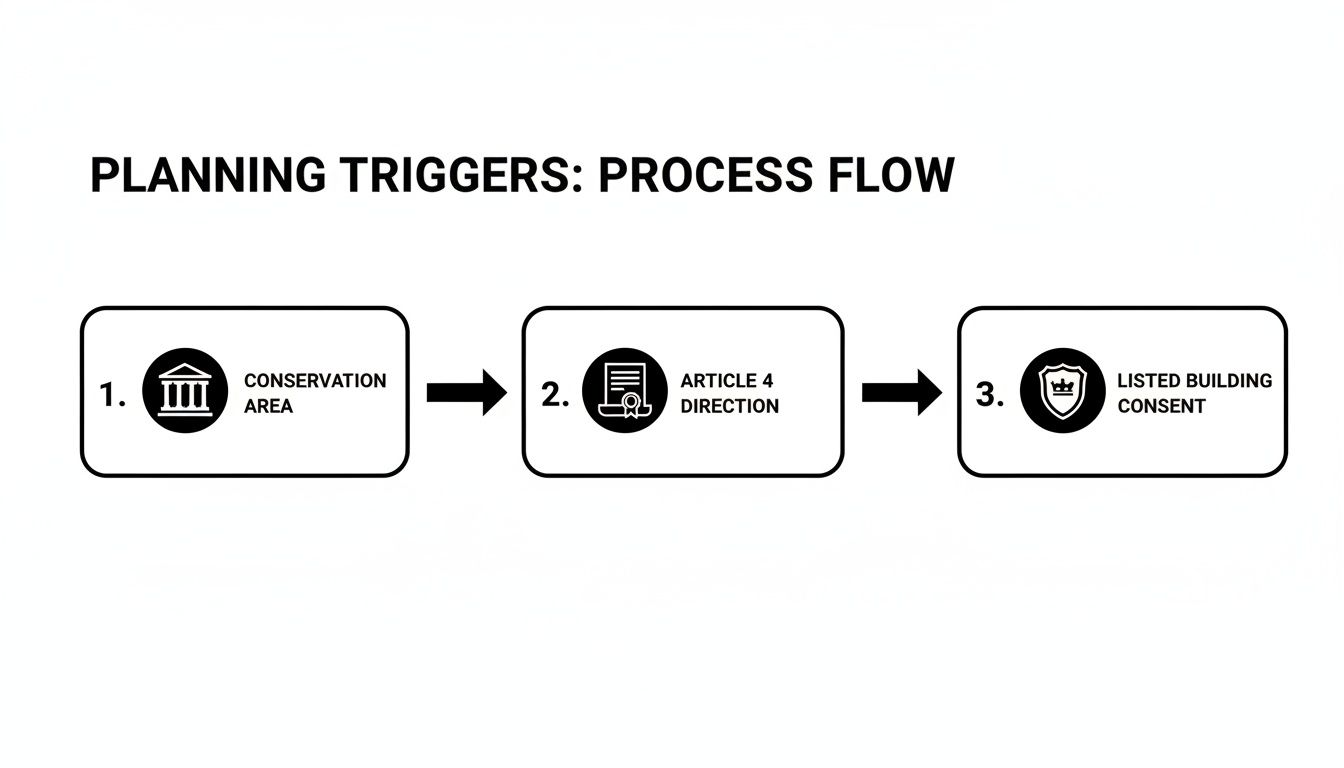
As you can see, designations like Conservation Areas, Article 4 Directions, or a Listed Building status almost always lead down the full planning route. This makes a robust and persuasive application strategy absolutely essential.
Assembling a Robust Application Pack
A compelling planning application is so much more than a set of drawings. It’s a comprehensive package of documents that tells the story of your project, justifying every design choice and demonstrating exactly how it meets all relevant local and national policies.
For a side return extension planning permission, the core components typically include:
Architectural Drawings: This is the visual heart of your application. We produce a full set of highly detailed existing and proposed drawings, including floor plans, every external elevation, and cross-sections that explain the building's construction and height relationships.
Design and Access Statement: Think of this as the written narrative. It explains the design thinking, justifies the materials we’ve chosen, and details how the extension relates to the original property and the wider street scene. For properties in conservation areas, this document is critical for proving how the design preserves or enhances local character.
Supporting Documents: Depending on your property and its location, we might also need to include a Heritage Statement (for listed buildings), an Arboricultural Report (if trees are affected), or even a Flood Risk Assessment.
The quality of your application pack directly reflects the quality of your proposed design. A well-presented, detailed, and persuasive submission gives the planning officer the confidence they need to grant approval.
We manage the entire submission process for our clients via the national Planning Portal, ensuring every form is correctly filled out and every document is present and correct. The goal is simple: to provide the council with a decision-ready application that leaves no room for doubt or ambiguity.
If you’re keen to learn more about what happens after submission, you can read about the UK planning application process in our detailed guide. This collaborative effort between you and your architect is what turns a great idea into an approved project, ready to move forward.
Typical Planning Application Timeline and Key Stages
Navigating the planning process can feel complex, but it follows a structured timeline. Understanding these stages helps set realistic expectations for your side return extension project. Below is a typical overview of the key milestones involved in a full planning application.
Stage | Description | Estimated Timescale |
|---|---|---|
Week 1 | Submission & Validation: The application is submitted via the Planning Portal. The council's admin team checks that all required documents and fees are included. | 1-2 weeks |
Week 2 | Registration & Consultation: Once validated, the application is registered, and a public consultation period begins. Neighbours are notified, and site notices may be posted. | 3 weeks |
Week 3-7 | Case Officer Assessment: A planning officer is assigned to review the application against local policies, consult with specialists, and conduct a site visit. | 4-5 weeks |
Week 8 | Decision Period: The officer prepares a report with a recommendation to either approve or refuse the application. The final decision is typically made at this point. | 1 week |
Post-Decision | Discharge of Conditions: If approved, you may need to submit further details to "discharge" any planning conditions before starting work. This is managed with your architect. | Varies (4-8 weeks) |
This timeline provides a standard 8-week target for most minor applications, but it's important to remember that more complex cases or council backlogs can sometimes extend these timings. We keep you informed every step of the way.
Beyond Planning Permission: What About Building Regs and Party Walls?
Getting planning permission for your side return extension is a fantastic milestone, but it's not the final green light for construction. Many homeowners are surprised to learn that planning approval is just one of two major legal hurdles. The second, and equally important, is compliance with Building Regulations.
These two approvals serve entirely different purposes. Think of it this way: planning permission is about the principle of your development—its appearance, size, and impact on the neighbourhood. In contrast, Building Regulations are all about the technical side of things—ensuring the structure you build is safe, warm, and healthy for whoever lives in it.
Getting to Grips with Building Regulations
While a planning officer is focused on aesthetics and land use, a Building Control inspector is concerned with construction quality. Their job is to sign off on key stages of the build, making sure everything meets rigorous national standards.
For a side return extension, this means detailed inspections of several critical elements. You can't legally start work without notifying Building Control, which you can do either through the local council or an approved private inspector.
Here's what they'll be looking at closely:
Structural Integrity: This is non-negotiable. They will need to see detailed structural calculations from an engineer to prove the new foundations are sufficient and that any steel beams (RSJs) are correctly specified and installed.
Fire Safety: Your new layout must have adequate means of escape, and materials need to meet fire resistance standards. This covers everything from new doors and windows to smoke detection.
Thermal Efficiency: The extension must meet minimum standards for insulation in the walls, floor, and roof. This prevents heat loss and contributes to your home's overall energy efficiency.
Ventilation: Proper airflow is essential to prevent damp and condensation. This includes mechanical extractor fans in kitchens or bathrooms and trickle vents in windows.
Securing a final Building Regulations completion certificate is essential. Without it, you will run into significant problems when you decide to sell your home, as solicitors will demand proof that the build is legally compliant.
Navigating the Party Wall Act
The third piece of the compliance puzzle, and one that often causes confusion, is the Party Wall etc. Act 1996. Because a side return extension nearly always involves building on or right up to the boundary line with your neighbour, this Act will almost certainly apply to your project.
This isn't about asking for your neighbour's permission to build. It's a legal process that requires you to serve them a formal written notice of your planned works, giving them time to respond. It’s designed to protect both you and them by setting out a clear legal framework for how the work will be carried out safely.
When You Must Serve a Party Wall Notice
You are legally obligated to serve notice if your side return extension involves any of the following:
Building on the Boundary Line: This applies if you plan to build a new wall directly on the line of junction between your two properties.
Working on an Existing Party Wall: This includes cutting into the wall to insert steel beams, increasing its height, or underpinning it.
Excavating Near Their Foundations: If you are digging new foundations within three metres of your neighbour's property and deeper than their own foundations, notice is required.
Once you serve notice, your neighbour has 14 days to respond. They can either consent in writing or dissent. If they dissent (which doesn't stop the work), you must appoint a Party Wall Surveyor to draw up a "Party Wall Award". This is a detailed legal document outlining the work and protecting everyone involved. To get a better handle on this, you can learn more about the Party Wall Act in our complete guide for homeowners.
Managing these post-approval stages correctly is vital for a smooth-running project. At Harper Latter Architects, we guide our clients through both the Building Regulations and Party Wall processes, ensuring your beautifully designed extension is also fully compliant and legally sound from start to finish.
Answering Your Key Questions on Side Return Extensions
Embarking on a side return extension project always throws up a lot of practical questions. To help you plan with a bit more clarity, we’ve gathered answers to some of the most common queries we get from clients across South West London, from initial costs to navigating relationships with neighbours.
Understanding these details right from the start helps set realistic expectations for your project's budget, timeline, and all the legal bits and pieces. Below, we tackle the key concerns that crop up time and time again during the planning phase.
How Much Does Planning Permission Cost?
This is a crucial question, and the answer really has two parts. First, there's the council's fee for submitting the application. For a typical householder application for an extension, this is a standard fee set by the government, which currently stands at £206 in England.
The second, and more significant, cost is the professional fees for your architect. This covers the extensive work needed to prepare a high-quality, persuasive application. We’re talking about detailed architectural drawings, a compelling Design and Access Statement, and managing all the back-and-forth with the council. For a bespoke extension, especially in a conservation area or on a listed building, this expert preparation is a vital investment. It hugely increases the chances of a first-time approval and helps you sidestep the much higher costs of a refusal and resubmission.
What Happens If My Planning Application Is Refused?
While our meticulous approach is designed to minimise this risk, planning applications can sometimes be refused. Common reasons often boil down to a perceived negative impact on a neighbour (like loss of light), a design that’s considered out of character with the area, or a failure to comply with specific local planning policies.
If your application is refused, don’t panic. You have several clear options:
Negotiate and Amend: We can get in touch with the planning officer to understand their specific objections. Often, small tweaks to the design can resolve their concerns, allowing for a swift resubmission.
Submit a Revised Application: A more formal route is to prepare a completely new application that directly tackles all the reasons for the initial refusal.
Appeal the Decision: If we genuinely believe the council’s decision was incorrect based on their own policies, we can appeal to the national Planning Inspectorate, who will review the case independently.
Our in-depth knowledge of policies in boroughs like Merton and Richmond upon Thames means we anticipate potential issues early, crafting applications that are built for success from day one.
A well-managed planning strategy isn’t just about getting a 'yes'—it's about getting the right 'yes' for the design you truly want, without unnecessary delays or compromises.
Do I Need My Neighbour's Permission?
This is a very common point of confusion. For side return extension planning permission, you don't need your neighbour's direct 'permission' in a way that allows them to veto your project. However, they are a key part of the process.
During a full planning application, the council will formally consult your immediate neighbours, inviting them to view the plans and submit comments or objections. The planning officer will then weigh these comments against planning policy when making their decision.
Separately, and just as important, is your legal duty under the Party Wall etc. Act 1996. You must serve a formal written notice to any adjoining property owners if your work affects a shared wall or involves digging foundations near their property. While a friendly chat over the fence is always the best strategy, this Act provides a legal framework to ensure the work is carried out correctly and safely, protecting everyone involved.
At Harper Latter Architects, we guide you through every stage of this complex journey. If you're considering a side return extension in Wimbledon or South West London, we can provide the architectural expertise to turn your vision into a beautifully designed, fully compliant reality. Contact us today to arrange your initial consultation.

Comments