
Party Wall Act Explained: A Guide for Homeowners

Updated: Dec 11, 2025
If you're planning a home renovation in England or Wales, you'll almost certainly come across the Party Wall etc. Act 1996. It's a key piece of law, but it's often misunderstood. The first thing to know is this: it's not there to stop your project. Think of it as a set of ground rules designed to prevent and resolve disputes between you and your neighbours when your building work affects a shared wall or boundary.
What's the Point of the Party Wall Act?
At its heart, the Party Wall Act gives homeowners and their neighbours a clear, structured process to follow. It’s a legal safety net, making sure construction is done responsibly and protecting the interests of both the person carrying out the work (the ‘Building Owner’) and their neighbour (the ‘Adjoining Owner’).
It's important to separate this from planning permission. The Act isn’t about getting approval to build; that’s the job of your local council's planning and building control departments. Instead, its sole focus is on managing the relationship between neighbours for specific types of work. It ensures your neighbours are formally told about your plans and provides a clear pathway for sorting out any disagreements before they escalate.
This organised approach is a relatively recent development. The Party Wall etc. Act 1996 created a single, uniform set of rules for all of England and Wales, coming into force on 1 July 1997. Before then, only London had a proper system, leaving everyone else to navigate these common neighbourly issues without clear guidance.
The Act’s main purpose is proactive, not restrictive. It aims to pre-empt disputes through formal communication, ensuring your neighbour’s property is protected before a single brick is laid, rather than dealing with costly problems afterwards.
What Kind of Work Does the Act Cover?
Figuring out if your project falls under the Act is your most important first step. The rules are triggered by three specific types of work, not by the size or cost of your project. Many people are surprised to find that even seemingly small jobs can require a Party Wall Notice.
Here's a quick reference guide to see what's typically covered.
When the Party Wall Act Typically Applies
Type of Work | Does the Act Apply? | Reason |
|---|---|---|
Loft Conversion | Yes | Usually involves inserting steel beams into the party wall for support. |
Rear or Side Extension | Yes | Involves excavating for foundations near a boundary and potentially building a new wall on the boundary line. |
Removing a Chimney Breast | Yes | Affects the structural integrity of the shared party wall. |
Internal Remodelling | No | Simple cosmetic changes like replastering or fitting kitchen units are exempt. |
Building a New Garden Wall | Yes | If the new wall is built up to or astride the boundary line. |
Underpinning Foundations | Yes | This is a major structural alteration to the party wall. |
The table above is a great starting point, but the specifics always matter. If your project involves any of the following, you will almost certainly need to serve a notice.
Generally, you will need to serve notice if you plan to:
Build on or at the boundary line: This is common when you're building a new wall for a rear extension right on the boundary you share with your neighbour.
Work on an existing party wall or structure: This covers lots of common jobs, like cutting into the wall to insert steel beams for a loft conversion, making it taller, or underpinning its foundations.
Excavate near a neighbouring building: If you're digging foundations for an extension within three metres of your neighbour’s property (and your new foundations will be deeper than theirs), the Act applies.
On the other hand, minor jobs that don't touch the shared structure don't need a notice. Simple cosmetic updates like replastering, wallpapering, or fitting new shelves to a party wall are completely fine. For bigger projects like extensions, getting this right from the outset is crucial, and you can learn more about the initial stages in our UK house extension planning permission guide.
Serving a Party Wall Notice: Your Essential First Step
Kicking off a building project on the right foot, especially under the Party Wall Act, comes down to one crucial action: serving a formal notice. This isn't just about being a good neighbour and having a quick chat over the fence; it’s a legal requirement that officially informs your neighbours about the work you’re planning.
Getting this step right is hands-down the best way to sidestep costly delays and avoid any legal headaches down the line. It sets a professional, respectful tone from day one.
The process involves two main roles. You, as the person carrying out the work, are known as the ‘Building Owner’. Your neighbours, whose property adjoins the boundary where you’re working, are the ‘Adjoining Owners’. It's your legal duty as the Building Owner to prepare and serve the correct notice.
Depending on the specific work, this notice needs to land on their doormat between one and two months before you plan to break ground. This gives them a reasonable amount of time to look over your plans and respond, paving the way for a clear and structured conversation.
The Three Types of Party Wall Notice
Because not all building work is the same, the Act lays out three distinct types of notice. Picking the right one is absolutely vital—serving the wrong notice can invalidate the whole process and set you back to square one. Each one is tailored to a specific kind of work you might be undertaking.
Your project's details will dictate which notice you need to use. For more complex projects, you might even find you need to serve more than one type.
Line of Junction Notice: This one comes into play when you’re building a brand-new wall, either right on the boundary line or up against it. Think new extensions where no wall existed before. For this, you must give at least one month's notice.
Party Structure Notice: You'll need this notice if your plans directly affect an existing party wall. Common examples include cutting into the wall for steel beams (a classic for loft conversions), taking out a chimney breast, or building the wall up higher. These jobs require a minimum of two months' notice.
Adjacent Excavation Notice: This notice is for when you’re digging within three metres of a neighbour’s property and your new foundations will go deeper than theirs. It’s almost always needed for extensions and basements. You have to provide at least one month's notice before the digging starts.
To help you figure out if the Act applies, this simple flowchart boils it down to the key questions.
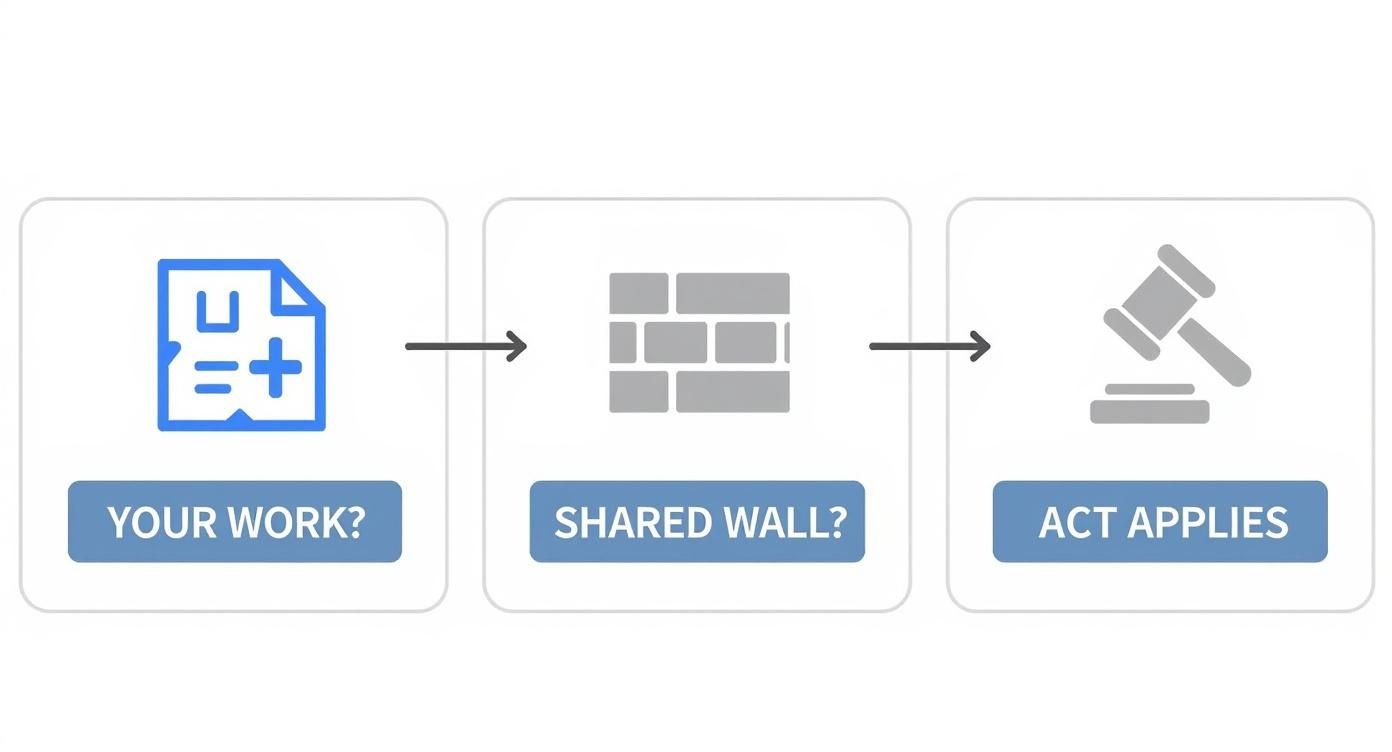
As the visual guide shows, if your work touches a shared wall or boundary, the Party Wall Act is almost certainly going to be a factor in your project.
What Must a Valid Notice Include?
A Party Wall Notice isn't just a casual letter. It’s a legal document, and to be valid, it has to contain specific information. Miss out a key detail, and the notice could be void, forcing you to start the whole process over again. A frustrating and totally avoidable delay.
A correctly served notice is your first, best opportunity to build trust and demonstrate professionalism. It shows your neighbours that you are taking their property rights seriously and are committed to following a fair and transparent process.
For any notice to be legally sound, it absolutely must include:
The full name and address of the Building Owner(s).
The address of the property where the work is taking place.
A clear, easy-to-understand description of the proposed work. For anything more than simple repairs, it’s always a good idea to include architectural drawings.
The date you plan to start the work.
One of the most common pitfalls is serving a vague or incomplete notice, which can sour relations and lead to an immediate dispute. It pays to be thorough and provide as much detail as you can to help your neighbour understand exactly what you’re planning.
The government's official guidance on the matter even provides example letters that you can use as a template to make sure you're covering all the bases. These are a great starting point for getting the legal wording right.
Of course, while many projects fall squarely under the Party Wall Act, some might have different requirements. Smaller extensions or loft conversions, for instance, might not even need full planning permission. To see if this applies to you, it's worth reading our detailed guide on what is permitted development rights in the UK. Getting a handle on all your legal obligations right from the start is the surest path to a smooth project.
What Happens After You Serve a Notice
So, you’ve done your part and served the Party Wall Notice. Now, the ball is in your neighbour's court, and their response will shape the next steps for your project.
They have a legal window of 14 days to reply after they receive it. This waiting period can feel a bit like you’re in limbo, but it’s a standard and necessary part of the process. It gives your neighbour the time they need to properly look over your plans and decide how they want to proceed.
The Three Potential Responses
Your neighbour’s reply will fall into one of three camps. Each one sends your project down a different path, but it's crucial to remember that none of them is a red light that stops your project in its tracks. The Party Wall Act is specifically designed to provide a clear, fair framework for whatever happens next.
It's a common myth that a 'dispute' means conflict or arguments. In the world of party walls, it simply kicks off a formal, structured procedure to ensure everyone is protected.
The three possible outcomes are:
Consent in Writing: The best-case scenario. Your neighbour gives your proposed works the thumbs-up.
Dissent: Your neighbour formally disagrees, or simply wants the protection of a Party Wall Award before work begins.
No Response: If the 14 days pass in silence, the Act automatically treats this as a dissent.
Let's break down what each of these really means for you and your project.
Path One: Consent in Writing
If your neighbour provides written consent, you've got the green light to move forward once the notice period expires. This is by far the quickest and most straightforward outcome.
The key here is "in writing." A friendly chat over the garden fence and a handshake, while neighbourly, won't cut it legally. You need something documented.
A simple letter or even an email from your neighbour confirming they agree to the works outlined in your notice is all you need. This is a vital piece of paper that protects you and satisfies the Act's requirements.
Once you have that written consent in hand, there’s no need to appoint surveyors or draw up a Party Wall Award. You can get on with your build, just be sure to keep the lines of communication with your neighbour open as things progress.
Path Two: Dissenting or Not Responding
Now, what if your neighbour dissents, or simply doesn't reply within the 14-day window? The Act considers a 'dispute' to have arisen. That word can sound a bit dramatic, but it really doesn't signal an argument or a falling out. It just means the formal dispute resolution process is now triggered.
This is the point where Party Wall Surveyors step onto the scene. A dissent is often just a practical move from a neighbour who, quite reasonably, wants the formal protection of a Party Wall Award before a digger shows up next door.
Here’s a quick rundown of what happens:
Appointing Surveyors: You and your neighbour can each appoint your own surveyor. Alternatively, and often more efficiently, you can both agree to use a single ‘Agreed Surveyor’ to act impartially for both sides.
Schedule of Condition: Before any work kicks off, the surveyor (or surveyors) will carry out a detailed inspection of your neighbour’s property. They’ll take photos and notes to document its current state, creating what’s known as a Schedule of Condition.
Party Wall Award: The surveyors then produce a legal document called a Party Wall Award. This sets out the 'rules of engagement' for the work, covering everything from working hours and access arrangements to specific measures needed to prevent damage.
Think of a dissent not as a roadblock, but as a detour onto a clearly signposted route. It's a path designed to make sure everyone's property is safeguarded by impartial professionals. Yes, it adds some time and cost to your project, but it also provides complete legal clarity and peace of mind for everyone involved.
Understanding the Surveyor and the Party Wall Award
So, your neighbour has formally dissented to your notice. Don't panic – this doesn't mean your project is dead in the water. Far from it. It simply triggers a formal, structured process where a Party Wall Surveyor steps in. Think of them as an impartial referee, there to ensure everything proceeds fairly and safely for everyone involved.

The surveyor's role isn't about taking sides or finding fault. Their sole duty is to the Act itself. They are there to safeguard the interests of both you (the Building Owner) and your neighbour (the Adjoining Owner), making sure your work is compliant and your neighbour’s property is protected.
How Surveyors Are Appointed
Once a dissent is registered, the Act gives you and your neighbour a clear framework for appointing a surveyor, with the goal always being impartiality.
The most common and cost-effective route is to jointly appoint an 'Agreed Surveyor'. This is one independent professional who acts impartially for both of you. They will work to resolve the dispute and prepare a single, binding document that sets out the rules for the work.
If you can't agree on one person, you can each appoint your own surveyor. In this case, the two surveyors will then select a third surveyor who acts as an arbitrator if they can't agree on a specific point. This approach is usually reserved for more complex or contentious projects and is naturally a more expensive option.
When a dispute arises, you have a few options for appointing surveyors. The choice often depends on the complexity of the project and the relationship between neighbours. Here's a quick breakdown of the options and what they entail.
Surveyor Options and Responsibilities
Surveyor Option | Who Appoints Them? | Key Responsibility | Typical Cost Implication |
|---|---|---|---|
Agreed Surveyor | Both owners jointly agree on and appoint a single surveyor. | Acts impartially for both parties to draw up a single Party Wall Award. | Most cost-effective. The building owner typically pays the single surveyor's fee. |
Two Surveyors | Each owner appoints their own surveyor. | Each surveyor represents their appointing owner's interests, but must still act impartially under the Act. They work together to agree on the terms of the Award. | More expensive. The building owner usually pays the fees for both their own surveyor and their neighbour's surveyor. |
Third Surveyor | The two appointed surveyors agree on and select a third surveyor. | Acts as an impartial adjudicator if the two appointed surveyors cannot agree on a particular matter related to the Award. | Only involved (and paid for) if required to resolve a disagreement, adding a potential further cost. |
Ultimately, the goal of any surveyor appointment is to reach a fair and legally sound Party Wall Award. The 'Agreed Surveyor' route is often the simplest and most economical path for straightforward residential projects.
The Surveyor’s Key Duties
One of the surveyor's first and most critical jobs is to prepare a 'Schedule of Condition'. This is an incredibly detailed record of your neighbour's property before any of your work begins. The surveyor will meticulously document the current state of the walls, floors, and ceilings, taking plenty of photographs and detailed notes of any existing cracks or defects.
This document is your safety net. It creates a definitive baseline, so if any damage does occur during construction, it can be clearly identified and attributed to your project. It protects you from false claims and gives your neighbour peace of mind that any legitimate damage will be put right.
The surveyor’s other main responsibility is to draft and serve the Party Wall Award.
The Party Wall Award isn't a prize or a penalty. It’s a legally binding document that sets out the 'rules of engagement' for your project, detailing precisely how and when the work can be done to minimise risk and inconvenience to your neighbour.
This Award sets out clear terms covering things like:
Permitted working hours to limit noise and disruption.
Specific construction methods needed to protect the neighbouring property.
Access arrangements if your builders need to go onto your neighbour's land.
A requirement for you to cover the costs of any damage your work causes.
The Legal Framework of the Party Wall Award
The Party Wall Award is the legal cornerstone of this whole process. It provides a robust framework that allows your project to move forward while offering solid protection for your neighbour. It’s a formal, enforceable document that both parties have to stick to.
Since the Party Wall etc. Act 1996 was introduced, its real-world application has been shaped by various court cases that have clarified how it works in modern construction. These legal precedents guide surveyors today. For instance, you can explore how party walls are viewed in case law on RICS.org for a deeper dive.
This legal backing gives the Award real teeth. It provides a clear path for resolving issues, helping everyone avoid the stress and expense of civil court action if something goes wrong. Understanding who does what on a project is crucial; you can learn more by reading our guide comparing the roles of a structural engineer vs an architect.
How to Avoid Common Party Wall Disputes
The best way to handle the Party Wall Act is to make sure you never have to use its dispute procedures in the first place. While the Act gives everyone a clear rulebook for disagreements, sidestepping the formal process entirely will save you a huge amount of time, money, and stress. It all comes down to proactive communication and a bit of neighbourly goodwill.

Honestly, most conflicts don't start because of the building work itself. They start because a neighbour feels blindsided or ignored. A formal notice landing on the doormat out of the blue can feel cold, official, and quite alarming. The single best thing you can do is have a friendly chat with your neighbours long before any paperwork is sent.
Foster Goodwill Through Early Communication
Pop round with your initial plans. Show them the drawings, explain what you’re hoping to do, and genuinely listen to what they have to say. This simple act of courtesy can change the entire dynamic from a legal formality into a cooperative neighbourhood project.
This early conversation is your chance to iron out potential problems before they become official objections. Your neighbour might raise a valid point you hadn't even thought of, which can often be fixed with a small tweak to your plans.
A cup of tea and a ten-minute chat about your extension plans can be far more effective than a dozen solicitor's letters. This informal step builds trust and shows you respect their property and peace of mind, making them much more likely to consent when the formal notice eventually arrives.
By being open about your project from the get-go, you show that you’re a considerate Building Owner, which immediately lowers the chance of a dispute.
Address Common Flashpoints Proactively
There are a few hot-button issues that tend to cause friction. Being ready to discuss these points openly can head off a lot of disagreements before they even start.
Surveyor's Fees: The first thing an Adjoining Owner often worries about is the cost. Reassure them from the start that, as the Building Owner, you are responsible for paying all reasonable surveyor’s fees if a dispute does arise. This takes a major financial worry off their plate.
Potential Damage: It's completely natural for neighbours to worry about cracks or other damage to their home. Explain that a professional Schedule of Condition will be done by a surveyor to document the exact state of their property beforehand. This protects everyone by creating a clear, impartial record.
Access Rights: If your builders will need access to their property, talk about it early. Be clear about when, why, and for how long, and be as flexible as you can to minimise the disruption to their lives.
Provide Clear and Comprehensive Information
When you do serve the official notice, make sure it’s as clear and detailed as it can be. Vague or incomplete notices are a recipe for disputes because they create uncertainty and suspicion.
Make sure to include high-quality architectural drawings with the notice. This gives your neighbour a solid understanding of what you’re proposing, rather than leaving it to their imagination. A professional, well-presented package of information shows you’re organised and serious about doing the job properly.
By taking the time to explain the process and its protections, you can manage expectations and build a foundation of trust that keeps your project moving smoothly and your neighbourly relations intact long after the builders are gone.
Common Questions About the Party Wall Act
When you're navigating the Party Wall Act for the first time, it's natural for a lot of practical questions to pop up. We get asked these all the time by homeowners, so we've put together some straightforward answers to the most common queries.
Who Is Responsible for Paying the Surveyor’s Fees?
This is easily one of the most frequent questions, and the answer is usually quite simple. The Building Owner—that’s the person carrying out the work—is responsible for paying all reasonable surveyor’s fees.
This means you’ll cover the cost of your own surveyor and, if your neighbour appoints one, their surveyor’s fees too. Think of it as a necessary part of the project's budget, ensuring your neighbour isn't left out of pocket for protecting their property under the Act.
What Happens If My Neighbour Ignores the Notice?
So, you’ve served a valid Party Wall Notice, but you’ve heard nothing back within the statutory 14-day period. The process doesn't just grind to a halt. In the eyes of the Act, their silence is treated as a dissent.
This automatically means a ‘dispute’ has arisen, and you are now required to appoint a surveyor. If your neighbour continues to be unresponsive, you can even appoint a surveyor on their behalf after giving them a final heads-up. This allows the process to move forward lawfully, so you can't just press on with the work.
Ignoring a Party Wall Notice doesn’t stop the project indefinitely. It simply kicks off the formal dispute resolution process, making sure the work can proceed properly under the protection of a Party Wall Award drawn up by impartial surveyors.
Can I Start Work Before the Notice Period Ends?
Absolutely not. You must wait for the notice period to run its course. The statutory notice periods—one month for excavation and line of junction notices, and two months for party structure notices—are a legal requirement.
Jumping the gun, even if you’re sure your neighbour will agree, puts you in breach of the Act. This could land you with a court injunction forcing you to down tools, leading to major delays and legal costs you really don't want.
Do I Need an Agreement for Minor Jobs Like Re-plastering?
The Party Wall Act is only concerned with specific, more substantial works that could affect the party wall’s structure. Thankfully, minor, superficial jobs are exempt.
You do not need a notice or an agreement for tasks like:
Re-plastering your walls.
Drilling holes to hang pictures or put up shelves.
Chasing out plaster to run new electrical wiring.
These kinds of jobs are considered too minor to risk damaging the shared structure or causing any real hassle for your neighbour.
At Harper Latter Architects, we guide clients through every stage of their high-end residential projects, including the complexities of the Party Wall Act. If you're planning a bespoke new build, refurbishment, or extension in South West London, our expertise ensures a smooth, compliant process from start to finish. Explore our architectural services and see how we can bring your vision to life.
Learn more about our approach at https://harperlatterarchitects.co.uk.
Comments