
Bats In Loft: UK Homeowner's Legal Guide
A loft project often begins in a mood of optimism. The staircase is being refined, the rooflights are placed, storage is being concealed into the eaves, and the awkward void above the top floor is finally about to become part of the house.
Then somebody notices the signs. A few dry droppings near the rafters. A faint stain at a tiny gap in the roof line. A fluttering movement at dusk. At that point, what looked like a straightforward renovation becomes something else entirely. Not a disaster, but a protected-species issue that has to be handled properly.
For homeowners in South West London and Surrey, especially those working on period houses, arts and crafts homes, villas, and listed buildings, bats in loft spaces are not unusual. They are also not something to improvise around. The right response is calm, early, and well coordinated.
An Unexpected Discovery in Your Loft Renovation Plans
A typical version of this starts with a house in Wimbledon, Richmond, or one of the Surrey villages where older roofs have survived decades of piecemeal repair. The family wants a loft conversion, perhaps a new principal suite, a study, or space for children. The measured survey is booked, the structural engineer is lined up, and the design is moving well.
Then the loft inspection raises a different question. Not whether the structure can take a dormer or whether the ridge height is sufficient, but whether the roof void is already occupied.
In practice, good projects distinguish themselves from rushed ones. The instinct to carry on discreetly, patch the hole, and ask questions later is understandable. It is also exactly what creates planning problems, legal exposure, and expensive redesigns.
High-end residential work demands a more disciplined response. If bats are present, they become a design parameter in the same way as a party wall, a conservation designation, or a difficult drainage run. You acknowledge the constraint early, bring in the right specialist, and design with precision rather than frustration.
The projects that cope best with bats are not the ones that avoid the issue. They are the ones that identify it before tender, before strip-out, and before the roof is opened.
Handled properly, bats in loft spaces do not have to ruin a scheme. They may alter the programme, influence details, and require licensing and mitigation, but they can usually be absorbed into a well-run refurbishment. In heritage work especially, that measured approach is part of quality.
First Signs of Bats and Your Immediate Responsibilities
The first task is not to diagnose everything yourself. It is to recognise credible signs and avoid doing the wrong thing in the first few hours.
In the UK, it is illegal to intentionally kill, injure, or disturb bats, even in lofts where 17 of the 18 resident species are known to roost, and that legal protection has been in place since the Wildlife and Countryside Act 1981 was established, as set out in the Bat Conservation Trust guidance on managing bats entering living areas.
What usually points to bats
Some signs are more persuasive than others. On older houses, I pay closest attention to a combination of small clues rather than one dramatic discovery.
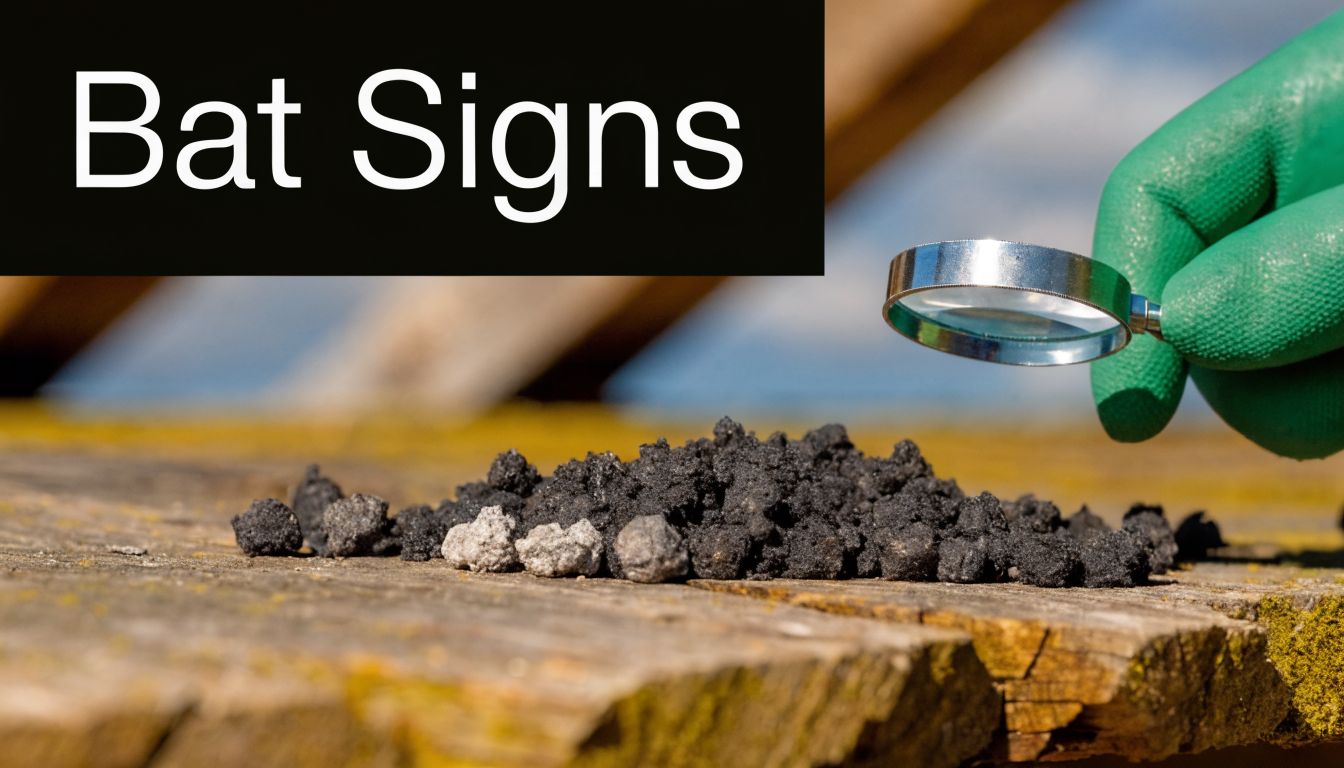
Dry droppings near eaves or timbers. Bat droppings are often small, dark, and brittle. People commonly notice them on loft boarding, insulation, or window sills beneath an access point.
Staining at entry gaps. Repeated use can leave a slight darkening or greasy mark around a crack, lifted tile, or junction in the roof.
No nest material. Bats don’t build nests in the way birds or rodents do, so the space may look oddly undisturbed apart from droppings.
Noise at the edges of the day. Soft chirping, scratching, or fluttering around dusk and dawn can be a useful clue.
Flight movement outside. If you stand back from the house around sunset, you may see bats emerging from a very small point in the roof.
A quick visual guide can help you understand what to look for before a professional visit.
What to do straight away
This stage is about restraint, not action.
Pause any intrusive work. Stop anything that could disturb the loft void, including insulation removal, timber repairs, electrical runs, roofing works, or demolition.
Record what you saw. Take clear photographs of droppings, stains, and likely entry points. Note the date, location, and any dusk activity.
Tell your architect and contractor. Everyone on the project needs the same information immediately so nobody accidentally proceeds.
Arrange specialist advice. If you are planning works, the matter should move quickly to an ecologist with relevant bat survey experience.
What not to do
These are the errors that cause the most trouble.
Don’t block holes. Sealing an access point may force bats into occupied rooms and can amount to unlawful disturbance.
Don’t clean up the evidence first. A well-meaning tidy-up can destroy the signs the ecologist needs to assess the roost.
Don’t shine powerful lights into the roost. It may disturb bats and alter their behaviour.
Don’t ask a general pest controller to “remove” them. Bats are protected wildlife, not a routine pest issue.
Don’t let contractors proceed without proper consultation. Even minor preparatory works can create legal and programme complications later.
Practical rule: if you suspect bats in loft spaces, the safest first move is always to stop, document, and seek ecological advice before anybody touches the roof void again.
Understanding the Legal Protection for Bats in the UK
The law treats bats differently from nuisance wildlife because they are not classified as a domestic pest problem to be solved by exclusion at convenience. Their ecological status matters, and so does the roost itself.
In practice, that means protection extends beyond the animals you can see on a particular day. A loft roost can be legally sensitive because of how bats use it over time, not because somebody spotted one during a builder’s visit. That is why apparently empty spaces still require caution.
What full protection means on a building project
For a homeowner, “protected” has practical consequences. It means you cannot assume that reroofing, loft conversion works, insulation replacement, new dormers, or structural alterations are internal building matters alone if bats are involved.
The legal framework sits within the Wildlife and Countryside Act 1981 and the Conservation of Habitats and Species Regulations 2017. On site, that turns into a straightforward principle. If works could affect a roost, there has to be a formal process, evidence, and usually ecological input before anything proceeds.
That can feel strict until you consider the kind of houses bats favour. Older roofs provide stable, dark, sheltered conditions that are increasingly scarce. Once lost, those conditions are not easy to replace casually.
Why this matters financially as well as legally
Clients sometimes focus first on prosecution risk, but design teams also need to think about cost, sequencing, and procurement. Improperly handling a bat issue during renovation can lead to mitigation costs ranging from £5,000 to £20,000, not including fines, as noted in the earlier Bat Conservation Trust material on living with bats.
Those costs usually arise because somebody acts too early. The roof is stripped before surveys are complete. Openings are sealed without approval. A contractor disturbs a roost and the design has to be revised in a hurry. Emergency mitigation is nearly always more expensive than planned mitigation.
A calmer approach protects the programme as much as it protects wildlife.
Project decision | Likely consequence |
|---|---|
Early ecological review before design is fixed | Better integration of roost protection into the scheme |
Late discovery during contractor mobilisation | Delays, redesign pressure, and awkward site stoppages |
Assumed “minor works” in an older loft | Risk that lawful process has been bypassed |
Formal strategy agreed before works | Cleaner procurement and fewer surprises on site |
Why the procedures are worth respecting
Many homeowners initially read the rules as bureaucracy. They are better understood as a conservation response to long-term habitat loss. Lofts have become one of the few dependable refuges left within built-up areas, particularly in older housing stock.
That is why the sensible professional stance is simple. Don’t treat bats as an interruption to your project. Treat them as an existing condition of the building that must be investigated and designed around with care.
Navigating the Bat Survey and Licensing Process
Once bats are suspected, the project moves out of the realm of guesswork. The ecologist leads the evidence-gathering, and the architect begins to understand what the building can and cannot absorb without affecting the roost.
For clients, the process is much less stressful when it is seen as a sequence rather than a mystery.
The professional pathway
A sound building project already begins with accurate information. If you are still at the early stage of understanding the house itself, a clear guide to measured building surveys helps explain why baseline records matter before any design decisions harden.
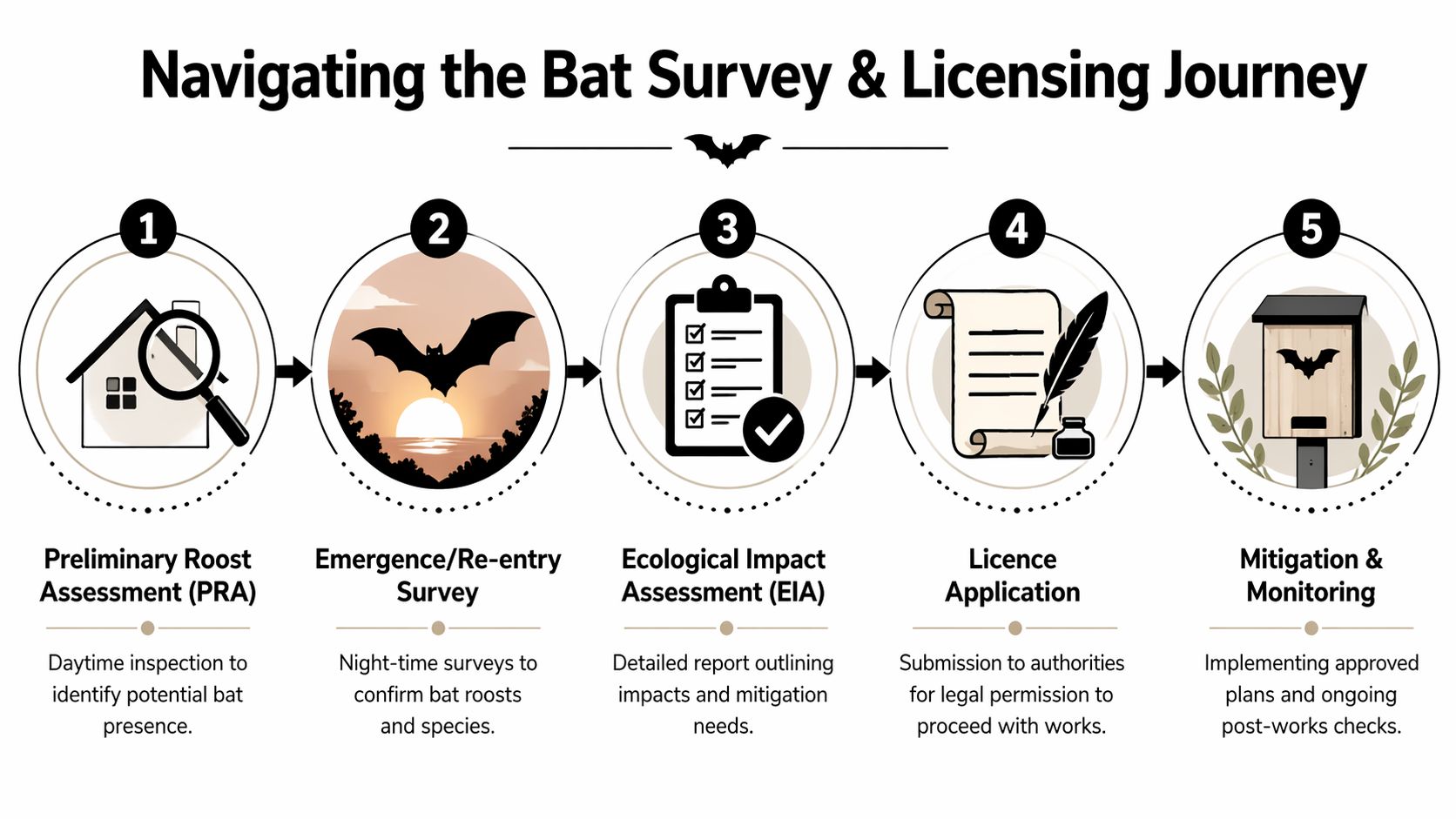
The bat process usually unfolds in five parts.
Preliminary Roost Assessment This is the daytime inspection. The ecologist examines the loft and exterior for droppings, staining, feeding remains, access points, and other evidence. They also assess whether the building has features that make roosting likely, even if signs are limited.
Activity surveys at the right time of year If the preliminary assessment indicates potential or confirmed use, further surveys usually happen at dusk or dawn in the survey season. These visits help establish species, likely numbers, access routes, and how the roost functions.
Classification of the roost This is one of the most important steps. A maternity roost, a day roost, and a hibernation roost do not create the same design constraints. The classification affects both the mitigation approach and the timing of works.
Ecological reporting The ecologist sets out the evidence, assesses likely impact, and recommends what the project must do to remain lawful.
Licence application and approved mitigation If the works will affect the roost, the report supports an application to Natural England for an EPS mitigation licence. Only after that approval can the relevant works proceed in the licensed way.
How the architect and ecologist work together
High-quality residential design matters. The ecologist does not design the house. The architect does not determine bat ecology. The scheme succeeds when both disciplines inform each other early enough.
The architect needs to know where access points are, whether those points must be retained or replicated, what internal volume needs protecting, how light spill should be controlled, and whether the roof build-up or insulation strategy could make a mitigation space fail. The ecologist, in turn, needs to understand what the client is trying to achieve structurally and spatially.
A licence application is not just a form. It is a design test. The scheme has to show that the roost issue has been understood and resolved, not merely acknowledged.
What homeowners should expect
The biggest mistake is assuming this can be compressed into a week because a builder is ready to start. Survey windows are seasonal, and licensing is administrative as well as technical. That means bat issues can influence when a project is drawn, submitted, tendered, and built.
A useful way to think about it is this:
If evidence is weak, the process may remain relatively light.
If a roost is confirmed, the project needs a coordinated strategy.
If the building is listed or in a conservation-sensitive area, consultation becomes more layered and detailing becomes more exact.
Clients who allow enough time generally preserve more control over the architecture. Clients who discover bats late often end up making hurried compromises that nobody wanted at the outset.
Architectural Mitigation for High-End Refurbishments
The phrase “bat mitigation” sometimes conjures up crude timber boxes fixed onto a handsome house as an afterthought. That is poor conservation and poor architecture.
In a well-designed refurbishment, mitigation is integrated into the building fabric. It can sit within the roof strategy, the thermal approach, the external envelope, and the planning narrative without diminishing the quality of the house.
What works better than bolt-on fixes
The key distinction is between attached products and designed habitat. Standard bat boxes have their place, but they are often less effective than dedicated internal spaces when a loft roost is already established.
Technical specifications matter. Crevice-dwelling bats such as common pipistrelles need access gaps of 15 to 20mm high, while brown long-eared bats require uncluttered internal flight paths of at least 5m by 5m. Architect-designed bat lofts have a 52% success rate, outperforming standard bat boxes at 31%, according to Bat Conservation Trust guidance on accommodating bats in buildings.
That single comparison tells you a lot. Success comes from designing the right internal conditions, not just attaching a generic product and hoping for the best.

For clients exploring roof-level alterations, this is one reason a thoughtful guide to high-end loft conversions in Wimbledon is useful. Good loft design is already a matter of section, access, insulation, structure, daylight, and spatial efficiency. Bat mitigation adds another layer of precision, not a separate universe.
Typical architectural responses
The right solution depends on species, roost type, existing access, and the scale of intervention, but several approaches consistently perform better.
Dedicated bat lofts or bat voids These are isolated roof spaces designed specifically for roosting while keeping the principal accommodation separate. They allow the house to gain usable interior space without eliminating habitat altogether.
Retained or replicated access points Access gaps need to be carefully formed into the roof or wall build-up. If they are too small, badly positioned, or exposed to light and draughts, the mitigation can fail.
Rough internal surfaces Roost spaces should not be over-finished. Smooth decorative linings may suit a dressing room, but bats need surfaces they can grip.
Careful lighting strategy Exterior lighting often causes avoidable conflict. Entrance routes and roost openings need darkness. A luxury decorative lighting design for the grounds has to be balanced against that.
Build-up choices that avoid harm Some modern materials are not suitable around bat spaces. In heritage projects especially, the roof specification has to be developed with ecology in mind, not chosen solely on standard contractor preference.
The trade-offs clients should understand
Mitigation changes design, but not always in a negative way. In many projects, the best answer is not to force complete occupation of every inch of roof void. It is to allocate the house intelligently.
You may give up a slice of roof volume to retain a compliant roost space. In return, you gain a cleaner planning route, a more reliable construction sequence, and a better-resolved home overall. That is usually a worthwhile exchange.
Some of the trade-offs are straightforward:
Design choice | Benefit | Constraint |
|---|---|---|
Separate bat void within new roof | Better ecological performance | Slight reduction in recoverable internal volume |
Hidden integrated access detail | Preserves external appearance | Requires exact coordination with roofer and ecologist |
Reduced light spill near eaves | Protects roost behaviour | Limits certain decorative lighting positions |
Retention of some existing roof character | Supports heritage and ecology aims | Can narrow material options |
The most elegant bat solutions are often invisible to visitors. They sit quietly within the roof, doing their job without advertising themselves.
What doesn’t work
There are recurring failures in bat-related refurbishment work.
One is the assumption that a generic bat box will compensate for the loss of a known loft roost. Another is treating the roofing package as a contractor substitution issue after planning and licensing are complete. A third is designing beautiful interiors right up into the roofline before anybody has confirmed what the ecology demands.
All three lead to friction. Better projects solve the ecology and the architecture together.
Special Considerations for Listed Buildings and Conservation
Listed buildings make the issue more exacting because you are conserving two things at once. You are protecting a historic structure and addressing a protected species that may already rely on it.
That dual responsibility changes the tone of the design conversation. The question is broader than how to make a bat access detail work. It is how to make it work without clumsy impact on historic fabric, roofscape, joinery, or significance.
Why heritage projects are more exposed to delay
Older buildings are especially likely to contain the kinds of gaps, roof spaces, and thermal conditions bats favour. They are also more tightly controlled when you propose changing them. As a result, ecological and conservation considerations tend to collide in the same parts of the building.
A 2025 report noted more than 1,200 bat-related planning objections in England, with 40% in London and the home counties, often delaying projects by 6 to 12 months, according to reporting on bat-related planning objections in England. That should concentrate the mind of anyone refurbishing a listed house in South West London or Surrey.
If your project also needs heritage consent, the wider planning route matters just as much as the bat licence. A practical listed building planning permission guide is useful background, but on a live scheme the key is early coordination between architect, ecologist, and conservation officer.
Sensitive detailing matters more than broad promises
Heritage authorities usually respond best when the strategy is specific. They need to see where access is maintained, what fabric is retained, how new interventions are concealed, and why the solution is less harmful than alternatives.
That can mean:
Working with existing entry behaviour rather than inventing entirely new openings.
Using discreet locations in flashing lines, under tiles, or within retained roof build-ups.
Retaining selected voids instead of over-converting every roof space.
Repairing rather than replacing sections of roof where ecological use and historic significance overlap.
The right attitude for conservation work
The wrong instinct is to see bats as a separate consultant problem to be “sorted out” after the heritage design is complete. In listed buildings, that nearly always leads to conflict because the ecologically suitable answer may affect fabric you have already promised to remove or alter.
The better route is to accept from the start that conservation architecture is about managed negotiation. Structure, planning, history, buildability, and ecology all have to fit together. That is not a burden. It is the discipline that produces better work.
In heritage projects, early ecological assessment is not caution for its own sake. It is what allows a scheme to stay elegant under scrutiny.
Conclusion A Seamless Blend of Conservation and Design
Finding bats in loft spaces can feel like the moment a straightforward renovation becomes complicated. In reality, it usually marks the point where the project needs to become more rigorous.
The important shift is mental. Once bats are suspected, the loft is no longer just spare volume to be claimed for living space. It is a protected part of the building’s ecology, and any serious design has to respond to that condition properly. When the response is early, coordinated, and technically precise, the project usually remains entirely workable.
That is especially true in high-end residential architecture. Luxury does not mean forcing every idea through unchanged. It means handling constraints intelligently, whether those constraints are structural, historic, legal, or ecological. A refined house is one where the difficult things have been resolved well.
For homeowners in South West London and Surrey, that often means accepting a more careful process from the outset. Survey first. Confirm the facts. Design the mitigation into the architecture rather than attaching it at the end. Keep the roof strategy, lighting, conservation issues, and licensing aligned.
Done properly, bats do not have to diminish the home you are creating. They require the sort of considered design response that good architecture should deliver anyway.
Frequently Asked Questions about Bats in Lofts
Some questions come up on almost every project. The answers below are the ones clients usually need in practical terms.
Common questions and direct answers
Question | Answer |
|---|---|
Can I still convert my loft if bats are present? | Often, yes. But the design, timing, and approvals may need to change. Works that affect the roost usually require ecological input and may need licensing before construction starts. |
Should I block the hole if bats are getting into the house? | No. Blocking access can disturb the roost and make the situation worse. The correct response is to seek professional advice before any sealing works are attempted. |
Will bats damage the property like rodents? | They are not rodents and do not create the same pattern of gnawing or nest-building. The main issue in building projects is legal protection and disturbance risk, not typical pest damage behaviour. |
Can builders clean up bat droppings during strip-out? | That is not a sensible DIY or general trade task. Public Health England reported a 15% rise in histoplasmosis cases in 2025, with incidents linked to disturbed lofts in South East England, which is why guidance discussing bat-related loft health risks underlines the need for licensed professionals and proper safety equipment. |
Will a bat box solve the problem on its own? | Not usually where an established loft roost is involved. Integrated architectural mitigation is often more effective than a simple bolt-on box. |
The short version
If you suspect bats in loft spaces, stop intrusive work and get the building assessed properly. Don’t seal holes, don’t ask for informal removal, and don’t assume a quick tidy-up will help.
Most projects can move forward, but they move forward best when the evidence, the design, and the legal route are aligned from the beginning.
If you're planning a refurbishment, loft conversion, basement extension, or listed building project and need experienced guidance, Harper Latter Architects can help you address the architectural, conservation, and practical challenges with clarity and care.