
A Homeowner's Guide: how to build indoor swimming pool with essential tips

Deciding to build an indoor swimming pool is one of the most exciting additions you can make to your home. It’s a promise of year-round wellness, a stunning architectural feature, and a space for family and friends to gather. But it’s also a serious undertaking, blending ambitious design with precision engineering to create a space that’s as functional as it is beautiful.
Starting with the Vision for Your Indoor Pool
An indoor pool is so much more than a concrete shell filled with water. It’s a reflection of your lifestyle and a long-term investment in your property and your family’s wellbeing. Before getting bogged down in the technical details, the first and most important step is to define exactly what you want to achieve. This is the foundation of the entire project, ensuring the finished pool perfectly matches your vision.
The possibilities are endless. You might want a sleek lap pool for fitness, or you could be dreaming of a complete leisure complex with a spa and sauna. Think about how you’ll use the space day-to-day.
Family Recreation: Will this be a hub for family fun? If so, you’ll need to consider a shallow end for younger children and safe, non-slip surfaces.
Wellness and Fitness: Is the main goal exercise and relaxation? This might point towards a longer, narrower design for swimming laps, perhaps with space nearby for a home gym or yoga area.
An Entertainment Space: Do you see yourself hosting guests around the pool? The design should then incorporate social areas, ambient lighting, and maybe even a seamless link to an outdoor terrace for summer parties.
Establishing Your Budget
Defining your budget early on is critical. A high-quality, bespoke indoor pool is a considerable investment. Based on industry analysis here in the UK, turnkey budgets often start around £80,000 and can easily extend beyond £250,000, depending on the size, finishes, and complexity of the environmental control systems. You can read more about the UK swimming pool market on IBISWorld.
For high-end projects, especially in areas like South West London or Surrey where you might be dealing with a listed building or a conservation area, costs frequently exceed £300,000. It's also vital to factor in the ongoing running costs from the start—heating and maintenance are significant lifetime expenses that need to be planned for.
By clarifying your core objectives and financial limits right at the beginning, you give your architectural team the clear direction they need. This allows them to design a space that isn't just breathtaking, but also practical and, most importantly, deliverable.
Getting to Grips with Design, Feasibility, and Planning
Before any ground is broken, the real work begins. The success of an indoor pool project is almost entirely down to meticulous planning and a realistic feasibility assessment. This is where we stress-test your vision, making sure your dream can be translated into a compliant, beautiful, and functional reality.
The first, and most fundamental, question is: where will the pool actually go? Each option brings its own unique challenges and architectural opportunities.
Commonly, we see clients opt for a purpose-built extension, a standalone garden building, or a sophisticated basement conversion. A new extension gives you the chance to create a seamless flow between your home and your new leisure space. On the other hand, a separate garden building can feel like a private wellness retreat, completely distinct from the main house. Basement pools, especially popular in London, are a fantastic way to transform underused space into a luxurious sanctuary, but they also come with the most significant structural and waterproofing hurdles.
Initial Architectural Concepts
The design journey always starts by translating your aspirations into tangible architectural concepts. It's a collaborative process. We use initial sketches and mood boards to capture the atmosphere you're after. Are you picturing a minimalist space flooded with natural light, or something more dramatic and opulent with atmospheric lighting and rich, dark materials?
We look at how the pool will fit into your lifestyle, thinking about the practicalities like changing rooms, showers, and where to discreetly locate the plant room. This stage is absolutely critical for properties in conservation areas or for listed buildings—a common scenario across Wimbledon and Surrey. Here, the design must carefully respect the building's historic character while delivering modern standards of performance.
The goal of the concept design phase is to establish a clear architectural direction that not only meets your personal requirements but also forms a robust foundation for navigating the complex planning and regulatory landscape ahead.
The Realities of Planning Permission
Understanding the regulatory hurdles from day one is non-negotiable. While some small outbuildings might fall under Permitted Development Rights, a project as significant as an indoor pool almost certainly requires formal approval. Getting the design through planning is a core part of an architect's job, ensuring it complies with both local and national policies.
For a deeper dive into the specifics, you can check out our guide on UK swimming pool planning permission explained.
For most new extensions and garden buildings, a full planning application is inevitable. This means submitting detailed drawings and supporting documents to your local authority to show how the proposed structure respects its surroundings in scale, materials, and visual impact. The process also includes a statutory consultation period, where neighbours and other parties can comment on the proposal.
This timeline gives you a sense of the typical journey, from the initial idea right through to project completion.
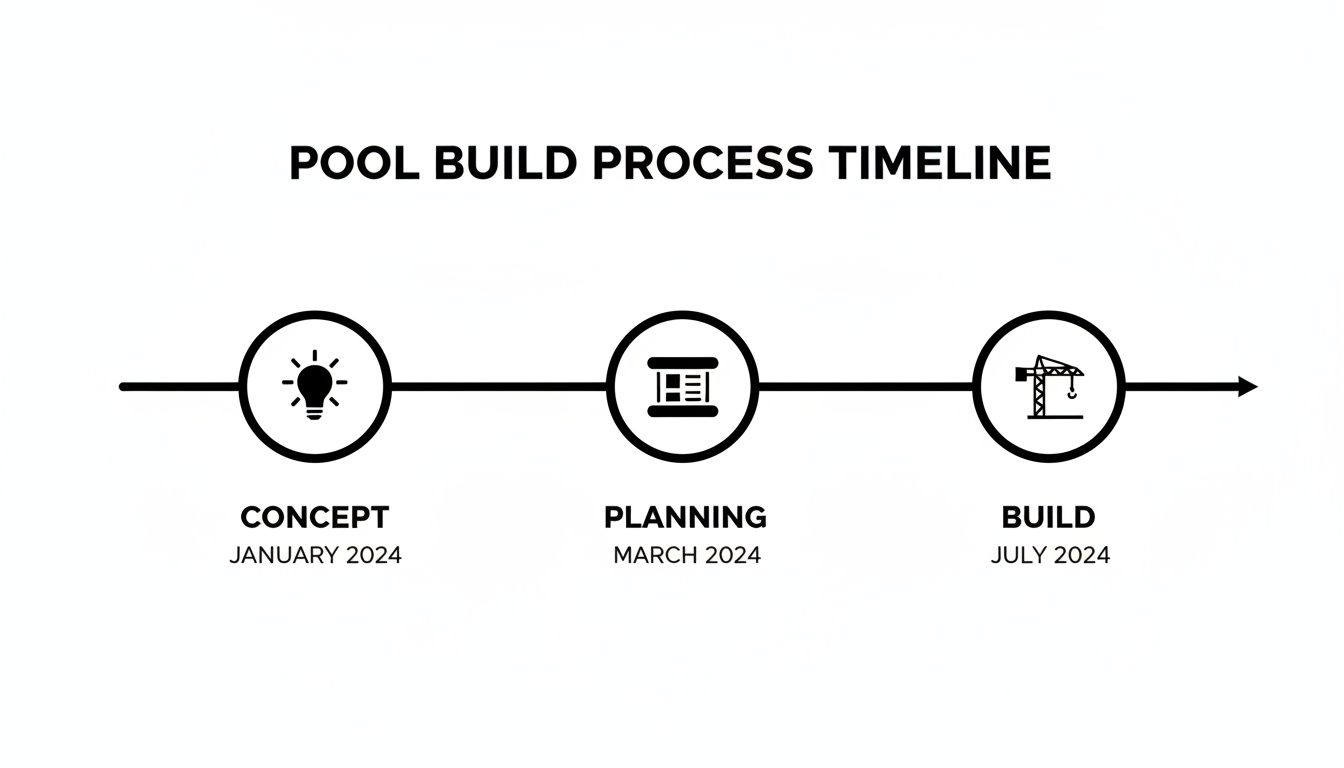
As you can see, the planning and approvals stage is a significant, foundational part of the overall project duration. Don't underestimate it.
Building Regulations and Project Timelines
Beyond planning permission, your project must comply with Building Regulations. These are the technical standards covering everything from structural integrity and fire safety to energy efficiency and ventilation. For an indoor pool, compliance is particularly demanding due to the unique challenges of managing a high-humidity environment. We will need to produce highly detailed technical drawings to prove how the structure, waterproofing, and HVAC systems all meet these stringent requirements.
Putting it all together, the entire process is a significant time commitment. The table below outlines a typical schedule, but remember that every project is unique.
Indoor Pool Project Timeline Overview
Project Phase | Typical Duration (Standard Project) | Additional Time for Listed/Conservation Properties |
|---|---|---|
Concept & Feasibility | 1–2 months | 1–3 months |
Developed Design & Planning | 2–5 months | 4–8 months (includes heritage reports) |
Technical Design & Tender | 2–3 months | 2–3 months |
On-Site Construction | 4–12 months | 6–14 months |
Total Estimated Timeline | 9–22 months | 13–28 months |
Generally, a bespoke indoor pool project involves a design and approvals period of 3–9 months, followed by an on-site build of 4–12 months. This gives you a total lead time of anywhere from 7 to 21 months. For our clients in areas like Wimbledon or Surrey, we find a conservative schedule of 9–18 months is a realistic expectation for a high-end project.
If you own a heritage property, the timeline will almost certainly be extended. Securing Listed Building Consent often requires specialist heritage reports and structural surveys to prove the new work won't harm the historic fabric of the building. This can easily add another 2–6 months to the approval stage. Careful, expert management of this pre-construction phase is the key to a smooth and predictable build.
Mastering Structural and Environmental Engineering
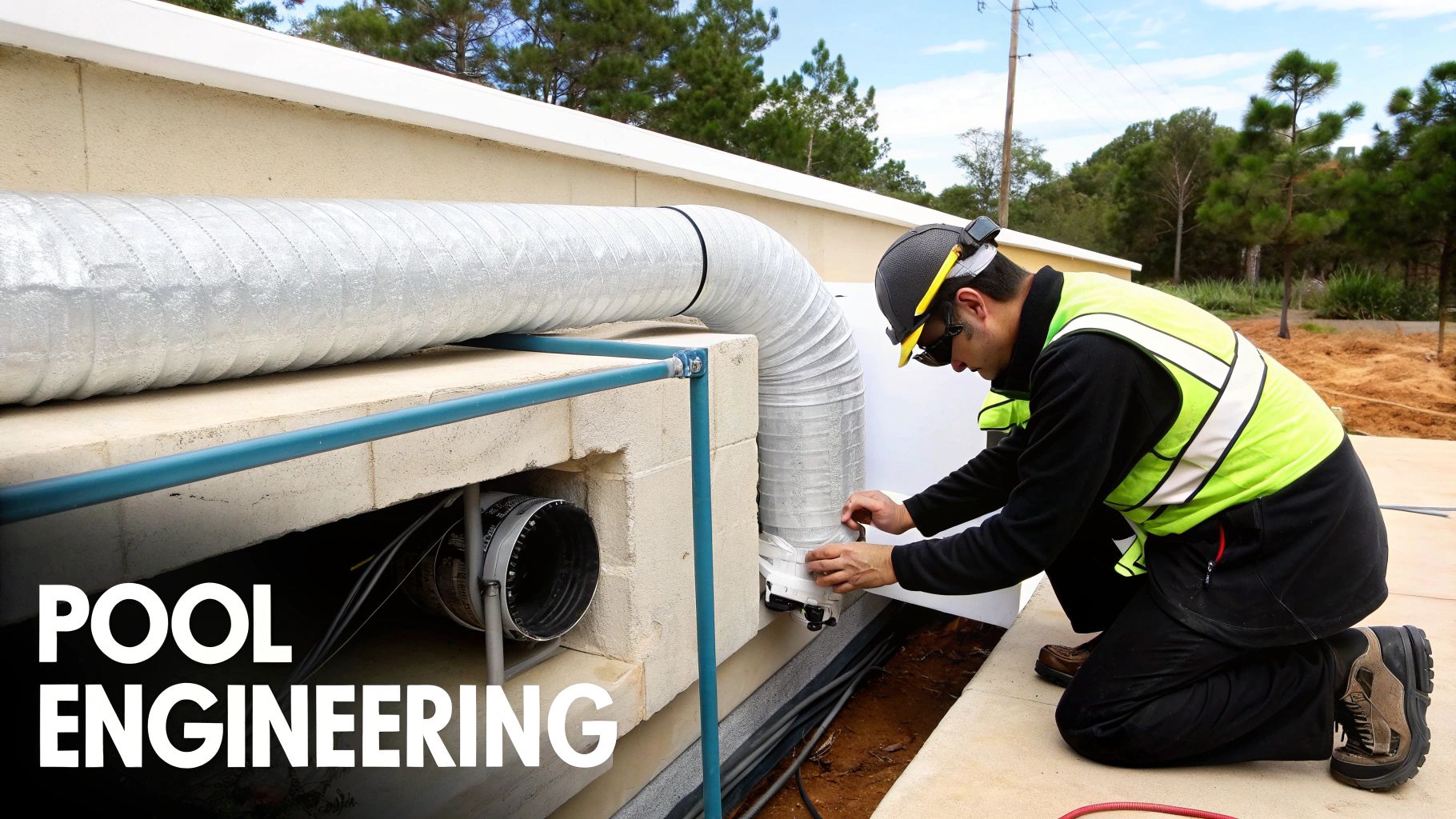
The real magic behind a successful indoor swimming pool happens long before the first tile is laid. It’s all in the technical heart of the project: the structural and environmental engineering. These elements are completely invisible in the finished space but are absolutely critical for its longevity, safety, and comfort.
Getting this right from day one prevents a cascade of future problems with damp, condensation, and structural movement. It protects both your investment and your property’s fabric, making the difference between a luxurious wellness sanctuary and a constant source of costly maintenance headaches.
The Foundation: A Robust Pool Shell
Unsurprisingly, the structure that contains thousands of litres of water is the single most important structural element. In the UK, we primarily rely on two methods for constructing the pool shell, and each has distinct advantages.
Reinforced Concrete Pools are the traditional and most flexible option. We build a steel reinforcement cage on-site, and concrete is then either sprayed on (a method known as shotcrete) or poured into custom-built formwork. This approach allows for complete design freedom – any shape, size, or depth you can imagine is possible.
This bespoke method is ideal for complex designs, pools with varying depths, or tricky installations in spaces like basements where the shell must be perfectly integrated with the building’s existing foundations.
Prefabricated Pools, often made from fibreglass or modern composites, are manufactured off-site as a single unit and then craned into position. While this limits customisation in terms of shape and size, it can significantly speed up the on-site construction phase. They are often a great fit for simpler, more straightforward garden room projects.
Waterproofing: The First Line of Defence
No matter how the shell is built, its ability to hold water is only as good as its waterproofing system. Even a tiny leak in an indoor pool can go undetected for years, potentially causing catastrophic damage to the surrounding structure, especially if it's in a basement.
Modern waterproofing isn't just one layer; it’s a multi-layered defence. This typically includes:
Integral Waterproofers: These are special admixtures blended directly into the concrete mix, making the concrete itself inherently resistant to water penetration.
Tanking Systems: After the shell cures, specialist waterproof renders or membranes are applied to the internal surfaces. This creates a seamless, impenetrable barrier, a process often referred to as "tanking."
External Damp Proofing: For basement pools, an external damp-proof membrane is also essential to prevent groundwater from pressing in against the outside of the shell.
Expert waterproofing is non-negotiable. It’s a highly specialised skill, and entrusting it to a team with a proven track record in pool construction is one of the most important decisions you will make during the build.
Creating The Perfect Indoor Climate
The air quality and temperature in your pool hall are just as important as the water quality. An indoor pool is constantly evaporating, releasing huge amounts of moisture into the air. Without proper management, this humid air will condense on cooler surfaces like windows and walls, leading to mould, mildew, and structural decay.
This is where a dedicated Heating, Ventilation, and Air Conditioning (HVAC) system comes in. A standard domestic system is completely inadequate for this task. A specialist pool environmental control unit performs three critical jobs at once.
1. DehumidificationThe system continuously draws in the warm, moist air from the pool hall. It then cools this air down to its ‘dew point’, causing the water vapour to condense so it can be safely drained away. This is the absolute key to preventing condensation and protecting the building’s fabric.
2. Air and Water HeatingHere’s the clever part. Modern systems recover a huge amount of heat during the dehumidification process. This captured energy is then recycled to help heat both the pool water and the air in the hall, making the whole system remarkably energy-efficient.
3. VentilationWhile it's busy dehumidifying, the system also introduces a controlled amount of fresh, pre-heated air from outside. This is crucial for maintaining excellent air quality. It gets rid of that lingering chlorine smell (caused by chloramines) and ensures the space feels fresh and inviting, not stale and stuffy.
All of these systems fall under the detailed remit of building control, and a good architect will manage this coordination. You can explore our introductory piece for more information on a guide to Building Regulations compliance to understand the broader context.
The combination of a robust structure and a precisely engineered environmental system is the technical foundation of your indoor pool. Mastering these elements ensures your beautiful new space remains a source of pleasure, not problems, for decades to come.
Designing Ambiance with Finishes and Lighting

With the complex engineering forming the backbone of your project, the focus can shift to the sensory experience of the space. This is where you transform a technically sound pool hall into a luxurious sanctuary, a process driven by carefully selected finishes, textures, and a sophisticated lighting scheme.
These aesthetic choices are what bring the architecture to life. They define the mood and turn a functional area into a stunning centrepiece of your home. The right materials not only look beautiful but also perform flawlessly in the demanding, humid environment of an indoor pool.
Choosing Your Pool and Surround Finishes
The surfaces you choose for the pool's interior and the surrounding floor are the most dominant visual elements. They need to be both stunning and incredibly practical, offering durability and, crucially, a non-slip finish for safety.
Your choice of pool tile sets the tone for the entire space, influencing the colour and reflectivity of the water.
Mosaic Tiles: A timeless classic, glass or ceramic mosaics offer limitless design possibilities. They can be used to create intricate patterns, shimmering gradients, or a single, deep block of colour that makes the water look incredibly inviting.
Large-Format Porcelain: For a more contemporary, seamless aesthetic, large-format porcelain tiles are an excellent choice. With fewer grout lines, they create a clean, minimalist look and are exceptionally durable and easy to maintain.
Natural Stone: Materials like granite or slate can be used for a dramatic, organic feel. However, it’s vital to select a stone that is suitable for submerged, chemically treated environments and to ensure it is properly sealed and maintained.
For the pool surround, safety is paramount. The flooring must have a high slip-resistance rating. Fortunately, many high-end porcelain and natural stone tiles are available with textured, non-slip finishes that are both safe underfoot and aesthetically pleasing, allowing for a cohesive design from the pool edge outwards.
The Art of a Layered Lighting Scheme
Lighting is arguably the most powerful tool for shaping the atmosphere of your indoor pool. A well-designed, layered scheme can make the space feel tranquil and spa-like or vibrant and dramatic at the flick of a switch. Simply flooding the room with uniform brightness is a missed opportunity.
A successful lighting plan is not just about illumination; it's about creating depth, highlighting architectural features, and crafting an emotional response. It balances functional needs with atmospheric effect.
A layered approach combines different types of lighting to build a rich visual environment. This means integrating ambient, task, and accent lighting to create a flexible and dynamic space. To learn more about the principles behind creating such an environment, explore our insights on expert lighting design for homes made simple.
Key Lighting Elements
To achieve a truly bespoke feel, consider incorporating a mix of lighting sources that work in harmony.
Underwater Lighting: Modern LED systems can transform the pool itself into a light feature. Options range from simple white light to fully controllable RGB systems that can change colour to suit the mood, creating a spectacular effect after dark.
Ambient Lighting: This provides the general, overall illumination. It can be achieved with discreet recessed downlights, elegant pendants, or concealed linear lighting within ceiling coffers, washing the space in a soft, even glow.
Accent Lighting: Use this to draw attention to specific features. You could uplight a textured stone wall, highlight a piece of sculpture, or use wall washers to accentuate the length of the pool hall, adding a sense of drama and architectural interest.
Finishing Touches for Ceilings and Walls
The ceiling is often overlooked but plays a vital role in both the look and sound of the room. A high, vaulted ceiling can create a sense of grandeur, while a lower, timber-clad ceiling might feel more intimate and spa-like.
Incorporating acoustic panels, either visibly or concealed, is also a wise move. The hard surfaces typical of a pool hall can create significant echo, and acoustic treatments will absorb sound, making the space far more comfortable and serene.
These finishing touches are the final layer in your design, ensuring every surface contributes to a cohesive and exquisitely realised vision when you build an indoor swimming pool.
Weaving in Wellness and Sustainable Tech
Today, luxury isn't just about how a space looks—it’s about how it feels and how it performs. Sustainability and personal wellness have moved from being nice-to-haves to absolute essentials. When you decide to build an indoor swimming pool, you’re creating what is, by its nature, a significant energy consumer. That’s why making intelligent, eco-conscious design choices right from the start is non-negotiable for managing long-term running costs and your environmental footprint.
This shift isn't just a feeling; it's a clear market trend. Recent analysis shows a resilient and growing demand for high-end indoor pools in the UK, especially in affluent hubs like South West London. The key takeaway? Sustainability is now a major differentiator. Energy-efficient technologies are no longer optional extras; they're vital for meeting client expectations and keeping a lid on lifetime operating costs. You can dive deeper into the data with this report on European swimming pool construction trends here.
Championing Energy Efficiency and Sustainability
Let's be blunt: an indoor pool's biggest ongoing expense is heating. You’re heating the water, and you’re heating the air. Tackling this head-on with sustainable technology isn't just about being green; it delivers very real, very substantial savings on your energy bills for decades to come.
The single most impactful change you can make is to move away from traditional gas boilers. Modern heat pumps are simply a far superior solution, offering incredible efficiency by pulling latent heat from the surrounding environment.
Air Source Heat Pumps (ASHPs): These units are brilliant. They draw heat from the ambient air—even on a typical grey British day—and transfer it to your pool water. For the UK climate, they hit the sweet spot between installation cost and year-round performance.
Ground Source Heat Pumps (GSHPs): If you're looking for the gold standard in efficiency, this is it. GSHPs use pipes buried in your garden to draw on stable, low-grade heat from the earth. Yes, the initial installation is more involved and costs more, but the payback comes in the form of exceptionally low running costs and rock-solid performance, whatever the weather is doing.
An automatic pool cover is, without a doubt, one of the most effective energy-saving features you can possibly install. It can slash heat loss and water evaporation by up to 70%. Think about that—it dramatically reduces the workload for both your heating and dehumidification systems, saving a fortune over time.
Beyond the plant room, you have to get the insulation right. This isn’t just about insulating the pool shell to stop warmth leaching into the ground. It means ensuring the entire building envelope—walls, roof, and glazing—is constructed to an exceptionally high thermal standard. Get this right, and you create a stable, airtight, and easily controlled environment.
Expanding Your Vision into a Full Wellness Suite
The decision to build a pool is the perfect catalyst to think bigger. Why stop at just a pool when you can create a complete, integrated wellness suite that’s tailored to your family’s lifestyle? This holistic approach ensures your investment pays dividends for your health and wellbeing, not just your property value.
When you plan for these features from day one, your architect can design a seamless and truly functional space where every element flows into the next. It’s far more effective than trying to bolt things on later.
Popular Wellness Integrations
Imagine how these additions could transform your home into a private sanctuary:
Spa and Hydrotherapy: A bubbling spa or jacuzzi with powerful hydrotherapy jets is the ultimate reward after a workout or a stressful day. We can design it as an integrated part of the main pool structure or as a separate, more intimate feature tucked away in a quiet corner.
Sauna and Steam Room: The classic wellness duo, for good reason. A traditional Finnish sauna offers intense, dry heat, while a steam room provides a high-humidity environment to soothe airways and skin. Both are renowned for boosting circulation and aiding detoxification.
Home Gym or Yoga Space: Placing a dedicated fitness area right next to the pool creates that exclusive health club experience, but with zero travel time. We often use large glass partitions to maintain a visual connection between the two zones, which makes the gym feel bright and open while containing any noise.
By combining forward-thinking sustainable tech with these kinds of wellness features, your indoor pool becomes so much more than a place to swim. It evolves into a private retreat that genuinely enhances your lifestyle, lightens its environmental impact, and adds profound, lasting value to your home.
Choosing Your Project Team and Final Considerations
Building an indoor swimming pool is a highly specialised undertaking. The success of your vision ultimately rests on the expertise of the team you assemble, and your most critical decision will be choosing an architect and main contractor with proven experience in this exact field.
Engaging a RIBA-accredited architectural practice is a smart move. They will act as your representative, managing the entire process from the first sketches right through to completion. It’s their job to safeguard the design's integrity, coordinate the various engineers, and ensure a high standard of quality on site. When you’re reviewing their portfolios, don't just look for beautiful projects—look specifically for high-quality indoor pools.
Selecting the Right Partners
When you start shortlisting potential firms, dig into their track record with your local planning authority, especially if your property is in a conservation area or is a listed building. A team that already knows the local council’s priorities and quirks can navigate the approvals process far more efficiently.
Before you commit, make sure you ask the right questions:
Can you show us examples of completed indoor pools that are similar in scale and complexity to what we have in mind?
How do you manage the budget, and what does your communication process look like with clients?
Who are your go-to structural engineers and environmental control specialists?
A collaborative relationship built on clear communication is paramount. Your architect shouldn't just design for you; they should design with you, translating your brief into a feasible and beautiful reality.
This collaborative approach, combined with a well-considered brief and a realistic budget, is the formula for a seamless project. It ensures the final result doesn’t just meet your expectations but completely surpasses them, delivering a timeless addition to your home.
Your choice of project team is the single most important investment you'll make in this entire process. Choose wisely. This decision will ensure your new wellness sanctuary is built to last, perfectly reflecting your lifestyle and enhancing your home for decades to come.
Your Indoor Pool Questions, Answered
Thinking about adding an indoor swimming pool is exciting, but it naturally brings up a lot of questions. We get asked the same things time and again by homeowners across the UK, so we’ve put together some straightforward answers to help you get started.
What's a Realistic Budget?
Let's be upfront: a bespoke indoor pool is a major investment. For a high-quality build, particularly in areas like London or Surrey, you should be looking at a starting budget of around £120,000. More complex projects can easily go beyond £300,000.
What drives that cost? It really comes down to the pool's size, the scale of any structural work (especially if you're digging out a basement), the sophistication of the environmental control systems, and of course, the quality of the finishes and tiles you choose.
Do I Actually Need Planning Permission?
More often than not, yes. If your pool is going into a new extension or a separate garden building, you will almost certainly need to submit a full planning application.
If you're converting an existing basement, the work itself is mainly covered by Building Regulations. However, if you add external elements like new light wells to bring in natural light, those parts might need planning consent on their own.
A quick but crucial note: if you live in a listed building or a conservation area, the rules are much stricter. You'll need both planning permission and Listed Building Consent for almost any change. Getting professional advice from the very beginning is non-negotiable here.
How Long Does it All Take?
From those first sketches to your first swim, a typical bespoke indoor pool project takes somewhere between 9 and 18 months to complete.
You can generally split this timeline into two key phases:
Design & Approvals: This part involves creating detailed designs, bringing in engineers, and getting the necessary permissions. It usually takes 3 to 6 months.
Construction: The on-site build, from breaking ground to filling the pool, typically lasts from 6 to 12 months.
Keep in mind that complex projects, like those involving major basement excavations or delicate work on a period property, can stretch this timeline. It’s vital to be realistic about this from the outset.
Ready to talk through your vision for a bespoke indoor pool? Contact Harper Latter Architects to arrange an initial consultation and see how we can turn your ideas into a stunning reality. Learn more about our architectural services.

Comments