
UK Swimming Pool Planning Permission Explained

Updated: 4 days ago
Here’s a refreshing bit of news: most outdoor swimming pools in the UK don’t actually need formal planning permission. They often fall under what’s known as ‘permitted development rights’—a kind of pre-approved green light for common home improvements. This means you can often skip the full, lengthy application process, provided your project ticks the right boxes.
Understanding Swimming Pool Planning Permission
Dreaming of a pool in your South West London garden is one thing, but navigating the rules to make it happen is another. The good news is, for many homeowners, the journey is more of a paddle than a deep dive into bureaucracy. The key is figuring out if your vision fits within the scope of permitted development.
This first step is where most of the confusion lies. Put simply, the planning system doesn't see an uncovered outdoor pool as a 'building' in the traditional sense. Instead, it’s classed as an engineering operation. As long as it's considered 'incidental to the enjoyment of the dwellinghouse' (meaning it’s for your family’s private use and enjoyment), it often sidesteps the need for a full-blown planning application.
But this doesn't mean it's a complete free-for-all. There are some important conditions you must stick to. Stray outside these boundaries, and you’ll find yourself needing to submit a formal application to your local council.
The Core Principles of Permitted Development
For your outdoor pool to qualify under permitted development, it generally needs to follow a few simple rules. Think of them as a common-sense checklist designed to make sure your new pool doesn't become a headache for your neighbours or the local area.
Here’s what you need to keep in mind:
Garden Coverage: The pool, along with any other garden buildings like sheds, summerhouses, or a pump house, cannot take up more than 50% of the total land around your original house.
Location Matters: It cannot be built on land in front of the principal elevation of your home. In other words, no front garden pools.
Property Type: These rights apply to houses, not to flats, maisonettes, or other types of buildings.
Following these guidelines is your first and most important step towards a hassle-free installation. For a more detailed look at the practical side of things, our complete [UK design for a swimming pool guide](https://www.harperlatterarchitects.co.uk/post/uk-design-for-swimming-pool-guide) offers much deeper insights into materials and construction.
When Permitted Rights Do Not Apply
It's crucial to know that permitted development rights aren't universal. Certain properties and locations have these rights restricted or removed entirely. If your home falls into one of these categories, you will almost certainly need to apply for full planning permission, no matter the size or location of your pool.
A common mistake is assuming that because a project feels minor, it doesn't need checking. For properties in Conservation Areas or for listed buildings, even small changes require proper scrutiny. Always, always check with your local planning authority before you even think about breaking ground.
The general consensus across the UK is that outdoor pools are often classed as a garden project and can be built under these rights. Guidance from the Planning Portal confirms that an unenclosed pool is typically permitted development, so long as it meets the conditions. This is the very foundation that allows thousands of garden pools to be built each year without formal applications.
To make things even clearer, here's a quick summary of when permission is usually needed.
Planning Permission at a Glance for Outdoor Pools
This table breaks down the most common scenarios you're likely to encounter.
Scenario | Permission Likely Required? | Key Consideration |
|---|---|---|
Standard Back Garden Pool | No | Must not cover more than 50% of your garden area. |
Pool in a Conservation Area | Yes | Permitted development rights are often restricted. |
Pool for a Listed Building | Yes | Any alteration to the setting of a listed building needs consent. |
Pool in Front Garden | Yes | Not allowed under permitted development. |
Pool with an Enclosure (e.g., a pool house) | Yes | The enclosure itself is considered a building and has its own rules. |
Pool for Flats or Maisonettes | Yes | Permitted development rights do not apply to these property types. |
Ultimately, while the rules might seem complex at first, they are designed to be logical. The next sections will explore these rules in greater detail.
How Permitted Development Rights Work for Pools
For many homeowners dreaming of a pool in South West London, the term Permitted Development Rights (PDR) is often the key. In short, these rights are a national grant of planning permission from the government, letting you carry out certain types of work without needing to lodge a full application with your local council.

Think of PDR as a pre-approved checklist. If your pool project ticks all the right boxes, you’re good to go. The specific rules for outbuildings—which is how swimming pools are classified—are set out in Class E of The Town and Country Planning (General Permitted Development) (England) Order 2015. This is the legal framework that dictates what you can and can't build.
Interestingly, the regulations treat outdoor and indoor pools very differently. Historically, English planning law hasn't typically considered digging a hole and filling it with water for an outdoor pool as 'development' that needs a formal application. If you’re interested in the nitty-gritty, you can explore the detailed legal basis of swimming pool regulations to understand why this is the case.
What Does "Incidental to the Enjoyment" Mean?
You’ll come across this phrase a lot: the pool must be "incidental to the enjoyment of the dwellinghouse."
All this really means is that the pool must be for the private, recreational use of you and your family. It can't be the main feature of the property or used for any commercial reason, like running a paid swimming school from your back garden.
A pool in the back garden of a family home in Wimbledon, for example, is clearly an incidental feature for their leisure. But if that same pool was the centrepiece of a commercial health retreat being run from the house, it would fail the 'incidental' test and need full planning permission.
The 'incidental' rule is there to make sure any outbuildings or structures, pools included, remain secondary to the main house. It's about enhancing your home life, not setting up a separate business in your garden.
The Practical Checklist for Permitted Pools
To make sure your project stays within permitted development rules, your pool—and any structures that go with it, like a pump house or decking—has to meet a strict set of criteria. Get just one of these wrong, and you’ll find yourself needing to submit a formal planning application.
Here are the essential conditions your project must meet under Class E:
No Front Garden Pools: The pool absolutely cannot be built on land in front of the principal elevation (the front wall) of the original house.
Total Coverage Limit: The pool, plus any other outbuildings like sheds or summerhouses, must not cover more than 50% of the total area of your home's curtilage (the land around your house). This calculation excludes the ground area of the original house.
Height Restrictions: Any building associated with the pool, like an enclosure or pump house, can't be higher than 2.5 metres if it's within two metres of a boundary. If it’s further away, a single-storey building can have a maximum eaves height of 2.5 metres and a maximum overall height of 4 metres for a dual-pitched roof, or 3 metres for any other roof type.
Proximity Rules: No part of the pool or its associated buildings can be within the grounds of a listed building.
Let's put this into a real-world context. Imagine a typical semi-detached home in Richmond with a 100-square-metre back garden. The owner wants a 4m x 8m pool (32 sq metres) and already has a 10-sq-metre shed. The total coverage comes to 42 sq metres, or 42% of the garden, so it’s comfortably inside the 50% limit. They also need a small pump house right on the boundary line, so they make sure its flat roof is only 2.4 metres high, keeping them compliant. This kind of project would very likely not require a full planning application.
While permitted development rights are a fantastic, streamlined route for many garden pool projects, they aren’t a universal pass. Certain circumstances and locations will always override these rights, making a formal planning application an absolute must.
Frankly, trying to sidestep these rules is a surefire way to face costly enforcement action from your local council down the line. It's just not worth the risk.

Think of the following points as your essential checklist. Getting your head around these non-negotiable scenarios will help you budget both time and money correctly from the very beginning, ensuring your project starts on a solid legal footing. Let's dig into the key situations where you absolutely must apply for swimming pool planning permission.
Navigating Projects in Protected Areas
If your property sits within a specially designated area, you should assume from the outset that your permitted development rights are either heavily restricted or gone completely. Local authorities apply far stricter scrutiny in these locations to preserve their unique character, and a swimming pool is no exception.
You will almost certainly need to file for full planning permission if your home is in:
A Conservation Area: These areas are protected for their special architectural or historic interest. Any development, including a pool, will be judged on how it impacts the character and appearance of the area.
An Area of Outstanding Natural Beauty (AONB): Here, the primary goal is conserving and enhancing the natural beauty of the landscape. A pool project will be evaluated on its visual impact and environmental footprint.
A National Park or The Broads: Much like AONBs, these areas have the highest level of landscape protection, and any new development is very strictly controlled.
A World Heritage Site: Any works within the curtilage of a property in such a site will need careful justification and a formal application.
In these locations, the council will want to see detailed plans showing exactly how your pool design respects its sensitive surroundings. This often means specifying certain materials or including detailed landscaping schemes to soften the visual impact.
The Certainty of Listed Building Consent
If your home is a listed building, any work that could affect its character as a building of special architectural or historic interest will require Listed Building Consent. This is a separate process from planning permission, but we typically apply for both at the same time.
For a listed property, it's not just about the house itself but also its 'curtilage' or setting. A modern swimming pool built in the garden is absolutely considered to alter the setting, making consent almost unavoidable. Attempting to bypass this can lead to criminal prosecution.
Your application will need to justify the proposal in great detail, demonstrating that the pool will not harm the historic significance of the building or its surroundings.
Other Automatic Planning Triggers
Beyond protected areas and listed buildings, several other common project types automatically fall outside the scope of permitted development. These are critical red flags that signal the need for a full application right away.
One of the most common triggers is when a pool is part of a larger project. For instance, if you're building a new extension that also houses an indoor pool, the entire development will be subject to planning permission. You can learn more about the complexities of extensions in our **UK house extension planning permission guide**.
Other definite triggers include:
Indoor Pools: Any pool housed within a new, permanent building is considered an extension to your home and will require a full planning application. This is because the structure itself falls under different planning rules than an open-air pool.
Significant Land Alterations: Permitted development covers the pool itself, but not major engineering works that dramatically alter the landscape. If your project involves extensive excavation to level a steep garden, for example, this could be classed as a separate engineering operation needing its own permission.
Flats and Maisonettes: Permitted development rights only apply to dwellinghouses. If you live in a flat, maisonette, or a house that has been converted into flats, you simply don't have these rights and must apply for permission for a pool.
Navigating the Planning Application Process
So, you've discovered your dream pool needs a formal planning application. Don't let that put you off. While it might sound intimidating, it’s a well-trodden path, and with a methodical approach, you can present a case that shows the council your project is a thoughtful addition to both your home and the neighbourhood.
The real work actually starts long before you fill out any forms. The most valuable first step is often getting pre-application advice from your local planning authority. This is your chance to have a chat—formally or informally—about your initial ideas and get early feedback. It’s an incredibly useful way to flag potential issues, like privacy concerns or visual impact, before you’ve invested time and money in detailed architectural drawings.
Getting Your Documentation in Order
With a clear direction, your focus can shift to putting together a comprehensive and persuasive application pack. This is about more than just paperwork; it’s about telling the story of your project. You'll submit everything online via the national Planning Portal, which keeps the process consistent across England.
A solid application for swimming pool planning permission hinges on a specific set of documents. Detail and precision are your best friends here.
Site Location Plan: This gives the wider context, showing your property’s boundary (clearly marked in red) in relation to the surrounding area.
Block Plan: A closer, overhead view that pinpoints the proposed pool's position relative to your house, boundaries, and any neighbouring properties.
Existing and Proposed Elevations: These are the 'before and after' drawings, showing your property as it is now and how it will look with the new pool and any extras, like a pump house.
Design and Access Statement: This is where you explain your thinking. It should cover the pool's size, materials, and appearance, and justify why it’s a suitable proposal for the site. This document is absolutely crucial, especially for projects in sensitive locations like Conservation Areas.
Presenting this information clearly and professionally signals to the planning officer that you've thought the project through. It answers their questions before they’ve even had to ask them, making their job of assessing your proposal that much easier.
This visual breaks down the key stages for building a strong planning application and highlights the common pitfalls that can lead to refusal.
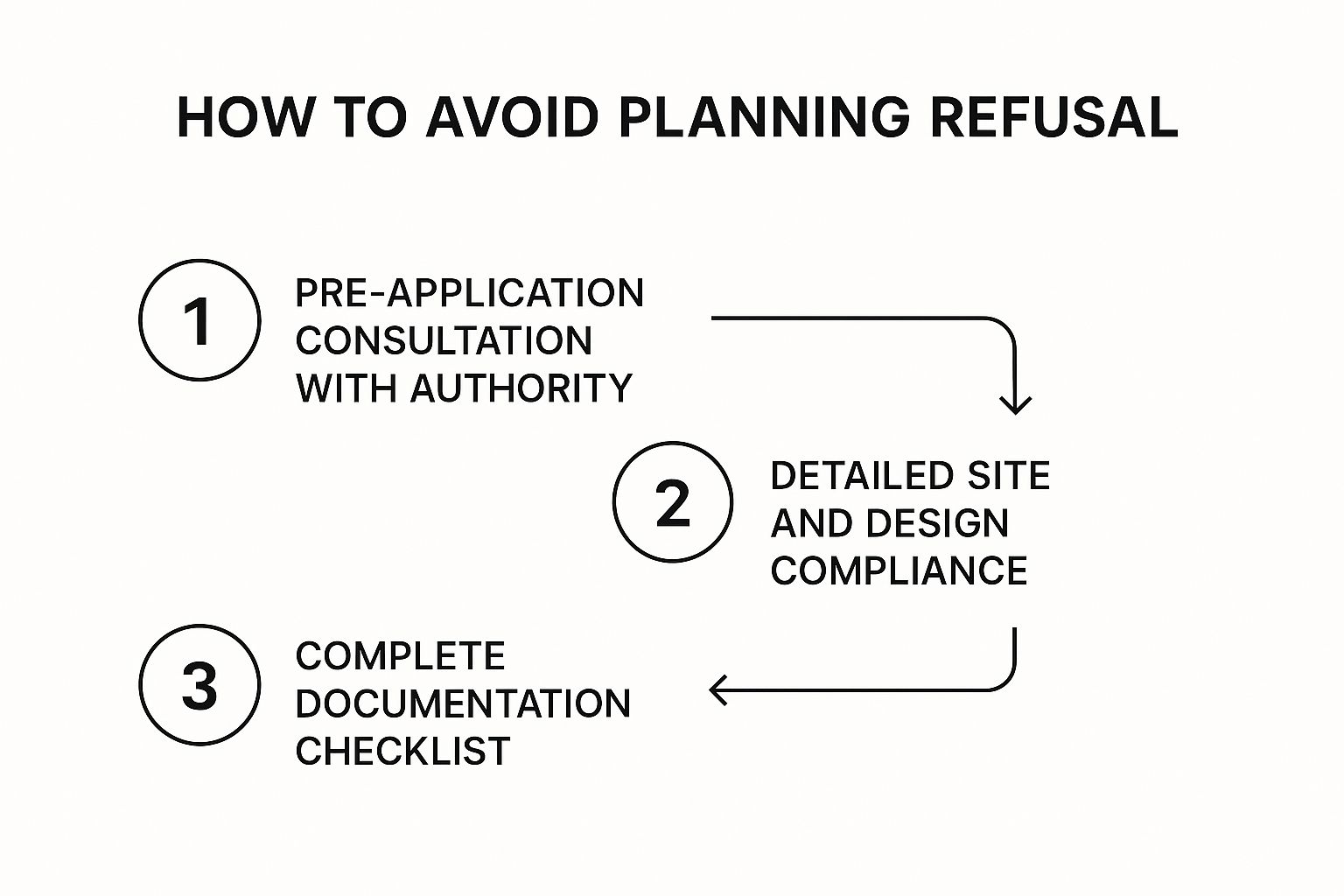
As you can see, a successful result is built on a foundation of early consultation, careful design compliance, and thorough, professional documentation.
Timelines and What to Expect
Once your application is submitted and validated by the council, a statutory determination period kicks in. For a straightforward householder application—which a swimming pool project usually is—this is typically eight weeks.
During this window, a case officer is assigned to your project, public consultations take place (your immediate neighbours will be notified), and various internal departments might be asked for their input.
It’s worth remembering that the system is generally geared towards approving well-considered projects. Between January and March 2025, district-level planning authorities in England received around 90,700 applications. Of the decisions made, a promising 87% were approvals, and householder applications for home improvements made up 51% of all decisions. You can dive into the full breakdown and find more insights on the government's website covering these national planning statistics on GOV.UK.
A common mistake is seeing the planning process as a battle you have to win. It’s far more productive to approach it as a collaboration. An application that respects local policies and proactively addresses potential concerns is much more likely to sail through.
Crafting a Strong Application
To give your application the best possible chance, you need to think like a planner. What are their primary concerns? By pre-empting these, you can demonstrate how your design respects the local character, protects your neighbours' amenity, and ticks all the right policy boxes.
Here are a few practical tips:
Address the Visual Impact: Don’t just show the pool; include landscaping plans. Show how thoughtful planting and screening can soften its appearance and shield it from neighbours’ views.
Minimise Noise Concerns: Think about the pump and filtration equipment. Position it away from neighbouring properties or, even better, place it within an acoustically insulated enclosure. Make sure to mention this in your Design and Access Statement.
Respect Privacy: Use your plans to clearly show that the pool’s location won’t create any overlooking issues for adjacent gardens or windows.
This level of detailed consideration is exactly what’s needed for other major home alterations, too. If you’re interested in how these principles apply elsewhere, our guide to [navigating basement extension planning permission](https://www.harperlatterarchitects.co.uk/post/the-ultimate-guide-to-navigating-basement-extension-planning-permission) offers similar insights into the planning system.
Ultimately, by putting yourself in the shoes of the planning officer and your neighbours, you can build a compelling case that makes approval a straightforward decision.
Understanding Building Regulations and Other Hurdles
Getting planning permission—or confirming you don't need it—feels like a massive milestone for your swimming pool project. But it's a common and costly mistake to think this is the only legal hurdle you need to clear. There’s another, equally important layer of compliance to navigate: Building Regulations.
These two systems are entirely separate. While planning permission deals with the appropriateness of your pool in its location and its visual impact, Building Regulations are all about the technical construction and safety standards of the build itself. Even if your pool is a permitted development, it absolutely must comply with these regulations.
Planning Permission vs Building Regulations
Think of it like this: planning permission asks, "Should this pool be built here?" while Building Regulations ask, "Is this pool being built safely and correctly?"
Getting this distinction right is critical. You could have full planning permission in your hands but still be served with an enforcement notice if your pool's electrical systems are unsafe or its structure is unsound. The two approvals run on parallel tracks, and you are legally required to satisfy both.
A key takeaway is that Building Regulations are non-negotiable for ensuring the safety and longevity of your pool. They cover critical aspects of construction, from the stability of the excavated hole to the safety of the lighting and filtration systems.
Key Building Regulations for Swimming Pools
While a full breakdown is extensive, several parts of the Building Regulations are particularly relevant to swimming pool construction in a residential setting. Your architect and build team will manage the specifics, but having a handle on the core areas is always helpful.
Part A Structural Safety: This is fundamental. The regulations require that the pool's structure—whether concrete, fibreglass, or liner—is properly engineered to withstand the immense pressure of the water and surrounding ground. This involves a proper ground assessment, reinforcement, and construction techniques to prevent collapses or leaks.
Part P Electrical Safety: Water and electricity are a dangerous mix. Part P governs all electrical work in and around the pool, including underwater lighting, pumps, heaters, and automatic covers. All work must be carried out by a competent, qualified electrician who can self-certify their installation, ensuring it’s protected against electric shock.
Part H Drainage and Waste Disposal: This covers how you'll manage your pool water. The regulations dictate how backwash water from the filter and any overflow must be directed into a suitable drainage system, preventing contamination of groundwater or flooding of neighbouring properties.
Beyond the Regulations: The Party Wall Act
Another significant legal hurdle, especially in the densely packed neighbourhoods of South West London, is the Party Wall etc. Act 1996. This legislation comes into play if you are excavating for your pool near a boundary or a shared wall.
If your excavation work is planned within three metres of a neighbour’s building and will go deeper than their foundations, you are legally required to serve them with a formal Party Wall Notice. This gives your neighbours the chance to have the condition of their property assessed by a surveyor before work begins, protecting both parties from disputes over potential damage. Ignoring this can lead to expensive legal injunctions that halt your project entirely.
Restrictive Covenants: Hiding in Your Deeds
Finally, before you commit any significant funds, it's vital to check the deeds to your property for any restrictive covenants. These are private legal agreements written into the property deeds that can limit what you can do with your land.
It’s not unheard of for older properties to have covenants forbidding the construction of certain structures or any building work at all without the original developer’s consent. Finding one of these after you’ve started can be a project-ending disaster, so a thorough check by your solicitor early on is an essential piece of due diligence.
Got Questions? We’ve Got Answers

Navigating the rules around swimming pools can feel a bit murky. It’s natural to have questions, and over the years, we’ve heard most of them. Here are some clear, straightforward answers to the queries that pop up most often from homeowners in South West London.
Do I Need Planning Permission for an Above-Ground Pool?
This is a classic "it depends" scenario. Generally, a simple, temporary above-ground pool that you could easily take down doesn't need planning permission. The council sees it in the same light as a trampoline or other garden play equipment.
But the line gets blurry when the structure becomes more permanent. If you’re planning a large, fixed pool with extensive decking, a proper pump house, or anything that stands over 2.5 metres high near your boundary, it’s a different story. At that point, it’s treated just like an in-ground pool, and if it takes up more than 50% of your garden space (along with other outbuildings), an application is almost certainly on the cards.
What Is a Lawful Development Certificate and Should I Get One?
A Lawful Development Certificate, or LDC, is an official document from your local council that legally confirms your pool project falls under permitted development and doesn't need full planning permission. It isn't mandatory, but we strongly recommend getting one.
Think of it as an insurance policy for your project. An LDC gives you absolute peace of mind, protecting you from any future disputes or enforcement action if a neighbour complains down the line. It's also a crucial document when you decide to sell your home, offering concrete proof to buyers and their solicitors that everything was done by the book.
How Much Does a Planning Application for a Pool Cost?
Let's talk numbers. The direct cost of submitting a householder planning application in England is currently £234. This is the standard statutory fee for alterations to a single home, which is the category a swimming pool usually falls into.
However, that’s just the council’s fee. You’ll also need to budget for the professional services required to put a strong application together. This typically includes:
Architectural Drawings: You'll need a full set of detailed site plans, block plans, and elevations.
Planning Consultant Fees: The cost for a professional to prepare and manage the submission can vary depending on the project's complexity.
Specialist Reports: If your home is in a conservation area, for example, you may need extra documents like a heritage statement to support your case.
It’s always a good idea to check the government's official Planning Portal for the most up-to-date fee schedule before you get started.
Can My Neighbours Object to My Swimming Pool Plans?
This all comes down to whether you need a full planning application or not. If your pool is a straightforward permitted development project, there’s no formal application process for neighbours to comment on. The project is essentially pre-approved.
But if you do need to apply for planning permission, the council is legally required to consult your immediate neighbours. They’ll be sent a letter with your plans and given a set time to submit their comments.
For an objection to have any real impact, it must be based on valid 'material planning considerations'. These are the specific, legitimate planning issues the council is allowed to consider.
Valid objections could be things like:
A significant loss of privacy or being overlooked.
Noise and disturbance from pumps and other equipment.
A negative visual impact on the character of the neighbourhood.
Personal gripes, a lost view, or worries about property values are not material considerations and will be set aside by the planning officer. A well-thought-out design that addresses privacy and noise from the very beginning is your best defence against any significant opposition.
Navigating the complexities of swimming pool planning permission requires specialist expertise, especially for high-end projects in sensitive areas like Wimbledon or Richmond. At Harper Latter Architects, we combine architectural creativity with an in-depth understanding of local planning policy to deliver exceptional results. Discover how our bespoke architectural services can bring your vision to life by visiting us at https://harperlatterarchitects.co.uk.

Comments