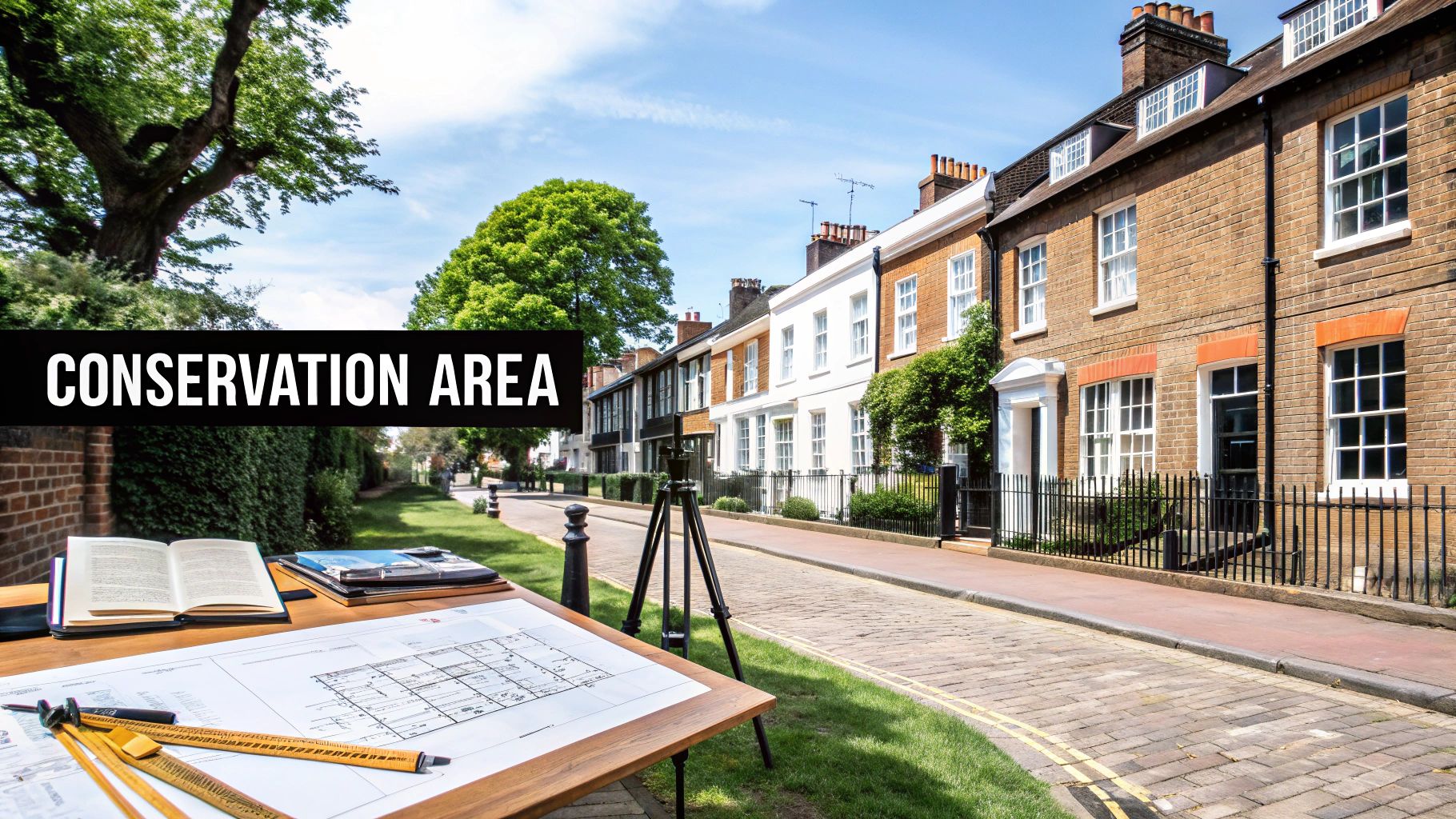
Ever wondered why some streets or neighbourhoods feel so perfectly preserved, almost like stepping back in time? You’re likely standing in a conservation area. In a nutshell, a conservation area is a place recognised for its special architectural or historic character, which local authorities have a legal duty to protect and enhance.
Understanding the Heart of a Conservation Area
Think of a conservation area not as a museum filled with individual exhibits, but more like a carefully preserved historic town or village. It’s a place where the entire streetscape—the buildings, the layout of the roads, the mature trees, and even the garden walls—all work together to create a unique and valuable atmosphere.
For homeowners, this designation introduces a specific set of rules designed to protect that collective character. This guide, created by specialists like us at Harper Latter Architects, will walk you through exactly what that means for your property in South West London and beyond.
Why Are Conservation Areas Designated?
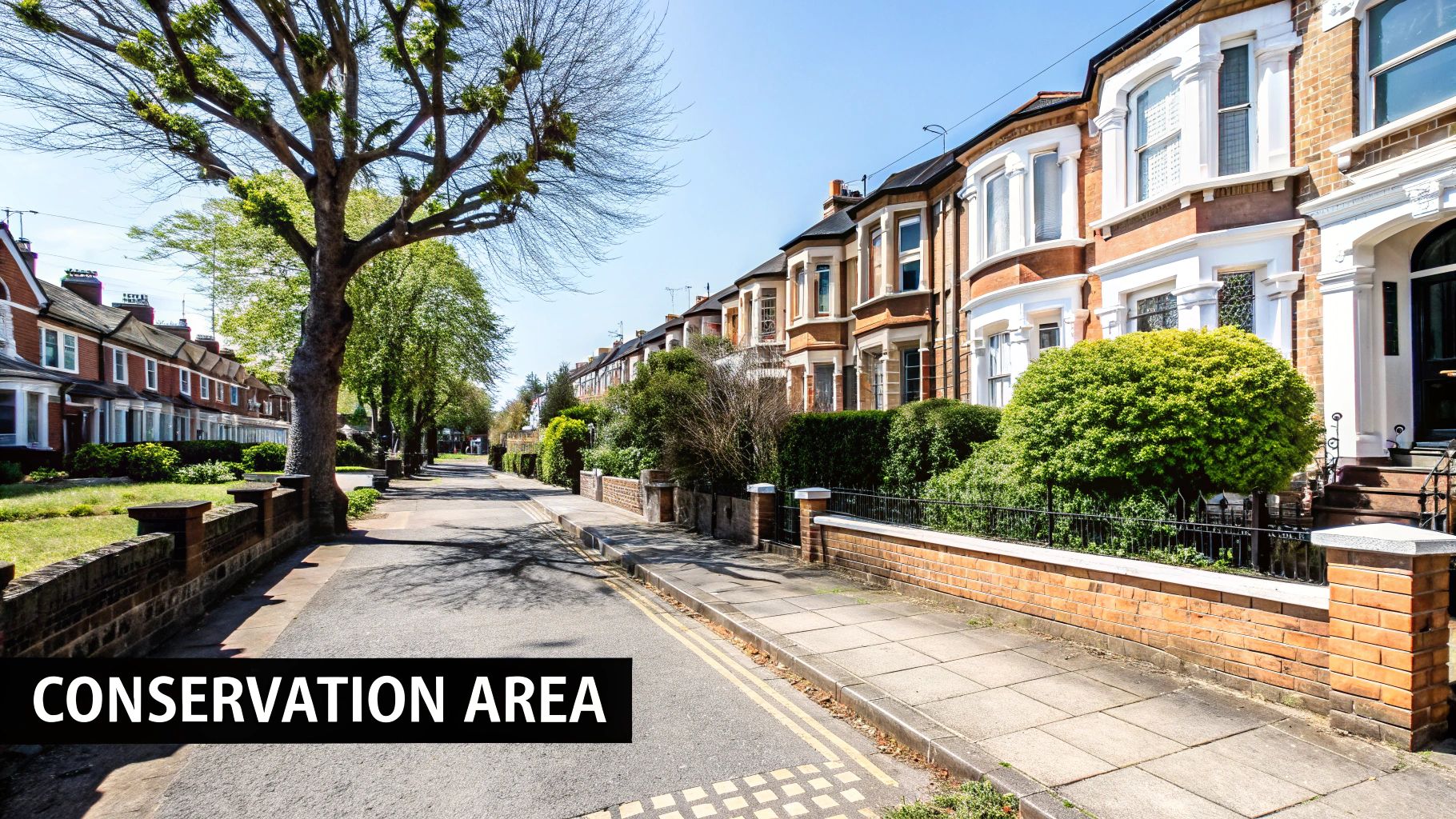
The primary goal is to manage change sympathetically, making sure any new developments don’t detract from the area's established charm. It’s not about freezing a place in time, but about guiding its evolution in a way that truly respects its past.
The scale of this protective effort is pretty significant. England alone has around 10,000 conservation areas, with at least one in every local authority, forming a protective mosaic over historic towns, villages, and urban gems. Designated by local councils, these zones help combat threats like neglect and poorly considered development. You can find out more about at-risk areas on the Historic England website.
What Defines the 'Special Character'?
The "special character" of a conservation area isn't just about grand, historic buildings. It’s a combination of many elements that, when brought together, create a distinct sense of place.
A conservation area is the entire team, where the interplay between all the players creates the winning formula. It’s the collective value of the whole street, not just one star building.
To give you a better idea, here's a quick summary of the key characteristics that often define these areas.
Key Characteristics of a Conservation Area at a Glance
This table breaks down the fundamental aspects of a conservation area, helping homeowners quickly grasp the concept and its implications.
Characteristic | Description & Implication for Homeowners |
|---|---|
Architectural Cohesion | Consistent use of materials (e.g., London stock brick) and styles. Any changes must use appropriate materials to maintain this harmony. |
Historic Layout | The original pattern of streets, plots, and boundaries. New extensions or builds must respect this historic footprint. |
Green Spaces | Mature trees, historic gardens, and public greens. Trees are often protected, and front gardens may have restrictions on paving. |
Distinctive Details | Original features like iron railings, cobbled streets, or sash windows. Homeowners are expected to repair rather than replace these features. |
Ultimately, it’s these combined elements that make a conservation area special, and it’s why any proposed changes are scrutinised so carefully.
The Legal Protections for Conservation Areas
So, what gives a conservation area its protective shield? It’s not just a suggestion from the local council; the authority comes directly from UK law. Specifically, it's the Planning (Listed Buildings and Conservation Areas) Act 1990. This key piece of legislation places a clear legal duty on local authorities to 'preserve or enhance' the character and appearance of these specially designated zones.
This isn’t some vague guideline. It translates into real-world planning policies that directly affect homeowners and developers. In practice, it means the council has much stricter control over everything from demolition and new builds to seemingly minor alterations like changing windows or even working on trees.
Any proposed development has to prove it’s sensitive to the area’s established character. This scrutiny covers the big picture, like architectural style and scale, right down to the small details, such as the specific building materials you plan to use.

The Core Duty to Preserve or Enhance
At the very heart of the legislation is that crucial phrase: “preserve or enhance.” This dual responsibility is everything. “Preserving” is about preventing harm, making sure the area’s special qualities and historic atmosphere aren’t chipped away by insensitive changes.
“Enhancing,” on the other hand, is more proactive. It’s about encouraging high-quality new designs that actually complement the historic setting. It can also mean removing features that detract from the area's character, like an unsightly 1970s extension or a poorly maintained public space. This is where a skilled architect can make a huge difference, proposing designs that feel both contemporary and respectful.
This commitment to our built heritage is a serious national priority. As of the latest data, there are a staggering 10,572 conservation areas designated across the UK. It’s a huge number, and it underlines just how important these special places are. You can dig into the UK conservation area data on the official government portal to see the full picture.
Specific Powers Granted to Local Authorities
The 1990 Act gives local planning authorities several key powers to fulfil their duty. If you’re a homeowner thinking about any kind of work, you need to know what they are.
Control over Demolition: You can’t just knock down a building in a conservation area. You need specific planning permission, often called ‘conservation area consent,’ for almost any structure, not just houses.
Stricter Planning Application Scrutiny: All planning applications are judged against much tougher criteria. The council will pay extremely close attention to how your proposal affects the character of the area, looking at its scale, materials, and overall design.
Protection of Trees: Thinking of cutting back a tree? If its trunk is more than 75mm in diameter, you have to give the council six weeks' notice. This gives them time to assess the tree's value to the streetscape and, if necessary, protect it with a Tree Preservation Order (TPO).
Restrictions on Advertisements: There are tighter controls on the size, design, and lighting of any ads to prevent the kind of visual clutter that would harm the area’s character.
The key takeaway is this: inside a conservation area, the usual planning rules are dialled up significantly. The default question shifts from "is this proposal acceptable?" to "does this proposal actively preserve or enhance the area's special character?"
Navigating the Regulations with Expertise
Getting to grips with these detailed regulations requires a deep understanding of both national law and the local council's specific policies. Each authority, whether it's the London Borough of Merton or Richmond upon Thames, interprets these duties through its own planning documents and detailed Conservation Area Appraisals.
This is exactly why working with a specialist firm is so valuable. An architect experienced in heritage projects, like our team at Harper Latter, is already fluent in the intricate language of local planning departments. We provide the expert guidance needed to ensure your project doesn’t just comply with the law, but genuinely enhances both your property and the cherished character of its surroundings.
Conservation Areas vs Listed Buildings
It’s a common point of confusion for homeowners, but conservation areas and listed buildings are two very different things, each with its own rulebook. While both exist to protect our architectural heritage, they operate on completely different scales. Getting your head around this distinction is the first step in planning any work on a historic property.
A listed building status protects a single structure recognised for its special architectural or historic interest. In sharp contrast, a conservation area designation protects the collective character of an entire neighbourhood. The focus shifts from an individual property to the wider streetscape—the unique feel created by the buildings, trees, gardens, and spaces between them.
The Team Player vs The Star Player Analogy
A simple way to think about it is to picture a football team.
A listed building is the star player. They are individually protected because of their unique, exceptional talent. Every part of their ‘performance’—from major changes down to the smallest tweak—is scrutinised to preserve what makes them special.
A conservation area is the entire team. It’s not just about one player; it’s about how everyone works together to create a winning dynamic. The protection focuses on the team's overall character and spirit—the interplay of all the elements that make the area successful.
This really gets to the heart of the matter. Listing is all about the intrinsic value of one building. A conservation area designation is about protecting the combined value of many elements that make a place special.
What Is Actually Covered?
The practical differences in what’s protected are huge. For a listed building, the protection is total, covering the entire structure, inside and out. It even extends to anything fixed to the building and any structure within its historic grounds, like an old garden wall.
For a property in a conservation area (that isn't also listed), the rules are mainly focused on its exterior appearance and how it contributes to the character of the street. Planners will be looking closely at any proposed changes to:
Windows and Doors: Their style, materials, and proportions must be appropriate.
Roofs: The shape, pitch, and materials, like traditional Welsh slate or clay tiles.
Brickwork and Renders: The colour, texture, and pattern of the brickwork matter.
Boundaries: Walls, railings, and fences are all part of the street scene.
Extensions: The scale, design, and materials of any addition will be carefully reviewed.
This is why you can often refurbish the inside of a non-listed home in a conservation area with a fair bit of freedom, whereas doing the same in a listed building would require specific consent for almost any change.
While a conservation area is primarily concerned with what can be seen from the street, a listed building is protected in its entirety. This is a crucial distinction that dictates the type of consent needed and the level of scrutiny your project will face.
To make this even clearer, here's a side-by-side comparison of the key differences that homeowners need to be aware of.
Conservation Area vs Listed Building Key Differences
Aspect | Conservation Area | Listed Building |
|---|---|---|
Focus of Protection | The overall character and appearance of an entire area. | A single building of special architectural or historic interest. |
Scope of Control | Primarily external appearance and features visible from the street. | The entire building (interior and exterior), plus its curtilage. |
Typical Consent Needed | Planning Permission (often for works that would be Permitted Development elsewhere). | Listed Building Consent (a separate, more rigorous process). |
Interior Changes | Generally not controlled, unless they affect the exterior. | Almost all interior changes, even minor ones, require consent. |
Legal Framework | Planning (Listed Buildings and Conservation Areas) Act 1990. | Planning (Listed Buildings and Conservation Areas) Act 1990. |
This table shows just how different the two designations are in practice. The type of permission you need, and what you’re allowed to do, hinges entirely on which set of rules applies to your home.
Different Types of Consent Required
This difference in scope naturally leads to different application processes. Any work that alters a listed building requires a specific application for Listed Building Consent. This is a separate process from standard planning permission and is often far more detailed, demanding a robust justification for any proposed changes. To learn more, you can explore our detailed guide on what is listed building consent.
For a non-listed property in a conservation area, you will usually need to apply for planning permission for works that would normally be 'Permitted Development' elsewhere. Demolishing a building or even a simple garden wall, for instance, requires planning permission. The council assesses your application based on one key question: does it preserve or enhance the area's character?
What if a Property Is Both Listed and in a Conservation Area?
This is a common scenario in historically rich parts of London like Wimbledon Village or Richmond. If this is the case for your property, it is subject to both sets of controls. You will need to satisfy the stringent requirements of Listed Building Consent for the building itself, while also demonstrating that the project positively contributes to the wider conservation area.
This dual designation creates a complex planning challenge where expert architectural advice isn't just helpful—it's essential. Navigating this successfully requires a deep understanding of heritage policies and a careful, considered design approach to satisfy conservation officers on multiple fronts.
How Permitted Development Is Restricted
For most homeowners in the UK, Permitted Development (PD) rights are a real godsend. Think of them as a kind of pre-approved planning permission, granted by Parliament, that allows you to carry out minor works without the headache of a full planning application. We’re talking about small extensions, loft conversions, or even just putting up a satellite dish.
But the moment your home is located within a conservation area, the rulebook changes dramatically. Those automatic permissions that many people take for granted are often stripped away.
Why? It all comes back to protecting the unique character of the neighbourhood. The goal is to prevent a slow, gradual erosion of what makes the area special, ensuring that even seemingly small alterations are carefully considered. This means you’ll almost certainly need to seek formal permission for projects your friends outside the boundary could start tomorrow.
Understanding Article 4 Directions
Just when you think you've got your head around the basic restrictions, local councils can introduce another layer of control: an Article 4 Direction.
Essentially, this is a legal tool that allows a council to withdraw specific permitted development rights in a designated area. It gives them much finer control, often to protect a very particular local character with pinpoint precision.
An Article 4 Direction isn't a blanket ban on development. Far from it. It simply means you have to submit a planning application for works that would otherwise have been 'permitted'. This gives the council's conservation officers a chance to review your proposal and make sure it’s a good fit for the area’s unique heritage.
An Article 4 Direction is the council's way of hitting the pause button on 'automatic' permissions. It ensures that even minor alterations, like changing your front door, are properly scrutinised to protect the local character.
The scope of an Article 4 Direction can vary, but they usually target the changes that are most visible from the street.
Common works controlled by an Article 4 Direction often include:
Replacing Windows and Doors: Preventing the use of modern materials like uPVC in favour of traditional timber.
Painting Brickwork: Stopping original brick facades from being painted, which permanently changes their appearance.
Altering Front Garden Boundaries: Controlling changes to original walls, fences, or iron railings.
Adding a Porch: Requiring permission for even small porches that would normally be allowed.
Changing Roof Materials: Ensuring roof repairs or replacements use sympathetic materials, such as natural slate.
Real-World Examples in South West London
Here in South West London, boroughs like Merton and Richmond make frequent use of Article 4 Directions to preserve their stunning Victorian and Edwardian architecture. For instance, in the Merton Park conservation area, a direction is in place to control everything from windows and doors to boundary walls, all to protect its unique 'garden suburb' feel.
Likewise, the Richmond Riverside conservation area has incredibly strict controls to maintain the look of its historic terraces. A homeowner there wanting to replace their timber sash windows would need full planning permission. And they’d have to prove the new windows perfectly replicate the design, materials, and sliding mechanism of the originals.
This incredible level of detail is backed by extensive research. The UK's conservation framework is supported by 14,584 conservation area documents, including appraisals and management plans that guide planners and architects like us. These documents are the blueprint for what makes a place special, and they are essential to our work at Harper Latter Architects.
Why You Must Always Check First
If there’s one critical takeaway, it’s this: never assume you know what is and isn't allowed in a conservation area. The rules are not one-size-fits-all. They are specific to your local council, your neighbourhood, and sometimes even your individual street.
Starting work without the correct permission is a serious breach of planning control. It can lead to an enforcement notice from the council, forcing you to undo all the changes at your own expense. It’s a costly and stressful mistake to make.
Before you plan any project, no matter how minor it seems, your very first step should be to check with your local authority's planning department. For a more detailed look at the process, our guide to planning permission in a conservation area is a great place to start. A little bit of homework upfront can save a world of trouble down the line.
Your Home Renovation in a Conservation Area
Knowing the rules is one thing, but what do these regulations actually mean for your dream renovation? This is where the theory hits home. For homeowners in heritage-rich pockets of South West London like Wimbledon Village, Richmond, or Chiswick, the conservation area designation calls for a more thoughtful, deliberate approach to any project, big or small.
Whether you're planning a light-filled rear extension, a much-needed loft conversion, or simply rethinking your garden layout, every decision has to be seen through the lens of preservation. It’s not about stopping progress; it’s about making sure that progress respects the story of the place you live in.
The Guiding Principles for Design
When you submit a planning application, a conservation officer will examine it with one main question in mind: does this proposal preserve or enhance the special character of the area? To answer this, they look for specific design principles that show a genuine respect for the existing context.
Far from being a barrier, the constraints of a conservation area can actually become a catalyst for better, more considered architecture. The rules encourage a level of craftsmanship and design quality that lifts a project far beyond the ordinary.
A conservation area isn't a block on modernisation; it's an invitation to create something exceptional that blends the best of old and new. The goal is a sensitive dialogue between the original structure and any new addition.
Thinking through these principles from day one is the key to a successful application and, ultimately, a beautiful result.
Materiality Matters More Than Ever
One of the first things a planning officer will look at is your choice of materials. The aim is to create a visual link between the new and the old, ensuring any addition feels like a natural evolution of the property, not an awkward, bolted-on feature.
You'll be expected to use materials that are either identical or highly sympathetic to those found on the original building and its neighbours.
Brickwork: Using reclaimed London stock brick or a carefully chosen handmade alternative that matches the colour, texture, and bond of the original is often a must-have for extensions.
Roofing: Natural slate or traditional clay tiles are typically required to maintain the character of the roofscape, steering clear of modern concrete or composite options.
Windows and Doors: Timber is almost always the required material for new windows, usually in a sash or casement style that replicates the originals.
Mortar and Pointing: Even the lime mortar mix may be specified to match the historic composition, which ensures both authenticity and the breathability of the brickwork.
Ensuring New Additions Are Subordinate
Another core principle is that any new addition should be subordinate to the original house. In simple terms, this means it shouldn't dominate the main building in its scale, massing, or visibility from the street. An extension should feel like a supporting act, not the main event.
Architects achieve this in several ways, perhaps by setting an extension back from the main building's facade, lowering its roof ridge line, or using lighter materials like glass to create a clear visual break between what is old and what is new. This honest approach is often looked upon very favourably by planners.
This is exactly where a bespoke architectural approach, like ours at Harper Latter, becomes invaluable. We specialise in cleverly integrating modern amenities—from basement cinemas and home gyms to sleek, contemporary glass extensions—in a way that not only gains planning approval but actively enhances the property’s historic context. The constraints become an opportunity for creative, high-quality design that respects the past while fully embracing the future.
Navigating the Planning Process with an Expert
Let's be honest: the idea of navigating the planning process in a conservation area can feel overwhelming. But it doesn't have to be. With the right professional guidance, it becomes an entirely manageable, and even exciting, part of the journey. This is precisely where a specialist architect becomes your most valuable ally.
An experienced firm does much more than just draw up plans. They are your expert guide through the entire planning maze, representing your interests and translating your vision into a language that planners understand. An architect who has a strong track record in heritage settings knows the specific priorities of local council conservation officers. They can spot potential hurdles long before they become problems and frame your proposal to highlight how it will preserve and enhance the area's unique character.
This kind of expert support transforms the process from a potential source of stress into a structured, predictable path forward.
A Clear Roadmap to Success
A clear, well-defined process is absolutely essential. For instance, our RIBA-accredited, 8-step process gives every project a transparent roadmap, ensuring no detail is overlooked and every critical stage is handled with precision.
A professionally managed project will always include key stages like these:
Initial Feasibility Studies: Before you invest significant time and money, we assess what's realistically achievable within the conservation area's constraints.
Heritage Assessments: We create detailed statements that analyse the historical significance of your property and carefully explain the impact of your proposed changes.
Detailed Negotiations: This involves having productive, collaborative conversations with conservation officers to address their concerns and refine the design for approval.
Meticulous Oversight: Once approved, we ensure the plans are executed perfectly during construction, respecting every single detail.
This infographic breaks down the core stages you can expect in a typical home renovation project.
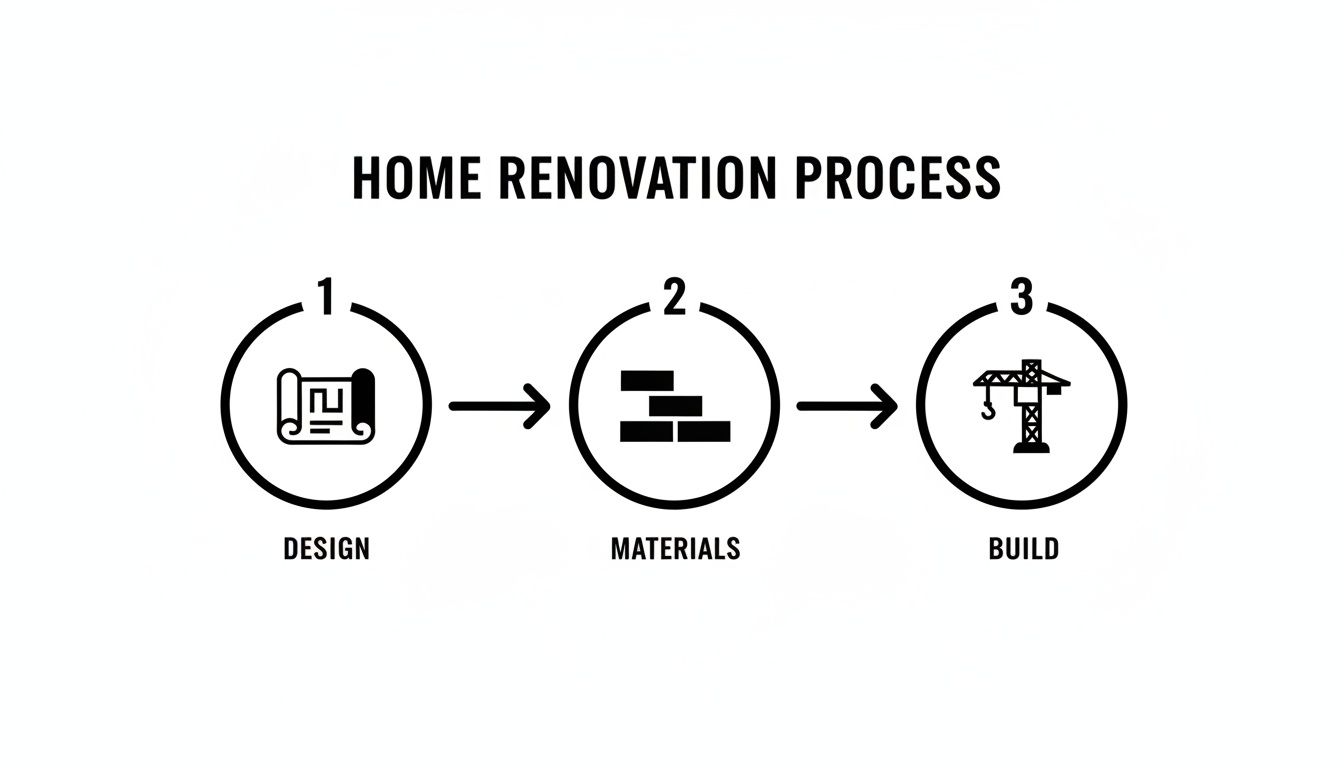
As you can see, a successful project flows logically from the initial design concept right through to the final build, with thoughtful material selection acting as that critical bridge between the two.
By partnering with experts who live and breathe this world, you can pursue your vision with confidence. A well-managed project doesn't just get the green light; it adds lasting value to your home and contributes positively to the cherished character of your neighbourhood. To dive deeper, you can learn more about navigating the planning application process in our detailed guide.
Frequently Asked Questions
Navigating the rules of a conservation area can throw up all sorts of questions. We get it. Below, we've put together some straightforward answers to the queries we hear most often from homeowners in Wimbledon, Richmond, and across South West London.
Can I Replace My Windows in a Conservation Area?
This is probably the number one question we're asked. The short answer is yes, but it comes with some very strict conditions. You will almost certainly need planning permission, especially if an Article 4 Direction is in place that removes your permitted development rights.
The guiding principle is always to replace 'like-for-like'. That means matching the original windows in material, design, and how they open. For this reason, uPVC is nearly always rejected by planners in favour of traditional timber frames that respect the building's heritage.
Do I Need Permission to Paint My House?
Quite possibly. To keep the streetscape looking harmonious and historically appropriate, some conservation areas have controls over exterior paint colours. It's always best to check first.
And if your house has beautiful, previously unpainted brickwork? Painting it would almost certainly require planning permission. Planners see this as a fundamental change to the building's character and appearance, so it’s crucial to speak with your local council before you even think about picking up a paintbrush.
Does a Conservation Area Affect My Property's Value?
Generally, living in a conservation area has a really positive impact on property value. The strong protections against inappropriate development help preserve the unique character and stability that made the neighbourhood so desirable in the first place.
This often means that properties in these areas command a premium price and hold their value more resiliently compared to similar homes just outside the designated boundary.
The special status of a conservation area acts as a quality assurance mark for the entire neighbourhood. It safeguards the architectural integrity that makes these locations so sought-after, directly supporting long-term property values.
What Is a Conservation Area Appraisal?
A Conservation Area Appraisal is a formal document drawn up by the local council that explains exactly what makes the area special. Think of it as the local rulebook for planners.
It identifies key features, important buildings, specific materials, and the overall historic characteristics that must be preserved or enhanced. This document is essential reading before you start planning any project, as it’s the very guide that planning officers will use to assess your application.
Embarking on a project in a conservation area demands expertise, creativity, and a deep respect for heritage. At Harper Latter Architects, we specialise in delivering bespoke architectural solutions that navigate these complexities with confidence.
Explore our conservation and heritage services to see how we can bring your vision to life.