
A Guide to Planning Permission in a Conservation Area
- Harper Latter Architects

- Dec 30, 2025
- 15 min read
Thinking about renovating your home in one of South West London’s beautiful conservation areas? It’s a fantastic idea, but it’s a world away from a standard home improvement project. The usual rules often don’t apply, and even small changes might need a green light from the council. This guide is your roadmap to understanding planning permission in a conservation area and why these neighbourhoods get special treatment.
Your Guide to Renovating in a Conservation Area
Living in a conservation area means you’re part of a neighbourhood with a unique character—one that’s legally protected. It’s not about freezing a single building in time like a museum piece. Instead, the focus is on preserving the collective charm of the entire streetscape. This covers everything from the architectural style and building materials to the trees and garden walls that create the area’s distinct atmosphere.
Because of this special status, many alterations that would normally fall under ‘permitted development’ rights are restricted. Local authorities put these controls in place to stop the slow erosion of character that can happen when lots of small, unmanaged changes add up over time. Your dream renovation is absolutely possible, but it demands a more thoughtful and sensitive approach right from the start.
Understanding the Key Differences
Embarking on a project here means navigating an extra layer of planning scrutiny. Success really comes down to appreciating what makes the area special and designing a project that respects its surroundings. The aim is always to enhance, not detract from, the very qualities that make your neighbourhood so desirable in the first place.
Key things to think about for your project will include:
Design Sympathy: Any new work, from a simple porch to a large extension, must be designed to complement the existing architecture and the wider area.
Material Authenticity: Your choice of materials is critical. Planners will want to see materials that fit the historical context, like traditional brick, natural slate, or timber windows.
Respect for Scale and Form: The size and shape of any addition must feel right for the original property and its neighbours, keeping the rhythm of the street intact.
A conservation area isn't a barrier to progress but a framework for thoughtful evolution. It encourages high-quality design that preserves the past while accommodating modern living, ensuring the neighbourhood's unique character endures for future generations.
This guide will walk you through the essentials, from special restrictions known as Article 4 Directions to the nuts and bolts of putting together an application that gets approved. Whether you’re planning simple upgrades or exploring more ambitious refurbishments and extensions, we'll give you the clarity to move forward with confidence. We’ll help you ensure your vision for a beautiful, modern home aligns perfectly with heritage requirements, protecting both your investment and the character of your community.
Understanding What a Conservation Area Truly Is
So, what exactly is a conservation area? Put simply, it’s a neighbourhood your local council has designated as having a special architectural or historic character that’s worth protecting. Think of it less like preserving a single, precious antique and more like curating an entire gallery, where the collective atmosphere is the masterpiece.
This protection isn't just about the buildings themselves. It extends to the entire streetscape—all the little details that create a distinct sense of place. We're talking about the relationship between buildings, mature trees, historic boundary walls, traditional paving materials, and even the original street layout. The aim is to safeguard the overall character that makes the area unique.
This is why getting planning permission in a conservation area is about more than just a good design for your own property. Your project will be judged on how well it fits in with, or at least doesn't detract from, the established character of the neighbourhood as a whole.
What Defines an Area's Special Character?
The 'special character' of a conservation area comes from a collection of tangible features that, together, tell a story. Planners and conservation officers look very closely at these details when they're assessing any proposed changes.
Key elements often include:
Architectural Cohesion: A consistent style of building, like rows of Victorian terraces or Edwardian villas, that creates a harmonious visual rhythm.
Historic Materials: The widespread use of traditional materials, such as London stock brick, Welsh slate for roofs, or timber sash windows.
Green Spaces: The role of parks, private gardens, and even significant individual trees that contribute to the area's feel and layout.
Boundary Treatments: The presence of original iron railings, old brick walls, or hedges that define property lines and add to the street scene.
For instance, in many of Wimbledon's most sought-after postcodes, the character is defined by a mix of grand Victorian architecture, leafy gardens, and quiet, well-preserved streets. Any alteration, no matter how small it seems, could upset this delicate balance. Exploring expert insights on conservation and heritage architecture can offer a much deeper understanding of how these elements are protected.
The Scale of Protection Across England
This commitment to preserving unique areas isn't a niche concept; it's a fundamental part of UK planning law. It’s formally recognised and gives councils real teeth when it comes to controlling development.
A conservation area is defined under Section 69 of the Planning (Listed Buildings and Conservation Areas) Act 1990 as a place "of special architectural or historic interest, the character or appearance of which it is desirable to preserve or enhance."
This legal framework allows local authorities to control development far more strictly than they can elsewhere. And the scale of this protection is huge. In England, there are between 10,000 and 11,645 designated conservation areas, covering everything from historic city centres to rural villages and old industrial sites. You can learn more about these national statistics on the official government release page.
Understanding this context is the first step in successfully navigating your renovation. It shows that the process isn’t about arbitrary rules, but about a shared responsibility to protect areas of genuine local and national importance. This sets the stage for the specific rules you'll encounter next, like Permitted Development rights and Article 4 Directions.
Permitted Development and Article 4 Directions Explained
Under normal circumstances, homeowners in the UK have what are known as Permitted Development (PD) rights. Think of them as a set of pre-approved, minor alterations you can make to your property without needing to lodge a full planning application. This covers things like building a small rear extension, putting up a garden shed, or adding a porch.
But if you live in a conservation area, the rulebook is completely different. This is one of the biggest tripwires for homeowners—assuming the standard rules apply when, in fact, an extra layer of protection is in place to preserve the area's special character.
What Is an Article 4 Direction?
The main tool councils use to enforce these tighter controls is an Article 4 Direction. It’s a legal order that removes specific Permitted Development rights across a designated area, giving the local planning authority much finer control over changes that could slowly chip away at the neighbourhood's historic fabric.
The logic behind it is straightforward. One house swapping its traditional timber sash windows for modern uPVC might not seem like a big deal. But if every house on that historic street did the same, the collective character would be lost forever. An Article 4 Direction prevents this kind of gradual erosion by requiring homeowners to apply for planning permission in a conservation area for works that would otherwise be automatically allowed.
The diagram below highlights the key elements that conservation status—and by extension, an Article 4 Direction—is designed to protect.
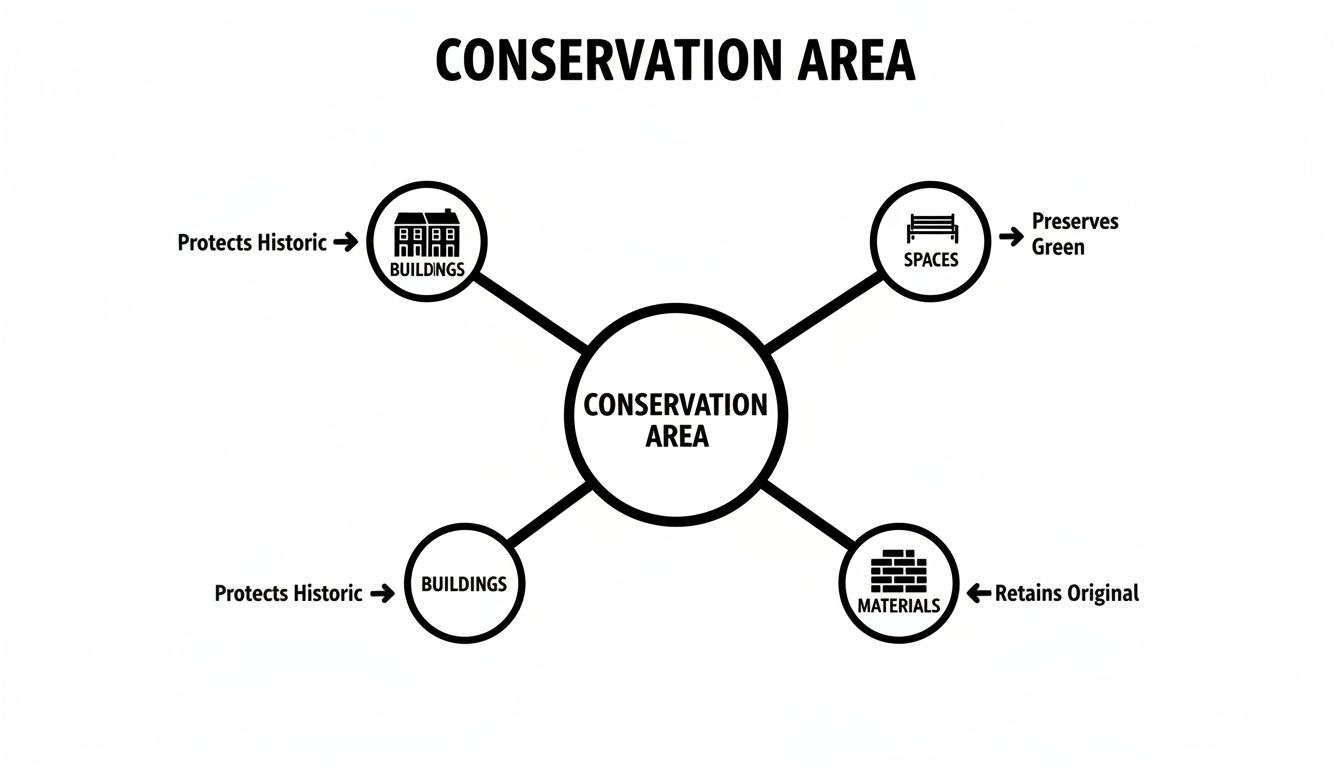
As you can see, it's not just about individual buildings. It’s about the whole picture: the architecture, the green spaces between properties, and even the original materials used to build them.
Comparing Permitted Rights with Article 4 Restrictions
To really grasp what this means for your project, it helps to see a side-by-side comparison of what’s normally permitted versus what’s restricted under an Article 4 Direction. The difference is often quite stark, showing why you need to be far more careful.
Here’s a quick breakdown of how an Article 4 Direction changes the game for common home improvement projects.
Permitted Development vs Article 4 Direction Restrictions
Project Type | Standard Permitted Development | Under an Article 4 Direction in a Conservation Area |
|---|---|---|
Window Replacement | Allowed, provided the materials have a similar appearance to the originals. | Full planning permission is almost always needed. Planners will want to see proposals for historically appropriate materials and styles (e.g., timber sash over uPVC casement). |
Painting Exterior Brickwork | Generally permitted without needing planning permission. | Often restricted. Painting over original brickwork is seen as harmful to the character of a period property, so planning permission is required. |
Adding a Porch | Permitted if it's under three square metres and meets height rules. | Planning permission is required. The design, scale, and materials must be sympathetic to the main house and the wider streetscape. |
Erecting a Garden Fence or Wall | Permitted up to one metre high next to a road, or two metres elsewhere. | Planning permission is needed, especially for boundaries fronting a road. The design must align with the area's historic boundary treatments. |
The key takeaway is that an Article 4 Direction means you can't assume anything is permitted without checking first. The default position flips from "you can do it unless told otherwise" to "you can't do it until you get permission."
This doesn't mean you're barred from making any changes to your home. It just means your plans will go through a formal review, where planning officers can properly assess their impact on the conservation area's character.
Before you even think about starting external work—no matter how small it seems—your first port of call should be your local council's website. A quick search or a call to the planning department will confirm if your property is in a conservation area and whether an Article 4 Direction is active. This simple check can save you from a very costly planning mistake.
Navigating the Planning Application Process
Applying for planning permission in a conservation area isn't just a case of submitting a few architectural drawings. It’s a meticulous process, one that requires you to build a compelling narrative for your project. You need to show that you've thought deeply about the neighbourhood's character and history.
Think of it less like a standard application and more like making a formal case. You're arguing to the local planning authority that your proposed changes will not only preserve but ideally enhance the area. This calls for detailed, specific documents that go well beyond what’s needed for a typical home renovation.
The journey starts long before you fill out any forms. It begins with a clear strategy, a solid grasp of local policies, and working with experts who can translate your vision into a language planning officers will understand and get behind.
The Power of Pre-Application Advice
Before you invest significant time and money into detailed designs, getting pre-application advice from your local council is an incredibly valuable first step. This is a formal or informal chat where you can present your initial ideas to a planning officer. It’s your chance to gauge their reaction and spot any potential red flags early on.
This simple conversation can stop you from chasing a design that’s a non-starter, helping you tweak your plans to align with what the council wants to see. It’s a proactive move that can dramatically improve your chances of a smooth approval down the line.
Essential Documents for Your Application
A strong application hinges on two key documents that explain the 'why' behind your project. These aren’t just formalities; they’re the very backbone of your proposal.
Design and Access Statement: This document lays out the design principles guiding your project. It explains how you’ve considered the site’s context—the scale, layout, appearance, and landscaping of your proposal—in relation to the surrounding conservation area. It has to prove your design is not just functional but also sympathetic to its setting.
Heritage Statement: This is arguably the most critical document for any project in a conservation area. It assesses the historical and architectural importance of the site and its surroundings. Then, it analyses the potential impact of your proposed works on that significance, making a clear case for why the changes are acceptable and won’t harm the area’s unique character.
For a planning officer, the Heritage Statement is the main tool they use to understand your project’s impact. A well-researched and persuasive statement, often put together by a specialist architect or heritage consultant, can be the difference between getting a yes or a no.
Collaborating with a Specialist Architect
Trying to navigate this complex process alone is a huge challenge. Your greatest asset is an architect who specialises in conservation and heritage projects. They bring a deep understanding of local planning policies, a proven track record of successful applications, and the expertise to craft all the necessary documents.
Their job is to translate your vision into a design that meets both your needs and the strict requirements of the conservation area. This means creating detailed drawings and persuasive statements that anticipate and address a planning officer's concerns from the outset. To see how an architect manages this journey, you can explore the stages involved in our professional process.
Keeping Up with Policy Changes
The planning landscape is always evolving. The government has recently been exploring significant updates to the planning framework, with the goal of creating a more efficient, digitised system for getting consent.
These recent policy updates could be the biggest shake-up to conservation area planning since the 2011 Localism Act, potentially slashing formal applications by up to 30% with a new tiered system. The proposal introduces categories for permitted minor works, fast-track moderates, and full consents for major projects, all managed digitally. You can discover more insights about these upcoming changes on ConservationAreaChecker.com. While these changes aren't fully in place yet, they signal a move towards a clearer—though still rigorous—pathway for homeowners.
Common Reasons for Refusal and How to Avoid Them
Getting planning permission in a conservation area isn't just about ticking boxes; it's about showing you understand what makes the area special. While every project is different, refusals often boil down to a few common mistakes. Knowing what these are from the outset is like having an insurance policy against a rejection letter.
Think of it this way: by anticipating what planners and conservation officers look for, you and your architect can build a case for your project before a single objection is raised. It's a proactive approach that not only boosts your chances of success but almost always leads to a better, more thoughtful design in the end.
Ultimately, a refusal happens when a proposal fails to prove it will preserve or, better yet, enhance the character of the neighbourhood. Let's break down why that happens and, crucially, how to get it right.
Inappropriate Materials and Poor Detailing
One of the fastest routes to a refusal is choosing materials that are completely out of step with the historic streetscape. Think modern uPVC windows or concrete roof tiles on a Victorian terrace—it’s a major red flag for planners. It instantly suggests a lack of respect for the area’s unique material palette.
It’s not just the big things, either. Clumsy details, like chunky window frames or poorly matched brickwork, can easily sink an otherwise promising design.
How to Avoid This: The solution starts with a careful look at the existing building and its neighbours. Your design should specify high-quality, traditional materials that echo the local character—things like natural slate, handmade bricks, or timber sash windows. Your architect’s detailed drawings must then show exactly how these materials will be used with a level of craftsmanship that honours the original building methods.
Unsympathetic Scale and Design
A classic blunder is designing an extension that completely overpowers the original house or throws off the rhythm of the street. This could be a rear extension that's simply too big, a dormer that dominates the roof, or a contemporary addition that feels jarringly out of place next to its historic neighbour. The aim is harmony, not a clumsy imitation.
Planners will be looking closely at how your proposal respects the scale, massing, and rhythm of the existing streetscape. A design that ignores these core principles is on shaky ground from the start.
How to Avoid This: A great design always begins with a deep appreciation of its context. Your architect should craft a scheme that complements the original building instead of competing with it. Sometimes this means creating a clear distinction between old and new, perhaps with a lightweight glass link connecting a contemporary extension. In other cases, it might mean ensuring a side extension is set back from the front of the house to appear secondary.
A refusal is rarely about a single mistake. It's often the cumulative effect of several design choices that, together, demonstrate a fundamental misunderstanding of what makes the conservation area special. The key to approval is proving you 'get it'.
Negative Impact on Key Views
Conservation areas are often prized for their important views, whether it's a long vista down a street, a glimpse of a local landmark, or a view from a public footpath across private gardens. Any proposal that blocks or harms one of these protected views will face an uphill battle.
Remember, the impact of your project isn't just judged from the front kerb. Planners will consider how it looks from every angle, including from neighbouring homes and public spaces.
How to Avoid This: This is where a thorough site analysis at the very beginning pays dividends. Your architect should identify any significant views and design the scheme to protect them. This doesn't always mean making things smaller; a cleverly positioned extension or thoughtful landscaping can often soften the visual impact and show you've considered the building's place in the wider environment.
Why a Specialist Architect Is Your Greatest Asset
Successfully getting planning permission in a conservation area isn’t just about having a great design; it’s about strategic navigation. It can be tempting to go it alone to save on fees, but tackling this intricate process without a professional guide is a huge gamble.
A specialist architect isn't just a designer. They're your expert guide, translator, and advocate, turning a complex challenge into a structured, manageable journey. This is especially true in places like Wimbledon, where local councils have specific—and often unwritten—expectations for what they'll approve. An architect with deep local experience knows these nuances inside out.
Their role goes far beyond just drawing up plans. They act as your project’s diplomat, liaising with planning officers from the very beginning. This relationship is vital for building trust and shaping a proposal that fits with the council's conservation goals before you even submit the application.
The Architect's Role in a Successful Application
A conservation specialist brings a unique set of skills to the table, helping transform your aspirations into a reality that planners can actually get behind. Their contribution is multifaceted and essential for steering clear of the common pitfalls that lead to refusal.
Here’s where a specialist architect adds immense value:
Crafting Persuasive Heritage Statements: This document is the story of your project. A good architect can articulate exactly how your design respects and even enhances the area's character, giving conservation officers the robust justification they need.
Expert Negotiation Skills: If the council comes back with requests for changes, an architect can negotiate from a position of strength and expertise. They know where you can compromise without sacrificing the heart of your project.
Deep Knowledge of Local Policy: Specialist architects live and breathe the Local Plan and other planning documents. They know which precedents matter and how to frame your proposal so it sits comfortably within the established policy framework.
Choosing the right architect is the single most important decision you will make. They are the key that unlocks your property's potential, ensuring your vision—whether a sleek glass extension or a sensitive whole-house refurbishment—can be realised within a strict regulatory framework.
From Aspiration to Approved Reality
At the end of the day, your goal is to create a beautiful home that works for modern life. You might be dreaming of a light-filled basement conversion with a home gym, or perhaps a seamless indoor-outdoor living space for your family. An architect is the one who bridges the gap between that vision and the council's strict requirements.
They bring the creative problem-solving needed to design something that feels contemporary while still being deeply respectful of its historic setting. By investing in this specialist expertise, you aren’t just buying a set of drawings; you are investing in a strategy for success. It’s this proactive approach that turns a daunting regulatory hurdle into a beautifully realised home.
Got Questions? We’ve Got Answers
Navigating the rules around home improvements in a conservation area can feel like a minefield. It’s only natural to have a lot of specific questions. Here are some of the most common queries we hear from homeowners thinking about their next project.
Do I Need Planning Permission to Replace Windows in a Conservation Area?
Almost certainly, yes. While swapping out windows might seem like a straightforward job, in a conservation area, it’s a big deal. Most of these areas are covered by what’s called an Article 4 Direction, a special order that removes your automatic 'permitted development' rights.
Why? Because windows are seen as absolutely crucial to a building's historic character—the style, the materials, even the way the glass is divided. Any replacement will need a full planning application to prove the new windows respect the property and the wider streetscape. It’s not just about what you want, but what the area needs to retain its charm.
Can I Build a Modern Extension in a Conservation Area?
Yes, you can, and often, it’s the best approach. A sleek, modern extension is entirely possible, but success hinges on a design that is both highly skilled and incredibly sensitive. You might think planners want a pastiche of a historic style, but they often prefer a clear, honest distinction between old and new.
A successful modern addition doesn't mimic the old; it complements it. This is achieved through high-quality materials, an appropriate sense of scale, and an intelligent design that respects the character of the original building and its setting.
This means your new structure has to harmonise with the existing property without overpowering it. It's about using materials and forms that feel contemporary yet respectful of their historic neighbour. Getting this delicate balance right is where architectural expertise really comes into its own.
What Is the Difference Between a Conservation Area and a Listed Building?
This is a really important distinction. A conservation area protects the character of an entire neighbourhood. The planning controls apply broadly to all the buildings and spaces within its boundary, focusing on the collective feel and look of the street. It’s about the big picture.
A listed building, on the other hand, has special legal protection for its own individual architectural and historic importance. The rules here are far more stringent and cover everything—not just the outside, but the interior fabric of the building too.
If your property happens to be both listed and located within a conservation area, you're dealing with the highest level of planning control. Any work you propose will likely require both Planning Permission and a separate Listed Building Consent, demanding the most rigorous and expert-led approach you can get.
Navigating the complexities of a conservation area requires specialist knowledge and a creative vision. At Harper Latter Architects, we have extensive experience in securing planning permission for high-end renovations, extensions, and bespoke new homes across South West London. We thrive on transforming regulatory challenges into beautifully realised living spaces.
Comments