
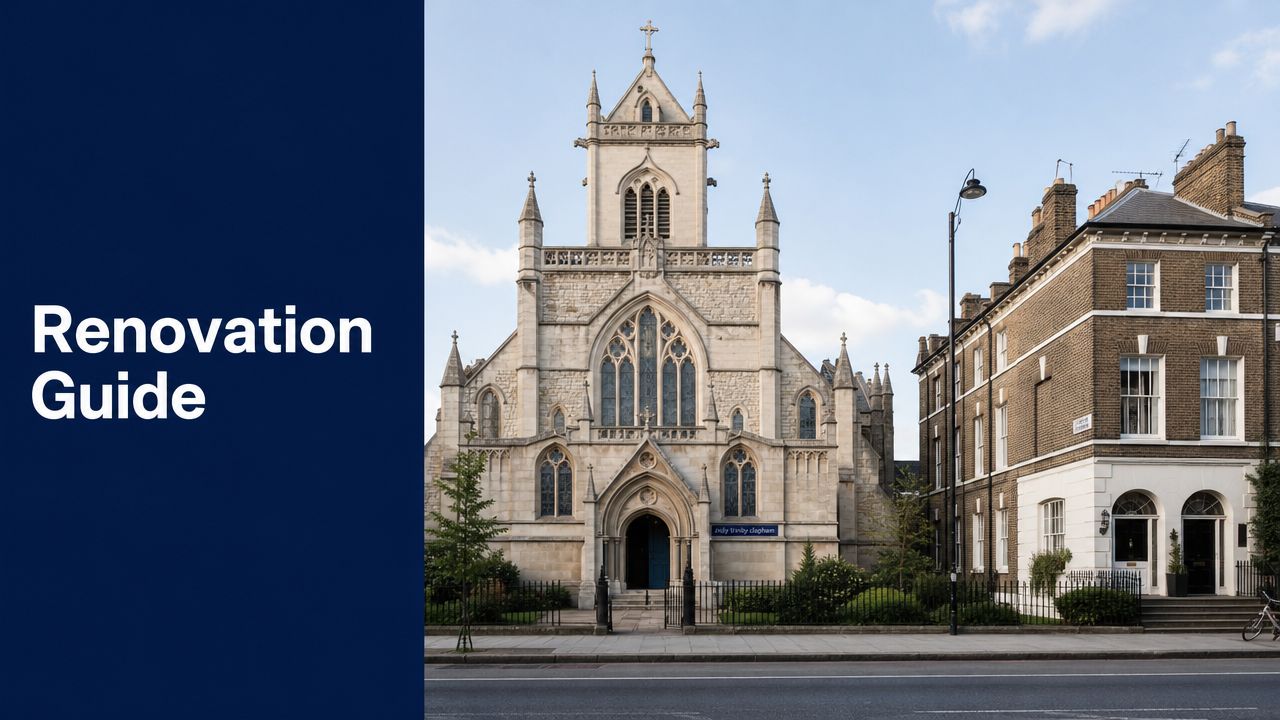
Trinity House Clapham: Renovation Guide 2026
If you've searched for Trinity House Clapham while planning a renovation, you're probably trying to answer a deceptively simple question. What exactly is it, and what does it mean for your house if you live nearby?
In practice, most local searches for Trinity House Clapham are really about Holy Trinity Clapham, the historic church on Clapham Common, not the national maritime body called Trinity House. That distinction matters because if your home sits close to a landmark with strong heritage significance, the planning conversation is rarely just about square metres and finishes. It's about setting, character, visibility, and whether your proposed work helps preserve or enhance the area.
For homeowners in this part of South West London, that can feel restrictive at first. In reality, it usually means your project needs to be sharper, better detailed, and more site-specific. The right approach doesn't fight the context. It uses it.
Understanding Trinity House Clapham and Your Home
The first thing to clear up is the name. In local property conversations, Trinity House Clapham is often used loosely when people mean Holy Trinity Church, Clapham. That's the place most relevant to nearby homeowners, because it anchors the identity of the surrounding streets and influences how people understand the neighbourhood's heritage value.
That matters whether you're considering a rear extension, a full internal reconfiguration, a basement, or a more careful energy retrofit. Homes near major landmarks are assessed differently in practical terms, even when the planning rules on paper look familiar. Officers, neighbours, and buyers all read the building through its setting.
Why the distinction matters
There is also a completely separate organisation called The Corporation of Trinity House, the London maritime authority with a long national history. It isn't the same thing as Holy Trinity Clapham, and confusing the two can send owners down the wrong path when they're researching planning constraints or local history.
For a homeowner, the useful question isn't only “what is Trinity House Clapham?”. It's “what does the local landmark mean for my project?”. That changes the brief immediately.
A house near Holy Trinity often needs a design response that is:
More context-aware. Materials, proportions and rooflines tend to attract closer scrutiny.
More selective. Not every desirable intervention is sensible merely because it is technically possible.
More bespoke. Standard developer-style solutions usually look out of place in established Clapham streets.
Better evidenced. Drawings alone aren't always enough. Heritage reasoning often carries equal weight.
Practical rule: If your house benefits from a distinguished setting, planning decisions will often turn on quality of response rather than quantity of new floor area.
What owners usually get wrong
The most common mistake is treating the project as a generic London refurbishment. That rarely works well around prominent heritage assets. Plastic detailing, overly reflective extensions, roof alterations that interrupt the street rhythm, and off-the-shelf windows almost always create friction.
The better route is to start with the building as it stands. Work out what contributes to its character, what has already been lost, and where contemporary change would be least harmful and most useful. Once that's clear, the design options usually become much easier to judge.
A Tale of Two Trinitys History and Heritage Explained
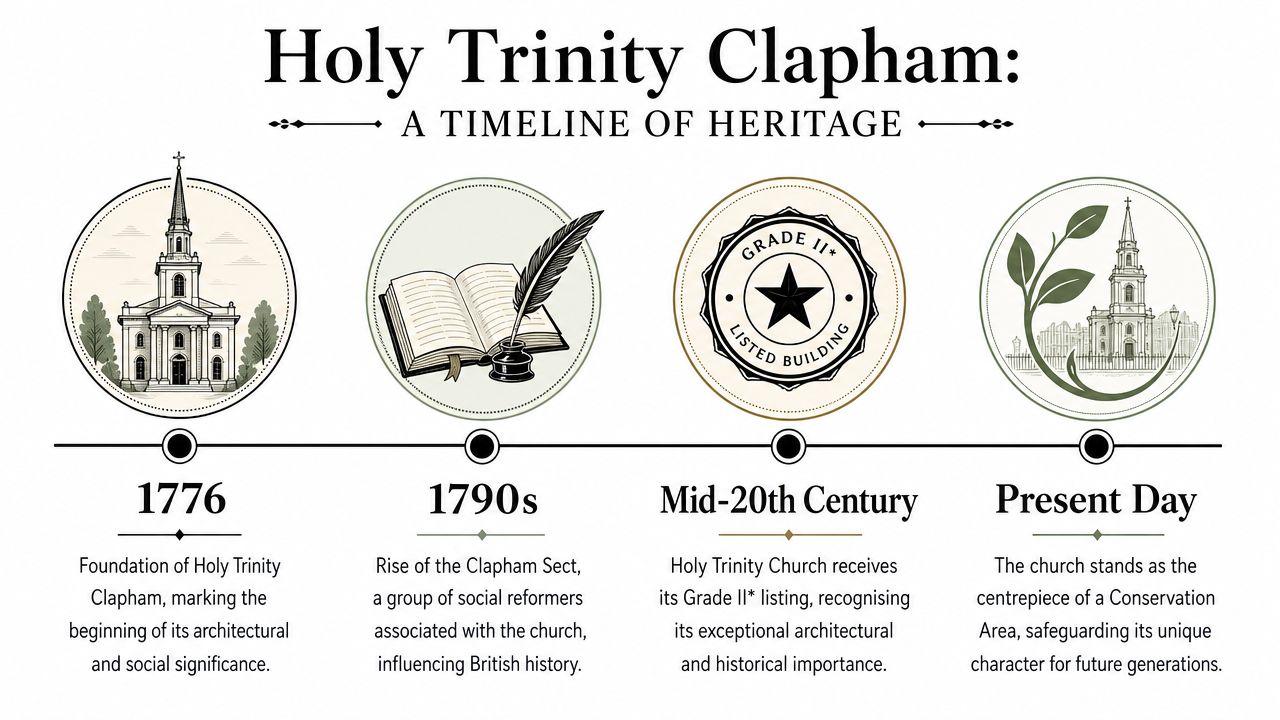
Holy Trinity Clapham has a precise and unusually resonant origin point. It opened for worship in 1776, the same year as the American Declaration of Independence, and that date gives it a clear place in late-Georgian Britain's religious and social history, as recorded on the Holy Trinity Clapham history page.
Its architectural character is often described as plain and simple. That is part of its significance, not a lack of it. The building's importance rests as much in what happened around it as in ornament or spectacle. Holy Trinity became closely associated with the Clapham Sect, a group of evangelical Anglicans and reformers linked to William Wilberforce, which makes the church a strong marker of the religious and social reform movements that shaped Britain in the Georgian period.
Why Holy Trinity carries so much local weight
In planning terms, churches like this do more than occupy a site. They organise how an area is perceived. Streets nearby are read as part of a wider historic setting, even when individual houses have changed over time.
That's why local owners benefit from understanding the church's story properly. A project next to a place associated with reform, abolitionist networks and enduring civic memory will be judged with an eye to continuity as well as design flair. A useful parallel can be found in the broader work of heritage architects in London, where significance often lies in social history as much as fabric.
The other Trinity House
The separate body is the Corporation of Trinity House in London. It was granted its Royal Charter on 20 May 1514 by Henry VIII, later reinforced by the 1685 charter and the Merchant Shipping Act 1995, according to the history of Trinity House. It also gained new powers in 1836 to buy out private lighthouse owners and take over maintenance itself. Today it remains the General Lighthouse Authority for England, Wales, the Channel Islands and Gibraltar.
That's an important national institution. It just isn't what is generally sought when searching for Trinity House Clapham.
The local issue is heritage setting around Holy Trinity Church. The maritime authority is a different story, in a different context, with different responsibilities.
For owners near Clapham Common, the church is the reference point that affects how alterations are understood. Once that confusion is removed, the planning context makes much more sense.
Architectural Character and Conservation Area Rules
Once you move from search terms to a live project, the primary issue is context. Around Holy Trinity, the question isn't merely whether your house is attractive or large enough. It's whether proposed changes sit comfortably within a protected historic townscape.
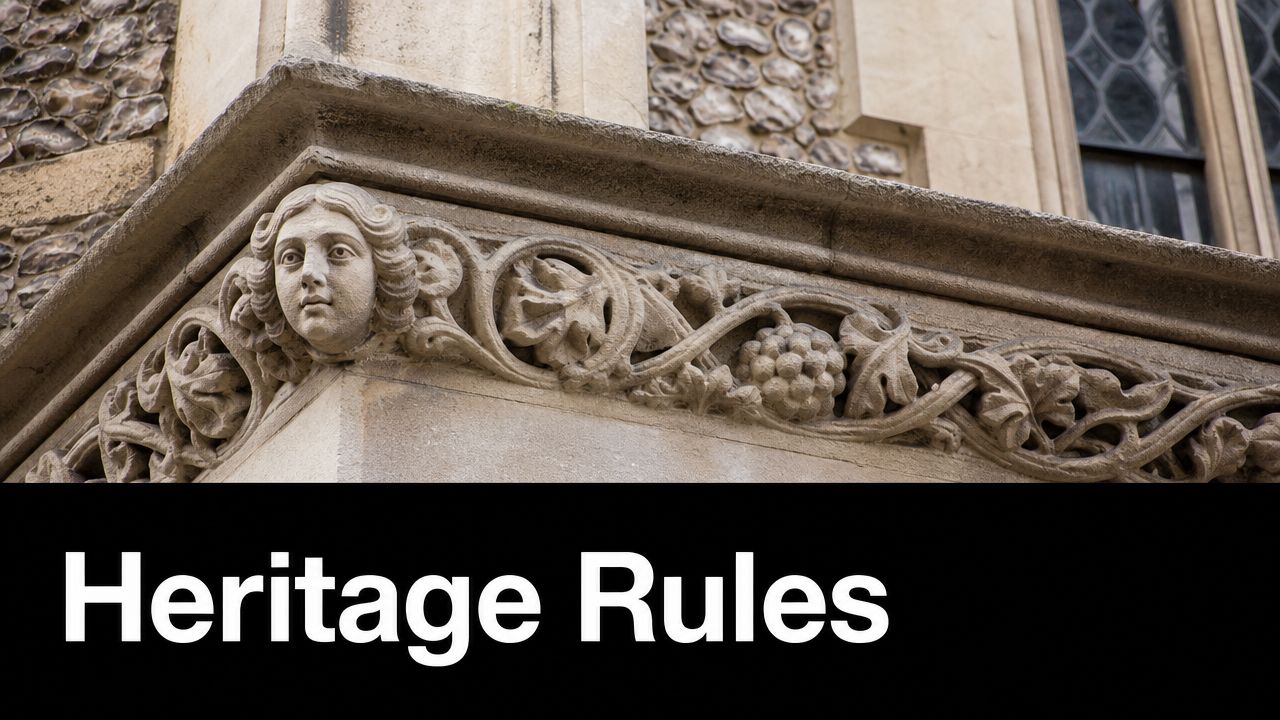
That's where conservation area controls begin to matter. If your property falls within a designated area, the council's concern is usually whether works preserve or enhance local character. That phrase sounds abstract until you apply it to actual decisions about brick, roof form, joinery, front boundaries, dormers and visibility from public streets.
What this means in practical terms
A conservation area does not freeze your house in time. It does, however, narrow the margin for casual alterations. Some changes that might pass unremarked elsewhere can become contentious if they affect the public face of the building or erode the collective character of the street.
Typical pressure points include:
Windows and doors. Replacement patterns, frame depths and opening methods matter more than many owners expect.
Roof changes. Dormers, rooflights and parapet alterations are judged for visibility and proportion, not just utility.
Front gardens and boundaries. Hard landscaping, bins, railings and paving can alter the historic reading of a terrace surprisingly quickly.
Rear extensions. The rear is often where modern family life can be improved most successfully, but scale and material choice still need discipline.
For a clearer primer on the planning framework, it helps to read about conservation area restrictions before fixing the brief too early.
Character is cumulative
One awkward truth about heritage areas is that harm is often cumulative rather than dramatic. A single poor window replacement may seem minor. Repeat that across a run of houses and the street loses coherence. Councils know that, which is why details that feel small to an owner can still trigger resistance.
A useful way to think about it is this:
Element | What usually works | What often struggles |
|---|---|---|
External materials | Matching or closely related materials with careful detailing | Contrasting finishes chosen for novelty alone |
Extensions | Clearly contemporary but visually disciplined additions | Bulky add-ons that dominate the host building |
Joinery | Profiles and proportions informed by the original building | Generic catalogue units with thick sections |
Street-facing changes | Minimal visual disruption | Alterations that flatten or simplify historic depth |
How to check your position
If you own nearby, don't rely on estate agent language such as “in a sought-after historic setting”. That tells you nothing operationally. Check whether your property sits within a conservation area boundary and whether any additional local controls apply.
Key point: Good conservation design is not imitation. It is informed restraint. The strongest projects know exactly what to leave quiet.
Owners often assume a more elaborate design argument will win the day. Usually the opposite is true. The most successful schemes identify where change delivers clear benefit, then resolve it with enough precision that the intervention looks inevitable rather than imposed.
Common Planning Constraints for Clapham Homeowners
Most planning friction in Clapham doesn't come from one dramatic objection. It comes from several moderate concerns combining at once. A rear extension may be acceptable in principle, but the materials jar with the terrace. A dormer may be hidden in part, but still reads as overlarge. New glazing may improve light, but reflect too aggressively against older stock.
That's why owners need to understand constraints as a stack, not a checklist.
The three constraints that shape most schemes
First, there's character impact. This is the broadest issue and often the most decisive. If an alteration weakens the established rhythm of a street or the setting of a recognised landmark, it will struggle even if the proposal is functional.
Second, there's permission type. Some houses only require planning permission for certain works. Others may also need listed building consent if they are designated in their own right. Nearby owners sometimes miss this distinction and commission design work on the assumption that one consent route covers everything.
Third, there's the question of removed permitted development rights. In some heritage-sensitive locations, an Article 4 Direction can limit changes that might otherwise have proceeded without a full planning application. This catches owners out regularly because the proposed work can seem ordinary from a domestic point of view.
Think of the system like layered tracing paper
When I explain this to clients, I often compare the planning process to laying tracing paper over a house drawing.
One layer shows your family brief. Another shows planning policy. Another shows conservation character. Another shows neighbour amenity. Another shows buildability. If you only design for one layer, the others start to conflict. The cleanest projects are the ones where those layers have been aligned from the start rather than forced into agreement later.
What usually triggers a closer look
These are the recurring pinch points around heritage-sensitive homes:
Over-scaled rear additions that make the original house feel secondary.
Basement proposals with weak justification for excavation, lightwells or external impact.
Roof alterations that interrupt the silhouette of a terrace or corner composition.
Hard modern materials used without enough regard for colour, texture and ageing.
Front elevation changes that seem small in isolation but alter the character of the street.
If a proposal looks as though it could be lifted off your house and dropped onto any other house in London, it probably isn't specific enough for a conservation setting.
What works better than owners expect
Some interventions are more achievable than people assume, provided they are handled properly. Internal remodelling often offers substantial gains without the same level of external planning risk. Rear extensions can work very well if they are subservient, carefully proportioned and honest in their detailing. Energy upgrades are increasingly part of the conversation too, especially where they improve comfort without eroding historic fabric.
The schemes that tend to go smoothly are not the most timid. They are the most coherent. Every move has a reason, and every visible choice supports the wider argument.
Realising Your Vision Renovation and Extension Opportunities
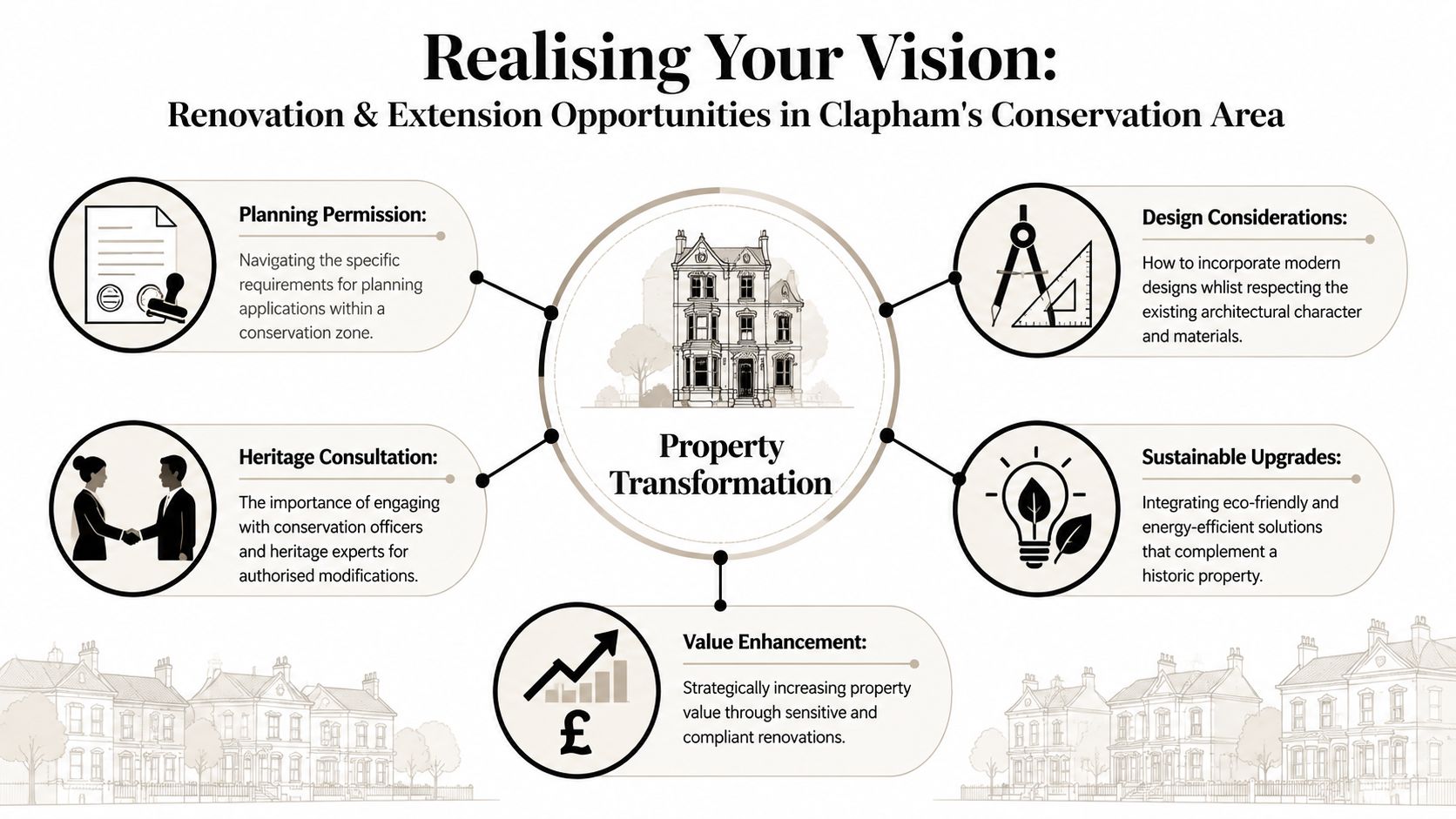
Conservation constraints don't prevent ambitious design. They filter out lazy design. That's an important distinction.
Owners sometimes arrive assuming they must choose between character and modern life. In most Clapham houses, that isn't the primary trade-off. The actual trade-off is between quick, generic interventions and slower, more customized ones that improve how the house works while respecting its setting.
Rear extensions that earn their place
A good rear extension doesn't try to compete with the original building. It supports it. That usually means keeping the mass controlled, resolving junctions cleanly, and choosing materials that either unobtrusively relate to the host house or contrast with discipline.
Glass can work well, but not as a default gesture. Full-width glazed boxes are often drawn before anyone has asked whether glare, privacy, summer overheating or visual bulk will become the main issue. The better versions use glazing strategically, frame views well, and give solid elements enough presence to make the addition feel grounded.
Basements and lower ground remodelling
For houses where outward growth is constrained, basements can provide significant value in daily use. They work best when the section is carefully studied early. Natural light, stair position, head height, waterproofing strategy and garden relationship all matter more than the notional room list.
A basement with poor circulation and borrowed light can feel expensive but joyless. A basement planned around family use, acoustics, storage, utility functions and discreet connections to the upper floors can transform the house.
Here, restraint above ground often creates freedom below it.
Interior architecture often delivers the biggest leap
Not every successful project is extension-led. In many period homes, the biggest improvement comes from re-planning the interior properly.
That can include:
Restoring hierarchy between principal rooms and service spaces instead of flattening everything into one open-plan volume.
Improving circulation so the house feels calmer and easier to use day to day.
Integrating joinery for storage, study space and utility functions without visual clutter.
Reworking thresholds between old and new so the transition feels deliberate rather than patched together.
This is often where one professional option such as Harper Latter Architects can be useful, because the practice offers residential design services across heritage work, refurbishments, basements and interior architecture within South West London. The point isn't who shouts loudest. It's whether the team can draw a coherent line between planning strategy, detailing and how you want to live.
Sustainable retrofit in heritage homes
The most interesting shift in recent practice is that retrofit is no longer treated as a side topic. The conversation has moved towards sensitive adaptation. The available UK policy material on Trinity House and climate adaptation points to a broader direction of travel, with greater focus on integrating insulation, glazing and low-carbon systems into older buildings without damaging historic fabric, as discussed in the UK government material on climate adaptation and heritage-related building resilience.
That doesn't mean every traditional wall should be sealed up with the same build-up, or every sash should be replaced. In fact, that's where many retrofit projects go wrong.
What usually works better is a whole-house view:
Aim | Better approach | Common mistake |
|---|---|---|
Thermal comfort | Targeted insulation where moisture risk is understood | Applying impermeable systems without considering breathability |
Windows | Repair, upgrade or selectively replace based on significance | Replacing all joinery with visually heavier units |
Heating | Match low-carbon systems to the building's actual fabric and use | Installing new systems before reducing demand sensibly |
Summer comfort | Use shading, ventilation and glazing strategy together | Assuming more glass automatically means better living quality |
Historic houses can perform much better. They just don't respond well to one-size-fits-all retrofit packages.
The best Clapham projects are rarely the ones that look the newest. They are the ones that feel resolved, comfortable and properly rooted in place.
How to Begin Your Clapham Property Transformation
The first productive step is not sketch design. It's clarity.
Before anyone starts chasing layouts, establish what your house can realistically support, what planning sensitivities are likely to matter, and which parts of the building are worth preserving, repairing or rethinking. That early feasibility work usually saves the most time because it prevents energy being spent on the wrong version of the project.
A sensible sequence
For houses near Holy Trinity and other heritage-sensitive streets, I'd usually advise owners to proceed in this order:
Confirm the planning context Check conservation area status, existing permissions, and any restrictions affecting the property.
Survey the building properly Measured information, photographs and an honest assessment of condition are essential. Guesses at this stage become expensive later.
Define your brief by priority Separate essentials from aspirations. Family accommodation, storage, energy performance, entertaining and future adaptability rarely carry equal weight.
Test options before committing A compact feasibility study can compare extension, basement and internal reconfiguration routes without over-investing too early.
Prepare the right planning material Clear, well-judged drawings and supporting information make a substantial difference, particularly in sensitive settings. A useful overview of that stage is this guide to planning application drawings.
A structured process helps because these projects involve linked decisions rather than isolated ones. Design affects planning. Planning affects cost. Cost affects scope. Scope affects detailing.
Why process matters more in heritage work
In ordinary refurbishments, some ambiguity can be absorbed during construction. In conservation-led work, ambiguity tends to reappear as delay, redesign or compromise. Decisions about windows, brick repairs, insulation build-ups, roof edges, stair geometry and services coordination all need to align earlier.
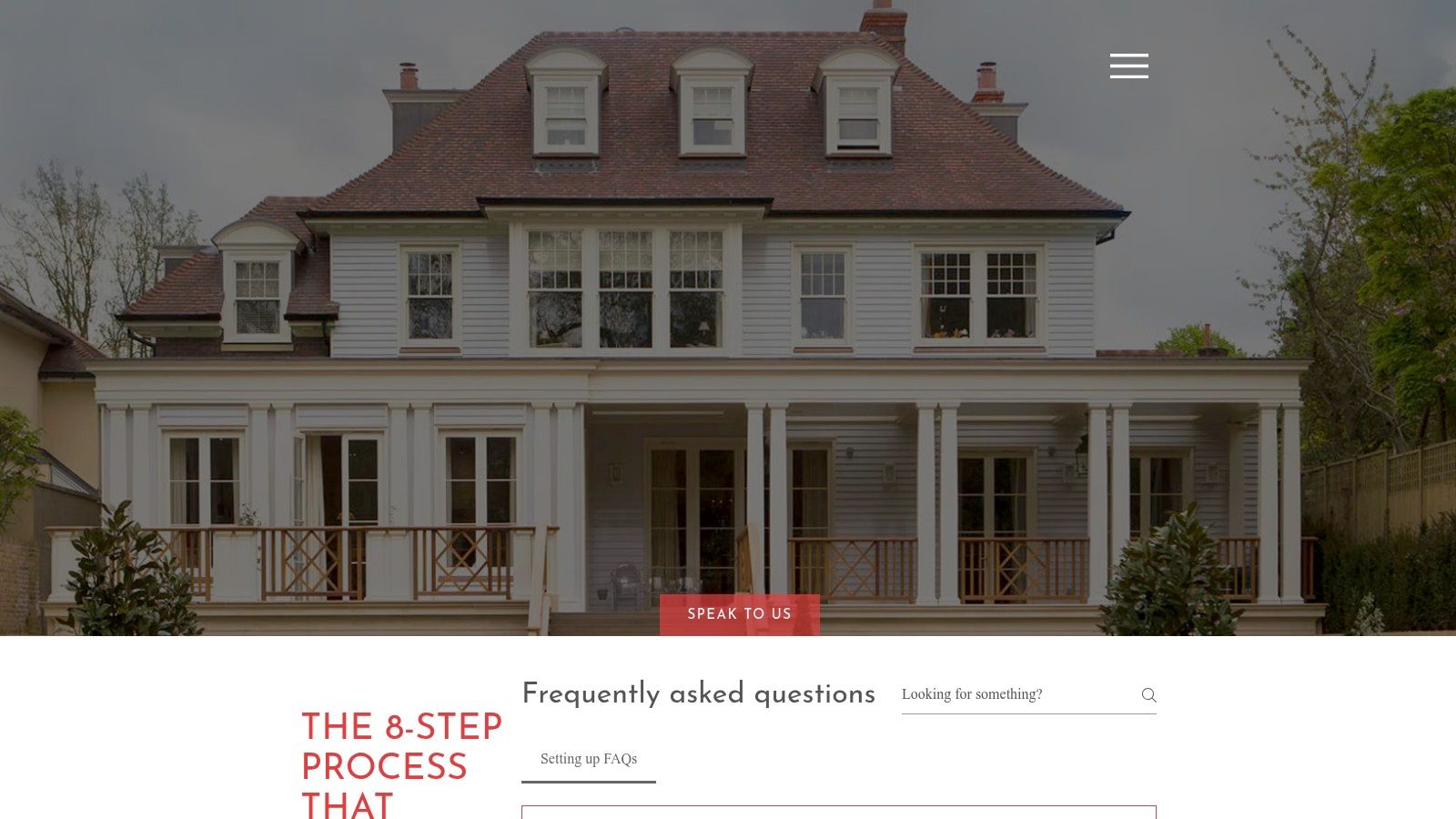
A formal project framework proves useful. Many residential practices use staged workflows, and Harper Latter Architects, for example, sets out an 8-step process from initial consultation through to completion on its process page.
The right starting mindset
The owners who get the best results don't approach heritage context as an obstacle. They treat it as design information.
That mindset usually leads to better houses. More measured changes. Better materials. Smarter planning arguments. Rooms that feel more natural. And upgrades that support long-term comfort without stripping away what made the property worth buying in the first place.
If you're considering work on a property near Holy Trinity in Clapham, Harper Latter Architects can discuss the planning context, heritage constraints and design opportunities in an initial consultation, then help map the next steps for a bespoke renovation, extension or retrofit.