
Semi Detached House Extensions: A 2026 London Guide
You're probably in a position many South West London homeowners know well. The house still suits the street, the school run, the park, the neighbours and the daily rhythm of life, but the rooms no longer suit the way you live. The kitchen is cramped, the ground floor doesn't flow, and the spare room stopped being spare some time ago.
That's why semi detached house extensions remain such a practical route forward. Moving often means paying a premium to stay in the same area, then inheriting someone else's compromises. Extending gives you the chance to keep the address that works and reshape the house around how your family lives.
The Enduring Appeal of Extending Your Semi-Detached Home
On a South West London street, the pattern is familiar. Two households can own near-identical semis, yet one extends well and gains a house that works for another decade, while the other ends up in a planning dispute, a strained relationship with the neighbour next door, and rooms that still do not quite fit daily life.
That difference rarely comes down to square footage alone. It usually comes down to how well the extension responds to the particular strengths and constraints of a semi detached house.
In Britain, the semi-detached house remains one of the country's defining domestic forms. Semi-detached homes make up 32% of English housing stock, and 41% of all properties built between 1945 and 1964 were semis, according to this overview of semi-detached housing in the UK. A large share of the homes now being extended sit within that inter-war and post-war stock, especially across parts of Richmond, Wandsworth, Kingston and Merton where families want more space without leaving the area.
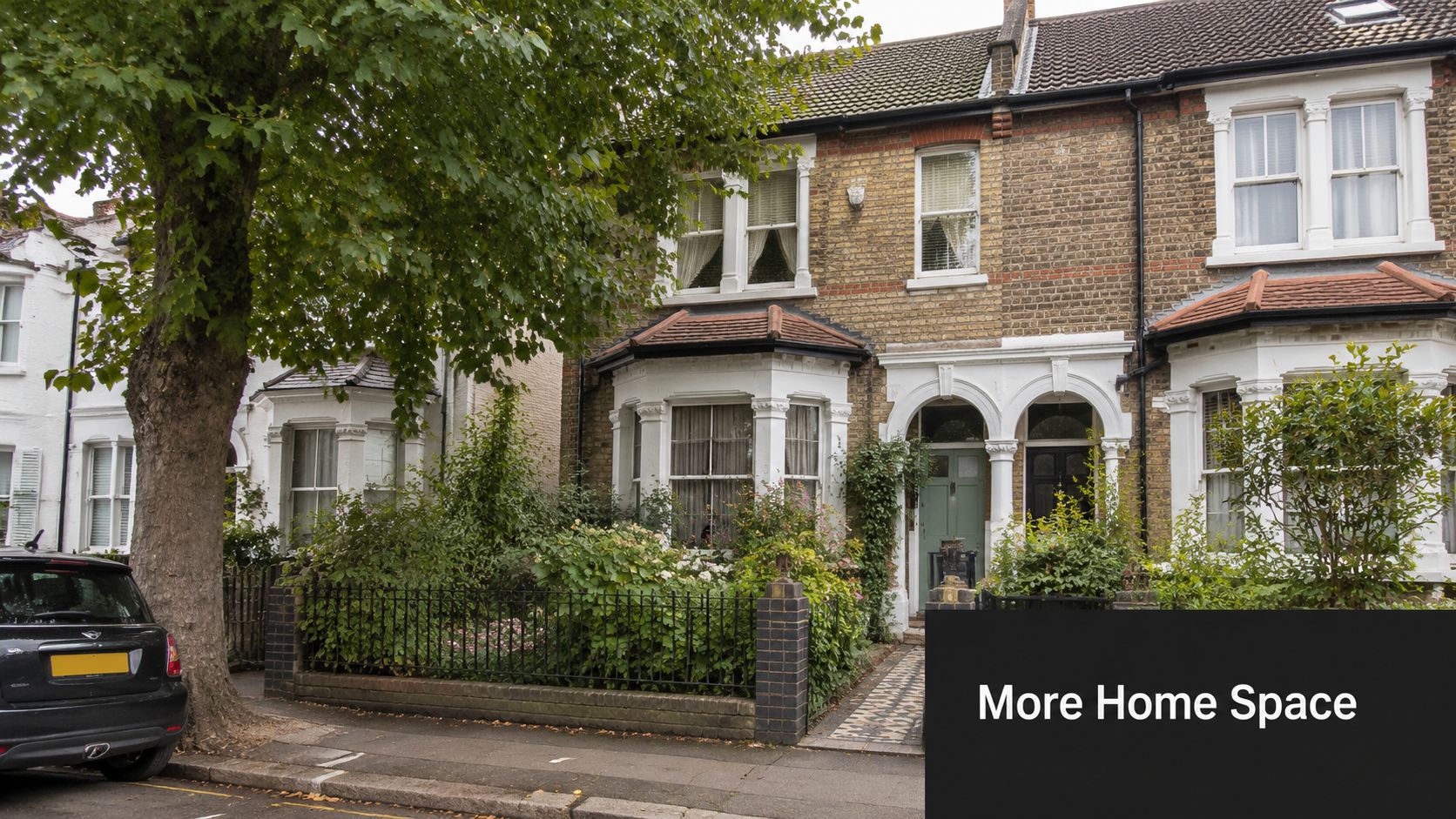
Why semis lend themselves to adaptation
A semi usually offers more options than a terrace. Side access can make construction less disruptive. A slightly wider plot can help with layout changes. The relationship to the boundary is often less constrained, which gives more freedom to bring in light and reorganise circulation.
Those advantages are real, but they are not a blank cheque.
On regulated streets in South West London, success often depends on details that generic extension advice misses. Conservation area character can limit how a side addition meets the front elevation. The shared party wall affects structure, sequencing and neighbour relations from the first sketch. Rear projections that look modest on paper can still run into objections if they affect daylight to the adjoining house or feel overbearing from the garden.
The strongest schemes work with the existing house rather than trying to overpower it. On many semis, that means accepting a smaller footprint in exchange for a better plan, better daylight and a form that stands a realistic chance of getting consent.
Practical rule: Start with what the house and site can do well. Force too much into a semi, and the compromises show up in planning, construction and daily use.
Why owners keep choosing to extend
Clients rarely ask for extra area in the abstract. They want a family kitchen that does not bottleneck every morning, a study that can close off properly, a main bedroom that feels intentional, or a top floor that finally earns its keep through a well-planned loft conversion for a semi-detached house.
The appeal is practical. A well-designed extension can correct the weak points many semis already have, such as narrow side return spaces, cramped kitchens, disconnected reception rooms or awkward landings upstairs. It can also protect what people value about the house in the first place, which is often the street, the garden, the school catchment and the sense of familiarity that made them stay.
There is a financial case as well, although it needs to be judged carefully. As noted earlier in the article, London and Surrey projects often sit within a wide cost range per square metre, and uplift in value depends heavily on design quality, planning risk, specification and build control on site. In my experience, the projects that justify themselves best are not always the biggest. They are the ones that solve the right problem, secure consent without unnecessary conflict, and feel as though the house was always meant to work this way.
Exploring Your Design Options from Loft to Basement
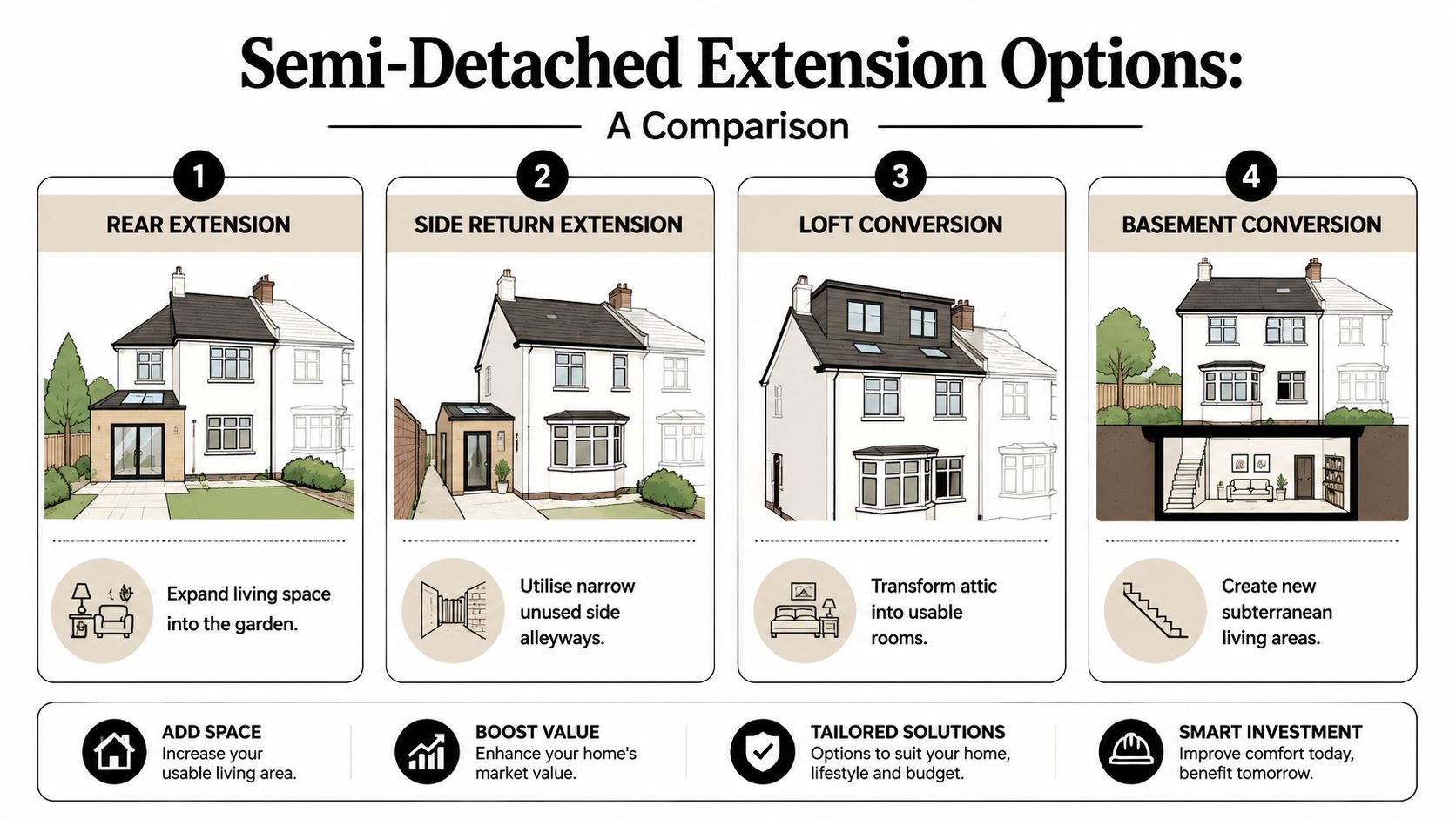
The right extension type depends less on fashion and more on the house you already have. Plot width, roof form, side access, neighbouring windows, garden depth and local planning history all matter. On semi-detached homes, the most successful schemes are usually the ones that feel inevitable once built, not the ones that try to force every possible square metre out of the site.
Rear and side options
A rear extension is still the workhorse option for many semis. It suits households that want a larger kitchen, dining and family space opening to the garden. It is often the cleanest way to improve everyday living without disturbing the upper floors too heavily.
A side extension can significantly improve a home if the house has enough width on the detached flank. As a practical benchmark, a side extension is often set back by about 1 metre from the front elevation, and for rear schemes a full-width ground-floor projection of up to about 6 metres is commonly achievable, while a typical first-floor rear extension is often around 3m wide by 2.5m deep because overlooking concerns become more significant, as discussed in these semi-detached extension design ideas.
That difference between ground floor and first floor matters. Clients often assume that if a rear extension works below, it should also work above. In practice, upper-floor additions trigger much sharper scrutiny around massing, privacy and impact on neighbouring gardens.
Extension type | Usually best for | Main trade-off |
|---|---|---|
Rear extension | Open-plan living and stronger garden connection | Loss of garden depth |
Side extension | Widening a narrow ground floor plan | Street-facing design sensitivity |
Wraparound extension | Replanning the whole ground floor | More planning complexity |
First-floor rear extension | Extra bedroom or bathroom space | Overlooking and bulk concerns |
Loft and basement routes
A loft conversion is often the neatest way to add sleeping accommodation without sacrificing the garden. It works especially well where the pressure is for an extra bedroom, dressing room or study rather than a larger family kitchen. If you're weighing that route, this guide on loft conversions for semi-detached houses gives a useful overview of the design considerations.
A basement conversion is a different proposition altogether. In London it can make sense where the house sits in a constrained urban plot and the ground floor footprint already works reasonably well. Basements suit utility spaces, media rooms, guest accommodation or ancillary family space, but they bring more structural, waterproofing and construction complexity than an above-ground addition.
What tends to work and what usually doesn't
Some choices age well. Some look appealing on a sketch and unravel under scrutiny.
What works - Clear hierarchy of spaces: A good extension improves the original house rather than swallowing it. - Respect for the semi pair: The relationship with the adjoining house matters, especially on visible elevations. - Light from more than one direction: Corner glazing, rooflights and carefully placed openings can make a modest footprint feel much larger.
What doesn't - Oversized first-floor additions: These are often where neighbour objections begin. - Token side extensions: If the added width doesn't meaningfully improve layout, the disruption may not justify the build. - Plans that chase area only: More floor space with poor circulation isn't an upgrade.
Angled rear glazing can be a useful privacy response. The same design source notes that glazing angled by 20 to 30 degrees can reduce direct views into neighbouring gardens, though it also increases construction and Building Regulations complexity in practice.
Navigating Planning Permission and Permitted Development
Many homeowners start with the same assumption. If the extension falls within national permitted development limits, the route should be straightforward. In parts of South West London, that assumption often falls apart quite quickly.
The two routes in principle
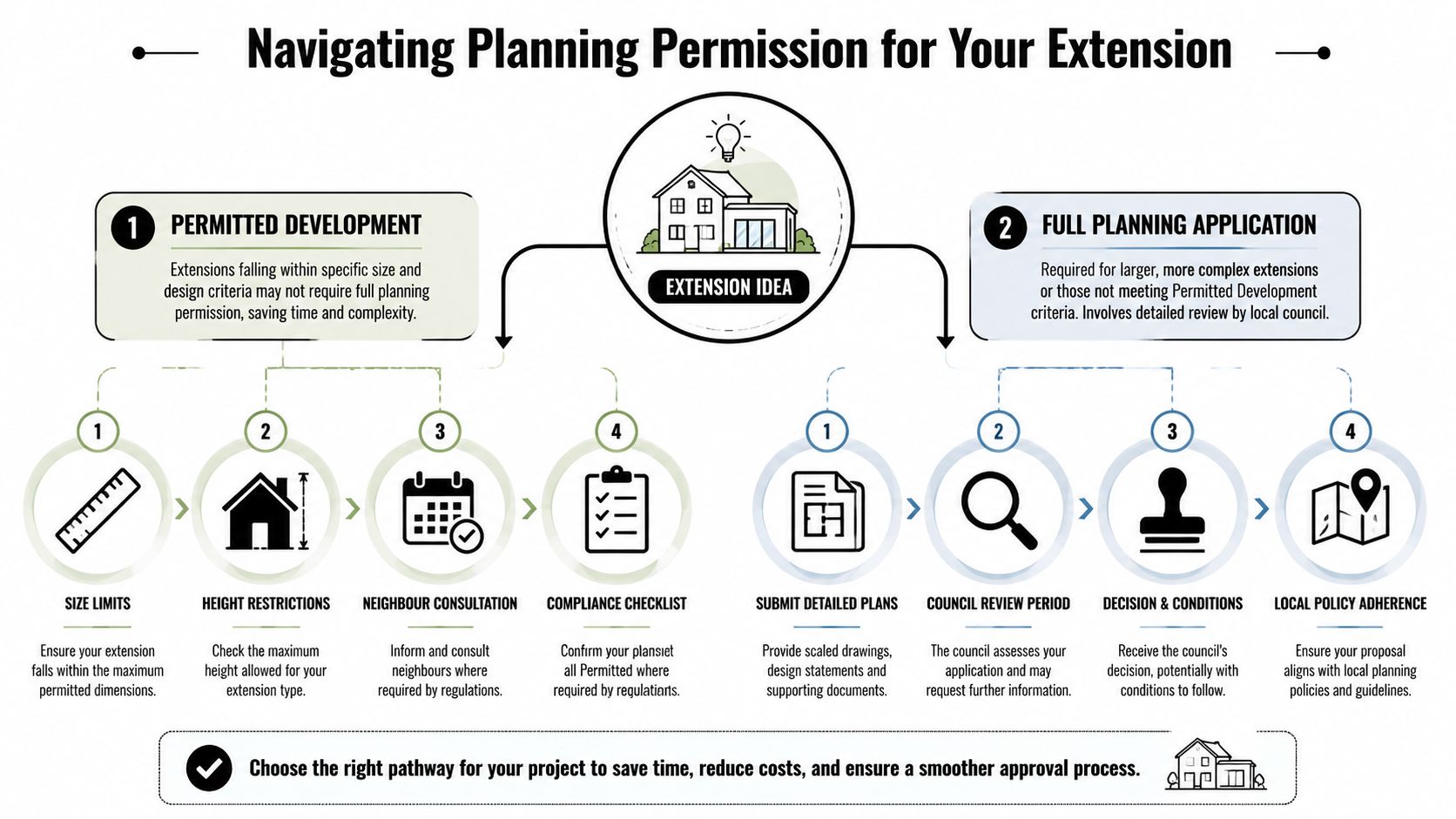
There are broadly two planning routes for most semi detached house extensions.
One is Permitted Development. National rules allow some single-storey rear extensions up to 3m for semi-detached homes, or up to 6m where prior approval applies and the property is not on Article 2(3) land. Two-storey extensions are more tightly limited, including a 3m rear projection and matching roof pitch requirements, according to this guide to semi-detached extension planning constraints.
The other is a full householder planning application. That route is usually necessary where the proposal falls outside those limits, where rights have been restricted, or where the design needs formal planning judgement rather than technical compliance alone.
Later in the process, many clients find this more detailed UK house extension planning permission guide useful for understanding how the route is chosen in practice.
Here's a useful visual summary before looking at the local reality:
Why South West London changes the answer
In Wimbledon, Richmond and similar boroughs, the practical question is rarely “Can I extend under the national rule?” It is “Will this particular proposal survive local scrutiny on this particular site?”
That's because permitted development rights are often more restricted in London boroughs and conservation areas, and the same extension can be straightforward in one postcode and materially harder in another, as noted in the planning guidance above.
A few issues come up repeatedly:
Conservation area context can tighten what is acceptable on visible elevations.
Article 2(3) land or removed rights can force a full application where owners assumed PD would apply.
Neighbour impact often becomes the deciding factor on deeper or taller rear forms.
Existing local precedent matters. If nearby approvals show a clear pattern, councils notice it. If refusals show the opposite, they notice that too.
A compliant drawing is not the same as an approvable proposal. Councils look at effect, not just dimensions.
What tends to cause refusals
The most fragile schemes are not always the largest ones. They are usually the ones that ignore context.
A rear extension can run into trouble if it feels overbearing from the neighbour's main outlook. A first-floor addition can become vulnerable if it introduces direct views into adjacent gardens. A side extension can fail if it clutters the street scene or erodes the visual gap that gives the semi pair its rhythm.
That is why pre-application thinking matters. You need to test not only what the rule permits, but what the borough is likely to accept on amenity, character and precedent grounds.
The Party Wall Act and Keeping Neighbours on Side
With semi detached house extensions, planning is only part of the picture. The shared condition of the building matters just as much. If your works affect the party wall, foundations near it, or structural elements tied to it, the Party Wall etc. Act 1996 is part of the job.
It helps to treat this correctly from the outset. The Act is not a request for permission to extend. It is a legal framework that manages how certain works are notified, recorded and protected.
When the process usually bites
Party wall issues tend to arise where the project includes excavation close to the shared boundary, cutting into the wall, inserting steelwork, or building in a way that relies on that line. On a semi, this is common rather than unusual.
The smoothest projects usually follow a simple pattern:
Establish the scope properly with your architect and engineer before anyone serves notices.
Issue notices correctly and in good time.
Respond professionally if the neighbour consents or dissents.
Keep records organised so the build team knows exactly what has been agreed.
If you want a fuller homeowner-focused explanation, this guide to the Party Wall Act explained for homeowners is a useful starting point.
Good neighbour management is not optional
The legal route matters, but so does tone. A neighbour who first hears about your extension when scaffold arrives is far more likely to become difficult, even where the proposal is perfectly lawful.
A better approach is straightforward:
Share the intent early: Show the neighbour what you're proposing before notices arrive.
Be clear about disruption: Access, noise, working hours and temporary inconvenience should be acknowledged fully.
Don't improvise technical answers: If they ask structural questions, get your surveyor or architect to answer them properly.
Avoid casual promises on site: If a builder says “we'll sort that”, it can create disputes later if that promise was never documented.
Early neighbour conversations don't replace the Act. They make the formal process less adversarial.
Where relations are already strained, keep communication courteous and written. That doesn't make the project cold. It makes it clear.
Budgeting Your Extension Costs and Project Timelines
A budget usually starts to go wrong before a builder is even appointed. In South West London, I often see homeowners fixate on a build figure for the rear addition or loft, then discover too late that fees, surveys, drainage work, party wall costs, utility upgrades and a realistic finish level were never properly allowed for.
That gap is what turns a manageable project into a strained one.
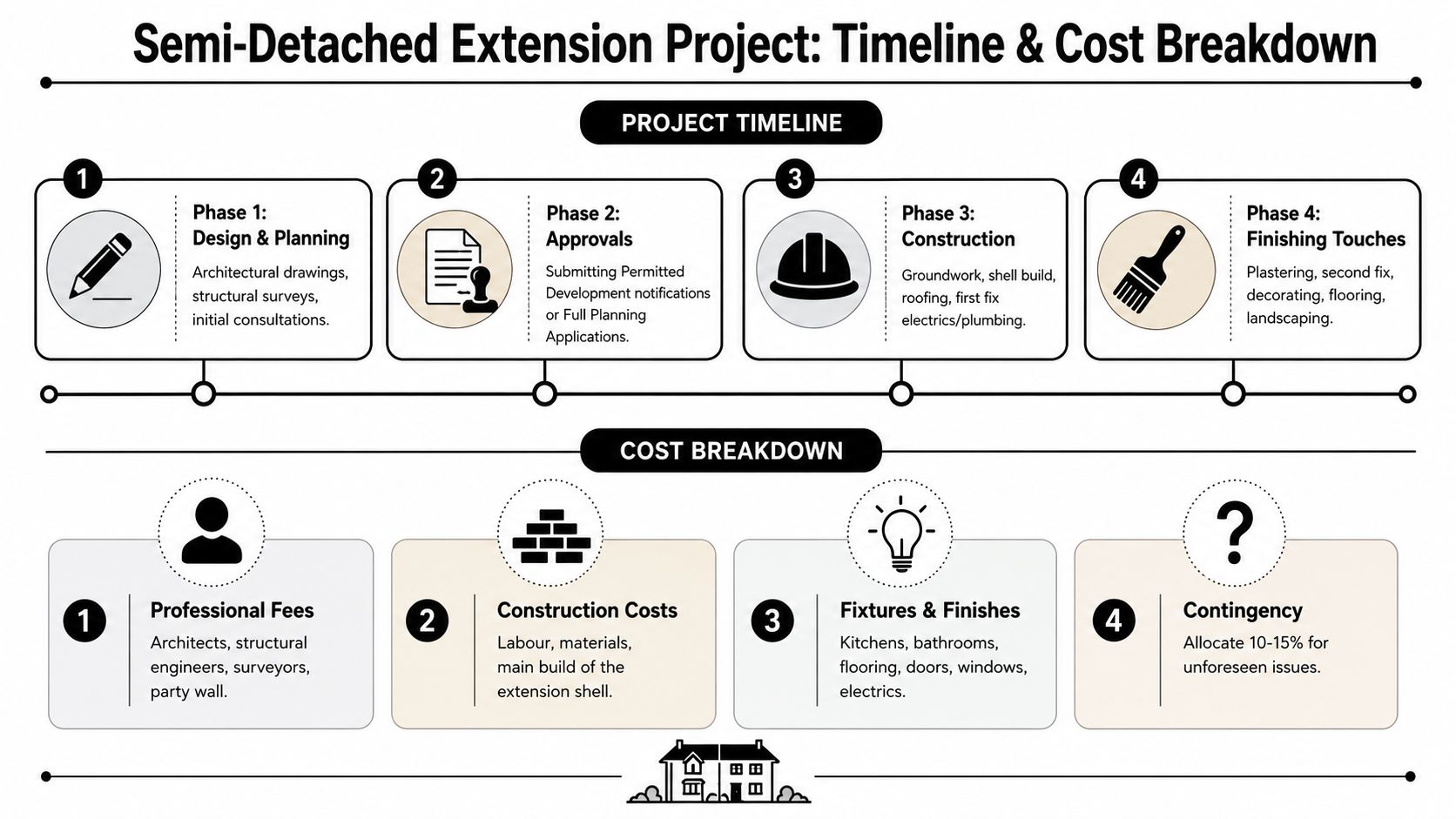
What actually drives cost
For semi-detached house extensions, square metre rates are only a starting point. They can be useful at feasibility stage, but they conceal the factors that make one project straightforward and another expensive.
In this part of London, the cost pressure often comes from conditions on the ground. Restricted side access can slow labour and increase handling costs. Mature trees can affect foundations. Older drains are regularly found in the wrong place. Conservation area expectations can push up the specification for windows, brickwork or roof details. If the house has already been altered over the years, opening up works can reveal awkward structure that needs redesign.
A simple rectangular rear extension with standard openings prices very differently from a scheme with large rooflights, slim-framed glazing, bespoke joinery and substantial steelwork. Both may be similar in area. They are not similar in cost.
A practical way to structure the budget
I advise clients to split the budget into clear layers so the whole commitment is visible from the outset.
Budget layer | What it covers | Why it matters |
|---|---|---|
Professional input | Architect, engineer, surveyors, measured survey, technical design | Reduces redesign, pricing gaps and avoidable site problems |
Statutory process | Planning submissions, Building Regulations, application fees, party wall administration where needed | Keeps the project compliant and properly documented |
Main construction | Demolition, groundworks, drainage, structure, envelope, windows, roofing, labour | Forms the core build cost |
Fit-out and finishing | Kitchen, bathrooms, flooring, lighting, decorating, joinery | This is often where budgets drift furthest from expectations |
Contingency | Unforeseen site conditions, client changes, service diversions, programme slippage | Existing houses always carry some uncertainty |
That final line should be real money, not a token allowance.
A useful programme benchmark appears in this step-by-step side extension guide, which sets out the sequence from design through planning, technical work and construction, and also recommends allowing extra time for delays. The exact durations will vary, especially in boroughs where planning caseloads are heavy or where revisions are needed after pre-application feedback, but the wider point is sound. The build is only one part of the timeline.
Programme risk is usually underestimated
Clients tend to underestimate two things. First, how long decisions take. Second, how much existing houses can surprise you once work starts.
A semi in Wandsworth or Richmond may look uncomplicated from the street, but site conditions often dictate the pace. Thames Water build-over consent may be needed if there is a public sewer nearby. UK Power Networks may need to be involved if the incoming supply is in the way of the proposed works. Matching stock brick can take time. Bespoke glazing rarely arrives quickly. If the extension ties into a full ground floor refurbishment, temporary kitchen arrangements and partial decant costs also need to be considered.
These are ordinary project realities, not exceptions.
Where budgets usually slip
Budget drift is rarely caused by one dramatic mistake. It usually comes from a series of smaller decisions and omissions:
Underdeveloped design before tender. Contractors price uncertainty cautiously, or they price low and recover margin later through variations.
Finishes discussed too late. A basic allowance may have been assumed where the client expected high-end stone, timber flooring or custom-made joinery.
Services and drainage overlooked. Moving boilers, consumer units, gullies or underground runs can have a noticeable cost impact.
Too little allowance for neighbour-related constraints. Restricted access, careful working hours and protection measures can affect both cost and programme.
Client changes during construction. Even sensible improvements made mid-build usually carry time and cost consequences.
One clear, coordinated package nearly always saves money compared with a cheap-looking start followed by constant revision.
Spend in the right places
The best value does not come from cutting every line item. It comes from matching the design ambition to the house, the street and the planning context.
On a semi-detached house in a regulated South West London setting, money is often better spent on layout clarity, good natural light, durable materials and proper integration with the existing house than on one expensive gesture that strains the budget. Overspecification can be just as wasteful as underbudgeting, especially where resale is part of the thinking.
A disciplined budget is realistic about three things. What the house can support. What the borough is likely to accept. What the project needs to finish well.
From Architectural Drawings to On-Site Construction
A semi-detached extension is won or lost before the builder arrives. In South West London, where access is often tight, neighbouring houses sit close, and existing fabric can be awkward, planning drawings are only the starting point. The work that follows determines whether the build runs in an orderly way or turns into a stream of queries, delays and extra cost.
What happens after planning
Once planning consent is in place, or lawful development is confirmed, the design needs to be turned into technical information that can be built. That usually means Building Regulations drawings, structural calculations and a coordinated set of details covering insulation, drainage, roof build-up, glazing, ventilation and the junctions between new and existing construction.
Those junctions matter more in a semi than many clients expect. A rear extension may look straightforward on paper, but on site you often find uneven floors, shallow drains, tired flank walls or a neighbour's structure affecting the foundation approach. If those conditions are not addressed early, the contractor is forced to make assumptions. Assumptions then reappear as provisional sums, exclusions or later variations.
A well-prepared pre-construction package usually includes:
A developed drawing set that goes beyond planning appearance and resolves how the extension is put together
Structural coordination so steelwork, bearing points and foundation strategy are understood before work starts
A written specification or schedule of works so each builder is pricing the same scope
Building Control input on the technical approach before site decisions become expensive to change
Tendering and builder selection
Tendering only works if the information is consistent. If one contractor has allowed for a basic rooflight, another for a conservation-style unit, and a third has missed the drainage diversion altogether, the figures are not comparable.
This stage is where continued architectural involvement pays for itself. Harper Latter Architects works on residential extensions in South West London, and the same principle applies whichever practice you appoint. The value lies in carrying the job through technical design, tender review and construction support, not stopping at the planning submission.
Price still matters, of course. It just cannot be read in isolation.
A contractor for a semi-detached extension should be assessed on a few practical points:
Relevant project experience. Working around an occupied house, restricted side access and close neighbours is different from building on a clear site.
Quality of tender returns. Clear qualifications and sensible questions usually indicate care, not difficulty.
Programme realism. Lead times for glazing, steelwork, kitchens and bespoke joinery regularly affect London projects.
Site discipline. Good contractors manage deliveries, protection, noise and neighbour relations properly because they know small failures escalate quickly on a semi.
Construction quality lives in the details
Clients often judge the scheme by the open-plan view or the amount of glass. The day-to-day quality comes from less visible decisions. Threshold levels, insulation continuity, ventilation, drainage falls, gutter positions, and how old ceilings and walls meet the new work all affect whether the extension feels settled and well made.
In regulated parts of South West London, material choices can also need more care than expected. A flank wall finish, roof profile or window proportion that seems minor in the studio can become a point of concern during approvals, inspections or neighbour discussions. The projects that hold together best are the ones where the design intent survives contact with these constraints because the technical stage was taken seriously from the outset.
A few decisions usually repay the extra thought:
Glazing specified for comfort, not only appearance
Insulation and airtightness detailed properly at junctions
Heating, lighting and ventilation designed as one system
Joinery considered early so storage and circulation are built in, not added as an afterthought
Good construction is rarely about one dramatic move. It comes from careful coordination, clear information and steady oversight on site.
Common Pitfalls and How to Avoid Them
A semi-detached extension usually starts going wrong long before work begins on site. The pattern is familiar in South West London. The drawings look promising, the budget feels plausible, and then the scheme runs into objections, unclear pricing, or a neighbour dispute that could have been avoided with better preparation.
The projects that struggle are rarely the ones with the boldest ideas. They are the ones built on assumptions.
The mistakes that cost most
Starting with a vague brief "We want more space" does not help a design team make good decisions. The real brief might be a larger kitchen, an extra bedroom, proper utility space, better storage, or a layout that works for family life without pushing too far into the garden. If the priorities are not clear at the start, the scheme often becomes oversized, underperforming, or both.
Relying on generic planning advice A semi in Richmond, Wandsworth or Kingston is not judged in the abstract. Street character, rear massing, roof form, overlooking, and the history of nearby approvals all shape what is likely to succeed. National allowances matter, but borough interpretation and local context often decide the outcome.
Sending incomplete information out to tender Builders can only price what they are shown. If structural steel, drainage changes, glazing specification, joinery, or external works are left vague, quotes look artificially competitive at the start and painful later. That is where budgets start to drift.
Letting the neighbour relationship deteriorate early On a semi, objections are rarely just about law. They are about trust, disruption, loss of light, and fear that the project will get out of hand. A neighbour who feels ignored can slow progress even when the proposal is technically sound.
Choosing a contractor on headline price alone A low tender can hide missing items, weak site management, or a programme that was never realistic. By the time those gaps appear, the build is under way and the client's negotiating position is weaker.
A better approach is more disciplined, and usually less stressful. Set the brief in the right order. Test the design against the borough's likely response, not only the broad rule set. Issue enough technical information for builders to price properly. Deal with neighbour concerns early, before positions harden.
Professional guidance reduces avoidable risk because it joins up decisions that clients are too often asked to make in isolation.
For semi detached house extensions in South West London, success usually comes from restraint and clarity rather than chasing the maximum possible volume. The best schemes respect the shared conditions of a semi, work with the planning character of the area, and arrive on site with fewer unanswered questions. Harper Latter Architects can help assess the brief, borough context and design options before a project commits to the wrong route.