
Colour Psychology Interior Design: Transform Your Home 2026
Choosing a paint colour often starts the same way. You stand in front of a fan deck, or scroll through neat digital swatches, and every option looks plausible until it reaches your actual room. Then the soft putty turns pink, the elegant grey looks flat, and the blue you thought would feel composed suddenly reads cold.
That disconnect is where colour psychology interior design becomes useful. Not as a set of rigid rules, and certainly not as shorthand claims that one hue always creates one emotion, but as a way to shape atmosphere with more precision. In residential work, the question isn't “Which paint is fashionable?” It's “How should this room feel at nine in the morning, on a winter afternoon, or during an evening with guests?”
In British homes, that question is inseparable from light. North-facing London rooms, deep-plan basements and heritage properties with lower light levels all alter how colour is perceived, and the UK has some of the lowest winter daylight levels in Europe, so the same palette can read very differently across seasons and orientations, as discussed in this design commentary on colour psychology and interiors. Colour never works alone. It works with daylight, surface finish, proportion and use.
Beyond the Paint Chart The Role of Colour in Your Home
A successful scheme starts long before paint goes on the wall. Colour sets the emotional baseline of a room. It influences whether a drawing room feels restrained or sociable, whether a bedroom settles the eye, and whether a kitchen feels sharp and brisk or relaxed and lived-in.
That's why colour psychology in interior design is worth treating seriously. Not because it offers magic formulas, but because it gives structure to decisions that can otherwise feel subjective. The difference between a comfortable room and an uneasy one is often less about the named colour family and more about how tone, saturation and light work together.
Why generic advice falls short
Simple advice such as “blue is calming” or “yellow is uplifting” isn't wrong, but it is incomplete. A soft grey-blue in a south-facing sitting room may feel airy and composed. The same shade in a north-facing reception room can lose its softness and become austere. In a listed property with deep reveals and smaller windows, that shift is even more pronounced.
Clients usually notice this instinctively. They'll say a room feels “a bit dead”, “too sharp”, or “not restful enough”. Those reactions are real, but they rarely come from hue alone.
Practical rule: Don't choose colour by label. Choose it by atmosphere, light level and the way the room will actually be used.
What colour is really doing
Colour does three jobs at once:
It shapes mood by setting the dominant emotional tone of a room.
It alters perception so spaces can feel larger, warmer, quieter or more intimate.
It links materials so timber, stone, metal and textiles sit together rather than compete.
In higher-end homes, this matters more, not less. Bespoke joinery, natural stone, antique pieces and layered lighting create richness, but they also make crude colour decisions more obvious. A refined interior usually relies on calibrated colour rather than dramatic gestures.
Understanding How Colour Shapes Perception
A useful way to think about colour is as the room's emotional soundtrack. You might not consciously analyse it every time you walk in, but you feel its effect immediately. Some rooms quieten the mind. Others sharpen it. Some encourage conversation. Others make people sit politely without ever settling.
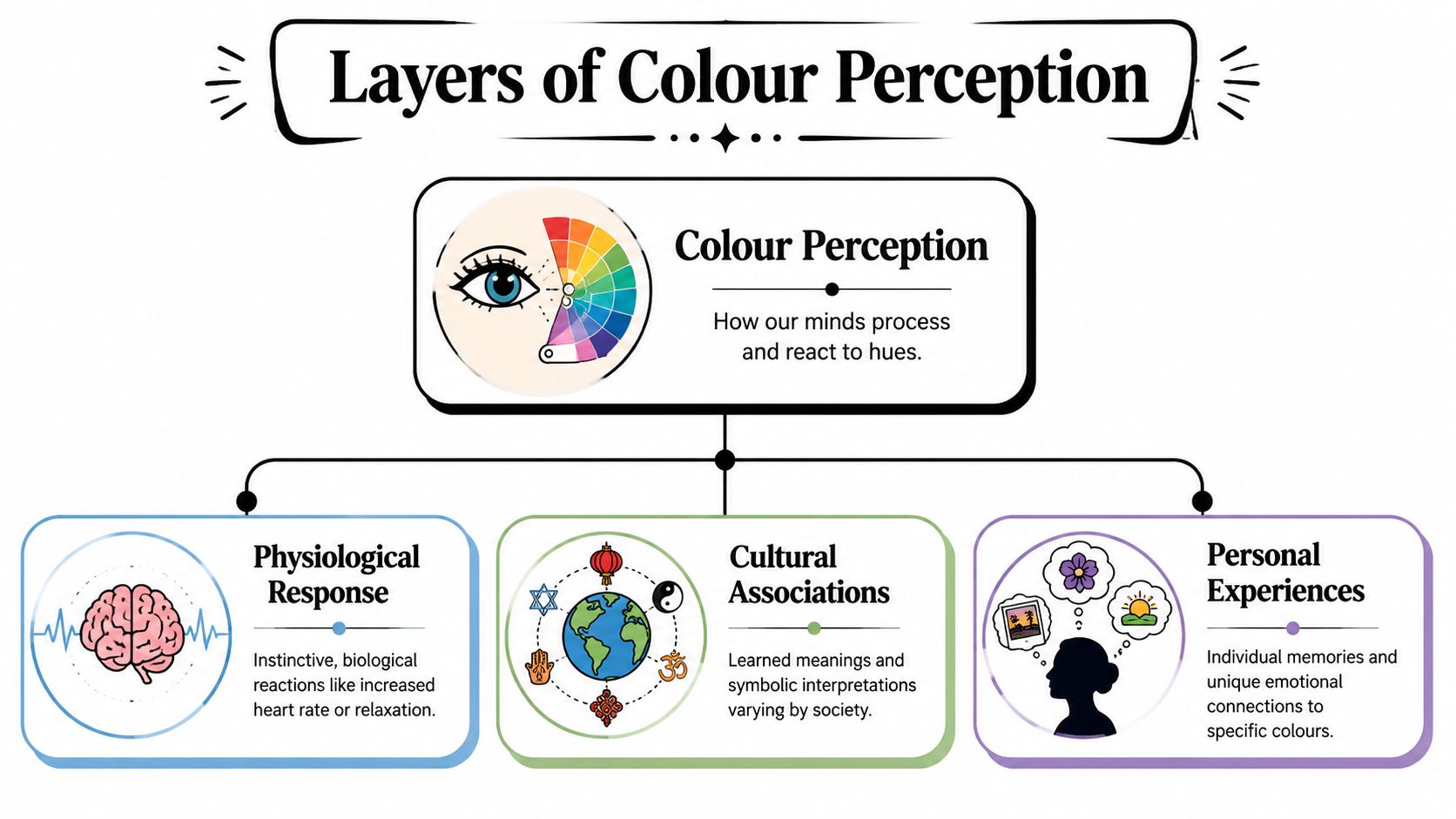
Our responses to colour are layered, which is why one-size-fits-all advice usually fails.
The three layers that matter
The first layer is physiological response. Some colours tend to feel more active, some more recessive, some softer on the eye over long periods. That doesn't mean every person reacts identically, but there are broad perceptual tendencies designers work with.
The second is cultural association. We learn meanings over time. White may suggest crispness, ceremony or simplicity. Deep green may suggest tradition, nature or club-room formality. Those associations vary by background and context.
The third is personal memory. This is often the decisive one in domestic interiors. A colour that feels grounding to one person can feel oppressive to another because it recalls a previous home, a school corridor, a hotel, an outdoor scene or even a favourite garment.
Why clients often disagree with each other
In family homes, colour decisions become difficult when two people are each “right” from their own perspective. One wants blue because it feels peaceful. Another dislikes blue because it feels cold. Neither reaction is irrational.
That's why I tend to ask better questions than “What colour do you like?” More useful prompts are:
When do you use the room most. Morning, afternoon or evening?
What do you want to feel there. Focused, relaxed, sociable, cocooned?
What materials are staying. Oak floors, marble tops, brass lighting, existing art?
What colours do you consistently live with elsewhere. Clothes, upholstery, books, objects?
Colour psychology works best when it translates lived preferences into design decisions. It doesn't override them.
The limit of colour theory
There's also a limit to what colour alone can do. Mood responses are context-dependent and influenced by light exposure, room use and individual differences, which is why a beautifully lit neutral room can feel more restorative than a badly lit room painted in a supposedly calming shade. Good design respects that complexity.
A Practical Guide to Key Colour Palettes
Most homeowners don't need an encyclopaedia of hues. They need a clear starting point. The simplest way to organise colour psychology interior design is by function, not by paint-chart order.
Evidence from a foundational study published in Color Research and Application showed a strong preference for cooler hues in interior spaces. Blue led preference in multiple samples, with 39.2% in one sample and 34.7% in another, while green followed behind it, according to the published study on interior colour preference. For residential interiors, that helps explain why cooler palettes so often feel broadly comfortable and inviting.
Calming and restorative
Blues and greens tend to work well when a room needs visual quietness. That doesn't mean every room should be pale blue. It means these families usually offer a reliable route to composure.
Soft blue-greys suit bedrooms, dressing rooms and reading corners where you want the eye to settle. Greener tones can be excellent in home offices because they feel connected to nature and tend not to over-stimulate. In bathrooms, cooler hues often support a clean, spa-like atmosphere.
The key is restraint. Heavy saturation can turn serenity into theatricality very quickly.
Energising and social
Yellows, ochres, terracottas and muted oranges have a different role. They bring warmth, sociability and movement. In the right room, that can be exactly what's needed.
These colours tend to work best in spaces where people gather briefly or actively. Kitchens, breakfast rooms and some family areas can carry them well, especially when there is good natural light. In smaller or dimmer rooms, they often perform better as an accent than as the dominant field.
Grounding and sophisticated
Deep neutrals, clay tones, mushroom shades, tobacco notes and muted earth colours are often the most versatile family in high-end residential work. They don't announce themselves loudly, but they create depth and steadiness.
These are useful in reception rooms, halls and heritage interiors where architecture, joinery and art should carry part of the visual weight. They also pair well with natural materials and can make expensive finishes feel more coherent.
Design judgement: Sophistication usually comes from nuance. A restrained earth tone with layered texture often has more presence than a louder colour used indiscriminately.
Colour Psychology Quick Reference
Colour Family | Psychological Association | Best For |
|---|---|---|
Blues | Calm, clarity, visual quiet | Bedrooms, bathrooms, sitting rooms |
Greens | Balance, restoration, softness | Bedrooms, home offices, garden rooms |
Yellows and ochres | Warmth, sociability, brightness | Kitchens, breakfast areas, accents |
Oranges and terracottas | Energy, welcome, informality | Dining spaces, family areas, accents |
Deep neutrals and earth tones | Grounding, sophistication, intimacy | Living rooms, halls, heritage interiors |
What works and what doesn't
Works well when the room's function matches the palette's emotional register.
Works badly when a colour is chosen for trend value but fights the light.
Works well when saturation is controlled and materials support the tone.
Works badly when every surface tries to make the same statement.
Creating Harmony with the 60-30-10 Rule
Even an excellent colour can fail if the proportions are wrong. Many interiors feel unsettled not because the palette is misguided, but because too many tones are competing for attention.
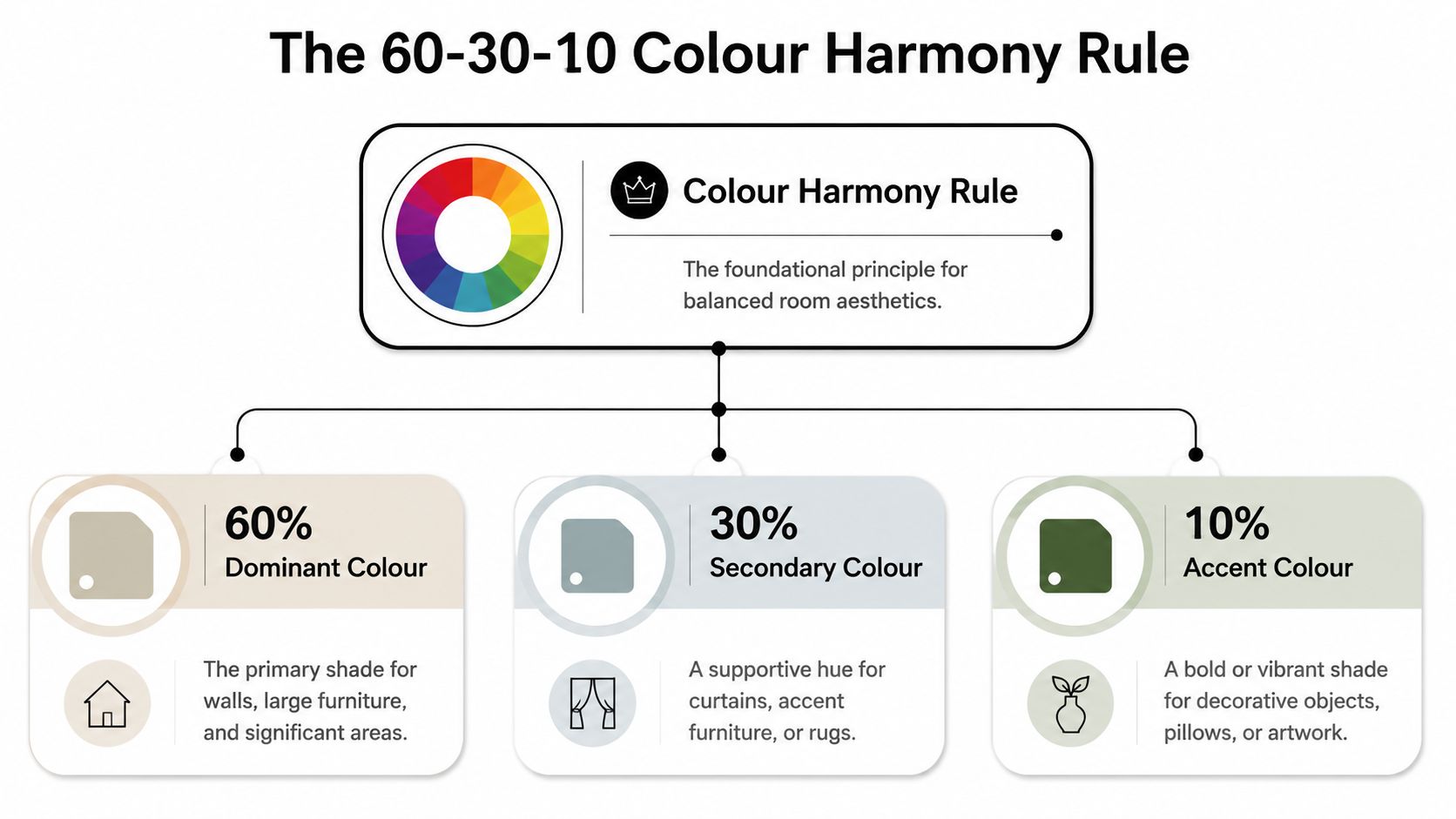
A practical way to avoid that is the 60-30-10 rule. Rockfon's UK guidance describes it as a widely used heuristic in which a scheme is divided into 60% dominant colour, 30% secondary colour and 10% accent colour, creating visual harmony and helping control the effect of stronger shades, as outlined in Rockfon's guidance on interior colour design for wellbeing.
How the rule works in practice
The 60% is the room's emotional foundation. Usually that means walls, large rugs, major floor area or substantial upholstery. This is the tone that people register first.
The 30% supports it. Upholstered pieces, curtains, casework or a secondary wall treatment often sit here. This colour adds depth without changing the room's core mood.
The 10% is where energy lives. Artwork, cushions, lampshades, ceramics, trim details or a small statement chair can all carry accent colour.
After the principle, it helps to see the balance visually.
A London refurbishment example
In a formal sitting room, the dominant field might be a soft stone or warm grey across walls and larger upholstered pieces. The secondary note could be a deeper blue through curtains and occasional seating. The accent might come through brass, ochre in art, or a rust velvet cushion.
That arrangement does two things. It keeps the room calm enough for everyday use, and it gives enough contrast to stop it feeling flat.
Where people go wrong
Too many equals. When every colour is given equal visual weight, the room has no hierarchy.
Accent overload. If accents spread across too many surfaces, they stop being accents.
Dark without balance. Deep colours can be superb, but they need proportion and light to avoid heaviness.
How Light and Materials Change Everything
The same paint can look composed in one room and completely wrong in the next. That isn't a failure of the paint. It's a reminder that colour is always filtered through light and surface.
Expert practitioners consistently stress that colour choices need to be assessed in the actual room because perceived hue changes with light temperature and reflectance. A neutral can look warmer beside oak and brass, but cooler beside polished stone, which is why in-situ testing under real daylight and artificial light is essential.
Orientation changes the brief
North-facing rooms usually flatten and cool colour. South-facing rooms reveal more warmth and often give greater tolerance for subtle hues. East- and west-facing rooms can shift noticeably over the day, which matters if a room is used primarily in the morning or evening.
A basement has its own logic. There, the success of colour often depends less on hue itself and more on how you handle reflectance, shadow and layered lighting. If the lighting scheme is poor, colour psychology won't rescue the room.
For a more detailed look at this relationship, our guide to expert lighting design for homes covers the practical decisions that shape how interiors feel after dark.
Materials alter colour perception
A painted wall doesn't exist in isolation. It sits beside floors, skirtings, joinery, fabrics, metals and stone. Those neighbouring materials push colour warmer, cooler, flatter or richer.
Consider the difference between these pairings:
Oak and brass tend to pull neutrals towards warmth.
Polished marble or cool stone can make the same neutral feel sharper.
Velvet absorbs light and deepens colour.
Lacquer or silk finishes reflect more light and can make colour feel brighter and more active.
Test large samples in place, then review them in morning light, afternoon light and evening light. Anything less is guesswork.
What usually works on site
I prefer physical samples at meaningful scale. Small chips tell you almost nothing once a colour occupies an entire wall. Samples should be viewed against fixed elements that aren't changing, especially flooring, fireplaces, stone surfaces and joinery finishes. In complex refurbishments, this step isn't decorative fussiness. It's risk control.
Room by Room Strategies for Your Home
Good residential design rarely relies on a universal palette carried from room to room without adjustment. A house needs continuity, but each space also needs its own psychological logic. The right question isn't “What's our house colour?” It's “What should each room do for us?”
Research reviews also suggest some caution. Colour's effect on wellbeing is strongly moderated by lighting, saturation and context rather than hue alone, and in many British homes the best psychological outcome may come from controlling reflectance, contrast and artificial lighting rather than picking only a supposedly calming colour, as discussed in this review of colour psychology in design.
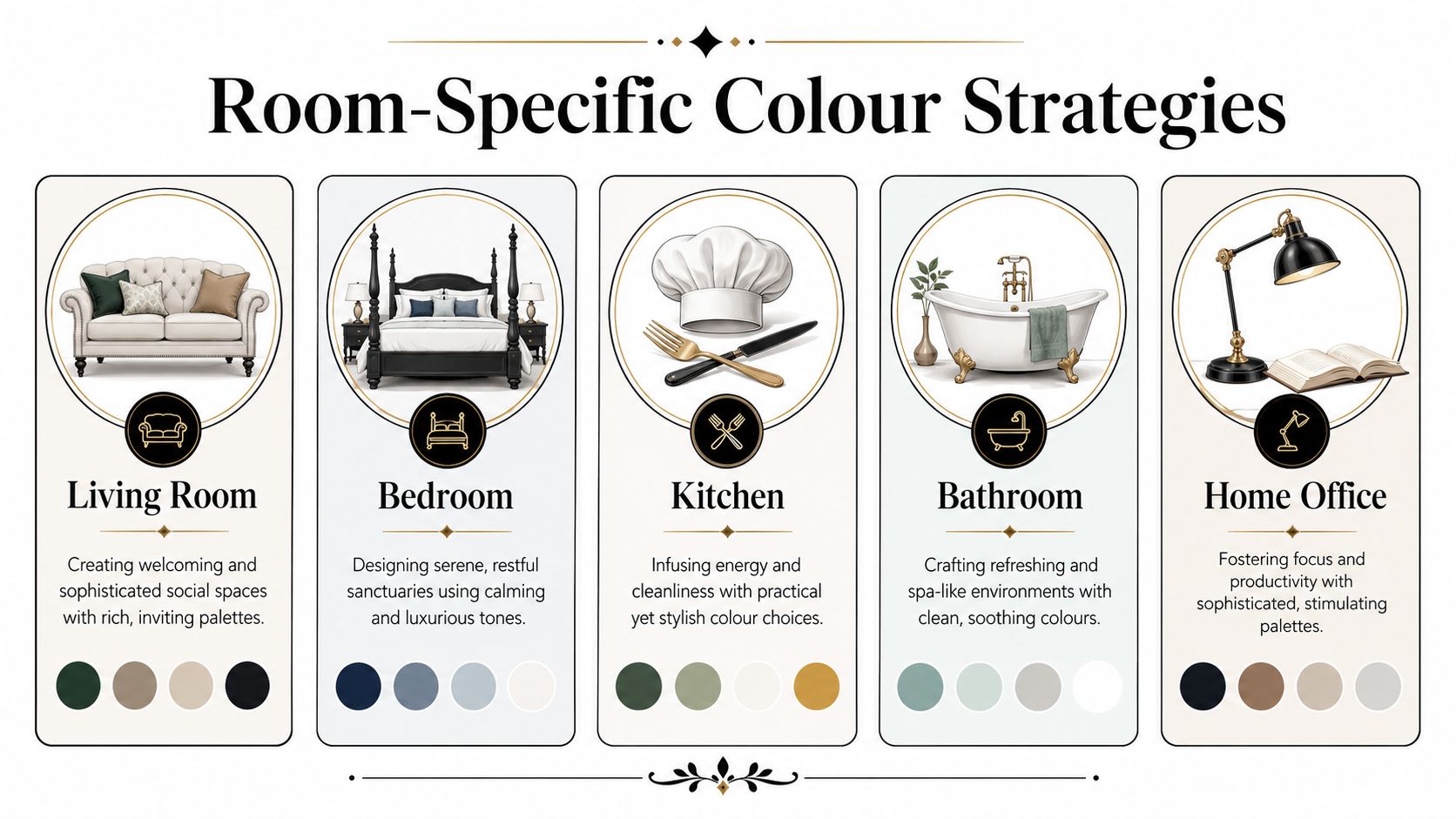
Living rooms and reception spaces
A living room usually benefits from layered warmth rather than obvious colour messaging. Neutrals, muted greens, deep taupes or controlled blues tend to work because they support conversation and allow furniture, books and art to give the room identity.
In heritage homes, saturated modern tones can jar against period detailing if they aren't carefully balanced. Earthier pigments, softer mineral notes and more complex off-neutrals often sit more comfortably with original cornicing, fireplaces and aged timber.
Bedrooms and dressing areas
Bedrooms need restraint. That doesn't always mean pale walls. In fact, deeper tones can work beautifully when they are soft rather than hard. Blue-green, smoky olive, warm mushroom or muted plaster tones can make a room feel cocooned without becoming oppressive.
The mistake is often excessive contrast. Bright white trim against a dark bedroom wall can break the sense of calm. Tonal treatment usually feels more settled.
A restful bedroom is built through low contrast, controlled light and tactile surfaces. Colour is part of that, not the whole story.
Kitchens and family rooms
Kitchens can tolerate more energy because they are active spaces. But activity doesn't require brightness everywhere. Often the better solution is a composed background with sharper notes in joinery, stools, art or lighting.
For family spaces in retrofit homes, reflectance matters hugely. If daylight is limited, it's often better to keep the larger surfaces balanced and bring colour through smaller, more characterful elements. That produces warmth without visual fatigue.
Bathrooms, home offices and lower-ground spaces
Bathrooms usually respond well to palettes that feel clean but not clinical. Greens, stone tones and softened whites often outperform stark contrasts. In home offices, colours that reduce distraction tend to be more dependable than bold statements, especially if the room is used for long periods.
Basement cinemas, gyms and lower-ground lounges are different. Here, stronger tones can be very effective because artificial lighting is doing more of the work. Deep colour can sharpen atmosphere, but only if the lighting, joinery finishes and contrast levels are designed in parallel. That's where a broader residential interior design approach becomes useful, because colour decisions need to sit within the architecture of the room.
Collaborating with Your Architect on Colour
Clients often arrive with a feeling rather than a palette. That's normal, and it's usually the right starting point. “I want it to feel calmer,” “I don't want the room to feel cold,” or “we entertain here a lot” are more useful than naming six paint colours too early.
The most productive conversations usually cover four things. First, how the room is used at different times of day. Second, which materials are fixed. Third, what emotional register you want. Fourth, what you already know you dislike. Eliminating the wrong direction can be just as valuable as chasing the perfect one.
Bring references, but edit them. A tightly chosen set of images tells an architect much more than a large folder of unrelated inspiration. Point to what you respond to in each image. The warmth of the timber, the softness of the contrast, the depth of the wall colour, the way the brass reads in evening light.
If the project includes major refurbishment, bespoke joinery or a heritage setting, colour should be treated as part of interior architecture rather than decoration applied at the end. That's often when working with an interior architect in London becomes valuable, because the relationship between layout, light, materials and colour can be resolved as one coherent design problem.
The best results come from collaboration. Clients bring instinct, memory and lived habits. Architects bring proportion, testing and control. Between those two, colour becomes much more than a paint decision.
If you're planning a refurbishment, extension or full interior reworking, Harper Latter Architects can help you develop a colour strategy that responds to light, materials and the way you live, rather than relying on generic rules.