
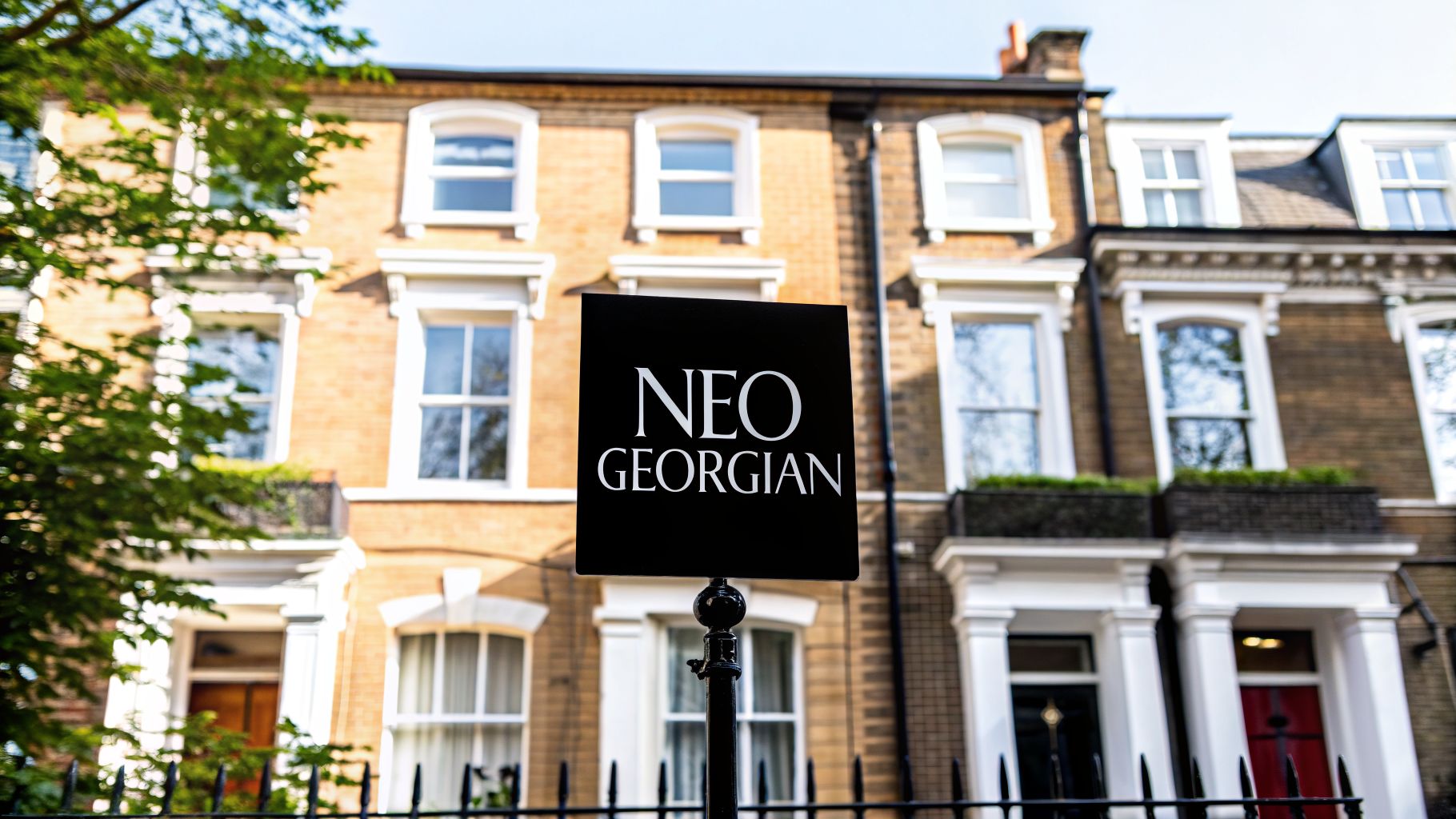
Neo-Georgian Architecture: A Guide to Timeless British Design
Neo-Georgian architecture is all about reinterpreting the classical elegance of 18th-century British design for a new age. It’s defined by a love for symmetry, balanced proportions, and an understated sense of grandeur, making it a truly timeless choice for luxury homes.
The Timeless Appeal of Neo-Georgian Architecture
Take a walk through almost any affluent London suburb, from Wimbledon to Richmond, and you'll find the unmistakable elegance of Neo-Georgian architecture. This isn't just some dusty style from the past; it’s a living design language that continues to define high-end homes today. It represents a very deliberate return to order and harmony—a philosophy that still feels profoundly appealing.
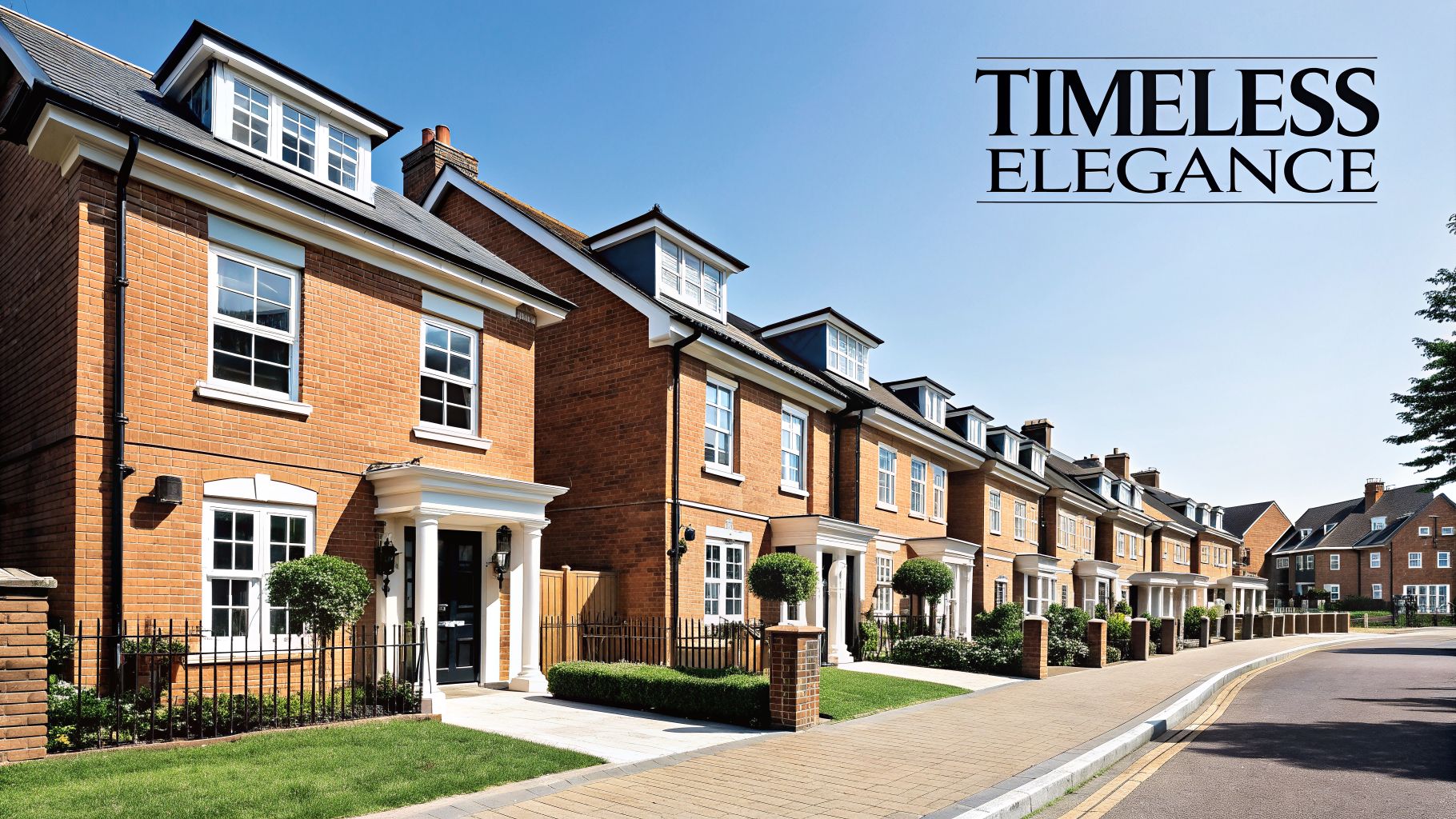
Its lasting popularity comes from its ability to project a sense of stability and refinement. Unlike the ornate, often fussy complexity of Victorian buildings, Neo-Georgian design offers a comforting clarity. Its core principles really resonate with modern homeowners who value both tradition and clean, uncluttered aesthetics.
Why This Style Endures
The strength of Neo-Georgian design is baked into its foundational elements. These homes are built on a visual grammar that’s both easy on the eye and deeply satisfying. This classic framework also happens to be the perfect canvas for contemporary living, allowing for modern interpretations that still honour the style's heritage.
There are a few key reasons for its lasting appeal:
Symmetry and Order: The balanced façade, with its central doorway and evenly spaced windows, creates an immediate sense of calm and harmony.
Human Scale: While often grand, the proportions are designed to feel welcoming and comfortable, avoiding the intimidating scale of other classical styles.
Understated Elegance: It relies on proportion, quality materials, and subtle detailing rather than over-the-top ornamentation, resulting in a sophisticated and timeless look.
For many, the appeal of Neo-Georgian architecture lies in its perfect balance. It is a style that feels both impressively formal and genuinely liveable, creating a home that is as suitable for quiet family life as it is for grand entertaining.
This inherent adaptability is crucial. The style's classic charm can be seamlessly blended with the comforts and technologies of the 21st century. As architects, we can honour this distinguished heritage while designing practical, sophisticated homes that feel magnificent without being ostentatious.
This fusion of past and present is what ensures Neo-Georgian architecture remains a benchmark for luxury British homes, creating spaces that feel both brand new and deeply rooted in a proud design tradition. The goal is to create a property that is not just built for today, but for generations to come.
Understanding the Revival of a National Style
To really get to grips with Neo-Georgian architecture, you have to see it for what it is: not just a copy of the past, but a powerful, deliberate revival. It sprang from a specific moment in British culture, a conscious return to the clarity and order of the 18th-century Georgian ideal. This was a direct and forceful reaction against what many architects of the day saw as the fussy, over-decorated, and frankly cluttered excesses of the high Victorian era.
The style found its greatest champion in architects like Sir Edwin Lutyens. He and his contemporaries were on a mission to bring a sense of national identity and classical grace back into British design. They turned their backs on the complex, asymmetrical buildings that had become so popular in the 19th century, instead favouring balance, restraint, and the timeless appeal of symmetry. It was, in essence, an architectural palate cleanser.
A Return to Classical Harmony
This revival was about more than just aesthetics; it was a statement of values. The Georgian period was remembered as an age of elegance, good proportion, and civic pride. By bringing back its architectural language, designers hoped to conjure a feeling of stability, domestic comfort, and visual harmony that struck a deep chord with the British public.
The movement really took off from the 1920s onwards. And this wasn't some niche style reserved for grand country estates. It quickly became the dominant force shaping Britain's public spaces for decades. It's telling that Neo-Georgian architecture was the go-to style for Britain's public realm between 1920 and 1960. It shaped the nation's streetscape, with countless banks, post offices, and even pubs built in this confident, ordered style, cementing its place as a true 'national style'. Heritage Calling offers some brilliant insights into this national style.
The Influence of Sir Edwin Lutyens
One of the undeniable giants of this revival was Sir Edwin Lutyens (1869-1944), who became the most important classical architect of his time. His work was at the heart of an early phase of the movement often called the 'Wrenaissance'—a clever nod to the great Sir Christopher Wren. This particular flavour of Neo-Georgian is instantly recognisable for its distinctive use of warm red brick, set off by elegant dressings of white stone, wood, or plaster.
This return to classical roots was a search for an authentic British architectural voice. It looked back to a time of perceived national confidence and translated its principles of order and understated grandeur for a new, modern Britain.
What made this approach so successful was its incredible versatility. It worked just as well for a grand public building as it did for a comfortable family home. The principles of balance and proportion were equally effective for a detached house in a leafy suburb as for a prominent bank on the high street. This adaptability is a huge reason why the style flourished and left such a lasting mark on the country.
Understanding these origins is vital for anyone thinking about building or renovating in this style today; it helps create a design that feels authentic to its roots. If you have an interest in historical properties, you might find value in our complete guide to restoring a Georgian house. The legacy cemented during this period continues to influence high-end residential architecture, especially in heritage-rich areas where fitting in with the surrounding streetscape is everything.
Identifying the Key Characteristics of Neo-Georgian Design
So, what are the tell-tale signs of a Neo-Georgian home? It’s more than just a passing resemblance to its 18th-century ancestors; the style has a very distinct visual grammar. Think of it as a language built on the unshakable principles of symmetry, proportion, and a deep respect for classical order. Once you learn to spot these core elements, you start to see the thoughtful, deliberate design choices that give these properties such timeless appeal.
At its very heart, Neo-Georgian design is an exercise in perfect balance. The front of the house is almost always a mirror image of itself, anchored by a centrally placed front door. This isn't just a casual preference – it's a foundational rule that orchestrates the entire façade, creating an immediate sense of harmony and calm. It’s a design that feels instantly logical and satisfying to the eye.
The Signature Façade and Fenestration
How a Neo-Georgian building handles its windows and doors is absolutely crucial. These aren't just practical openings; they are the key notes in the building's rhythmic and orderly composition.
A handsome panelled front door typically sits right at the centre, often dressed up with classical details like an elegant pediment above or a decorative fanlight to let in more light. This touch of grandeur draws the eye and establishes the symmetrical pattern that the rest of the façade meticulously follows.
The windows are just as vital to the overall look. There are a few key things to watch for:
Sash Windows: Tall, graceful, multi-paned sash windows are a dead giveaway. You’ll often see a 'six-over-six' or even an 'eight-over-eight' pane design, which creates that characteristic grid-like pattern.
Uniform Arrangement: The windows are set out in neat, orderly rows, lining up perfectly both across and down the building. This disciplined placement reinforces that deep-seated sense of order.
Decreasing Proportions: It’s a subtle trick borrowed from classical architecture, but look closely and you’ll often notice that the windows on the upper floors are slightly smaller than those below. This clever detail creates an illusion of greater height and makes the whole building feel more elegantly proportioned.
Materials and Detailing
The materials used in Neo-Georgian architecture give a firm nod to 18th-century tradition, but they often do so with the benefit of more modern construction techniques. The goal was always to create an impression of substance, quality, and understated class.
Brick is by far the most dominant material, usually a high-quality red or brown brick laid with precision. The Flemish bond – a pattern that alternates the short end (header) and long side (stretcher) of the bricks in each row – was a particular favourite for its decorative texture and strength.
To provide a touch of elegant contrast, you’ll often find subtle stone dressings. These might appear as:
Stone quoins defining the corners of the building.
A decorative string course running horizontally between storeys.
Delicate window surrounds or prominent keystones.
These details add a layer of sophistication without ever shouting for attention or overwhelming the clean lines of the brickwork. This idea of a visual hierarchy, where details enhance rather than dominate, is absolutely central to the style.
This diagram shows how the style grew from a conscious rejection of Victorian fussiness, was championed by leading architects, and eventually became a go-to language for British architecture.
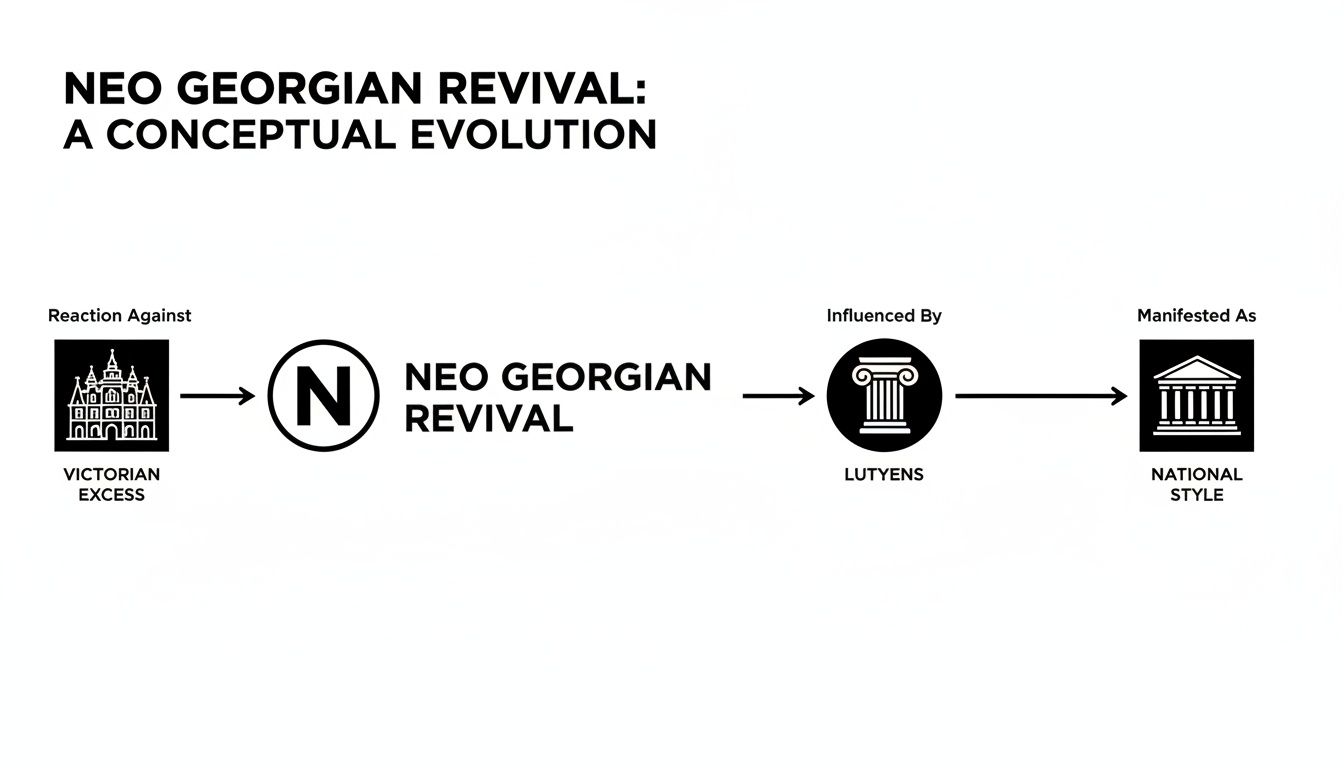
As the diagram shows, this wasn't an accidental drift but a purposeful move back towards classical simplicity, solidifying Neo-Georgian design's role in shaping Britain's architectural identity in the 20th century.
Roofs and Classical Embellishments
The roofline is another major clue. A hipped roof, which slopes gently inwards from all four sides, is incredibly common and helps give the building its neat, self-contained silhouette. If there are dormer windows, they are usually small, understated, and placed symmetrically so as not to disrupt the overall harmony.
The real beauty of Neo-Georgian design lies in its discipline. Every single element, from the placement of a window to the choice of brick bond, is part of a cohesive and carefully considered whole. It is architecture that speaks with quiet confidence, not a loud display.
Finally, many Neo-Georgian homes will feature a classical portico or porch framing the front door. This could be anything from a simple, elegant canopy on brackets to a more formal structure with grand columns. Whatever its scale, the portico adds depth to the façade and powerfully reinforces the entrance as the focal point, welcoming you with a sense of formal grace.
Crafting Timeless and Elegant Interior Spaces
The disciplined principles of Neo-Georgian architecture extend far beyond the striking exterior. Step inside, and the focus shifts to creating spaces that feel grand yet completely liveable, striking that perfect balance between classical elegance and a comfortable, human scale. The same dedication to symmetry and proportion defining the outside is masterfully carried through into stunning, light-filled interiors.
This interior philosophy isn't just about decoration; it's about the very bones of the space. It all starts with the fundamentals of volume and light, creating a canvas of quiet sophistication that sets the stage for modern living.
Embracing Light and Proportion
High ceilings are a cornerstone of any Neo-Georgian interior, immediately creating a sense of openness and air. These generous ceiling heights, often exceeding 2.7 metres, allow natural light from large sash windows to flood deep into the rooms, making everything feel brighter and more spacious.
This vertical scale is matched by generously proportioned rooms. They are typically arranged with a clear, logical flow – often symmetrically around a central hallway – echoing the order of the exterior. The result is a sequence of well-balanced spaces that feel both impressive and inherently calming.
To add character and architectural interest without being fussy, decorative mouldings are essential. These elements gracefully bridge the gap between wall and ceiling, providing a subtle layer of classical detail.
Cornicing: The ornamental moulding that runs around the very top of the room, softening the line where the wall meets the ceiling.
Dado Rails: A traditional moulding fixed horizontally to the wall, originally intended to protect walls from the backs of chairs.
Skirting Boards: Deep, elegantly profiled skirting boards provide a solid, handsome base for the walls.
These details are never over-the-top. In true Neo-Georgian style, they are refined and carefully scaled to suit the room’s proportions, adding a layer of texture without creating visual clutter. To get a better sense of how these structural elements shape a room’s character, it’s worth exploring the relationship between interior architecture and interior design.
The Fireplace as a Natural Focal Point
Long before televisions dominated our living rooms, the fireplace was the undisputed heart of the home. In Neo-Georgian architecture, the feature fireplace acts as a powerful anchor, a natural focal point that brings symmetry and warmth to any room.
The surround is typically crafted from stone, marble, or elegantly carved wood, with designs ranging from simple and classical to more detailed interpretations. Placed centrally on a principal wall, it provides the perfect axis around which furniture can be arranged, encouraging conversation and creating a truly welcoming atmosphere. Even in modern homes where a real fire is less common, the architectural presence of a mantelpiece remains a key part of the room's identity.
The interior of a Neo-Georgian home is a masterclass in understated quality. It’s a space where bespoke joinery, generous proportions, and classical details combine to create an environment that feels both established and perfectly suited for contemporary life.
The Role of Bespoke Joinery
Finally, high-quality, bespoke joinery is absolutely fundamental to achieving an authentic Neo-Georgian feel. This is about so much more than simple storage; it becomes an integral part of the room’s architecture, creating a sense of permanence and crafted quality.
Think of beautifully executed panelled walls that add texture and depth, or floor-to-ceiling bookcases that line a study, lending it gravitas and personality. Built-in wardrobes and custom cabinetry are designed to blend seamlessly into the structure of the room, maintaining clean lines and an uncluttered feeling. These classic elements can be masterfully combined with modern necessities, from discreetly integrated technology to open-plan layouts, creating homes that are as functional as they are beautiful.
Adapting Neo-Georgian Design for the 21st Century
How can a style with such deep historical roots genuinely meet the demands of modern life? This is the central challenge—and the real opportunity—of contemporary Neo-Georgian architecture. The most successful projects today aren't museum pieces; they're intelligent adaptations that fuse timeless aesthetics with 21st-century performance and comfort.
The key is to honour the style's classical grammar while thoughtfully weaving in features that reflect how we live now. It's about embedding sustainable technologies and modern lifestyle amenities without ever compromising the core principles of symmetry, proportion, and understated elegance that define the style.
Weaving in Sustainable Technology
There's a common misconception that a traditional aesthetic has to come at the expense of energy efficiency. In reality, modern building science allows us to create homes that are both beautiful and highly sustainable, marrying classic looks with impressive performance.
This fusion of old and new is most obvious when you look at the windows. High-performance double or even triple-glazed units can now be housed within traditional timber sash window frames, perfectly replicating the classic multi-paned look while offering exceptional thermal insulation. This approach really does deliver the best of both worlds: authentic kerb appeal and a significant drop in your energy bills.
Beyond the windows, other sustainable features can be seamlessly incorporated:
Air-Source Heat Pumps: These highly efficient systems provide heating and hot water, and can be discreetly located to avoid disrupting the home's classical lines.
High-Performance Insulation: Modern insulation materials installed within the walls, roof, and floors ensure the building envelope is airtight, drastically reducing heating costs.
Discreet Solar Technology: For new builds, solar panels can often be integrated onto less visible rear roof slopes, generating clean energy without compromising the primary façade.
This approach proves that timeless design can also be future-proof. By prioritising energy efficiency from the outset, a bespoke Neo-Georgian home becomes a long-term asset that is as kind to the environment as it is beautiful to look at.
Accommodating Modern Lifestyles
The way families live has changed dramatically since the original Georgian era. While formal reception rooms still have their place, modern life often calls for more relaxed, multi-functional spaces and amenities that support wellbeing and entertainment.
A significant evolution in modern Neo-Georgian design is the integration of expansive, open-plan areas. A well-designed kitchen that flows into a dining and family living space creates a social hub for the home—perfect for informal gatherings. This can be achieved while maintaining the classic, formal rooms at the front of the house, offering a clear separation between public and private zones.
The genius of modern Neo-Georgian architecture lies in its ability to contain contemporary life within a classical framework. It’s about creating homes that feel perfectly aligned with today’s aspirations for comfort, leisure, and seamless indoor-outdoor living.
Furthermore, today’s bespoke homes often include lifestyle features that were unimaginable in the 18th century. Basement extensions are a popular way to accommodate these desires without altering the building’s elegant footprint. These subterranean spaces can be transformed into:
Home cinemas and media rooms
Private gyms and wellness suites
Bespoke wine cellars and tasting rooms
Similarly, a strong connection to the outdoors is a modern priority. Large glazed doors can be artfully incorporated into the rear elevation, opening onto beautifully landscaped terraces and creating a fluid transition between the interior and the garden. This is where heritage meets innovation, crafting homes perfectly aligned with how families want to live today and in the future.
Designing Your Bespoke Neo-Georgian Home
Embarking on a Neo-Georgian project is an exciting journey, whether you're building from the ground up or breathing new life into an existing property. The success of this kind of venture really boils down to translating your vision into a meticulously crafted reality—a process that absolutely demands the right architectural expertise. It’s a true collaboration, one built on a rigorous design process that respects the style's integrity while fitting your life perfectly.
This isn’t just about the four walls and a roof, either. A truly successful Neo-Georgian home demands a holistic approach, where the exterior, the interiors, and even the landscape design are all considered as one cohesive whole. The aim is to create a deeply harmonious environment where every single element feels perfectly placed and thoughtfully connected.
Realising Your Architectural Vision
For homeowners in places like Wimbledon or Richmond, creating a bespoke Neo-Georgian property is about crafting something that feels both brand new and deeply rooted in its local heritage. The whole process starts by understanding your aspirations—not just what you need on a practical level, but how you truly want to live in the space. This vision becomes the bedrock for every decision we make from that point on.
A successful design has to navigate several crucial stages:
Conceptual Design: This is where we explore layouts, scale, and massing to make sure the home sits gracefully on its plot and genuinely suits your lifestyle.
Detailed Planning: Here, we get into the real nuts and bolts. We address the nuances of the design, from selecting the right handmade bricks to finalising intricate joinery details, ensuring every last aspect sings from the Neo-Georgian hymn sheet.
Regulatory Approvals: We carefully manage the planning applications, which is especially important in heritage-sensitive locations. Navigating the complexities of planning permission in a conservation area is a specialist skill that can genuinely make or break a project.
The design process is a dialogue. It’s about listening intently to a client's dream and then applying architectural principles to create a home that is not only beautiful and functional but also a true reflection of their identity.
Your Next Steps to a Timeless Home
When you partner with an architectural practice that’s fluent in Neo-Georgian design, you ensure that the style’s classical language is spoken throughout your home. From achieving that perfect exterior symmetry to crafting elegant, well-lit interior proportions, expert guidance turns what can be a complex process into one of clarity and confidence.
By focusing on a blend of creativity, craftsmanship, and close collaboration, we clear the path to delivering a truly individual, future-proof home. This approach ensures your property becomes a timeless asset, ready to be loved and enjoyed for generations to come.
Your Questions Answered: Neo-Georgian Architecture
To help you get a clearer picture, we've gathered some of the most common questions we hear from homeowners thinking about a Neo-Georgian project.
Is Neo-Georgian Architecture Really Suitable for a Modern Family?
Absolutely. In fact, its core principles are a fantastic starting point for modern living. Think generously proportioned rooms, high ceilings, and a flood of natural light – all elements that create a superb foundation for a family home.
While we love the classic layout, it's also incredibly adaptable. We can intelligently blend in the open-plan kitchen, dining, and living areas that so many families want today, without losing the character of the home. You can still have those elegant, formal reception rooms perfect for entertaining, while the rest of the house flows effortlessly.
Modern comforts like bespoke kitchens, spa-like bathrooms, and integrated smart home technology can be woven in so seamlessly they feel like they’ve always been there. The result is a property that’s both timelessly beautiful and perfectly in tune with contemporary life.
Can We Actually Make a New-Build Neo-Georgian Home Sustainable?
Yes, and it's something we are passionate about. Just because the aesthetic is historical doesn't mean the building technology has to be. A modern Neo-Georgian home can be a showcase of green innovation.
We regularly build sustainability right into the design, enhancing energy efficiency and reducing the home's environmental footprint. Some of the most effective solutions include:
High-Performance Glazing: We use triple-glazed sash windows that are a perfect visual match for the traditional style but offer exceptional thermal performance.
Efficient Heating Systems: Air source heat pumps are a brilliant, low-carbon alternative to conventional boilers, providing reliable heating and hot water.
Renewable Energy: Solar panels can be discreetly positioned on less visible roof slopes to generate your own clean electricity without compromising the classic roofline.
The style's inherent qualities, like its large windows that maximise natural light and its solid construction, already give you a head start on creating a highly energy-efficient home that meets today's toughest sustainability standards.
A common myth is that historical styles and modern efficiency can't coexist. The truth is, a well-designed Neo-Georgian home can be a shining example of sustainable luxury, blending classic elegance with future-proof performance.
What Are the Planning Rules for Building in a Conservation Area?
Working within a conservation area requires a careful and knowledgeable hand. Planning authorities often look quite favourably on Neo-Georgian designs because they harmonise so well with older, historic architecture. However, the regulations around scale, materials, and detailing are understandably strict.
A successful project hinges on a deep understanding of local planning policies, which usually involves early, collaborative discussions with planning officers. You’ll need detailed design statements that clearly justify how your proposal will preserve or even enhance the unique character of the area. Specialist expertise is absolutely crucial here to navigate the requirements, ensuring your design satisfies both your vision and the council's regulations.
Ready to create a timeless home that perfectly reflects your vision? The team at Harper Latter Architects blends creativity, craftsmanship, and a deep understanding of Neo-Georgian principles to deliver exceptional bespoke properties across South West London. Explore our architectural services and begin your journey today.