
Interior Architecture vs Interior Design: Key Differences Explained

At its core, the difference between interior architecture vs interior design comes down to a single question: are you moving walls, or just decorating them? In short, interior architecture reshapes the structure and spatial layout of a building's interior, while interior design focuses on the aesthetic, functional, and atmospheric elements within that space. Your choice of professional hinges entirely on that distinction.
Defining Interior Architecture and Interior Design
When planning a project, it's easy to use the terms ‘interior architect’ and ‘interior designer’ interchangeably. And while their work certainly overlaps, they are two distinct disciplines demanding different skills, responsibilities, and project focus. Knowing who to hire starts with understanding what each one actually does.
An interior architect operates at the intersection of architecture and design. Their primary concern is the structural integrity and spatial functionality of an interior. This means they are qualified to alter the physical ‘bones’ of a building—moving walls, designing a bespoke staircase, or integrating complex systems like plumbing and electrics. We explore this structural focus in much more detail in our guide on what interior architecture is.
An interior designer, on the other hand, curates the experience within the space. Their work really begins after the structural elements are set in stone. They focus on creating a cohesive and appealing atmosphere through furniture, colour palettes, lighting, textures, and finishes.
This visual perfectly captures the core distinction: one side shows the technical blueprint of architectural change, while the other reveals the curated, finished environment that follows.
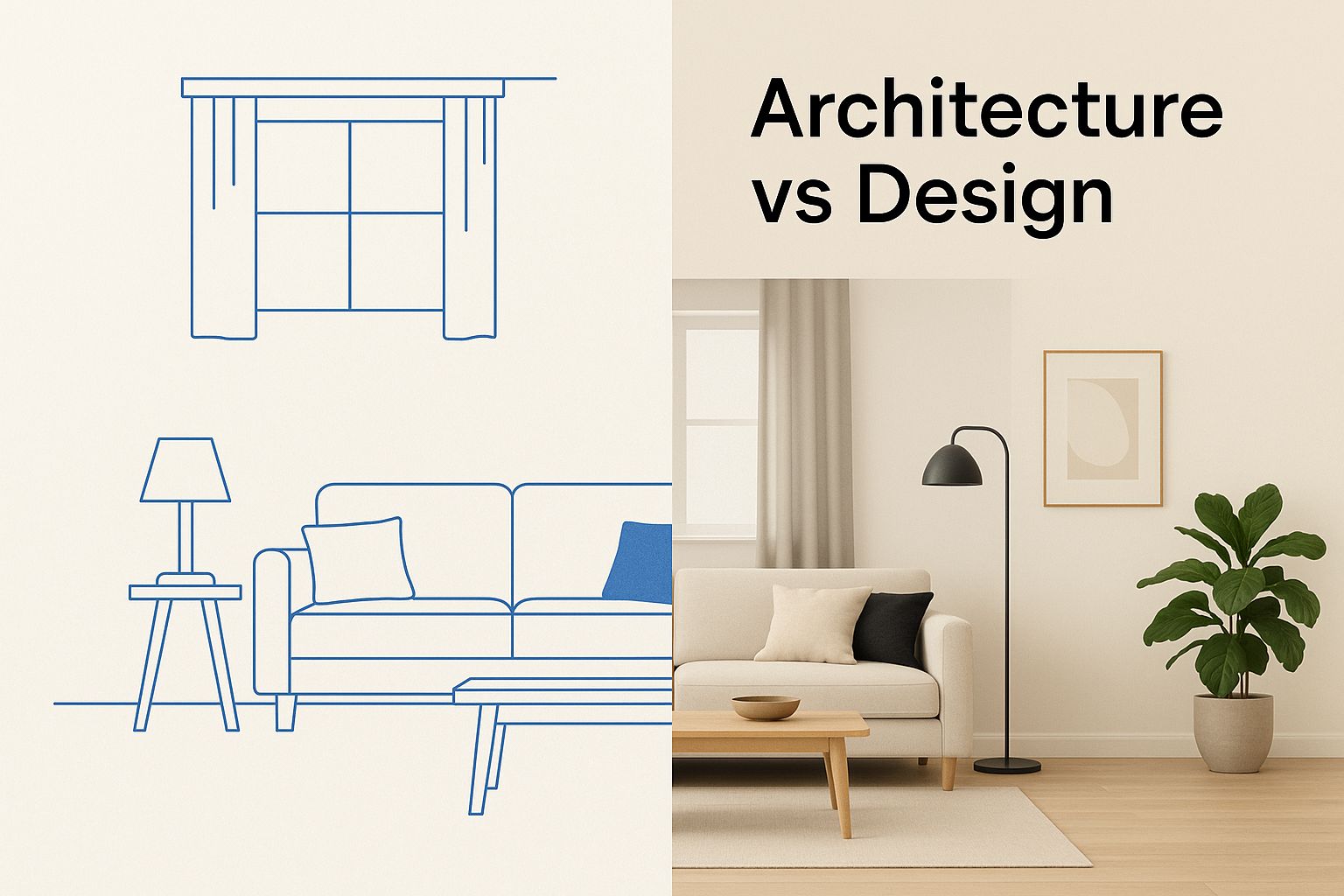
The image clearly separates the structural planning from the final aesthetic, which is the key differentiator between these two roles.
A UK Perspective on the Professions
Here in the UK, the lines between interior architecture and interior design are quite clearly drawn by the scope and focus of each field. Interior architecture centres on structural and spatial work, including the remodelling and adaptive reuse of existing buildings. The main goal is ensuring any changes support the building's physical fabric and architectural integrity.
Interior design, however, focuses on the atmosphere and aesthetics. It uses finishes, furniture, and lighting to improve how the environment feels for its occupants. This fundamental difference is why you'll see interior architects involved in the early stages of a project requiring structural work, whereas interior designers often come in later to refine the interior experience.
To put it simply:
Aspect | Interior Architecture | Interior Design |
|---|---|---|
Primary Focus | The structural 'bones' of a space. | The aesthetic 'skin' of a space. |
Core Skills | Technical drawing, building regulations, space planning. | Colour theory, material selection, furniture layout. |
Typical Tasks | Removing walls, altering layouts, planning systems. | Selecting furnishings, choosing paint colours, arranging decor. |
Project Stage | Early stages, during construction or major renovation. | Later stages, focusing on finishing and decoration. |
Comparing Professional Roles and Responsibilities
So, we’ve covered the textbook definitions, but what do these roles actually look like day-to-day on a real project? Understanding the practical differences between an interior architect and an interior designer comes down to seeing where they focus their skills, what they’re responsible for, and when they bring the most value.
Think of an interior architect as a strategic problem-solver for the building itself. Their work is grounded in the technical, structural, and legal realities of a space. You bring them in when the bones of the building—the layout, the flow, the core function—are the problem.
An interior designer, on the other hand, is a curator of the human experience within that space. They work with the established architectural shell to craft a specific atmosphere and bring a client's personality to life. Their focus is on the elements we see, touch, and interact with every day.

While the best projects involve collaboration, their core responsibilities are distinct and often follow a logical sequence.
The Architect's Technical Realm
The daily work of an interior architect is a blend of creative vision and serious technical expertise. They are responsible for ensuring that any proposed changes are safe, structurally sound, and fully compliant with UK building regulations. It’s a job that demands precision.
Their key responsibilities typically include:
Structural Modifications: This is their bread and butter. They design and manage the removal of load-bearing walls, create new openings for windows, or engineer complex features like a bespoke staircase.
Space Planning: This goes far beyond arranging sofas. An interior architect reconfigures entire floor plans to fix poor flow and unlock a property's potential. Think moving a kitchen to the other side of the house or completely redesigning a master suite.
Building Systems Integration: They must have a deep understanding of how essential services like HVAC, plumbing, and electrical systems are woven into the building's fabric, coordinating with specialist trades to ensure everything works together seamlessly.
"An interior architect shapes the container, ensuring it is structurally sound, logically organised, and legally compliant. Their canvas is the very fabric of the building itself."
Because their focus is on the building's core structure, they are almost always the first professionals on board for a major renovation, long before anyone starts thinking about paint colours.
The Designer's Aesthetic Focus
Once the architectural "container" is defined and built, the interior designer steps in to fill it with personality and character. Their role is far more artistic and human-centric, focusing on how a space feels and reflects the people who live in it. This is where a house truly becomes a home.
An interior designer's main duties revolve around:
Aesthetic and Conceptual Development: They are masters of mood. They develop a cohesive design concept—be it minimalist, traditional, or eclectic—and present it through mood boards and sketches to define the overall look and feel.
Material and Finish Selection: This is where their deep knowledge of materials comes into play. They select everything from flooring and tiles to fabrics and wall finishes, understanding how texture, colour, and light interact to create a specific atmosphere.
FF&E Curation: A huge part of their job is sourcing and specifying Furniture, Fixtures, and Equipment (FF&E). This covers every last detail, from sofas and dining tables to light fittings, rugs, and accessories, ensuring each piece works within the greater design scheme.
Their involvement usually ramps up after the heavy construction work is done, although they often collaborate with the architect early on to make sure the structural plans will support the final aesthetic vision.
A Side-by-Side Comparison
To really nail down the differences, it helps to see the roles laid out side-by-side. This table breaks down their core responsibilities and helps clarify who you need to hire for your specific project.
Key Differences: Interior Architecture vs. Interior Design
Aspect | Interior Architecture | Interior Design |
|---|---|---|
Primary Scope | Modifying the building's physical structure and layout. | Enhancing the aesthetic and atmosphere of a space. |
Key Skill Set | Technical drawing, structural knowledge, building codes. | Colour theory, material knowledge, furniture sourcing. |
Project Stage | Early stages (planning, construction). | Later stages (decoration, furnishing). |
Regulatory Focus | Planning permission, building regulations, listed building consent. | Fire safety for furnishings, product standards. |
Deliverables | Construction drawings, technical plans, permit applications. | Mood boards, furniture layouts, FF&E schedules. |
Typical Project | Loft conversion, basement extension, full property reconfiguration. | Cosmetic refurbishment, room styling, furnishing a new build. |
Ultimately, understanding these nuances is the key to assembling the right professional team and ensuring your project runs smoothly from the first sketch to the final cushion.
UK Educational Paths and Professional Qualifications
To really get to grips with the difference between interior architecture and interior design, you have to look at how each professional is trained. The educational routes in the UK are quite distinct, and this training is what shapes their core skills, their mindset, and ultimately, their role on a project.
An interior architect’s education is built on a technical, structural foundation. Their degree programmes are usually rooted in architectural principles, often sharing core modules with traditional architecture students. This means they spend a lot of time getting to grips with building construction, material science, and the physics of how a space works.
In contrast, interior design courses lean much more into the creative, artistic, and sensory aspects of a space. The curriculum is just as demanding, but it centres on things like colour theory, textiles, the history of furniture, and the psychology of how different environments affect our mood and behaviour.
Academic Foundations and Accreditations
The journey to becoming an interior architect in the UK typically starts with a degree like a BA (Hons) in Interior Architecture. These courses are heavy on the technical side of things – think computer-aided design (CAD), building regulations, and structural principles. It’s not uncommon for them to be validated by the Royal Institute of British Architects (RIBA), which is a clear signal of their strong architectural focus.
A future interior designer, on the other hand, would likely enrol in a BA (Hons) in Interior Design. This qualification is all about honing a different set of skills:
Conceptual Development: Mastering the art of creating mood boards and telling a visual story.
Material Specification: Learning how to source the perfect fabrics, finishes, and furnishings.
Aesthetic Curation: Developing a cohesive design scheme and knowing how to execute it perfectly.
Simply put, this educational split trains an interior architect to think about a building’s ‘bones’, while an interior designer becomes an expert in its ‘skin’.
The Role of Professional Bodies
Once they leave university, professional bodies are crucial for maintaining high standards. For interior designers, the British Institute of Interior Design (BIID) is the leading professional organisation in the UK. Becoming a member is no walk in the park; it involves a tough assessment of a designer’s portfolio, their hands-on experience, and their professional practices.
Hiring a BIID-registered designer gives you a powerful mark of quality and professionalism. It’s an assurance that the designer has met a high industry benchmark, follows a strict code of conduct, and is serious about their ongoing professional development.
This accreditation gives clients real peace of mind, confirming their chosen expert is not just creative but also competent and accountable. While interior architects don’t have one single equivalent body (many align with architectural organisations), a degree from a respected institution provides a similar guarantee of their technical expertise.
Diversity and Accessibility in Design Education
Interestingly, the different educational routes also tell a story about the changing face of the design industry. Research from the BIID has found that interior design education in the UK is becoming remarkably diverse. Their data shows that around 29% of interior design students come from ethnic minority backgrounds, which is higher than the 23% for the UK student population as a whole.
The field also seems to be a more accessible pathway into the creative sector. The same study noted that interior design courses attract a higher proportion of students from less privileged backgrounds compared to traditional architecture degrees. These aren't just dry statistics; they show a profession that is not only growing but also becoming more inclusive and representative of modern Britain. You can find out more in the BIID's diversity analysis of interior design students.
Ultimately, the different degrees and professional bodies aren't just formalities. They are the very foundation of the distinct services an interior architect and an interior designer offer, giving them the specific knowledge needed to transform spaces—whether by moving walls or by perfecting the final finish.
Project Deliverables: From Concept to Completion
When you get down to the brass tacks, the clearest way to see the difference between an interior architect and an interior designer is to look at what they actually produce. The documents they create aren't just paperwork; they're the tangible results of their expertise, showing you exactly where your investment is going.
From the first sketches to the final snagging list, each professional delivers a distinct set of plans that brings a project to life. Understanding these outputs helps you see how your vision gets translated from an idea into a finished, liveable space.
What to Expect From an Interior Architect
Hiring an interior architect means you're investing in the technical thinking that reshapes the very bones of your home. Their deliverables are precise, legally compliant documents that give builders and tradespeople the exact instructions they need to get the job done safely and accurately. These aren't just pretty pictures; they're construction-grade blueprints.
Key deliverables will almost always include:
Detailed Technical Drawings: These are the highly specific plans, elevations, and sections created with CAD software. They show every single structural change, from the exact dimensions needed for a new window opening to the specifications for a load-bearing steel beam.
Construction Documents: Think of this as the master file for your build. It’s a comprehensive package of drawings and specifications that forms the legal foundation of your building contract. It leaves no room for error, detailing materials, construction methods, and quality standards.
Planning Permission Applications: For any project that changes the external look of your property or involves a listed building, your interior architect will be the one preparing and submitting all the necessary drawings and documentation to the local council.
An interior architect's deliverables are the bedrock of a renovation. They provide the technical certainty needed to transform a building's structure, ensuring everything is built to code, on-spec, and legally approved before a single hammer is swung.
These documents are absolutely vital for getting accurate quotes from builders and making sure the project is executed precisely as planned. They’re the bridge between the architectural concept and the physical construction.
What to Expect From an Interior Designer
Once the structural work is mapped out, the interior designer’s work comes to the forefront. Their focus is all about the look, feel, and day-to-day function of the interior, and their outputs are designed to communicate this aesthetic vision clearly to you, the suppliers, and the decorators. This is where the personality of your home is truly forged.
Here’s what you can typically expect an interior designer to produce:
Mood Boards and Concept Visualisations: These are thoughtfully curated collections of images, material samples, and colour palettes that set the overall aesthetic direction. They’re a crucial tool for making sure you and your designer are completely aligned on the atmosphere you want to create.
Furniture Layout Plans: More than just a rough sketch, these are detailed floor plans showing the exact placement of every piece of furniture. They ensure the space flows properly and functions for your lifestyle, preventing costly mistakes like ordering a sofa that’s too big for the living room.
FF&E Schedules: This is short for Furniture, Fixtures, and Equipment. It’s an exhaustive spreadsheet that lists every single item to be bought—from sofas and light fittings to taps and tiles—complete with supplier details, prices, and dimensions.
Detailed Lighting Plans: Good lighting can make or break a space. A designer will provide specific plans showing the location and type of every light source, from ambient ceiling lights and task lighting in the kitchen to decorative lamps that create the perfect mood.
Choosing the Right Professional for Your Project
Making the right choice between an interior architect and an interior designer is one of the most important decisions you'll make for your home. It doesn’t just shape the final result; it has a huge impact on your budget and timeline from day one.
The real question to ask yourself is this: are you fundamentally changing the structure of your home, or are you transforming how it looks and feels? Answering that honestly will point you in the right direction. To make it even clearer, let's walk through a few common UK home improvement projects and see who you should have on speed dial.

Scenario One: A Loft Conversion
A loft conversion is a classic British home improvement, and it sits firmly in the interior architect’s camp. The goal here isn't just cosmetic; you’re turning a dusty, unused attic into a functional, liveable part of your home – a new bedroom, a home office, or an extra bathroom.
This kind of project involves serious structural work. Think adding floor joists to support the new room, installing a proper staircase for safe access, and often altering the roofline to fit dormer windows. These are fundamental changes to the building's very fabric, demanding a solid grasp of structural engineering, building regulations, and the planning permission process.
Primary Need: Structural changes to create a new, habitable space.
Key Tasks: Designing a layout that is both safe and compliant, managing structural calculations, and submitting technical drawings to the local council.
Verdict: An interior architect is essential. Their technical expertise is non-negotiable for a project of this scale and complexity.
Scenario Two: A Full Cosmetic Refurbishment
Now, let’s picture a completely different project. Imagine a three-bedroom house where the layout is perfect, the walls are all staying put, and there are no extensions planned. The aim is simply to give the entire property a fresh, cohesive, and luxurious new identity.
In this case, the focus is entirely on aesthetics and atmosphere. The work involves choosing new flooring, selecting the perfect paint colours and wallpapers, designing sophisticated lighting schemes, and sourcing all the furniture, textiles, and finishing touches.
The success of a cosmetic refurbishment hinges on creating a unified and beautifully executed vision. This requires an expert eye for colour, texture, scale, and material—the core skills of an interior designer.
An interior designer will guide the entire aesthetic journey. They'll start by creating mood boards to capture the feeling you're after, then procure every last item and oversee the final installation to make sure it all comes together perfectly. For more on getting that high-end finish, our guide to luxury home interior design done right is packed with useful insights.
Scenario Three: A Large-Scale Renovation with an Extension
So, what happens when your project involves both major structural work and a complete aesthetic overhaul? Let's say you're renovating a period property, which includes building a new kitchen extension, knocking through walls for an open-plan living area, and then redecorating the entire home from top to bottom.
This is where you see the magic of collaboration. A project like this is best served by bringing both an interior architect and an interior designer on board, as it has two distinct but deeply connected phases.
Phase One (The Architect's Lead): The interior architect takes charge of the initial, structural stage. They are responsible for designing the extension, managing the engineering for the open-plan space, and securing all the necessary planning permissions and building regulation approvals. Their job is to create the perfect architectural "canvas."
Phase Two (The Designer's Vision): Working alongside the architect right from the start, the interior designer ensures the new layout will support the desired look and feel. Once the structural work is underway, they take the lead on specifying every finish, designing the bespoke kitchen and bathrooms, creating the lighting plan, and curating the furniture that brings the new space to life.
By breaking it down like this, you can get a much clearer picture of what your project truly needs and choose the professional whose skills are perfectly aligned to make it a success.
To make it even easier, here's a quick-reference table to help you decide.
Project Scenario: Which Professional Do You Need?
This table matches common home improvement projects in the UK to the professional best suited for the job, helping you make a confident decision from the outset.
Project Type | Primary Need | Recommended Professional |
|---|---|---|
New Home Extension | Creating new space, structural design, planning permission | Interior Architect |
Full Room Redecoration | Aesthetics, furniture sourcing, colour schemes, styling | Interior Designer |
Kitchen & Bathroom Remodel | Layout changes, plumbing, electrics, finishes, fixtures | Interior Architect (if walls move) / Interior Designer (if layout is fixed) |
Knocking Down an Internal Wall | Structural assessment, load-bearing calculations, compliance | Interior Architect (often with a Structural Engineer) |
Furnishing a New Build | Space planning, furniture selection, lighting, window treatments | Interior Designer |
Period Property Restoration | Both structural integrity and authentic aesthetic finishes | Collaboration (Architect leads structure, Designer leads finishes) |
Ultimately, whether you're making small cosmetic tweaks or undertaking a major structural overhaul, having the right expert on your team is the key to a successful, stress-free project.
Typical Costs and the UK Market Landscape
Getting to grips with your budget is a vital early step, and understanding how professionals charge is a huge part of the interior architecture vs interior design decision. Costs can swing quite dramatically depending on the professional’s experience, the complexity of your project, and where you are in the UK.
Interior architects, because of the technical demands and legal responsibilities tied to their work, typically charge a percentage of the total construction cost. This usually falls somewhere between 8% and 15%. For smaller projects or those with a very clear scope, they might agree on a fixed fee instead.
Interior designers, on the other hand, have more varied fee structures. You'll likely come across:
Hourly Rates: Often ranging from £50 to £200+ per hour, depending on their reputation and location.
Fixed Fees: A set price for a defined scope of work, like designing a single room.
Percentage of Budget: A commission calculated from the total cost of the furniture and materials they source for you.
It's a common myth that hiring a designer is just another expense. A good professional can actually save you money through their trade discounts and by steering you away from costly mistakes, making sure every pound in your budget is put to good use.
Understanding the UK Market
The UK’s design and architecture scene is both dynamic and growing. The interior design profession alone is made up of somewhere between 6,000 and 7,000 businesses. But unlike architects, who must be on a government-regulated register, interior designers are not, which can make getting precise workforce numbers a bit tricky. Residential projects are the biggest driver of revenue, especially in hubs like London. You can learn more about the UK's interior design industry landscape for a deeper look.
Ultimately, whether you lean towards an architect or a designer, getting multiple quotes is non-negotiable. Having an open chat about fee structures from the outset is the best way to find a professional who fits both your project goals and your budget. For a really detailed look at architectural fees in particular, you might find our complete guide to the cost of an architect in the UK helpful.
Frequently Asked Questions
It’s completely normal to have a few questions when figuring out the difference between interior architecture and interior design. Let's clear up some of the most common ones to help you make a confident choice for your project.
Can an Interior Architect Also Provide Interior Design Services?
Yes, absolutely. Many interior architects have a strong eye for design and are more than capable of handling a project from the structural work right through to the final decorative touches. Their architectural training gives them a solid grasp of aesthetics, proportion, and how a space should feel.
That said, their core expertise is always going to be technical and structural. If your project hinges on highly specialised styling, intricate soft furnishings, or curating art and accessories, bringing in a dedicated interior designer often delivers the most polished outcome. It simply allows each professional to play to their strengths.
The best results on complex projects often come from collaboration. Think of it this way: the interior architect builds the perfect ‘bones’ of the space, and the interior designer brings it to life with an exquisite ‘skin’.
Do I Need Planning Permission for an Interior Designer's Work?
For purely decorative work, you generally won't need planning permission. Things like painting walls, laying new flooring, or arranging freestanding furniture are considered cosmetic changes in the UK and don't require council approval.
The big exception is if your property is a listed building. In that case, even seemingly minor internal changes might require Listed Building Consent. An interior architect is the right professional to handle the complex world of planning permission and building regulations, making them essential for any project involving structural changes or protected properties.
What Is the Main Cost Difference Between the Two Professions?
The biggest difference in cost usually comes down to the level of technical complexity and legal responsibility involved in the work.
Interior Architects: Their fees are typically higher because they carry the responsibility for structural integrity, building regulations compliance, and producing detailed construction drawings. You'll often see their fees calculated as a percentage of the total build cost, usually between 8% and 15%.
Interior Designers: Their fee structures can be more flexible. They might charge by the hour (anywhere from £50 to £200+), set a fixed fee per room, or take a percentage of the budget for the furnishings and finishes they source.
Ultimately, the scope of your project is the single biggest factor that will determine the final cost, regardless of who you hire. A simple room refresh with a designer is always going to be far less of an investment than a full structural reconfiguration managed by an architect.
At Harper Latter Architects, we specialise in creating exceptional living spaces through expert interior architecture, seamlessly blending structural innovation with timeless design. If your project involves reshaping your home's layout, from bespoke staircases to entire refurbishments, our team has the technical and creative expertise to bring your vision to life.
Explore our interior architecture services to see how we can transform your South West London home.

Comments