
Home Extensions Cost Calculator: Your London & Surrey Budget Guide

Trying to pin down the true cost of a home extension can feel like chasing a moving target. While a home extensions cost calculator might seem like a good place to start, the final figure is never just one number. It’s a complex blend of size, the quality of finish you’re after, and the structural work involved—especially for high-end projects in areas like Wimbledon and South West London. The most reliable budget comes from a detailed breakdown, not a generic online estimate.
Calculating Your Home Extension Cost
Think of it like commissioning a bespoke suit. The final price isn’t just a single tag; it depends on the fabric you choose (the finishes), the complexity of the cut (the architectural design), and the tailor's expertise (your professional team). A home extension budget works in exactly the same way. An online calculator gives you a ballpark figure, but it can’t possibly grasp the nuances that make a living space truly exceptional.
This guide is designed to be your practical financial roadmap. We’ll move beyond simplistic calculators to give you real clarity, dissecting the variables that shape your total investment. The goal is to help you approach your project with confidence, fully aware of what’s driving the costs.
Understanding the Financial Framework
Before we get into specific numbers, it’s vital to understand the core components of any extension budget. These elements form the foundation of every cost calculation, whether you’re planning a modest kitchen bump-out or a multi-storey luxury addition. Getting your head around this now prevents nasty surprises down the line.
The main financial pillars of your project are:
Construction Costs: This is the big one, covering all the labour, materials, structural work, and the physical build itself.
Professional Fees: This accounts for the expertise of your architect, structural engineer, and any other consultants needed to deliver a successful and compliant project.
Statutory Fees: These are the necessary costs paid to your local authority for things like planning applications and building regulations approval.
Contingency Fund: This is your safety net. We always recommend setting aside 10-15% of the build cost to cover any unforeseen issues that crop up during construction.
A well-planned budget isn’t about finding the cheapest price; it's about achieving the best value. It’s a delicate balance between your vision and financial reality, ensuring every pound spent adds tangible quality and enjoyment to your finished home.
By breaking the budget down into these key areas, that intimidating grand total becomes much more manageable. It stops being a single, daunting number and turns into a series of logical, controllable expenses. This structured approach is the first step towards building not just a beautiful extension, but a financially sound investment. Now, let's explore each of these elements in more detail to give you the tools for creating a robust financial plan for your London or Surrey home.
The Building Blocks of Your Extension Budget
If you want to budget for a home extension with any real accuracy, you have to look beyond the generic online calculators. They’re a starting point, but not much more.
To get a real grip on the numbers, you need to think like a quantity surveyor would, breaking the project down into its core parts. This way, you gain control over the budget right from the first sketch. Every single choice, from the size of the footprint to the type of light fitting, has a direct financial consequence.
An online home extensions cost calculator is a blunt instrument. It can't appreciate the unique character of your property, the specific ground conditions, or your personal taste in materials. True financial clarity comes from examining the individual building blocks of your budget.
Size and Scope: The Foundation of Your Estimate
Unsurprisingly, the biggest factor driving the cost of your extension is its size, usually measured in square metres (m²). A larger footprint naturally requires more materials, more labour, and a longer build time, all of which push the price up. A simple cost-per-square-metre calculation gives you a basic financial baseline before anything else is factored in.
But it’s not just about size. The type of extension is just as important. A straightforward single-storey rear extension will have a completely different cost profile to a more complex wrap-around or a double-storey addition. The latter involves much more intricate structural work, potentially affecting the existing first-floor layout and roof structure, which adds layers of complexity and cost.
The relationship between size and cost is foundational. Every square metre you add is a multiplier for materials, labour, and professional fees. But complexity acts as an accelerator, meaning a small, complicated extension can often cost more than a larger, simpler one.
This diagram gives a great visual overview of the main ingredients that go into the total cost of your home extension.
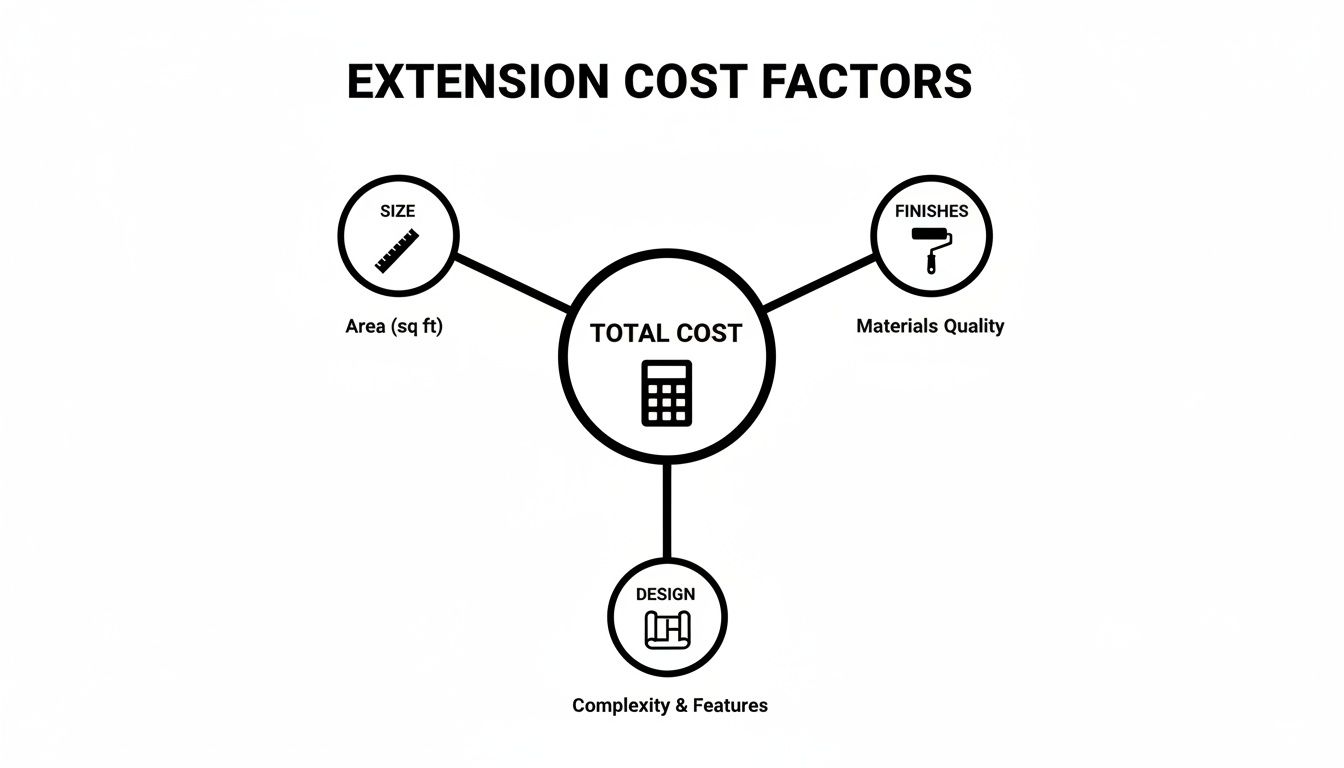
As you can see, your total investment is a blend of the physical size, the quality of the materials you choose, and how intricate the architectural design is.
Quality of Finishes: From Standard to Supreme
The specification level of your finishes is where a budget can really stretch or shrink. This covers everything you see, touch, and interact with every day—from flooring and kitchen worktops to lighting and door handles. The difference between a standard, mid-range, and high-end finish can easily alter the final cost by tens of thousands of pounds.
Think about it in three tiers:
Standard Finish: This is about functional, off-the-shelf components. Think laminate worktops, simple ceramic tiles, and standard uPVC windows. It does the job and is cost-effective, but it won’t have that bespoke character.
Mid-Range Finish: Here you’re stepping up to better quality materials. This could be solid wood flooring, composite worktops, or popular aluminium-framed bi-fold doors. It’s a great balance of quality, durability, and aesthetic appeal.
High-End/Luxury Finish: This is where you find bespoke joinery, marble or polished concrete surfaces, designer lighting, and specialist glazing. These premium materials and custom craft deliver a superior finish, but they come at a significant cost. For projects in areas like Wimbledon or Richmond, this level of quality is often what’s needed to match the existing property's value.
To put some figures against these levels, the table below gives a rough guide to construction costs per square metre. Remember, these are just for the build itself and don't include professional fees or VAT.
Estimated Building Cost Per Square Metre by Finish Quality
Finish Quality Level | Description of Finishes | Typical Cost per m² (excl. VAT & Fees) |
|---|---|---|
Basic Quality | Standard materials, off-the-shelf kitchen and bathroom fittings, basic lighting, uPVC windows. | £1,800 - £2,200 |
Mid-Range Quality | Good quality materials, engineered wood flooring, aluminium bi-folds, mid-range kitchen with stone worktops. | £2,200 - £2,800 |
High-End Quality | Premium and bespoke materials, custom joinery, high-end glazing systems, designer fittings, smart home tech. | £2,800 - £4,000+ |
These figures are a good starting point, but they highlight just how much your choice of "stuff" impacts the bottom line. A high-spec kitchen alone can cost more than the entire structure of a small, basic extension.
Less Obvious (But Critical) Cost Factors
Beyond the obvious things like size and finish, there are several other critical factors that will have a big say in your budget. These are the variables that online calculators almost always miss, which is why their estimates can be so misleading.
Site Conditions and Access The nature of your property plays a huge role. Is your house on a slope? You might be looking at expensive excavation and retaining walls. Poor ground conditions could mean deeper, more costly foundations are needed. Access is another classic one. A terraced house in a dense London borough with no rear access will rack up higher labour and delivery costs than a detached home in Surrey with a big driveway for the builders to use.
Structural Requirements Everyone wants that beautiful open-plan living space, but creating it often requires serious structural work. This usually involves installing large steel beams (RSJs) to support the upper floors or roof once you’ve knocked down internal walls. How much steel you need and how complex it is to install is a major cost, and it's something your structural engineer will figure out.
Professional Fees A successful, well-managed project relies on a team of experts, and their fees need to be in your budget from day one. This typically includes:
Architects: For the design, planning applications, technical drawings, and project management.
Structural Engineers: To calculate all the structural loads and design the necessary supports.
Party Wall Surveyors: Essential if your extension is built on or near a boundary with a neighbour.
Approved Inspectors: To ensure everything complies with Building Regulations.
Understanding these building blocks is the first step toward creating a realistic budget. It’s how you turn a vague guess into a confident financial plan for your home extension.
How London and Surrey Drive Up Extension Costs
Location is one of the biggest factors influencing your budget, and it's something a standard online home extensions cost calculator just can't get right. Building in South West London and Surrey means dealing with the 'London Premium'—a reality shaped by a unique cocktail of economic pressures that makes construction here noticeably more expensive than the UK average.
Understanding this from day one is vital if you're planning a high-end extension or refurbishment in postcodes like Wimbledon, Richmond, or Cobham. It isn't just a case of adding a little extra on top; you're entering a completely different financial ballpark where everything, from skilled labour to site logistics, comes at a higher price.
This regional premium is a well-documented fact. For instance, a standard 20m² single-storey rear extension in London can average £75,531, which works out at roughly £3,777 per square metre. That’s a significant 9% higher than the national average of £69,798. This gap reflects London's inflated costs for labour and materials, driven by fierce demand in affluent areas where specialist architects are tasked with designing bespoke extensions that blend luxury with heritage sensitivity. You can learn more about these national cost comparisons and see just how different the London market is.
Why Does Building in This Region Cost More?
So, what exactly is behind this price gap? It’s a mix of several overlapping challenges that contractors and architects in the capital have to juggle on every single project. These factors all feed into the higher figures you'll see in any realistic budget.
The key drivers include:
Demand for Skilled Labour: South West London and Surrey are hotspots for high-end construction. This creates intense competition for the best tradespeople, from specialist bricklayers to master joiners. With demand constantly outstripping supply, the rates for top-tier labour are pushed up significantly.
Complex Site Logistics: Trying to run a building site in a dense urban or suburban environment is a logistical headache. Restricted access, no space for parking vans or deliveries, and tighter working hours all add time and, therefore, cost to a project. A detached home in a rural setting just doesn't have these daily hurdles.
Premium Material Sourcing: High-value properties demand high-quality materials. Sourcing premium stone, specialist glazing, or reclaimed bricks to match a period property often means turning to specialist suppliers and navigating more complex supply chains, which naturally adds to the cost.
Higher Professional Fees: The cost of living and running a business in London is higher for everyone, including professionals. Fees for architects, structural engineers, and surveyors are priced to reflect this. Their expertise in navigating tricky local planning departments and conservation area rules also commands a premium.
Think of it like dining out. A meal in a central London restaurant will always cost more than the exact same meal in a provincial town. The ingredients might be similar, but you’re also paying for the location, the higher staff wages, the rent, and the overall operational costs of being in a prime area. The same principle applies directly to construction.
Navigating the London Premium with Expert Guidance
While these costs are a reality of building in the area, they aren't unmanageable. The secret is to work with local experts who understand this specific market inside and out. An experienced architect based in Wimbledon or Richmond will have established relationships with trusted local builders and suppliers who know how to work efficiently within these constraints.
They can give you accurate, location-specific cost projections from the very beginning, making sure your budget is grounded in reality, not guesswork. Better still, their design expertise allows them to specify materials and construction methods that deliver that high-end finish without unnecessary expense, ensuring you achieve the best possible value for your investment. This local knowledge is your most powerful tool for managing regional cost pressures without ever compromising on the quality your home deserves.
Real Project Budgets in South West London
Abstract figures and cost-per-square-metre rates are useful, but they only tell part of the story. To really get a feel for how a budget comes together, let’s move from theory to practice with some tangible, real-world examples. Think of this section as a mini home extensions cost calculator in action, bringing the numbers to life with budgets for popular extension types in South West London and Surrey.
We’ll model the costs for three common scenarios, layering in all the core components we’ve talked about: the build cost, professional fees, VAT, and that all-important contingency fund. This process shows you exactly how a complete, realistic budget is put together, connecting those abstract figures to the dream of a bespoke kitchen-diner or a tranquil garden room.
Scenario 1: The Wimbledon Kitchen-Diner Extension
Our first example is a classic project for many families in the area: a 20m² single-storey rear extension designed to create a bright, open-plan kitchen and dining space. It’s a hugely popular way to transform a period terraced or semi-detached house in a postcode like SW19. We’ll budget for a mid-to-high-range finish to match the quality of the existing property.
A standard 20m² single-storey house extension in the UK might average £48,000, typically ranging from £40,000 to £56,000 before VAT. However, in high-demand postcodes like Wimbledon, those per-square-metre rates can easily climb to between £1,800-£3,000.
Let's break down the potential budget for our Wimbledon project, using a realistic local rate:
Construction Cost: At £2,800 per m², the build cost would be £56,000.
Professional Fees: At 12% of the build cost, this comes to £6,720.
Contingency Fund: A sensible 10% of the build cost is £5,600.
Subtotal (before VAT): This brings us to £68,320.
VAT on Build & Fees: At 20%, this adds £12,544.
Estimated Total Project Cost: £80,864
Scenario 2: The Richmond Wrap-Around Extension
Next up, let's look at something more ambitious: a 30m² wrap-around extension on a semi-detached property in Richmond. This design, which extends to both the rear and side of the house, is perfect for creating a large, multi-functional family room with a utility area and downstairs WC. Because of the extra structural complexity, the cost per square metre is naturally higher.
For a high-end project like this, we'll use a rate of £3,200 per m².
Construction Cost: At £3,200 per m², the build cost is £96,000.
Professional Fees: Budgeting 12% gives us £11,520.
Contingency Fund: A 10% buffer adds £9,600.
Subtotal (before VAT): The running total is £117,120.
VAT on Build & Fees: 20% VAT adds a further £21,504.
Estimated Total Project Cost: £138,624
These examples illustrate a critical point: the final cost is far more than just the build price. Professional fees, VAT, and a contingency fund can add over 40% to the initial construction estimate, a detail often overlooked by basic online calculators.
Scenario 3: The Surrey Garden Room Extension
Finally, let's model a larger, 50m² garden room extension for a detached property in Surrey. The goal here is to create a seamless link between inside and out, featuring extensive glazing, a high-end kitchen, and luxury finishes throughout. Given the scale and premium specification, we’ll be budgeting at the upper end of the cost spectrum.
Using a premium rate of £3,500 per m² reflects the bespoke joinery, specialist glazing, and high-performance materials involved in a project of this calibre.
Here’s how the budget might look:
Construction Cost: 50m² at £3,500 per m² equals £175,000.
Professional Fees: At 12%, these would be £21,000.
Contingency Fund: For a project of this scale, a prudent 15% is wise, adding £26,250.
Subtotal (before VAT): This comes to £222,250.
VAT on Build & Fees: 20% adds a significant £39,200.
Estimated Total Project Cost: £261,450
These simulations show how a properly structured budget provides clarity and control. By breaking down costs logically, you can make informed decisions about size, specification, and scope right from the start. For a more in-depth look, you might be interested in our guide on detailed house extension cost examples in South West London, which explores even more scenarios.
Planning for Costs Beyond the Build
A builder’s quote is a huge milestone, but it’s only one piece of the puzzle. It covers the bricks, mortar, and labour—the tangible construction—but a successful project budget needs to account for everything else that comes before, during, and after.
It’s these ‘hidden’ costs that basic online home extension cost calculators almost always miss. Yet, if left unplanned, they can seriously inflate your total spend. An experienced architect sees the whole picture from day one, building these costs into the financial plan to give you complete clarity and peace of mind. This foresight prevents nasty surprises down the line, ensuring your project stays on stable financial footing from the first sketch to the final handover.

Uncovering the Necessary Pre-Construction Costs
Long before the first spade hits the ground, there's a trail of essential administrative and technical steps to navigate. These aren’t optional extras; they're the legal and structural necessities that form the backbone of a compliant and well-executed extension.
Common pre-build costs include:
Planning Application Fees: Your local authority charges a set fee to assess your application. In England, this is currently £206 for a home extension.
Building Regulations Approval: This process ensures your extension meets crucial health and safety standards for its structure, fire safety, and energy efficiency. Fees vary based on project size but typically range from £500 to £2,500.
Structural Engineer Reports: An engineer is needed to design key structural elements like foundations and steel beams. Their fees can range from £500 to £2,000+, depending on how complex your project is.
Specialist Surveys: Depending on your site, you might need extra reports, such as a topographical survey, an arboricultural report (if trees are nearby), or a drainage survey.
Managing Neighbourly and Boundary Matters
When your extension gets close to a neighbouring property, you enter the world of party wall agreements. This is a legal requirement under the Party Wall etc. Act 1996, designed to protect everyone involved.
A Party Wall Agreement is needed if you’re building on or near the boundary line. If your neighbours give their consent, the process is simple. But if they dissent or don’t respond, you'll need to appoint surveyors, which brings in extra costs of around £1,000 to £2,000 per neighbour. Getting your head around these agreements is vital, and you can dive deeper in our complete budgeting guide to UK Party Wall Agreement costs.
A key part of your architect’s job is to spot these potential costs early. By flagging the need for a Party Wall Agreement or a specific survey during the initial design phase, they make sure these figures are part of your budget from the start, not a stressful add-on later.
The Non-Negotiable Contingency Fund
No matter how carefully a project is planned, the unexpected can—and often does—happen during construction. This is especially true when working with older properties in areas like Wimbledon or Richmond. You might uncover old drainage runs, find poor ground conditions that need deeper foundations, or discover structural issues in the existing house.
This is where a contingency fund becomes your project’s lifeline. It’s a pot of money, typically 10-15% of the construction cost, set aside purely for the unforeseen. Having this financial buffer means you can resolve issues properly without cutting corners on quality or derailing the project completely. It is the single most important tool for managing financial risk.
To help you get a complete view of your potential spending, we've put together a checklist of costs that sit outside the main build contract.
Your Complete Budget Checklist Beyond Construction
The table below outlines the professional fees and other expenses you'll need to factor into your total project budget.
Expense Category | Typical Cost Range (£) | Notes |
|---|---|---|
Architect & Design Fees | 8-15% of build cost | Covers concept design, planning drawings, technical details, and site oversight. |
Structural Engineer Fees | £500 - £2,000+ | Essential for calculating steel beams, foundations, and structural openings. |
Planning Application | £206 (in England) | Fixed fee paid to your local council for a standard householder application. |
Building Control Approval | £500 - £2,500 | Fees for checking compliance with Building Regulations, paid to the council or a private inspector. |
Party Wall Surveyors | £1,000 - £2,000 per neighbour | Only required if works affect a shared wall and your neighbour doesn't consent. |
Specialist Surveys | £400 - £1,500+ | May include topographical, arboricultural (tree), or drainage surveys. |
Site Insurance & Warranties | £500 - £2,000 | Protects against risks during construction and can provide a warranty on the finished work. |
VAT on Professional Fees | 20% | Remember to add VAT to all consultant and professional service fees. |
Contingency Fund | 10-15% of build cost | Your crucial safety net for any unexpected issues that arise during the build. |
Temporary Accommodation | Varies | If you need to move out during the build, factor in rental costs. |
New Kitchen/Bathroom | £5,000 - £50,000+ | Often budgeted separately from the main construction contract. |
Landscaping & Exterior Works | £2,000 - £20,000+ | Don't forget the costs for patios, fencing, and garden reinstatement after the build. |
Decorating & Furnishings | Varies | The final touches—paint, flooring, furniture, and window dressings. |
Thinking through each of these categories gives you a far more realistic and robust budget, setting your project up for success from the very beginning.
Why Your Architect Is the Best Budgeting Tool You Have
While an online home extensions cost calculator can give you a rough, ballpark figure to get started, it misses the most important ingredient for financial success: real-world expertise. The single most effective budgeting tool you can have isn't a piece of software—it’s the detailed knowledge and foresight of a RIBA-chartered architect.
Thinking of an architect as just a designer is a common and costly mistake. Their role goes far beyond just producing drawings; they are your primary financial advocate, tasked with making your investment work harder and protecting your budget from day one. This makes their fee less of a cost and more of an investment in financial control.
Financial Value That Goes Beyond the Drawings
An architect’s financial input starts right at the beginning, well before any construction begins. They provide accurate, location-specific cost projections based on real data from similar projects right here in South West London and Surrey. This instantly puts their estimates in a different league to the generic figures any online tool can spit out.
This detailed financial oversight continues right through the project. An experienced architect safeguards your budget in several key ways:
Intelligent Design: They don’t just design something that looks good; they design something that can be built efficiently. This means using materials and construction methods that minimise waste and avoid unnecessary expense, all while delivering on your vision.
Competitive Tendering: They manage the process of getting quotes from reputable builders, ensuring you receive fair, comparable, and totally transparent pricing. Without this, you're just comparing apples and oranges.
On-Site Supervision: They oversee the build to make sure the work is completed to the specified standard. This is crucial for preventing expensive mistakes or the need for rework later on.
An architect acts as your project's financial guardian. Their expertise in managing tenders and overseeing construction can save you far more than their fee, preventing budget blowouts and ensuring a high-quality finish.
An Investment in Certainty
Ultimately, bringing an architect on board is about managing risk. They anticipate planning permission hurdles, foresee potential structural headaches, and manage the complex network of contractors and suppliers. This is what keeps a project running smoothly and, crucially, predictably.
Their professional oversight ensures that every pound you spend directly contributes to the quality and long-term value of your finished home.
By seeing their involvement as a crucial investment, you shift your mindset from simply calculating costs to actively controlling them. This is the difference between a project that's just beautifully designed and one that's financially sound. To dig a little deeper, you can explore our detailed breakdown of what goes into extension architect costs and the real value they bring to the table.
Your Extension Questions, Answered
When you're starting to think about an extension, a lot of questions come up, especially around the budget. Here are some straightforward answers to the queries we hear most often from homeowners.
How Much Should I Budget for Architect Fees in the UK?
As a rule of thumb, architect fees tend to fall somewhere between 5% and 15% of the total construction cost. For a complex, high-end residential extension here in London, you’d likely be looking at the 10-15% range. This reflects a comprehensive service that goes far beyond just drawing up plans—it covers everything from initial design and planning applications to managing the tender process and keeping an eye on the build itself.
Is It Cheaper to Extend Up or Out?
It’s a great question. In pure cost-per-square-metre terms, going up with a loft conversion is often more cost-effective because you’re not starting from scratch with new foundations. However, a ground-floor extension typically offers more versatile living space that can completely change how you use your home. The right answer really depends on the structural quirks of your existing property and what you’re trying to achieve.
How Much Value Does an Extension Add to a House in London?
A thoughtfully designed kitchen extension can add a significant 15-20% to a property's value in a competitive market like London. If you're adding a new double bedroom, that could boost the value by around 10-12%. Of course, the actual return hinges on a few key factors: the quality of the finish, the ceiling price for your particular street, and whether the design feels like a natural part of the home.
What Is the Biggest Unforeseen Cost in a Home Extension?
If there’s one area that can throw up a nasty surprise, it’s what lies beneath the ground. Unexpected issues with foundations and underground services are the most common source of unforeseen costs. Things like finding unrecorded drainage routes, dealing with poor soil conditions, or discovering old pipework can all lead to significant, unbudgeted work. This is exactly why a contingency fund of at least 10-15% isn’t just advisable—it’s essential.
Ultimately, the most reliable home extensions cost calculator isn't a spreadsheet; it's professional expertise. At Harper Latter Architects, we focus on providing detailed, realistic costings right from the outset, ensuring your project is not only beautifully designed but also financially sound.
To see how we approach every project with this clarity, take a look at our detailed architectural process.

Comments