

Hire a Home Remodel Architect: London Guide
You're probably at the point where the house no longer fits the way you live, even though the address still does. Perhaps the kitchen feels disconnected from the garden, the lower ground floor is underused, or you've bought a period property in Wimbledon, Richmond or wider South West London and already sense that the usual renovation advice won't quite apply.
That instinct is usually right. A high-value remodel, especially in a conservation area or listed building, needs more than drawings and good taste. It needs a process that protects the design, the budget and the approvals path at the same time. A good home remodel architect does exactly that. They turn ambition into something buildable, consentable and worth living in for the long term.
Realising Your Vision When to Engage a Home Remodel Architect
A common South West London scenario starts with a simple ambition. Open up the back of the house, bring in more light, add better joinery, perhaps gain a utility room or a study. Once surveys begin, the project often proves more involved. The rear wall is loadbearing, the drains run where the extension wants to sit, the first floor structure is uneven, or the house falls within a conservation area where seemingly minor external changes need careful justification.
That is the point to bring in a home remodel architect. The right time is while you are still testing options, priorities and budget, before the house has been mentally redesigned around an idea that may be difficult to approve or expensive to build.
If the work is limited to finishes within an unchanged layout, a builder or interior designer may be enough. Once you alter structure, circulation, building fabric or planning status, the decisions start to affect one another. Design, approvals, cost and programme need to be considered together.

Projects that usually need architectural oversight
Architectural input is usually justified where the remodel includes:
Structural alteration such as removing loadbearing walls, lowering floors, inserting rooflights or forming wide rear openings.
Major reconfiguration where the brief depends on better flow, improved proportions and stronger links between rooms.
Planning or heritage sensitivity including conservation areas, listed buildings, Article 4 restrictions or close scrutiny from the local authority.
Basement or roof interventions where waterproofing, neighbour impact, rights of light, access and technical coordination can affect both risk and cost.
High-value bespoke requirements such as integrated joinery, climate control, specialist lighting, acoustics, wine storage, wellness spaces or strong garden connection.
In period houses across Wimbledon, Richmond, Putney and nearby areas, hidden conditions are routine. We regularly find irregular structural spans, altered chimney breasts, redundant drainage, patchwork extensions from different decades and walls that are nowhere near as straight as the original sales details suggest. Those realities shape the design from the beginning.
What an architect adds before design starts
A strategic architect begins by testing the brief's feasibility. That means measuring the house properly, checking the planning context, understanding the existing structure, identifying likely constraints and comparing the cost implications of different routes before the design language is settled.
This early work matters most on heritage and high-value homes. In those projects, the goal is not to add area alone. It is to improve how the house performs day to day, while protecting long-term value and avoiding expensive revisions later. A good architect will challenge assumptions early if the proposed basement is likely to trigger neighbour issues, if the glazed rear addition may struggle in a conservation setting, or if the budget suits a careful refurbishment better than a full strip-out.
The formal design process helps here. The guide to choosing an architect in the UK explains the professional framework, but in practical terms the value is straightforward. Someone is coordinating the brief, the surveys, the planning strategy, the consultant team and the technical information in the right order.
That order saves time and protects the budget.
In high-end remodels, the best results usually come from decisions made early. Ceiling heights, stair geometry, sightlines to the garden, natural light at the back of a deep plan, storage that does not eat into the rooms, and the relationship between architecture and interiors all need to be resolved before a contractor prices the job. Once the project is built around the wrong assumptions, changing course becomes slow and costly.
Selecting the Right Architectural Practice in South West London
Choosing an architect isn't about finding the prettiest portfolio. It's about finding a practice that suits your house, your borough and the way you want the project run.
A handsome new-build portfolio won't tell you much about someone's ability to remodel a Victorian villa in a conservation area. Equally, a practice that understands listed consent may not be the right fit if your priority is a contemporary family extension with strong interior detailing and garden integration.
What to look for first
Start with three filters.
What to check | Why it matters | What a good answer looks like |
|---|---|---|
ARB and RIBA status | You want regulated professional standards and a formal design process | Clear registration, clear scope, clear contract terms |
Relevant project type | A listed townhouse and a detached Surrey refurbishment require different judgement | Examples close to your scale, era and planning context |
Local authority familiarity | Merton, Richmond and Wandsworth don't all respond the same way | Specific experience with local planners, heritage officers and approval routes |
If you want a practical overview of the selection process, this guide on how to choose an architect in the UK is a useful place to start.
Questions worth asking in the first meeting
Don't ask only about style. Ask how they think.
A productive first consultation usually reveals more from process questions than aesthetic ones:
How do you handle briefing? You want a practice that asks how you live, not just what finishes you like.
What proportion of your work involves existing period homes? Experience with old buildings changes technical judgement.
Who prepares planning strategy? Some firms draw well but rely too heavily on others for planning direction.
How do you coordinate interiors and outdoor spaces? If these are split too late, the house can feel disjointed.
How often do you review cost during design? This tells you whether the team values design control or instead pushes risk downstream.
The right architect should make the project feel clearer after the meeting, not more mysterious.
Signs of a good fit
You're looking for competence, but also for alignment. A remodel can run for many months, sometimes longer, and poor communication takes a visible toll on decision-making.
Good signs include:
Direct answers rather than vague assurances.
Realistic caution about approvals, buildability and sequencing.
A portfolio with restraint, not just visual drama.
Evidence of technical depth, such as experience with Revit coordination, heritage work, basement detailing or bespoke interior architecture.
A transparent process showing when design decisions are made, by whom, and how they're documented.
One practical point matters more than many clients expect. Ask who in the studio will run your job. In some firms, the person you meet first stays closely involved. In others, the project moves quickly to a different team. Neither model is automatically wrong, but it should be clear from the outset.
Navigating the Design and Planning Approval Journey
A homeowner in Putney or Richmond often comes to us after sketching out the exciting parts. A larger kitchen, better connection to the garden, a basement for family space, a calmer top floor. The pressure point usually appears later, when the house turns out to be listed, the street sits in a conservation area, neighbours are close, and the planning route is more delicate than expected.
That is why design and approvals need to be handled as one joined-up process from the start, especially on high-value and heritage homes in South West London.
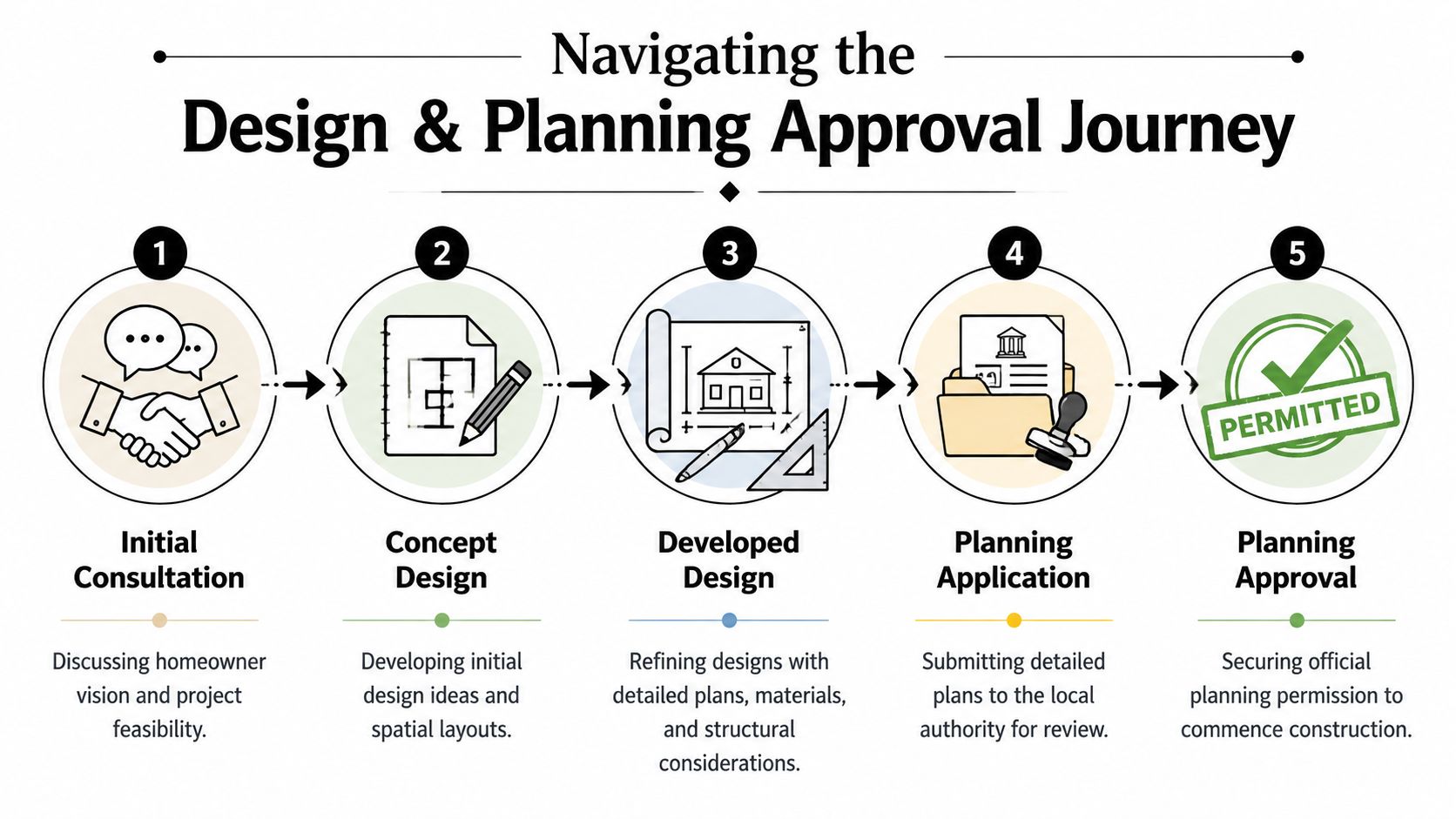
How the architect-led sequence works
A well-managed remodel usually follows the domestic version of the RIBA stages, but its primary value lies in how those stages are connected.
Strategic definition and briefing The brief is tested against the property, its planning history, and the constraints that will shape the design. On period and heritage projects, that often includes listed status, conservation area controls, and the practical implications of the Planning (Listed Buildings and Conservation Areas) Act 1990.
Survey and measured information Existing houses rarely forgive guesswork. Good base information often means a measured survey, sometimes with laser scanning where the geometry is complex or the tolerances matter. If the house has been altered over time, accurate as-built drawings can prevent expensive redesign later.
Concept design This stage sets the planning logic. The best schemes deal with circulation, daylight, views, privacy, and garden connection before anyone gets distracted by finishes. On a constrained London site, those early decisions often determine whether a proposal feels persuasive to a case officer.
Spatial coordination The design is then coordinated with structure, services, and buildability. In our studio, that usually means developing the project in 3D so junctions, level changes, stair geometry, and head heights are tested properly before they become site problems.
Technical design and submission package The drawings and reports are prepared for planning, listed building consent where required, Building Regulations, and tender. A clear package gives the planning officer confidence and gives the contractor fewer opportunities to price uncertainty.
For homeowners, the main point is simple. Approval strategy does not sit in a separate box from design. Each decision affects the next one.
The South West London complications clients often underestimate
South West London brings a particular mix of planning pressure, heritage sensitivity, and neighbour scrutiny. Basements near shared boundaries, roof alterations on period terraces, and rear extensions to houses in conservation areas all need careful judgement.
In practice, successful applications usually have three qualities. They respect the existing building. They explain the effect on neighbours clearly. They show that the proposal can be built without causing avoidable disruption or damage.
That matters with basements in particular. A basement may look straightforward on plan, but planners, neighbours, and technical consultees will want to understand excavation method, light and ventilation, impact on trees, waterproofing approach, and how spoil and deliveries will be handled on a tight residential street. A strong planning strategy must integrate neighbour and heritage impact alongside a compliant drawing set.
The same principle applies to listed and locally significant houses. Small external changes can trigger more scrutiny than clients expect, especially where rooflines, brickwork, window proportions, or boundary walls contribute to the character of the street. On these projects, restraint often gets better results than visual overstatement.
If you're trying to understand the drawing package itself, these notes on planning application drawings explain what local authorities typically expect.
What usually goes wrong
Planning setbacks are often caused by missing groundwork rather than over-ambition.
Common examples include:
Party Wall matters considered too late. By the time neighbours are formally notified, the design may already rely on assumptions that are difficult to defend or expensive to change.
Ecology constraints missed early. Roof works and rear additions can require surveys, seasonal checks, or mitigation measures that affect both programme and scope.
Basement technical assumptions made too casually. Waterproofing, groundwater conditions, structure, and temporary works need specialist input early, not after consent.
Heritage significance described too weakly. If the application does not explain what matters about the building and how the proposal responds to it, the planning case is weaker than it should be.
CIL and other local liabilities ignored. Clients sometimes assume a consent route will be administratively simple, then discover extra submissions, charges, or conditions that should have been allowed for from the outset.
One sentence in a report can save weeks later. Equally, one missing survey can slow the whole job.
A smooth planning route comes from drawings and reports that already account for structure, neighbours, heritage, and construction logic.
What good architects do differently
A good home remodel architect reduces risk by making careful decisions early. That can mean sounding out planning officers where appropriate, bringing in structural or heritage advice before the design hardens, and shaping proposals around the realities of the specific house rather than a generic idea of what a remodel should be.
On higher-value homes, that discipline protects more than the planning decision. It protects design quality, programme certainty, and the budget assumptions that sit behind them. It also makes the later stages of the process calmer, which is one of the reasons we structure projects around a clear step-by-step delivery method rather than treating planning as an isolated hurdle.
Establishing a Realistic Budget and Project Timeline
A South West London remodel usually becomes more expensive in a familiar way. The client approves a promising layout, then the first detailed prices arrive and expose everything that was assumed rather than defined. Bespoke joinery was allowed too lightly. Drainage diversions were not priced. Temporary works for a party wall excavation sit in no one's budget. On a period house or heritage asset, those gaps widen quickly.
Good budgeting starts earlier than many homeowners expect. It begins while the design is still being tested, not once planning is in hand. On higher-value homes, that early discipline protects more than the cost plan. It gives you a clearer brief, a more believable programme, and fewer unpleasant decisions once the house is open.
What sits inside a proper remodel budget
A realistic remodel budget has several moving parts, and construction cost is only one of them.
Building works for demolition, structure, envelope, services, finishes and external works.
Professional fees for the architect, structural engineer, party wall surveyor, planning consultant, heritage consultant, building control and other specialist input.
Statutory and legal costs such as application fees, Thames Water matters where relevant, licences, and party wall awards.
Interior scope including kitchens, bathrooms, fitted furniture, lighting, audio visual and specialist finishes.
Client-held contingencies for discoveries within the existing building and late-stage preferences.
The practical question is not whether unknowns exist. They do. The question is whether the budget acknowledges them in the right place.
Older houses in South West London often carry hidden work. Chimney breasts have been altered. Floor levels are inconsistent. Existing drains are poorly recorded. Previous extensions may not be built as drawn. In listed or locally significant buildings, repair obligations can also sit alongside improvement works. That is why I prefer to build budgets in layers, with clear allowances and named risks, rather than one reassuring headline number that proves fragile later.
Budget control comes from decision timing
The biggest cost overruns on remodels are often caused by timing rather than extravagance. A staircase redesigned after structural steel is coordinated is expensive. A kitchen revised after first-fix electrics are installed is expensive. A basement waterproofing approach changed after tender can affect both price and programme.
Clients protect value by making a few decisions at the right moment:
Agree the brief before technical design expands. Area changes, room swaps and late scope additions are far cheaper on paper than on site.
Set priorities clearly. If pressure appears, decide whether space, finish quality, sustainability measures or specialist features matter most.
Tender a coordinated package. Contractors price more accurately when architecture, structure and services are aligned.
For a fuller breakdown of likely cost headings, this guide on how much it costs to remodel a house in the UK gives a useful starting point.
Why timelines slip in London
Programmes tend to slip at the joins between stages. Surveys arrive late. Design decisions stay open too long. A contractor is asked to price information that is still evolving. Then everyone hopes those gaps can be solved during construction.
They usually cannot.
A realistic sequence for a well-run remodel often looks like this:
Phase | What happens |
|---|---|
Brief and surveys | Measured survey, condition information, consultant appointments, and budget parameters are assembled |
Concept and developed design | Layout, appearance, scope, heritage response and cost priorities are tested and refined |
Planning period | The application is assessed, consultees respond, and revisions are made if required |
Technical design and tender | Construction information is coordinated in enough detail for contractors to price properly |
Construction | The works proceed under a building contract with defined responsibilities, reporting and cost control |
The duration of each phase depends on the house, the scope, the consent route and the quality of information available at the start.
As noted in the planning section, mishandled basement issues can add an average delay of 8 to 12 weeks in the relevant cases. That earlier section should carry the linked source. Here, the practical point is simpler. If basement structure, waterproofing strategy, neighbour impact and construction logistics are not resolved early, the programme rarely recovers cleanly later.
What a realistic programme looks like in practice
High-end clients often ask for certainty very early. That is understandable, particularly when temporary accommodation, school terms, financing and contractor availability all matter. The honest answer is that certainty improves in stages.
At concept stage, the programme should be treated as a planning tool. By tender stage, it should be much firmer because the design is more settled and the contractor is pricing known information. Once a builder is appointed, the programme can become contractual. Each version should be more precise than the last.
That staged approach is not caution for its own sake. It is how good projects stay calm.
Budget and programme discipline come from clear choices, tested information, and a design team willing to identify risks before they become expensive.
Integrating Interiors, Landscaping and Sustainability
A South West London remodel usually feels most convincing in the places clients notice every day. The threshold from kitchen to garden. The way cabinetry sits within an existing room rather than fighting it. The relationship between a lower-ground family space and the courtyard outside. In period and high-value homes, those decisions shape whether the house feels resolved or merely extended.

Why integration matters in practice
Interiors, outdoor spaces and building performance need to be designed together from the outset. If they are separated, the compromises show up quickly. Floor levels become awkward, storage interrupts sightlines, lighting is added too late, and expensive glazing underperforms because shading, ventilation or privacy were never properly considered.
This matters even more in heritage settings. A listed house or a home within a conservation area often allows less freedom on external change, so the internal planning, material palette and garden design must work harder. In those cases, restraint usually produces the best result. Fewer moves, better judged.
Technical decisions also sit inside this joined-up approach. For example, upholstered furniture and fitted seating should be specified with appropriate fire performance in mind, and the UK Government gives the current requirements in its guidance on the Furniture and Furnishings (Fire) (Safety) Regulations 1988. Basement waterproofing should follow a clear strategy that suits the structure and ground conditions, with the NHBC guidance on waterproofing of basements and other below ground structures providing a useful reference point for Type A, B and C protection. Thermal bridges need careful detailing as well, particularly around existing masonry and new steelwork, and the BRE guide to thermal bridging and heat loss is a sound starting point for understanding how Psi-values affect performance.
Sustainability works best when it is embedded
Clients often assume sustainable design will announce itself visually. In well-handled remodels, it is usually quieter than that. The gains come from the fabric of the building, the way fresh air is introduced, how solar gain is managed, and whether old and new elements are detailed with enough care to avoid condensation and heat loss.
For high-value refurbishments in South West London, a fabric-first approach is normally the right starting point. It protects comfort, reduces running costs, and tends to be more compatible with Georgian, Victorian and Edwardian houses than chasing technology-led solutions too early. The London Energy Transformation Initiative sets out that case clearly in its guidance for retrofit and design teams on LETI.
What that can include
Insulation-led upgrades to walls, roofs and floors, chosen carefully to avoid trapping moisture in older construction.
MVHR where the extent of refurbishment, airtightness target and ceiling coordination make it worthwhile.
Passivhaus-informed detailing to improve comfort and reduce drafts, even where full certification is not realistic.
Solar-ready or heat-pump-ready planning so future upgrades do not require disruptive rework.
Low-carbon material choices where they suit the character of the house and the expected lifespan of the element.
In practice, there are trade-offs. Slim heritage-style glazing may preserve the look of a façade but offer less thermal improvement than a deeper contemporary frame. Natural insulation can help with breathability in an older property, but it needs careful specification and more build-up. Air source heat pumps work well on many remodels, though not every London plot has the external space or acoustic conditions to accommodate one neatly.
The indoor and outdoor connection
Garden design is part of the architecture. It changes how the house is used and how generous it feels.
A rear extension can feel materially larger when internal floor levels align with a terrace, drainage is resolved early, lighting is coordinated across inside and out, and planting gives privacy without sacrificing daylight. The same principle applies to courtyard remodels, roof terraces and garden rooms. In many London houses, these decisions improve daily life more than adding another enclosed room.
Good remodels organise the whole site, not just the interior envelope.
The Harper Latter Architects 8-Step Project Delivery
Clients often ask what a well-run process looks like once you move beyond broad principles. The clearest answer is an end-to-end framework that connects briefing, surveys, planning, technical detail, tendering and site oversight without gaps.

The benchmark data supports that kind of structure. An 8-step process mirroring the Harper Latter model achieves 87% client satisfaction and 78% adherence to budget, according to the LABC Warranty Report 2025 and BCA stats 2024 in the verified dataset. That same verified source notes that 22% of UK basement extensions fail initial Building Regulations due to radon or groundwater miscalculations, which is exactly the kind of issue a disciplined process is meant to catch early.
The eight steps that matter
1. Initial consultation
During this stage, the brief is stress-tested. The process goes beyond rooms and finishes to address how you want the house to function, what planning sensitivities may apply, and whether the aspiration suits the property.
2. Site and measured surveys
Good decisions need reliable information. Depending on the project, this may include topographical or LiDAR surveys with verified accuracy, plus drainage, structure and heritage recording where needed.
3. Planning strategy and pre-application thinking
For sensitive homes, this stage shapes the project's direction before a full application goes in. It's where local policy, neighbour implications and heritage impact are translated into a strategy instead of a hopeful guess.
4. Detailed design development
Ambition crystallizes into coordinated architecture. Layout, structure, materials, sustainability and bespoke elements are resolved together rather than in fragments.
The projects that feel calm on site are usually the ones that did the hard thinking on paper.
5. Tender and contract preparation
The contractor can only price what is properly described. A strong tender package narrows assumptions, clarifies scope and supports the use of suitable contracts such as JCT Minor Works, as referenced in the verified benchmark material.
6. Site monitoring
Once work starts, design still needs stewardship. Queries arise, existing conditions reveal themselves and details need checking. Weekly RFIs and regular architect review keep the build aligned with the intent.
7. Snagging and standards review
Completion isn't a single day. It is a process of checking, correcting and confirming quality against the specification and relevant standards.
8. Post-completion close-out
The final stage ensures the house is not only finished but properly handed over, documented and understood by the client.
Why this framework works for complex remodels
It reduces blind spots. Basement extensions, listed refurbishments and major spatial reconfigurations fail when too many decisions are deferred or scattered across consultants without a single design lead.
One practice that uses this type of structured route is Harper Latter Architects, a Wimbledon Village-based RIBA and ARB accredited residential studio working across South West London on refurbishments, heritage work, basements, interiors and exterior design. The reason that matters isn't branding. It's that a transparent process lets a client judge how their architect will manage risk, information and decision-making before the build begins.
A home remodel architect earns their place by making complexity legible. That is what clients are really buying. Not just drawings, but a route through planning, design, procurement and construction that holds together when the project becomes demanding.
If you're considering a remodel in South West London and want clear advice on feasibility, planning constraints, heritage issues or how an architect-led process would work for your home, Harper Latter Architects is a sensible place to start the conversation.