
UK Party Wall Agreements Costs: A Complete Budgeting Guide

If you’re planning a home extension or renovation, you’ve probably heard of the Party Wall Act. But what does it actually cost? As a rule of thumb, total party wall agreement costs typically land somewhere between £700 to £1,500 for a straightforward job with a single surveyor. However, that figure can easily double if you and your neighbour decide to appoint separate surveyors.
The most important thing to remember is that the person carrying out the work is responsible for covering all reasonable professional fees. Let’s break that down.
Understanding Your Party Wall Agreement Costs
Embarking on a big project like a loft conversion or basement extension involves more than just architects and builders. One of the first financial hurdles you'll likely face is the cost associated with the Party Wall etc. Act 1996. This bit of legislation is there to protect both you and your neighbours from potential damage and disputes when your building work affects a shared wall or boundary.
It helps to frame these costs not as an unwelcome surprise but as a crucial, manageable part of your project budget. The person undertaking the work, known as the 'building owner', is almost always responsible for paying all associated professional fees. This includes the cost of your own surveyor and, crucially, the reasonable fees for your neighbour's surveyor if they choose to appoint one.
The Role of Surveyors in Determining Cost
The single biggest factor driving party wall costs is surveyor involvement. Essentially, you'll find yourself in one of two main scenarios:
Agreed Surveyor: This is where you and your neighbour agree to use a single, impartial surveyor to act for both of you. It's the most cost-effective and cooperative route, and it helps to keep things simple.
Two Surveyors: If your neighbour would rather have their own representation, you will need to pay for both your surveyor and theirs. As you can imagine, this approach significantly increases the total cost.
This chart shows you just how much the costs can differ between appointing a single 'Agreed Surveyor' versus two separate ones.
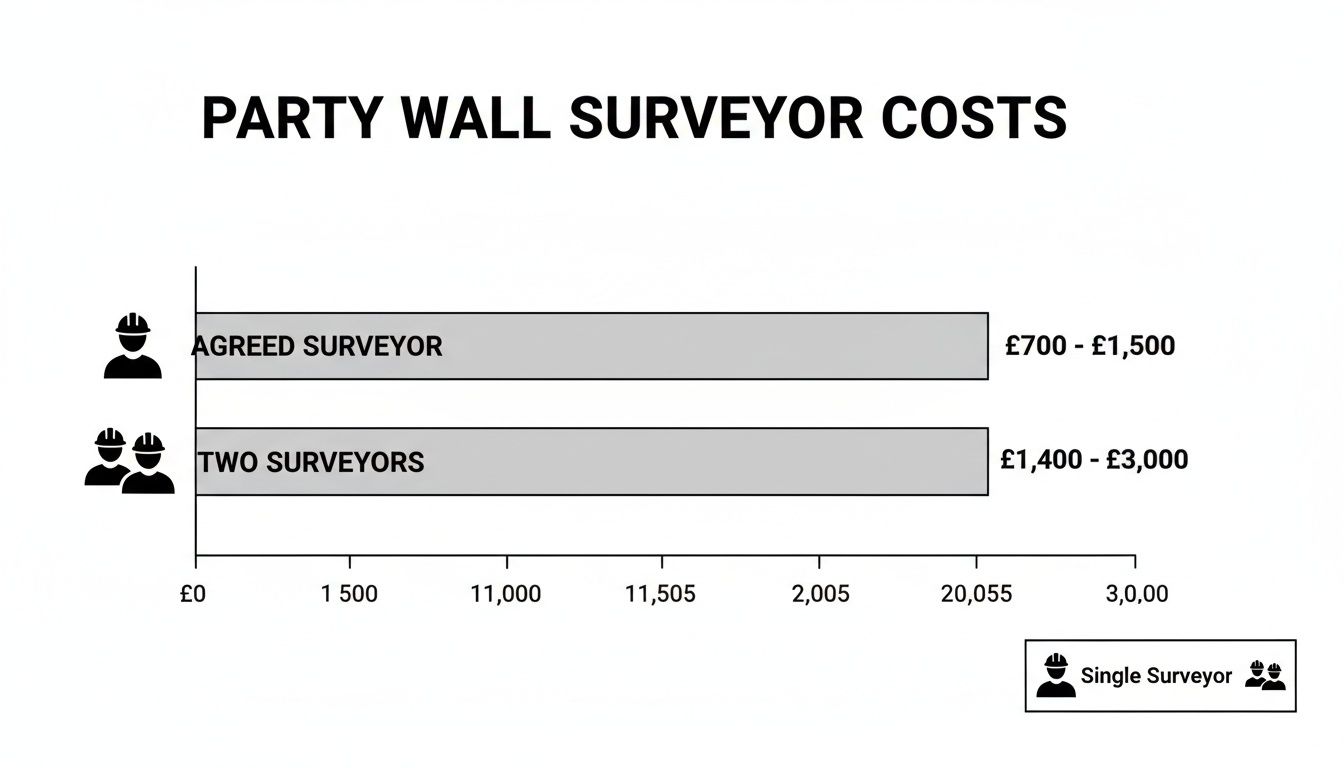
As the numbers show, opting for two surveyors can pretty much double your spend. This is why having a friendly chat with your neighbour early on can be a powerful cost-saving tool.
The Party Wall Act is designed to facilitate development while protecting everyone involved. Understanding that you, as the building owner, are responsible for the costs is the first step towards a successful and legally compliant project.
This guide will walk you through exactly what these costs cover, from serving the initial notices to finalising the agreement, which is officially known as a 'Party Wall Award'. By understanding the process, you can anticipate and manage your budget far more effectively. To get a better handle on the legislation itself, you can learn more about the Party Wall Act in our detailed guide. It will help you appreciate why these steps—and their costs—are so important for protecting your investment and keeping things amicable next door.
At a Glance: Estimated Party Wall Costs in the UK
To give you a clearer picture, here’s a quick breakdown of what you might expect to pay for common home renovation projects in the UK, particularly with a London or South West London context in mind.
Project Type | Agreed Surveyor Cost (Single) | Two Surveyors Cost (Separate) | Key Considerations |
|---|---|---|---|
Simple Loft Conversion | £800 – £1,200 | £1,500 – £2,500 | Involves one adjoining owner, straightforward steel beam insertions. |
Rear/Side Extension | £900 – £1,500 | £1,800 – £3,000 | Costs can rise if foundations are deep or close to the boundary. |
Basement Conversion | £1,500 – £2,500+ | £3,000 – £5,000+ | Higher risk, requires more detailed surveys and engineering input. |
Chimney Breast Removal | £700 – £1,100 | £1,400 – £2,200 | Generally a lower-risk project but still requires a formal Award. |
These figures are estimates and can vary based on the complexity of your project, the surveyors' hourly rates, and how smoothly the process goes. The key takeaway is that cooperation and clear communication with your neighbours from the outset can have a direct, positive impact on your final bill.
So, What Am I Actually Paying For?
When a surveyor’s invoice for a party wall agreement lands on your doormat, it’s easy to see it as just another big, abstract project cost. But you're not just paying for someone's time. You’re investing in a legally sound, structured process designed to protect your project, your property, and, crucially, your relationship with your neighbours. Understanding what goes into it makes the whole thing feel much more transparent.
I often compare it to commissioning a bespoke suit. You’re not just buying the fabric; you’re paying for the initial measurements, the pattern cutting, the detailed stitching, and the final fitting. Each step is essential for a perfect result. The same idea applies to party wall costs, which are generally broken down into three core professional services.
Serving the Party Wall Notices
The first official step is getting the Party Wall Notices prepared and served. This is the formal, written notification you’re legally required to send your neighbours, explaining the work you’re planning that falls under the Party Wall etc. Act 1996. While it might look like a simple letter, it has to be legally perfect and contain very specific details about your project.
Getting this notice right is critical. When a surveyor drafts it professionally, it ensures there are no mistakes, grey areas, or missing details that could invalidate it and cause expensive delays later on. It also sets a professional, cooperative tone from the get-go, showing your neighbour you’re taking your legal obligations seriously. A small investment here prevents much bigger headaches down the line.
The Schedule of Condition Survey
Once the notice is served, the next key element is the Schedule of Condition. In my opinion, this is one of the most valuable parts of the entire process. Before a single spade hits the ground, a surveyor carries out a detailed inspection of your neighbour’s property, focusing on any areas that could potentially be affected by your building work.
They'll document its existing state with detailed written notes, sketches, and a lot of photographs. This creates an impartial, factual record—a "before" snapshot of the property.
The Schedule of Condition acts as a protective shield for both of you. For you, the building owner, it stops false claims of damage in their tracks. For your neighbour, it provides clear, undeniable evidence if any genuine damage does happen because of your work.
Without this survey, any crack or scuff your neighbour spots during or after your project could be blamed on your builders, leaving you tangled in a difficult and costly dispute. This documented baseline is your best defence against "he said, she said" arguments.
Drafting the Party Wall Award
The final piece of the puzzle is the Party Wall Award. This is the comprehensive legal document that lays down the ground rules for your project. It's drafted and signed by the surveyor (or surveyors) and is legally binding for everyone involved.
The Award does more than just grant permission; it meticulously details the how, when, and what of the work affecting the party wall. It will almost always include:
The agreed scope of the notifiable works.
Working hours and specific arrangements for surveyor access.
Protective measures needed to prevent damage.
A copy of the Schedule of Condition as a reference.
Confirmation that you, the building owner, are responsible for making good on any damage.
This detailed structure of charges ensures every stage is handled professionally. As a guide, serving the initial notices can cost between £50 and £300 per neighbour. The vital Schedule of Condition typically ranges from £350 to £1,500. Finally, the Party Wall Award itself, which pulls everything together, averages around £1,000, though this can vary. You can find more insights on these surveyor costs at hardingsurveyors.co.uk. Think of the Award as your project's rulebook—it provides clarity and prevents misunderstandings before they can start.
Key Factors That Drive Surveyor Fees
When you start collecting quotes for party wall surveyors, you’ll probably notice the prices can vary quite a bit. One surveyor might quote significantly more than another, leaving you scratching your head. The truth is, these fees aren’t just plucked out of the air. They’re a direct reflection of the time, complexity, and risk involved in your particular project.
Getting a handle on what drives these professional fees is the key to forecasting your party wall agreements costs accurately. Think of it this way: a complex structural survey requires a far more detailed investigation than a basic one. In the same way, a major basement dig demands much more from a surveyor than simply removing a small chimney breast. By understanding the main cost drivers, you can set a realistic budget and make smarter decisions.
Project Complexity and Scale
Without a doubt, the biggest factor influencing your bill is the nature and scale of your building works. A surveyor’s time is their main commodity, and the more complicated your project is, the more of their time it’s going to take up.
For instance, a straightforward loft conversion might only involve slotting a few steel beams into the party wall. While this still needs a formal Party Wall Award, the surveyor’s job of assessing the plans and drawing up the document is relatively contained. That means fewer site visits and a simpler, quicker Award to draft.
Now, contrast that with a deep basement excavation right next door to your neighbour. This kind of work carries a much higher risk of causing structural movement or damage. The surveyor will have to spend a lot more time poring over architectural and engineering drawings, carrying out a more detailed Schedule of Condition, and probably making several trips to the site during the dig to check that all the protective measures are being followed to the letter. All this extra work and responsibility is directly reflected in higher fees.
The Number of Affected Neighbours
The Party Wall Act doesn't just apply to one single shared wall. If you live in a terraced or semi-detached house, your project could easily affect neighbours on both sides. And if you’re building in a dense part of London like Wimbledon or Richmond, your work might even impact the freeholder of your building or several adjoining leaseholders.
Every neighbour affected, known as an 'Adjoining Owner', has to be served their own separate Party Wall Notice. This means the whole process—serving the notices, waiting for a response, conducting a Schedule of Condition, and drafting the Award—gets duplicated for each person.
One Adjoining Owner: You'll need one set of notices and one Party Wall Award.
Two Adjoining Owners: You'll need two sets of notices and two separate Party Wall Awards.
This duplication of work naturally leads to a multiplication of costs. A project affecting two neighbours will often cost close to double what it would for one, simply because the surveyor's workload increases in line with this. If you're planning a complex project, it's vital to identify every Adjoining Owner early on to get a realistic cost estimate. You can often get a better feel for the initial property assessment stages by understanding what is a structural survey and why you need one, as many of the same principles of detailed inspection apply here.
One Surveyor or Two
Finally, the quickest way for your costs to climb is through the number of surveyors involved. The best-case scenario, both for your wallet and for keeping things friendly with your neighbour, is to appoint a single 'Agreed Surveyor'.
An Agreed Surveyor has a legal duty to act impartially for both you and your neighbour. This collaborative approach isn't just more efficient; it can slash your professional fees by as much as 50%.
However, your neighbour is perfectly within their rights to appoint their own surveyor to represent them. If they go down that road, you, as the person doing the building work, are responsible for paying the reasonable fees for both your surveyor and theirs. This instantly doubles the professional cost, as you're now paying for two separate experts to liaise, review all the documents, and agree on the terms of the Award. This factor alone can turn a manageable £1,200 fee into a £2,400+ expense, which makes having a friendly chat with your neighbour early on incredibly valuable.
How Disputes Can Double Your Budget
By far the biggest thing that sends party wall costs through the roof is disagreement. A friendly, collaborative approach can keep your budget in check, but a dispute with your neighbour is the fastest way to watch your professional fees spiral. Getting your head around this financial reality is crucial before you start planning any project that falls under the Party Wall Act.
The moment your neighbour dissents to the Party Wall Notice—or decides they want their own surveyor—the cost structure changes completely. Instead of paying for a single, impartial professional to act for both of you, you're now legally on the hook for the reasonable fees of two separate surveyors: yours and theirs. This one decision can pretty much double what you expected to pay before any real work has even started.
The Financial Impact of Two Surveyors
Having two surveyors isn't just a minor admin change; it's a major financial one. Why? Because both professionals have to spend time talking to each other, independently reviewing documents, and negotiating the details of the Party Wall Award. Every phone call, email, and meeting between them adds to the billable hours you're paying for.
For homeowners doing architectural work in South West London, the difference between having one 'agreed surveyor' versus two separate ones is huge—we're talking a cost increase of around 100 percent. Industry figures show that a single surveyor arrangement typically costs between £900 and £2,700, depending on the project. But with two surveyors, those figures jump to between £1,800 and £5,400. As you can discover from these homeowner insights, getting your neighbour to agree on one surveyor from the start is a smart move that can slash your costs by about 50 percent.
The Third Surveyor: The Ultimate Cost Escalator
So what happens if the two appointed surveyors just can't agree on the terms of the Award? This is where things can get even more expensive, with the appointment of a Third Surveyor. This impartial expert is brought in by the first two surveyors to resolve the deadlock and make a final, binding decision.
The Third Surveyor's job is basically to act as an adjudicator, making sure a fair outcome is reached so your project can finally move forward. The catch? This adds yet another layer of professional fees to your bill.
The involvement of a Third Surveyor is the direct result of an unresolved dispute. Their time is charged in addition to the fees for the initial two surveyors, meaning you are now paying three professionals to finalise one agreement.
This situation can quickly turn a manageable project cost into a serious financial headache. A disagreement that might have started over a minor detail can escalate into a complicated and expensive process. It just goes to show how valuable it is to keep things positive and cooperative with your neighbours from day one. By keeping the lines of communication open and aiming for a single, agreed surveyor, you can keep your project on track and your budget under control.
Putting a Price on Your Project: What to Expect for Common Renovations

To stop things from feeling too abstract, let's look at some real-world examples. The final figure for your party wall agreement costs is tied directly to the scale and complexity of the work you're planning. Seeing the numbers for common home improvements can give you a much clearer idea of what to budget for.
Here, we'll break down the likely costs for three popular projects. You'll see just how much of a financial difference there is between appointing a single Agreed Surveyor versus needing two separate ones. These estimates reflect typical rates, especially within the competitive London and South West London markets, giving you a solid baseline for your planning.
Loft Conversion Costs
A loft conversion is one of the most common jobs that falls under the Party Wall Act, usually because it involves slotting steel beams into the shared wall. Because the work is relatively straightforward and seen as lower risk, the surveyor fees tend to be at the more affordable end of the spectrum.
With an Agreed Surveyor: You can expect costs to land somewhere between £900 and £1,200. This is the quickest and most economical route, covering everything from serving notices and completing the Schedule of Condition to drafting the final Party Wall Award.
With Two Surveyors: If your neighbour decides to appoint their own surveyor, the cost climbs significantly, typically to between £1,800 and £2,400. Remember, you’re responsible for paying the fees for both professionals.
Side Return Extension Costs
A side return or rear extension is another firm favourite, but this time the work is a bit more involved, especially when it comes to excavating foundations near the boundary line. This raises the potential risk to your neighbour’s property, which means the surveyor needs to be more hands-on.
The depth of your foundations and how close they are to the party wall are the two big factors that will really shape the final cost.
The complexity of foundation work is a major cost driver. Deeper excavations require more rigorous assessment by the surveyor to ensure structural integrity is maintained, which is reflected in their professional fees.
With an Agreed Surveyor: It's wise to budget for around £1,100 to £1,600. On top of the standard procedures, the surveyor will need to carefully review the structural engineer's drawings for the foundations.
With Two Surveyors: With separate surveyors for each side, costs will likely be between £2,200 and £3,200. The extra time spent on communication and negotiation between the two surveyors is what pushes the fees up.
Basement Excavation Costs
Basement projects are, without a doubt, the most complex and high-risk type of residential work governed by the Party Wall Act. They involve deep excavations and major structural changes, demanding the highest level of scrutiny from surveyors to protect the neighbouring properties. As you’d expect, the party wall costs are considerably higher.
For big jobs like basement extensions, a popular choice in high-value London homes, the costs can escalate quickly. You could be looking at £1,800 to £2,700 for a single surveyor, or £3,600 to £5,400 when two separate surveyors are brought in. You can get more insights into these surveyor costs in the UK from rellimsurveyors.co.uk. On average, a party wall surveyor charges between £150 and £270 per hour, though rates in London almost always sit at the top end of that scale.
Planning Your Next Steps With An Architect
Having explored the various factors that influence party wall agreement costs, from project complexity to the number of surveyors, the path to a smooth and budget-friendly project becomes much clearer. The most effective strategy to keep these costs under control isn't a secret formula; it’s proactive planning and early, open communication with your neighbours.
This is where engaging an experienced architect from the very beginning becomes your greatest asset. A skilled architect does far more than just design your dream extension or renovation. They act as your strategic partner, guiding you through the procedural maze of the Party Wall Act with foresight and expertise.
Your Architect as a Strategic Partner
Think of your architect as the conductor of an orchestra. They ensure every part of the project—from creative design to legal compliance—works in harmony. A good architect with local experience, particularly in areas like Wimbledon or South West London, will have a network of trusted professionals.
They can recommend reputable and impartial party wall surveyors, helping you and your neighbour find a single ‘Agreed Surveyor’ to minimise costs and foster cooperation. This early professional guidance is invaluable. It helps you anticipate requirements, serve notices correctly, and integrate the entire party wall process seamlessly into your project timeline, preventing costly delays.
By involving an architect early, you are not just investing in design; you are investing in a well-managed process that safeguards your budget and minimises the risk of disputes. Their expertise transforms a potentially complicated legal hurdle into a manageable project milestone.
Taking Action for a Successful Project
The key takeaway is simple: the earlier you start planning, the more control you have over the final costs. Discussing your plans with an architect before they are finalised gives you the best chance to approach your neighbours with a clear, professional proposal. This organised approach builds trust and makes it far more likely they will consent to an Agreed Surveyor.
An architect helps you navigate the complexities of construction, from initial sketches to the final build. They ensure your project is a success not only from a design standpoint but also from a procedural one. If you are considering a major renovation, understanding the scope of professional fees is a critical first step. You can learn more about how much an architect might charge for your project in our detailed guide, which provides a transparent breakdown of what to expect.
Ultimately, proactive engagement with a professional is the best way to ensure your vision becomes a reality, on time and within budget.
A Few Final Questions on Party Wall Costs

To finish off, let's tackle some of the most common questions we hear from homeowners about the Party Wall Act and the costs involved. Getting your head around these practical points will help you navigate the process with a lot more confidence.
Think of this as a quick-fire round to reinforce what we've covered, making sure you can move forward with your project smoothly and, crucially, within budget.
Who Is Actually Responsible for Paying the Party Wall Agreement Costs?
This one is quite straightforward: the person carrying out the building work (known as the 'Building Owner') is responsible for covering all reasonable party wall agreement costs. This is a fundamental principle of the Party Wall etc. Act 1996.
This means you’ll be paying for your own surveyor’s fees and, if your neighbour chooses to appoint their own, their surveyor’s reasonable fees too. These costs are simply seen as a necessary part of getting the work done legally and safely.
Can I Save a Bit of Money by Serving the Party Wall Notice Myself?
Yes, you are legally allowed to serve a Party Wall Notice yourself. You can find templates online, and if your project is incredibly simple and you're on great terms with your neighbour, this can be a way to save on the initial professional fees.
However, be warned. Any mistakes or missing information in the notice can make it invalid, which often leads to major delays and, ironically, higher costs down the line. For this reason, getting a surveyor or architect to serve the notice is usually a smart investment to ensure everything is spot-on from the very beginning.
Serving a notice isn't just sending a letter; it's the first step in a formal legal process. A dodgy notice can create mistrust and make your neighbour far more likely to appoint their own surveyor, pushing your overall costs up.
What Happens if My Neighbour Just Ignores the Notice?
If your neighbour doesn't respond to the Party Wall Notice within the legal 14-day period, a 'dispute' is automatically triggered. This doesn't necessarily mean they're trying to be difficult – they might have simply forgotten or been away.
Your next step is to send a follow-up letter giving them a final 10 days to reply. If you still hear nothing, the Act requires you to appoint a surveyor to act on their behalf to make sure their interests are protected. And yes, you will be responsible for this surveyor's costs, as well as your own.
How Can I Keep My Party Wall Costs to an Absolute Minimum?
Keeping a lid on costs is a top priority for any project. Here are the most effective ways to do it:
Chat Early and Openly: Talk to your neighbours about your plans long before any formal notices land on their doormat. A friendly, transparent approach builds a huge amount of trust and goodwill.
Push for an Agreed Surveyor: This is the single biggest money-saver. Actively encourage your neighbour to agree to use one, impartial surveyor for both of you. It could easily halve your professional fees.
Lean on Your Architect: Your architect can produce professional, detailed drawings that give your neighbour confidence in the plans, making them more likely to give their consent without fuss.
Get the Notices Right: Avoid expensive delays by having a professional serve the notices. It ensures they are legally watertight from the get-go.
Following this advice will help you manage the process efficiently and keep your budget from spiralling.
Planning a renovation demands careful financial oversight, especially when navigating statutory duties like party wall agreements. At Harper Latter Architects, we guide clients through every single stage of their project, from the initial sketch to the final build, ensuring the whole process is smooth and legally sound. If you're thinking about a project in Wimbledon or South West London, contact us today to discuss how we can help bring your vision to life.

Comments