
Eco-friendly architect: How to Choose the Right Sustainable Designer

An eco-friendly architect is more than just a designer of buildings; they are a strategic partner dedicated to creating spaces that are healthier for both people and the planet. Their primary role is to combine aesthetic vision with environmental science to deliver homes that are beautiful, efficient, and built to last.
What an Eco-friendly Architect Actually Does
Think of an eco-friendly architect like a master chef who carefully selects the finest local, seasonal ingredients. Instead of just focusing on taste, the chef considers the origin of the food, its nutritional value, and its environmental footprint. The result is a meal that is not only delicious but fundamentally nourishing and responsible.
In the same way, an eco-friendly architect moves beyond standard building practices. They meticulously select sustainable materials, devise intelligent construction techniques, and integrate systems that work in harmony with the natural environment.
A Strategic Partner for a Better Home
Their mission extends far beyond simply drawing up plans. An architect specialising in sustainable design will focus on:
Reducing Energy Consumption: Employing passive design strategies to minimise the need for artificial heating and cooling, which significantly lowers your energy bills.
Improving Occupant Wellbeing: Using non-toxic materials and maximising natural light to create healthier indoor environments that enhance your quality of life.
Future-Proofing Your Property: Building homes that are resilient, durable, and prepared for future climate challenges and regulations.
This proactive approach is becoming increasingly crucial. In the UK, the green building market is experiencing explosive growth, propelled by government policies targeting net-zero carbon emissions by 2050. Initiatives like the Future Homes Standard, which demands a 75-80% reduction in carbon emissions for new homes from 2025, are reshaping the industry.
For practices like Harper Latter Architects, this isn't just about compliance; it's a core philosophy. We apply these principles to high-end residential projects across South West London, proving that luxury, heritage, and genuine sustainability can coexist beautifully.
Our team focuses on delivering bespoke solutions that integrate these forward-thinking principles from day one. You can learn more about how we approach sustainable architecture in our projects.
The Core Principles of Sustainable Home Design
Creating a truly sustainable home is about more than just bolting a few solar panels onto the roof. A thoughtful, eco-friendly approach is more like conducting an orchestra; an experienced architect ensures every design principle works in harmony to cut your home's environmental impact, reduce running costs, and ultimately, improve your quality of life. It’s a holistic way of thinking that starts long before the first shovel hits the ground.
The entire process is anchored by passive design, a clever philosophy that uses your home's very structure and position to work with nature, not against it. Imagine designing an extension in Wimbledon with large, south-facing windows. In winter, these would capture the low sun, flooding the room with natural warmth and cutting your reliance on central heating. Come summer, carefully calculated overhangs would block the high, intense sun, keeping the space comfortably cool without needing air conditioning. It’s simple, effective, and built right in.
Material Selection and Embodied Carbon
Beyond capturing natural energy, the very bones of your home—the materials used to build it—are just as critical. A forward-thinking architect will always prioritise materials with low embodied carbon. This term refers to the total greenhouse gas emissions produced during a material's entire lifecycle, from extraction and manufacturing to transport.
This often leads us to local and reclaimed sources. Sourcing reclaimed London stock brick for a refurbishment in Richmond, for instance, does more than just preserve the area's unique character; it completely avoids the huge carbon footprint that comes with firing brand-new bricks.
This mindset is guided by a 'fabric first' approach, a cornerstone of sustainable design. The idea is to perfect the building's envelope—think exceptional insulation, airtight construction, and high-performance windows—before even considering active heating or cooling systems. By locking in efficiency from the start, you dramatically reduce the energy your home will ever need to consume.
Integrating Advanced Systems for Efficiency
Once the building's fabric is performing at its peak, the next step is to integrate advanced systems that actively reduce the resources you use. These technologies are chosen to complement the passive design, not as a plaster to fix a leaky, inefficient one. To explore these concepts further, you can read our complete UK energy-efficient home design guide.
Key technologies that make a real difference include:
Renewable Energy Systems: Think solar photovoltaic (PV) panels generating your own electricity, or ground/air source heat pumps providing incredibly efficient heating and hot water by drawing warmth from the environment.
Advanced Glazing: Modern triple-glazed windows with low-emissivity coatings are a game-changer. They act like a thermal shield, stopping heat from escaping in winter and preventing it from baking your interiors in summer, leading to stable, comfortable temperatures year-round.
Water Conservation: Simple systems like rainwater harvesting can make a big impact. They collect and store rainwater for uses like flushing toilets or watering the garden, significantly cutting your reliance on treated mains water.
To help clarify how these principles fit together, here’s a quick summary of the core strategies and the tangible benefits they bring to your home.
Sustainable Design Strategies at a Glance
Strategy | Primary Goal | Benefit for Your Home |
|---|---|---|
Passive Design | To work with natural elements like sunlight and airflow. | Lower heating and cooling bills, and more comfortable living spaces. |
'Fabric First' Approach | To create a highly insulated and airtight building envelope. | Drastically reduced energy demand and a quieter, draught-free home. |
Low Embodied Carbon | To select materials with a minimal carbon footprint. | A home that is sustainable from construction through to completion. |
Renewable Energy | To generate your own clean energy on-site. | Energy independence, lower utility bills, and reduced CO2 emissions. |
Water Conservation | To reduce consumption of mains water. | Lower water bills and less strain on local resources. |
By weaving these principles together, an architect crafts a home that is far more than just a beautiful structure. It becomes a high-performance, healthy, and resilient environment—one that’s designed to be comfortable and cost-effective for generations to come.
Understanding Key UK Certifications and Credentials
Trying to navigate the world of sustainable architecture can sometimes feel like learning a new language, full of acronyms and technical standards. But when you’re looking for an eco-friendly architect, these credentials are your shorthand for quality and expertise. They’re much more than just badges; they are robust, independently-verified frameworks that signal a genuine commitment to green design principles.
The first and most important credential to look for in the UK is RIBA Chartered Architect status. This is awarded by the Royal Institute of British Architects and confirms that an architect has met stringent standards for education, professional experience, and ethical practice. Think of it as your baseline assurance of quality, ensuring your project is in safe hands before you even get to the sustainable specifics.
Specialist Green Building Standards
Beyond the foundational RIBA accreditation, certain green building certifications show a much deeper, more specialised level of expertise. In the UK, two of the most influential and respected standards are Passivhaus and BREEAM.
Passivhaus (or 'Passive House') is a globally recognised, performance-based standard for energy efficiency. An architect with a Passivhaus certification is an expert in creating buildings that need next to no energy for heating or cooling.
Imagine a Passivhaus as a perfectly sealed flask. It's so well-insulated and airtight that the tiny amount of heat generated inside from people and appliances is enough to keep it comfortable all year round. It’s a goal achieved through a meticulous ‘fabric-first’ design philosophy.
BREEAM (Building Research Establishment Environmental Assessment Method), on the other hand, takes a much wider view of sustainability. As one of the world's longest-running methods for assessing and rating buildings, it offers a more holistic evaluation.
A BREEAM assessment looks at a project's performance across a whole range of criteria, including:
Energy and water efficiency
The health and wellbeing of occupants
Pollution and waste management
Ecological impact and sourcing of materials
This comprehensive scoring system paints a complete picture of a building's green credentials. An architect who’s well-versed in BREEAM knows how to juggle these different elements to deliver a project that is sustainable in the truest sense of the word.
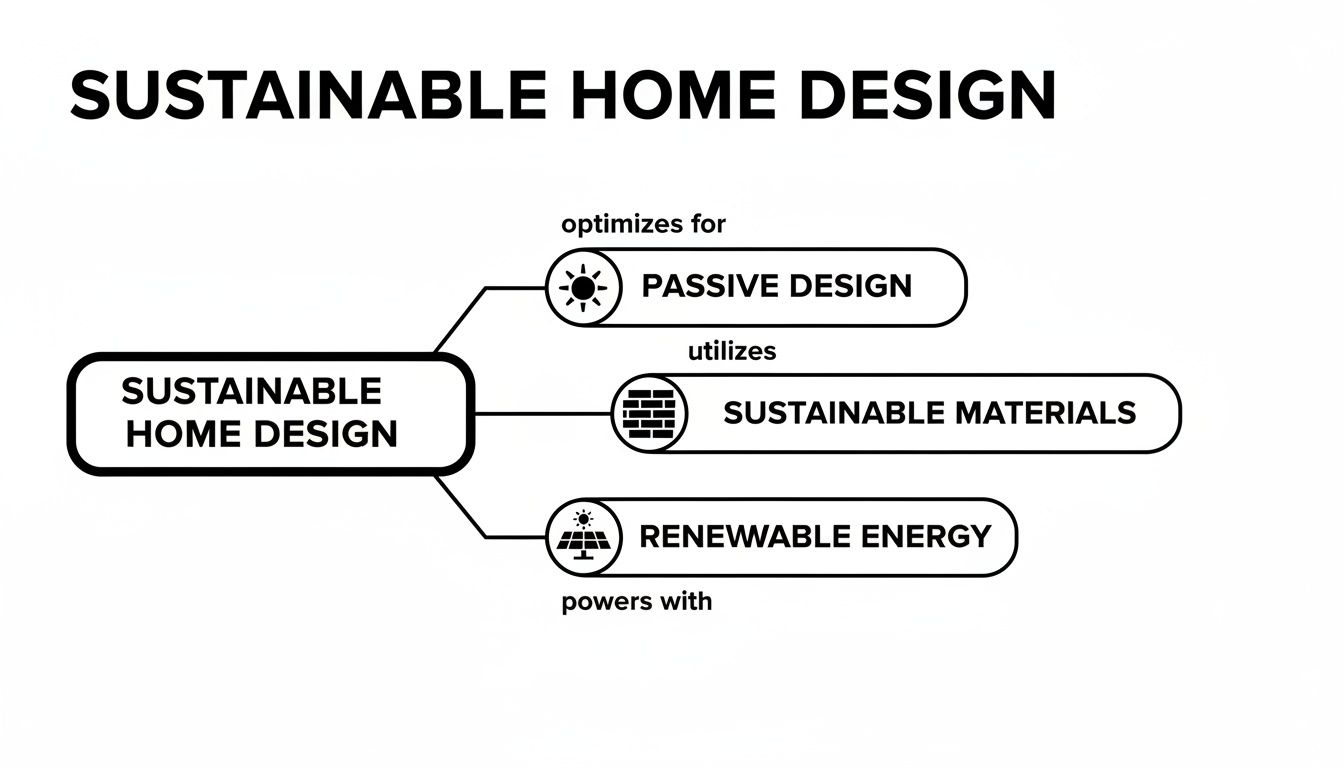
As the diagram shows, achieving these high standards isn't about one single solution. It’s about weaving together passive design, sustainable materials, and renewable energy into a cohesive strategy. Getting to grips with these certifications will help you find an architect whose skills are a perfect match for your sustainable ambitions.
Balancing Sustainability with Heritage and Listed Buildings
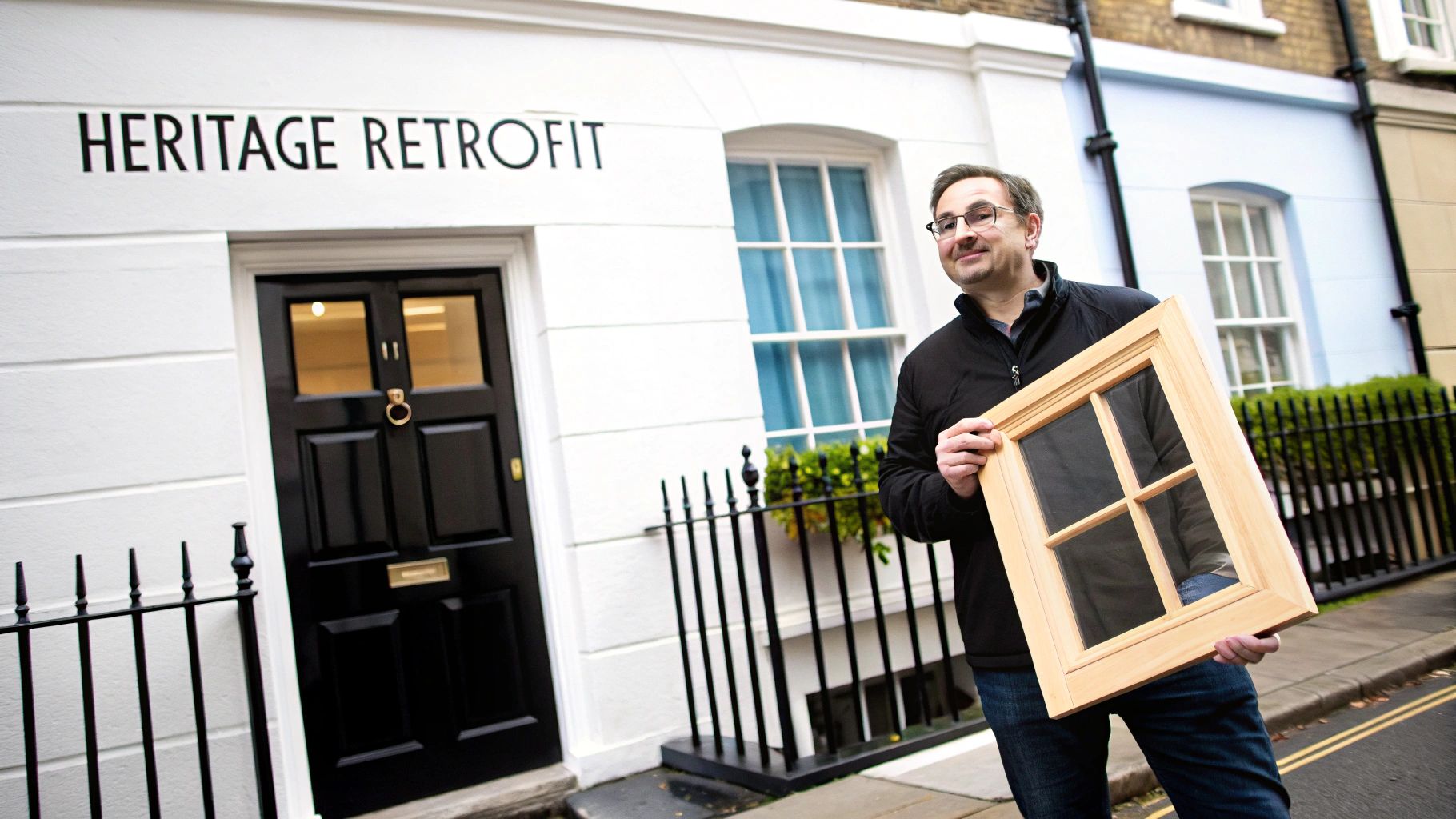
Upgrading a period property in South West London to modern energy standards without stripping away its historical soul is one of the greatest challenges in architecture today. This delicate process is far more art than science. It demands an eco-friendly architect with specialist conservation skills to weave sustainable solutions into the very fabric of a heritage home.
The goal isn’t to impose a modern aesthetic onto a historic building. It’s about enhancing performance from within, preserving the past while making the home comfortable and cost-effective for the future. We're talking about subtle, intelligent interventions that work with the original structure, not against it.
Sympathetic and Sensitive Retrofitting Techniques
To successfully retrofit a heritage building, you need a deep respect for traditional construction methods and materials. A common mistake is slapping modern, non-breathable insulation onto old walls, which can trap moisture and lead to damp, decay, and long-term structural problems.
A specialist architect knows how to avoid this, specifying materials that complement the building's original design. Key strategies include:
Breathable, Natural Insulation: Using materials like wood fibre, cork, or sheep's wool allows the building's walls to "breathe" as they were designed to. This helps regulate moisture and prevents the damp issues often caused by synthetic, impermeable solutions.
Sensitive Window Upgrades: Original sash windows are a defining feature of so many period homes. Instead of ripping them out, a conservation-focused approach involves meticulous draught-proofing and installing discreet, high-performance secondary glazing. This boosts thermal efficiency without touching the historic facade.
Discreet Heating Systems: We can integrate modern, efficient systems like underfloor heating or low-profile radiators thoughtfully. They can often be hidden beneath original floorboards or within bespoke joinery, keeping the property's character completely intact.
This philosophy of retrofitting over rebuilding is not just about aesthetics; it's a powerful environmental statement. By preserving the existing structure, we honour the energy and resources that went into its original construction.
The Power of Adaptive Reuse
This approach, known as adaptive reuse, is a vital sustainability strategy. Embodied carbon—the emissions from construction and refurbishment—accounts for a staggering 20% of the UK's total built environment emissions. In areas like South West London, where listed properties abound, repurposing a structure can slash the carbon footprint of a project by up to 50% compared to a new build.
An experienced eco-friendly architect can navigate the complex planning permissions that come with listed buildings, finding creative ways to improve energy performance while respecting the property's heritage. This is where expertise in both conservation and sustainable design truly comes together.
You can explore our approach to working with these unique properties in our guide to conservation and heritage architecture.
Finding the Right Architect for Your Project
Choosing the right architect is arguably the most important decision you'll make for your project. It sets the tone for everything that follows. When you’re aiming for a sustainable, high-performance home, that choice becomes even more critical. You need more than just an architect; you need a partner who gets your aesthetic vision and has the deep technical skill to deliver genuine environmental benefits—not just "greenwashing."
The first step is always to get a feel for their work. Dive into their portfolio and look for tangible evidence of sustainable design in action. Are there projects that clearly use passive design principles? Can you see thoughtful use of reclaimed materials or the seamless integration of renewable technologies? A portfolio full of varied, thoughtful examples shows real experience. If it’s thin on eco-credentials, sustainability might just be a marketing term for them, not a core value.
Assessing Genuine Sustainable Expertise
A truly eco-friendly architect won’t just show you pretty pictures; their case studies will explain the how and why behind their design choices. They should be able to clearly articulate the specific strategies they used to improve energy efficiency, lower the building's embodied carbon, and make the home healthier for its occupants. Look for hard data, performance metrics, or certifications that back up their claims.
For instance, a project description that just says "eco-friendly materials" is a red flag for vagueness. A credible architect would be specific, saying something like, "we used locally sourced, reclaimed London stock brick to reduce embodied carbon" or "we specified wood fibre insulation for its breathable, moisture-regulating properties, which is ideal for period properties." That level of detail is a sure sign of authentic expertise.
The key is to find an architect who treats sustainability as an integral part of the design process from day one, not as an optional extra bolted on at the end. Their work should prove that environmental responsibility and beautiful, high-end design aren't mutually exclusive—they’re two sides of the same coin.
Insightful Questions for Your Consultation
Once you've got a shortlist, the consultation is your chance to dig deeper. This is where you move past the polished portfolio and test their real-world knowledge and approach. Here are a few insightful questions to get the conversation started:
How do you balance ambitious design aspirations with rigorous energy performance targets like Passivhaus or BREEAM? This question gets to the heart of their ability to blend creative vision with technical discipline.
Can you show me a project where you navigated heritage or planning constraints to improve its sustainability? This is absolutely crucial in areas like South West London and reveals their problem-solving skills, especially with listed buildings.
What is your process for material selection, and how do you calculate and minimise embodied carbon? A confident answer will touch on things like lifecycle assessments and a clear philosophy on sourcing materials.
How do you model a home's energy performance before construction even begins? This probes their use of specialist tools, like energy modelling software, to ensure the final building actually performs as designed.
Can you explain the 'fabric first' approach and why it's so fundamental to your designs? Their response will tell you if they prioritise solid, foundational principles for long-term efficiency over trendy, quick-fix gadgets.
By asking these kinds of targeted questions, you put yourself in a much stronger position to find a true partner—an architect with the proven skill to turn your vision of a sustainable, luxurious home into a beautifully crafted reality.
How We Weave Sustainability into Every Design
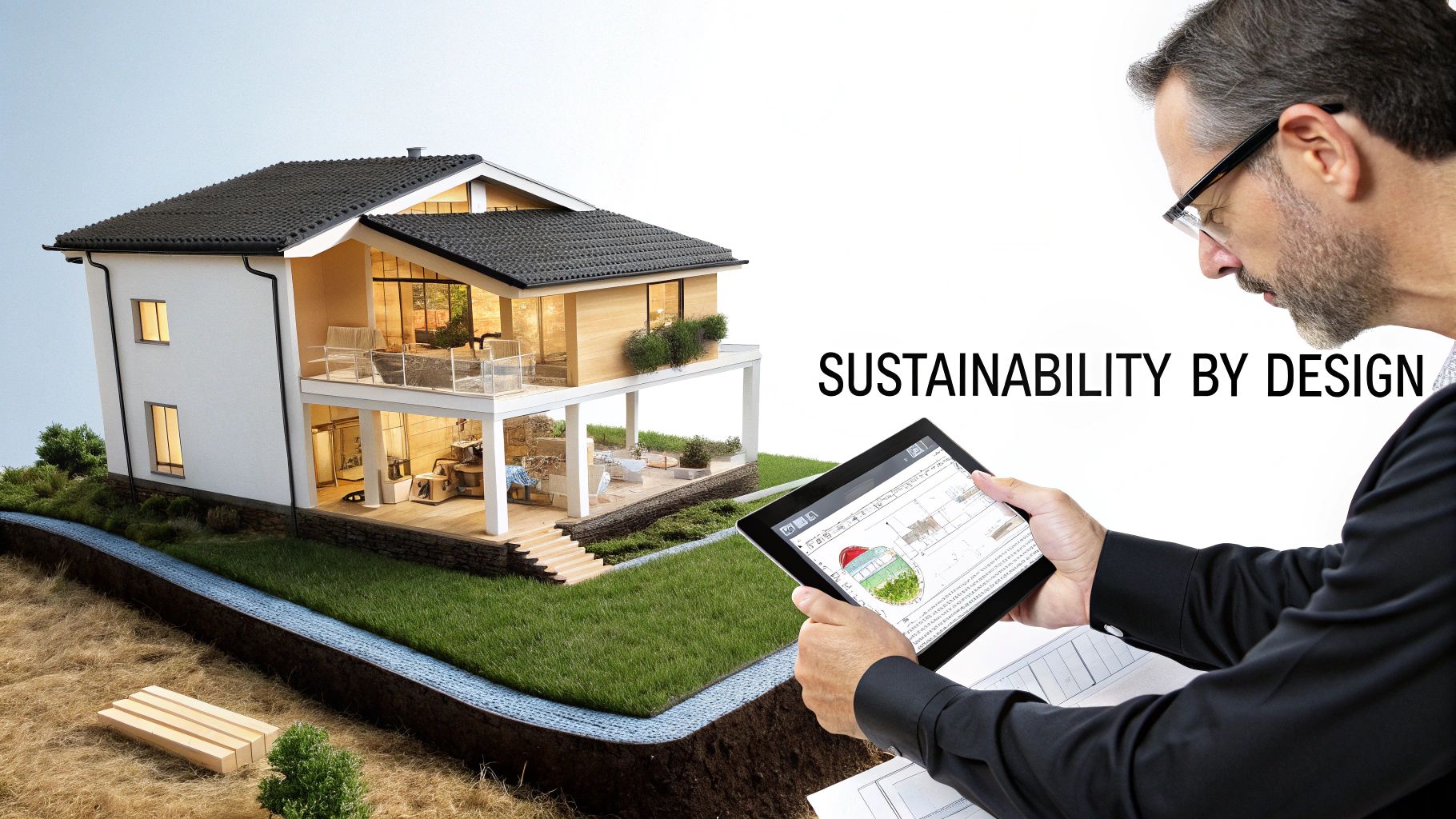
At Harper Latter Architects, sustainability isn’t an add-on or a box-ticking exercise. It's woven into our design process from the very first sketch right through to the final build.
We see every project—whether it's a bespoke new build, a sensitive refurbishment, or an ambitious basement extension—as an opportunity. An opportunity to create a future-proof home where luxury and environmental responsibility not only coexist but enhance one another. Our commitment is to deliver tangible green outcomes, moving beyond theory to put proven strategies into practice across South West London.
A Holistic Approach to Every Project
For us, being an eco-friendly architect means looking at the entire lifecycle of a building. We meticulously analyse how each decision impacts energy consumption, the wellbeing of those living inside, and the local environment. This philosophy applies to every part of your home, even the unexpected corners.
Take a basement extension, for instance. It’s often seen as just extra space. We see it as a chance to innovate. By designing with strategically placed light wells, superior insulation, and integrating ground-source heat pumps, a basement can be transformed from a dark cellar into an energy-positive living area that actually generates more energy than it consumes.
Our proven process ensures that sustainability is a constant consideration. It guides our thinking at every stage, allowing us to seamlessly merge high-end aesthetics with high-performance building standards.
This deep integration is becoming essential as regulations tighten. The UK government's Future Homes Standard, set to roll out in 2025, will demand a 75-80% reduction in carbon emissions for new homes. For practices like ours, working on luxury properties and heritage renovations, this requires a sophisticated understanding of how to blend creativity with compliance—a challenge we genuinely embrace. You can find out more about the upcoming changes for sustainable architecture in the UK.
Extending Green Design to the Outdoors
Our vision for sustainable living doesn’t stop at the four walls of your home; it flows right into the garden. Our landscape design services focus on creating beautiful, functional outdoor spaces that also support local biodiversity and manage resources intelligently.
We bring this to life by:
Prioritising native planting to create resilient gardens that thrive in the local climate with minimal intervention.
Implementing sustainable drainage systems (SuDS) to manage rainwater effectively, reducing runoff and nourishing the landscape naturally.
Designing outdoor living spaces that connect seamlessly with the home, encouraging a stronger, more immediate relationship with nature.
Any Questions?
When you start thinking about an eco-friendly architect, it’s only natural for questions to pop up about the practical side of things, from costs to whether your ideas are even possible. Here are some clear answers to the queries we hear most often, designed to help you move forward with confidence.
Is an Eco-Friendly Home More Expensive to Build?
It’s a common myth. While certain high-performance materials and technologies can have a higher initial price tag, a skilled eco-friendly architect designs for long-term value, not just the upfront build cost. The bigger financial picture is what truly matters.
For instance, intelligent passive design can dramatically reduce, or even eliminate, the need for expensive heating and cooling systems from the moment you move in. When you factor in the huge savings on energy bills over the home’s lifespan, the total cost of ownership is often far lower. This makes a sustainably designed home a financially savvy investment for your future.
Investing in sustainable features isn't just an expense; it's a value-add. Green buildings often command a higher resale value, thanks to the growing demand for homes that are efficient, healthy, and comfortable to live in.
Can My Period Property Be Made Genuinely Energy-Efficient?
Absolutely. Bringing a period property up to modern standards of energy efficiency is a specialist skill – it demands a delicate and knowledgeable touch, but the results can be outstanding. In fact, it's one of our core specialities here at Harper Latter.
The trick is to avoid imposing generic, modern solutions. Instead, we use materials and techniques that work in harmony with the building’s original construction. An architect with experience in heritage properties will focus on:
Breathable Insulation: Using natural materials like wood fibre or cork that allow the building's walls to breathe. This manages moisture effectively and prevents the damp issues that can be caused by trapping vapour with modern synthetics.
Sensitive Glazing: Discreetly upgrading original sash windows or installing high-performance secondary glazing. This boosts thermal efficiency enormously without spoiling the character of the property.
Cleverly Integrated Systems: Weaving in modern, efficient heating systems in a way that respects and preserves the historical interior, keeping them out of sight but highly effective.
The aim is always the same: to drastically improve your comfort and slash running costs, all while protecting the building's unique heritage and charm.
What Does the ‘Fabric First’ Approach Actually Mean?
‘Fabric first’ is the bedrock of good sustainable design. It's the most effective strategy for creating a genuinely low-energy home, because it prioritises perfecting the building's envelope – its roof, walls, floors, and windows – before even thinking about adding technologies like solar panels.
It means obsessing over the details: achieving exceptional levels of insulation, making the construction completely airtight to stop draughts, and installing high-performance windows and doors. By getting the building’s ‘fabric’ right from the start, you minimise heat loss so effectively that the house simply doesn't need much energy to stay warm and comfortable for its entire life. It’s simple, robust, and it works.
Ready to create a home that is both luxurious and sustainable? The team at Harper Latter Architects specialises in integrating bespoke, eco-friendly design into high-end residential projects across South West London. Contact us today to arrange your initial consultation.

Comments