
Cost of Architect UK: Cost of an Architect Explained for Fees and Builds

When you're planning a high-end residential project, one of the first questions that comes to mind is almost always: what does an architect actually cost?
There’s no single, off-the-shelf answer. In the UK, architect fees are typically calculated as a percentage of the total construction cost, generally falling somewhere between 5% and 12%.
Demystifying UK Architect Fees
Getting to grips with how an architect's fee is structured is the first step towards budgeting for your dream home with confidence. Think of it less as a simple transaction and more as an investment in the creative vision, technical expertise, and meticulous project management needed to bring your ideas to life.
For homeowners in prime locations like South West London and Surrey, where projects often involve bespoke new builds or sensitive heritage renovations, clarity on costs is absolutely essential. This guide is here to demystify the process, building a foundation of trust and giving you a clear resource for planning your home’s transformation.
The Main Fee Models Explained
Architects in the UK generally use one of three main fee structures. The one that’s right for your project usually depends on its scale, complexity, and the level of service you need. Understanding these models will help you anticipate how your own project will likely be priced.
The three common approaches are:
Percentage-Based Fees: This is the most common model for full-scope projects, taking you from the first sketch to the final handover. The fee is simply a set percentage of the final construction cost.
Fixed Fees: For projects with a very clearly defined and predictable scope—like securing planning permission for a straightforward extension—a fixed fee gives you cost certainty right from the start.
Hourly Rates: This pay-as-you-go model is perfect for smaller, one-off tasks, initial consultations, or situations where the scope of work is tricky to define upfront.
By understanding these fee structures, you can have much more productive conversations with potential architects. You'll be better equipped to evaluate their proposals and see the value they bring, ensuring your financial planning is as solid as your architectural designs. To dive deeper, you can read our detailed guide on how much an architect charges.
This initial understanding is vital. As we go on, we'll break down how these fees apply to different project types and explore the factors that can make them vary. The goal is to give you the knowledge you need to navigate the financial side of your architectural journey with complete assurance.
How UK Architects Structure Their Fees
Trying to figure out what an architect will cost starts with understanding how they actually put their fees together. It’s not just a number plucked from thin air; it’s a reflection of your project’s ambition, its complexity, and the level of service you need from us. In the UK, architects generally use one of three models, each suited to different scenarios.
For a full-service project—like a completely bespoke new build or a sensitive whole-house refurbishment—the percentage-based fee is the most common approach. For tasks with a very clear, predictable scope, like getting planning permission for a simple extension, a fixed fee gives you certainty. And for initial chats or quick design advice, an hourly rate is often the most straightforward way to go.
Percentage of Construction Cost: The Industry Standard
The percentage-based model is really the backbone of architectural fees for comprehensive projects. Here, your architect’s fee is calculated as a percentage of the total construction budget. But it's more than just a billing method; it’s a partnership.
Think of your architect as a co-pilot on your journey. By linking their fee to the project's final cost, their goals are naturally aligned with yours: to deliver a phenomenal design that brings your vision to life, all while managing the budget smartly. If we find a clever design solution that brings construction costs down, our fee comes down too. It’s a structure that encourages efficiency and creative problem-solving every step of the way.
For the kind of high-end residential work we specialise in, like complex basement conversions or thoughtful renovations in conservation areas, this model gives us the flexibility to navigate unexpected challenges while staying completely focused on achieving the best possible result for you.
Fixed Fees For Predictable Work
A fixed fee, sometimes called a lump-sum fee, is exactly what it sounds like: a single, agreed-upon price for a clearly defined set of services. This approach is perfect when the scope of work is crystal clear and isn’t likely to change.
Common situations where a fixed fee works brilliantly include:
Planning Permission Drawings: Creating all the necessary drawings and documents to submit a planning application for a straightforward project, like a single-storey rear extension.
Feasibility Studies: An initial deep dive to explore what’s possible with a property, assess planning hurdles, and sketch out some early concepts.
Building Regulations Drawings: Producing the detailed technical drawings needed for building control approval once you have planning permission in the bag.
A fixed fee gives you complete clarity on costs from the outset, which is fantastic for budgeting specific project stages. The key, however, is to ensure the scope of work is meticulously defined in your agreement to avoid any confusion if your requirements change later on.
This model is best suited for distinct project milestones rather than the entire architectural journey from start to finish.
Hourly Rates For Flexible Support
Sometimes, you might just need an architect for a short burst of work or for a task where it’s impossible to know how long it will take. This is where hourly rates come into their own. It’s a pay-as-you-go model that offers maximum flexibility.
In the UK, architects typically charge between 5% and 12% of the total construction cost for residential projects. This has been the industry benchmark since the Royal Institute of British Architects (RIBA) moved away from mandatory fee scales back in the 1980s. For high-end, complex work in South West London, fees naturally sit at the upper end of this range, reflecting the challenges of integrating sustainable design or navigating strict heritage constraints. A £250,000 extension, for example, could see fees ranging from £12,500 (5%) to £30,000 (12%), a cost that reflects the immense value added by RIBA-accredited expertise. Hourly rates, which typically range from £50 to £100 per hour, are better for initial consultations or smaller, ad-hoc tasks, whereas percentage fees ensure your architect is fully aligned with your goals on comprehensive services like basement extensions. You can discover more insights about UK architect prices and what to expect for your project.
Architect Cost Breakdowns for Common Projects
Theory is one thing, but seeing how numbers translate to real-world projects is what really matters when you're planning your budget. So, let's put some figures to the concepts and explore typical cost breakdowns for the kind of high-end homes we specialise in across South West London and Surrey.
These examples are here to give you a clearer picture of how the total cost of an architect in the UK scales with the size and ambition of your project. They also show how fees are typically spread across different stages of work, giving you a financial roadmap for the journey ahead.
Example Project Scenarios
Let's imagine three distinct projects: a luxury home extension, a bespoke new build, and a sensitive renovation of a heritage property. Each presents a different level of complexity, scope, and construction budget, which naturally shapes the architect’s fee.
Luxury Home Extension: Think of a large, single-storey rear extension in Richmond. It features high-specification glazing, a bespoke kitchen, and beautifully integrated landscaping. The design is contemporary but has to sit harmoniously with the existing period property.
Bespoke New Build: This is about creating a unique, high-performance family home in Wimbledon from a blank canvas. The brief includes sustainable technologies, custom joinery, and premium finishes from top to bottom.
Heritage Property Renovation: This could be a Grade II listed home in Chiswick that needs a complete internal refurbishment alongside careful conservation work. This kind of project requires specialist knowledge of historic materials and navigating strict conservation guidelines.
The infographic below gives a quick overview of the most common fee structures you’ll come across when speaking with an architect.
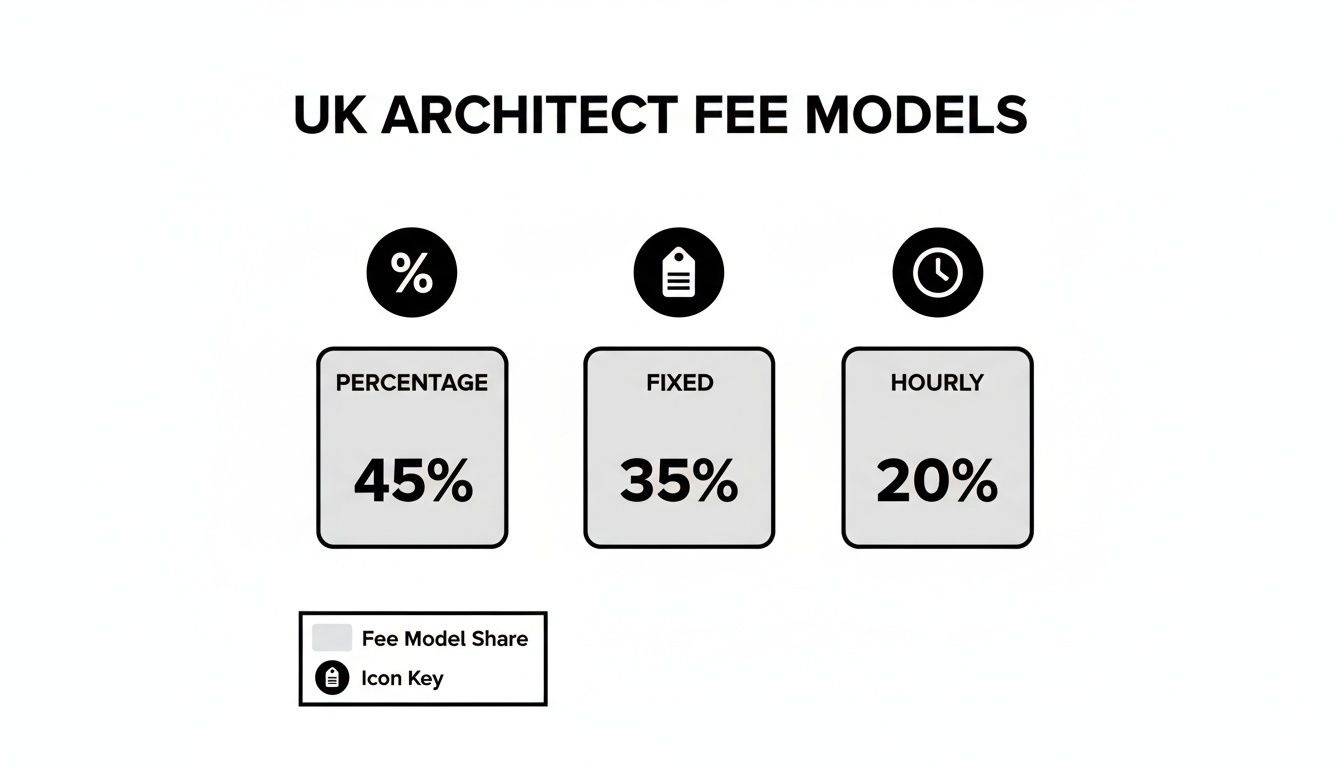
As you can see, while percentage fees are the most common route for full-scope projects, fixed and hourly rates definitely have their place for specific, well-defined pieces of work.
To give you a clearer idea of what this looks like in practice, here is a table of estimated fees based on typical construction budgets for the high-end residential projects we work on.
Estimated Architect Fees for High-End UK Residential Projects
This table illustrates potential architect fee ranges based on typical construction budgets for bespoke projects in South West London and Surrey. Fees are shown as a percentage and in GBP (£).
Project Type | Estimated Construction Budget | Typical Fee Percentage | Estimated Architect Fee |
|---|---|---|---|
High-End Extension | £150,000 - £300,000 | 10% - 15% | £15,000 - £45,000 |
Full House Refurbishment | £350,000 - £600,000 | 9% - 13% | £31,500 - £78,000 |
Bespoke New Build Home | £700,000 - £1,500,000+ | 8% - 12% | £56,000 - £180,000+ |
Listed Building Renovation | £500,000 - £1,000,000+ | 12% - 18% | £60,000 - £180,000+ |
Please remember these figures are illustrative. The final fee for your project will depend entirely on its specific scope, complexity, and the level of service you require from us.
Understanding the London Premium
You might be wondering why projects in areas like Wimbledon, Richmond, or Cobham often come with higher architect fees. This isn't just an arbitrary "London premium"; it's a direct reflection of local factors that add layers of complexity and demand a higher level of expertise.
Here’s what’s behind it:
Higher Property and Construction Values: Since architect fees are often tied to construction costs, the higher build costs in London and the South East naturally lead to higher fees.
Stricter Planning Controls: Many London boroughs have notoriously tough planning policies, especially within conservation areas. This means applications need to be incredibly detailed and robustly justified.
Logistical Challenges: Tight sites, tricky access, and party wall agreements are the norm in dense urban areas. Navigating these requires meticulous planning and co-ordination, adding to an architect's workload.
For a full-service new 4-bedroom home in the UK, architect fees can range from £39,000 to £43,000+. This is often calculated at 7-15% of the total build cost, which can easily surpass £500,000 for the kind of luxury bespoke projects we deliver in premium areas like Wimbledon. To put it in perspective, a smaller project with a £100,000 budget might see fees of £5,000-£12,000, depending on how involved you want your architect to be.
The value of a full RIBA-accredited service is in making these complexities feel seamless. We handle everything from the first sketch to the final handover, justifying the investment through peace of mind and a superior result.
How Fees Align with Project Stages
The good news is that architect fees aren't one big upfront payment. They are invoiced in stages that mirror the RIBA Plan of Work, the industry-standard framework that breaks a project down into clear, logical steps. This way, you only pay for the work that’s been completed.
A typical payment schedule might see fees divided across key milestones like Concept Design (RIBA Stage 2), Developed and Technical Design (Stages 3 & 4), and Construction (Stage 5). This phased approach keeps things transparent and helps you manage your project's cash flow.
This structure means your financial commitment grows as the project gathers momentum. Your architect’s role intensifies as the design gets more detailed and construction begins, and the fee payments simply reflect that increased involvement.
We explain this process in much more detail in our complete guide to understanding architect costs for an extension, which is a must-read for anyone considering this type of project.
Key Factors That Influence Your Architect's Fee
It’s a question we hear all the time: why do architect fees vary so much? The truth is, the final cost of an architect in the UK isn't just about the size of the building. It’s shaped by the unique DNA of each project—a blend of interconnected factors that define its character, challenges, and ambition.
Think of it like commissioning a bespoke suit versus buying one off the peg. Both serve the same function, but the level of detail, customisation, and expertise required for the former is on a completely different scale. The same principle applies to architecture.
Understanding these key cost drivers is vital. It helps you see exactly where the value in your architect’s fee lies and appreciate the expertise needed to turn your vision into a beautifully crafted home.
The Impact of Project Complexity
At its heart, project complexity is the single biggest influence on an architect’s fee. A simple, single-storey rear extension on a flat, accessible site requires a very different level of design and co-ordination than, say, a multi-level basement conversion with a home cinema and wine room built beneath a period property.
The more intricate the project, the more time, skill, and detailed co-ordination are needed from your architect.
Consider these two scenarios:
A Simple Extension: This might involve standard construction methods, straightforward structural calculations, and a relatively simple planning application.
A Complex Conversion: This could demand intricate structural engineering to support the house above, sophisticated waterproofing systems, and complex party wall agreements. Each of these elements adds layers of work and responsibility.
The more bespoke elements you introduce—such as a custom-designed staircase, curved walls, or large expanses of specialist glazing—the more complex the design process becomes. This directly translates into more architectural time for detailed drawings, supplier co-ordination, and on-site supervision.
This is precisely why a higher percentage fee often applies to complex renovations compared to a straightforward new build; it reflects the increased intensity of the work involved.
Your Required Level of Service
An architect can be involved as much or as little as you need, and this scope of service has a direct impact on the fee. Are you simply looking for drawings to get you through planning, or do you want a trusted partner to guide the entire project from the first sketch to the final handover?
Here's a breakdown of how different service levels affect the cost:
Planning Drawings Only: This is a limited service focused purely on producing the plans and documents for a planning application. It represents the lowest cost but leaves you to manage the technical design and construction phases yourself.
Technical Design and Building Regulations: This next stage involves creating the highly detailed construction drawings and specifications that builders will use to price and build the project accurately.
Full Project Management: This is the most comprehensive service, where your architect oversees the entire process. This includes tendering the project to contractors, administering the building contract, regularly inspecting work on-site, and managing quality control right through to completion.
Choosing a full service provides end-to-end support, ensuring the design's integrity is maintained and protecting you from costly mistakes during construction.
Property Status and Specialist Design
The unique status of your property and any specialist design requirements also play a significant role. If your home is a listed building or sits within a conservation area, your project will demand a much higher level of specialist knowledge and detailed justification to get it over the line.
Working with heritage properties involves meticulous research, sensitive design proposals, and navigating a far more rigorous planning process. Similarly, incorporating advanced sustainable technologies, like ground source heat pumps or passive solar design, requires specialist expertise to integrate them effectively.
Elements like bespoke joinery, integrated smart home systems, or sophisticated landscape architecture all add to the design workload. Each specialist component requires careful co-ordination, contributing to the overall cost of an architect in the UK but ultimately adding immense value and character to your finished home.
Seeing the Value Beyond the Cost
It’s easy to see an architect’s fee as just another big number on a budget sheet. But looking at it as a pure cost is missing the point entirely. A skilled, RIBA-accredited architect is actually one of the smartest investments you can make in your property, delivering value that goes far beyond a set of drawings.
Instead of asking, "What does an architect cost?", a much better question is, "What value does an architect create?". The answer is in their ability to unlock your home's hidden potential, sidestep expensive mistakes, and deliver a home that not only ticks every box but genuinely improves your quality of life for years to come.
An Advocate for Your Vision and Budget
Right from the start, your architect is your professional advocate. Think of them as your expert guide through the maze of planning permissions and building regulations, making sure your project gets off to a solid legal and technical start. That step alone can save you from disastrous delays or enforcement action later on.
They also bring a huge amount of rigour to the tendering process. By creating a detailed package of technical drawings and specifications, they make sure you get clear, like-for-like quotes from builders. This competitive environment often leads to fairer construction prices, frequently saving you a sum that makes a serious dent in their own fee.
"An architect is your project's guardian. They oversee construction, ensuring the quality of work matches the design intent and protecting you from defects, shortcuts, or costly misunderstandings with contractors. This oversight is invaluable."
This role as a guardian of quality is absolutely crucial. Having an architect on-site means you have an expert pair of eyes and ears, making sure every detail is executed correctly and that the final build is completely true to your shared vision.
Maximising Your Property’s Potential
Intelligent design isn't just about looks; it's about making every square metre work harder for you. A great architect can completely reimagine your space to improve flow, flood it with natural light, and create a sense of spaciousness you never thought possible. Sometimes, this clever use of space means you don't even need that bigger, more expensive extension you were planning.
This spatial intelligence translates directly into financial gain. A well-designed home simply commands a higher market value. Projects that thoughtfully improve a property's layout, functionality, and connection to the garden consistently see a better return on investment.
Think about these long-term benefits:
Enhanced Kerb Appeal: A considered exterior design, whether it’s crisp and modern or beautifully traditional, massively boosts a property's desirability and sale price.
Improved Energy Efficiency: By specifying high-performance insulation, triple-glazed windows, and efficient heating systems, an architect can dramatically lower your home's running costs for its entire lifetime.
Future-Proofed Design: Good design looks ahead. It creates flexible spaces that can adapt as your family grows and your needs change over time.
Ultimately, the fee you pay isn't just for a service. It's an investment in a process that protects your budget, maximises your home’s value, and delivers a space that is perfectly aligned with how you want to live. The right architect doesn’t just cost you money—they create and save it, ensuring a result that will stand the test of time.
Begin Your Architectural Journey with Confidence
We created this guide to give you a clear, honest understanding of architect fees, so you can plan your project properly from the very beginning. The main thing to remember is that while the cost of an architect in the UK changes from project to project, understanding the fee structures and what drives value allows you to set a realistic budget.
The journey to creating a home that is truly yours is one of the most exciting investments you can make. It doesn’t start with digging foundations, but with a clear, shared vision between you and your architect.
Your Next Step: A Personal Conversation
If you are planning a bespoke home in Wimbledon, South West London, or Surrey, the best next step is a simple conversation. We invite you to schedule a complimentary initial consultation with us at Harper Latter Architects.
This is your chance to talk through your ambitions in detail. We'll listen to what you want to achieve, explore the potential in your property, and answer all your questions about the design process, timescales, and likely costs.
After our chat, we’ll put together a transparent, personalised fee proposal crafted specifically for your project. This document will clearly set out all the services included and the associated costs, so you can move forward with total clarity and confidence.
Starting this dialogue is the surest way to turn your ideas into a tangible plan. You’ll begin to see a clear path forward, supported by a trusted partner who knows the ins and outs of high-end residential design in your area.
For more guidance on choosing the right professional, take a look at our practical guide to finding and hiring the right architect.
We are here to help you begin your journey with the confidence that comes from expert advice and open communication. Contact our Wimbledon Village studio today to arrange your first meeting and start bringing your vision to life.
Your Questions Answered
To finish up, let's walk through some of the questions we hear most often from homeowners trying to get a handle on architect costs. These straightforward answers should help clear up any lingering queries and give you the confidence to move forward.
Are Architect Fees Paid All at Once?
Not at all. You'll never be asked to pay the full fee upfront. Instead, payments are structured to follow the project's progress, typically aligning with the industry-standard RIBA Plan of Work. This keeps the process transparent and helps you manage your finances.
You can expect invoices to be issued at key milestones. This staged approach is designed to help you manage your cash flow, meaning you only pay for work as it’s completed.
A typical payment schedule might look something like this:
Concept Design: An invoice is sent once the initial design concepts are agreed upon.
Developed Design & Planning: Payment is due after we finalise the drawings for your planning application.
Technical Design: An invoice will follow the completion of the detailed construction drawings.
Construction Phase: Fees for our site visits and contract administration are usually billed monthly.
Is It Cheaper to Hire an Architectural Technician?
While it’s true that an architectural technician or technologist will often charge less for producing drawings, their role is quite different from that of a fully qualified, ARB-registered architect. A technician’s expertise is primarily focused on the technical side of construction and building regulations.
An architect, on the other hand, offers a much broader, more strategic service. We are trained not just in technical detailing but in creative design, spatial planning, project management, and contract administration, allowing us to guide the entire project from the very first sketch to the final handover.
For complex, high-value projects—like a bespoke new build, a tricky basement conversion, or a sensitive renovation of a listed building—the holistic design vision and project oversight of an architect provides immense value. This expertise often saves more than the initial fee difference by preventing costly mistakes and truly maximising your property's potential.
What Other Professional Fees Should I Budget For?
Beyond your architect, it's wise to budget for a small team of essential consultants. Their specialist expertise will be vital to getting your project off the ground and built correctly. As the lead consultant, your architect will help you identify exactly which specialists your project needs.
Depending on the scale and complexity of your plans, you should anticipate costs for:
A Structural Engineer: Absolutely essential for designing and signing off on the structural integrity of new elements like steel beams, foundations, or roof structures.
A Quantity Surveyor: For larger, more complex projects, a QS provides detailed cost management to help keep the budget firmly on track.
A Party Wall Surveyor: You'll need one of these if your building work affects a shared boundary wall with a neighbour.
Specialist Surveys: This could include topographical (land) surveys, arboricultural (tree) reports, or drainage surveys, all of which provide critical information for the design process.
Factoring these professional fees into your initial budget is a key step towards realistic and responsible project planning.
Planning a bespoke home transformation in South West London or Surrey requires a trusted partner to guide you through every stage. At Harper Latter Architects, we combine creative vision with meticulous project management to deliver exceptional homes. To discuss your project and receive a transparent, personalised fee proposal, contact our Wimbledon Village studio today.

Comments